Countdown to Calvary. We Have Set both our feet inside the Upper Room. The Humility of Love. John 13:1-17

Today is Holy Thursday, also called Maundy Thursday, one of the holiest days in the Church year.  We are in the Upper Room with the man, Rabbi Jesus and his disciples. We will celebrate Passover. We will recite the ancient story and we will sing the ancient hymns all over again. But as we sit with our Rabbi, we become surprised at sone of his words – he takes the bread and says, “this is my body broken for you” and then he takes the cup of wine and says, “this is my blood poured out for you and for many for the forgiveness of sin.” What is all this?

In just a short while, he will raise from the table with a pitcher of water and a bowl and a towel. He kneels at our feet, and as the lowest of house slaves, he washes our feet. Soon after that, he will cry tears of red. We will next watch him be betrayed and arrested and given a sham trial. He will be condemned to die on a Cross he will have to carry on his back and wide across his bloodied shoulders.

He will be raised up, nails hammered into his body to suffer. We will watch him suffer humiliation as no other man ever has in history. We will celebrate the greatest act of love ever performed: Jesus’s death on the cross for our salvation.

But first, in our Gospel text for today, Jesus demonstrates for us the humbled, humbling act of the washing of the disciples’ feet. He is the example for all Christian acts of servanthood, but more importantly, servants of their people.  That being said, this reading really made me think about humility, love and service—not just on this single day of the Christian Calendar but every day.

John 13:1-17Easy-to-Read Version

Jesus Washes His Followers’ Feet

13 It was almost time for the Jewish Passover festival. Jesus knew that the time had come for him to leave this world and go back to the Father. Jesus had always loved the people in the world who were his. Now was the time he showed them his love the most.

Jesus and his followers were at the evening meal. The devil had already persuaded Judas Iscariot to hand Jesus over to his enemies. (Judas was the son of Simon.) The Father had given Jesus power over everything. Jesus knew this. He also knew that he had come from God. And he knew that he was going back to God. So while they were eating, Jesus stood up and took off his robe. He got a towel and wrapped it around his waist. Then he poured water into a bowl and began to wash the followers’ feet.[a] He dried their feet with the towel that was wrapped around his waist.

He came to Simon Peter. But Peter said to him, “Lord, you should not wash my feet.”

Jesus answered, “You don’t know what I am doing now. But later you will understand.”

Peter said, “No! You will never wash my feet.”

Jesus answered, “If I don’t wash your feet, you are not one of my people.”

Simon Peter said, “Lord, after you wash my feet, wash my hands and my head too!”

10 Jesus said, “After a person has a bath, his whole body is clean. He needs only to wash his feet. And you are clean, but not all of you.” 11 Jesus knew who would hand him over to his enemies. That is why he said, “Not all of you are clean.”

12 When Jesus finished washing their feet, he put on his clothes and went back to the table. He asked, “Do you understand what I did for you? 13 You call me ‘Teacher.’ And you call me ‘Lord.’ And this is right, because that is what I am. 14 I am your Lord and Teacher. But I washed your feet. So, you also should wash each other’s feet. 15 I did this as an example for you. So, you should serve each other just as I served you. 16 Believe me, servants are not greater than their master. Those who are sent to do something are not greater than the one who sent them. 17 If you know these things, great blessings will be yours if you do them.

The Word of God for the Children of God. Gloria! In Excelsis Deo! Alleluia! Amen.

The Humbled, Humbling Humility of His Great Love for US! …….

We live in a very proud and egotistical generation.

It is now considered acceptable and even normal for people to promote themselves, to praise themselves, and to put themselves first. Pride is considered a virtue by many. Humility, on the other hand, is considered a weakness. Everyone, it seems, is screaming for his or her own rights and seeking to be recognized as someone important.

The preoccupation with self-esteem, self-love, and self-glory is destroying the very foundations upon which our society was built. No culture can survive pride run rampant, for all of society depends on relationships. When all people are committed first of all to themselves, relationships disintegrate. And that is just what is happening, as friendships, marriages, and families fall apart.

Sadly, the preoccupation with self has found its way into the church.

Perhaps the fastest growing phenomenon in modern Christianity is the emphasis on pride, self-esteem, self-image, self-fulfillment, and other manifestations of selfism. Out of it is emerging a new religion of self-centeredness, pride—even arrogance. Voices from every part of the theological spectrum call us to join the self-esteem cult.

Scripture is clear, however, that selfism has no place in Christian theology.

The man, Rabbi Jesus repeatedly taught against pride, and with His life and teaching He constantly exalted the virtue of humility. Nowhere is that clearer than in John chapter 13.

John 13 marks a turning point in John’s gospel and the ministry of Jesus Christ. Jesus’ public ministry to the nation of Israel had run its course and ended in his complete and final rejection of Him as Messiah.

On the first day of the week, Jesus had entered Jerusalem in triumph to the enthusiastic shouts of the people. Those people nevertheless misunderstood His ministry and His message. The Passover season had arrived, and by Friday He would be utterly rejected and executed. God, however, would turn that execution into the great and final sacrifice for sin, and Jesus would die as the true Passover Lamb.

He had come unto His own people, the Jews, “and those who were His own did not receive Him” (John 1:11). So He had turned away from His public ministry to the intimate fellowship of His disciples.

Now it is the day before Jesus’ death, and rather than being preoccupied with thoughts of His death, sin-bearing, and glorification, He is totally consumed with His love for the disciples. Knowing that He would soon go to the cross to die for the sins of the world, He is still concerned with the needs of twelve men, including his betrayer! His love is never impersonal—that’s the mystery of it.

In what were literally the last hours before His death, Jesus kept showing them His love over and over. John relates this graphic demonstration of it:

Now before the Feast of the Passover, Jesus knowing that His hour had come that He should depart out of this world to the Father, having loved His own who were in the world, He loved them to the end.  During supper, the devil having already put into the heart of Judas Iscariot, the son of Simon, to betray him, Jesus, knowing that the Father had given all things into His hands, and that He had come forth from God and was going back to God, got up from supper, and laid aside His garments; and taking a towel, He girded Himself.  Then He poured water into the basin and began to wash the disciples’ feet and to wipe them with the towel with which He was girded.

So He came to Simon Peter.  He said to him, “Lord, do You wash my feet?”  Jesus answered and said to him, “What I do you do not realize now, but you will understand hereafter.”

Peter said to Him, “Never shall You wash my feet!”

Jesus answered him, “If I do not wash you, you have no part with Me.”

Simon Peter said to Him, “Lord, then wash not only my feet, but also my hands and my head.”

Jesus said to him, “He who has bathed needs only to wash his feet, but is completely clean; and you are clean, but not all of you.” For He knew the one who was betraying Him; for this reason, He said, “Not all of you are clean.”

So when He had washed their feet, and taken His garments and reclined at the table again, He said to them, “Do you know what I have done to you?  You call Me Teacher and Lord; and you are right, for so I am.  If I then, the Lord and the Teacher, washed your feet, you also ought to wash one another’s feet.  For I gave you an example that you also should do as I did to you.  Truly, truly, I say to you, a slave is not greater than his master, nor is one who is sent greater than the one who sent Him.  If you know these things, you are blessed if you do them.” (John 13:1-17)

It is very likely that Jesus and the disciples had been hiding at Bethany during this final week before the crucifixion. Having come from there (or from anywhere near Jerusalem), they would have had to travel on extremely dirty roads. Naturally, by the time they arrived, their feet were covered with dust and Lord knows what else from the road.

Everyone in that culture faced the same problem. Sandals did little to keep dirt off the feet, and the roads were either a thick layer of dust or deep masses of mud. At the entrance to every Jewish home was a large pot of water to wash dirty feet. Normally, foot washing was the duty of the lowliest slave.

When guests came, he had to go to the door and wash their feet—not a pleasant task. In fact, washing feet was probably his most abject duty, and only slaves performed it for others. Even the disciples of rabbis were not to wash the feet of their masters—that was singularly and most uniquely the task of a lowly slave.

As Jesus and His disciples all arrived in the upper room, they found that there was no servant to wash their feet.

Only days before, Jesus had said to the twelve, “Whoever wishes to become great among you shall be your servant, and whoever wishes to be first among you shall be your slave” (Matthew 20:26-27).

If they had given mind and heart to His teaching, one of the twelve would have washed the others’ feet, or they would have mutually shared the task. It could have been a beautiful thing, but it never occurred to them because of their selfishness. A parallel passage in Luke 22 gives us an idea just how selfish they were and what they were thinking about that evening:

And there arose also a loud dispute among them as to which one of them was regarded to be greatest.  And He said to them, “The kings of the Gentiles lord it over them; and those who have authority over them are called ‘Benefactors.’  But it is not this way with you, but the one who is the greatest among you must become like the youngest, and the leader like the servant.” (vv. 24-26)

What a sickening picture this is! They were bickering about who was the greatest. And in an argument about who is the greatest, no one is going to get down to the ground and wash feet. The basin was there, the towel was there, and everything was ready. But no one moved to wash the others’ feet.

If anyone in that room should have been thinking about the glory that would be his in the Kingdom, it was Jesus. John 13:1 says that Jesus knew His hour was come. He was on a divine time schedule, and He knew He was going to be with the Father. He was very conscious of the fact that He soon would be glorified:

“Jesus [knew] that the Father had given all things into His hands, and that He had come forth from God and was going back to God” (v. 3).

But instead of their being more concerned with His glory, and in spite their selfishness, He was totally conscious of revealing clearly His personal love to the twelve that they might be secure in it. They might be a part of His Kingdom.

Verse 1 says, “Having loved His own who were in the world, He loved them to the end.”

“To the end” in the Greek is ‘eis’ telos, and it means this:

He loved to them to perfection. He loved them to the uttermost. He loved them with total fullness of love. That is the nature of Christ’s love, and He showed it repeatedly—even in His death.

When He was arrested, He arranged that the disciples would not be arrested.

While He was on the cross, He made sure that John would give Mary a home and care in years to come.

He reached out to a dying thief and saved him.

It is most amazing that in those last hours of carrying the sins of the world, in the midst of all the pain and suffering He was bearing, He was conscious of that one would-be disciple hanging next to him.

He loves humbly, utterly, absolutely, to perfection, totally, completely, without reservation. At the moment when most men would have been wholly concerned with self, He selflessly humbled Himself to meet the most basic needs of others.

Genuine humble, humbled, humbling love is EXACTLY like that.

And here is the great lesson of this whole account:

Only absolute humility can generate absolute love.

It is the nature of love to be selfless, giving. In 1 Corinthians 13:5, Paul said that love “does not seek its own.” In fact, to distill all the truth of 1 Corinthians 13 into one statement, we might say that the greatest virtue of love is its humility, for it is the humility of love that proves it and makes it visible.

Christ’s love and His humility are inseparable.

He could not have been so consumed with a passion for serving others if He had been primarily concerned with Himself.

“Love…in Deed and Truth”

How could anyone reject that kind of love? Men do it all the time. Judas did.

“During supper, the devil [had] already put into the heart of Judas Iscariot, the son of Simon, to betray Him” (v. 2).

Do you see the tragedy of Judas?

He was constantly basking in the light, yet living in darkness, experiencing the love of Christ, yet hating Him at the same time.

The contrast between Jesus and Judas is striking. And perhaps that is the very reason the Holy Spirit included verse 2 in this passage. Set against the backdrop of Judas’ hatred, Jesus’ love shines even brighter. We can better understand its magnitude when we understand that in the heart of Judas was the blackest kind of hatred and rejection.

The words of love by which Jesus gradually drew the hearts of the other disciples to Himself only pushed Judas further and further away. The teaching by which He uplifted the souls of the other disciples just seemed to drive a stake into the heart of Judas.

Everything Jesus said in terms of love must have become like chafing shackles to Judas. From his fettered greed and his disappointed ambition began to spring jealousy, spite, and hatred—and now he was ready to destroy Christ, if need be.

But the more men hated Jesus and desired to hurt Him, the more it seemed He manifested love to them. It would be easy to understand resentment. It would be easy to understand bitterness. But all Jesus had was love—He even met the greatest injury with supreme love. In a little while He would be kneeling at the feet of Judas, washing them.

Jesus waited until everyone was seated and supper was served. Then, in a devastating act of humility that must have stunned the disciples,

[Jesus] got up from supper and laid aside His garments; and taking a towel, He girded Himself.  Then He poured water into the basin and began to wash the disciples’ feet and to wipe them with the towel with which He was girded. (Verses 4-5) 

With calmness and majesty, in total silence, Jesus surprised everyone except himself, stood up, walked over and took the pitcher, and poured the water into the basin. He then removed his outer robe, His belt, and very likely His inner tunic—leaving Him clothed like a slave—put a towel around His waist and knelt down to wash the feet of His disciples, one by one – without exception!

Can you imagine how that must have stung the disciples’ hearts? Do you feel the pain, the regret, and the sorrow that must have shot through them? One of them could have had the joy of kneeling and washing the feet of Jesus. I’m sure they were dumb-founded and broken-hearted. What a painful and profound lesson this was for them!

We, too, can learn from this incident.

Sadly, the church is full of people who are standing on their dignity when they ought to be kneeling at the feet of their brother. The desire for prominence is death to love, death to humility, and death to service. One who is proud and self-centered has no capacity for love or humility. Consequently, any service he may think he is performing for the Lord is a waste.

When you are tempted to think of your dignity, your prestige, or your rights, open your Bible to John 13 and get a good look at Jesus—clothed like a slave, kneeling, washing dirt off the feet of sinful men who are utterly indifferent to His impending death.

To go from being God in glory (v. 3) to washing the feet of sinful, inglorious disciples (vv. 4-5) is a long step. Think about this: the majestic, glorious God of the universe comes to earth—that’s humility. Then He kneels on the ground to wash the feet of sinful men—that’s indescribable humility.

You see, for a fisherman to wash the feet of another fisherman is a relatively small sacrifice of dignity.

But that Jesus Christ, in whose heart beats the very pulse of eternal deity, would humbly stoop down and wash the worse than filthy feet of lowly men, that’s the greatest kind of humiliation.

And that is the nature of genuine humility, as well as the proof of genuine love.

Love has to be more than words. The apostle John wrote, “Let us not love with word or with tongue, but in deed and in truth” (1 John 3:18). Love that is real is love expressed in activity, not just words.

“If I Do Not Wash You, You Have No Part with Me”

Here we have one of the most interesting insights into Peter we see anywhere in Scripture. As Jesus loves from disciple to disciple, He finally arrives at Peter, who must have been completely broken.

He said with a mixture of remorse and incredulity, “Lord, do You wash my feet?” (v. 6), and perhaps he pulled back his feet.

Jesus replied to Peter, “What I do you do not realize now, but you will understand hereafter” (v. 7).

At this point, Peter was still thinking that the Kingdom of God was coming, and Jesus was the coming King of that Kingdom. Exactly how could he ever allow the King of kings to leave his throne and be seen stooping down and wash his feet?

It wasn’t until after Jesus’ death, resurrection, and ascension that Peter understood the total humiliation of Jesus.

Peter got bolder. In verse 8, he says, “Never shall You wash my feet!”

To emphasize his words, Peter uses the strongest form of negation in the Greek language. He calls Jesus Lord but acts as if he is lord. This is not praiseworthy modesty on Peter’s part – this is Peter’s overzealous over-protective selfism.

Jesus bluntly answered him, “If I do not wash you, you have no part with Me.”
Simon Peter said to Him, “Lord, then wash not only my feet, but also my hands and my head.” (vv. 8-9)

That is typical of Peter—he goes from one extreme (“Never shall You wash my feet!”) to the other (“Not only my feet, but also my hands and my head.”).

There is profound meaning in Jesus’ words, “If I do not wash you, you have no part with Me.”

You see, the typical Jewish mindset could not accept the Messiah humiliated. In Peter’s own mind, there was no place for the coming Christ to be humiliated like this. He must be made to realize that Christ came to be humiliated.

If Peter could not accept this act of humiliation, he would certainly have trouble accepting what Jesus would do for him on the cross.

There is yet another, more profound, truth in Jesus’ words. He has moved from the physical illustration of washing feet to the spiritual truth of washing the inner man. Throughout John’s gospel, when He dealt with people, Jesus spoke of spiritual truth in physical terms. He did it when He spoke to Nicodemus, the Samaritan woman at the well, and the Pharisees. Now He does it with Peter.

He is saying, “Peter, unless you allow Me to wash you in a spiritual way, you are not clean and you have no part with Me.”

All cleansing in the spiritual realm comes from Christ, and the only way anyone can be clean is if he is washed by regeneration through Jesus Christ (Titus 3:5).

No man has a relationship with Jesus Christ unless Christ has cleansed his sins. And no one can enter into the presence of the Lord unless he first submits the whole of his and her heart and soul unto that humble, humbling cleansing.

Peter learned that truth—he preached it himself in Acts 4:12: “And there is salvation in no one else; for there is no other name under heaven that has been given among men by which we must be saved.”

When a man puts his faith in Jesus Christ, he’s clean, and not until then.

“He Who Has Bathed…Is Completely Clean”

Thinking that the Lord was speaking of physical cleansing, Peter offered his hands and head—everything.

He still did not see the full spiritual meaning, but he said in essence, “Whatever washing you’ve got to offer me that makes me a part of You, I want it.”

Jesus, still speaking of spiritual washing, said, “He who has bathed needs only to wash his feet, but is completely clean; and you are clean” (v.10).

There is a difference between a bath and a foot washing. In the culture of that day, a man would take a bath in the morning to get himself completely clean. As he went through the day, he had to wash his feet from time to time, because of the dusty roads, but he didn’t have to keep taking baths. All he needed was to wash the dust and the dirt off both his feet when he entered someone’s home.

Jesus is saying this: once your inner man has been bathed in redemption, you are clean. From that point on, you do not need a new bath—you do not need to be redeemed again—every time you commit a sin.

All God has to do is daily get the dust off your feet. Positionally, you are clean (as He told Peter in 13 verse 10), but on the practical side, you need washing every day, as you walk through the world and get dirty feet.

That spiritual washing of the feet is what 1 John 1:9 refers to:

“If we confess our sins, He is faithful and righteous to forgive us our sins and to cleanse us [literally, keep on cleansing us] from all unrighteousness.”

Jesus knew which of the disciples were truly cleansed by redemption.

Furthermore, He knew what Judas’ plans for the evening were: “For He knew the one who was betraying Him; for this reason, He said, ‘Not all of you are clean'” (v. 11). That should have pricked the darkened heart of Judas.

Judas knew what He meant. Those words, combined with Jesus’ washing his feet, constituted what would be the last loving appeal for Judas not to do what he was planning to do. What was going through the mind of Judas as Jesus knelt washing his feet? Whatever it was, it had no deterring effect on Judas.

“You also Ought to Wash One Another’s Feet”

Notice what happened after Jesus finished washing their feet:

So, when He had washed their feet, and taken His garments and reclined at the table again, He said to them, “Do you know what I have done to you?  You call Me Teacher and Lord; and you are right, for so I am.  If I then, the Lord and the Teacher, washed your feet, you also ought to wash one another’s feet.  For I gave you an example that you also should do as I did to you.  Truly, truly, I say to you, a slave is not greater than his master, nor is one who is sent greater than the one who sent him.  If you know these things, you are blessed if you do them.” (vv. 12-17)

Having inserted a parenthetical lesson on salvation—a sort of theological interlude—Jesus gets back to the real point He is teaching His disciples: that they need to begin to experience, practice, operate on the basis of humility.

He argues from the greater to the lesser.

If the Lord of glory is willing to gird Himself with a towel, take upon Him the form of a servant, act like a slave, and wash the dirty feet of sinful disciples, it is reasonable that the disciples might be willing to wash each other’s feet.

The visual example Jesus taught surely did more good than a lecture on humility ever would have. It was something they never forgot. (Perhaps from then on they had a contest to see who got to the water first!)

Many people believe that Jesus was instituting an ordinance for the church.

Some churches practice foot washing in a ritual similar to the way we have baptism and communion.

I have no quarrel with that, but I do not feel that it is being taught in this passage. Jesus was not advocating a formal, ritualistic foot washing service.

Verse 15 says, “I gave you an example that you also should do as I did to you.”

The word “as” is a translation of the Greek word kathos, which means “according as.”

If He were establishing foot washing as a pattern of ritual to be practiced in the church, He would have used the Greek word ho, which means “that which.”

Then He would have been saying, “I have given you an example that you should do what I have done to you.”

He is not saying “Do the same thing I have done”; He is saying, “Behave in the same manner as I have behaved.”

The example we are to follow is not the washing of feet, it is His humility. Do not minimize the lesson by trying to make foot washing the important point of John 13. Jesus’ humility is the real lesson—and it is a practical humility that governs every area of life, everyday practice of life, in every experience of life.

The result of that kind of humility is always loving service—doing the menial and humiliating tasks for the glory of Jesus Christ. That demolishes most of the popular ideas of what constitutes spirituality.

Some people seem to think the nearer you get to God the further you must be from men, but that’s not true. Actual proximity to God is to serve someone else.

In terms of sacrificing to serve others, there was never anything Jesus was unwilling to do. Why should we be different? We are not greater than the Lord:

“Truly, truly, I say to you, a slave is not greater than his master; nor is one who is sent greater than the one who sent him. If you know these things, you are blessed [happy] if you do them” (vv. 16-17).

Do you want to be blessedly fulfilled and happy? Develop a servant’s heart.

We are His bondservants, and a servant is not greater than his master.

If Jesus can step down from a position of deity to become a man, and then even further humble Himself to be a servant and wash the feet of twelve undeserving sinners, we also ought to be willing to suffer any indignity to serve Him.

It should then come to be a surprise to no one ……

that is truer than true love, and truer than true humbled, humbling humility. 

In the name of God, the Father and God the Son and God the Holy Spirit,

Let us Pray,

Heavenly Father, thank You for this precious picture in the upper room, when in humble submission to the Father’s will, the Lord Jesus laid aside His garment and began to wash the feet of His bewildered disciples. Lord there are too many times in my finite life I simply do not understand the reason that You would allow certain things to happen but help me to simply trust You in all things and enable me to pray, thy will not mine be done. Open my understanding to all You are seeking to teach me, and may I grow in grace as I submit to Your will for my life – in Jesus’ name I pray, Gloria! In Excelsis Deo! Alleluia! Alleluia! AMEN.

https://translate.google.com/

Countdown to Calvary. On the very prospect of Suffering for our faith – Do Not be Surprised! Only Rejoice in the Lord Always! (1 Peter 4:12 – 19)

Today, we are walking alongside Peter. We are curious to what he is thinking.

Calvary is before us, though we realize it not. If we are in realization, we are not yet in a place where we can even begin to comprehend its awesome magnitude.

Three times, our Rabbi Jesus has told us of his having to suffer at the hands of his betrayers. He has prophesized that he must suffer unbelievable humiliation at the hands of the people – that he will be crucified, and he will be killed. We do not believe this is possible for such a one as our Rabbi – we will never allow it to happen as long as we are alive, can expend all strengths, and able to prevent it.

But, to our surprise, our Rabbi sharply rebukes us. He tells us we are to get out of his way – do not try to prevent his coming suffering. It is ordained by God! I cannot wrap my head or my heart or my suffering soul around such a notion. I am struggling with the notion that Rabbi suffering is a God ordained necessity.

I understand what it means to struggle and suffer – I have spent many days in my father’s boats – struggling and suffering to bring in the nets filled with my days catch. I also understand what it means to suffer and to struggle when the nets are empty at the end of the day, and that I have no fish to sell in the local market or to feed my family, friends and neighbors or donate to the Temple. I am used to such days and count them as the cost of doing what I choose to do.

But now, with these words of my Rabbi, weaving into and out of my soul, I do not believe I really know, nor comprehend what suffering he is referring to. I have seen people being crucified – and it frightens me to the core of my being. My own Rabbi tells me he must absolutely experience this for my greater good. These are strange words to me! These are surprising words to me! What now?

So, I continue to walk with my Rabbi as we prepare to celebrate the Passover ….

1 Peter 4:12-19 Easy-to-Read Version

Suffering as a Follower of Christ

12 My friends, do not be surprised at the painful things that you are now suffering, which are testing your faith. Do not think that something strange is happening to you. 13 But you should be happy that you are sharing in Christ’s sufferings. You will be happy and full of joy when Christ shows his glory. 14 When people say bad things to you because you follow Christ, consider it a blessing. When that happens, it shows that God’s Spirit, the Spirit of glory, is with you. 15 You may suffer, but do not let it be because you murder, steal, make trouble, or try to control other people’s lives. 16 But if you suffer because you are a “Christ-follower,” do not be ashamed. You should praise God for that name. 17 It is time for judging to begin. That judging will begin with God’s family. If it begins with us, then what will happen to those who do not accept the Good News of God?

18 “If it is hard for even a good person to be saved,
    what will happen to the one who is against God and full of sin?”

19 So if God wants you to suffer, you should trust your lives to him. He is the one who made you, and you can trust him. So, continue to do good.

The Word of God for the Children of God. Gloria! In Excelsis Deo! Alleluia! Amen.

What ought we to learn from such a lesson as Peter dictates to us?

I want to highlight important four truths from this text.

First, don’t be surprised when you suffer for your faith in Jesus Christ (v. 12).

Second, rejoice, and glorify God when you suffer for your faith in Jesus Christ (vv. 13-14).

Third, don’t be ashamed to suffer for your faith in Jesus Christ (vv. 15-18).

Fourth, trust God when you suffer for your faith in Jesus Christ (v. 19).

In order to understand vv. 12-19, I will first discuss two introductory points about the context of our text.

1. Context of 1 Peter 4:12-19.

First, in my own personal view, Peter wrote this letter to exhort Christians who have suffered for their faith in Jesus Christ to be holy and to hope in God as they suffered for their faith in Christ.

For example, in 1:6-7, Peter states that these Christians should rejoice although they suffer “various trials” so that their faith would be tested (i.e., refined) and proven to be real at the revelation of Jesus Christ.

In 1:13, he exhorts them to hope in the saving grace of Jesus Christ, grace that will be offered to them when Jesus returns (see also 1:13-16).

In 2:18-25, he exhorts Christian slaves to endure their suffering at the hands of both unjust masters and just masters in a manner that honors Christ.

In 3:14, Peter exhorts these Christians not to fear their oppressors if they suffer for righteousness (i.e., if they suffer as a Christian).

Finally, in 4:12-19, Peter exhorts these Christians to honor Christ even if they are insulted, reviled, and ridiculed for their Christian faith.

Thus, in my view, Peter wrote this letter to exhort Christians who suffered for their faith in Jesus to be holy and to hope (i.e., trust/wait) for their salvation in Christ as they suffered for Christ.

Second, Peter grounds his exhortations to be holy and to hope in God and God’s sovereign work of salvation in Christ.

For example, in 1:1-2, Peter calls these Christians, scattered throughout Pontus, Cappadocia, Asia, Galatia, and Bithynia, elect (chosen by God) in accordance with his foreknowledge (i.e., in accordance with his covenantal love that he chose to place on them before the foundation of the world).

In 1:2, Peter further states that these Christians are the people of God when he refers to their conversion with the words elect by the sanctification of the Spirit for obedience and for sprinkling with the blood of Jesus Christ.

In 1:3-5, Peter further explains to his audience they are the people of God by emphasizing God himself has reached down from heaven and supernaturally entered their lives by causing them to be born again to a living hope according to his great mercy by the resurrection of Jesus Christ from the dead unto an incorruptible, unfading, and undefiled inheritance,

which is being kept in heaven for them, who are being kept by the power of God for an eschatological salvation that has invaded this present evil age and that will be revealed on the last day.

Then, Peter says, in verses 6-12, although they suffered various trials in this life, they should rejoice, because they would receive the goal of their faith, namely, the salvation of their souls.

Their suffering was a means by which their future salvation would be realized.

Based on Peter’s brief doxology about God’s sovereign work of salvation on behalf of his people in 1:3-12, Peter then exhorts these Christians in 1:13 until the end of the letter to be holy as they are suffering for their faith in Christ.

Therefore, before considering 4:12-19, we must remind ourselves that Peter grounds his gospel imperatives to be holy and to hope in the gospel indicatives of God’s own sovereign work of salvation in the lives of his people who were suffering for their faith in Christ.

This reminder takes me to my first point from 4:12-19.

First, don’t be surprised when you suffer for your faith in Jesus Christ (v. 12).

Don’t be surprised by the fiery trial (12)Peter begins verse 12 by exhorting his audience not to be surprised/shocked by this fiery trial that has come upon them as though something strange/foreign has come upon them. The fiery trial refers to suffering for their faith in Jesus Christ.

More specifically, it refers to suffering insults, revilements, social ostracism from the society in which these Christians lived, because Peter states in verse 14 these Christians are blessed if they are reviled/insulted for the name of Jesus. This latter point is supported elsewhere in 1 Peter (e.g., 1 Pet 2:12, 18-25; 3:14).

Peter calls this trial “fiery” because he associates it with God’s chastening or judgment of his people for the sake of purifying their faith.

In 1 Peter 1:7, Peter refers to the suffering of these Christians with an analogy of gold being refined through fire. He asserts in 1:7 that their tested faith, is more precious than gold refined by fire, will be proven to be real when Jesus returns.

Furthermore, in 4:17-18, Peter associates this fiery trial with God’s judgment and chastening of his people when he states that judgment begins with God’s people at God’s house first and that the righteous will be saved by means of difficulty (i.e., by means of suffering).

In 4:19, he declares that it is God’s will for Christians to suffer.

Consequently, if we read 1:7 beside of 4:12-19, we can infer that God brings the fiery trial of suffering for faith in Jesus Christ upon these Christians through evil antagonists of the Christian faith to be a means by which he keeps them in order to strengthen the faith of these Christians so that they will be saved from God’s eschatological wrath when Jesus returns.

Second, rejoice when you suffer for your faith in Jesus (vv. 13-14).

The tension between suffering and joy (13):

This verse introduces us to one of the many tensions of the Christian faith: namely, the tension of joy co-existing with suffering.

Peter says if “you participate in the sufferings of Christ” (by which I think he mentions you suffer for righteousness as a Christian), “then rejoice.”2 I do not expect Peter to say “rejoice” when you suffer!

Honestly, in light of verse 12, verse 13 comes as a shock to me since Christians who heard this exhortation and who have read this exhortation throughout history have suffered severely.

Nevertheless, Peter’s exhortation to rejoice is not a contradiction, but it is an exhortation to hope in God’s promise of eschatological salvation.

That is, he is exhorting these Christians to look to the eschatological salvation for which they have been saved and which God will reveal to them on the last day when Jesus returns.

In the midst of the certainty of their suffering for their faith in Jesus Christ, Peter reminds these Christians of the certainty of their future salvation, which has invaded this present evil age.

This interpretation seems right for the following reasons.

First, in the first half of verse 13, Peter says “but to the degree that you share/ participate in the sufferings of Christ, you rejoice!” In the second half of verse 13, he gives the reason for the command: “so that at the revelation of his glory” (i.e., at the second coming) “you may rejoice with much exultation.”

Second, in 1:6-9, Peter exhorts these Christians to hope in their various trials in this life because their suffering is a direct means by which they will truly inherit future salvation.

Finally, in 1:13, Peter exhorts these Christians to hope in their salvation that God will give to them when Jesus returns.

Therefore, in 4:13, Peter exhorts these Christians to hope in the certainty of God’s eschatological salvation in the midst of the shame and dishonor that their persecutors brought upon them for their faith.

Instead of being ashamed of suffering for Jesus, they should be rejoicing because they will be saved from their suffering and from God’s wrath when Jesus returns since they are the people of God.

The Spirit of God and of glory rests upon those who suffer (v. 14):

I believe verse 14 further supports the preceding interpretation. The Spirit rests upon the people of God in 1 Peter.

In 1:2, Peter states these Christians have been sanctified by the Holy Spirit: i.e., they have been converted.

Thus, Peter’s point in 4:14 seems to be when Christians suffer for their faith in Christ, this particular suffering proves they have the Spirit, it proves they are the people of God, and their suffering for Christ proves they will be saved on the last day when Jesus returns. Therefore, Christians should rejoice (i.e., hope in Christ’s salvation) when they suffer, because we are indeed blessed by God.

Third, don’t be ashamed when you suffer for your faith in Jesus Christ (vv. 15-18).

In verses 15-18, Peter further explains the argument he has been making in verses 12-14.

Namely, in verses 12-14, the argument is don’t be shocked/surprised when you suffer for your faith in Jesus Christ as though this is a strange thing.

But instead rejoice now when you suffer for your faith in Jesus Christ, so you will rejoice on the last day when Jesus returns in his glory, because if you suffer for your faith in Christ, then such suffering proves that you are converted.

In verse 15, Peter now says be ashamed to suffer for unrighteousness because that kind of suffering brings dishonor in God’s eschatological law-court.

There is no honor when one suffers as a murderer or as a thief or as a busy-body or as an evil-doer, for these acts bring shame in society and in God’s eschatological law-court (v. 15).

But Christians should not be ashamed to suffer as a Christian (i.e., for their faith in Christ) because suffering for Christ brings honor in God’s eschatological law-court although it brings shame in this life.

Christians should, nevertheless, glorify God by suffering for the name of Jesus Christ when non-Christian’s dishonor and shame them for their faith in Christ.

In v. 16, the command to glorify God by the name of Christ is another way of talking about hoping in God (cf. 1:13) and trusting God (cf. v. 19).

In verse 17-18, with an appeal to Proverbs 11:31 from the Septuagint (LXX), Peter specifically offers a reason why Christians should not be ashamed to suffer for their faith in Christ.

Namely, God judges his people in the current evil age by means of suffering via evil opponents of the Christian faith (v. 17).

In v. 18, he confirms this interpretation by asserting that the righteous (i.e., Christians [v. 16]) will be saved by means of difficulty, whereas the ungodly and the sinner (i.e., the non-Christian) will experience God’s wrath (vv. 17-18).

Although vv. 17-18 do not explicitly state the latter point, the context supports it since Peter has emphasized throughout the letter up to 4:18 that Christians are the people of God and that they will be saved from God’s future wrath.

The implication of 4:17-18 is that non-Christians will not escape God’s wrath since they reject Christ, which they demonstrate by persecuting Christians.

Fourth, trust God when you suffer for Christ (v. 19).

Peter concludes 4:12-19 with v. 19 by exhorting these Christians to implicitly trust God when they suffer in accordance with his will (i.e., when they suffer for righteousness as Christians) as they live righteously. (Consider Isaiah 43 here!)

The Long and the Short of this text is this …. against our 21st Century context,

Any “Suffering” sucks. Suffering for Christ is something else altogether.

To suffer for Jesus is something we should expect according to Jesus Himself.

He said that the world would be hostile to His followers and suffering through persecution was something we needed to prepare for. (Consider John 17)

That is because Christians were meant to shake up the world with a message of radical love, mercy, grace, forgiveness, salvation, and transformation.

But, WHERE IN GOD’S KINGDOM DO WE NOTE SUCH RADICAL BEHAVIOR?

Even though the world needed to know the truth, it would not take it easily.

There would be resistance and even fear, all directly and decisively, maliciously aimed at the messengers of The Gospel Message.

If we are honest, we do not want this to be our common faith experience.

Yet, we must absolutely acknowledge the struggle and suffering of churches in countries where communicating the message of the Gospel comes with a heavy price – imprisonment, torture, public humiliation, even worse is their death.

We must pray for the “underground churches” their leaders and congregants.

Where and when possible, support them with our abundance of resources.

https://americanbible.org/

https://lp.billygraham.org/ukrainian-fundraiser/

We have more freedom here in America to follow Jesus, but unfortunately, I don’t know if that has made us bolder or more urgent with God’s message.

If anything, the culture is indifferent to Christians, because sadly, maybe that is how indifferently we live for Jesus too.

We are in a weird situation. We can be free to be faithful.

The prospect of suffering for our faith is low.

You would think the church would be thriving and believers emboldened and on fire for God’s work.

That is not the case at all.

If anything, Christians seem to blend in with the secular culture more and more.

The church does not struggle with suffering, rather, things like a how to have a more convenient and comfortable faith.

We have lost the edge that can only be sharpened through pressure and testing.

The irony is that the world around us is suffering.

People are struggling and broken without Jesus.

They are looking for hope and a way out.

While that is not pleasant, suffering for being a Christian would at least mean people recognize you are a Christian and you are living in a way that stands out.

However, persecution is not really a threat or reality for most of us.

I can’t say if that a good or bad thing.

What I can say is that a faith that you have to fight and stand up for is a stronger and more enduring faith, simply because it has been tested.

I firmly believe some of the believers reading this devotion right now would identify more with today’s Word because they would have come from countries where living for Jesus has a real price and potentially lethal consequences.

We need those stories and that faith experience to impact our churches here.

We know, or should make a point to know, that there are believers suffering for Christ all over the world.

We are richer for those who have suffered for Christ and come up the other end still standing.

Perhaps, a first step and response to a faith that is relatively free, is to wake up and seize that God-given opportunity by living boldly and recklessly for Jesus.

Believe thou this!

Think about that.

Pray without ceasing about that.

Do something ASSERTIVE about that ……

In the name of God, the Father and God the Son and God the Holy Spirit,

Let us Pray,

Heavenly Father, thank You for the Lord Jesus Christ and all that He has done for me. Thank You that in Him, I have eternal life and am secure in Your hands, no matter what I may have to suffer in this life. Thank You that by His blood, I have been fully and finally redeemed and forgiven of my sin. I pray that those who abuse me and cause me to suffer because of my faith in Jesus, may then be convicted of their sin and come to a saving faith in Christ. Thank You that Your grace is sufficient for everything I may have to face. May my life bring honor to You and Your Son’s suffering. In Jesus’ name, Alleluia! Alleluia! Alleluia! AMEN.

https://translate.google.com/

Countdown to Calvary: Humility, We See Jesus – Dying to Bear Much Fruit. Lessons in our Living John 12:20 – 26

Today, I want to try to tell you a short story about two men and their wheat.

One man had a grain of wheat and he loved it very much. He spent the majority of his time and energies on securing the best possible container for his wheat.  

When it came to moving his wheat from one place to another, he spared no expense. He loved his wheat, so he bought the best. He made sure his grain of wheat stayed out of harm’s way; if wheat gets wet you know it will quickly spoil.

So, he was very careful to be sure to always do what the wheat experts told him to do in order to see his grain of wheat stay strong even into old age. This man was sold out for his wheat, and it showed. Then the man died.

The other man also had a grain of wheat but what he did was very different. 

He went out into the backyard, dug a hole, threw his wheat in to it, covered it with dirt, and poured water all over it thus completely ruining the wheat. 

Then the man died.

Sometime after both men were dead and buried a news reporter got wind of these two unusual men and their wheat. The reporter decided to do a follow up. 

Where the first man had lived the grain of wheat was easily spotted surrounded by the best. But when the lid was removed, and the cameras pulled in close the sight was saddening; that grain of wheat though greatly prized and protected had been ruined. Stuck away in the dark of selfishness that wheat had spoiled

The reporter got back in her car and assumed she was about to go from bad to worse. If the first man had done everything to protect his wheat and it had all been for nothing, then what would there be to show for the other man who just threw his in the ground and wasted it?

As she drove closer, she noticed these tall and vibrant green plants along the side of the road; very strange. As she pulled into the driveway the entire yard of the second man was covered in three-foot-tall green grass. Now filled with curiosity the reporter asked the neighbor, “What are all these plants.” And he responded, “It’s this man’s wheat”

One man protected his wheat and lost it all. 

The other man threw his wheat into the ground, and it produced much fruit. 

Christ’s life is that single grain of wheat. He is glorious and he has done many glorious things. But if he doesn’t die there is no salvation for you or for me. If Jesus is not the suffering Servant/Savior of Isaiah 53, then he is no savior at all. 

But if he did come to die and if he did die and rise again, then he will produce much fruit. There will be lives changed. There will be a great harvest of joy-filled Christ-followers. Jesus came to die, and he died so to bear much fruit.

John 12:20-26 Holman Christian Standard Bible

Jesus Predicts His Crucifixion

20 Now some Greeks were among those who went up to worship at the festival. 21 So they came to Philip, who was from Bethsaida in Galilee, and requested of him, “Sir, we want to see Jesus.”

22 Philip went and told Andrew; then Andrew and Philip went and told Jesus. 23 Jesus replied to them, “The hour has come for the Son of Man to be glorified.

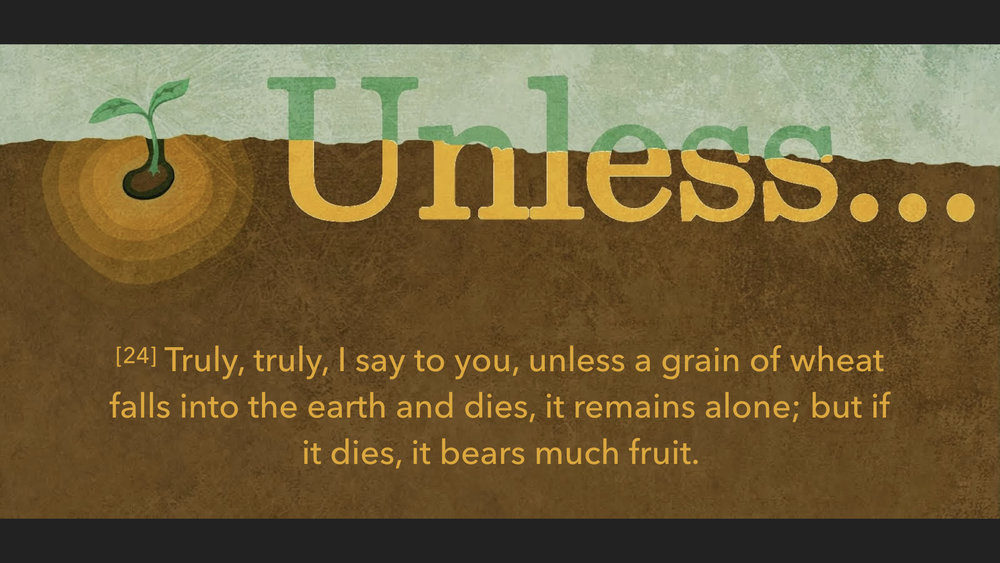
24 “I assure you: Unless a grain of wheat falls to the ground and dies, it remains by itself. But if it dies, it produces a large crop. [a] 25 The one who loves his life will lose it, and the one who hates his life in this world will keep it for eternal life. 26 If anyone serves Me, he must follow Me. Where I am, there My servant also will be. If anyone serves Me, the Father will honor him.

The Word of God for the Children of God. Gloria! In Excelsis Deo! Alleluia! Amen.

I. Eternal life requires more than fearing God and being interested in Jesus (20-23)

As we look into these verses from John, we need to realize that we are at a turning point in salvation history. God’s plan to reconcile the world to himself through the seed of the woman is about to advance at a rapid pace.  

Here’s the point

A.  The glorification of Jesus Christ is required for the salvation of the nations.

The Pharisees in verse 19 make the observation that, “the world has gone after [Jesus].” In the triumphal entry and in the people’s loud praises the Pharisees see the popularity of Jesus. That confession in verse 19 leads us to the account of “some Greeks” in verses 20-22.

Now among those who went up to worship at the feast were some Greeks. So these came to Philip, and asked him, “Sir, we wish to see Jesus.” Philip went and told Andrew; Andrew and Philip went and told Jesus.

Literally the people and nations are coming to Jesus. They want to see him. Now this phrase means more than look at him. These Greeks want to talk with Jesus.

They are hesitant. Possibly because they have just witnessed Jesus clean out the court of the Gentiles when he cleansed the temple; that’s a bit intimidating. So, they instead go to Philip who probably spoke Greek and asked for an audience with Jesus. The people and the nations are mightily curious coming to Christ.

And Jesus responds with a surprising and an unexpected word, verse 23, “The hour has come for the Son of Man to be glorified.”

Up to this point in the life of Christ when Jesus has spoken of “his hour” it has always been in the future tense.

In John 2:4 he told Mary, “My hour has not yet come.”

In John 7:30 we read, “So they were seeking to arrest him, but no one laid a hand on him, because his hour had not yet come.”

In John 8:20 we read, “These words he spoke in the treasury, as he taught in the temple; but no one arrested him, because his hour had not yet come.” 

From here on, from the coming of the Greeks on, Jesus will emphasize the fact that his hour is here.

In John 12:27, “Father, save me from this hour? But for this purpose, I am come to this hour.”

Using the language of the time to glorify the Son Jesus says in John 13:31, “Now is the Son of Man glorified, and God is glorified in him. If God is glorified in him, God will also glorify him in himself, and glorify him at once.”

It is possible that Jesus is only 4 days from the cross. Jesus is fully aware that his death his required for the salvation of the people and the nations.

And Jesus is fully aware that now is the appointed time of his glorification. He must be glorified in order for these Greeks to be saved. He must be glorified in order for you, me to be saved. No one from Adam to the last of God’s children will see eternal life if Jesus does not fulfill the Father’s plan of redemption.

Let’s drive this point home

B.  Your salvation depends upon Jesus’ glorification

Let’s bring in some of the terminology from verse 23. Unless Jesus is glorified, unless the grain of wheat is put into the ground, he will not bear fruit.  Unless Jesus be glorified no one will be saved.

That’s how crucial the cross is. That’s how important this hour is; salvation depends on it.

We should expect the theme of glory to be central from here on in John and it is. We’ll unpack this more, Lord willing, I just want you to see what glorification is.

Look down to verses 28-33.

‘Father, glorify your name.’ Then a voice came from heaven: ‘I have glorified it, and I will glorify it again… verse 31…’Now is the judgment of this world; now will the ruler of this world be cast out. And I, when I am lifted up from the earth, will draw all people to myself’ He said this to show by what kind of death he was going to die.

The glorification of God is displayed through the judgment of sin when God’s wrath for poured out on Jesus. The glorification of God is displayed through the defeat of Satan when his power is broken through the resurrection of Jesus.

The glory of God is about to be displayed through Jesus’ finished work on the cross, resurrection from the grave, ascension back to God’s glorious right hand, and the salvation of the people and the nations who come to Him.

Our salvation and the salvation of the nations, depends on the Son of man being glorified.  The death, resurrection, and ascension of Jesus do not just show us something they secure something.  The glorious work of Jesus Christ on your behalf secures your salvation. 

If this hour doesn’t ever come, then we are lost and hopeless but if Jesus has been glorified then we are saved and we are all born again into a living hope.

These Greeks in John 12 were God-fearers who were willing to submit to God’s laws. They were interested in meeting and learning from Jesus.

But that’s not what is required for salvation. We must be connected by faith, by hope and by love, to the glorified Jesus crucified, resurrected, and ascended.

Where are you today? Does our religion consist only of some rule keeping and occasional interest in Jesus?

If so, you and I would do well to fear that we are missing salvation all together (Hebrews 4:1).  Salvation depends on you being connected to the glorified Jesus.

By faith you and I are joined to him. And with him we are as righteous as God and have power over the grave. Jesus has been glorified. There is salvation and eternal life for you. But you and I must absolutely be connected to him by faith.

Salvation is a promise because salvation depends on the completed work of Jesus Christ. Jesus’ death is a necessity. – The Single Seed must Be Planted!

II. Nature proves that a harvest requires death (24)

A.  Jesus illustrates the necessity of his death by pointing to the planting and harvesting of wheat. Verse 24

Truly, truly, I say to you, unless a grain of wheat falls into the earth and dies, it remains alone; but if it dies, it bears much fruit.

We grow vast fields of wheat to make bread.

Here is what a grain of wheat looks like. 

If you do nothing with this single wheat, then as a whole, it is 100% worthless.

But if you plant that wheat there comes a miracle. By continual harvesting and sowing, one grain of wheat can produce millions of grains of wheat. But what is required to make that harvest happen? You absolutely have to plant the wheat.

You must make it for the moment ruined. Once that grain of wheat is put in the ground and watered you cannot dig it up, grind it up, and make bread out of it. 

But when it dies it bears much fruit.

Jesus obviously isn’t giving us instructions for our gardens.

He’s giving us hope for our souls.

If Jesus skips the cross, if he does not die, then there is no salvation.

But since Jesus endured the cross dying in our place then there is salvation.

Just as millions of grains of wheat come from the death of one grain so the salvation of the people, the nations, comes from the death of the only Son of God.  Eternal life depends on the death of Jesus Christ.

All of the Realm of Nature illustrates this clearly.

Here’s our third point that comes out of Jesus’ death on our behalf.

III. You are the fruit (24-25)

A.  God, The Father is the Lord of the harvest, Jesus the Son is the single grain which starts the harvest, and all that we are and do is a part of the harvest

You and I must fight to keep the call of verses 25 and26 grounded in the work of Christ explained in verse 23 and 24. You and I will live life rightly, enjoy eternal life, serve Jesus, follow Jesus, be with Jesus, and be honored by God as we cling to the glorified Jesus.

All that we are as a Christian is a direct product of all that Jesus has done. God doesn’t demand our death for your salvation. God saves only those who have the glorification of Jesus credited to their souls.

B.  I was quite surprised! Verse 25 is not what I expect

I thought verse 25 should read, “Whoever loves his life loses it, and whoever hates his life in this world bears much fruit.

But the teaching here is not that you and I should die to bear fruit.

That is true and Jesus is going to teach us all about that in John 15.

But before we get to chapter 15, we need to get this point. 

Our redeemed life, our experience of eternal life this very moment, is the produce of Jesus’ death, resurrection, and ascension.

If we get our place wrong when you think about God’s will for all of creation, then we’ll get our life wrong, and we’ll be frustrated by a lack of fruit bearing.

Let’s lay a foundation and hold fast to it.  Our salvation and the salvation of others realized through our good works is ultimately the result of Jesus’ work. 

Since Jesus is the grain of wheat that fell into the earth and died, and since Jesus bears much fruit, we are saved and so are others.  Eternal life today is the result of the glorification of Jesus Christ 2000 years ago.

C.  Your Christian Life is “found” not by protecting yourself but in your gaining the Life of Jesus Christ

Look at John 12:25, Whoever loves his life loses it, and whoever hates his life in this world will keep it for eternal life.

When we read the bible there is a repetition of someone loving a person and hating another person.

Romans 9:13 reiterates the facts that God loved Jacob and hated Esau.

Now let us read and study and pray over Genesis 29:30 – 32

30 So Jacob…loved Rachel more than Leah and served Laban for another seven years. 31 When the Lord saw that Leah was hated, he opened her womb, but Rachel was barren.

Hate is not necessarily the emotional disgust that we feel when we say we hate something. Love and hate in this context have more to do with priorities.

Think about it this way, “Whoever focuses on his life loses it, and whoever forgets his life in this world will keep it for eternal life.”

Have you and I ever been so focused on one thing that we completely forget everything else? That’s the idea. If you focus on your life, your wants, your plans, and yourself then you will also forget, lose your focus on Christ. 

But as we focus on Christ, his wants, his plans, and his self then we will forget our life.

Look at God’s promised product: if we love our life, we will destroy our life.

We are like Lennie from Of Mice and Men by John Steinbeck.

Our thinking is off and so we end up destroying the thing we love the most. 

By protecting ourselves and looking out for ourselves and taking care of numeral uno we ultimately end up destroying ourselves. That is warning.

But here is the promise of John chapter 12: whoever hates his life in this world will keep it for eternal life.

I believe it’s important that the verbs loving, loses, hating, and keeping are present active indicatives. That means they keep right on happening.

These are not one-time events but characteristics, a way of living.

A life primarily focused on Christ will necessarily be a life which neglects self.

You can’t love yourself and Christ. You will love the one and hate the other.

Please do not be fooled into thinking there is a healthy balance between loving self and loving Jesus. There is no such place as a “middle ground.” To attempt to be there is to be disgusting. Jesus promises to vomit you out of his mouth.

We love Jesus.

So, here’s how to pursue this self-hating Christ loving life: follow Christ. 

We must never set out to hate or neglect our lives.

What we must set out to do is focus on, prioritize, and follow Christ. 

This is the connection between verses 25 and 26. It leads to our final point.

IV. Following Christ entails serving now, and gaining heaven and honor then (26)

A.  Following Christ is forgetting self

You can’t protect yourself and follow Christ because going after Christ means following the One who came to die.

Look at verse 26, “If anyone serves me; he must follow me.” 

This is Christianity: finding life not in yourself but in the glorified Jesus.

Adopt his plans as your plans.

Do the things he did. Care about the things he cared about.

Christianity is not keeping the rules and being somewhat interested in Jesus. 

Please notice something.

Twice the word ‘serve’ is repeated in these two verses.

Christians are those people who see the glorified Jesus and serve him.

We are those who are changed by the work of Christ so that we give ourselves to the work of Christ.

Christians work the works God sent Jesus to do.

Christians serve Christ and follow Christ by joining in the grain harvest. Serving and following Jesus demand our everything.

This is why in a similar passage Jesus tells us to count the cost (Luke 14:25-33).

Notice, eternal life is not something we get after we die because of a decision we made as a kid with little consequence for the time in between. 

Eternal life is the time span in which we will enjoy the life Christ has given us.

When we forget ourselves and follow Christ, we will gain a life that is worth living and enjoying for all of eternity. Our self-centered lives would make for a miserable eternity. God’s Christ-centered life makes for an amazing eternity.

Here’s the promise of heaven, verse 26, “and where I am, there will my servant be also.” 

Jesus said in John 14:3, “If I go and prepare a place for you, I will come again and will take you to myself, that where I am you may be also.” 

The promise of heaven, everlasting life and joy in the presence of God, is held out to both you and to me today. 

Follow Christ. 

Serve Christ. 

Ground yourself in the glorification of the only Son. 

Heaven is for you.

Plant your hopes in the death, resurrection, and ascension of Jesus.

You will not be disappointed.

There’s more.

Verse 26, Jesus promises, “If anyone serves me, the Father will honor him.” 

Jesus knows nothing of bait-and-switch. Hating your life is not going to turn out to be a bad idea. If you trust Christ and let him shape your desires and your direction, then look what you’ll get.

Do you see it in verse 26? God himself will honor you. 

Every honor bestowed on man by man goes no farther than this earth and our graves and that appointed day we are all laid therein – never to be seen again.

But every honor bestowed on the servants of Christ is eternal and unceasing.

The honor given by God to you because of Christ cannot be taken away, revoked, or destroyed. There is a meaningful substantial life for you and for me,

and it all depends on Jesus.

V. Imagine with me that your lunch plans have changed and instead of what you had planned you’re going to sit down with Jesus on a public park bench and review your life

Would it become evident that the reason you do what you do and have a family and come to worship and live where you live is so that you can get something for yourself?

Or would it become evident that the reason for everything you do is because you are caught up in the great harvest that depends on the glorified Jesus?

Do you do what you do because of you?

Or do you do what you do because Jesus has been glorified?

Jesus has been glorified. Your salvation, your life, and your future can be secure but only if you give your life over to him. Turn from your sin and insufficiency and utterly trust in the Jesus who makes you pure and is himself Sufficiency.

There is an amazing harvest going on all over this globe and in our community. 

We are a people who have faith in the work of Jesus and will get engaged in his works.  Because Jesus is glorified giving us eternal life we serve him, follow him, and look forward to the honor of eternal life. 

Look around your neighborhood and your work and the grocery store. the fields are indescribably vast and white for harvest. Let’s plant the seed of Jesus! Let’s praise the Lord of the harvest and go from this place to be a part of the harvest.

In the name of God, the Father and God the Son and God the Holy Spirit,

Let us Pray,

Dear Heavenly Father, how I praise and thank You for Your amazing plan of redemption and that the Lord Jesus was ready and willing to forgo all human glory and praise and be led as a lamb to the Cross, so that His death could pay the price for my sin and the sin of the whole world.

Thank You that Jesus lived a perfect life, foregoing any honor, in order to be made sin on my account and died a cruel death on Calvary’s Cross so that by faith in Him I might be forgiven of my sin and receive life everlasting. Praise Your Holy Name, and thank You, Lord Jesus, Alleluia! Alleluia! Alleluia! AMEN.

https://translate.google.com/

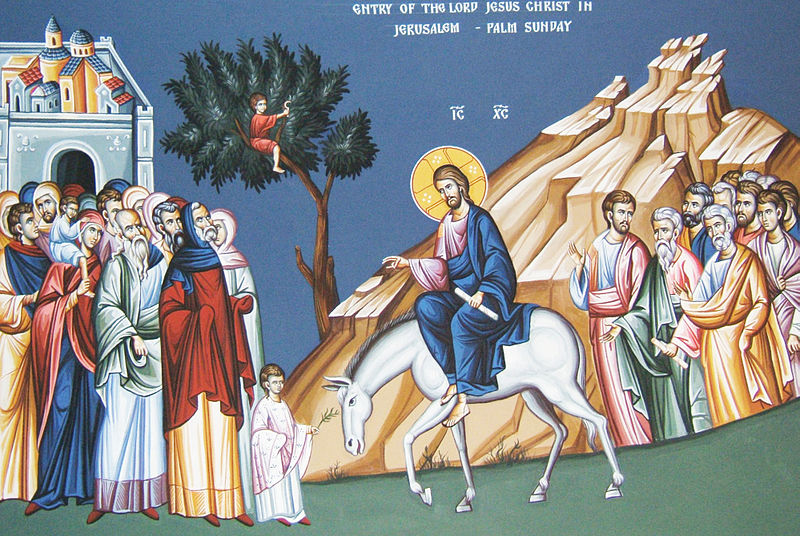
Luke 19:33-34 ||Devotion in Action|| “My God! The Lord has need of ME!?”

“My God! My God! The Lord hath need of ME!?!”

Who is saying this?

The Twelve Disciples standing behind Jesus as he rides the donkey?

The crowd which is before Jesus as he is about to enter the city gates?

The small man in the tree – remember the newly repentant Zacchaeus?

The small man in front of the donkey holding the palm in his hand?

The donkey itself as it carries Jesus on its back with a small smile on its face?

The owner of the donkey who gave his ascent to his animal being taken away by men he never met before who told him simply: “The Lord Hath Need of It?”

The City of Jerusalem itself now in the midst of celebrating the Passover?

The citizens of Jerusalem aware and/or unaware of Jesus’ arrival?

The Priests and Workers of the Temple – the Center of Religious Life for the Jewish people. Where people come to worship and sacrifice as God requires?

How about the mountain – “The Mount of Olives?”

How about the rocks on the ground which the people and donkey walk on?

How about the man, Itinerant Master Rabbi Jesus Himself?

A whole lot of revelation is going on here – each one singularly unique!

Each one saying to themselves ….

Each one shouting unto and into the heavens ….

“MY GOD! MY GOD! THE LORD HATH NEED OF ME!”

“MY GOD! MY GOD! THE LORD HATH NEED OF ME?”

And so, Jesus comes unto the city …. on the back of a donkey ……

This is the moment they were living in, as the events unfolded.

It is now the 21st Century, the year of our Lord and Savior 2022.

Today is Palm Sunday – we will gather for worship this morning.

We will have our families with us.

Those who only come once or twice a year – will miraculously appear.

We have those who cannot or will not come to church – but have some connection to a social media site – Facebook, or You Tube, or ZOOM.

God will (hopefully, prayerfully) have their undivided attention again.

We still have the ancient stories of the Gospel narratives.

We have the benefit of history.

We have the benefit of their struggles and the fruits of their labors.

We have the benefit of the full Biblical Canon, God’s Holy Scriptures.

We have the benefit of commentaries and sermons and devotions.

We read, re-read these Gospel Narratives year after year after year.

As we consider one angle after another trying to be original, trying to reach the older generations and communicate to current and coming generations of both believers and non-believers alike – unto into those “great clouds of witnesses,” “MY GOD! MY GOD! THE LORD HATH NEED OF ME!?!

What are we to anticipate in the coming minutes and hours ahead?

As we consider the words – “THE LORD HATH NEED OF ME ….”

Relevant or Irrelevant?

Absolutely Meaningful or Utterly Useless?

Are we exclaiming it or are we questioning it?

Are we accepting the possibility or are we brushing it away and denying it?

Is anybody even seriously reading or studying, listening or praying, teaching or preaching the critically true meaning and absolute importance to the words?

“MY GOD! MY GOD! THE LORD HATH NEED OF ME!?!

Luke 19:28-40 Amplified Bible

The Triumphal Entry

28 After saying these things, Jesus went on ahead [of them], going up to Jerusalem.

29 When He approached Bethphage and Bethany, at the mount that is called Olivet, He sent two of the disciples, 30 saying, “Go into the village ahead of you; there, as you enter, you will find a [donkey’s] [a]colt tied, on which no one has ever sat. Untie it and bring it here. 31 If anybody asks you, ‘Why are you untying the colt?’ you will say, ‘The Lord needs it.’” 32 So those who were sent left and found the colt just as He had told them. 33 As they were untying the colt, its owners asked them, “Why are you untying the colt?” 34 They said, “The Lord needs it.” 35 They brought it to Jesus, and [b]they threw their robes over the colt and put Jesus on it. 36 As He rode along, people were spreading their coats on the road [as an act of homage before a king]. 37 As soon as He was approaching [Jerusalem], near the descent of the Mount of Olives, the entire multitude of the disciples [all those who were or claimed to be His followers] began praising God [adoring Him enthusiastically and] joyfully with loud voices for all the miracles and works of power that they had seen, 38 shouting,

“Blessed (celebrated, praised) is the King who comes in the name of the Lord!
Peace in heaven and glory (majesty, splendor) in the highest [heaven]!”

39 Some of the Pharisees from the crowd said to Him, “Teacher, rebuke Your disciples [for shouting these Messianic praises].” 40 Jesus replied, “I tell you, if these [people] keep silent, the stones will cry out [in praise]!”

The Word of God for the Children of God. Gloria! In Excelsis Deo! Alleluia! Amen.

The Lord Needs It – Luke 19:34

I wonder how much our faith, hope and love would affect our daily lives if we lived to exclusively serve Christ’s needs instead of our own?

Is that even possible? Would our churches be filled with people on Sundays because the Lord needed them to be there? Would missions throughout the world be fully funded because the Lord needs affluent Christians in the West to ‘pony up’ and provide from their ample resources all that is needed by Christ to medicate, educate, feed and clothe people living in poverty across the globe?

If we are 100% comfortable doing religious things without being challenged by the radical nature of the surprise and scandal of the Gospel, then we are going to go through life as spiritually shallow people.

However, if we take time to really think about what Christ needs us to do with our lives and resources, then everything will change about how we ‘do’ church and how we share our faith.

The owners of the colt in today’s Gospel passage (Luke 19:28-36) could have told the disciples to “get lost or I will call the cops”, or that it was inconvenient, or that it would be okay the next day. They didn’t do that; when they heard the words “The Lord Needs It,” they gave over the colt freely and perhaps gladly.

In these 21st century times, would we be so accommodating or dismissive?

The Lord hath need of many things from each and every one of us ……

YEA OR NAY ……

21 So get rid of all uncleanness and [a]all that remains of wickedness, and with a humble spirit receive the word [of God] which is implanted [actually rooted in your heart], which is able to save your souls. 22 But prove yourselves doers of the word [actively and continually obeying God’s precepts], and not merely listeners [who hear the word but fail to internalize its meaning], deluding yourselves [by unsound reasoning contrary to the truth]. 23 For if anyone only listens to the word [b]without obeying it, he is like a man who looks very carefully at his natural face in a mirror; 24 for once he has looked at himself and gone away, he immediately forgets [c]what he looked like. (James 1:21-24 Amplified)

Questions for personal reflection

What does the Lord need of me?

Am I willing to give my time, talents, and resources to Him for His work?

In the name of God, the Father and God the Son and God the Holy Spirit,

Let us Pray,

Lord Jesus, Your Gospel brings goodness and forgiveness, strength and love into our lives. It also presents us with unique challenges and causes us to reflect upon our daily choices. Help us so to live according to Your needs and liberate us from our insecurities, as well as our desires. In Your Holy Name, we cheerfully pray. Amen.

https://translate.google.com/

Imagine the Possibility! I am Finding Myself at a Loss for Words! Escaping the Thought Trap!!! |Joshua 1:7 – 9|

Wonderful Words of Life (Philip P. Bliss, 1838-1876)

1. Sing them over again to me,
wonderful words of life;
let me more of their beauty see,
wonderful words of life;
words of life and beauty
teach me faith and duty.
Refrain:
Beautiful words, wonderful words,
wonderful words of life.
Beautiful words, wonderful words,
wonderful words of life.

2. Christ, the blessed one, gives to all
wonderful words of life;
sinner, list to the loving call,
wonderful words of life;
all so freely given,
wooing us to heaven.
(Refrain)

3. Sweetly echo the gospel call,
wonderful words of life;
offer pardon and peace to all,
wonderful words of life;
Jesus, only Savior,
sanctify forever.
(Refrain)

Joshua 1:7-9 English Standard Version

Only be strong and very courageous, being careful to do according to all the law that Moses my servant commanded you. Do not turn from it to the right hand or to the left, that you may have good success[a] wherever you go. This Book of the Law shall not depart from your mouth, but you shall meditate on it day and night, so that you may be careful to do according to all that is written in it. For then you will make your way prosperous, and then you will have good success. Have I not commanded you? Be strong and courageous. Do not be frightened, and do not be dismayed, for the Lord your God is with you wherever you go.”

The Word of God for the Children of God. Gloria! In Excelsis Deo! Alleluia! Amen.

Someone, somewhere at some point in time, began to ponder and pray …..

They have probably been pondering these questions for quite some time …..

So, we have been gazing at the unsearchable beauty of the Lord our God.

We have been craning our necks upward – mightily focusing on His face.

We have been craning our necks and eyes upwards until it now hurts us.

Not just our necks hurt, not just a struggle against keeping our eyes open,

But now we also find steadily creeping into our heads – new thoughts we do not recognize – or as much as we recognize them – we deem them 100% unwanted.

We search for God, turning our faces and our thoughts away from the world.

Now, without our permission, our day-to-day thoughts are being muddled.

We like it- we like it (maybe) – we like it not – we realize it – we are not sure?

We cannot stop these thoughts – we try to re-shape them – but no success?

Are we struggling against our worldly thoughts leaving our heads?

Might this be true?

Without realizing – are we struggling against God trying to get into our heads?

Struggling with negative thoughts? Maybe low self-esteem? Self-putdowns?

When I think about these thought struggles, I am both awed, amazed and (gasp) very scared at how easy it is to adopt or fall into a bad thought habit.

That’s right I said it, “habit.” All our thought patterns are, in fact, habits.

Our whole lives, we have all been taught, trained on how to think and what to think and why to think what we should think until they become 100% natural.

And these habits can even impact our ability to problem solve and our ability to decide how, what we use to filter truth vs untruth. Even learned helplessness is copied and can gradually develop into (negative) thought and behavioral habits.

Sometimes, these thoughts become a significant burden we know not what to do with the breadth of them. Scratch heads? Move forward? Stand still? Retreat?

We are looking for the indescribable, unknowable, unsearchable, face of God anywhere and everywhere we can. We want to cannot look upon His face, to look upon His visage, crawl or walk up to Him – look directly into His eyes!

But that is not possible to do and survive.

But survivability is not our concern – we only want to be eye to eye with Him.

Beholding His face – Looking into His eyes – knowing His thoughts for us, is very much where we all prefer to be. We will brave everything for this chance.

We cannot know the thoughts of God for us and that disturbs us – we are all called to look upon Him, but reality is we cannot do so – but our thoughts are still on God – YET our eyes and our souls our thoughts remain 100% fixated.

We are now fixated on God despite our thought habits! This is great news because just as we develop bad habits, we can retrain our thinking and learn new habits. It’s really pretty simple but requires truth, faith, commitment.

Let me introduce you to the one presenting us with this array of questions.

He is Joshua, Son of Nun …. His reality has just been seriously altered ….

Before him, the prospect of replacing Moses as leader of millions of people.

Prepared to lead? Prepared to stand still? Prepared instead to retreat?

Prepared to think, act and believe according to his understanding?

And what would that accomplish for him, his family, his people, His nation?

God knows all of our thoughts before we even have them – but in the midst of our sorting out our own stuff – are we realizing that God is trying to overcome, overwhelm the unrelenting burden of our thoughts at the exact same time?

How? God persistently speaks His greater thoughts over our lesser thoughts …

Only be strong and very courageous, being careful to do according to all the law that Moses my servant commanded you. Do not turn from it to the right hand or to the left, that you may have good success[a] wherever you go. (Joshua 1:7 ESV)

“This Book of the Law shall not depart from your mouth, but you shall meditate on it day and night, so that you may be careful to do according to all that is written in it. For then you will make your way prosperous, and then you will have good success.” (Joshua 1:8, ESV)

What are we to make of this seldom considered, thought-provoking revelation?

Whatever the time, whenever the season of life, it’s 100% safe to say we are the sum total of our habits. If you want to know your future, just look at your habits today! It will show you where your thoughts and behaviors will be tomorrow.

God says ….

For my thoughts are not your thoughts,
    neither are your ways my ways, declares the Lord.
For as the heavens are higher than the earth,
    so are my ways higher than your ways
    and my thoughts than your thoughts.

10 “For as the rain and the snow come down from heaven
    and do not return there but water the earth,
making it bring forth and sprout,
    giving seed to the sower and bread to the eater,
11 so shall my word be that goes out from my mouth;
    it shall not return to me empty,
but it shall accomplish that which I purpose,
    and shall succeed in the thing for which I sent it.
(Isaiah 55:8-11 ESV)

The finite Mind and wayward Thoughts of Man Repeat ….

Trust in the Lord with all your heart,
    and do not lean on your own understanding.
In all your ways acknowledge him,
    and he will make straight your paths.
Be not wise in your own eyes;
    fear the Lord, and turn away from evil.
It will be healing to your flesh[a]
    and refreshment[b] to your bones.
(Proverbs 3:5-8 ESV)

Thorns and snares are in the way of the crooked;
    whoever guards his soul will keep far from them.
Train up a child in the way he should go;
    even when he is old he will not depart from it.
(Proverbs 22:5-6 ESV)

Set your minds on things that are above, not on things that are on earth.” (Colossians 3:2)

When I allow myself to think about setbacks, hurts and the many different pains of life we experience through people, places, things or events, I realize there is ever a choice we can make; there is a crossroad before us; a decision:

Do I hand myself and my emotions over to my own thoughts, hardships of life and allow them to define me? To permit my thought to dictate how I should feel and ought to live? Or do I, in my pain, bring it to God and find healing and rest?

I guess that’s the difference between freedom and chains. You may be afraid and have it in great abundance, but fear doesn’t have to have abound in you.

Over seasons. the stories and scripts we tell ourselves are powerful. What we tell ourselves not only threatens to define our behavior but also predicts our future.

Do we speak negativity and lies in opposition to the Word of God, or do we speak the truth of God as medicine over our hurting souls and against the lies and narratives we have been taught? Being set free is to experience the truth of the gospel showing up in every area of our lives, even in our thought life.

To fight my thought battles, I use Scripture to correct false assumptions and to confront bad behaviors. When our experiences and thoughts don’t line up with biblical truth, we should always yield our thoughts and accept the 100% truth of Scripture in all its authoritative truth. Make it our filter and meditate on it over and over until God develops our new thought habits. It will replace the old one!

The Truth Will Set You Free (John 8:31-32 ESV)

31 So Jesus said to the Jews who had believed him, “If you abide in my word, you are truly my disciples, 32 and you will know the truth, and the truth will set you free.”

Our thought habits can be such a pervasive trap. Or they can be the source of a pure spring that flows from the Word of God, deposited deep into our lives.

We are not to be continuously chained to negative thinking anymore. Living Word of God: We no longer have to be. Yield to the truth that can set you free.

In the name of God, the Father and God the Son and God the Holy Spirit,

God, my Wisdom, Speak, them over again to me, thy Wonderful Words of Life ….

Lord of wisdom, I sometimes finding understanding the Bible to be difficult. I know you want me to apply your word to my life. I thank you for giving me your word so I can grow in my relationship with you. Help me grasp what you want me to know as I read your revealed word. Open my eyes so to see the wonderful truths in your instructions. Be my teacher, be my wisdom, be my truth, so I can live and obey your word. Thank you for your wise advice. Gloria! Alleluia! Amen.

https://translate.google.com/

When I Survey the Wondrous Cross, No Other Name, No Other Option, No Other Power. A Study of Acts 4:1-12

Peter quoted from the Psalms as he answered the religious powerbrokers about the power, he had invoked to heal the man at the gate of the Temple. While he quoted only one verse, those religious scholars would have known the context and the MAX message that surrounded the verse and should have heard Peter’s poignant and urgent message to them about the gate of the LORD and salvation:

Open to me the gates of righteousness,
that I may enter through them
and give thanks to the LORD.
This is the gate of the LORD;
the righteous shall enter through it.
I thank you that you have answered me
and have become my salvation.
The stone that the builders rejected
has become the cornerstone.

This is the LORD’s doing;
it is marvelous in our eyes.
This is the day that the LORD has made;
let us rejoice and be glad in it.

(Psalm 118:19-24 ESV)

Even though Peter spoke to those who intended to harm him, he was extending the offer of salvation outward into eternity. YAHWEH, the LORD, the covenant God of Israel, had done through Jesus all that is in this great Messianic psalm.

The assembled religious leaders Peter was addressing could turn and accept Jesus as the cornerstone and be saved or not. It could be a day of rejoicing and not of accusation. For rejoicing to reign, people must turn to Jesus, recognize what he has done as being marvelous in their eyes because he is the only name, the only person, who is the foundation of grace and by whom we are saved!

Acts 4:1-12 NRSV

Peter and John before the Council

While Peter and John[a] were speaking to the people, the priests, the captain of the temple, and the Sadducees came to them, much annoyed because they were teaching the people and proclaiming that in Jesus there is the resurrection of the dead. So they arrested them and put them in custody until the next day, for it was already evening. But many of those who heard the word believed; and they numbered about five thousand.

The next day their rulers, elders, and scribes assembled in Jerusalem, with Annas the high priest, Caiaphas, John, [b] and Alexander, and all who were of the high-priestly family. When they had made the prisoners[c] stand in their midst, they inquired, “By what power or by what name did you do this?” Then Peter, filled with the Holy Spirit, said to them, “Rulers of the people and elders, if we are questioned today because of a good deed done to someone who was sick and are asked how this man has been healed, 10 let it be known to all of you, and to all the people of Israel, that this man is standing before you in good health by the name of Jesus Christ of Nazareth,[d] whom you crucified, whom God raised from the dead. 11 This Jesus[e] is

‘the stone that was rejected by you, the builders;
    it has become the cornerstone.’[f]

12 There is salvation in no one else, for there is no other name under heaven given among mortals by which we must be saved.”

The Word of God for the Children of God. Gloria! In Excelsis Deo! Alleluia! Amen.

The book of Acts is filled with stories of amazing devotion, and it reads like the script of a movie.

 Acts 3, when Peter and John were going up to the temple at the hour of prayer. They were both evidently on their way to a large colonnaded area known as Solomon’s Portico. As they entered the temple there was a lame man sitting in front of the Gate Beautiful, and he asked them for a gift.

Peter said, “Silver and gold have I none, but such as I have give I to thee. In the name of Jesus of Nazareth, rise up and walk.”

Peter reached down and grabbed the man’s hand and pulled him to his feet. Suddenly the man’s feet and legs received strength and he want walking and leaping and praising God into the temple. A great crowd gathered on Solomon’s Portico, and Peter began preaching the, Gospel But his sermon was interrupted when the temple police came, pushed through the crowd and arrested the two disciples. That’s where we pick up the devotional story today in chapter 4.

When he is giving testimony in Acts 4, Peter asks the Temple Authorities if the healing of a lame man is a good deed or not. If this is an act of kindness, then it must come from God. The obvious answer seems to be yes, it is a good deed from God. If they agree it is a good deed from God, then they have a problem:

Peter states the man was healed by the name of Jesus of Nazareth, the one put to death by this very council only two months before!

The problem for the High Priest is obvious.  If Peter healed the man “in the name of Jesus” that means that Jesus was, at the very least, an innocent man and God is now doing miracles “in the name of Jesus.”  

If Jesus was innocent, then the High Priest is guilty of killing an innocent man. If he was Messiah and actually raised to the right hand of God, then the coming messianic age has begun, and the High Priest finds himself “on the outside.”

The last line of Peter’s defense is a classic statement of the gospel: “There is no other name under heaven given to men by which we must be saved” (Acts 4:12).

This is a bold, strong statement of total dedication to Jesus Christ. There is no possibility of religious pluralism, Jesus is in fact the only way, truth and life. If humans (these people before Peter or any human) expect to be right with God, they can only do it through the name of Jesus.

This is really an outgrowth of the belief that God raised Jesus from the dead and seated him on his right hand. The name of Jesus is now the highest authority possible, so Paul can say in Phil 2 that at the name of Jesus every knew will bow.

There is a remarkable and radical boldness in this statement which must not be under-estimated, but from the modern perspective of religious pluralism. The boldness is that uneducated Galilean Peter is saying this to a group of highly educated, highly respected, highly religious Jews who thought that they were the only ones who held the right way to salvation. “If you wanted to be right with God, you had to “humbly” come to them and hear their interpretation of the Law and participate in worship only in the Temple, which they control.

Peter is saying that salvation now comes through Jesus, not the Temple. Little wonder why these men were shocked at Peter’s boldness!

The Great Rabbi Gamaliel had cautioned them.

If all of this were an invention of man’s mind alone – it will very soon go away.

If it were a thing of God – there was nothing anyone could ever do to stop it.

Now, everything was becoming real!

Now, the stark implications of these past two months since the crucifixion was revealing for all, a living and unstoppable thing of God in the eyes of the people.

It was coming from an uneducated man – a man close to the everyday people. The people saw uneducated Peter stand boldly before thousands and speak the same words Jesus spoke as he walked among them. Jesus died. But the Word is continuing to emanate forth with an authority not of the Temple Leadership.

The people were listening to Peter. They heard the tongues being spoken. Had heard Peter recite God’s Holy Scriptures, and were convicted by the Holy Spirit.

They came to Peter literally by the thousands and were baptized and the Church was born. They gathered as a believing community as they had not done under the authority of the Temple leadership. The Temple leaders were losing ground. They were fast losing the respect of the people. Jesus whom they killed – LIVED!

Now it was real.

The words of this man Jesus were coming to life too – and they could not stop it! They could not command the people to not speak of Jesus without losing it all! It was all becoming crystal clear to them – they could only remember the events which had led up to this “no return now” moment of incalculable implications

Before, they heard Jesus had taught his disciples about what would happen to them because of him and his name. He had told them that they would be his witnesses to the ends of the earth. He had told them that they would be hated because of him.  He told them that they would be handed over to rulers and authorities–and much worse–because of him. They thought it had all ended when they had him humiliated as the ultimate criminal – crucified – crucified!

Now Peter and John were before them, under arrest of the Sanhedrin, perhaps eerily familiar to what happened to their beloved Teacher not too long before. All were gathered – they were experiencing exactly what Jesus had foretold.

But, instead of fear, there was a definite change, there was boldness. Peter and John did not back down. Would they, could they refuse to talk about Jesus? And would, could they obey men rather than God? They couldn’t and they wouldn’t.

Why? Why be so resilient? Why ignore the threat of prison, torture, or death?

Why?

They had surveyed the humiliation of cross for themselves.

Had a long three-day chance to think about it, its implications for them.

They had both peered into Rabbi Jesus’ tomb and found it to be EMPTY!

The Jesus Himself returned to the Upper Room – through a locked door!

Convinced beyond any shadow of a doubt – They stood before the authorities.

Peter gives us the only reason that matters:  Salvation is found in no one else, for there is no other name under heaven given to men by which we must be saved.

Peter and John were convinced! Had their lives changed because they came to know salvation through Jesus. They also knew that other people had to know about this too, for there is no other way of salvation except through Jesus alone!

No other message mattered to them in that moment! So today, we Christians who also are persecuted. Perhaps not in America at the same level as the early disciples were, or even as other Christians around the globe are persecuted.

But regardless of how much or little we are oppressed or persecuted now or in the future, the message remains – Salvation is in Jesus! We will not back down!

1. When I survey the wondrous cross
on which the Prince of Glory died;
my richest gain I count but loss,
and pour contempt on all my pride.

2. Forbid it, Lord, that I should boast,
save in the death of Christ, my God;
all the vain things that charm me most,
I sacrifice them to his blood.

3. See, from his head, his hands, his feet,
sorrow and love flow mingled down.
Did e’er such love and sorrow meet,
or thorns compose so rich a crown.

4. Were the whole realm of nature mine,
that were an offering far too small;
love so amazing, so divine,
demands my soul, my life, my all.
(Isaac Watts, 1707)

God has worked in our hearts faith to know and believe salvation through Jesus.

That faith is so empowering, so overwhelming that we also can’t help but boldly share what we have seen and heard. Other people need to know about Jesus to.

So fellow Christian, without ceasing: Testify! Witness! Preach! Teach! The only name, no other power, no other option under heaven that matters for Salvation!

I Pledge My Allegiance to the Lamb of God …..

In the name of God, the Father and God the Son and God the Holy Spirit,

Let us Pray,

O LORD God, Father of Abraham, Isaac, Jacob, and Jesus, you are my only Abba Father. I love you. I see your love for me poured out in what Jesus did for me and for all others because we all need salvation. Thank you for sending him — thank you for YOU coming in human flesh in Jesus to show us this love. Your work, your plan, your salvation, and, most of all, a Savior sent for me are marvelous. Thank you for such a great salvation. In Jesus’ name, I offer my thanks and my heart. Gloria! In Excelsis Deo! Alleluia! Alleluia! Alleluia! Amen.

https://translate.google.com/

Fellow Christians, “As Iron Sharpens Iron,” So You too Can Truly Influence Others for the Better! |Proverbs 27:17

The mightily influential, Late Evangelist Reverend Dr. Billy Graham wrote,

The human soul is a lonely thing. It must have the assurance of companionship. Left entirely to itself, it cannot enjoy anything. God said in the beginning, “It is not good that man should dwell alone” (Genesis 2:18). The creation of Eve was the beginning of human companionship. God’s people are a body, not intended to function separately, not intended to be unconcerned for one another.

The only true body in the world is the Church. The world may talk grandly of brotherhood, but in reality, its philosophy is “each man for himself.” All of God’s children are guaranteed the richest and truest friendship, both here and hereafter. Only in a true friendship and a true love do we find a genuine basis for peace. Only God can break down the national and racial barriers that divide men today. Only God can supply that love that we must have for our fellowman.

We will never build brotherhood of man upon earth until we are believers in Christ Jesus. The only true cohesive power in the world is Christ the Lord. He alone can bind all generations of human hearts together in one genuine love.

Proverbs 27:17 Amplified Bible

17 
As iron sharpens iron,
So, one man sharpens [and influences] another [through discussion].

The Word of God for the Children of God. Gloria! In Excelsis Deo! Alleluia! Amen.

Within the Hebrew (Old) Testament, there are many nuggets of wisdom to take in, with whole books dedicated to the subject. The wisest man to ever walk the earth, King Solomon, wrote several books, including Proverbs. Many of these proverbs come in a poetic form; some of them are long, symbolic narratives, while others are but the briefest of couplets full of truth. One such statement is, “Iron sharpens iron, and one man sharpens another” (Proverbs 27:17).

Sometimes these metaphoric statements can be complex and rather difficult to understand, especially when they are taken out of context. Most Christians thinkers believe this statement regarding iron sharpening iron only relates to having a good friend, honesty that improves one’s character and calls out sin in a loving way; though there are some who believe it refers to also someone who brings down another, and argue it is a negative statement.

Either way, the phrase “iron sharpens iron” from Proverbs 27:17 highlights the important truth that people affect and influence one another, words and actions define relationships for better or worse, and they change people, so people need to act accordingly.

What Is the Context Around Proverbs 27:17?

Proverbs 27 falls towards the end of the book, as there are 31 chapters. It is grouped with several other chapters which are labelled as having been written by King Solomon, the son of David and the builder of the temple, copied later by men who worked for King Hezekiah of Judah. Solomon’s reign was around 970-931 BC, while Hezekiah’s was from 715-686 BC, two centuries later.

The verses in Proverbs are chocked full of advice, many of which are about positive and negative interactions and behaviors. Some examples include:

“Let another praise you and not your own mouth; a stranger, and not your own lips” (Proverbs 27:2).

“Better is open rebuke than hidden love” (Proverbs 27:5).

“As in water face reflects face, so the heart of man reflects the man” (Proverbs 27:19).

“Sheol and Abaddon are never satisfied, and never satisfied are the eyes of man” (Proverbs 27:20).

In the middle of these verses is, “iron sharpens iron, and one man sharpens another.” However, the back half is sometimes given as, ‘…sharpens the face of another.’ Like many of the Proverbs, it uses metaphor to make its point.

What Does “Iron Sharpens Iron” Mean?

When creating and shaping a metal blade, it is often sharpened, and then it is maintained through its life, by dragging it against a harder metal. Without this periodic maintenance, a blade will eventually become quite dull and less useful.

During the life of Solomon, many weapons, pieces of armor, and tools were made of iron. It would not have been a highly refined version of metal, like steel. It was also not necessarily consistent in how hard or soft it was.

A tool would have been sharpened, ground against something harder, to make it smoother, remove deformities, and to maintain its ability to cut. When iron is scraped against another material in this way, it too becomes more refined. The metaphor in the first half of the verse refers to a common practice with which many of that day would have been extraordinarily acquainted, familiar with.

The second half of the verse explains the metaphor. Like a piece of hard iron will sharpen another piece of iron, the interactions between two people will shape and change one another. Most scholars and theologians interpret this changing as a refinement of character. Being in the presence of a truly strong believer, within their sphere of influence, can help refine another person too.

Earlier verses in chapter 27 reflect this idea, “Better is open rebuke than hidden love. Faithful are the wounds of a friend; profuse are the kisses of an enemy” (Proverbs 27:5-6). An honest acquaintance will lovingly address when someone they care about is doing something wrong or struggling with a decision. 

It is also in alignment with philosophies of behavior encouraged in the New Testament; “Therefore encourage one another and build one another up, just as you are doing” (1 Thessalonians 5:11). Calling out sin, encouraging each other, and lifting one another up in prayer are all ways of sharpening one another.

Like both metals are altered by the sharpening process, both believers who interact with one another have an impact on each other. If a believer disciples another, they grow as well. Their understanding of the Bible can grow, they can deepen their relationship with God, and each other and have new experiences.

Where Else in the Bible Do We See Believers Strengthening One Another?

God wants Christians to challenge one another and strengthen the community in love as a family and in fellowship (Acts 2:43-47), because they are all the sons and daughters of God. In the New Testament, particularly in the epistles, the writers decidedly, deliberately, put a particularly strong emphasis on it.

Some of these verses include:

“Let no corrupting talk come out of your mouths, but only such as is good for building up, as fits the occasion, that it may give grace to those who hear” (Ephesians 4:29).

“So then let us pursue what makes for peace for mutual upbuilding” (Romans 14:19).

“But exhort one another everyday, as long as it is called ‘today’, that none of you may be hardened by the deceitfulness of sin” (Hebrews 3:13).

“Is anyone among you suffering? Let him pray. Is anyone cheerful? Let him sing praise” (James 5:13).

“But you, beloved, building yourselves up in your most holy faith and praying in the Holy Spirit, keep yourselves in the love of God, waiting for the mercy of our Lord Jesus Christ that leads to eternal life” (Jude 1:20-21).

“My brothers, if anyone among you wanders from the truth and someone brings him back, let him know that whoever brings back a sinner from his wandering will save his soul from death and will cover a multitude of sins” (James 5:19-20).

How Can We Sharpen One Another Today? 

These many ways of lifting one another up mentioned in the Bible still apply today. Singing songs to God together, reading the Word, and praying for one another is a great start. Learning more about one another so as to help each other in their specific weaknesses is a way to be supportive and grow stronger in character. Devoting yourselves to innovatively teaching generations about being a success, about mentoring, modeling for each other Christian character.

Availability is so important. Many serve one another by providing meals, time, and energy in each other’s daily lives. This builds trust, meaning believers can challenge each other in more personal ways, people do not live in a vacuum, and the way they are all positively influenced and treated will leave a lasting impact.

True and lasting friendship seems to be a rare gift these days. Many people have made themselves too busy to truly invest the time and energy it takes to develop significant relationships. Often, we will hear people say to each other, “We’ll have to get together soon”–but it seldom happens, and opportunities are lost.

Individuals and communities want to be taught they can come together and be strong in the Lord, believe in themselves – believe in their diverse strengths, to share hopes and dreams for something better than where they find themselves. As the Lord has promised, there is always going to be a time of a greater future.

It is a tough lesson to learn. It is an even far tougher lesson to devote oneself to communicating and teaching, modeling and mentoring, living and sacrificing for. And this is the lesson of the life and ministry, death and resurrection of our Savior Jesus Christ, who for the joy, which was before Him, endured the Cross!

Good friends are one of God’s greatest gifts. Not one of us is ever meant to go through life alone and without help. God longs to use you as his hands and feet to those he has placed in your midst. He longs to make you a friend as God is a great friend to us, in order to bless others and extend the reach of his kingdom.

God is calling you and me to love our friends “at all times.” He is calling you and me to a lifestyle of service and grace. What friend of yours needs your help right now? Who can we choose to serve over ourselves? What friend is God calling you to influence and love with the love and influence He has shown all of us today?

1. Pray and Meditate upon God’s desire for us to pursue godly friendship. Allow Holy Scriptures to stir up our desire to influence and love friends well today.

2. How can you be a better friend today? In what ways can you and I love those whom God has given us as friends? Ask the Holy Spirit to reveal to your ways you can better love and influence those around you today.

3. Ask God to empower you to be a friend who loves unconditionally. Ask him to make you more like himself every day. Spend quality time just resting in his presence and allowing his love to fill you and influence you and empower you.

In the name of God, the Father and God the Son and God the Holy Spirit,

Let us Pray,

Heavenly, Father, there are times in my life when I need true and genuine friends, a comforting arm, a listening ear, a shoulder to cry on, or even just sensible good advice. But there are no true friends to turn to. No one who I can relate to, who truly understands exactly how I feel. It leaves me feeling broken, empty, and lost. Fill me, Lord with Your divine holy presence. Allow me to feel Your tender, warm embrace wrapped around me, as I sit here and cry out to You. Gloria! In Excelsis Deo! Alleluia! Alleluia! Alleluia! Amen.

https://translate.google.com/

In the Pit with the King: Persistence, Patience and Purpose |Psalm 40:1-3|

Some roads to healing and wholeness are rather long journeys. Even though we live in a quick fix, microwave fast sort of world, we don’t always see the results we desire immediately. When results are slow in coming, we need to be both patient and persistent in our pursuit of bringing our concerns before the Lord. We know that He hears us and that His heart is to bring us up out of the dark pit we’re currently enduring, but the question remains, why is there a delay.

Perhaps, like Job the angel assigned to respond to you is being delayed or maybe there’s a divine timing and alignment of circumstances that needs to happen first. It’s OK to bring this concern over delay to the Lord and ask Him to show you why there is a delay. Is there a specific need in your life where it feels like you just aren’t getting an answer to your prayers? Are we extending our arms upward? Are we keeping our arms extended until we feel the presence of God?

Even strongest and mightiest of arms gets tired trying to stay raised. It is true also that even the strongest most mature of souls get tired of waiting upon the Lord!

Psalm 40:1-3 NRSV

Psalm 40

Thanksgiving for Deliverance and Prayer for Help

To the leader. Of David. A Psalm.

I waited patiently for the Lord;
    he inclined to me and heard my cry.
He drew me up from the desolate pit,[a]
    out of the miry bog,
and set my feet upon a rock,
    making my steps secure.
He put a new song in my mouth,
    a song of praise to our God.
Many will see and fear,
    and put their trust in the Lord.

The Word of God for the Children of God. Gloria! In Excelsis Deo! Alleluia! Amen.

One of the great benefits of reading the psalms is that they present us with patterns of life that the godly go through in every age. And in doing that they encourage us that we are made of the same stuff as the saints of old, and they give us guidance how to follow the pattern of godliness through to the end.

One of the cyclical patterns of life recurring in the psalms is getting in the pits, staying there for a time and a season and getting out again. And my favorite statement of this pattern comes from David’s experience found in Psalm 40.

We are going to focus only on verses 1–3.

We will read the whole psalm so not to miss any insight the context might give.

Psalm 40 (New Revised Standard Version)

Thanksgiving for Deliverance and Prayer for Help

To the leader. Of David. A Psalm.

I waited patiently for the Lord;
    he inclined to me and heard my cry.
He drew me up from the desolate pit,[a]
    out of the miry bog,
and set my feet upon a rock,
    making my steps secure.
He put a new song in my mouth,
    a song of praise to our God.
Many will see and fear,
    and put their trust in the Lord.

Happy are those who make
    the Lord their trust,
who do not turn to the proud,
    to those who go astray after false gods.
You have multiplied, O Lord my God,
    your wondrous deeds and your thoughts toward us;
    none can compare with you.
Were I to proclaim and tell of them,
    they would be more than can be counted.

Sacrifice and offering you do not desire,
    but you have given me an open ear.[b]
Burnt offering and sin offering
    you have not required.
Then I said, “Here I am;
    in the scroll of the book it is written of me.[c]
I delight to do your will, O my God;
    your law is within my heart.”

I have told the glad news of deliverance
    in the great congregation;
see, I have not restrained my lips,
    as you know, O Lord.
10 I have not hidden your saving help within my heart,
    I have spoken of your faithfulness and your salvation;
I have not concealed your steadfast love and your faithfulness
    from the great congregation.

11 Do not, O Lord, withhold
    your mercy from me;
let your steadfast love and your faithfulness
    keep me safe forever.
12 For evils have encompassed me
    without number;
my iniquities have overtaken me,
    until I cannot see;
they are more than the hairs of my head,
    and my heart fails me.

13 Be pleased, O Lord, to deliver me;
    O Lord, make haste to help me.
14 Let all those be put to shame and confusion
    who seek to snatch away my life;
let those be turned back and brought to dishonor
    who desire my hurt.
15 Let those be appalled because of their shame
    who say to me, “Aha, Aha!”

16 But may all who seek you
    rejoice and be glad in you;
may those who love your salvation
    say continually, “Great is the Lord!”
17 As for me, I am poor and needy,
    but the Lord takes thought for me.
You are my help and my deliverer;
    do not delay, O my God.

Verses 1–3 present a pattern of life at least part of which every Christian knows about firsthand. My goal today, though, is that we all be enabled to follow the whole pattern all the way through to its exciting conclusion.

David leads us through six stages of his experience, and I want us to follow him closely.

First, David is in a muddy pit;

Second, he cries to God for help;

Third, he waits for the Lord;

Fourth, God draws him out of the pit to safety;

Fifth, God gives David a new song to sing (probably the one we are reading);

Sixth, many others come to trust God when they see this pattern of life.

The king’s pit, the king’s cry, the king’s patience, the king’s rescue, the king’s song, and the king’s influence. Here is King David, a man after God’s own heart.

Let us see if we can make his pattern part of our life.

David Is in the Pits

First, the king is in the pits (v. 2).

What is this experience? What are we supposed to feel with the king when we read that it is like being caught in a desolate pit and in miry clay?

I looked up this word translated “destruction” in the NASB and “horrible” in the KJV and “desolate” in the RSV.

What I found was it refers elsewhere to roaring or tumult, like stormy waves.

When you consider that the usual meaning of “pit” is a well or a cistern, the image you get is striking. It is as if David had descended into a deep, dark well and plunged not into a clean, placid pool but a roaring storm like Hurricane Katrina, only all dark and underground.

Then alongside that picture is the image of mire and mud. The two don’t seem to go together. But don’t forget these are images that are supposed to make us feel what David was feeling. “Feeling” what David “feels” we are stirred to live.

They are not photographs.

It helped me to get a picture of this mud to read what King Zedekiah did to Jeremiah when he wanted to get rid of him.

It says in Jeremiah 38:6, “So they took Jeremiah and cast him into the cistern of Malchiah, the king’s son, which was in the court of the guard, letting Jeremiah down by ropes. And there was no water in the cistern, but only mire, and Jeremiah sank in the mire.”

There is one other time David wrote about an experience similar to the one here in Psalm 40, and there, too, he combined the images of mud and flood. 

Psalm 69:1–2 says, “Save me, O God, for the waters have come up to my soul. I have sunk in deep mire and there is no foothold; I have come into deep waters and a flood overflows me.”

So perhaps what we are to most likely to imagine is our falling into a well and sinking deep in the smelly sludge at the bottom and going deeper every time we try to do what comes naturally to us: to lift a foot and then all of a sudden there is roaring water coming from somewhere and it rushes around us in the dark.

And then comes the sense of helplessness and desperation, and all of a sudden air, just air, is worth a million dollars, worth more than all the world’s money.

Helplessness, desperation, apparent hopelessness, the breaking point for the overworked businessman, the outer limits of exasperation for the mothers and fathers raising their children, their special needs children, it is the impossible expectations of too many classes to finish in school for graduation, the grinding stress of a lingering illness, the imminent attack of a vastly powerful enemy.

It is good that we don’t know what the experience was. It makes it easier to see ourselves in the pits with the king. Anything that causes a sense of helplessness and desperation and threatens to ruin life or take it away—that is the king’s pit.

David Cries Out to the Lord

Now the king’s cry (v. 1):

“I waited patiently for the Lord; he inclined to me and heard my cry.” One of the reasons God loved David so much was because he cried so much. 

Psalm 6:6, “I am weary with my mourning; every night I flood my bed with tears; I drench my couch with my weeping.” 

Psalm 56:8, “Put my tears in thy bottle; are they not in thy book?” Indeed, they are, because, “blessed are they that mourn.”

It is a beautiful thing when a broken man genuinely cries out to God. Not like the athlete who gets a cramp while swimming but struggles to get to shore unassisted lest he appear to be weak, but like the little child who wanders too far out in the surf and starts to get taken out by the undertow and cries out immediately, “Daddy! Daddy!” God loves to answer all our childlike prayers.

But make sure the cry is to God and for God, not to man. Notice the inference David draws in verse 4: “Blessed is the man who has made the Lord his trust and has not turned to the proud.” Some are willing to say they need help but will seek it anywhere but from the Lord.

But God is very displeased with such behavior.

A good example is King Asa. God punished him for relying on Syria as an ally instead of relying on God. But Asa refused to learn his lesson and at the end of his life, it says in 2 Chronicles 16:12, “In the 39th year of his reign, Asa was diseased in his feet, and his disease became severe, yet even in his disease he did not seek the Lord but sought help from physicians.”

The point here is not that doctors are bad, but that it is bad to make a doctor your God . . . to think that with him alone is healing.

Whatever benefit comes through physicians comes from the Lord and therefore his help is to be sought. 

Psalm 118:89: “It is better to take refuge in the Lord than to trust in man; it is better to take refuge in the Lord than to take trust in princes.”

Or as one of my favorite passages puts it: “Do not trust in princes, in mortal man, in whom there is no salvation. His spirit departs, he returns to the earth; in that very day his thoughts perish. How blessed is he whose help is the God of Jacob, whose hope is the Lord his God!” (Psalm 146:3–5).

Therefore, when we are in the pit, we don’t just cry out to anybody, cry to God.

David Waits for the Lord

And then—and then is a very important part of the pattern—you wait. Verse 1: “I waited patiently for the Lord.” Or more literally, I waited intently for the Lord. The reason this is so important for us to hear is that it guards us from slipping into unbelief (Mark 9:23:24) when God’s help seems long in coming.

We can draw no deadlines for God. He hastens or he delays as he sees fit.

He knows the time for joy and truly
Will send it when He sees it meet,
When He has tried and purged thee duly
And found thee free from all deceit.

Waiting for the Lord is a great part of the Christian life.

There are at least two essential elements in the way we should wait with the king: humility and hope.

Look upon the words of the Psalmist Psalm 37:9, “Evildoers will be cut off, but those who wait for the Lord, they will inherit the land.” Then in verse 11 the same promise is repeated, but in the place of those who wait it is the meek or the humble: “But the humble will inherit the land and will delight themselves in abundant prosperity.” Those who wait are the humble.

Have you ever been in a large waiting room at a doctor’s office when the doctor is late returning from a call and the patients are stacked up?

Who are the ones who get feisty with the receptionist, grumble to everybody?

Not the meek, not the humble. Humble people can wait. They are not so presumptuous about their rights. So, it is in waiting for God. We simply show how badly we need the chastisement of his delay when we do not wait patiently.

Secondly, those who wait patiently hope in God. 

Psalm 39:7, “And now, Lord, for what do I wait? My hope is in thee.” 

Psalm 130:5, “I wait for the Lord, my soul does wait, and in his word do I hope.”

The soul of one who waits for God is not listless. It is not like a weathervane pointing this way, then blowing that way as the winds blow through it.

But it is like a hungry animal straining toward his food, longing for his food.

“As a deer pants for the water brooks, so my soul pants for thee, O God. My soul thirsts for God, for the living God” (Psalm 42:12). Those who wait like David strain toward the moment when God will come, and they hope in him. When will he come? At the right time. That is all we can know. And that is enough.

The Lord Delivers David

When he comes, he will lift us out of the pit.

Verse 2: “He brought me up out of the pit of tumult, out of the miry clay; and he set my feet upon a rock making my steps firm.”

There is a world of difference between quicksand and rock.

God moves, stirs us, when he comes, from a sense of desperation to a sense of security. In the pit we had not forgotten God, but our sense of his presence and comfort was not nearly as lively as when he rescues us. In fact, the essence of the rescue is the restoration of that strong feeling of God’s nearness and help.

For David, the rescue may have been the healing of some disease as well.

This was the case in Psalm 30:2, “O Lord, my God, I cried to thee for help, and thou didst heal me.”

Or it may have been deliverance from his enemies as in Psalm 69, “Save me, O God . . . those who hate me without a cause are more than the hairs of my head; those who would destroy me are powerful.”

Or it may have been deliverance from the oppressive guilt of the great sin he had committed as in Psalm 51, “Be gracious to me, O God, . . . wash me thoroughly from my iniquity and cleanse me from my sin.”

The Lord Gives David a New Song to Sing

God can deliver from every sort of pit and mire and will deliver his servants from any plight that would destroy their faith. And when he does, we will sing.

Verse 3: “He put a new song in my mouth, a song of praise to our God.” People who never sing, at least in their heart, are people who do not cherish anything very deeply, or feel intense gratitude for anything. They are the sort of people who take all of life for granted. They never soar with a sense of joy in their heart.

In tines and seasons of life, all of us gravitate to that condition because of our fallen nature. And one of the ways God keeps us awake is by letting us hit the pits, leaving us there for a time and a season and then bringing us out into the fresh air of his unconditional forgiveness, his grace and his mercy again.

Do you know of any other way to get someone to love air besides letting them almost be suffocated and breathe again?

During Navy Basic Training, I was ordered to step off a high diving platform into pool one time, about ten feet deep. I do not like going underwater for fear of drowning. Still, I had to obey orders and off the platform I stepped plunging all the way to the bottom of the pool. As I submerged underneath the water – fear instantly arose. I was in a state of panic feeling certain my life was over.

In a matter of seconds air was almost all I cared about. I was almost good for about fifteen more seconds, before one of the divers grabbed me and brought me back to the surface so I could take a breath and feel like I was going to live. I had to feel what it was like to be drowning so I could then discipline, train my mind and my body to literally struggle and fight for every last breath of my life.

I cried out to God, and he set me upon the concrete deck and put a new song in my mouth, a hymn to air, precious air, sweet air, priceless air, and unto God.

That is the kind of love God wants from us for himself. And if he must, he will get it by hiding himself for a time and a season, until we finally crave him like a drowning person craves air. And when he shows himself again and we come up gasping for life into his presence, we will surely sing like never before. All the old songs will become new. And if they are not adequate, we will write our own.

Others See and Are Saved

Who knows how many people might see, fear and put their trust in the Lord?

That is the end of verse 3, and the final step in the pattern of life described in these three verses. Isn’t it tremendous that whenever God gives us deliverance from the pit and puts a new song in our mouth, his aim is not only our benefit but also the benefit of others through us?

Let us never view our own song as the stopping place of God’s mercies. God aims for us to sing others into the kingdom. How does this happen?

They see, fear, and put their trust in God. What do they see?

They see a person who, contrary to human nature, was humble in distress and who never lost hope, banked on God and who when he was delivered gave God the glory.

They see something real, genuine, authentic, something that rings true in the human heart.

As the conviction starts to build, to grow and to mature in the aching unbeliever that there is truth and reality in the life of the godly, the soul begins to fear, fear the implications of his own unbelief: “What if nothing is done about this fear?”

If God is exactly that real and can be depended on to help those who hope in him, then probably those who disregard him and pin their hopes on all sorts of other things are in trouble (cf. Philippians 1:28).

And by the grace of God many will make the final move and put their trust in the Lord. The music of the rescued saints is a tremendous means of evangelism.

What a surprise!

The whole story turns out to be a lesson in personal evangelism.

How shall we win others to Christ?

In that time and in that season, when you are in the pits with the king, cry out to the Lord like a helpless child; then humbly and hopefully wait patiently for the Lord; and when he comes in his own time and makes you secure, then sing a new song to his grace so people can see and fear and put their trust in the Lord.

In the name of God, the Father and God the Son and God the Holy Spirit,

Let us now pray,

Heavenly Father, thank you your name is powerful. At your name, mountains shake and seas roar. At your name, all of creation sings with joy. At your name, demons flee. At your name, every knee will bow, and every tongue confess that you are Lord. In your powerful name, I offer my prayer for breakthrough. Give me assurance that there is no power greater than your name. Work your power in my life. Through Jesus Christ, our Lord, Alleluia! Alleluia! Alleluia! Amen.

https://translate.google.com/

Whether I am Abounding within the Abundance of God’s Blessings, in the Absence of Blessings, there is still the Power of “YET!” Habakkuk 3:17-19

We live in a time when we have trouble seeing the forest through the trees. We live in a time where the best-selling Christian books seem to be the ones that tell you how to be optimistic, to prosper, succeed and live the good life. And you know what, it’s easy to put your faith in God when you are prospering, when life is going well and everything according to your plans. But when reality intrudes?

But the book of Habakkuk challenges us to put your faith in God even during the worst times when we can hardly even see the trees. When Habakkuk reached the end of his journey, he had been moved from a place of doubting God to a place of trusting God no matter what. And that “no matter what” was a serious issue for Habakkuk, far more serious than most of the issues we deal with each day.

Do you have hopes and dreams for the future, but no visible signs that they will ever come to fruition? YET do you ever feel like saying, “God, please just give me a sign, some type of hope that things are going to change, something to hold on to?” Then you know how Habakkuk felt. And Habakkuk would tell you, when you have nothing to hold on to for the future, hold on to God, and that will be enough. “YET, though I have no visible sign of hope for the future, nothing tangible that I can see or touch or grasp, yet I will rejoice in the Lord. I will be joyful in God my Savior.” Habakkuk says, “YET, Trust God no matter what.”

Habakkuk 3:17-19 New Revised Standard Version

Trust and Joy in the Midst of Trouble

17 Though the fig tree does not blossom,
    and no fruit is on the vines;
though the produce of the olive fails,
    and the fields yield no food;
though the flock is cut off from the fold,
    and there is no herd in the stalls,
18 yet I will rejoice in the Lord;
    I will exult in the God of my salvation.
19 God, the Lord, is my strength;
    he makes my feet like the feet of a deer,
    and makes me tread upon the heights.[a]

To the leader: with stringed[b] instruments.

The Word of God for the Children of God. Gloria! In Excelsis Deo! Alleluia! Amen.

Have you experienced times in your life where you can’t feel God’s presence?

When the worst happens in our lives, while we do our best to cling to our faith, when we try our hardest to remain hopeful and upbeat and optimistic, it is still incredible easy to roll our eyes, question God. Where is He when a loved one dies far too young? Where is God in catastrophe and threats of catastrophe? Where is He when both the forests and the trees, standing tall directly in front of us, are invisible, in the moments when the storms of life rage in every which direction?

Where is God in the midst of countless people suffering because of the storms which do not quit? Why can I not feel the trees? Why can I not feel the winds blowing through the forests on my face? Why can I not feel the heat of the sun? I know they are there – I have felt them many times before and they were good! I have always enjoyed their presence, I have always found great joy, much fun! I have always felt abundantly blessed God always gives me one more new day.

Except, in this moment, there are those individuals whose testimony and witness are “I am not sure whether or not I am abounding in the abundance of God’s blessings or abounding in the abundant absence of God’s blessings.”

We can select any corner of the globe, put our fingers on any point on any map anywhere in the world, and we are confronted by these same age-old times and age-old questions humans have struggled with for centuries, and questions we can easily ask today. It seems as if the world is forever on the brink of disaster, so we are left searching for God through all of it. YET! YET! YET! YET! ……!

Habakkuk wrote his prophecy at time when he and God’s people were asking the same questions. The Babylonians were preparing to invade Judah where the remnant of God’s people remained. This was a direct judgment from the Lord, for they had experienced a time of continuous and rapid moral and spiritually decline. Habakkuk complains against God, not understanding how he could use a downright wicked nation in Babylon to judge a less wicked one in Judah. But YET we know (praise Him) that God’s ways are not our ways (Isaiah 55:8-13).

The Lord answers Habakkuk and reminds him that He is a God of justice and mercy and that the righteous have to live by faith (2:4) and YET trust Him.

Habakkuk’s ultimate summary is no matter what comes, he will choose joy and trust God. Though the world seems to crumble, YET he will rejoice in the Lord.

I can’t read this passage and not think about the classic hymn “It is Well With My Soul.” YET How many people know the sadly dramatic story behind it.

Horatio Spafford wrote the lyrics after a series of traumatic events: his two sons died in the Chicago fire of 1871 and the rest of his family perished two years later when their ship crossing the Atlantic sank. YET, even after all of those things, he was able to overcome, to turn his eyes, soul heavenward and write: 

“When peace like a river, attendeth my way, When sorrows like sea billows roll; Whatever my lot, Thou hast taught me to say, It is well, it is well, with my soul.”

What are you going through today? Does is seem like your world is falling apart?

To put it in contemporary terms: You get laid off after years of faithful service to the company. You lose your job and have no current source of income. You invest all your money in what looks like an iron-clad, “can’t miss” portfolio and the market goes bust. You put years into a relationship with another person and now that relationship falls apart. You are healthy, then suddenly – NOT!

What do you do when all that you are and have been counting on in the present suddenly comes crumbling down around you?

What do you do when you suffer bitter disappointments in life?

Habakkuk says, YET! Trust God no matter what.”

“YET, Though the olive crop fails, and the fields produce no food, YET I will rejoice in the Lord. YET I will be joyful in God my Savior.”

Habakkuk began his journey in the valley of doubt, and he ended his journey scaling the heights with God with feet like a deer. It is a beautiful journey and one that is open to everyone who will come honestly to God with their questions and seek him with all of their heart.

As God promises in Jeremiah 29:13: “[YET!] You will seek me and find me when you seek me with all your heart.” (Jeremiah 29:13)

And so, wherever you may be in your own personal journey from bouts with doubt to faith, let me encourage you, keep seeking God. Keep coming to him with your doubts and with your questions. Come to God through Jesus his Son, knowing [YET] that God loves you so much he sent his Son to die for your sins.

And I pray that God will also lead you to that place where you will learn to trust him no matter what, where you may run along the heights in God’s presence with feet like a deer. May God help us to [YET] learn the beautiful lessons that he has recorded for us in the book of His Prophet Habakkuk.

Know this: you don’t choose what you go through, but YET you can choose how you go through it and who you go through it with. Choose God! Choose joy, and know that God is YET good, just and merciful. No matter what you face, you can choose to shout, sing, “YET, I will rejoice in the Lord…the God of my salvation.”

In the name of God, the Father and God the Son and God the Holy Spirit,

Let us Pray,

1 When the storms of life are raging,
stand by me; (stand by me)
when the storms of life are raging,
stand by me. (stand by me)
When the world is tossing me
like a ship upon the sea,
thou who rulest wind and water,
stand by me. (stand by me)

2 In the midst of tribulation,
stand by me; (stand by me)
in the midst of tribulation,
stand by me. (stand by me)
When the hosts of hell assail,
and my strength begins to fail,
thou who never lost a battle,
stand by me. (stand by me)

3 In the midst of faults and failures,
stand by me; (stand by me)
in the midst of faults and failures,
stand by me. (stand by me)
When I’ve done the best I can,
and my friends misunderstand,
thou who knowest all about me,
stand by me. (stand by me)

4 In the midst of persecution,
stand by me; (stand by me)
in the midst of persecution,
stand by me. (stand by me)
When my foes in war array
undertake to stop my way,
thou who rescued Paul and Silas,
stand by me. (stand by me)

5 When I’m growing old and feeble,
stand by me; (stand by me)
when I’m growing old and feeble,
stand by me. (stand by me)
When my life becomes a burden,
and I’m nearing chilly Jordan,
O thou Lily of the Valley,
stand by me. (stand by me)  Charles Albert Tindley (1905)

Alleluia! Alleluia! Alleluia! Amen.

https://translate.google.com/

God is Asking Us …. Do We want Him to Bless Us today? Proverbs 28:18-22

“Count your Blessings!” “Hug your Blessings!” “Be a Blessing unto Others!”

Each an expression most of us know well. It was made famous by a great old hymn you may not be familiar with if you’re younger. This inspiring hymn of thankfulness to God makes for a truly wonderful meditation for your private devotions or to share in a time of quiet prayer, reflection with a small group, 

Do you want God to bless you today? Are you in the mood to be blessed? Do you want to be blessed? Do you genuinely “feel like” being blessed today? Christians obtain blessings by living like Christ. But who wants to live their life like Jesus? “Blessed to be a Blessing?” What is that supposed to mean when all is not well?

I mean, I would never turn away the opportunity to experience feel the comfort of another human being who wants to turn all of my frowns into widest smiles. But, to sort out abundant uncountable blessings from the uncountable curses, to count, to give any number, unto the uncountable blessings promised of God?

I simply do not know, perhaps I do not want to know, how high that number truly is.

Proverbs 28:18-22 NASB

18 One who walks blamelessly will receive help,
But one who is [a]crooked will fall all at once.
19 One who works his land will have plenty of food,
But one who follows empty pursuits will have plenty of poverty.
20 A faithful person will abound with blessings,
But one who hurries to be rich will not go unpunished.
21 To [b]show partiality is not good,
Because for a piece of bread a man will do wrong.
22 A person with an evil eye hurries after wealth
And does not know that poverty will come upon him.

The Word of God for the Children of God. Gloria! In Excelsis Deo! Alleluia! Amen.

Although quite precious, abounding faithfulness to God is a rare virtue today.

The Bible has many references to it. But Proverbs 28:20, in particular, says that faithfulness is the key to our abounding in our God’s uncountable blessings.

First, there are two types of blessings in general.

The first kind is known as the common blessings such as rain, sunlight, etc. One does not have to be a faithful child of God to the abundance of receive these.

The second kind is known as the unique blessings which include both spiritual and material riches but available only to God’s children.

In today’s devotional, we are going to look at the story behind the writing of the famous Hymn – “Count Your Blessings” written by Johnson Oatman, Jr. (1897)

The Story Behind Count Your Blessings

Johnson Oatman, Jr. grew up in New Jersey in the middle of the 19th Century singing hymns with his father. His life is a testimony to the legacy left by a loving Father who sings praise to God with his children!

Johnson grew up to become a bi-vocational Methodist minister and he wrote over 5,000 hymns, including Count Your Blessings in 1897. Count Your Blessings is considered his finest hymn and for over one century it has been one of our most loved hymns. It’s a song of thankfulness to God that is sung by English speaking people around the world on Thanksgiving Day and all year long.

One writer said about Count Your Blessings, “It is like a beam of sunlight that has brightened up the dark places of the earth.” Early on it was especially popular in Great Britain, where it was said, “The men sing it, the boys whistle it, and the women rock their babies to sleep on this hymn.” During the revival in Wales, it was one of the most favored of hymns sung at every service.

The Meaning Behind Count Your Blessings

The wonderful encouragement to “Count your blessings” is often misused.

It does not mean to deny that you’re having problems.

It does not mean to ignore your troubling emotions. It does not mean, “Cheer up and act like everything is fine.” That does not work and never will work!

It certainly does not lead to lasting joy and peace. The hymn is actually encouraging us to acknowledge openly that we are “tempest-tossed” or “burdened with a load of care” and bring our concerns unto God in prayer.

When we go to God with our troubles, we can begin to see that we do not need to be discouraged because “God is over all.”

In other words, we bring ourselves and our circumstances to Christ in the Kingdom of the Heavens, which he said is right “at hand” (Matthew 4:17). In the spiritual reality of God’s Kingdom is “wealth untold,” a “reward in heaven” and a “home on high,” “Help and comfort” now and “to [our] journey’s end.”

To count all of our blessings is to appreciate, one-by-one, that we have “every spiritual blessing in Christ” (Ephesians 1:3). And genuine thanks and praise to God goes with openly unburdening ourselves before the listening ears of the “Father of compassion” and “God of all comfort,” (2 Corinthians 1:3-4).

Meditate on Count Your Blessings

In the name of God, the Father, Son and Holy Spirit, I invite each of you readers to join me by prayerfully reading the lyrics to this great hymn, letting God use it to work within, help you count your blessings today. Ask God to make this sweet song become a beam of sunlight to brighten up any dark places in your life and inspire you to shine the light of Christ more brightly in your circle of influence.

Count Your Blessings

When upon life’s billows you are tempest-tossed,
When you are discouraged, thinking all is lost,
Count your many blessings, name them one by one,
And it will surprise you what the Lord hath done.

Refrain:
Count your blessings, name them one by one,
Count your blessings, see what God hath done!
Count your blessings, name them one by one,
Count your many blessings, see what God hath done.

Are you ever burdened with a load of care?
Does the cross seem heavy you are called to bear?
Count your many blessings, every doubt will fly,
And you will keep singing as the days go by.

When you look at others with their lands and gold,
Think that Christ has promised you His wealth untold;
Count your many blessings—money cannot buy
Your reward in heaven, nor your home on high.

So, amid the conflict whether great or small,
Do not be discouraged, God is over all;
Count your many blessings, angels will attend,
Help and comfort give you to your journey’s end.

Quiet Prayer and Reflection

How has God blessed you?

What has he done in your life?

As the hymn teaches, do not just look to God’s physical blessings, but also to his spiritual blessings, which are eternal and are in the heavenly realms for us to drawn on today and ever more so into eternity. 

As you quiet yourself in the presence of the Lord (Psalm 46:10-11) “count your blessings” one by one. You will find that “it will surprise you what the Lord has done.” (Indeed, experiencing a sense of surprise is one of the distinguishing marks that God has spoken to your heart or acted in your life in a special way.)

You may want to then write a prayer of thanks and praise to God. Then it’d be read, wonderful to share with your group or a friend how God has blessed you.

In the name of God, the Father and God the Son and God the Holy Spirit,

Let us Pray,

Savior Jesus Christ, I thank you that, on the basis of your merit, I have inherited a full, abundant and eternal life. Awaken confidence in me that I may receive all the blessings that you have prepared for me. In union with you, I ask for special favor today. If it be your will, grant my request and fix my eyes upon you that I may honor and glorify your name.  In your blessed and glorious name, Amen.

https://translate.google.com/