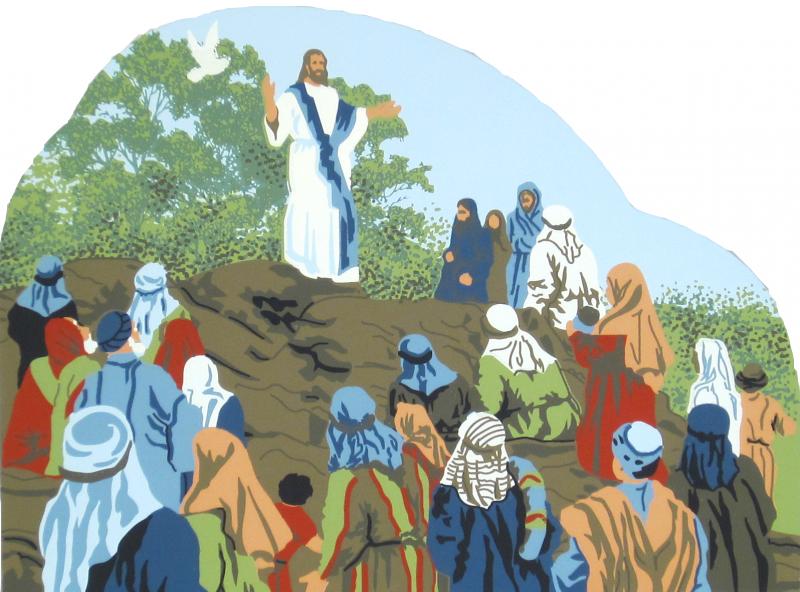
Sit Down, Be Still, Pay Attention, Be Ready, Be Alert and Be Seen By Jesus. Matthew 5:1-2

Matthew 5:1-2 New Living Translation

The Sermon on the Mount

One day as he saw the crowds gathering, Jesus went up on the mountainside and sat down. His disciples gathered around him, and he began to teach them.

The Word of God for the Children of God.

Glory be to the Father,
and to the Son, and to the Holy Ghost;
as it was in the beginning,
is now, and ever shall be,
world without end. Amen, amen.


One day as He saw the crowds gathering …

As many times as I have read this passage, I realize that somehow I have always read past, glossed over, those very first words … One day as HE SAW the crowds.

Now I have to confess I don’t really appreciate the way I learned the Beatitudes.

I’m in my early 60’s now and I think I’m only starting to observe, understand, what’s really happening in this passage at the beginning of The Sermon on the Mount, courtesy of a recently fantastic sermon and sweet, wonderful context.

I’ve been able to by rote rattle off “Blessed are the poor in spirit… blessed are those who mourn… blessed are the meek” and most of the rest of them for quite a while.

Because I was given that passage to memorize during my early adult studies.

And it sounded deep, and beautiful, but also a little empty and off.

I’d learned that Matthew 5:2-12 was a passage known as The Beatitudes, and that the word “blessed” being repeated some nine times here meant “happy.”

Okay – that is pretty much all I have ever heard preached or taught about it, it is all any Bible teacher or preacher I have ever had ever really focused – “blessed.”

Except now, as I sit here, as I sat there in that Church pew, sitting still, listening and paying attention and recalling a moving wonderfully preached sermon on the Matthew 25 Christian, I am observing things differently about this passage.

I sat down, I sat still, and I paid attention and I listened to the message as if I was being preached to by Jesus Himself – as if Jesus were looking directly at me.

Now, as I read the Beatitudes passage again, the first words I observe are the one’s which communicate – “that one day, Jesus saw the crowds gathering.”

I sit here writing this devotional with that first verse in my mind and I have to wonder to myself – “If Jesus saw the crowds gathering, how many saw Jesus?”

How many in the gathered crowd were observant enough to see Jesus coming?

How many people in the crowd were observing Jesus as He was observing them?

How many in the crowd knew who Jesus was?

How many actually paid attention to His arrival?

How many sat down versus remained standing giving Jesus their full attention?

I see a new teaching coming to this crowd and I wonder about their attitudes?

I see the people that Jesus saw, I begin to wonder about them as if I was there.

I observe that the people listed here at first didn’t sound very happy to me.

More than that, knowing these words came from Jesus, it sounded as if Jesus was commanding his followers to be mourners and peacemakers, merciful and persecuted – they had heard similar messages from more hypocritical mouths.

I can see their eyes rolling, hear them saying one of those examples of upside-down living in the Kingdom of God we know now were part of Christ’s teaching.

But something entirely different happened here – the people sat down, they sat still, they paid attention to the teacher, they listened, they were seen by Jesus.

Think about where this passage appears.

These are the FIRST WORDS of The Sermon on the Mount.

The very beginning.

The first thing Jesus has to say, what and who He observes, what He did, how he did it, after he “saw the crowds” from Galilee, the Decapolis, Jerusalem, Judea and the region across the Jordan referenced at the end of Matthew Chapter 4.

He’d been teaching and healing and proclaiming the good news, and many are gathering.

And what kind of people are in this crowd?

I think we know.

We know because this is the introduction to the largest uninterrupted session of teaching we have recorded from Jesus.

And in an introduction, it’s common to address your audience directly.

Its common to want to draw the attention of your audience to your message.

It is common for the writer to want future readers to draw their attention to the moment, into the moment, to get them to sit down, sit still, and to observe the whole scene, to listen, pay attention to message. ultimately, to be seen by Jesus.

Jesus we are told, sees the crowds.

He goes to a higher place from which to see them, then sits down and rests among them.

I can imagine a lot of eye contact and a few deep breaths before Jesus, who sees into their souls and knows every cell of their bodies, speaks right to their hearts and directly into the exact issues of their life that have brought them to his feet.

He gestures to a group gathered nearby and says, “Blessed are the poor in spirit, for theirs is the kingdom of heaven.”

An attention grabber par excellence! What a strange way to start a sermon.

Unless it’s actually the most beautiful way to speak to someone there could possibly be.

Who are the “poor in spirit,” after all?

I never really knew, until I heard a sermon about this Sermon during a time I am being treated for my post open heart surgery anxiety and depression .

For the first time in my life, I certainly related to being “poor in spirit.”

And Jesus continues his way around the crowd, next finding those who are mourning.

His heart breaks for them, too.

Maybe sees someone meek shyly lurking near the edge.

He knows some are there because they have a deep longing for truth and righteousness.

He finds some rich in mercy who may be downtrodden or taken advantage of in life.

He sees the pure and the peacemakers, and know the loneliness these types can experience, but tells them they will see God and be called children – part of his family.

And finally, the persecuted, the cast-out, the misfits, who dare to seek him out anyway.

He sees and addresses them all, all these types who are drawn to want to know God.

HE SEES THEM.

HE SEES THEM ALL

He sees you!

He sees me!

Before Jesus has anything else to say, He sees you.

And what’s more, He knows what you’re going through.

He knows whether you are pure in heart or poor in spirit, that very condition has brought you to him in a way thirsting for self or needing nothing could never do.

And He wants you to know: not only do I see you, not only has your character or your current life situation brought you to me, but I have a nugget for each and every one of you, a warm blanket to your chill, a silver lining to your dark cloud.

You, poor in spirit, you feel ill at ease in this world.

Jesus sees you, and wants you to know, yours is the Kingdom of Heaven.

A time is coming when you’ll know peace and a deep, rich purpose.

There is reason to hold fast in faith.

You, mourner, you feel abandoned and lost.

But Jesus sees you and wants you to know: lean into those who will pamper you, cry with you, feed you and comfort you.

That’s got to be a good, good feeling, and one you’ll certainly be able to hang onto and want deeply, authentically, to reciprocate to others in turn.

You, feeling meek, mild, powerless. Jesus sees you.

He knows things aren’t easy, but he wants you to know you have an inheritance!

The meek in the world are given nothing. Jesus says he plans to give them everything.

Talk about a silver lining.

You, the merciful, Jesus sees you.

He knows your forgiving heart, and he knows maybe this causes you to feel walked over at times.

He also knows you will be shown mercy for having treated others as you would want to be treated.

It goes on and on through the list.

Before Jesus teaches anything, he lets you know he sees you there ready to learn from him, that he appreciates how this very thing has brought you to him, and that there is good news on the flip side of your coin.

What a difference!

Be still, sit still, take a rest on this hillside now and go through The Beatitudes again only this time calmly, quietly, with wisdom and insight, considering what it was that first brought you to the feet of Jesus because: He SAW YOU FIRST!

And observe exactly how that very condition has caused you to be called blessed.

Ask others to observe you – communicate exactly how and what and why they see and observe how that condition has caused you to be called, to feel, blessed.

Happy.

Amen.

In the name of God, the Father and God the Son and God the Holy Spirit,

Let us Pray,

Psalm 121 The Message

121 1-2 I look up to the mountains;
    does my strength come from mountains?
No, my strength comes from God,
    who made heaven, and earth, and mountains.

3-4 He won’t let you stumble,
    your Guardian God won’t fall asleep.
Not on your life! Israel’s
    Guardian will never doze or sleep.

5-6 God’s your Guardian,
    right at your side to protect you—
Shielding you from sunstroke,
    sheltering you from moonstroke.

7-8 God guards you from every evil,
    he guards your very life.
He guards you when you leave and when you return,
    he guards you now, he guards you always.

Glory be to the Father,
and to the Son, and to the Holy Ghost;
as it was in the beginning,
is now, and ever shall be,
world without end. Amen, amen.

https://translate.google.com/

Seeking and Finding the Disconnect in Our Connection with the Lord Our God. Matthew 6:31-34

Matthew 6:31-34 New King James Version

31 “Therefore do not worry, saying, ‘What shall we eat?’ or ‘What shall we drink?’ or ‘What shall we wear?’ 32 For after all these things the Gentiles seek. For your heavenly Father knows that you need all these things. 33 But seek first the kingdom of God and His righteousness, and all these things shall be added to you. 34 Therefore do not worry about tomorrow, for tomorrow will worry about its own things. Sufficient for the day is its own trouble.

The Word of God for the Children of God.

Adeste Fideles! Laeti Triumphantes! Venite Adoremus! Dominum.

Gloria! In Excelsis Deo! Alleluia, Alleluia, Alleluia, Amen.

During a small group Bible Study one night a friend once told me he set his alarm for 6:33 a.m. for a stretch of time during his teenage and young adult years.

He would wake up, put his feet on the floor, see his alarm, and immediately be reminded of Matthew 6:33 and his absolute need to “seek first the kingdom of God and His righteousness.”

To me, it was a pointed example, in one way, of Matthew 6:33 in action.

The question to me then was what impact would it have on someone, anyone who did not know the meaning of “the kingdom of God” (at the time – me) and “His righteousness” and did not know how to “seek” them?

The myriad of ideas floating around about the Kingdom of God is evidence that the devil has successfully deceived millions of people about the true meaning of the Kingdom of God—the center of Jesus’ message.

Even to this day, Satan actively obscures the heart and core of Jesus’ teaching, leading many sincere Christians to confidently say the Kingdom of God is the warm, fuzzy feeling people experience when they “invite Jesus” into their lives.

Yet God’s Word testifies that Jesus preached “the gospel of the kingdom of God”—not just a message about Himself, but the good news of a literal, world-ruling government to be set up on this earth (Mark 1:14).

So, just what is the Kingdom of God, and how does one go about seeking it?

What exactly is “His righteousness”?

What “things” will be added to us if we prioritize seeking the Kingdom and His righteousness?

What does Matthew 6:33 say that believers should do?

Matthew 6:33 is a foundational scripture that directs our focus and attention to what God considers to be the most important goal a person can have.

In order to weave this critical verse into our own lives, we need to have a biblical understanding of its core concepts.

“But Seek First the Kingdom of God”

The New Testament has much to say about the Kingdom of God, but one of the most memorable visions of God’s government replacing human governments can be found in the Old Testament book of God’s Prophet Daniel.

In Daniel chapter 2 Nebuchadnezzar, the ancient king of the Babylonian Empire, dreamed about a great image or statue—presumably of a man—with a head of gold, chest and arms of silver, belly and thighs of bronze, legs of iron, and feet of iron and clay.

But as the dream went on, the image was eventually shattered by a cataclysmic stone (Daniel 2:31-34).

Unsure of the dream’s meaning, Nebuchadnezzar turned to the prophet Daniel for its interpretation.

Under God’s inspiration, Daniel explained, “You [Nebuchadnezzar] are this head of gold. But after you shall arise another kingdom inferior to yours; then another, a third kingdom of bronze, which shall rule over all the earth. And the fourth kingdom shall be as strong as iron . . . and like iron that crushes, that kingdom will break in pieces and crush all the others” (Daniel 2:38-40).

According to Daniel’s interpretation, the statue represented the rise and fall of four great, successive empires.

These empires, or kingdoms, have been identified in history as the Babylonian Empire, the Medo-Persian Empire, Greco-Macedonian Empire and the Roman Empire. 

With this understanding in mind, notice what Daniel said about the symbolism of the stone that came and broke the image:

“And in the days of these kings the God of heaven will set up a kingdom which shall never be destroyed; and the kingdom shall not be left to other people; it shall break in pieces and consume all these kingdoms, and it shall stand forever” (Daniel 2:44, emphasis added throughout).

This kingdom that “stands forever” is the Kingdom of God, a literal kingdom with territory, subjects, laws and rulers just like the other great empires.

The Kingdom of God will be:

  • Set up here on earth (territory).
  • Ruling over and serving human beings (subjects) during Christ’s millennial reign.
  • Governed through God’s commandments and statutes (laws).
  • Ruled by Christ and the saints (rulers).

The Kingdom of God is not figurative nor is it another way of saying going to heaven, as many passionately argue.

It is the very real government of God to be established here on earth at Christ’s return.

Those who will inherit God’s Kingdom are called the “saints of the Most High,” they will “possess the kingdom forever, even forever and ever” (Daniel 7:18).

To “seek” that Kingdom is to have a strong desire to enter it—a willingness to go to any length to do so.

Matthew 6:33 tells us that this must be the main priority of a Christian’s life.

“And His Righteousness”

After instructing His followers to prioritize the Kingdom of God, Rabbi Jesus added that they also need to prioritize not just any kind of righteousness, but “His righteousness” – His righteousness meaning God’s righteousness.

What is the biblical definition of God’s righteousness? 

Psalm 119:172 says, “All Your commandments are righteousness.”

Take careful notice that the verse does not say “a few” “some” or “half” or “two thirds” “three quarters” “nine out of 10” (excluding the commandment to keep the Sabbath day holy), but rather it says “all” of God’s commandments.

Understanding the biblical definition of righteousness, this verse could read: “Seek first the Kingdom of God and obey all His commandments.”

Unfortunately, obedience is a very unpopular message in a society where people are obsessed with the idea of freedom to do whatever they please, no matter how much harm that kind of liberty may pose to themselves or others.

The result is people who lack self-esteem, self-respect and lack any respect for any authority figure and contemptibly refuse to yield one inch to that authority.

Many of the laws of the land—let alone God’s laws—have become more of a suggestion than anything mandatory.

They’re viewed as something that is optional for those who “feel” like obeying.

People nowadays bristle at the idea of someone else telling them what to do.

Yet the Bible is replete with scriptures that prove, beyond a shadow of a doubt, obedience to God’s law is absolutely necessary to be a true Christian.

Here is one of the plainest of those scriptures: “He who says, ‘I know Him,’ and does not keep His commandments, is a liar, and the truth is not in him” (1 John 2:4).

For those who follow the clear teachings of Scripture and value obedience, there is a special blessing in place.

Take extra careful notice of Revelation 22:14: “Blessed are those who do His commandments, that they may have the right to the tree of life, and may enter through the gates into the city.”

The blessing is entry into the Kingdom of God.

That is the reward for those who seek God’s righteousness.

Righteousness and the Kingdom of God are inextricably linked together!

“And All These Things Shall Be Added Unto You”

To know what this part of the verse refers to, we have to examine the context.

Matthew 6:25-32 New King James Version

Do Not Worry

25 “Therefore I say to you, do not worry about your life, what you will eat or what you will drink; nor about your body, what you will put on. Is not life more than food and the body more than clothing? 26 Look at the birds of the air, for they neither sow nor reap nor gather into barns; yet your heavenly Father feeds them. Are you not of more value than they? 27 Which of you by worrying can add one [a]cubit to his [b] stature?

28 “So why do you worry about clothing? Consider the lilies of the field, how they grow: they neither toil nor spin; 29 and yet I say to you that even Solomon in all his glory was not [c]arrayed like one of these. 30 Now if God so clothes the grass of the field, which today is, and tomorrow is thrown into the oven, will He not much more clothe you, O you of little faith?

31 “Therefore do not worry, saying, ‘What shall we eat?’ or ‘What shall we drink?’ or ‘What shall we wear?’ 32 For after all these things the Gentiles seek. For your heavenly Father knows that you need all these things.

In verses 25-32 Jesus instructs His disciples not to fret or be anxious about the physical necessities of life.

Food, water and clothing and shelter will always be the very basic must-haves for our very good health and happiness as long as we are living human beings.

But prioritizing any single one of these things or all of them over a disciplined life of prayer, study, obedience and a close relationship with God would be a potentially dangerous misallocation of our focus and attention upon our God.

In reassuring fashion, Jesus reminded His disciples,

“Do not worry, saying, ‘What shall we eat?’ or ‘What shall we drink?’ or ‘What shall we wear?’ . . . For your heavenly Father knows that you need all these things.”

“Father” is a fitting description of our loving God!

God could have designated Himself using any number of titles, but Father communicates His authority, strength and, most of all, His tender love.

The Sermon on the Mount can, in some ways, be seen as an explanation of why God is called our Heavenly Father.

Again and again throughout Matthew 5-7, we vividly see God’s function as our ultimate provider. 

Recognizing God’s commitment to protect and look out for His children is what this part of Matthew 6:33 is all about.

Again, please take careful notice of Matthew 7:9-11:

“Or what man is there among you who, if his son asks for bread, will give him a stone? Or if he asks for a fish, will he give him a serpent? If you then, being evil, know how to give good gifts to your children, how much more will your Father who is in heaven give good things to those who ask Him!”

The point is, God always knows.

God always sees.

God is not blind to our needs or desires.

God promises to provide for the physical necessities of this life if we prioritize His Kingdom and His righteousness.

Please look to these life transformative scriptures and claim God’s promises if you have been seeking God with your whole being but find you are struggling to make ends meet and are overwhelmed with life’s demands.

What Does Matthew 6:33 Really Mean?

In a nutshell, Matthew 6:33 serves as every Christian’s marching orders.

Our ability to seek first God’s Kingdom and His righteousness can be hampered if we become entangled with the cares of this life.

Nonetheless, diligently, prudently, regularly practicing spiritual disciplines like fellowship, and prayer, Bible study, meditation and the occasional fast can help refocus our minds, support the notion of reprioritizing on what matters most.

As much or as little we strive do our part to make our relationship with God our highest priority, God will surely do His part to provide for our every need, which is something we can count on.

This means always putting Him first in our lives, even the first few moments of our day.

He is the One who graciously woke us up, gave us the breath in our lungs, and provided us the opportunity to live another day.

He deserves our fullest possible measure of devotion the moment our eyes pop open, even if it is a mere “thank you, God” before our feet even hit the floor.

Intersecting Faith and Life and Matthew 6:33

As we strive to figure out life in the great information age, we are bombarded with an infinite measure of opportunities to fill our time and our minds with many things that can so easily replace our time of fellowship with the Lord.

The information available to us, literally at our fingertips, at all times, is a wonderful gift, but that mobile device we carry around in our purses and pockets can also be a mobile distraction that follows us everywhere we go.

Although our cell phones, smartphones, tablets, laptops, etc. are not evil, I do believe we need to be extra cautious as to how much time we devote to them.

We need to be more aware of where we are directing our focus.

We need to be attentive to what is “moving in” and capturing our attention.

Perhaps you may not have an issue with technology distracting you from the Lord- that’s great!

Stay strong and become an accountability partner for those around you who have easily pulled away from the things of God because of the ever-increasing information age.

But if you are like me (a stay-at-home/work-from-home, caregiving retired person,) you are finding yourself with limited time to spend with Jesus in prayer and the Word, I challenge you to prioritize seeking out the Lord if there is some way you can arrange in your schedule to allow better time management.

Also, ask Him if perhaps He would like for you to prioritize a fast (technology, that is) something which could be causing a division between you and Him. 

Prioritize devoting specific time every day to spend some quiet time in quiet fellowship with God and reading your Bible, without your cellphone or iPad within reach- to “turn them off” during that time and perhaps put a timer on the most-used apps that you access throughout your day.

Be thankful for the benefits of the tools and global connections that technology brings us, but also do not allow this technology to rob you of your connection to Jesus – un-connect technology for a while, refocus, reconnect with the Lord!

Always keep the Kingdom of God and His righteousness at the forefront of life.

“But Put God First” — That is the life-changing meaning of Matthew 6:33.

In the name of God, the Father and God the Son and God the Holy Spirit,

Let us Pray,

Sovereign Majesty, God and Ruler over all creation, since the beginning of time you have been our Provider, our Refuge, our Shelter, Defender, Protector and Redeemer. Your covenant with the human race, is from everlasting to everlasting and all that we possess and will ever possess, comes from you. Father, we have sinned greatly against you, but being a God of Righteousness, you have exhibited and manifested your steadfastness and faithfulness which prevails forever, through which we are saved, when we turn all of us over to you with fervent hearts and complete trust.

Your unshakable promises reflects your perfect attributes, for whatever we do in our arrogant and sinful nature makes your incomprehensible compassion more evident, proving you will never abandon us, will rescue all who are lost. Jesus has revealed to us the honor and glory of his Father, and we have the assurance that you will never leave us orphans, but have, through your plan of Redemption and Eternal Salvation, obediently fulfilled by Jesus your only Son, made us citizens, co-heirs of heaven.

By our deep faith, our belief, our resolve to focus on you and to obediently follow your Divine Providence for us, knowing that you have provided and taken care of all our needs, we concentrate on studying the right path to heaven, and promote your kingdom in the world, to bring hearts into subjection to your Will. We seek only your Holy Grace and hope to bring others to the obedience of faith, for we need not worry about the things of this world, since you have bestowed upon us all that we need and our only hope is in beholding your beatific face and be added to the ranks of the elite of your kingdom, in blessed, in highest possible exaltation of Jesus’ Name. Amen

Adeste Fideles! Laeti Triumphantes! Venite Adoremus! Dominum.

Gloria! In Excelsis Deo! Alleluia, Alleluia, Alleluia, Amen.

https://translate.google.com/