The Gospel of our GOD in a Nutshell: Servants of Freedom. Exodus 3:10-15

There’s the story, I am sure you have heard it before, of the college professor who always began his first day of class at the University dramatically telling his students he could unequivocally prove that God absolutely did not exist.

Looking up toward the ceiling he would shout, “God if you are real, then I want YOU to knock me off this platform. Come on, God, I will give you 15 minutes!”

Over the next several minutes he kept taunting God, saying things like “Here I am God, I’m still waiting and still standing” and smugly smiling at the class.

Then – all of a sudden – a burly 240-pound halfback for the football team came rushing forward from the back of the classroom and collided with the professor, knocking him full head over heels over his desk and into the chalkboard behind.

More shocked than hurt, the professor sputtered as the young man helped him back to his feet, brushed the chalk off of him, “Why on earth did you do that?”

The football player smiled as he walked away… and replied,

“Well, Professor, I guess God was busy; So, He sent me with your answer!”

Exodus 3:10-15Amplified Bible

The Mission of Moses

10 Therefore, come now, and I will send you to Pharaoh, and then bring My people, the children of Israel, out of Egypt.” 11 But Moses said to God, “Who am I, that I should go to Pharaoh, and that I should bring the children of Israel out of Egypt?” 12 And God said, “Certainly I will be with you, and this shall be the sign to you that it is I who have sent you: when you have brought the people out of Egypt, you shall serve and worship God at this mountain.”

13 Then Moses said to God, “Behold, when I come to the Israelites and say to them, ‘The God of your fathers (ancestors) has sent me to you,’ and they say to me, ‘What is His name?’ What shall I say to them?” 14 God said to Moses, “[a]I Am Who I Am”; and He said, “You shall say this to the Israelites, ‘I Am has sent me to you.’” 15 Then God also said to Moses, “This is what you shall say to the Israelites, ‘The Lord, the God of your fathers, the God of Abraham, the God of Isaac, and the God of Jacob (Israel), has sent me to you.’ This is My [b]Name forever, and this is My memorial [name] to all generations.

The Word of God for the Children of God. Gloria! In Excelsis Deo! Alleluia! Amen.

In our text this morning, we find God saying to Moses:

“I will SEND YOU to Pharaoh that you may bring my people, the children of Israel, out of Egypt.” Exodus 3:10

God was SENDING Moses to confront Pharaoh and free Israel from their slavery.

But as I was studying and preparing today’s Fourth of July devotional today, a staggering question and thought just rushed unto the forefront of my mind:

Why did GOD send Moses or anyone else for that matter?

Why not just do it Himself?

Did God really need the help?

Was He busy or something?

No… God was not busy.

But there was something about sending Moses on this task that speaks to us about God’s plans for our lives.

First, we need to realize God doesn’t need us.

It’s true.

He owns the sheep, the cattle, every other animal on a thousand, thousand hills.

He has an army of angels at His beck and call.

And as Amos 4:13 put it

“He who forms the mountains, creates the wind, and reveals his thoughts to man, he who turns dawn to darkness, and treads the high places of the earth—the LORD God Almighty is his name.”

If God HAS all that, and can DO all that,

what’s He need with me… or you… or Moses???

Psalm 8:4 asks, “What is man that you are mindful of him, the son of man that you care for him?”

But, the fact of the matter is:

God IS mindful of us.

He DOES care for us.

And when it comes to doing His will, God graciously allows us to take part.

One of the most intriguing promises (for me) that Jesus ever made was this one:

“I tell you the truth, anyone who has faith in me will do what I have been doing. He will do even GREATER THINGS THAN THESE, because I am going to the Father.” John 14:12

Jesus promised that WE would do GREATER THINGS than He did on earth?

Really?

But Jesus quite literally fed thousands with just 5 loaves and 2 fish.

He healed the sick.

He raised the dead.

Have you ever done any of those things?

Me neither.

In fact, I have NEVER done anything even remotely like that.

And yet Jesus clearly says to me: “I’ll do greater things than those?!!!”

How’s that possible?

Well, consider these two stories out of the book of Acts.

The first story is found in Acts 8:26 where we’re told:

“AN ANGEL of the Lord said to Philip, ‘Go south to the road— the desert road— that goes down from Jerusalem to Gaza.’”

As we read the rest of the story, we find that Philip does as he’s told and goes down to that road and sees a man riding in a chariot.

He begins running alongside the chariot and hears a high official from Ethiopia reading from the 53rd chapter of the book of Isaiah (famous chapter predicting many things about who Jesus would be), and he asks the man if he understands what he’s reading.

The Ethiopian replies ““How can unless someone explains it to me?” Acts 8:31

So, Philip climbs up into the chariot and begins talking about Jesus, and the conversation turns to how the Ethiopian Servant can become a Christian.

As they’re riding along, the Ethiopian says:

“Look, here is water. Why shouldn’t I be baptized?” (Acts 8:36) and they went over to the water and Philip baptized this “Queens Servant” man into Christ.

Now, a couple of questions:

1. WHO sent Philip to meet the Ethiopian Eunuch? (An angel)

2. WHY didn’t the angel go themself?

Hold that 2nd question in your mind for a second as we go the next story.

In Acts 9 we read about the conversion of Saul (who we know of as Paul).

Now, at the time, Paul was an enemy of the church.

He hated Christianity and did everything in his power to undermine and hurt those who belonged to Christ.

So committed to this task that, when he heard there was a body of Christians meeting up in Damascus, he led several men up there to take those Christians prisoners back to Jerusalem in chains for trial and their suitable punishment.

But on the way to Damascus, Jesus confronts him, blinds him and knocks him to the ground.

And he “heard a voice say to him, ‘Saul, Saul, why do you persecute me?’

‘Who are you, Lord?’ Saul asked.

‘I am Jesus, whom you are persecuting,’ he replied. ‘Now get up and go into the city, and you will be told what you must do.’” (Acts 9:4-6)

Then after three days, Jesus goes to man named Ananias and commands him to go and teach Saul/Paul what he needs to know about being a servant of Christ.

And amongst the things Ananias told Paul was this:

“… what are you waiting for? Get up, be baptized and wash your sins away, calling on his name.” (Acts 22:16)

Now: a couple of questions

1. WHERE was Paul when his sins were washed away? (Damascus)

2. WHY didn’t Jesus’ wash Paul’s sins away when He met him on the road to Damascus?

(PAUSE)

Why?

Because this is what Jesus meant when He promised that “greater things you will do than I have done.”

Philip (in baptizing the Ethiopian) and Ananias (in baptizing Paul) were given the honor of serving Christ and freeing others of the chains of their sins.

They were given the privilege of being the agents of God’s salvation to those around them.

On each occasion, Jesus or an angel COULD have led these men to salvation.

But in both cases, it was a mortal Christian who was given that honor to serve.

It’s not that the angel and Jesus COULD NOT have directly saved those men.

The fact is – they WOULD NOT do that.

That privilege was reserved for men and women who belonged to Christ.

You see, God doesn’t NEED us.

But He WANTS us… to be His partners in SERVANT ministry.

Just like Moses who led his people out of the darkness of slavery into the light God’s light, it’s a high honor we’ve been given. And a great privilege to serve.

But there are times when people aren’t sure they can do that.

Just like Moses… they don’t feel up to the job.

They might even think they’ll mess it up and make God mad or something.

But as you notice from our story, the only thing Moses did that made God angry.

You know when that was?

It was when Moses tried to turn God down.

He tries telling God he can’t talk very well.

God says, “I will help you speak and will teach you what to say.” Exodus 4:12

Then Moses simply says: “Send someone else”

“Then the LORD’s ANGER BURNED against Moses…” Exodus 4:14

I tell you – if you’re going make God mad, you don’t want to do it by turning Him down.

It just doesn’t seem like a good career move.

Besides think of all the adventure and excitement and honor Moses would have missed if he’d just walked away from God’s Servant commission.

To this day, Moses is highly revered in both Judaism and Christianity, and Moses’ name is mentioned nearly as many times in Scripture as Jesus.

But God didn’t just send Moses to the people unequipped to do this task.

He gave Moses three tools to help him get the job done.

And what we’re going to do today is look at them in the reverse order in which they occur in Scripture.

The 1st tool God gave Moses (and the last in the story) has to do with the issue of Moses’ fear he did not think he could speak well enough to get the job done.

“O Lord, I have never been eloquent, neither in the past nor since you have spoken to your servant. I am slow of speech and tongue.” Exodus 4:10

I know a lot of Christians who say that.

They don’t believe they know enough or can present the Gospel of GOD well enough to speak to others. AND you may be one of those people here today.

Now, I guess it should be enough for us to accept God’s statement to Moses:

“Who gave man his mouth? Who makes him deaf or mute? Who gives him sight or makes him blind? Is it not I, the LORD? Now go; I will help you speak and will teach you what to say.” Exodus 4:11-12

But sometimes that just not enough for some folks.

I believe there are a whole lot of people who struggle mightily with that fear.

And that fear just shows me that many are NOT all that different than Moses.

Moses was one of the greatest men that ever walked, but even he was afraid to share with the people exactly what message God wanted him to communicate.

But God did give something to Moses to help him overcome his fear.

You know what God gave him?

That’s right – God gave him a helper.

“What about your brother, Aaron the Levite? I know he can speak well. He is already on his way to meet you, and his heart will be glad when he sees you. You shall speak to him and put words in his mouth; I will help both of you speak and will teach you what to do.” Exodus 4:14-15

God gave Moses a helper.

He sent Moses’ brother (Aaron) to speak for him.

Do you have a “brother” who might help you share your faith?

Yeah? Who might those “brothers be”?

That’s right – you have a whole bunch of Christian brothers and sisters right in your churches and communities and neighborhoods.

And I bet that if you had someone, you’d like to talk to about Christ they’d be more than happy to step up and go with you.

You have got servant helpers

– Elders and Deacons and Laity, Sunday School teachers, all kinds of Godly women and men who would be your “Aaron” and help you share your faith.

They’re your backup team.

As Servants of Christ, they can help you share your faith for the “first time” or they might be able to step up and help you try a different angle on friends or relatives who you HAVE witnessed to, but who won’t listen to you anymore.

Have you ever been to a car lot to buy a car?

Did you ever notice that you first meet with a floor salesman?

Then if you show interest, they’ll pass you along to another “higher up” in the company… and maybe even a 3rd person to talk to about your potential sale.

Do you know why they do that?

Because they know if you’re genuinely interested, the chances of their making a sale go up dramatically depending on how many people they get you to talk to.

In the same way, the more of your “back up ‘Servant’ team” at church you get talking to your family and friends and neighbors, the higher your chances of courageously communicating your faith in Christ to the people you care about.

The 2nd tool God gave Moses was the opportunity to have some “skin in the game.”

The LORD said, “Put your hand inside your cloak.” So, Moses put his hand into his cloak, and when he took it out, it was leprous, like snow. Now put it back into your cloak,” he said. So, Moses put his hand back into his cloak, and when he took it out, it was restored, like the rest of his flesh. Exodus 4:6-7

When I first read, pondered that, I wondered, what do these verses say to me.

And then a phrase came into my mind: “Skin in the game.”

In focusing on Moses’ hand God was getting Moses to put his skin in the game.

Then I went on the internet to look up exactly what that phrase meant.

According to one on-line dictionary, this was the definition:

Skin in the game means “To have a personal stake or investment.”

In other words, to have “skin in the game” means that you, I, are committed to the success of a project or cause, and we’ve shown that by investing something incredibly valuable and intimately personal in struggling, achieving its success.

So, when it comes to Servanthood,

how do you and I know if you and I have “Skin in the game?”

Well, someone once boiled it down to 3 issues:

How much TIME, TALENT and TREASURE do you have committed to Christ?

How much TIME have you invested in God each week?

Some folks would say… “well, I show up for church 1 or 2 hours a week.”

And that’s nice… but that’s hardly what you’d call “investing”.

That’s more like dabbling.

No, to really have “skin in the game” when it comes to the amount of time you spend for God each week, you and I have got to do so much better than that.

We’re talking about –

how much time do we spend talking to others about our faith during the week?

How much time do we spend reading our Bible on our own?

How much time do we spend throughout the week praying, talking with God?

How much time do we spend during the week serving in God’s neighborhood?

Then there’s the topic of how much of your TALENT do you give to the church?

What talent do you have that you can use for God?

I recently passed by a church sign of a congregation, and I was a little jealous about something they put on their marquee… mostly because they thought of something completely original and so 100% immensely useful before I did!

Their marquee sign read if your car could not afford to pay for inflation, they were offering to freely change the oil in your car to keep it ready for its work.

That was a GREAT idea!

I am just sorry that my former auto mechanics heart did not suggest it first.

Somebody at that Church was using their talents for serving their neighbors.

There’s the matter of putting genuine ‘kingdom value” on our ‘TREASURES’.

Mark 10:17-22 Amplified Bible

The Rich Young Ruler

17 As He was leaving on His journey, a man ran up and knelt before Him and asked Him, “Good Teacher [You who are essentially good and morally perfect], what shall I do to inherit eternal life [that is, eternal salvation in the Messiah’s kingdom]?” 18 Jesus said to him, “[a]Why do you call Me good? No one is [essentially] good [by nature] except God alone. 19 You know the commandments: ‘Do not murder, Do not commit adultery, Do not steal, Do not testify falsely, Do not defraud, Honor your father and mother.’” 20 And he replied to Him, “Teacher, I have [carefully] kept all these [commandments] since my [b]youth.” 21 Looking at him, Jesus felt a love (high regard, compassion) for him, and He said to him, “You lack one thing: go and sell all your property and give [the money] to the poor, and you will have [abundant] treasure in heaven; and come, follow Me [becoming My disciple, believing and trusting in Me and walking the same path of life that I walk].” 22 But the man was saddened at Jesus’ words, and he left grieving, because he owned much property and had many possessions [which he treasured more than his relationship with God].

How does this poignant Gospel text speak to your allegedly “Servants Heart?”

If we don’t have any ‘genuine’ “skin in the game” as far as our “treasure” goes, are we or are we not ready to become ‘fully’ invested serving God’s kingdom?”

What does it mean to fully commit ourselves to the success of God’s kingdom?

Matthew 6:19-21Amplified Bible

19 “Do not store up for yourselves [material] treasures on earth, where moth and rust destroy, and where thieves break in and steal. 20 But store up for yourselves treasures in heaven, where neither moth nor rust destroys, and where thieves do not break in and steal; 21 for where your treasure is, there your heart [your wishes, your desires; that on which your life centers] will be also.

The last thing I want to point out… is the first thing God asked Moses:

“Then, the LORD said to him, ‘What is that in your hand?’

‘A staff,’ he replied.” Exodus 4:2

What have you got in your hand Moses? God had asked.

Well, what did Moses have in his hand?

A staff.

(Pause) That’s a dumb question.

Of course he has a staff in his hand… he’s a shepherd.

But this was more than just a staff.

This staff symbolized everything Moses was and everything Moses owned.

This staff represented the totality of Moses’ wealth.

He may not have had much, but this staff represented all he had.

At one time Moses had been a prince of Egypt, with power, prestige and palaces.

Now, he was lowly shepherd living out in the middle of the desert in a tent that’s moved whenever they needed to find new pasture for the flocks.

Even the sheep weren’t his – they belonged to his father-in-law.

Moses had little that was really his own… except his staff.

“So, (God asks) Moses what is your hand?”

As long as the staff belonged to Moses, it was just a staff. But once Moses gave it to God, God used it shake an empire. With that staff of God,

• Moses struck the Nile River and turned it to blood (Exodus 7:17)

• He stretched it over the waters of Egypt and brought a plague of frogs upon the land (Exodus 8:5),

• He struck the dust of the earth and up from the dust rose a plague of gnats (Exodus 8:16),

• He stretched it toward heaven and down came fire, thunder, and hail (Exodus 9:23),

• He waved it in the air and a horde of locust invaded the land (Exodus 10:13),

• He stretched it out over the Red Sea and the waters parted for Israel to pass on dry ground (Exodus 14:16),

• He struck a rock and water poured forth to quench the thirst of God’s people (Exodus 17:6)

• And when he held it high in the air, the Israelites prevailed in battle over their enemies the Amalekites (Exodus 17:8-16).

Once that symbol (of who he was) was given to God, it was no longer a mere shepherd’s staff.

Once it was given to God, it was as though God had placed in Moses’ hand the very power of the universe.

Had any part of the nature of the wooden staff changed even in the slightest?

No, it was still the same shepherd’s staff – but with a difference.

Now, it was no longer a mere piece of wood shaped by the hands of man.

Except now, as was shaped by human hands it belonged exclusively unto God.

Except now it had been consecrated by God to serve ALL OF God’s Children!

A Servant’s Attitude and Character

How do we advance in our careers?

How do we receive the recognition we think we deserve?

For many, the logical strategy is through self-promotion and our bringing attention to ourselves. Seeking credit for successes and pointing the blame at others for failures are other strategies often employed for advancement.

It’s being sure others know us by name and being aggressive to lobby for the best seat, the greatest rewards.

The Bible describes these attitudes as claiming honor “in the presence of the king.”

But the Bible gives us another, godlier model: to have the attitude of a servant in everything we do, to seek to serve God and others with a selfless attitude.

We are not to be proud or focus on ourselves but to stay humble.

We are always to work as unto the Lord, being max sure that GOD above all others is pleased with what we do and how we do it.

We are urged to remember that “those who exalt themselves will be humbled, and those who humble themselves will be exalted” (Matthew 23:12 NLT).

If we humble ourselves before God, He will exalt us (James 4:10).

This year I will live the Gospel Life by:

Committing to at least two new spiritual practices to deepen my faith. – Philippians 2:1-4, Philippians 2:12-18

I will share radical hospitality by:
• Making my heart a welcoming place for God.
• Inviting a friend, colleague, classmate or family member to attend worship.
• Warmly welcome all who attend.

Welcome one another, therefore just a Christ has welcomed you,
for the glory of God. – Romans 15:7

I will be passionate in worship by:
• Preparing my heart and mind for worship.
• Attending worship regularly.
• By finding a daily devotional that works for me.

Let us not give up the habit of meeting together,
but let us encourage one another. – Hebrews 10:25

I will be intentional in my faith development by:
• Praying regularly.
• Being part of a group for discussions, study, or prayer.
• Discovering my spiritual gifts and talents.

They devoted themselves to the apostle’s teaching and fellowship,
to the breaking of bread and prayer. – Acts 2:42

I will be risk-taking in mission and service by:
• Listening more closely for God’s call on my life.
• Making a positive difference in the lives of others.
• Being willing to risk failure for Christ’s ministry.

Truly I tell you, just as you did it to one of the least of these who are members of my family, you did it to me. – Matthew 25:40

I will be extravagant in my generosity by:
• Offering more of my heart, my hands and my feet and my soul for God
• Supporting the church in our mission to make disciples of Jesus Christ
• Giving regularly, with tithing being the aim.

You will be enriched in every good way for your great generosity.
Job 42:10-15, 2 Corinthians 9:11, Jude 20-25

Remember others may see outward appearances, but God looks at your heart.

Remember to seek first His kingdom.

Sow seeds with the gifts and talents you have been given.

Be confident GOD ALONE will provide all you need and bless you abundantly.

In the name of God, the Father and God the Son and God the Holy Spirit,

Let us Pray,

John Wesley’s Covenant Prayer

I am no longer my own, but yours.
Put me to what you will, place me with whom you will.
Put me to doing, put me to suffering.
Let me be put to work for you or set aside for you,
Praised for you or criticized for you.
Let me be full, let me be empty.
Let me have all things, let me have nothing.
I freely and fully surrender all things
To your glory and service.
And now, O wonderful and holy God,
Creator, Redeemer, and Sustainer,
You are mine, and I am yours.
So be it.
And the covenant which I have made on earth,
Let it also be made in heaven.
Alleluia! Alleluia! Alleluia! Amen
https://translate.google.com/

The Gospel in a Nutshell: The Son of Man Came to Serve. Mark 10:35-45.

Ladies and Gentlemen, we are all on top of the world! The glittering prizes of “our wealth and honor – our fame and fortune – of intellectual prowess our great importance” is highly prized in today’s world system but can too often bedazzle the eyes of believers as well, and even Christ’s own disciples were not exempt.

How petty and self-serving can we get? How petty and self-serving were these two disciples – James and John? They wanted special favors from their Rabbi.

They were arguing about who was to be the most important in their little group and were jostling for the highest and best position in Christ’s coming kingdom.

James and John? They thought more highly of themselves. But what a shocking silence must have descending on each person, when Rabbi Jesus stunned them into silence with these head scratching words: that even the Son of Man did not come to be served, but to serve, and to give His life -as a ransom for many.

SELF-SERVING

How are the decisions we make impacting those around us?

Rabbi Jesus said that we should seek to love others as we would love ourselves (Matthew.22:39). Nothing could be more central to that command than for us to spend more time considering how our plans, actions, and words will either serve us or serve others, help, hurt, hinder, the people in our circle of influence.

As Christians we no longer “live to serve ourselves” (Romans14:7)—or at least we shouldn’t. God’s will for us is to see our lives as instruments of Christ to aid, build up, positively enhance the well-being of all the ‘neighbors’ in our lives.

Having been called by the humility of our Savior Jesus, to no longer simply look out for our own interests, but also for the interests of others (Philippians 2:4), we should instead be driven to carefully ponder how pursuing our desires in that purchase, this move, or that meeting is going to affect and benefit others.

The world will continue to tell us to “Look out for number one!”

I’m all for that—as long as we remember that we’re not number one! Christ is.

And he has directed us to look out for the interests of the people with whom he has sovereignly surrounded us. Yes, every day we will make decisions for our own good, but they should all be evaluated with a willingness to modify them or even abandon them as we prayerfully consider their impact on others.

Sometimes we allow ourselves to think we are the centre of the universe. We get so wrapped up in our own world and issues of daily life, we forget about others and their struggles. The incredibly little word ‘me’ becomes most important. We somehow think all of ‘everything’ revolves (or should revolve) around ourselves.

All too often we think all of our feelings and ideas are the most important in all of the world. But guess what: often times, others probably have better ideas than we do. Life has a habit of jolting us into reality, and a lot of things don’t work out as we expect them to. We need to learn we can be wrong sometimes.

Some people love to talk, mainly about themselves, and can be quite dismissive about the point of view of others.

They are not all that interested in what you’ve got to say—they have already worked out their response before you can say too much.

You know people like that?

Does my opinion matter? Probably not.

The New American Webster Dictionary has a really great definition for selfish people: 

“they are much too busy absorbing their whole selves into themselves.”

It’s like everything revolves around them, and no-one else. It’s all about me, myself and I. The self-centered person loves no-one else except themselves.

James and John, Sons of Thunder, tried to bargain with their Rabbi for quite the most prominent places in the Kingdom Jesus is leaving behind, for themselves.

James and John, sons of Thunder, were in pursuit of all the wrong things – and even after they heard the words of their Rabbi, could not begin to understand the staggering implication of His words: “Give my Life as a Ransom for Many!”

Mark 10:35-45Amplified Bible

35 James and John, the two sons of Zebedee, came to Him, saying, “Teacher, we want You to do for us whatever we ask of You.” 36 And He replied to them, “What do you want Me to do for you?” 37 They said to Him, “Grant that we may sit [with You], one on Your right and one on Your left, in Your glory [Your majesty and splendor in Your kingdom].” 38 But Jesus said to them, “You do not know what you are asking. Are you able to drink the cup that I drink, or to be baptized with the baptism [of suffering and death] with which I am baptized?” 39 And they replied to Him, “We are able.” Jesus told them, “The cup that I drink you will drink, and you will be baptized with the baptism with which I am baptized. 40 But to sit on My right or left, this is not Mine to give; but it is for those for whom it has been prepared [by My Father].”

41 Hearing this, the [other] ten became indignant with James and John. 42  Calling them to Himself, Jesus said to them, “You know that those who are recognized as rulers of the Gentiles lord it over them; and their powerful men exercise authority over them [tyrannizing them]. 43 But this is not how it is among you; instead, whoever wishes to become great among you must be your servant, 44 and whoever wishes to be first and most important among you must be slave of all. 45 For even the Son of Man did not come to be served, but to serve, and to give His life as a [a]ransom for many.”

The Word of God for the Children of God. Gloria! In Excelsis Deo! Alleluia! Amen.

We are going to take a step back in time today to conceptualize, contextualize what Jesus meant when He asked Bartimaeus: “Come. What Can I Do for You?”

Jesus was asking Bartimaeus, “How will you, then, serve the Kingdom of God?”

When Bartimaeus receives his miraculous healing from Jesus – whom will he be most grateful to, whom will he follow and serve – His Savior God or himself?

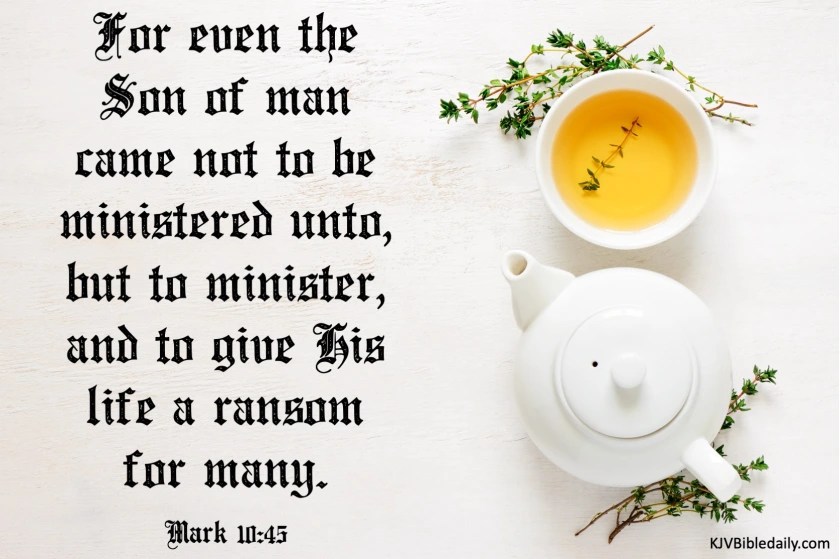
45 For even the Son of man came not to be ministered unto, but to minister, and to give his life a ransom for many.

Here is the heart of our Lord and Savior, Jesus, given in one simple statement.

The foundation and basis of servanthood is giving – and Jesus gave His life as a ransom for all who believe in Him.

No one “took” His life – He willingly gave it up. 

Jesus, with all of His power and might did not come to be served as He deserves, but by His love and grace, came down to serve us. 

He served us by giving us a way to spend eternal life with Him even though we do not deserve it, nor can we earn it on our own merit. 

He gave His life freely so that we might have eternal life. 

He served us by being the payment for our sins.

Romans 6:23 tells us that the wages of sin is death, but Jesus paid the price for us. He was our “ransom.”

The word “ransom” refers to the price one paid in Jesus’ day to release a slave.

We are slaves to sin, but Jesus’ life became our ransom that set us free from the bonds of sin.

To be a servant of Jesus, as Jesus himself modeled servanthood, means we must be willing to give up all rights to our life and to do anything God wants us to do.

When we look at Jesus’ ministry, we can see how Jesus served others, just as the disciples had seen Him do: they saw Him touch those that were unclean.

Without any partiality or bias, they saw him heal the sick, deaf, blind, and mute.

Without any partiality or prejudices, they saw Him raise people back to life.

Without any single thought given as to how they were different from him, they saw their Rabbi Jesus feed thousands with just a small amount of bread and fish.

Without biases or prejudices, knowing all their hearts down to the most finite of details, even knowing who would betray him, they saw Him wash all their feet.

They saw Him beaten and nailed to a cross.

Face to Face, Eye to Eye, Soul to Soul, Heart to Heart;

they quite literally watched Him die – for them.

Over and over again Jesus – the only Son of God – for the JOY, which was before Him, placed Himself in humble service to others – even death on a CROSS!

After he was arrested in Gethsemane, Jesus told Peter after Peter had struck the Temple Servant, Malchus:

“He had ten thousand angels at His disposal if his true intention was to call them down to ultimately “Subdue, and then Lord Himself over his Captors.”

He was in the Beginning! He was the Creator of the world!

He shared in the glory of the Father and the Holy Spirit.

Yet He gave up all of Heaven to come to earth, born to a poor virgin girl in a stable with only an animal feeding trough for a bed.

He gave up his own majesty for the humility of needing his diaper changed. 

For JOY, He willingly accepted the humiliation and torture of the cross.

And we esteemed Him not?

And He went to the Cross ANYWAY?

Luke 16:15 AKJV 15 And he said unto them, Ye are they which justify yourselves before men; but God knoweth your hearts: for that which is highly esteemed among men is abomination in the sight of God.

Romans 5:8-10 AKJV But God commendeth his love toward us, in that, while we were yet sinners, Christ died for us. Much more then, being now justified by his blood, we shall be saved from wrath through him. 10 For if, when we were enemies, we were reconciled to God by the death of his Son, much more, being reconciled, we shall be saved by his life.

Why would He do that for you and me?

Why should He do that for you and me?

Why did He do that for you and me?

His only reason for doing so, was to utterly and completely minister, utterly serve all of humanity throughout all the ages through His willing sacrificial death in our place so we could all one day spend eternity in Heaven with Him.

The greatest servant of all gave us the greatest gift of all because of His greatest expression of unconditional love for us. (Matthew 22:34-40, Mark 12:28-34)

We often talk today about our desire to utterly and completely “serve” God.

And certainly, we should be completely obedient to do what He asks us to do.

But we also need to remember Jesus did not come to earth to be ministered to.

He came so that he could utterly and completely minister unto us.

He still wants to utterly and completely minister to us today.

We don’t have to do life on our own.

He ready to utterly and completely help us.

When we are utterly and completely exhausted or anxious or fearful,

He tells us to cast all our care on Him because He cares for us (1 Peter 5:7).

When we need wisdom, He tells us to ask Him for it and He will give it to us generously (James 1:5).

When life gets busy and overwhelming, Jesus says, “Be still and know that I am God.” (Psalm 46:10).

Whatever it is we face in life, Jesus utterly, completely, stands ready to minister to us.

If He utterly and completely loves us enough to die for us, you can bet it all He stands completely ready to help us through every single moment of our life.

How utterly humbling it is to know the Son of God longs to serve one like me.

“Even the Son of Man did not come to be served, but to serve, and to give his life as a ransom for many.” Mark 10:45

Jesus is speaking in broad terms as he describes what people in power can be like. They can freely coerce, intimidate, bully, threaten, and seek to control.

In contrast, Jesus says, we are called to live differently.

We must not follow the way of the world with its structures of riches, privilege, race, class castes, culture, nationalities, influence, politics, or religious elitism.

Jesus says we are to be counter cultural servants, following HIS example. He came not to be served but to serve and “to give his life as a ransom for many.”

All our relationships—parent-child, wife-husband, pastor-congregation, teacher-student—need to be refreshed from tendencies to control and manipulate. Instead, the focus should be on serving others, helping people to flourish, and empowering everyone to honor, worship, and follow Christ.

Are you a servant in the example of Christ in your circles of influence?

In what ways are you serving others as a neighbor, friend, spouse, parent, family member, teacher, or church member?

We are children of the heavenly Father and disciples of Jesus, who did not consider glory a thing to be grasped, but who humbled himself to die on a cross (Philippians 2:5-11).

Christ’s life was the exemplary witness to the truth of these words.

He was the eternal Son of God – the King of kings and Lord of lords.

All power in heaven and earth had been entrusted to Him, but He did not demand the service of others but knelt to wash His disciple’s feet.

The One before Whom all creation will one day bow in humble adoration, came to be Servant to all…

and His final act of Service to the children of men, was to become the pivotal point in the history of the universe –

when for the JOY which was before Him, He gave His life as a ransom for many.

Because of Jesus, we offer ourselves as living sacrifices so that the name and kingdom of God are made known.

His words must be our legacy. His example must be the pattern for our lives.

By His death and Resurrection, Jesus bought us out of Satan’s grasp and brought us to an everlasting freedom through the ransom price he paid.

We are now called to follow his example and live his life in our world. We are to serve and sacrifice for others. Living to serve others is the Jesus-way of life!

May we, in these radically challenging contemporary times we must navigate, be endowed with the mind of Christ – for although He was the Son of God,

He learned obedience by the things that He suffered – and humbled Himself by becoming obedient to the point of death, even death on a cross, to pay the price for the sin of humanity – and to ransom ALL of those who trust in His name.

In the name of God, the Father and God the Son and God the Holy Spirit,

Let us Pray,

Jesus, thank you for you dying in my place so that my sins could be forgiven. Help me to live my life so that it brings honor and glory to you. May I learn from your example of servanthood to serve others that you have placed in my life so that your love shines through every act of service and every spoken word. Help me, please, Holy Spirit so to remember you stand ready to serve, to minister to me in every situation, I face in life. 

Lord God, Author of my life, I pray for wisdom and grace to know how to suffer with You in this life and to give my life in service to others and to You. Keep me from my hankering after every glitz and glamour of this world and may I, like Christ humble myself, become truly obedient to Your word, selflessly follow in Your footsteps – so that Your name may be glorified, in Jesus’ name I pray, Alleluia! Alleluia! AMEN.

https://translate.google.com/

The Gospel in a Nutshell: And so, Jesus Asked, He is still Asking, “What Do You Want Me to Do for You?” Mark 10:49-51

As we look into this story again today, let’s now focus on the one question Jesus asks Bartimaeus, the man who is blind: “What do you want me to do for you?”

Since Bartimaeus has been customarily begging by the roadside, we would expect him to ask for handout—some bread or ­money, perhaps.

But in response to Jesus’ sudden question, the marginalized man is bold enough to ask for much more than what he might have originally asked for. He asks to be able to see—and that means he is asking to have his life completely changed.

If this, were you, in that exact moment Jesus spoke to you, asked you that one question you never expected to hear come from anyone’s mouth, how would you now respond to Jesus’ question “What do you want me to do for you?”

You have just been given a blank check with Jesus’ signature with full authority to ask for whatever you want in that exact moment, what is your first answer?

We all could use a little help, or a little healing, or some additional resources to get us through another hour or day, right? And surely, we would be thankful for whatever small amount of help the man Rabbi Jesus would give to balance life.

But let’s not forget who is asking. Just as Bartimaeus could see that Jesus was the Son of David, the promised deliverer who could make all things right, we need to see that Jesus is the Lord and Savior who ­offers us full, new life forever.

Jesus invites us, right here and right exactly NOW to be 10000% GENUINE and honest about our single greatest need: the mercy of God for sinners. So, we need to ask him for our miracle, and a new life, that we may serve with him forever.

Mark 10:46-52Amplified Bible

Bartimaeus Receives His Sight

46 Then they came to Jericho. And as He was leaving Jericho with His disciples and a large crowd, a blind beggar, Bartimaeus, the son of Timaeus, was sitting beside the road [as was his custom]. 47 When Bartimaeus heard that it was Jesus of Nazareth, he began to shout and say, “Jesus, [a]Son of David (Messiah), have mercy on me!” 48 Many sternly rebuked him, telling him to keep still and be quiet; but he kept on shouting out all the more, “Son of David (Messiah), have mercy on me!” 49 Jesus stopped and said, “Call him.” So, they called the blind man, telling him, “Take courage, get up! He is calling for you.” 50 Throwing his cloak aside, he jumped up and came to Jesus. 51 And Jesus said, “What do you want Me to do for you?” The blind man said to Him, “Rabboni (my Master), let me regain my sight.” 52 Jesus said to him, “Go; your faith [and confident trust in My power] has made you well.” Immediately he regained his sight and began following Jesus on the road.

The Word of God for the Children of God. Gloria! In Excelsis Deo! Alleluia! Amen.

This word has been on my heart for quite some time.

Today, for whatever reason, for whatever purpose, to whatever end God has set aside by His own sovereign Authority, I felt specifically moved by the Lord God, who literally woke me up from a sound sleep, release it into your soul today.

The specifics in this word won’t be for everybody, although the principles in this word are truly for everybody. But if the specifics of this word are for you, you’ll recognize yourself described below.

The message the Lord gave me for those of you to whom Holy Spirit bears witness today is:

You and I have a blank check with God.

Inserting ourselves into the Gospel Conversation between Bartimaeus and Jesus. We are saved, and we are healed. We share with Bartimaeus, a holy and miraculous life transforming experience, which at first, neither could believe.

We both know it has happened and it was Jesus alone who came, summoned us. Two Thousands of years apart, Jesus still lives and miraculously, blessedly, we are His witnesses, both ancient and contemporary. How much more real can it possibly get for us? Far more real for Bartimaeus because he stood face to face.

I find myself wanting to know from Bartimaeus himself – Face to Face! Face to Face with Rabbi Jesus – 100% Physically, not spiritually as is the case with me.

I find myself contemplating actually, genuinely, having that conversation in my living room – sharing my food and sharing my drink and sharing OUR Jesus!

So, this is how I have contemplated having, sharing that conversation with him.

“You AND I have sought God with all your heart for many years. We have loved Him; we still continue to do forever. Along the way, we have done everything possible to bring every aspect of our life into full maximum obedience to Jesus.

We have been healed, and the Lord has refined you in His fire. We have been through hell and back three times. (I heard the Lord say that very specifically: “three times.”) This triple refining has removed the dross from your life and mine in greater ways than you or I could ever know or think to ever imagine.

Listening! What measure and degree of absolute JOY fills my heart right now!

Now the Lord says: “I am pleased with you.”

Then eye to eye, The Lord looks at you. The Lord says to you, “I am pleased with you. I love the way you love Me. I love the way you faithfully serve Me. I TRUST YOU. I trust you to obey My Word, follow My instructions, to pull back if you get ahead, to keep pace with Me, and to venture out where and when I send you.”

So now Jesus says to you, “I want you to know that you have a blank check with Me.”

My Word is true, and I told you over and over in My Word that you have a blank check with Me when you are obedient. I have refined you as silver; yes, I have refined you as gold. I have searched you and found nothing amiss. You have been weighed in the balances and found NOT WANTING.

Now, beloved, I want to know what burdens you.

The aspirations in your heart are there because I placed them there; but I desire not to work alone, but to co-labor with you. I am moved by what moves you. I will be burdened for what burdens you, for you are My hands, feet on the earth.

So, I want you to please tell Me: Bartimaeus, (insert your name) what do you want to do?

What would you like to accomplish next for the building and strengthening and taking of My Kingdom? Where would you like to go? What would you like to do?

Surely, (insert your name) “I know your heart already, but I desire for you to tell Me anyway. I want to converse with you; to talk with you; to plan and dream with you. We are friends, you and I; and I just love to see what matters to you.”

You have a blank check with Me.

I say it again: ‘You have a blank check with Me.’ If you get ahead of Me, I will tell you; I will make it plain. If you are in step with Me, and I with you, you will know that too. There are no secrets between you and Me; I am keeping nothing from you. You are My friend, and there is open communication between us. 

Matthew 9:35-38Amplified Bible

35 Jesus went throughout all the cities and villages [in Galilee], teaching in their synagogues and proclaiming the good news (gospel) of the kingdom and healing every kind of disease and every kind of sickness [His words and His works reflecting His Messiahship].

36 When He saw the crowds, He was moved with compassion and pity for them, because they were dispirited and distressed, like sheep without a shepherd. 37 Then He said to His disciples, “The harvest is [indeed] plentiful, but the workers are few. 38 So pray to the Lord of the harvest to send out workers into His harvest.”

We have no idea what this man Bartimaeus did with his Miracle of Healing. We are only told that after he regained his sight, he followed Jesus “on the road.”

How Bartimaeus engaged with the ancient Roman world we do not know. How he came to fulfill his ministry, mission part in the Great Commission, Acts 1:8, is not known nor can it really be stated with any certainty how he Shared Jesus.

However, we can definitely say he played a significant role for John Mark in his writing of this Gospel Narrative which carries his name and Christ’s life to us.

Thanks be to God that those two came together somewhere, somehow. John Mark and Bartimaeus were introduced to each other by someone. Brought together to share a common miraculous experience, Salvation in Jesus alone!

Does this word resonate with you today?

Does Holy Spirit bear witness in your spirit that this word is for you?

So, now, I pray that God, the Father and God the Son and God the Holy Spirit have revealed themselves to you, and you are now ready to have that talk with them – to do that face to face, eye to eye, voice to voice thing, hear them say:

So, (insert your name) let’s move. Let’s go forth together. Let’s co-labor on the earth.

“What do you want to do? You have a blank check with Me. Ask, and you shall receive. There will be a process of discovery as I move with you; you will learn as you go; I will teach you what to say. We will labor, and we will work together.”

In the name of God, the Father and God the Son and God the Holy Spirit,

Let us Pray,

Psalm 146Amplified Bible

The Lord an Abundant Helper.

146 Praise the Lord! (Hallelujah!)
Praise the Lord, O my soul!

While I live I will praise the Lord;
I will sing praises to my God as long as I live.

Do not trust in princes,
In mortal man, in whom there is no salvation (help).

When his spirit leaves him, he returns to the earth;
In that very day his thoughts and plans perish.

How blessed and graciously favored is he whose help is the God of Jacob (Israel),
Whose hope is in the Lord his God,

Who made heaven and earth,
The sea, and all that is in them,
Who keeps truth and is faithful forever,

Who executes justice for the oppressed,
Who gives food to the hungry.
The Lord sets free the prisoners.


The Lord opens the eyes of the blind;
The Lord lifts up those who are bowed down;
The Lord loves the [a]righteous [the upright in heart].

The Lord protects the strangers;
He supports the fatherless and the widow;
But He makes crooked the way of the wicked.
10 
The Lord shall reign forever,
Your God, O Zion, to all generations.
Praise the Lord! (Hallelujah!)

https://translate.google.com/

The Gospel of Jesus Christ in a Nutshell: Is the Good News for everyone? Is there always someone around to abundantly help or hinder all others? Mark 10:47-49

Every single day, we all need the Gospel of our Lord and Savior Jesus Christ.

We all need to hear the Good News of Salvation only through Jesus Christ!

And perhaps the best news is that we are all children of the loving God, who calls us to trust and obey him so that we can live life abundantly. God wants to save us so that we can live life forever with him. God wants this for all of us.

In these devotions I try to write, we try to explore what this means to each of us, but especially for those people who experience poverty and hunger, also often oppressed, displaced, and vulnerable, those who somehow are on the fringes.

But living life on the fringes? Customarily living life sitting with a cup in your hand, on the roadside? That is not the way life is supposed to be. Instead, there should be “a customary – extraordinary” abundance and flourishing for all.

From the beginning, back in the Garden of Eden, that is the great vision of peace and flourishing God originally had for all of his creatures and all of his creation.

The Bible reminds us again and again God has great compassion for all who are poor and oppressed, marginalized, “forced” to the fringe and he acts on their behalf. God also wants his followers to love and serve these people in his name.

God places these people directly, decisively in our line of sight and of influence.

“Line of Sight,” meant to stir within us a sense of deep thought for them as we’re always decisively made aware by the Gospel of Jesus’ great compassion.

So, while we are wrangling with our abundance, let’s pray about how we can serve God by caring for people in tangible ways, from feeding, helping people to rebuild “their roadside lives, cities” to helping with long-term development.

As we do this, we’ll also be praying and thinking about God and his heart for those customarily on “the roadside,” revealed in Jesus Christ. And this will lead us into deeper discipleship, doing justice and loving mercy in Jesus’ name.

Mark 10:46-52Amplified Bible

Bartimaeus Receives His Sight

46 Then they came to Jericho. And as He was leaving Jericho with His disciples and a large crowd, a blind beggar, Bartimaeus, the son of Timaeus, was sitting beside the road [as was his custom]. 47 When Bartimaeus heard that it was Jesus of Nazareth, he began to shout and say, “Jesus, [a]Son of David (Messiah), have mercy on me!” 48 Many sternly rebuked him, telling him to keep still and be quiet; but he kept on shouting out all the more, “Son of David (Messiah), have mercy on me!” 49 Jesus stopped and said, “Call him.” So, they called the blind man, telling him, “Take courage, get up! He is calling for you.” 50 Throwing his cloak aside, he jumped up and came to Jesus. 51 And Jesus said, “What do you want Me to do for you?” The blind man said to Him, “Rabboni (my Master), let me regain my sight.” 52 Jesus said to him, “Go; your faith [and confident trust in My power] has made you well.” Immediately he regained his sight and began following Jesus on the road.

The Word of God for the Children of God. Gloria! In Excelsis Deo! Alleluia! Amen.

Today, I am drawn to these particular verses from Mark’s Gospel Narrative:

47 When Bartimaeus heard that it was Jesus of Nazareth, he began to shout and say, “Jesus, [a]Son of David (Messiah), have mercy on me!” 48 Many sternly rebuked him, telling him to keep still and be quiet; but he kept on shouting out all the more, “Son of David (Messiah), have mercy on me!” 49 Jesus stopped and said, “Call him.” So, they called the blind man, telling him, “Take courage, get up! He is calling for you.”

Then almost immediately, I am reminded of these words from Apostle Paul:

1 Thessalonians 2:11-12 Amplified

11 For you know how we were exhorting and encouraging and imploring each one of you just as a father does [in dealing with] his own children, [guiding you] 12 to live lives [of honor, moral courage, and personal integrity] worthy of the God who [saves you and] calls you into His own kingdom and glory.

There’s those familiar words live and walk that Scripture often uses to describe our journey in life with God.

Genesis chapters 1, 2 and 3, from the beginning, before their “apple rebellion,” God enjoyed creating access to Him, walking in the garden with Adam and Eve.

And guess what, Brothers and Sisters IN CHRIST?

Even today, He still greatly enjoys creating access, long walks, with us today.

walk is simply how we live our lives every day, through practical daily actions.

An authentic believer lives the life of a servant, and lives at peace with other servants. Cowboy philosopher Will Rogers said it this way, “Live in such a way that you would not be ashamed to sell your talking parrot to the town gossip.”

These verses tell us that God calls us “into His own kingdom and glory.”

We are reminded throughout Scripture that

God calls us both from something and to something.

We are called from labor to rest in Matthew 11:28.

We are called away from death to life in 1 John 3:14.

We are called away from bondage to liberty in Galatians 5:13

and away from darkness to light in 1 Peter 2:9.

We are called away from “HINDERING” to “HELPING!” in Mark 10:48-49

Called away from “CROWD CONTROL” to “Turn Your Eyes Upon Jesus!” in these exact same two verses from the Gospel Narrative of Mark 10:48-49.

When did Authentic Christianity become all about “CROWD CONTROL?”

When did Authentic Discipleship become all about “BLOCKING ACCESS?”

I am sure Jesus’ Disciples heard the same words we still hear declared today:

Matthew 11:28-30Amplified Bible

28 “Come to Me, all who are weary and heavily burdened [by religious rituals that provide no peace], and I will give you rest [refreshing your souls with salvation]. 29 Take My yoke upon you and learn from Me [following Me as My disciple], for I am gentle and humble in heart, and you will find rest (renewal, blessed quiet) for your souls. 30 For My yoke is easy [to bear] and My burden is light.”

When did our Authentic Christianity become all about “CROWD CONTROL?”

When did our Authentic Discipleship become all about “BLOCKING ACCESS?”

Isaiah 61:1-4Amplified Bible

Exaltation of the Afflicted

61 The Spirit of the Lord God is upon me,
Because the Lord has anointed and commissioned me
To bring good news to the humble and afflicted;
He has sent me to bind up [the wounds of] the brokenhearted,
To proclaim release [from confinement and condemnation] to the [physical and spiritual] captives
And freedom to prisoners,


To proclaim [a]the favorable year of the Lord,
[b]And the day of vengeance and retribution of our God,
To comfort all who mourn,


To grant to those who mourn in Zion the following:
To give them a [c]turban instead of dust [on their heads, a sign of mourning],
The oil of joy instead of mourning,
The garment [expressive] of praise instead of a disheartened spirit.
So they will be called the trees of righteousness [strong and magnificent, distinguished for integrity, justice, and right standing with God],
The planting of the Lord, that He may be glorified.


Then they will rebuild the ancient ruins,
They will raise up and restore the former desolations;
And they will renew the ruined cities,
The desolations (deserted settlements) of many generations.

So, I ask again,

When did our “customs and traditions” become all about Crowd Control?

When did “our customs and traditions” become all about Blocking Access?

Unbiased, Unadulterated, Unfettered, Unhindered Access to our Sanctuaries?

Unbiased, Unhindered Access to Authentic Worship of our Authentic God?

When did our Authentic Christianity become all about “CROWD CONTROL?”

When did our Authentic Discipleship become all about “BLOCKING ACCESS?”

When did “Turning our, other’s Eyes Upon Jesus'” become all about “CROWD CONTROL,” “BLOCKING ACCESS” by “Turning our Eyes Upon our Disputes?”

By turning our eyes, and everyone else’s eyes upon our disputes and divisions?

by turning our attentions, and our Authentic Callings away from “Bartimaeus?”

Forcefully communicating, yelling, our ‘Bartimaeus’ – “Stop Bothering Jesus!”

When did that “creep” into the Gospel of Good News to all of the Poor sitting on the roadside, become our over-riding, over-arching call to Authentic Ministry?

I remember Jesus himself fervently praying in the Garden on all our behalf’s:

John 17:13-21Amplified Bible

The Disciples in the World

13 But now I am coming to You; and I say these things [while I am still] in the world so that they may experience My joy made full and complete and perfect within them [filling their hearts with My delight]. 14 I have given to them Your word [the message You gave Me]; and the world has hated them because they are not of the world and do not belong to the world, just as I am not of the world and do not belong to it. 15 I do not ask You to take them out of the world, but that You keep them and protect them from the evil one. 16 They are not of the world, just as I am not of the world. 17 Sanctify them in the truth [set them apart for Your purposes, make them holy]; Your word is truth. 18 Just as You commissioned and sent Me into the world, I also have commissioned and sent them (believers) into the world. 19 For their sake [a]I sanctify Myself [to do Your will], so that they also may be sanctified [set apart, dedicated, made holy] in [Your] truth.

20 “I do not pray for these alone [it is not for their sake only that I make this request], but also for [all] those who [will ever] believe and trust in Me through their message, 21 that they all may be one; just as You, Father, are in Me and I in You, that they also may be one in Us, so that the world may believe [without any doubt] that You sent Me.

Our God is constantly calling us to new, higher ground because our walk is never to become static but constantly dynamic and changing for the good.

How else will our legions of ‘Bartimaeus’ know we are Authentic Christians?

How else will our legions of ‘Bartimaeus’ know we are Authentic Disciples?

In the name of God, the Father and God the Son and God the Holy Spirit,

Let us Pray,

Psalm 146 Amplified Bible

The Lord an Abundant Helper.

146 Praise the Lord! (Hallelujah!)
Praise the Lord, O my soul!

While I live I will praise the Lord;
I will sing praises to my God as long as I live.

Do not trust in princes,
In mortal man, in whom there is no salvation (help).

When his spirit leaves him, he returns to the earth;
In that very day his thoughts and plans perish.

How blessed and graciously favored is he whose help is the God of Jacob (Israel),
Whose hope is in the Lord his God,

Who made heaven and earth,
The sea, and all that is in them,
Who keeps truth and is faithful forever,

Who executes justice for the oppressed,
Who gives food to the hungry.
The Lord sets free the prisoners.


The Lord opens the eyes of the blind;
The Lord lifts up those who are bowed down;
The Lord loves the [a]righteous [the upright in heart].

The Lord protects the strangers;
He supports the fatherless and the widow;
But He makes crooked the way of the wicked.
10 
The Lord shall reign forever,
Your God, O Zion, to all generations.
Praise the Lord! (Hallelujah!)

https://translate.google.com/

The Gospel in a Nutshell – Courage! Leaving it all Behind. Mark 10:46-52

Our hearts stir with the many stories of bold and courageous people in the Bible.

We admire and are greatly inspired by the Patriarch Noah, heard the command of God, who stood alone built the Ark in the face of enormous unrighteousness.

We admire Abram for leaving his homeland to follow the Lord.

We applaud Moses for marching in before Pharaoh with God’s demand “Let my people go!” We love to hear of young David going out to meet mighty Goliath.

Well, we look at God’s approach to Joshua, who is about to take over in Moses’ place. God’s first words to Joshua are about courage. Three times in his address to Joshua, God repeats the challenge for all to hear “Be strong and courageous.”

Courage is needed when the task is big–and this task of communicating the Gospel is immense! God says, in effect, “Call Israel together; cross the Jordan; conquer the cities; overcome the enemies; resist their gods. Yes, the enemies of the Gospel will be many and will be fearsome, but you, I, must be courageous!”

Courage has always been a necessary quality among the people of God. Standing up in the face of opposition for the sake of God’s righteousness in a society that freely accommodates itself to evil takes courage.

Communicating and spreading the true gospel of Jesus Christ in a culture that wants to say any religion will do, takes courage. Allegiance to Jesus Christ in a world that is often against the Gospel truth of Jesus Christ takes great courage.

David’s confidence, immense courage in the Lord in the face of his enemies –

“The Lord is my Shepherd; I shall not want.”

“Thou preparest a table before me in the face of mine enemies.”

“Yea though I walk through the valley of the shadow of death, I will fear no evil; for You are with me; thy rod and thy staff they comfort me.”

“Surely goodness and mercy shall follow me all the days of my life; and I will dwell in the house of the Lord forever!”

“Thou anointest my head in oil, my cup runneth over.”

Paul’s charge to his friends in Corinth applies to us all. “Be alert. Continue strong in the faith. Have courage, and be strong” (1 Corinthians 16:13, NCV).

Mark 10:46-52Amplified Bible

Bartimaeus Receives His Sight

46 Then they came to Jericho. And as He was leaving Jericho with His disciples and a large crowd, a blind beggar, Bartimaeus, the son of Timaeus, was sitting beside the road [as was his custom]. 47 When Bartimaeus heard that it was Jesus of Nazareth, he began to shout and say, “Jesus, [a]Son of David (Messiah), have mercy on me!” 48 Many sternly rebuked him, telling him to keep still and be quiet; but he kept on shouting out all the more, “Son of David (Messiah), have mercy on me!” 49 Jesus stopped and said, “Call him.” So, they called the blind man, telling him, “Take courage, get up! He is calling for you.” 50 Throwing his cloak aside, he jumped up and came to Jesus. 51 And Jesus said, “What do you want Me to do for you?” The blind man said to Him, “Rabboni (my Master), let me regain my sight.” 52 Jesus said to him, “Go; your faith [and confident trust in My power] has made you well.” Immediately he regained his sight and began following Jesus on the road.

The Word of God for the Children of God. Gloria! In Excelsis Deo! Alleluia! Amen.

Throwing his cloak aside, [the blind man] jumped to his feet and came to Jesus.

—  Mark 10:50

The expression “in a nutshell” describes an important point that can be shared in just a few words.

Did you happen to notice that in the VERSE about the ‘BLIND’ Bartimaeus “THROWING HIS CLOAK ASIDE, HE JUMPED UP and HE CAME TO JESUS.”

this series of actions includes a critically important detail!

Bartimaeus’s cloak was probably his only possession, and he needed it for his meager life sitting around on the side of the road, on the fringes of society.

DAY IN AND DAY OUT! EVERYDAY WITHOUT CHANGE!

AS WAS HIS CUSTOM …

HOW MUCH COURAGE DOES IT TAKE FOR US, THE CHURCH, TO SIT ON THE SIDE OF THE ROAD, DAY IN AND DAY OUT, EVERY DAY, AS IS OUR CUSTOM?

Bartimaeus was blind and could not see what people might toss to him as they passed by, so he would have to spread some of his cloak on the ground to catch the small bits of food or gather the small number of coins that he might receive.

Then he would have to search, to feel around the cloak, find the offerings on the cloak. In ­other words, he needed his whole cloak in order to gather his income.

At night he would wrap the cloak around his body for warmth. It was his bed.

His courage was essentially what he searched for every day on his spread cloak.

So, to THROW HIS CLOAK ASIDE without thinking about it …. represented what?

What did that moment of ‘throwing the source of his courage aside’ represent to the Blind Bartimaeus?

Throwing his cloak aside … the cloak which served critical purposes for him …

Covering his nakedness? Collecting his source of income? His food for the day?

Throwing it aside … to who knows where, … to who knows who …

Exposing himself before those who he could not see, every last vulnerability?

“For the absolute shame, which was ever before him, which he could not see?

“For the absolute shame, which was ever before him, WHOM he could not see?

The absolute courage to stand there at the risk of ultimate public humiliation?

The absolute courage to stand there and either be arrested for indecency or to see, to be healed and made whole by his faith in Jesus whom he could not, see?

By the way, wow old was Bartimaeus? What season, stage of life, was he living?

Every age, every season of our lives carries with them different vulnerabilities!

How long had Blind Bartimaeus been Blind? From birth or from what age?

Physically Blind or Spiritually Blind?

https://www.blueletterbible.org/kjv/mar/10/46/t_conc_967046

https://www.blueletterbible.org/lexicon/g5185/kjv/tr/0-1/

If “spiritually” blind – for how long, to what effect, affect, on his faith in God?

How long had Bartimaeus been customarily sitting by that customary roadside?

How long had Bartimaeus been customarily waiting to finally “jump up?”

How old are we now? How long have we been, like Bartimaeus, “customarily” waiting by our “customary” roadside, to shed our own “customary customs?”

What would it take for the Peanuts character Linus Van Pelt to stop sucking his thumb, carrying his security blanket over his shoulder – as was his “custom?”

Does Linus Van Pelt ever give up on his custom of philosophically sucking his thumb?

Does he ever give up on his customary “I always carry my blanket” philosophy?

When Jesus called the first disciples, they left everything behind to follow him (Mark 1:16-20; 10:28).

Similarly, blind Bartimaeus stands up, leaves his “security” cloak behind as he jumps to his feet to come to Jesus, to have his life changed, and to follow Jesus.

This is the gospel in a nutshell. Bartimaeus leaves his security blanket behind as he jumps up, comes to Jesus, gains his sight, follows his Savior into his new life.

What “customs” do we still “customarily ” still carry around with us – on the side of the street, we customarily sit at every day – waiting for Jesus to come?

Are we really ready to do as Blind Bartimaeus did – shed all of our “customs?”

Are we genuinely ready to expose all of our “nakedness/vulnerabilities” before a world we cannot see to communicate a Gospel, so few ever wants any part of?

Job 1:20-21Amplified Bible

20 Then Job got up and tore his robe and shaved his head [in mourning for the children], and he fell to the ground and worshiped [God]. 21 He said,

“Naked (without possessions) I came [into this world] from my mother’s womb,
And naked I will return there.
The Lord gave and the Lord has taken away;
Blessed be the name of the Lord.”

Cheer up! Jesus is calling you too!

Cheer up!

But not just “cheer up”

BUT …

JUMP UP!

The Gospel promise of God is this: Jesus is absolutely coming back!

In the name of God, the Father and God the Son and God the Holy Spirit,

Let us Pray,

O Lord, my Salvation, I am blind to the world around me. I know there are issues to face, temptations to withstand, and enemies to meet. You gave us the Gospel! Give me a courageous heart, that I may be firm in my obedience. For Jesus’ sake, Amen.

Dear Jesus, in your mercy and with your grace, restore my “sight,” please give me new life. Help me to see that following your call is the way to live each day. Amen.

https://translate.google.com/

Okay, Let’s talk about our Self-Control. “God, become My Guide and Guardian right EXACTLY NOW!” Proverbs 25:28

We are bound to get into an argument every once in a while, — whether it’s with your business partner, a family member, a friend, or a complete stranger.

We all possess strong thoughts, aspirations, and opinions that sometimes transform everyday conversations into long debates and hostile disputes.

But while our tendency to disagree may be shared, did you know that everyone has a different approach to handling strong thoughts and emotions, a “fighting style” if you will, that provides us with a glimpse into their mental health, too?

How you and I respond to an argument and the tactics and strategies we use to confront a verbal altercation says a lot about your emotional and mental state.

Since few of us are strangers to the realm of combative discussions, we may be asking ourselves, “Okay, what does my fighting strategy reveal about my inner thoughts and mental health?”

Below, are outlined a list of the typical fighting styles used by individuals when they get into a heated discussion or argument — and what these tactics show about our personality, our emotional state and our self-control.

1. Personal Attacks

Research studies show that individuals with low self-esteem were much more likely to show hostility and aggression toward others when compared to their confident and more secure counterparts.

And nothing is more aggressive or unproductive during an argument than ad hominem attacks on the other person’s character, rather than sticking to the topic at hand.

If we tend to break down our opponent by using the information you know about their character as a leverage point, we may want to stop and evaluate how we would feel if you were in their shoes – if our character was under attack.

When people struggle with self-esteem, they can be their own worst enemy and may pick apart their own character traits and flaws.

That’s why it’s not uncommon for these same individuals to resort to “below the belt” tactics in an argument, too.

2. Accepting Defeat or Faking Indifference

In many ways, those who accept defeat or feign indifference during a fight are the same. In both instances, the individual doesn’t open up their inner thoughts — regardless of their reasoning.

Whether we fear that our argument is invalid, or irrelevant, or we cannot find the strength within us to craft an argument or fight, merely accepting defeat or pretending we do not or will not care may indicate that we think and we believe others may find it difficult to or incapable of understanding our thoughts.

This is a common symptom of depression, as individuals who grapple with this mental illness often seek love — rather than arguments or debates or disputes, simply because they don’t believe they have the emotional energy to surrender.

Whenever it appears that their opinions do not align with those of the opposing party, they may act indifferent or accept defeat in an attempt to feel more loved, acknowledged, included, validated and accepted.

3. The Silent Treatment

Maybe we are the type of person who applies the silent treatment tactic every time an argument or heated discussion appears to suddenly arise before us.

If we have found ourselves on the receiving end of the proclamation of “Why aren’t you saying anything to me?” then we may also be subtly wondering what this says about our mental state and our self-esteem and sense of self-control.

While you may have been called out on your quiet tendencies in the past, it may actually be a good thing we become active listeners whenever a dispute erupts.

There are many benefits to being quiet during an argument, especially when your rival is emotional or loud.

If your natural tendency is to take the silent approach during a fight, it may serve as an indication of sound mental health and that one acknowledges that proactive discussions, resolutions often arise when one speaker remains calm.

Just be sure to evaluate whether we’re choosing to give the silent treatment, as making this calculated choice could likewise indicate we are acting emotionally distant, insensitive and invalidating toward, unto, our “assertive challenger.”

4. Openness and Honesty

Perhaps one of the healthiest fighting styles that indicates a positive mental state is adopting a style which promotes both openness and honesty — offering an open welcoming platform for every party involved in the discussion to speak.

Those who do not communicate openly and honestly may do well to try to learn how to be open, inclusive and welcoming and then intentionally practice them.

An inclusive and welcoming, and open and honest fighting style generally sees the most successful results for both parties at the end of an argument or debate.

Find Your Balance

When we labor and work to establish a sense of respect that lets our and our “opponent” work through the argument with ease, we’ll experience an easier, less stressful time overcoming whatever difficulties or opposing views arise.

Since psychology has long revealed that getting into healthy arguments can be beneficial to our relationships, it’s very crucial for us, as Christians, to develop a constructive fighting style that not only helps us to enjoy deep and proactive communication channels, but likewise enhances a healthy state of self-control.

But why does all of this or any of this matter to edifying the Kingdom of God?

Proverbs 25:28 King James Version

28 He that hath no rule over his own spirit is like a city that is broken down, and without walls.

The Word of God for the Children of God. Gloria! In Excelsis Deo! Alleluia! Amen.

WHY I MUST LET GOD GUIDE MY SPIRIT AND BECOME MY SELF-CONTROL

Self-control helps us to resist temptation and avoid conforming to the things of this world.

It guides our decisions, and it correlates with how we connect and relate to each other and reveals the “things of God” and shows the other fruits in our lives.

For example, forbearance, or patience, requires self-control.

Proverbs 14:29 says, “Whoever is patient has great understanding, but one who is quick-tempered displays folly.”

Our sinful nature leads us to give into our temper, but we are called to rise above this and show patience.

Self-control can be applied to all of the fruits of the Spirit in the same way it is applied to forbearance.

Displaying self-control is often a matter of responding rather than reacting.

When we react to a situation, we all too easily let our emotions take control.

We are more likely to become defensive and say hurtful things.

Responding, consistent with the Word of God, however, involves developing a more thoughtful Godly response that is guided by reason more than emotions.

As Christians, our responses to situations are to be guided by the fruits of the Spirit – this devotional covering the Spiritual fruit of Self-Control.

Jesus Christ gives us the perfect example of self-control, because He lived a sinless life and possessed every fruit of the Spirit.

Jesus demonstrated self-control because He was sent to earth to carry out the Father’s will. He was to live a perfect life in order to set an example for us, and in the end, He, in obedience, died for our sins so that we may have eternal life.

In Matthew 26:53-54, Jesus says, “Do you think I cannot call on my Father, and He will at once put at my disposal more than twelve legions of angels? But how then would the scriptures be fulfilled that say it must happen this way?”

Jesus knew what He was sent to Earth to do, and despite his own fears, He demonstrated self-control in submitting to the Father’s perfect plan. Without the self-control of Jesus, we would face death as the punishment of our sin.

2 Timothy 1:7 says, “For God gave us a spirit not of fear but of power and love and self-control.”

With the Holy Spirit inside of us, we are able to possess self-control and demonstrate the fruits of the Spirit.

As a result, we can live in a way which are both controlled by and honorable to God, the Father and God the Son and God the Holy Spirit.

So, next time you are in a tough situation, remember God the Father, Jesus and the Holy Spirit, the perfect example he gave us of how to live.

While it may seem challenging to demonstrate self-control,

the rewards will definitely and decidedly will be great –

Psalm 103:1-5 Amplified Bible

Praise for the Lord’s Mercies.

A Psalm of David.

103 Bless and affectionately praise the Lord, O my soul,
And all that is [deep] within me, bless His holy name.

Bless and affectionately praise the Lord, O my soul,
And do not forget any of His benefits;

Who forgives all your sins,
Who heals all your diseases;

Who redeems your life from the pit,
Who crowns you [lavishly] with lovingkindness and tender mercy;

Who satisfies your years with good things,
So that your youth is renewed like the [soaring] eagle.

How are we to take David’s three-thousand-year-old Song and make it ours?

Four vital reasons why WE need to learn to let God become our Self Control.

1. BECAUSE OUR FEELINGS OF SELF-CONTROL ARE OFTEN UNRELIABLE.

Our feelings are often far too easily and dangerously unreliable.

They can lead you and me in the wrong direction.

How many times have you and I thought …?

“I just know this is the right thing to do. I just feel it in my gut.”

And you do it and it doesn’t work out. Every one of us have done that.

We have given people motives for doing things, that were not true.

We have had a feeling this person would be a great friend.

We have had a feeling this time we were going to win.

Our feelings are often wrong.

Our intuition does not always work.

Your emotions often lead you down a blind alley with no exit point.

You and I cannot depend on everything you feel.

We do not have to believe everything we feel or think.

I’m telling you the reader; you do not have to accept everything you feel.

Because not everything you feel is right. Not everything you feel is reality.

Some of the things you feel about yourself are flat out dead wrong.

Some of the things you feel about other people are dead wrong.

You say, I’m sure this is the right direction, but it’s not.

So, you and I need to let God do a better job managing our emotions.

Proverbs 14:12 says this “There is a way that SEEMS right to a person, but in the end, it leads to death.”

So, our emotions are not infallible.

Just because you and I feel it so strongly does not always make it 100% true.

Our feelings are often wrong, and they often guide us in the wrong direction.

The second reason I need to let God control my emotions is.

2. BECAUSE I DON’T WANT TO BE MANIPULATED.

If you and I don’t let God control our emotions, they will control us, and we will be manipulated by your moods.

If you and I are always 100% guided by OUR feelings, You and I will all too quickly reject the truth of the Word of God, because you and I feel as though something else is infinitely, temporarily more noble, more just or more loving.

If you and I are always guided by feelings other people are going to quickly take advantage of us.

In fact, politicians, salesmen and advertisers are trained in how to stir up your emotions because they know if they can get you hooked emotionally, you are going to buy the message or the product they want to move off their shelves.

So, the emotional bent of the message, the color scheme of the packaging and the music in the commercial and the things that they say in the presentation are all deliberately and intentionally designed to quickly, if not immediately, to get us emotionally involved to the point of saying, “I genuinely need one of those.”

And if you make snap decisions like what you buy based on emotion it’s called impulse buying, you are going to buy stuff that you do not really need or want.

Has anybody ever done this?

Could I see your hands?

We all have!

You go home and you go,

why in the world did I believe that?

why in the world did I buy that?

The Bible says in Proverbs 25:28 – I love this in the New American Bible, “Like an open city with no defenses is the person with no check on his feelings.”

Remember in the days Proverbs was written, you built walls around the city to keep the enemy out.

Otherwise, the enemy just rushes into the city and take whatever they wanted.

Let me show you this verse in another translation.

The New Living Translation says this “A person without self-control is as defenseless as a city with broken down walls.”

Not only are you defenseless against the manipulation of other people but you are defenseless to the manipulation of other people by your own old nature.

Our own old nature will maliciously use our feelings to turn us inside out.

It will convince you, “you deserve whatever you feel like having.”

The sinful nature in me, can use my best feelings against me and against the truth of the Word of God for His Children.

We have people feeling as though Jesus was not “unconditionally” loving “all of the people” when he said marriage was exclusively between man and a woman.

So now people feel as though they are being more loving and compassionate than Jesus, by letting Jesus know he was wrong, it doesn’t have to be a man and a woman. How can you and I be more loving or compassionate than Jesus was?

The woman caught in adultery felt like what she was doing was right.

Jesus had absolute 100% compassion on her by telling her to go, sin no more.

Worst of all Satan’s favorite tool in your life is negative emotions.

He will never hesitate to use fear to keep you in bondage.

He will never hesitate to use resentment and jealousy and envy to get you off track from the will of God.

He will never hesitate to use bitterness, worry, anxiety and shame to keep us from growing in Christ.

He will never hesitate to use despair, desperation and discouragement to keep us from confidently, fervently, going to God in prayer. (James 5:13-18)

If you don’t know how to manage your emotions, you are 100% helpless against Satan. Because he so quickly wreaks so much havoc in our lives emotionally.

1 Peter 5:8 says this “Be self-controlled and alert. Your enemy the devil prowls around like a roaring lion looking for someone to devour.”

If you and I don’t have self-control, he will very quickly “eat you and I up.”

The third reason I need to control my emotions because:

3. BECAUSE I WANT TO PLEASE GOD.

God cannot be God in my life if my emotions are “my god in my life.”

God cannot rule my life if my emotions rule my life.

Jesus can’t be Lord of my life if my emotions are the lord of my life.

If I make all my decisions simply based on how I feel, then I have tragically made my feelings my god.

And then my GOD cannot be MY GOD!

The Bible says in Romans 8:6-8 “To be controlled by human nature results in death; to be controlled by the Spirit results in life and peace. . . Those who obey their human nature cannot please God.”

So, you and I cannot please God if our emotions dominate our life

and they are running our life and our decisions are made based on;

“How do I feel rather than what does the Word of God say?”

The fourth reason I must let God manage my emotions is…

4. BECAUSE I WANT TO SUCCEED IN LIFE.

This is probably one of the number one predictor of success or failure in life.

Do you and I know how to manage our moods?

Do you and I know how to deal with how you and I feel?

Do you and I know how to control our emotions?

The answer to these questions is unequivocal – “ABSOLUTELY NOT!”

But if you and I don’t learn how to do this you and I will never be the success in life that God wants you and I to be and that, for God’s sake you and I want to be.

Study after study after study have shown our EQ is more important than our IQ.

That for success in business Emotional Quotient is far more important than your Intelligence Quotient.

What is emotional intelligence?

Emotional intelligence is a skill that refers to one’s ability to understand, and process, and express one’s feelings, as well as recognise and be able to engage with the feelings of others.

Emotional intelligence is a skill that can be improved. But more than learning about it, it requires a deliberate, intentional effort to be trained by practicing.

Why is emotional intelligence important?

  • This skill is essential for building relationships with other people.
  • It’s also an essential key to understand yourself and your needs.
  • Emotional intelligence can help you handle difficult moments in your life.
  • Developing emotional intelligence can help your career because it makes you a more stable and cooperative team member.

That is why, by God’s Grace, we have the Word of God for the Children of God.

A better relationship, also with yourself

But emotional intelligence not only improves our relationships with others.

By developing a better understanding and connection with our feelings and our needs, we will be able to develop a more balanced life and a good mental health.

Even if it becomes “impossibly” hard to stop our “inner chatter”, through emotional intelligence we can learn from God how to develop within ourselves an inner chatter that is more compassionate and edifying also with ourselves.

A lot of people who do not have a high IQ are very successful in life.

They have got good smarts in dealing with their emotions.

As a result, they are people-people. They know how to get along with others.

I consider emotional intelligence to be a very necessary “Christian” life skill.

Not only does emotional intelligence make life easier, but it also makes it better too.

By intentionally, deliberately, consciously, setting our whole selves in a known difficult environment where you have to rely on other people, we see the Lord and His labors, His Spirit, becoming increasingly engaged in His community.

We’ve all known people who live by their emotions and waste their life. They don’t feel like doing anything relational, so they don’t do anything relating.

How many people do you know, who you have tried to witness to who have ruined their reputation because of their lack of effort towards self-control?

How many people have been kicked out of school, have been sent to jail, have families who want nothing to do with them all because of a lack of self-control?

When you give your heart to Jesus that includes your emotions.

So, when you say, “I gave my heart to Jesus,” you gave your emotions to him to be managed by him.

Because the heart is the seat of your emotions.

Jesus wants to be Lord of how you feel not just what you think and what you do.

He wants to be Lord of your emotions.

In fact, the Bible says this to believers 

1 Peter 4:2 “From now on you must live the rest of your earthly lives [the rest of your earthy lives] controlled by God’s will and not by human desires.”

In the name of God, the Father and God the Son and God the Holy Spirit,

Let us Pray,

My God, You shaped my whole being, authored my entire life from within my mother’s womb. Yet, the sum total of my life is more “why me?” instead of “the Lord is my Shepherd, I shall not want.” I pray that the fruit of self-control will grow in me like a tree of strength. I pray that I will control what I say and do and make them subject to Your spirit. I pray this in Jesus’ name. Alleluia! Amen.

https://translate.google.com/

Heartbeat of Love and Hate. “I Love to Hate!” “I Hate to Love!” 1 John 3:11-18.

Human nature we say has multiple intense emotions attached to it, a couple of those intense feelings condensed into 4 letter words are love and hate.

If it is justified that we can just happen to instinctively or naturally love a person or an activity, can the same logic be used to justify hatred?

To understand if that is the case or not, we need to begin by defining hatred.

Both Merriam Webster, as well as Oxford dictionary, define hate as ‘extreme disgust’ and ‘intense dislike’ respectively.

Of course, both the adjectives mentioned here are pretty vague because it is difficult to decide what level of extremity or what measure of intensity can be termed as extreme or intense, the constant question comes, what parameters qualify this threshold?

Love and hate are two parallel emotions that are always used together. One needs to experience the extremes of hate/love to know entirely about them. 

Hate is defined as a powerful feeling of not liking somebody/something at all. It’s a negative emotion that affects our rationales and way of thinking, and it comes out of anger, hostility and resentment. Hate harms the hater as well as the hated person, and it makes life more miserable.

In simple words where a feeling of mild disgust or of mild dislike makes us uncomfortable till that extent which we end up having a subconscious wanting to harm or cancel or just eliminate the target, that’s where the mild feeling gets converted into hatred. 

Think about this. Our mental defense mechanisms are self-protective in nature, we subconsciously end up equipping the tool of greatest personal reassurance.

Hence, if we have already devalued the image a person or a group in our mind on the basis of what we have ‘heard’, we confirm the bias against something that we already have heard to reinforce and reassure our beliefs we feed ourselves with even more information to back it.

Aristotle states that ‘whereas anger is customarily felt toward individuals, hatred is often felt towards groups…. hate is based on the generalized attribution of action to the basic traits and features of a person’.

Hence if one day we experience or get to know that an individual having a specific trait, be it color or religion or anything similar we rather than disliking that specific instance end up reinforcing our stereotype that we have made and label the group showing that trait to be potential causes of the same actions. 

Rather than hate, one should always spread love and bring positivity in their and others’ lives. One should not let hatred consume them as it will only have both serious and severe adverse effects on their physical and mental health.

Hence, I have brought these love – hate quotes to yours and mine attention to “put an elbow into our ribcages” and remind us to spread happiness and love!

“Hate, it has caused a lot of problems in this world but has not solved one yet.” Maya Angelou

“Darkness cannot drive out darkness: only light can do that. Hate cannot drive out hate: only love can do that.” Martin Luther King Jr.
Source: A Testament of Hope: The Essential Writings and Speeches

“I have decided to stick to love…Hate is too great a burden to bear.” Martin Luther King Jr.
Source: A Testament of Hope: The Essential Writings and Speeches

“Somewhere between love and hate lies confusion, misunderstanding and desperate hope.” Shannon L. Alder

“When we don’t know who to hate, we hate ourselves.” Chuck Palahniuk
Source: Invisible Monsters

“I imagine one of the reasons people cling to their hates so stubbornly is because they sense, once hate is gone, they will be forced to deal with pain.” James Baldwin
Source: The Fire Next Time

“I will permit no man to narrow and degrade my soul by making me hate him.” Booker T. Washington

“Hating people because of their color is wrong. And it doesn’t matter which color does the hating. It’s just plain wrong.” Muhammad Ali

“Throughout life people will make you mad, disrespect you and treat you bad. Let God deal with the things they do, cause hate in your heart will consume you too.” Will Smith

It is our love for one another that lets our light shine unto the world and boldly states we are Christians!

In 1 John 3:11-18 John states if one is indifferent or hates a brother or sister then either one is not saved or is out of fellowship with God.

1 John 3:11-18Amplified Bible

11 For this is the message which you [believers] have heard from the beginning [of your relationship with Christ], that we should [unselfishly] love and seek the best for one another; 12 and not be like Cain, who was of the evil one and murdered his brother [Abel]. And why did he murder him? Because Cain’s deeds were evil, and his brother’s were righteous.

13 Do not be surprised, believers, if the world hates you. 14 We know that we have passed out of death into Life, because we love the brothers and sisters. He who does not love remains in [spiritual] death. 15 Everyone who hates (works against) his brother [in Christ] is [at heart] a murderer [by God’s standards]; and you know that no murderer has eternal life abiding in him. 16 By this we know [and have come to understand the depth and essence of His precious] love: that He [willingly] laid down His life for us [because He loved us]. And we ought to lay down our lives for the believers. 17 But whoever has the [a]world’s goods (adequate resources), and sees his brother in need, but has no compassion for him, how does the love of God live in him? 18 Little children (believers, dear ones), let us not love [merely in theory] with word or with tongue [giving lip service to compassion], but in action and in truth [in practice and in sincerity, because practical acts of love are more than words].

The Word of God for the Children of God. Gloria! In Excelsis Deo! Alleluia! Amen.

A new command Christ has given to us born of the water and the Spirit.

That is to “love one another” so that the world will “know that you are My disciplines” (John 13:34)!

As Christ’s ambassadors (2 Corinthians 5:20) we are called to not curse human beings made in God’s image (James 3:9) but instead labor to do good unto them (Luke 6:27) so that the comfort and love we have received (2 Corinthians 1:3-5) from the Father might be apparent and a witness of His grace and mercy.

If by Jesus’ own words, (Matthew 5:43-44) If God commands us to love our enemies, pray for those who persecute us. then how much more ought we love, seek unity and peace with our spiritual brothers within the same body of Christ?

While the command to love one another is clearly to be a priority for God’s own it is difficult to put into practice because it invites intense persecution!

Rabbi Jesus warns us that while obeying His command to love results in our light shining amongst the lost it at the same time invites hatred amongst those who don’t want to approach the light because their evil deeds will be exposed (John 3:20, 15:18).

While it is painful to be persecuted by non-Christians who have not passed from death to life (1 John 3:14), how much more so when indifference or “active antagonism” comes from within the body of believers?

This was the situation that Apostle John wrote about in 1 John 3:11-18.

The Johanne community were “experiencing a pattern of prejudicial treatment and resentment” from two God-fearing bodies.

First, the Jews were putting them out of the synagogue and killing them (John 16:2, 9:34) due to their belief in the Messiah dying once and for all, and

second, they faced intense persecution from a group of heretics, followers of Cerinthus, that were spreading false teaching.

The incredibly sad part is that these secessionists used to belong to their church!

Today’s devotion is going review the reasons John gave as to why it is not ok to be indifferent or outright hate those created in God’s image, especially when they belong to the same body of Christ because such negative emotions often demonstrate your bond is with Satan and you in fact are not born again!

The Message from the Beginning

John begins by stating that he is “not giving the church a message they have never heard” but instead one that was given from the beginning!

The command to love was Christ’s command given to His disciples “likely dependent of the Last Supper discourse.”

Jesus said, “a new command I give you: love one another. As I have loved you, so must you love one another. By this everyone will know you are my disciples if you love one another” (John 13:34-35).

This is not meant to be some “academic, theological, doctrinal statement,” but one of the litmus tests one can use to determine if one has indeed “passed from death to life” (1 John 3:14)!

“As the knowledge of God is tested by conduct—whether one walks in the light (1:5–2:11)—so being “born of God” (2:29) is tested by righteous action and love of the brethren.”

While the definition of “love” by the world is incredibly broad and often self-gratifying, the kind of love John is referring to,

agape love, is the “responsibility to demonstrate selfless concern for our brothers and sisters in Christ as our response to the grace God has given us!”

Agape love is crucial for “living for Jesus and for advancing God’s kingdom.”

Because it is by considering others better than ourselves and looking out for their best interests (Philippians 2:3) that one demonstrates one has indeed received and is now able to pass the comfort one has received from the Father onto His children!

It is not by our carrying Bibles, singing worship songs, theological astuteness, or even the size of our church or our congregations that others see God’s light but instead by our visible and invisible expression of sacrificial love for them!

While we are called to love all humans because they are created in God’s image,

John stresses how important it is to show those who have a bond with the Devil and are filled with jealousy, hatred and strife that when you chose a bond with God through belief in the atoning sacrifice of His Son (John 3:16-17) you receive the opposite: expressions of unity, peace and love for both God and one another.

It is covenanted within this testimony of love that a believer can point the lost sheep to the Good Shepherd to be found, loved, and redeemed by His blood!

Hatred as a Sign of Death

Before John tells his audience more about the love believers are to emulate, he begins by using Cain as an example of the opposite of love, hated!

We are told in Genesis chapter four that “in the course of time” (4:3) both Cain and Abel brought offerings unto the Lord.

While “Cain brought some of the fruits of the soil” Abel brought “fat portions from some of the firstborn of the flock” (4:3-4).

We are told that the Lord looked favorably on Abel’s offering and rejected Cain’s (4:4-5). “Cain became very angry; his face was downcast” (4:5) so the Lord said to Cain, “if you do what is right, will you not be accepted? But if you do not do what is right, sin is crouching at your door; it desires to have you, but you must rule over it” (4:7).

In a fit of jealousy and anger we are told that Cain invited his brother Abel to go out into the field where he proceeded to butcher him like one would an animal!

I believe the greater issue here is not that Cain brought an inferior sacrifice, a grain instead of animal sacrifice as some commentaries suggest, but that Cain lacked love, trust and faith (Hebrews 11:4) to give God his very best and was filled with murderous hatred in the sight of his brother’s righteousness!

Despite both brothers being raised in the same environment and by the same parents, unlike Abel, Cain chose to reject God as the Master of his destiny and tried to control his own future.

Cain did not “become a child of the Devil (1 John 3:12) by murdering his brother.

Rather, he murders his brother because he is already a child of the Devil!”

The “evil character of Cain is universally assumed in both biblical, extrabiblical sources” and the murder of Abel constantly reminds us that every single person has to make a choice between “hatred and love, life and death, murder and self-sacrifice” that comes from either having love, trust and faith in self or in God!

With the story of Cain in mind John boldly warns the successionists, the Jewish people and his own flock that what one possesses within one’s heart, either good or evil, is a sign of whether one has passed from death to life (1 John 3:14)!

From Cain’s murder of Abel, we learn an absence of love means living in an atmosphere of death!

Our choosing between being “right in our own eyes, being right in the eyes of God will draw hatred from others who cannot tolerate the light, morality, and selfless, sacrificial righteousness of those who rely on God’s grace and mercy.

Since “genuine love cannot be fabricated or imitated, it is either present within our hearts from Christ or not.”

Love and fellowship with God are an amazing barometer to determine if one is saved or not!

In Mark 7:21-23 Rabbi Jesus said that true murder is that which is conceived in the heart. For from within, out of the heart of man, come evil thoughts, sexual immorality, theft, murder, adultery, greed malice, deceit, lewdness, and envy, slander, arrogance, and folly.

All these evils come from inside and make a man unclean!

An absence of evil within one’s heart or having love for others “will not cause spiritual life to occur but will give evidence of it. Conversely, to be unable to love means that a person is without life from the Father and remains in death.”

For John when a believer is either indifferent or outright hates other believers this is the “spiritual equivalent of murder” (Matthew 5:21-22), as a lustful eye is the spiritual equivalent of adultery (Matthew 5:28).

John is not saying that any person who hates is unsaved or have committed an unpardonable sin but merely that since “hate and death go together” as evil from the Devil, these are signs one either has not passed from death to life or at the very least are not abiding in the new life in Christ, therefore stand outside of the fellowship of God!

To these first century secessionists who rejected both faith in Jesus (2:22–23; 4:2–3) and love for one’s brothers and sisters (2:9–11; 3:11–15), John point blank states you are not saved but to those inside his flock he is saying that since by your fruit you will be known make every effort to not hate but love those within the family of God!

Love as a Sign of Life

When it comes to knowing exactly what love is, John says we are to emulate Jesus who laid down His life for us (1 John 3:16)!

While Cain is a universally acknowledged example of ultimate hate,

He who emptied Himself and became the suffering servant for even His enemies is an ultimately holy and ultimately perfect example of agape love!

The kind of love we are to have for our brothers and sisters in Christ is one that goes beyond self to focus on the well-being of all others.

When John speaks of Christ laying down His life this makes us think of the passage where Jesus talks about being the Good Shepherd who voluntarily lays down His life for the sheep (John 10:11, 15-18).

Agape “love is denial of self for another’s gain.”

It is doing what Jesus Himself already did and continues to do.

It is becoming like Apostle Paul who said, “I have been crucified with Christ and I no longer live, but Christ lives in me. The life I now live in the body, I live by faith in the Son of God, who loved and gave Himself for me” (Galatians 2:20).

“The effacement, (the quality of not claiming attention for oneself) of another’s rights and perhaps existence for one’s own sake is the essence of hatred; the effacement of oneself for another’s sake is the essence of agape love!”

Being angry, envious, and holding extreme grudges against those born again and created in the image of God drives a wedge between us and Him for God above all is pure love!

While loving all people, especially those with different dreams, goals, hobbies, and yes even different theology is impossible for our sinful natures to accept, those born of the water and Spirit (John 3:5) can do so for they have been given a new heart to replace their one of stone (Ezekiel 36:26)!

While we “are unlikely to have opportunities to literally die for others” we are to walk in Christ’s footsteps and voluntarily (John 10:18) “sacrifice our own self-interests” so that the vertical relationship of love between us and the Father might horizontally be known amongst our fellow believers!

It is through this kind of sacrificial other focused love that the world and we too see ourselves as true children of God!

To keep these first century Secessionists, Jews, and members of his own church from enthusiastically speaking with the tongue the kind of love that is not in their hearts; above all,

John says agape love “must be practical, visible, and active” (1 John 3:17-18)!

How easy and self-assuring it is to say I love all of humanity while at the very same time being indifferent or hatful towards those who are “uninteresting, exasperating, depraved, or otherwise radically different and unattractive!”

To follow in Jesus’ footsteps, one must be willing to seek and acknowledge the needs of others by practically meeting them when possible.

What would have happened to us if Christ had not emptied Himself of the glory, He had with the Father but instead chose not to lift a finger to help us “sinful, ungodly, unrighteous folks?” What if Paul never wrote Romans chapter 5,6?

Without His grace and mercy would we not remain lost sheep looking for our Master?

“Actions speak louder than words”

for it is precisely in our putting other’s interests above our own that we demonstrate we have learned much from the Lord who is our Shepherd!

Since “love that fails to take form of action on behalf of others is nothing more than religious rhetoric,” with unspeakable joy in the presence of He who voluntarily atoned for our sins may we emulate His love for all by offering those around us whatever we can to reduce their burdens.

Since we have more material possessions than even the children of Israel when they entered the Promised Land, let’s give sacrificially, not with the expectation of reciprocity but with thankful hearts that what God has entrusted to us we get to share with His own!

Let us not give up meeting together (Hebrews 10:25), become indifferent to some and infatuated by others, but instead let us share with one another, unified as one body in Christ who share the same Spirit and glorious hope of one day going home to be with Jesus!

Let this be one more Affirmation of faith, hope and love for today,

“Lord Jesus the love and comfort You have given me help me to share it with my brothers and sisters for Your honor and glory, Alleluia! Alleluia! Amen!”

In the name of God, the Father and God the Son and God the Holy Spirit,

Let us Pray,

Father, my Guide, illuminate my mind so I can understand how you want me to live. Your word tells me that people of integrity who follow your instructions are joyful. You have said that those who obey your laws and search for you with all their hearts are blessed and happy. I want that joy! Holy Spirit, please guard me against allowing evil to influence what I believe and do. Help me walk only in your paths. May my actions consistently reflect what you have said is right and good. Gloria! In Excelsis Deo! Alleluia! Alleluia! Alleluia! Amen.

https://translate.google.com/

When Giving Advice: “It is always wise, wiser, and wisest to pay close, closer, closest attention to who you pay close, closer, closest attention to.” 1Kings 12

The Bible tells us to seek advice.

But not all advice is good advice.

It pays to pay attention to whom you pay attention to.

But how do I know the difference between good advice and bad?

In my files I have the following pieces of advice that you may want to consider:

· Always keep your words soft and sweet, just in case you have to eat them.

· Never buy a car you cannot push to the service station five miles away.

  • When everything’s coming your way, you’re probably in the wrong lane.

· Find out what you do not do well, then do not do it.

· Never put both feet in your mouth at the same time, because then you won’t have any legs to stand on.

· An ounce of prevention is worth a pound of bandages and adhesive tape.

· It may be that your sole purpose in life is simply to serve as a warning to others.

The world is filled with people who would like to give us advice.

And the Bible SAYS it is a good thing to listen to advice.

For example:

Proverbs 12:15 “The way of a fool seems right to him, but a wise man listens to advice.”

Proverbs 15:22 “Plans fail for lack of counsel, but with many advisers they succeed.”

Proverbs 19:20-21 “Listen to advice and accept instruction, and in the end you will be wise.

Proverbs 16:1 “The plans and reflections of the heart belong to man,
But the [wise] answer of the tongue is from the Lord.

Interestingly enough those proverbs were written by Solomon for the benefit of his sons – those who would come to sit on the very throne of Israel after he died.

Repeatedly – throughout Proverbs – Solomon would say things like this:

“Listen, my son, to your father’s instruction and do not forsake your mother’s teaching.” Proverbs 1:8

From One Generation to the next, we try to impart the very best advice to then that they might come to avoid making the same mistakes we made, they would come to make better, sounder and much more thoroughly considered decisions.

But does this always work?

It would be so much greater than great for everyone in whole the world if it did.

But as we are about to read and consider from our biblical text – our answer is:

Obviously, Unfortunately, Ultimately, NOT!

1 Kings 12:1-19Amplified Bible

King Rehoboam Acts Foolishly

12 Rehoboam went to [a]Shechem, for all Israel had come to Shechem to make him king. Now when Jeroboam the son of Nebat heard about it, he was living in Egypt (for he was still in Egypt, where he had fled from King Solomon)So they sent word and called for him, and Jeroboam and all the assembly of Israel came and spoke to Rehoboam, saying, “Your father made our yoke (burden) heavy; so now lighten the hard labor and the heavy yoke your father imposed on us, and we will serve you.” Rehoboam replied to them, “Leave for three days, then come back to me [for my decision].” So, the people left.

King Rehoboam consulted with the elders who had served and advised his father Solomon while he was still alive and said, “How do you advise me to answer this people?” They spoke to him, saying, “If you will be a servant to this people today, and will serve them and grant their request, and speak good words to them, then they will be your servants forever.” But he [b]ignored the advice which the elders gave him and consulted the young men who grew up with him and served him. He said to them, “What do you advise that we answer this people who have said to me, ‘Lighten the yoke (burden) which your father put on us’?” 10 The young men who had grown up with him answered, “This is what you should say to this people who told you, ‘Your father made our yoke heavy, but as for you, make our yoke lighter’—say this to them: ‘My little finger is thicker than my father’s loins [and my reign will be even more severe]. 11 And now, whereas my father loaded you with a heavy yoke, I will add to your yoke. My father disciplined you with whips, but I will discipline you with [c]scorpions.’”

12 Jeroboam and all the people came back to Rehoboam on the third day, just as the king had instructed, saying, “Return to me on the third day.” 13 The king answered the people harshly and [d]ignored the advice which the elders had given him, 14 and spoke to them in accordance with the advice of the young men, saying, “My father made your yoke heavy, but as for me, I will add to your yoke; my father disciplined you with whips, but I will discipline you with scorpions.” 15 So the king did not listen to the people; for the situation was from the Lord, so that He might fulfill His word which He spoke through Ahijah the Shilonite to Jeroboam the son of Nebat.

The Kingdom Divided, Jeroboam Rules Israel

16 So when all [the ten northern tribes of] Israel saw that the king did not listen to them, the people replied to the king, saying,

“What portion do we have in David?
We have no inheritance in the son of Jesse;
To your tents, O Israel!
Look now after [e]your own house, David!”

Then Israel went back to their tents. 17 But as for the sons (descendants) of Israel who lived in the cities of Judah [including Benjamin], Rehoboam reigned over them. 18 Then King Rehoboam sent [f]Adoram, who was in charge of the forced labor [to represent him], and all Israel stoned him to death. And King Rehoboam quickly mounted his chariot to escape to Jerusalem. 19 So Israel (the ten northern tribes) has rebelled against the house (royal line) of David to this day (the date of this writing).

The Word of God for the Children of God. Gloria! In Excelsis Deo! Alleluia! Amen.

Solomon’s oldest son was Rehoboam.

Solomon’s oldest son was Rehoboam, and today we’re reading about the day Rehoboam sought that very kind of advice.

When Solomon died, his throne was passed down to his eldest son Rehoboam.

Rehoboam was approached by his people saying they needed relief from the high taxes his father had imposed during his reign to build the Temple and to govern and run the kingdom.

Wisely, Rehoboam asked for 3 days so that he could consult with his advisors.

1st he goes to his father’s advisors… older men whom Solomon trusted for good advice.

These men tell Rehoboam to listen to the people.

They say, “If today you will be a servant to these people and serve them and give them a favorable answer, they will always be your servants.” 12:7

But Rehoboam rejected the advice of these Elders.

Instead, Rehoboam goes to his friends, his younger inexperienced friends … and asks their advice.

But HIS friends are not wise and experienced men.

They are proud, arrogant and selfish men.

They like to “talk big”.

They probably spend a great deal of their time sitting around and making fun of people who aren’t like them.

These are men who probably enjoyed the “trash talk” of their day.

And you can tell – that’s the kind of men they are – from the kind of answer they give Rehoboam

“Tell these people who have said to you, ‘Your father put a heavy yoke on us, but make our yoke lighter’— tell them, ‘My little finger is thicker than my father’s waist. My father laid on you a heavy yoke; I will make it even heavier. My father scourged you with whips; I will scourge you with scorpions.’”

Now, it doesn’t take much of a genius to realize that this was definitely NOT the smartest advice they could have given in that moment when Charity is required.

Those were not words destined to make a whole lot of people very happy with their new King Rehoboam.

Those weren’t the words a good king would say.

Those were the words of tyrants and bullies.

People who like to push others around.

(Pause…) But those were the words Rehoboam listened to.

Where Charity and Love Prevail ….

Where Greed and Avarice Prevail ….

And so, when the people of Israel reassembled 3 days later,

King Rehoboam shows off for his friends and as a result — he loses nearly everything he’d inherited from his father. He lost more than half his kingdom and neither he nor any of his descendants could ever get it back again.

From that day forward,

the 10 tribes of Israel (to the North) and the two tribes of Judah (to the South and ruled by the descendants of Rehoboam) were never to be reunited again.

The ultimate focus of this devotional message today is this:

Proverbs 16:1 Amplified Bible

Contrast the Upright and the Wicked

16 The plans and reflections of the heart belong to man,
But the [wise] answer of the tongue is from the Lord.

It pays to pay attention to who you pay attention to.

NOT ALL advice is good advice.

Psalm 1 Amplified Bible

Book One

The Righteous and the Wicked Contrasted.

[a]Blessed [fortunate, prosperous, and favored by God] is the man who does not walk in the counsel of the wicked [following their advice and example],
Nor stand in the path of sinners,
Nor sit [down to rest] in the seat of [b]scoffers (ridiculers).


But his delight is in the law of the Lord,
And on His law [His precepts and teachings] he [habitually] meditates day and night.


And he will be like a tree firmly planted [and fed] by streams of water,
Which yields its fruit in its season;
Its leaf does not wither;
And in whatever he does, he prospers [and comes to maturity].


The wicked [those who live in disobedience to God’s law] are not so,
But they are like the chaff [worthless and without substance] which the wind blows away.


Therefore, the wicked will not stand [unpunished] in the judgment,
Nor sinners in the assembly of the righteous.


For the Lord knows and fully approves the way of the righteous,
But the way of the wicked shall perish.

In that short Psalm, God warns us to be careful who we hang around with.

Who we listen to.

Blessed [fortunate, prosperous, and favored by God] is the man who does

· Doesn’t walk in the counsel of the wicked

· Doesn’t stand in the way of the sinners

· Doesn’t sit in the seat of mockers.

Why not?

Why don’t I want to spend time with these folks?

Because, the reason they are the way they are, is because they think the way they think.

God tells us these folks are more wise in their own eyes than in God’s eyes.

They won’t stand in the judgment.

They’re not going to sit with the righteous in the last day.

They will perish!

And you DO NOT want to go where they end up.

Their actions and their words tell us what kind of people they are, and what kind of advice they’d give us.

What about Psalm 1 makes it so relevant here?

Psalm 1 is called the preamble to the book of Psalms.

That is, it serves as an introduction to the entire book.

What is said in Psalm 1 is relevant to all the rest of the book of Psalms.

Reverend Charles Haddon Spurgeon viewed it this way:

The matter of the first Psalm, which may be looked upon, in some respects, as the text upon which the whole of the Psalms make up a divine sermon.

The psalms begin with these words: “Blessed is the man.”

In Psalm 1, God addresses man’s most basic question: How can I be happy (blessed, fortunate, prosperous, favored by God) in this life?

Is this true?

Does God really want us to be blessed, fortunate, prosperous, favored by God?

Absolutely!

And this happiness is not temporary, but perpetual.

The word translated blessed is plural in the original Hebrew.

That is, it means perpetual blessings.

It can be read blessedness’s or happiness’s.

So how can I be happy, truly happy?

Psalm 1 is called a wisdom psalm because we learn that happiness results from our choice to follow God’s direction of life.

In this psalm the writer sets forth two ways or two directions in life.

One is the right way that leads to happiness,

and the other is the wrong way that leads to misery.

The Right Way

Psalm 1:1–3
Blessed is the man that walketh not in the counsel of the ungodly, nor standeth in the way of sinners, nor sitteth in the seat of the scornful. But his delight is in the law of the Lord; and in his law doth he meditate day and night. And he shall be like a tree planted by the rivers of water, that bringeth forth his fruit in his season; his leaf also shall not wither; and whatsoever he doeth shall prosper.

Psalm 1 captures a basic fundamental teaching found in both the Old and New Testaments.

In the Old Testament God teaches His people that one’s choice will determine both the direction and the outcome of your life.

I call heaven and earth to record this day against you, that I have set before you life and death, blessing and cursing: therefore choose life, that both thou and thy seed may live. (Deuteronomy. 30:19)

In the New Testament, Jesus’ message to the crowds is to choose the right way in life:

Enter ye in at the strait gate: for wide is the gate, and broad is the way, that leadeth to destruction, and many there be which go in thereat: because strait is the gate, and narrow is the way, which leadeth unto life, and few there be that find it. (Matthew. 7:13–14)

Choosing the Right Path

First, in Psalm 1:1 we learn that happiness comes by choosing to walk on a righteous path.

This determination is directly connected to other people.

Each line in this verse tells us to avoid the wrong kinds of interpersonal relationships.

Your friends and your enemies make all the difference in your life.

Notice what this verse says: “Blessed is the man that walketh not in the counsel of the ungodly.”

Choosing the righteous path includes refusing advice from those who hold godless values and whose moral choices violate the laws of God.

The second line goes a step further: “nor standeth in the way of sinners.”

It is one thing to listen to wicked counsel. It is another to decisively side with that viewpoint. Instead, the happy person refuses to follow the worldly crowd.

You don’t see him “hanging out” with those who pursue sin as a lifestyle.

Finally, he refuses to sit and associate with those whose conversations mock and curse God: “nor sitteth in the seat of the scornful.”

If you want to be miserable, make your best friends those who are scornful, critical and disrespectful.

The three verbs—walkstand and sit—show the slippery slope of evil. Evil is not passive. It is ever descending. The longer you go, the worse you get. A pattern of evil choices causes a downward spiral in character that leads to destruction.

But we must also be very careful with our interpretation of this “right way.”

“Our interpretation” and “Our actions which follow our interpretation,” can go horribly wrong, and the only thing created is useless division inconsistent with the Words and essential Gospel Teachings of our Lord and Savior Jesus Christ.

Jesus took His disciples into the much hated, thoroughly avoided Samaria to interact with the Woman at the Well with the message: How to Worship God.

John 4:15-25 Amplified

15 The woman said to Him, “Sir, give me this water, so that I will not get thirsty nor [have to continually] come all the way here to draw.” 16 At this, Jesus said, “Go, call your husband and come back.” 17 The woman answered, “I do not have a husband.” Jesus said to her, “You have correctly said, ‘I do not have a husband’; 18 for you have had five husbands, and the man you are now living with is not your [a]husband. You have said this truthfully.” 19 The woman said to Him, “Sir, I see that You are a prophet. 20 Our fathers worshiped on this mountain, but you Jews say that the place where one ought to worship is in Jerusalem [at the temple].” 21 Jesus replied, “Woman, believe Me, a time is coming [when God’s kingdom comes] when you will worship the Father neither on this mountain nor in Jerusalem. 22 You [Samaritans] do not know what you worship; we [Jews] do know what we worship, for salvation is from the Jews. 23 But a time is coming and is already here when the true worshipers will worship the Father in spirit [from the heart, the inner self] and in truth; for the Father seeks such people to be His worshipers. 24 God is spirit [the Source of life, yet invisible to mankind], and those who worship Him must worship in spirit and truth.” 25 The woman said to Him, “I know that Messiah is coming (He who is called Christ—the Anointed); when that One comes, He will tell us everything [we need to know].”

Jesus sat with and shared a meal with the hated, thoroughly avoided ones.

Matthew 9:9-13 Amplified

Matthew Called

As Jesus went on from there, He saw a man named Matthew (Levi) sitting in the tax collector’s booth; and He said to him, “Follow Me [as My disciple, accepting Me as your Master and Teacher and walking the same path of life that I walk].” And Matthew got up and followed Him.

10 Then as Jesus was reclining at the table in Matthew’s house, many tax collectors and [a]sinners [including non-observant Jews] came and ate with Him and His disciples. 11 When the Pharisees saw this, they asked His disciples, “Why does your Master eat with tax collectors and sinners?” 12 But when Jesus heard this, He said, “Those who are healthy have no need for a physician, but [only] those who are sick. 13 Go and learn what this [Scripture] means: ‘I desire compassion [for those in distress], and not [animal] sacrifice,’ for I did not come to call [to repentance] the [self-proclaimed] righteous [who see no need to change], but sinners [those who recognize their sin and actively seek forgiveness].”

John 21:15-17 Amplified

The Love Motivation

15 So when they had finished breakfast, Jesus said to Simon Peter, “Simon, son of John, do you love Me more than these [others do—with total commitment and devotion]?” He said to Him, “Yes, Lord; You know that I [a]love You [with a deep, personal affection, as for a close friend].” Jesus said to him, “Feed My lambs.” 16 Again He said to him a second time, “Simon, son of John, do you love Me [with total commitment and devotion]?” He said to Him, “Yes, Lord; You know that I love You [with a deep, personal affection, as for a close friend].” Jesus said to him, “Shepherd My sheep.” 17 He said to him the third time, “Simon, son of John, do you love Me [with a deep, personal affection for Me, as for a close friend]?” Peter was grieved that He asked him the third time, “Do you [really] [b]love Me [with a deep, personal affection, as for a close friend]?” And he said to Him, “Lord, You know everything; You know that I love You [with a deep, personal affection, as for a close friend].” Jesus said to him, “Feed My sheep.

John 10:11-18 Amplified

11 [a]I am the Good Shepherd. The Good Shepherd [b]lays down His [own] life for the sheep. 12 But the hired man [who merely serves for wages], who is neither the shepherd nor the owner of the sheep, when he sees the wolf coming, deserts the flock and runs away; and the wolf snatches the sheep and scatters them. 13 The man runs because he is a hired hand [who serves only for wages] and is not concerned about the [safety of the] sheep. 14 I am the Good Shepherd, and I know [without any doubt those who are] My own and My own know Me [and have a deep, personal relationship with Me]— 15 even as the Father knows Me and I know the Father—and I lay down My [very own] life [sacrificing it] for the benefit of the sheep. 16 I have [c]other sheep [beside these] that are not of this fold. I must bring those also, and they will listen to My voice and pay attention to My call, and they will become [d]one flock with one Shepherd. 17 For this reason the Father loves Me, because I lay down My [own] life so that I may take it back. 18 No one takes it away from Me, but I lay it down voluntarily. I am authorized and have power to lay it down and to give it up, and I am authorized and have power to take it back. This command I have received from My Father.”

The essential key here to properly contextualizing and applying the essential lessons from the Word of God from Psalm 1 into our New Covenant times is:

Hungering for God’s Word – ALL OF IT!

Second, Psalm 1:2 declares that happiness comes by developing a strong appetite for God’s Word.

We learn to enjoy the Bible by nurturing the disciplined habit of meditation.

Meditation involves a 24/7— “day and night”—focus on the Scripture.

This means seeking to understand the Bible’s meaning as well as its application to us personally.

The Spirit of God makes the Word of God satisfying to the soul of man.

The Scriptures are “sweeter than honey” (Psalm. 119:103) and “more to be desired [desirable] are they than gold” (Psalm. 19:10).

In some contexts, the word meditate can be translated growl or groan or moan.

It conveys the idea of muttering.

Perhaps you know someone who walks around mumbling to himself.

We tend to view such behavior as socially odd.

But the reality is that all of us talk to ourselves inside our heads all the time.

There is a mental discussion going on continuously.

Some people simply express parts of their dialogue audibly.

This mental conversation is meditation.

God blesses us as we mull over ALL OF HIS Words, both day and night.

The reason this way of life makes one so happy is that is fulfills the purpose for which we were created.

God’s first command to man was to “be fruitful” (Genesis. 1:28).

Psalm 1 describes the happy man as being “like a tree planted by the rivers of water, that bringeth forth his fruit in his season; his leaf also shall not wither; and whatsoever he doeth shall prosper” (Psalm 1:3).

Fruit bearing is the result of deep roots’ finding an abundant supply of nourishment from underground streams of water. God’s Word is an all-sufficient, eternal supply of empowering grace for all of life.

Even during difficult, seemingly barren times, the Word will sustain life.

A fruitful life is a blessed life.

So, David states that God’s way to happiness is being in, but separated from the world, saturated with the Word, and fruitful and successful in doing God’s will.

Jesus’ High Priestly Prayer for us as we navigate through our seasons today;

John 17:13-21 Amplified

The Disciples in the World

13 But now I am coming to You; and I say these things [while I am still] in the world so that they may experience My joy made full and complete and perfect within them [filling their hearts with My delight]. 14 I have given to them Your word [the message You gave Me]; and the world has hated them because they are not of the world and do not belong to the world, just as I am not of the world and do not belong to it. 15 I do not ask You to take them out of the world, but that You keep them and protect them from the evil one. 16 They are not of the world, just as I am not of the world. 17 Sanctify them in the truth [set them apart for Your purposes, make them holy]; Your word is truth. 18 Just as You commissioned and sent Me into the world, I also have commissioned and sent them (believers) into the world. 19 For their sake [e]I sanctify Myself [to do Your will], so that they also may be sanctified [set apart, dedicated, made holy] in [Your] truth.

20 “I do not pray for these alone [it is not for their sake only that I make this request], but also for [all] those who [will ever] believe and trust in Me through their message, 21 that they all may be one; just as You, Father, are in Me and I in You, that they also may be one in Us, so that the world may believe [without any doubt] that You sent Me.

The Wrong Way

Psalm 1:4–6
The ungodly are not so: but are like the chaff which the wind driveth away. Therefore the ungodly shall not stand in the judgment, nor sinners in the congregation of the righteous. For the Lord knoweth the way of the righteous: but the way of the ungodly shall perish.

David goes on in verse 4 to contrast the way of the righteous with the way of the ungodly: “the ungodly are not so.”

Reverend Charles Haddon Spurgeon makes a powerful point when he notes that the Hebrew proposes a double negative:

“‘Not so the ungodly, no so.’ Oh! how terrible is it to have a double negative put upon the promises! and yet this is just the condition of the ungodly.”

Ungodliness will never, never prosper!

In the end ungodly people’s lives are deemed as “chaff.”

In other words, they are worthless, lifeless and useless.

They will be driven away by the wind of God’s judgment.

They will not dwell with the people of God in the congregation of the righteous (Psalm 1:5).

At the end of the passage, the psalmist sets forth two directions

—the way of the righteous and the way of the ungodly; two decisions

—to meditate on God’s Word or to listen to ungodly counsel; and two destinies

—the righteous will enjoy God’s presence forever, but the ungodly will perish.

So let me repeat: It pays to pay attention to who you pay attention to.

BUT who SHOULD I pay attention to?

Well, the reason Jesus created the church was so that we could look to each other for support and advice.

When you listen to the counsel of fellow Christians, you at least stand a good chance of getting Biblical advice.

But it’s interesting. The first people Rehoboam consulted were the Elders.

1Kings 12:6 tells us “Then King Rehoboam consulted the elders who had served his father Solomon during his lifetime. ‘How would you advise me to answer these people?’ he asked.”

Now, of course, these were not exactly “Elders” like a church might have.

They were older men whom Solomon had trusted for advice when he was King.

But older men have always the standard advisors in the Bible.

When Moses was leading the people out of Egypt, he was helped by 70 Elders of Israel, and these 70 Elders were often part of God’s dealing with His people because these 70 men were recognized leaders and wise men in Israel. Numbers 11:16, 25

Later, Elders of each city would sit at the city gates, and they’d act as judges in civil disputes. Deuteronomy 25:7

And throughout much of Israel’s history, the Elders of the people often guided Israel both in good and bad ways.

And that continued once God began His church.

Paul told the two young preachers – Timothy and Titus – to appoint Elders in their churches.

But these Elders were not just to be older men.

“An elder must be blameless, the husband of but one wife, a man whose children believe and are not open to the charge of being wild and disobedient.

Since an overseer is entrusted with God’s work, he must be blameless— not overbearing, not quick-tempered, not given to drunkenness, not violent, not pursuing dishonest gain. Rather they must be hospitable, one who loves what is good, who is self-controlled, upright, holy and disciplined.

He must hold firmly to the trustworthy message as it has been taught, so that they can encourage others by sound doctrine and refute those who oppose it.” Titus 1:6-9

When God began His church, He intended that Elders, both ordained and Laity, should be the ultimate “advisors” for church.

They had to be men with a proven track record.

They had to be good husbands and fathers.

They had to have a good reputation in the community.

AND they had to be men who stood firmly with good doctrine because their main job was

“… encourage others by sound doctrine”

“… and refute those who oppose it”

That’s why it is so critical for a church to prayerfully consider who gets to be an Elder.

These men are the guardians of Christ’s bride/ His church.

They stand beside the preacher to do the work of the ministry.

They stand before the congregation to lead.

And they are here to help give you and I Godly advice when we need it.

And they can be counted on to give good advice because…

· they are good fathers

· they are good husbands

· They are men you can trust to stand with God’s Word.

But my point is this:

When you need advice… look to God’s people (that’s why God formed the church)

When you need serious advice… look to your Elders (that’s why God formed the Eldership)

If you follow this guideline in your life God will protect the things that are important to you.

If you don’t, you may end up listening to foolish people– whose advice may cost you everything you hold precious.

Now Solomon gave one more piece of guidance to his son Rehoboam that Rehoboam ignored:

“Trust in the LORD with all your heart and lean not on your own understanding; in all your ways acknowledge him, and he will make your paths straight. Do not be wise in your own eyes; fear the LORD and shun evil.” Proverbs 3:4-7

In this entire story in I Kings 12, we don’t find ONE time that Rehoboam even prayed to God.

He never consulted the priests at the Temple.

He never visited one of the Prophets God used to proclaim His will.

Even when he visited with the Elders for advice, He wasn’t really looking for God’s will.

Rehoboam was looking for someone who would agree with what he’d already decided to do.

One person observed: “When we ask others for their advice, we are usually, actually, looking for a willing accomplice.” Marquis de la Grange

Rehoboam was looking for a willing accomplice.

He wasn’t looking for God’s advice or counsel.

He probably had already made up his mind what he wanted to do and his friends only confirmed the decision he’d already made.

But why would Rehoboam ignore God?

Why seek his own counsel rather than God’s?

Perhaps because Rehoboam thought he was wiser than both his father and God.

He didn’t think God would be wise enough for him to do what was best for him?

Why would he want to entrust his life to the wisdom of God when he did not believe God’s wisdom would be wise enough for him in the important matters.

Why would we want to entrust our life to the wisdom of God when/if we do not believe God’s wisdom will/would be wise enough for us in our critical times?

But Paul wrote: “… I am not ashamed, for I know whom I have believed and am persuaded that

He is [wise enough, able enough {my emphasis}] able to keep what I have committed to Him until that Day.” 2 Timothy 1:12 (NKJV)

In other words, Paul believed that no matter what happened in his life – if he entrusted that which was precious to God’s hands – God would take care of it.

Finally,

Anne Graham Lotz, in her book Just Give Me Jesus declared:

“No means of measure can define God’s limitless love…

No far-seeing telescope can bring into visibility the coastline of His shoreless supply…

No barrier can hinder Him from pouring out His blessings…

· He forgives and He forgets

· He creates and He cleanses.

· He restores and He rebuilds

· He heals and He helps

· He reconciles and He redeems

· He comforts and He carries

· He lifts and He loves.

He is the God of the 2nd chance, the fat chance, the slim chance…

Just give me Jesus!

He makes change possible!

Just give me Jesus.

Just give me His counsel and guidance.

Just give me His will and way for my life.”

And the best way to have those blessings in your life?

Is to give your not so “wise” self to GOD’S “WISER SELF” completely.

In the name of God, the Father, and God the Son and God the Holy Spirit,

Let us Pray,

Lord of wisdom, I sometimes finding understanding my life and my connection to the Bible to be far too difficult. I know you want me to apply your word to my life. I thank you for giving me your word so I can grow in my relationship with you. Help me to grasp what you want me to know as I read your revealed word. Open my eyes to see the wonderful truths in your instructions. Be my teacher, so I can live and obey your word. Thank you for your much wiser advice. Amen.

https://translate.google.com/

What Does the Bible Teach us About Sexual Orientation? What is our God’s Answer for the Complex Question of our Sexual Orientation? Genesis 1:26-28

When a baby is born, the first thing usually said is, “It’s a boy!” or “It’s a girl!”

The sex of a child is based on biology-anatomy and chromosomes. But, for some individuals, their sense of gender does not always match their sex.

That mismatch was brought to our attention in 2015 when Olympic superstar Bruce Jenner announced that he no longer wanted to be Bruce. Several months later he was introduced on the front cover of Vanity Fair as Caitlyn Jenner.

That same year, same sex marriage was legalized in all fifty states on June 26, 2015, by an act of the United States Supreme Court.

Who would have thought that momentous decision was possible but just a few short years earlier?

But the speed at which our culture’s view on gender and sexuality has changed with lightning speed.

I remember reading that the Facebook in the U.S. used to list over 50 gender alternatives, if the word ‘alternatives’ are the right terminology whereas in the United Kingdom. a person has over 70 gender alternatives!

However, I believe that now one is able to custom list one’s gender preference throughout social media. So, I do not know how many options there are today?

When I was praying and considering what topic my devotional time to today, I felt directed to this one on Sexual Orientation and what God has to say about it.

I believe this extraordinarily complex topic was important for us to examine in light of the current socio-cultural conditions.

Not only is there real divisive pressure in the contemporary culture to accept modern conceptions of sex and gender, but children are also being taught that at school too. “Drag Queens” are reading books to children in Public Libraries.

Where young children are involved, parents become, rightly so, very protective.

While I could write a multitude of sessions on this topic, I am going to cover it in only one session.

Therefore, this devotional will be necessarily cursory.

However, I believe, at least I pray I believe, it will be sufficient (by the grace of God) to give a biblical answer to the issue of sexual (and gender) orientation.

I have become aware of the book; The Gospel & Sexual Orientation by Michael Lefebvre (2012) and I am going to my Kindle to read it to better educate myself.

I have also become aware of the book; Gender as Calling: The Gospel & Gender Identity (2017) and I am going to my Kindle to read it to better educate myself.

I encourage my readers to read them to better educate and inform themselves.

I should also mention that I have no University Degrees, expertise in medicine, biological sciences, or any branch of social work or psychology or counseling.

My perspective on this is this – 40 years ago, the circumstances of my life required me to “fight this battle of intimacy and orientation” with my soul.

I fought it very privately for the first twenty years with no thought of God other than extreme anger and even stronger feelings of the absolute worst betrayal.

Then, circumstances changed drastically, and I accepted Christ as my Savior.

I spent the next eight years privately trying to sort things out with God and then in 2008 I met the woman who in 2010 became my wife of twelve + years now.

There are reasons and rationales galore why I remained a bachelor for 48 years.

God alone knows them all.

God alone collected and recorded in His Book, every single one of my tears.

Psalm 56: 8 Amplified.

You have taken account of my wanderings;
Put my tears in Your bottle.
Are they not recorded in Your book?

It’s only but by the Grace of God, My Savior

– I fought the wars, I ‘bled,’ carried the scars, cried the tears and then

ULTIMATELY GOD WON!

I leave the details, for obvious reasons, strictly between my God and Me and those I have learned by time and tragedy and betrayal to implicitly trust.

I also will point out that I have no Seminary training nor Ordination license.

My training is “limited” to what I try to read and grasp in God’s Scriptures.

And so, I believe my approach to this topic is more theological and pastoral.

My concern in this devotional is what the Bible teaches about this topic, and also how we as Christians and as the Body of Christ – the church should help, counsel, those wrestling with issues related to sexual and gender orientation.

As the Body of Christ, God’s Church in the world, it is a very righteous effort to rigorously and vigorously examine the Word of God as it relates to such issues.

“One God – Father, Son and Holy Spirit – One Faith – One Baptism.” Amen!

God is absolutely Sovereign over His own Creation.

God is the Author of all life – Psalm 139:13-18 Amplified.

Turn your eyes upon Jesus
Look full in his wonderful face
And the things of earth will grow strangely dim
In the light of his glory and grace

Genesis 1:26-28Amplified Bible

26 Then God said, “Let Us (Father, Son, Holy Spirit) make man in Our image, according to Our likeness [not physical, but a spiritual personality and moral likeness]; and let them have complete authority over the fish of the sea, the birds of the air, the cattle, and over the entire earth, and over everything that creeps and crawls on the earth.” 27 So God created man in His own image, in the image and likeness of God He created him; male and female He created them. 28 And God blessed them [granting them certain authority] and said to them, “Be fruitful, multiply, and fill the earth, and subjugate it [putting it under your power]; and rule over (dominate) the fish of the sea, the birds of the air, and every living thing that moves upon the earth.”

The Word of God for the Children of God. Gloria! In Excelsis Deo! Alleluia! Amen.

Let me briefly define a few terms so that we are thinking about the same thing:

* Sex-refers to the biological classification of a person as male or female based on physical features.

* Gender-refers to the social and psychological classification of a person as male or female based on personal perception.

There are a few instances in which a person’s physical anatomy is different from his or her chromosome make-up. That is very rare, and very difficult emotionally, very difficult pastorally, and beyond the scope of this writing.

Historically, a person’s physical sex and social gender were regarded as unified.

So, a physical male was also a social male, and physical female was also social female.

Today, however, this historical view has been challenged.

A person’s sex and gender are no longer regarded as necessarily matching.

Today, a physical male may be gendered as a female, or vice versa.

That is where the term transgender comes in: a transgender is a person whose sex and gender do not match.

Lesson

What is God’s answer for the issue of sexual orientation?

Let’s use the following outline:

1. Current Concerns about the Issue of Sexual Orientation

2. Culture’s Answers to the Issue of Sexual Orientation

3. God’s Answer to the Issue of Sexual Orientation

I. Current Concerns about the Issue of Sexual Orientation

First, let’s look at current concerns about the issue of sexual orientation. Why do we even need to examine this issue?

Sexual orientation and gender identity are at the forefront of today’s culture. A tremendous amount has been written about it. Laws have been changed. The media accepts that sex and gender do not need to match for people. And as I said, even social media, like Facebook, allows people to self-identify.

People who wrestle with sexual orientation and gender identity issues often struggle very deeply, and very privately although admittedly not all do.

A Transgender Remembrance Day poster stated,

“34% of trans people attempt suicide. 64% are bullied. 73% of trans people are harassed in public. 21% of trans people avoid going out in public due to fear.”

If these numbers are accurate, even if they are not close, that is sad testimony.

Our culture has been pressing very hard, especially in recent years, to accept whatever sexual orientation or gender identity a person chooses.

However, as we consider issues of sexual orientation and gender identity, we must be sure that any answers are in complete agreement with God’s Word.

We must not capitulate to “political correctness,” social media posts, medicine, science, or psychology unless its propositions are consistent with God’s Word.

Second, notice culture’s answers to the issue of sexual orientation.

One current view promoted is sexual orientation is determined by our biological make-up. They say sexual orientation is akin to eye color or left-handedness.

And with regard to gender, transgender activist and entertainer, Chaz Bono, said,

“There’s a gender in your brain and a gender in your body. For 99% of people, those things are in alignment. For transgender people, they’re mismatched. That’s all it is. It’s not complicated, it’s not a neurosis. It’s a mix-up. It’s a birth defect, like a cleft palate.”

The Question is being asked, researched and only relatively briefly studied:

Is Homosexuality in our Genetic make- up? I have no Idea whatsoever.

Is there a “Homosexual Gene?” Again, I have no Idea whatsoever.

It is far beyond my expertise ergo I can give no answers, nor I can offer one.

I suppose it is possible that future science will more thoroughly demonstrate that the biological factors associated with such conditions are truly causative.

I suppose that even the opposite may eventually be scientifically demonstrated.

Eventually it may even be discovered that there is indeed a “gay gene,” so that even homosexuality can be said to be congenital.

Again, this is beyond my expertise, and I leave it to the scientific community to do all of the necessary research and studies and the certainly inevitable debates.

The answers to these questions are extremely important; however, I believe they do not in and of themselves call for any reform of the church’s historic doctrine of man, of human sexuality, the undeniable impact of original sin.

Another current view promoted is that sexual orientation is determined by psychological and environmental factors.

Alfred Kinsey eventually stated,

“I have come to the conclusion that homosexuality is largely a matter of conditioning.”

Perhaps this is why sex authorities Masters and Johnson emphasized,

“It is of vital importance that all professionals in the mental health field keep in mind that the homosexual man or woman is basically a man or woman by genetic determination and homosexually oriented by learned preference.”

There are people who have “same-sex attraction” (SSA).

And there are also people who have what is known as “gender dysphoria,”

which is defined as an experience of clinically significant distress due to a “marked incongruence between one’s experienced/expressed gender and assigned gender, of at least six months duration.”

Our culture’s answers to the issue of sexual orientation and gender identity are inadequate. The vast majority of people dealing with these issues still struggle.

So, then, the question: what is God’s answer to the Body of Christ – HIS Church?

Matthew 28:18-20 Amplified Bible

18 Jesus came up and said to them, “All authority (all power of absolute rule) in heaven and on earth has been given to Me. 19 Go therefore and make disciples of all the nations [help the people to learn of Me, believe in Me, and obey My words], baptizing them in the name of the Father and of the Son and of the Holy Spirit, 20 teaching them to observe everything that I have commanded you; and lo, I am with you always [remaining with you perpetually—regardless of circumstance, and on every occasion], even to the end of the age.”

Matthew 10:16Amplified Bible

A Hard Road before Them

16 “Listen carefully: I am sending you out like sheep among wolves; so be wise as serpents, and innocent as doves [have no self-serving agenda].

So, what is God’s answer?

III. God’s Answer to the Issue of Sexual Orientation

Third, let’s examine God’s answer to the issue of sexual orientation.

Biblically, a person’s social gender is identified with his or her anatomical sex.

People are created by God with a male or female anatomical sex, and that sexual identity marks the person’s gender identity.

(There are, however, a very small number of people born with ambiguous anatomy, but that is echelons beyond the scope of this devotional message.)

The Bible’s foundational statement on sexual orientation and gender identity is Genesis 1:26-28:

“Then God said, ‘Let us make man in our image, after our likeness. And let them have dominion over the fish of the sea and over the birds of the heavens and over the livestock and over all the earth and over every creeping thing that creeps on the earth.’ So, God created man in his own image, in the image of God he created him; male and female he created them. And God blessed them. And God said to them, ‘Be fruitful and multiply and fill the earth and subdue it and have dominion over the fish of the sea and over the birds of the heavens and over every living thing that moves on the earth.'”

Note this passage of text introduces God’s design for humanity as “male” and “female.”

These two categories are not merely descriptive of all humans; they are prescriptive.

These are not the two outer ranges, with a gradation between them.

No, there are only two categories: male and female.

This passage of text also conflates sex and gender.

The biological classification is exactly the same as the social classification.

The reproductive and social duties of the man is presented within the same gender, as it is for the woman.

Lefebvre notes,

“Nowhere in Scripture are men or women exhorted to question their gender identity based on tastes or mannerisms-let alone their sexual orientation.”

Modern proponents for the sexual revolution say the Bible does not condemn homosexuality when it is properly understood.

They say that homosexual promiscuity in the Bible related to cultic prostitution or to rape or to pederasty.

They argue that the Bible approves of homosexual relationships, if they are true committed, life-long, monogamous relationships.

The theological problem is Scripture simply does not teach what they assert.

There are a number of passages in Scripture dealing with the complex issue of homosexuality.

These are: 

Genesis 19:1-29 (the account of Sodom and Gomorrah), 

Judges 19:1-30 (the Levite’s concubine), 

Leviticus 18:22; 20:13 (the Mosaic prohibitions), 

Romans 1:26-27 (Paul on unnatural desire), 

1 Corinthians 6:9-11 (Paul’s list of defilements), 

1 Timothy 1:8-11 (Paul’s application of the Ten Commandments), 

Jude 5-7 (Sodom and Gomorrah remembered).

We don’t have time to examine each of these texts, but I do definitely invite readers to do their own process of discernment and independent studies.

God’s answer, however, must also, by necessity, be given pastorally.

First, the Bible clearly teaches that there are only two sexes: male and female.

There are two genders, and these genders correspond to our biological sex.

Second, if you are experiencing sexual orientation or gender identity issues, please find qualified professional help, talk with someone whom you trust.

Third, grace is available to all.

All of us deal with sin and suffering in our lives.

Paul struggled with an unnamed affliction that God never removed from him (2 Corinthians 12:8-10). But God did promise that his grace was sufficient for him.

Fourth, the gospel provides the only hope for us to fulfill the Great Commission.

Luke 18:9-14 Amplified Bible

The Pharisee and the Tax Collector

He also told this parable to some people who trusted in themselves and were confident that they were righteous [posing outwardly as upright and in right standing with God], and who viewed others with contempt: 10 “Two men went up into the temple [enclosure] to pray, one a Pharisee and the other a tax collector. 11 The Pharisee stood [ostentatiously] and began praying to himself [in a self-righteous way, saying]: ‘God, I thank You that I am not like the rest of men—swindlers, unjust (dishonest), adulterers—or even like this tax collector. 12 I fast twice a week; I pay tithes of all that I get.’ 13 But the tax collector, standing at a distance, would not even raise his eyes toward heaven, but was striking his chest [in humility and repentance], saying, ‘God, be merciful and gracious to me, the [especially wicked] sinner [that I am]!’ 14 I tell you, this man went to his home justified [forgiven of the guilt of sin and placed in right standing with God] rather than the other man; for everyone who exalts himself will be humbled, but he who humbles himself [forsaking self-righteous pride] will be exalted.”

God promises the total redemption of our whole man in Christ Jesus, our Savior.

In this life, we must continually make humble use of the means of grace, gifted to us by God, to Scripturally deal with our sin, grow, mature in Christlikeness.

John 8:1-11 Amplified Bible

The Adulterous Woman

8 But Jesus went to the Mount of Olives. Early in the morning He came back into the temple [court], and all the people were coming to Him. He sat down and began teaching them. Now the scribes and Pharisees brought a woman who had been caught in adultery. They made her stand in the center of the court, and they said to Him, “Teacher, this woman has been caught in the very act of adultery. Now in the Law Moses commanded us to stone such women [to death]. So, what do You say [to do with her—what is Your sentence]?” They said this to test Him, hoping that they would have grounds for accusing Him. But Jesus stooped down and began writing on the ground with His finger. However, when they persisted in questioning Him, He straightened up and said, “He who is without [any] sin among you, let him be the first to throw a stone at her.” Then He stooped down again and started writing on the ground. They listened [to His reply], and they began to go out one by one, starting with the oldest ones, until He was left alone, with the woman [standing there before Him] in the center of the court. 10 Straightening up, Jesus said to her, “Woman, where are they? Did no one condemn you?” 11 She answered, “No one, Lord!” And Jesus said, “I do not condemn you either. Go. From now on sin no more.”]

2 Corinthians 5:17-21Amplified Bible

17 Therefore if anyone is in Christ [that is, grafted in, joined to Him by faith in Him as Savior], he is a new creature [reborn and renewed by the Holy Spirit]; the old things [the previous moral and spiritual condition] have passed away. Behold, new things have come [because spiritual awakening brings a new life]. 18 But all these things are from God, who reconciled us to Himself through Christ [making us acceptable to Him] and gave us the ministry of reconciliation [so that by our example we might bring others to Him], 19 that is, that God was in Christ reconciling the world to Himself, not counting people’s sins against them [but canceling them]. And He has committed to us the message of reconciliation [that is, restoration to favor with God].

20 So we are ambassadors for Christ, as though God were making His appeal through us; we [as Christ’s representatives] plead with you on behalf of Christ to be reconciled to God. 21 He made Christ who knew no sin to [judicially] be sin on our behalf, so that in Him we would become the righteousness of God [that is, we would be made acceptable to Him and placed in a right relationship with Him by His gracious lovingkindness].

Finally, let us be a fellowship of God’s people who love all people, regardless of the issue with which they are struggling.

It grieves my heart greatly when I hear people make off-color comments about those struggling with sexual orientation gender identity issues.

May we celebrate and love others as God first celebrated and loved Us. Amen.

In the name of God, the Father and God the Son and God the Holy Spirit,

Let us Pray,

Heavenly Father, thank you that nothing is impossible for you. Hear my prayer for a miracle. Fill me with faith that you can answer. What seems impossible to me is within your power. When I can’t think of a solution, you are still able to act. Please help me believe that nothing I face in life can compare to you. You are the God of the impossible. Neither death or life, angels or rulers, things present or future, height or depth, or anything else in all creation, will be able to separate me from your love. Through Jesus Christ, our Lord, Alleluia! Amen.

 https://translate.google.com/

Where God’s Charity and Truest Love Prevails. Making our Relationships Work. The Role of Sexual Intimacy in Marriage. Genesis 1:26-28 and 2:24-25.

Making our relationships work involves how we relate and connect to one and to each other as male and female… a connection involving us as sexual beings.

So, today, by the charity of God, His unconditional love, we are now going to get deeply personal and try to consider God’s design and desire for sexual intimacy.

I know that sexual intimacy is a topic that can often awaken plenty of interest.

I know, also, that sexual intimacy is a topic that raises many “red flags” as well.

I also know this topic of sexual intimacy can likewise tend to be a very sensitive, even embarrassing or humiliating subject or traumatic, even traumatizing one.

It’s about something very personal and intimate.

In a culture and economic climate that wants to turn sexuality into a source of public commodity and consumption… something still feels very personal and intimate when the topic is brought up and an effort is made to “give it to God.”

I certainly want to respect and protect that personal nature and sensitivity. 

We live in a time that prides itself on being sexually free.

Yet the reality, I believe, is that we are actually sexually conflicted.

We will not hesitate to politicize, we freely weaponize sexual intimacy in Congressional Hearings considering changes to the Roe Vs. Wade Supreme Court decision and in testimony and “political” speeches before Senatorial Hearings considering the nomination of our Supreme Court Justices.

It’s been said that what a culture tries to laugh at is what is most unresolved within it.

Our comedy is obsessed with sex because there is so much tension unresolved within us.

On Awards Shows, a man can make “very personal comments” about another man’s wife on National Television – and then “get slapped around and down.”

Our personal feelings about being sexual can elicit a mix of goodness and guilt…beauty and shame.

Sexuality is such a deep part of our identity and a deep part of our insecurity.

We live in a tension marked by both repression and obsession… inhibition and indulgence.

The only one NOT hung up in sexual confusion… is God.

God surrounds us … to speak of a gift that needs to be restored…. to speak of a gift often negated or neglected.

He says, “I made the stars… the seas… but lastly, I made you as male and female… as sexual beings.”

It’s God who created us as bodily beings. So, I’d like to stop and ask you to join me in a brief moment of prayer…and opening our hearts to God’s heart for us.

Let’s hear again the words from the first book of the Bible… as God gives poetic summary of who we are…

Genesis 1:26-28Amplified Bible

26 Then God said, “Let Us (Father, Son, Holy Spirit) make man in Our image, according to Our likeness [not physical, but a spiritual personality and moral likeness]; and let them have complete authority over the fish of the sea, the birds of the air, the cattle, and over the entire earth, and over everything that creeps and crawls on the earth.” 27 So God created man in His own image, in the image and likeness of God He created him; male and female He created them. 28 And God blessed them [granting them certain authority] and said to them, “Be fruitful, multiply, and fill the earth, and subjugate it [putting it under your power]; and rule over (dominate) the fish of the sea, the birds of the air, and every living thing that moves upon the earth.”

Genesis 2:24-25 Amplified Bible

24 For this reason a man shall leave his father and his mother and shall be joined to his wife; and they shall become one flesh. 25 And the man and his wife were both naked and were not ashamed or embarrassed.

The Word of God for the Children of God. Gloria! In Excelsis Deo! Alleluia! Amen.

From these ancient words of God, we are each poetically reminded of that God alone created sexuality…. and the potential for sexual intimacy.

It’s not like God created the first humans, went on lunch break and then came back and was like, “what are they doing? Who taught them that?!”

The original state was His idea. And how different it is from what we often feel.

Last verse (25)“The man and his wife were both naked, but they weren’t ashamed of it.”

Can you imagine that?

A nakedness of body that had nothing to hide from God or anyone…no shame.

No shame from their past.

No shame that comes from falling short of some expectations for performance.

The truth is that…

Our sexuality is rooted in God…. and reflected in…

• Our Complimentary Nature (‘male and female’)

We are uniquely created as male and female… to reflect the complimentary aspects of God’s character.

It’s helpful to ask what God says about when they become sexual beings.

When did they become male and female?

Was it when they left and joined partners? No

Was it when they united and created life? NO

At the very moment they were created…they were either male or female.

And that speaks to a valuable truth: You and I will never be or become more fundamentally a man or woman than you and I already are.

Now I acknowledge how deeply some find conflict with being male or female… some physical … some psychological…

I believe it is a conflict that is incredible deep because it is with something real… our biological nature as male and female is not something we can ever escape… but we must yet, by the charity and mercy of God, somehow navigate through.

• Creative Potential… (‘be fruitful and multiply’)

Male and Female were told to ‘be fruitful and multiply’ as their physical union could create new life.

God who is creating endows us with creative power…including the ability to create life.

Sexual intimacy is not reduced to the power and purpose of creating life… but neither can it be understood outside of that sacred power.

The command to go and multiply is not simply a matter of following an order… but reflecting the very divine order or nature itself.

In essence we are “continuing God’s creation act” from chaos into order.

It’s notable… that when God calls a people of this earth through whom he would miraculously make himself known

… what is the sign of the covenant

… circumcision… a marking out of the life creating male anatomy.

A sacred reminder that our sexuality is rooted in the Divine order.

• Covenant Partnerships (‘leave and become united’)

God describes that we were given a purpose… and a means to partner in fulfilling that purpose.

We were created as complimentary beings…able to create life… and therefore a man will leave his initial family to create a new union.

This partnership is the essence of marriage.

Now I know that some rigorously question the nature of marriage today.

Some may say that there were many forms of marriage in the Bible… the ancients would practice polygamy in which a man may have had many wives.

There were obligations to provide for the lineage of a brother who dies…by taking his wife.

The ancient cultures had some patterns that may seem strange in light of what God’s original design of an individual man joining an individual woman

… but the truth is…. that as God began to form a people… the understanding of marriage turns back to this original design… of a man leaving his father and mother… cleaving…. becoming bound to one woman…and becoming one flesh…uniting in a sacred intimacy only with her.

What is described is how the “becoming one flesh” …the physical union… consummates the commitment.

When two become one…. they then experience oneness in sexual union.

This helps us begin to understand how sexual oneness is designed for marriage… where the bonds of oneness have been divinely established.

The very nature of “passion” reflects the desire to give ourselves fully…with great fervor. Sexual Intimacy and Sexual passion are about giving ourselves physically and personally to another.

I believe it can be captured this way…

“Sexual passion is the stimulating of a God-given, God -driven longing from deep within us for oneness, for uniqueness; through the pleasure of releasing both personal and physical boundaries, leading to the uniting of one’s body and being, designed by God (Psalm 139:13-18) as a part of a lifelong partnership.”

I realize that within our current culture we have been trying to negate this idea.

The so called “sexual revolution” may have rightfully challenged the unhealthy repression of sexual desires…but in trying to ignore that sexual intimacy as that which God intended to unite us…it has instead, … been politicized, weaponized, and traumatically divided, torn apart, what wasn’t designed to be separated.

Experiencing oneness without being one deeply violates our personhood.

I acknowledge and recognize that may be hard for some to accept… and you may not agree at this point.

I don’t have the time today to engage how to consider such a truth today.

But I would suggest that through study of scripture and through prayer, the truth of our sexual nature speaks from both within us…and from around us.

The physical and personal were not neat to be separated.

Freedom is found when body and being are united…. when experiencing oneness is bound within the God created bonds and bounds of oneness.

Sexual intimacy is designed to unite us.

As Reverend Dr. Timothy Keller describes…

“Sexual Intimacy is a way to say to somebody else, “I belong completely and exclusively to you,” and if you use it to say anything else, it’s a lie. It’s a nonverbal piece of communication God designed, and it’s meant to carry a message…God said sex is a way to give yourself totally to somebody else and to say, “I belong completely and totally and exclusively to you.”

The simple truth is that no little girl dreams of the day they will find themselves in the arms of a stranger. No little boy dreams of the day they will be addicted and consumed by looking at a computer… or engaging in something rough and abusive. At our core, we were not designed for such separation of body and soul.

Our culture has invested more into the promotion of casual sex than any other idea I can think of.

We simply have to decide … is it really a progressive idea… or a regressive idea?

Do I really believe that becoming like the prevailing culture, succumbing to the prevailing social media driven peer pressure, is fulfillment of my personhood?

Godly Restoration comes with realigning the longings of being and body… rediscovering what it means that we are human beings expressed in bodies.

Our current cultural desire to try to separate physical pleasure from personal commitment….is not because we don’t feel the connection…it’s not because the facts regarding social cost aren’t clear … it’s because we have found it hard.

Self-Discipline, Self-control is hard… and it’s hard when there is such a long period between when sexual desires arise, and marriage tends to arise.

And it’s this tension which the Apostle Paul addresses.

He writes to those who are living in Greece…the city of Corinth.

And here is what he says…as captured in a paraphrased translation.

II. God’s Desire for Sexual Intimacy in Marriage

1 Corinthians 7:1-7The Message

To Be Married, to Be Single . . .

Now, getting down to the questions you asked in your letter to me. First, is it a good thing to have sexual relations?

2-6 Certainly—but only within a certain context. It’s good for a man to have a wife, and for a woman to have a husband. Sexual drives are strong, but marriage is strong enough to contain them and provide for a balanced and fulfilling sexual life in a world of sexual disorder. The marriage bed must be a place of mutuality—the husband seeking to satisfy his wife, the wife seeking to satisfy her husband. Marriage is not a place to “stand up for your rights.” Marriage is a decision to serve the other, whether in bed or out. Abstaining from sex is permissible for a period of time if you both agree to it, and if it’s for the purposes of prayer and fasting—but only for such times. Then come back together again. Satan has an ingenious way of tempting us when we least expect it. I’m not, understand, commanding these periods of abstinence—only providing my best counsel if you should choose them.

Sometimes I wish everyone were single like me—a simpler life in many ways! But celibacy is not for everyone any more than marriage is. God gives the gift of the single life to some, the gift of the married life to others.

The words of the Apostle Paul here may not sound like the greatest promotion of marriage.

In fact, the wording of other translations can sound even more like a “resignation” …as if to say “if you must get married…it’s okay” … as if Paul merely resigns marriage as a necessity for the less self-controlled.

Admittedly, it does not quite have that Hallmark Valentine’s Day card feel.

But the first verse helps us understand what Paul’s intent is.

He begins. “Now, getting down to the questions you asked in your letter to me. First, is it a good thing to have sexual relations?

While Paul certainly has reasons to see the benefits of celibacy

… we need to understand that he is beginning to address particular issues and questions raised by those in Corinth.

Other Translations. – ‘Is it good for a man to touch a woman?’… euphemism for sexual relationship.

To really understand the question, we need to remember the philosophy that was pervading the culture at the time…

Corinth…the city to which he is writing… was part of Greece…and just 40 miles from Athens.

The idea can be summed up as DUALISM = a complete separation of material and spiritual… and that which is of the earthly desires and bodily life being deemed either an enemy of the spiritual or at least irrelevant.

Out of this false separation, some conclude we can do anything with your body we would like.

Others found in this dualistic thinking a more ascetic approach to life… detach themselves from their sexuality.

This included those who were married thinking that such physical pleasure may be unfitting of spiritual life.

Such marriages are called “Platonic marriages” after the Greek philosopher Plato.

Many people married but did not consummate the marriage with a physical joining together; instead, they did that kind of physical activity with temple prostitutes and child slaves.

As some may or may not recall

…the city of Corinth had one of the most massive temples of its day… the Temple of Aphrodite…which has been uncovered and can be visited today.

It housed an estimated 1,000 priestesses who served as temple prostitutes…. A form of sacred legal prostitution.

That may sound crazy to us… the idea that a culture would invest so much to create non-relational sex…give it an almost sacred glorified place.

I wonder if we haven’t invested far more than that considering the length and breadth, height, depth and width of the reaches of technology, social media, to create our own “temples of sex”… where we try to find “virtual” not eternal life.

Satan’s great strategy, when it comes to sex, sexual intimacy is to do everything he can to hyper encourage sex outside of marriage, and to discourage sex within marriage. It is an equal victory for Satan if he actually accomplishes either plan!

So, Paul wants to make it clear: Physical intimacy in marriage is GOOD.

That may sound like the most obvious statement ever made… but I actually believe that a part of us may wonder. We need to really know that sexual intimacy in marriage is GOOD and not just a good thing but a God thing.

Whatever feels awkward in connecting God with our sexual pleasure is a reflection of something corrupted.

He wants us to stop letting sexuality become defined as something bad in itself.

Paul is not saying sex is the only reason for marriage, or the most important reason for marriage.

Paul is simply confronting their negating of sex, sexual intimacy within God’s covenant of marriage.

Our feelings about sex today, including sexual intimacy in marriage, are often still caught between obsession and repression.

…. And Paul here reminds us that neither the indulgent nor the inhibited are really enjoying true sexual freedom.

Apostle Paul concludes saying he himself embraces his circumstances of being unmarried. He was almost certainly married earlier in his life

… but is likely widowed now.

And he values the freedom to serve God’s work with the freedom this gives him.

That affirms that marriage is not an end in itself… there is a larger purpose.

He knows that sexual intimacy is not essential to life…but it is powerful…and cannot be negated or neglected.

So his advice is simple…

1. Experience sex only with your spouse

Paul writes in verse 2: …But since there is so much immorality…

“It’s good for a man to have a wife, and for a woman to have a husband. Sexual drives are strong, but marriage is strong enough to contain them and provide for a balanced and fulfilling sexual life in a world of sexual disorder…”

So Paul is saying sex only within marriage…

In a world that directs us away from relational intimacy

…. God calls the heart back to home.

This is the wisdom we hear in the Book of Proverbs.

Proverbs 5:15-19 (NIV)

Drink water from your own cistern, running water from your own well. 16 Should your springs overflow in the streets, your streams of water in the public squares? 17 Let them be yours alone, never to be shared with strangers. 18 May your fountain be blessed, and may you rejoice in the wife of your youth. 19 A loving doe, a graceful deer– may her breasts satisfy you always, may you ever be captivated by her love.

2. Satisfy your spouse’s sexual needs

Look at 1 Corinthians 7 verses 3 and 4:

“The marriage bed must be a place of mutuality—the husband seeking to satisfy his wife, the wife seeking to satisfy her husband. Marriage is not a place to “stand up for your rights.” Marriage is a decision to serve the other…”

The husband and wife have a marital duty to each other.

And in this context, that “marital duty” is sex.

Paul is saying that you and I are to satisfy our spouse’s sexual needs.

Paul says that we should not be depriving each other of what our bodies offer each other. He’s referring to the powerful DESIRE he had just described.

He’s not speaking about creating children…but of the pleasure itself.

As people who really value our spiritual nature, we may be quite comfortable acknowledging that physical intimacy is good, but perhaps a bit awkward with acknowledging, thinking, believing Creator God really intended such pleasure.

Paul not only affirms but even calls for both husbands and wives to ‘satisfy’ one another. Yes… it is a sacred means for being co-creators of life… but there is also a very necessary dimension of pleasure… of satisfying natural sensual desires.

In the Song of Songs…we hear of very sensual love…a love story shows marital sex to be erotic and personal, romantic and fun, passionate and patient.

As God’s gift to the intimacy between husband and wife, physical intimacy should be HIGHLY VALUED, THOROUGHLY ENJOYED on a REGULAR basis.

All of these adjectives will vary in diverse measures and to varying degrees…

Will our value always be the same?

No… but we can still each share in valuing it.

Will the level of enjoyment always be the same?

No… but enjoyment can always be a part.

What is regular?

That is to be defined through prayer and the comfort of the husband and wife.

So how can we develop such a sexually healthy marriage?

Ecclesiastes 4:9-12 Amplified Bible

Two are better than one because they have a more satisfying return for their labor; 10 for if [a]either of them falls, the one will lift up his companion. But woe to him who is alone when he falls and does not have another to lift him up. 11 Again, if two lie down together, then they keep warm; but how can one be warm alone12 And though one can overpower him who is alone, two can resist him. A cord of three strands is not quickly broken.

Please let me mention four quick points…

But FIRST and FOREMOST, and UTMOST,

Pray God, the Father and God the Son and God the Holy Spirit into the moment.

Examine and be aware of the eternal equation: God plus Husband plus Wife

– Relational and Sexual intimacy in the Covenant of marriage always and forever begins and ends with God as Sovereign.

With God listening, and with Holy Spirit Guidance, being Husband and Wife in the image of God means you are having those “uncomfortable” conversations,

1. Confronting your SHARED sense of autonomy, individuality and uniqueness

2. Discovering and Challenging and Exploring your issues of fear and trust.

• Sex is never just about sex. It’s about connection.

3. Intentionally seek to know the other’s needs… which involves talking

4. Be considerate, intentional, utmost respectful about the sexual relationship

Finally….Paul makes one more main point…

3. Guard your relationship from the tensions and temptations which will seek to threaten it.

Paul says…we need to realize there is that which is set against us.

He warns us…there are spiritual forces who sees marriage as a sign of God’s covenant love on earth… a signpost of God…and wants to utterly tear it up.

He will try to draw every married life away from its center – GOD!

To submit to one another and to God (Ephesians 5:22-33),

to submit and to yield to one another sexually, intimately in marriage is to truthfully, faithfully, obediently step forward into God-created intimacy.

“My beloved is mine, and I am his; he grazes among the lilies.” Song of Solomon 2:16

These are poetic words of belonging, words that for an engaged couple can generate tender imagining and anticipation of what life together will be.

Lived into and lived out by a married couple, these words can hold together in intimacy what much of the world seems to determined to break apart.

Intimacy in marriage, sexual and otherwise, was created by God and is to be fervently and vigorously fought for, delighted in and also fiercely guarded.

To yield to one another sexually in marriage is to step into God-created intimacy that takes us out of ourselves and into places where the walls can crumble, and we can be tenderly vulnerable and real.

There is peace and expansiveness of heart that come with this intimacy, one that offers such glorious contrast to the confusion and momentum of the world.

We must be willing to fight for intimacy in our marriages, to fiercely guard it.

We fight for it by being attentive to each other’s hearts, by yielding to God in a way that allows us to more easily submit to God, freely yield to one another.

We guard it by being intentional, considering what pulls us from intimacy and stepping away from those places, considering what brings us life and stepping deliberately into those places.

“My beloved is mine, and I am his.”

We long to belong.

First and Foremost, unto God, our Father, God the Son and God the Holy Spirit.

Then to each other, in the image of God into which we were created.

The Covenant of Marriage, as an intimate coming together before God, offers a sense of divine connection, belonging that mirrors our belonging to the Father.

While the risk-reward vulnerability that intimacy brings is sometimes hard or scary to step into, it is such a wonderfully holy place that God gives unto us, a place of delighting in each another that echoes of our Father’s delight in us.

God’s demand is that we love each other perfectly and consider the needs of each other before our own, even in the bedroom.

We know all too well how hard it is to make marriage and intimacy work and it is no surprise that we cannot do all that is required of us.

Sometimes it feels like we can barely do any part of it.

This is the weight of sin and the work of God’s law.

When we see those failures, we don’t just need to forgive each other, we look to Christ who forgives all our sins – who forgives all our sexual sins and failures – and we embrace his righteousness as we seek to move forward.

This is the work of the gospel, peace and forgiveness in Christ that flows over to one another.

He alone empowers us to do good in all our duties.

So, we do love one another.

We do try to set aside our own needs and serve one another in Christ-like love. We live in the strength of the gospel to the glory of God, even in the bedroom.

In the name of God, the Father and God the Son and God the Holy Spirit,

Let us Pray,

Heavenly Father, the gift of marriage and its many blessings come from your loving hand. Thank you for these gifts which enrich our home and strengthen our relationship.  Continue to work your love in our hearts that we may grow in grace and our understanding of your plan for marriage and sexuality.

Give us an extra measure of charity and selfless love in our intimacy as we strive to set our own needs aside and look only to serve one another. Thank you for the grace that forgives us and spurs us forward to forgive one another when we fail.

By thy charity and mercy, do not let us lose heart in our journey and sustain us when we face overwhelming despair. Bring us your love and mercy every day as we look to honor you in our marriage, reflect your intimate love to the world.

In Jesus’ name, Gloria! In Excelsis Deo! Alleluia! Alleluia! Alleluia! Amen.

https://translate.google.com/