Tell Your Heart to Beat Again! Facing, Confronting our Fears, Trusting God!

Jesus Christ was the Son of God from all eternity, but it is clear that his ministry and life was empowered by the Holy Spirit (Luke 3:22). The Holy Spirit led him, tested him, and empowered him. When he went into the wilderness to do battle with Satan, he went “full of the Spirit” (Luke 4:1). If Christ needed and relied on the Holy Spirit in his reliance on his Father, then ask yourselves, just how much more did his disciples rely on the Holy Spirit? He told them that they must wait for power to come upon them before setting off on his mission (Luke 24:49).

One sure and certain test of what spirit is working in us is the result that it has upon our hearts and our souls. Do we feel timid, fearful or do we feel the joy and strength of the Lord (Nehemiah 8:11)? Do we feel hate and indifference to God and others, or do we feel love? Do we feel out of control, led around by the lusts of the flesh (Philippians 3:19), or do we experience self-discipline? God did not leave us on our own, but gave us his powerful Spirit, so often underestimated and unappreciated and under taught, if even taught at all, by we, God’s people.

2 Timothy 1:1-7 The Message

1-2 I, Paul, am on special assignment for Christ, carrying out God’s plan laid out in the Message of Life by Jesus. I write this to you, Timothy, the son I love so much. All the best from our God and Christ be yours!

To Be Bold with God’s Gifts

3-4 Every time I say your name in prayer—which is practically all the time—I thank God for you, the God I worship with my whole life in the tradition of my ancestors. I miss you a lot, especially when I remember that last tearful good-bye, and I look forward to a joy-packed reunion.

5-7 That precious memory triggers another: your honest faith—and what a rich faith it is, handed down from your grandmother Lois to your mother Eunice, and now to you! And the special gift of ministry you received when I laid hands on you and prayed—keep that ablaze! God doesn’t want us to be shy with his gifts, but bold and loving and sensible.

The Word of God for the Children of God. Gloria! In Excelsis Deo! Alleluia! Amen.

This passage and these verses are extraordinarily powerful and empowering because within them God tells us that we do not have to be shy about glorifying God, Exalting Christ, or expressing, living, loving or being afraid of our faith.

Did you catch that, or did it fly right past you?

Let me say it again, God, through the Apostle Paul, tells us that you and I do not ever have to be the least bit shy or even the least bit afraid of living in and into our faith in the name of God, His Son, our Savior Jesus, and the Holy Spirit.

But what about in time of sudden or chronic or deadly sickness? What about at or approaching the point of death? What about that wavering economy? What about my keeping my job or retiring? What about my being able to maintain my house? What about supporting my family, loving my neighbors, community?

What about the current socio-cultural political climate in our country and in your own country? The list could go literally on and on ad infinitum because there is no limit to the wholly unique situations that’ll tempt us to be afraid.

While all of these things are undeniably important, none of these situations mentioned or not mentioned is cause for the Christian to fear or to shy away from his family or his or their faiths. Let’s discover together why this is true.

Not a Spirit of Fear

First, notice that God does not take credit for the spirit of fear.

“Spirit of fear” speaks of fearfulness and timidity.

It is cowardice in the face of hostility.

In Timothy’s case it was the fear of an unknown future, carrying on in ministry and mission with a new growing and maturing orthodoxy that did not include the brilliant guidance of his mentor and teacher Paul helping and guiding him.

Paul wrote this letter to Timothy shortly before he was executed in Rome by the Emperor Nero for advocating, preaching of the necessity of faith in Jesus Christ.

Timothy, no doubt, was incredibly fearful of losing his father in the faith, Paul.

He was afraid of ending up in a prison similar to Paul and perhaps he was afraid of receiving the same immediate, sudden, sentence of death as Paul received.

Timothy felt as if he had too much to fear and too little maturity to grow out of it and to lead and guide the new and growing and maturing Church he pastored.

Paul writes to Timothy, speaking the truth in love (Ephesians 4:15), to tell him the fear he is experiencing is not any spiritual gift from God therefore it must be rigorously, vigorously challenged, prayed through, using God’s Holy Scriptures.

Not a Spirit of Fear but instead an Inspired Spirit of Power and Empowerment.

God has not given us a spirit of fear, but the Holy Spirit (2 Corinthians 5:5).

One characteristic of the Holy Spirit is power.

This power is mighty and strong, and it is irresistible and forever available.

From the very beginning, the Holy Spirit was powerful at the moment of Creation as He “was hovering over the face of many waters” (Genesis 1:2).

It was “by the Spirit of God that [Jesus] cast out demons” (Matthew 12:28).

It was by the Spirit of God overshadowing Mary that she was able to conceive Jesus without ever knowing a man (Luke 1:35).

It was the Spirit of God that rushed upon the timid, fearful disciples and then transformed them into bold apostles that very first moment of the Pentecost.

Peter, for example, went from being fearful and refusing to acknowledge Christ in the presence of a servant girl in a courtyard to being bold and powerful before the Jewish religious leaders as he resoundingly, soberly proclaimed, “Let all the house of Israel therefore know for certain that God has made him both Lord and Christ, this Jesus whom you crucified” (Acts 2:36).

The Holy Spirit brings God’s power, passion and purpose not shyness nor fear.

Not a Spirit of Fear and Shyness but a Spirit of Unconditional Unwavering Love

God has not given us a spirit of timidity or fear, but the power of the Holy Spirit.

Another characteristic of the Holy Spirit is unconditional and unwavering love.

Jesus said in John 15:12, “This is my commandment, that you love one another as I have loved you.”

This point is very important, and 1 John 4:13-21 explains it perfectly:

By this we know that we abide in him and he in us, because he has given us of his Spirit. And we have seen and testify that the Father has sent his Son to be the Savior of the world. Whoever confesses that Jesus is the Son of God, God abides in him, and he in God. So, we have come to know and to believe the love that God has for us. God is love, and whoever abides in love abides in God, and God abides in him.

By this is love perfected with us, so that we may have confidence for the day of judgment, because as he is so also, we in this world. There is no fear in love, but perfect love casts out fear. For fear has to do with punishment, and whoever fears has not been perfected in love. We love because he first loved us. If anyone says, “I love God,” and hates his brother, he is a liar; for he who does not love his brother whom he has seen cannot love God whom he has not seen. And this commandment we have from him: whoever loves God must also love his brother.

Our hearts and our souls do not need to have any degree or measure of fear that God, the Father, God the Son and God the Holy Spirit does not love us in more ways we can ever hope to define or imagine or comprehend. (John 3:16 – 17)

The Holy Spirit, who is given to us, gives us certainty and confidence (not fear) in this world because He gives us His assurance, His 100% confidence in the Day of Judgment which is to come. This perfect love of God casts out all fear because “there is no condemnation to those who are in Christ Jesus” (Romans 8:1).

Not the Spirit of Fear and Shyness but the Spirit of Sound Mind & Self-Control

God has not given us a spirit of fear, but the Holy Spirit.

The last characteristic of the Holy Spirit mentioned here is Self-Control (or more easily understood as a Sound and Disciplined mind).

The Spirit of God gives power and love and also brings discipline, self-control by transforming you to become more like Christ. (Romans 12 whole chapter)

Romans 8:29 tells us that those who are foreknown by God are “predestined to be conformed into the image of His Son.”

The Holy Spirit works in us to preserve us daily and help us to live a life that is pleasing to God.

We now read in the words of St. Jude 1:24, “to him who is able to keep you from stumbling and to present you blameless before the presence of his glory with great joy.”

We are not to be shy nor be enveloped by being afraid, but we are to work boldly and confidently knowing that if we are united with Christ “we are more than conquerors” (Romans 8:37) who can never be separated from the Love of God (John 10:27-30, Romans 8:38-39)

because

“He who is in you is greater than he that is in the world” (1 John 4:4).

How about a contemporary application of this passage from 2 Timothy? ….

I have heard it repeatedly preached and taught that fear is

“Our failure to realize what God has given us, and is giving us, in giving us the gift of the Holy Spirit.”

Let’s be a wee bit more intentional in these coming days, weeks and months ahead in refusing to be afraid and having and living into and out of our faith.

Second Timothy 1:1–7 encourages Timothy to be brave in the face of hardships. Paul is reminding Timothy that he is being prayed for, and that he comes from a family of strong faith. Paul also reassures Timothy that they are both in service of the same God, who gave them a spirit of ”power and love and self-control.”

Timothy, like us all… need to be continuously, continually, reminded that we have the permanently, indwelling Holy Spirit of God, who has gifted us with Spiritual Gifts of God, and has empowered us with all that we need for life and godliness, no matter how difficult or dangerous life in this world may become.

We each have it within us to make a difference and be and become a difference!

God already knows what that difference is and will become when we move forth.

God, the Father, knows exactly what and who is holding us back!

God the Son knows exactly what and who is holding us back!

God the Holy Spirit knows exactly what and who is holding us back!

Do we know or even want to minimally know who or what is holding us back?

Dare any one of us too afraid to pray unto God, the Father, Son and Holy Spirit?

Psalm 139:23-24 The Message

23-24 Investigate my life, O God,
    find out everything about me;
Cross-examine and test me,
    get a clear picture of what I’m about;
See for yourself whether I’ve done anything wrong—
    then guide me on the road to eternal life.

In the name of God, the Father and God the Son and God the Holy Spirit,

Let us Pray,

Faithful Father, thank you that you are the resurrection and the life, death holds no power over you. The power that you used to conquer death now lives in me. Use your miracle-working power to bring a breakthrough in my life. May I truly and genuinely know your all-conquering power, today, Lord. Hear my prayer.  You have loved me, and you have freed me from my sins by your blood. To you be glory and power forever and ever. Through Jesus Christ our Lord, Amen.

https://translate.google.com/

In Christ, we are being Transformed into a New Creation! We are Helping More People Become God’s Friends!

One of my favorite past times involves watching the array of home renovation shows on television and you tube.  There is simply something magical about the transformation of a tired old room or tired old house into a cozy place of rest.  From dated, decrepit and broken to new, refreshed and restored.  From hideous and unsightly to beautiful and welcoming.  From useless to hopeful and useful.

Having participated through several renovation projects following the days of Hurricane Katrina, I can assure you there is nothing magical about the process itself!  Our Volunteer in Mission team I spent two years renovating old homes.  It was dirty, tedious and tiresome.  Many days were spent tearing down the old walls, pulling out nails, getting dirty, tired, and sometimes, frustrated.  But the results were homes that were beautiful, refreshing, functional, and welcoming.

Why is it that our human nature receives so much satisfaction in viewing the process of transformation?  We delight in watching this progression over and over again as is evidenced by the popularity of renovating shows on HGTV and similar channels.  We simply can’t get enough of seeing what was once old and ugly being changed and renewed into something our minds had not conceived.

Perhaps we are drawn into this reclamation process because it reflects the very work, we wish we could do on ourselves if we should be granted the chance to do it over again and differently. Perhaps it is the recognition what God longs to do in each of our hearts, souls and lives.  When we receive Christ as our Savior, scripture claims we “exchange our old life for a new one.”  We exchange sin for forgiveness, pride for humility, legalism for grace, fear for love, weakness for strength, immorality for morality, self-defeat for victory in God, anger for joy.

2 Corinthians 5:11-21 Easy-to-Read Version

Helping People Become God’s Friends

11 We know what it means to fear the Lord, so we try to help people accept the truth. God knows what we really are, and I hope that in your hearts you know us too. 12 We are not trying to prove ourselves to you again. But we are telling you about ourselves. We are giving you reasons to be proud of us. Then you will have an answer for those who are proud about what can be seen. They do not care about what is in a person’s heart. 13 If we are crazy, it is for God. If we have our right mind, it is for you. 14 The love of Christ controls us, because we know that one person died for everyone. So, all have died. 15 He died for all so that those who live would not continue to live for themselves. He died for them and was raised from death so that they would live for him.

16 From this time on we do not think of anyone as the world thinks of people. It is true that in the past we thought of Christ as the world thinks. But we don’t think that way now. 17 When anyone is in Christ, it is a whole new world. [a] The old things are gone; suddenly, everything is new! 18 All this is from God. Through Christ, God made peace between himself and us. And God gave us the work of bringing people into peace with him. 19 I mean that God was in Christ, making peace between the world and himself. In Christ, God did not hold people guilty for their sins. And he gave us this message of peace to tell people. 20 So we have been sent to speak for Christ. It is like God is calling to people through us. We speak for Christ when we beg you to be at peace with God. 21 Christ had no sin, but God made him become sin[b] so that in Christ we could be right with God.

The Word of God for the Children of God. Gloria! In Excelsis Deo! Alleluia! Amen.

“Therefore, if anyone is in Christ, the new creation is come; the old has gone, the new is here!”  2 Corinthians 5:17 NIV

There are those among us who are deeply pondering the questions: “can who I am now, can where I am now, can my future be brighter and more hopeful and hope-filled than it is right now?” What chance is there that the outlook on my life would be, could be, should be, will be changed if I had a chance to do it over again?” “What can I do to remove myself from my past choices, and decisions?” “There is no more of me which I can surrender, I have done all I know how to do!” “But I am still stuck, in my here and my now and I am going nowhere fast.

Who is it who is not asking themselves this series of questions in these times? We do not dare to surrender ourselves to the ravages of pandemic, we want to live, we want to be wholly alive healthy and wholly more prosperous than we were yesterday and the day before that. Someone once said we were promised a future filled with hope and prosperity, but who said it and where is it right now?

Jeremiah 29:10-14Easy-to-Read Version

10 This is what the Lord says: “Babylon will be powerful for 70 years. After that time, I will come to you people who are living in Babylon. I will keep my good promise to bring you back to Jerusalem. 11 I say this because I know the plans that I have for you.” This message is from the Lord. “I have good plans for you. I don’t plan to hurt you. I plan to give you hope and a good future. 12 Then you will call my name. You will come to me and pray to me, and I will listen to you. 13 You will search for me, and when you search for me with all your heart, you will find me. 14 I will let you find me.” This message is from the Lord. “And I will bring you back from your captivity. I forced you to leave this place. But I will gather you from all the nations and places where I have sent you,” says the Lord, “and I will bring you back to this place.”

Where we are now and where we have been and where our current outlook on our future is right now will definitely continue to have a powerful influence on who we are in this moment. We cannot escape our past, but we can refresh it. We can change our perspectives; we can re-interpret them and reframe them. We can choose to reassign, re-consign them into the waters of forgetfulness. We can give them their beach towels, their beach umbrellas and just walk away.

We take a chance; we exercise our God-given right to risk everything on the sure belief that there is an absolutely better future waiting for us to discover it and experience it. We take a chance; we risk it all in faith that God does in fact have the greater and greatest plan for our future than we did. Once we surrender our lives unto, into, God, He sends his Holy Spirit to dwell within us and begin a process of transformation.  But into what exactly are we all being transformed?

“And we all, who with unveiled faces contemplate the Lord’s glory, are being transformed into his image with ever-increasing glory, which comes from the Lord, who is the Spirit.” 2 Corinthians 3:18

GOD SLOWLY TRANSFORMS US

Transformed into the image of God.  Though we are created by God in His image, sin taints how we view God and, therefore, how we see ourselves. An incorrect view of God leads us into a warped view of ourselves.  But once His Spirit lives within us, God begins to peel back the layers of deceit and doubt that cloud our vision of Him, and which prevent us from reflecting His image in our lives.

Just as any home renovation takes time, our transformation is slow and steady. Day by day, God strips us off the old habits and old thoughts that keep us blind and replaces it with truth.  Though the echoes of our old life will come calling, we do not have to assign them any priority or relevance or any power over us.  Sometimes, we fear that we haven’t changed at all, but rest assured, if you are walking obediently in God’s Word, you are not the same person you used to be!

Exercising this personal risk of choosing God and choosing transformation does and will not come easily.  Though God does the internal work, we are called to surrender every inside and outside area of our life and live in obedience to His will. If it seems like hand-to-hand combat with an enemy you cannot see, it is because it is supposed to be internal hand to hand combat! We will Overcome!

Liken your experience to watching a jumbo jet soaring gracefully in the skies.  From the ground, the flight seems smooth and graceful.  We would never know, unless you are on the plane, the amount of turbulence the passengers could be or actually are experiencing.  In the same way, we feel every bump and bruise in our journey with Christ, and sometimes we get discouraged because it gets so very difficult.  But that’s not what others see.  They see your victories, your joy, your faithfulness, your hopefulness.  They see the light of Christ in your life.

Along with the old passing away, “the new has come!” Old, dead things are replaced with new dynamic, vibrant living things, full of an empowered life and the indescribable glory of God. The newborn soul delights in the things of God, abhors the past things of the world and the flesh. Our purposes, feelings, our desires, understandings are fresh and different. We see the world differently.

The Bible seems to be a new book, and though we may have read it before, there is a beauty about it which we never saw before, and which we wonder at not having perceived. The whole face of nature seems to us to be changed, and we seem to discover ourselves in a new world. The heavens and the earth are filled with new wonders, and all things seem now to speak forth the praise of God.

There are new feelings toward all people—a new kind of love toward family and a refreshed kind of love for neighbors, a new compassion never before felt for enemies, and a new love for all mankind. The things we once loved, we now detest. The sin we once held onto, we now desire to put away forever. We “put off the old man with his deeds” (Colossians 3:9), and put on the “new self, created to be like God in true righteousness and holiness” (Ephesians 4:24).

What about the Christian who continues to sin?

There is a substantial difference between continuing to sin and continuing to live in sin. No one reaches sinless perfection in this life, but the redeemed Christian is being sanctified (made holy) day by day, sinning less and hating it more each time he fails. Yes, we still sin, but unwillingly and less and less frequently as we mature. Our new self-hates the sin that still has a hold on us.

The difference is that the new creation is no longer a slave to sin, as we formerly were. We are now freed from sin, and it no longer has any measure or degree of power over us (Romans 6:6-7). Now we are Holy Spirit empowered by and for righteousness. We now have the choice to “let sin reign” or to count ourselves “dead to sin but alive to God in Christ Jesus” (Romans 6:11-12).

Best of all, now we have “holy boldness,” and the power to choose the latter.

The new creation is a wondrous thing, formed in the mind of God and created by His power and for His glory. When we reflect on the ways in which we have grown and matured, we can see how slowly, ever so slowly, God has been chipping away at places in our lives that needed restoring.  Be encouraged by the promise found in Philippians 1:6“Being confident of this, that he who began a good work in you will carry it on to completion until the day of Christ Jesus.”

In the name of God, the Father and God the Son and God the Holy Spirit,

Let us now pray,

Psalm 40 The Message

40 1-3 I waited and waited and waited for God.
    At last he looked; finally he listened.
He lifted me out of the ditch,
    pulled me from deep mud.
He stood me up on a solid rock
    to make sure I wouldn’t slip.
He taught me how to sing the latest God-song,
    a praise-song to our God.
More and more people are seeing this:
    they enter the mystery,
    abandoning themselves to God.

4-5 Blessed are you who give yourselves over to God,
    turn your backs on the world’s “sure thing,”
    ignore what the world worships;
The world’s a huge stockpile
    of God-wonders and God-thoughts.
Nothing and no one
    compares to you!
I start talking about you, telling what I know,
    and quickly run out of words.
Neither numbers nor words
    account for you.

Doing something for you, bringing something to you—
    that’s not what you’re after.
Being religious, acting pious—
    that’s not what you’re asking for.
You’ve opened my ears
    so I can listen.

7-8 So I answered, “I’m coming.
    I read in your letter what you wrote about me,
And I’m coming to the party
    you’re throwing for me.”
That’s when God’s Word entered my life,
    became part of my very being.

9-10 I’ve preached you to the whole congregation,
    I’ve kept back nothing, God—you know that.
I didn’t keep the news of your ways
    a secret, didn’t keep it to myself.
I told it all, how dependable you are, how thorough.
    I didn’t hold back pieces of love and truth
For myself alone. I told it all,
    let the congregation know the whole story.

11-12 Now God, don’t hold out on me,
    don’t hold back your passion.
Your love and truth
    are all that keeps me together.
When troubles ganged up on me,
    a mob of sins past counting,
I was so swamped by guilt
    I couldn’t see my way clear.
More guilt in my heart than hair on my head,
    so heavy the guilt that my heart gave out.

13-15 Soften up, God, and intervene;
    hurry and get me some help,
So those who are trying to kidnap my soul
    will be embarrassed and lose face,
So anyone who gets a kick out of making me miserable
    will be heckled and disgraced,
So those who pray for my ruin
    will be booed and jeered without mercy.

16-17 But all who are hunting for you—
    oh, let them sing and be happy.
Let those who know what you’re all about
    tell the world you’re great and not quitting.
And me? I’m a mess. I’m nothing and have nothing:
    make something of me.
You can do it; you’ve got what it takes—
    but God, don’t put it off.

Gloria! In Excelsis Deo! Alleluia! Alleluia! Alleluia! Amen.

https://translate.google.com/

When Making our Life’s Investment in Jesus, Walk Worthy of the Calling!

Apostle Paul calls us all to be like-minded… having unity in the spirit and the love of Christ in our hearts – being of one accord; encouraging the saints and demonstrating tender-compassion in humility of heart, towards one another. But mercy, truth and unity will only come when we have the grace of the Lord Jesus Christ, the love of God and the fellowship in the Spirit flowing through our inner beings – for it is only as we are fully surrendered, yielded to the Holy Spirit, that He is enabled to work in us, conform us, into the likeness of Christ.

Ephesians 4:1-6 J.B. Phillips New Testament

Christians should be at one, as God is one

1-6 As God’s prisoner, then, I beg you to live lives worthy of your high calling. Accept life with humility and patience, making allowances for each other because you love each other. Make it your aim to be at one in the Spirit, and you will inevitably be at peace with one another. You all belong to one body, of which there is one Spirit, just as you all experienced one calling to one hope. There is one Lord, one faith, one baptism, one God, one Father of us all, who is the one over all, the one working through all and the one living in all.

The Word of God for the Children of God. Gloria! In Excelsis Deo! Alleluia! Amen.

Paul has written this letter to the Ephesians and God has preserved it for our reading so that we would learn who we are. God wants you to know who you are.

Each and every one of us an identity, and that identity has been given to you by God. Each and every one of us have been called to a great calling. We have been called to being something significantly more than mundane living on this earth.

Ephesians Chapter 3 covenanted that we are to display God’s wisdom and glory. This is what we have been called to do. We are chosen, redeemed, predestined, adopted, heirs, saved, and reconciled so that God would be glorified, and his wisdom would be on display. Ephesians 3:20-21 summarizes the calling. God would be glorified through us (His Body – the church) and through Jesus for all generations forever and ever. God being immeasurably glorified is our calling.

Ephesians 3:20-21 J.B. Phillips New Testament

20-21 Now to him who by his power within us is able to do far more than we ever dare to ask or imagine—to him be all glory in the Church through Jesus Christ for ever and ever, amen!

Walk Worthy (Ephesians 4:1)

Our covenant calling is that God is glorified by people for all generations.

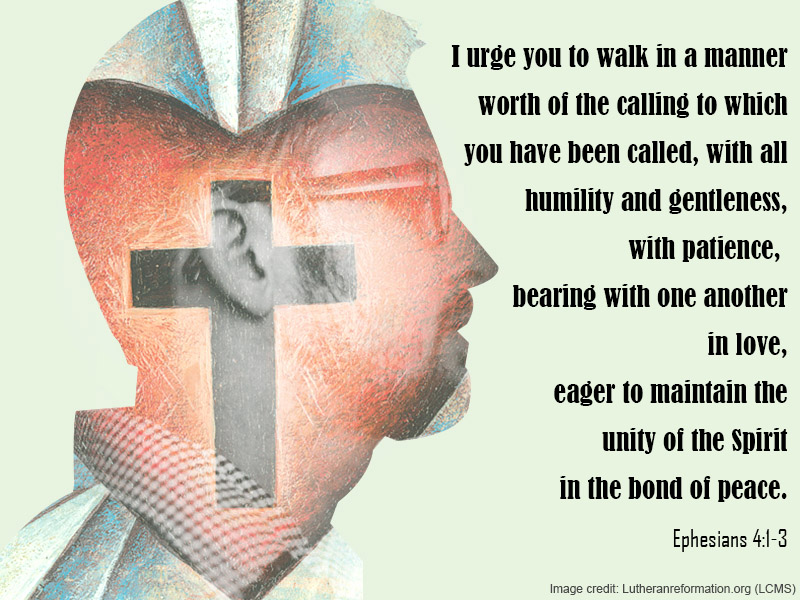
Therefore, Paul urges us “to walk in a manner worthy of the calling to which you have been called.”

If our purpose is to display God’s glory and God be glorified through us, then there is a particular way to covenant our lives for this calling. We do not get to be a Christian and act and behave how we want to act or do what we want to do. That is not our covenant calling. This walk is our response to all that God has done for us, which we read about throughout the first 3 chapters of Ephesians.

We are to live covenant lives reflecting this new identity. You and I have been called to something great and glorious. Walk worthy of it!

In Ephesians chapter 2 Paul condemned us because we were walking in a way that followed the ways of this world, following the plans of Satan, following the passions of our flesh, and carrying out the desires of the body and mind.

That is the former walk. Now you and I have a new walk. The new walk is not to go back carrying out your desires in your body and mind. The new walk is not following our passions. Our new walk is not following the ways of this world. Now you and I are to walk worthy of the calling to which you have been called.

Now Paul says something subtle, but very important in this first verse. Paul says, “I therefore, a prisoner of the Lord.” Paul starts there before he tells us to walk worthy of the calling. Why does Paul even bring up that he is a prisoner for Christ at this moment? Because we need to know up front, before we make a decision to follow in Christ’s covenant, our walking worthy is going to be costly.

Paul urges to walk in this way understanding that the walk is costly. You and I will not fit in with the world when we start making decisions for the sake of not ourselves but for all of those who God just declared have become our neighbors. Understand that trying to walk according to our calling is countercultural. How you will now behave is the opposite of what the world thinks is right or good.

The Character Which Brings Christian Unity (Ephesians 4:2)

Now, consider what you think would be the first command for walking worthy.

Of all the things God could command us first to consider in walking worthy of the calling, what do you think that command would be?

Read Ephesians 4:2-3. Notice the first point Paul makes is for Christian unity.

In verse 2 teaches us the character needed to maintain Christian unity.

Verse 3 gives us the charge to maintain this unity.

Ought that we should be overly surprised that the first quality Paul addresses for walking worthy is unity? Unity is very important to our Lord because a lack of unity can never bring any God glory. Disharmony wrecks God being glorified.

Paul begins with the attitudes necessary for unity. Too often there has been an attitude that we can have unity on doctrine alone. There is an attitude that as long as we agree that there is one Lord, one faith, one baptism, one body, one Spirit, one hope, and one God and Father of all, then we can be ugly to each other, have poor attitudes, be rude, attacking, and the like and still have unity.

Much to the great grief of God, we have each seen and heard far too many times supposed Christians attempt to defend the gospel and defend the truth by being angry, vicious, slanderous, condescending, and sometimes even being deceitful.

I unfortunately experienced this when I was training to preach. A preacher from another church decided that what we were doing was wrong, primarily because we were teaching and preaching the Gospel of our Lord and Savior Jesus Christ from a more traditional Bible Based approach and perspective. The ugly, hateful attitudes, words were just echelons beyond shocking and disappointing to me.

I want us to notice where Paul starts for Christian unity. “With all humility and gentleness with patience, bearing with one another in love” (Ephesians 4:2).

There cannot be any degree or measure of unity without these things. It does not matter how much doctrine we think we have right and correct. We have missed the gospel completely and do not know the calling to which we have been called when we are lacking humility, gentleness, patience, and forbearing.

Jesus exerted the power of God and defended the teachings of Christ without resorting to being ugly or hateful. I think we can get the idea of how we are to behave when we read humility, gentleness, and patience. People are going to say things and do things that are simply not right and unscriptural. We are to respond with humility, gentleness, and patience.

Any number of other Christians in the Body of Christ do not know what you and I know. They may not have studied the Bible as long as both you and I have.

They may not be as smart as you and I think you and I are. They may be confused on some teachings. They may have adopted some ideas that others have learned through culture have taught but are not found in the scriptures.

How are we going to handle important these things? A correcting response must be with humility, gentleness, and patience. Some of you simply will not accept some of the concepts from the scriptures I have taught while I have been studying and praying over the Scripture passages and writing these devotions.

How should I handle that? Should I be angry? Should I be more forceful with you? Should I put you down? Should I intimidate you? Should I make slanderous comments about you to you or to others? No! that’s very much wrong! When Christians are speaking, we must remember humility, gentleness, and patience.

If this was not enough, Paul says that we are to bear with one another in love. We are to endure patiently with one another because we love the soul of the person. We ought to love each other and will continue to work together without bitterness or anger. Think about how we talk to each other. Think about how we act toward each other. Think about each and every one of these things especially when we are too busy vigorously disagreeing. Why? Paul continues in verse 3.

The Charge To Maintain Christian Unity (4:3)

We are to be “eager to maintain the unity of the Spirit in the bond of peace.” Some translations rightly read that we are to make every effort to maintain the unity of the Spirit in the bond of peace. We are to desire unity and do all we can to continue it. Notice that we are not to create unity but to maintain it. We are to keep the unity that is already in existence that comes from the calling. We have been joined together in Savior Jesus Christ. Be eager to maintain that unity. Be diligent to maintain this unity. Make every effort to continue together in unity.

Consider: We do not have unity if it cannot be seen. Unity is not something that ought to be seen as only a concept. Unity is seen in behavior. A lack of unity in a marriage is evident. Unity in a marriage is evident. If we truly have unity in our marriage to Jesus Christ, then it will be evident. Peace is the bond that holds this unity together. We will see peace in our relationships and behaviors. We desire unity and will, by our marriage to Christ, make all effort to maintain that unity.

Look carefully at this image of a chain. Do you notice even for one hot fleeting moment the “red question mark” linking(?) the two ends of the chain together? This is not unity. Too often we think this is unity. Occasionally all the links sit in the same room. But this is not one chain. They are not unified. There is no unity. We do not have Christ-like unity unless we have participation and involvement.

As I have already said above,

The Apostle Paul calls us all to be like-minded… having unity in the spirit and the love of Christ in our hearts – being of one accord: encouraging the saints and demonstrating tender-compassion in humility of heart, towards one and another. But mercy, truth and unity will only come when we have the grace of the Lord Jesus Christ, the love of God and the fellowship in the Spirit flowing through our inner beings – for it is only as we are fully surrendered, yielded to the Holy Spirit, that He is enabled to conform us, into the likeness of Christ.

We have the mind of Christ – to think as He did; to speak as He did; to live as He did and to love all our neighbors and behave as He did. And so individually and collectively we have the means to walk and live and pray in spirit and truth.

In his letter to the Philippians the Apostle Paul gives this vital challenge to all believers – IF we have received any consolation in Christ; if therefore we have any comfort of love; if therefore we have any fellowship of the Holy Spirit and if therefore, we have any bowels and mercies in Christ, we are to demonstrate this in our lives by being of one same mind. (Philippians Chapter TWO)

If we, as children of God, have received His goodness and grace, comfort and hope, hope and compassion, then we are to maintain the same goodness, grace, comfort and love and be diligent to preserve the unity of the Spirit in the body of peace. There ought to be no question marks between any two-chain links!

The challenge to all believers is to faithfully and committedly and prayerfully develop a Christlike character, demonstrating the same love that He displayed.

We are to be united in spirit and fervent in love – looking to Jesus, the author and perfecter of our faith, who for the joy set before Him endured the cross.

We are to walk worthy of this glorious calling we have been given. Walking worthy means being eager and making every effort to maintain the unity of the Spirit in the bond of peace. As we make this walk with Christ, let us place a much higher priority on coming together in Christ, a greater focus on unity.

First, let us be more patient with each other. Let us be gentler with each other. Let us be humbler, not thinking so much of our abilities or knowledge. Let us patiently bear with one another because of the love we have through Christ.

Second, let us be eagerly maintaining the unity which is to be found only through God, the Father, God the Son and God the Holy Spirit. Unity is visible. Unity is not accidental. Unity requires us merging, weaving our lives together in God’s word regularly. Otherwise, we are individual links who have questionable proximity to one another proclaiming the “united chain” we are to be in Christ.

You will never see any question marks or any missing links between the link of God, the Father and God the Son and God the Holy Spirit. It can never ever exist!

In the name of God, the Father and God the Son and God the Holy Spirit, let us come together as One Body, “perfectly” united as Father, Son and Holy Spirit,

Heavenly Father I pray that I may show forth the grace of Christ, the love of the Father and the fellowship of the Holy Spirit – in thought word and deed towards all who are the called according to Your purpose, so that in unity of spirit we may honor Your name, through our earthly witness, in Jesus’ name I now pray, Alleluia! Alleluia! Alleluia! AMEN.

https://translate.google.com/

Making a Genuine Investment in our Futures. Investing in Self or in Jesus?

The 16th century German theologian, Martin Luther is credited with saying “A religion which gives nothing, which costs nothing, and which suffers nothing, is worth nothing.”

We understand the value of anything is determined by its investment, either in time, money, or personal sacrifice. When Savior Jesus Christ says, “follow me,” he is beckoning us, not just to go to the nearest trendiest outdoor cafe, hang out with him, or tag along, but instead unto a devout, different, and dedicated, life.

An old time, circuit riding preacher, Alex Johnson, in his sermon “It’s easy to become a Christian, but so very much harder to live as a Christian,” observed that “the mark of a great leader is the demands he makes upon his followers.”

In today’s devotional Bible passage from Luke, Jesus reminds us of the value of “future investments,” discipleship and its sacrificial demands upon the lives of those who choose and desire to follow Him to Follow Him EVERY SINGLE DAY!

Luke 9:23-27 The Message

23-27 Then he told them what they could expect for themselves: “Anyone who intends to come with me has to let me lead. You’re not in the driver’s seat—I am. Don’t run from suffering; embrace it. Follow me and I’ll show you how. Self-help is no help at all. Self-sacrifice is the way, my way, to finding yourself, your true self. What good would it do to get everything you want and lose you, the real you? If any of you is embarrassed with me and the way I’m leading you, know that the Son of Man will be far more embarrassed with you when he arrives in all his splendor in company with the Father and the holy angels. This isn’t, you realize, pie in the sky by and by. Some who have taken their stand right here are going to see it happen, see with their own eyes the kingdom of God.”

The Word of God for the Children of God. Gloria! In Excelsis Deo! Alleluia! Amen.

Master Rabbi Jesus had just finished His ministry in the Galilee area and set His face to Jerusalem. He started to prepare His followers for His fast-approaching death and resurrection. He earnestly started to train His disciples for their post resurrection mission and ministry and increasingly, He has made hints to his disciples about His person, His sacrifice on the cross and his coming kingdom.

Jesus not only started to explain privately to His disciples about His mission and ministry – His death and resurrection, but He has also talked to the gathering crowds about what it genuinely means for a believer, to become a true disciple of His – and we read that Jesus said unto all, if anyone would come after Me, let him deny himself and take up his cross daily and follow Me.”

All believers are children of God but there is a vital difference between being saved as a son and following the Lord as His disciple. (Ephesians 1:3-14)

We are saved from our sins because we trusted Jesus as Savior, who died on the cross – we are saved by grace through faith in Christ. (Ephesians 2:8-10)

But to become a true disciple we must make critical sacrifices in how we view and perceive the world and the circumstances we are daily presented through it.

We must look in the mirror and essentially believe that who and what we see looking back at us has quite a few and very different interpretations when seen only through the tainted eyes of mankind versus the eyes of Savior Jesus Christ.

From somewhere beyond our biases and prejudices, Jesus here covenants with us to not see the world as we see it – endless vistas of hopelessness and “see the world as He sees it,” with an everlasting hope for an eternal future far beyond our understanding, far, far beyond our time and season of living on this planet.

But to get to that ultimate place of hope, we have to ultimately sacrifice those “treasures we treasure beyond everything, and everyone else,” take up our own cross, daily, and follow the Lord Jesus – we are to walk the way of the cross. (Matthew 6:19-21, Matthew 13:44-52, Matthew 19:16-22, Luke 12:13-21)

James 1:19-25 ESV

Hearing and Doing the Word

19 Know this, my beloved brothers: let every person be quick to hear, slow to speak, slow to anger; 20 for the anger of man does not produce the righteousness of God. 21 Therefore put away all filthiness and rampant wickedness and receive with meekness the implanted word, which is able to save your souls.

22 But be doers of the word, and not hearers only, deceiving yourselves. 23 For if anyone is a hearer of the word and not a doer, he is like a man who looks intently at his natural face in a mirror. 24 For he looks at himself and goes away and at once forgets what he was like. 25 But the one who looks into the perfect law, the law of liberty, and perseveres, being no hearer who forgets but a doer who acts, he will be blessed in his doing.

To be a disciple it must not only be hearing the Word and being a listener, but it is also add doing the Word and sacrificially applying it to our everyday agendas.

Hebrews 12:1-2 ESV

Jesus, Founder and Perfecter of Our Faith

12 Therefore, since we are surrounded by so great a cloud of witnesses, let us also lay aside every weight, and sin which clings so closely, and let us run with endurance the race that is set before us, looking to Jesus, the founder and perfecter of our faith, who for the joy that was set before him endured the cross, despising the shame, and is seated at the right hand of the throne of God.

It is not only knowing that Christ has identified with our sins – (sonship) – but that we are to reciprocate in kind and identify with Christ – (discipleship)… We are to identify with His sacrifice and surrender, His crucifixion, His suffering.

We are covenanted to be like Christ in His humanity and to deny ourselves if we are to be His disciples – but to do so we are to surrender our lives to the Spirit, to give ourselves as a willing and living sacrifice to the Father and then to say as did Christ, thy will not mine be done. Self, the self-life and all that is connected with the old sin nature, must remain thoroughly consigned unto God’s Grace.

The world does not understand this kind of life and worldly Christians have opted to keep “self on the throne of their life” – but to follow the way of the cross we are to give our lives to the Lord. Our life is to be a life of surrender, suffering, sacrifice and service to the Him.

If you and I freely choose to give up your lives for the Lord, you and I will not lose it but rather, by making the choice for salvation through Christ to save it.

Following the Lord in sacrificing, surrendering and re-surrendering, suffering and service is a daily discipline – as Jesus said, “if anyone would come after Me, let him deny himself and take up his cross daily and follow Me.”

As the founder of Methodism Reverend John Wesley famously quipped in his well-considered advice about being a day-to-day Christian every single day.

“Do all the good you can,
By all the means you can,
In all the ways you can,
In all the places you can,
At all the times you can,
To all the people you can,
As long as ever you can.”

What are the kingdom implications for Christians in these days of pandemic?

Social Isolation, Quarantine, Social Distancing, Mask on Mask off, vaccination!!

The day-to-day challenge is even greater to be the Body of Christ, the Church in such a sacrificial way as not to risk the safety of others and to make others sick.

Jesus asks us to surrender ourselves, to deny ourselves. To just say “no” to our- selves. This is more than just denying oneself of personal comfort, pleasures or possessions. It is giving up, surrendering, re-surrendering, self-gratification. Self-indulgence. Self-centeredness. Self-interest, not cause harm unto others.

Denying self goes against the grain. It’s not what our self-seeking culture is about. In our technology driven, virtual reality existence, everything today is geared toward self- gratification, self-satisfaction. Self-love. Self-devotion.

Jesus calls for self-denial. Self-sacrifice. Self-abasement. Self-control. Self-surrender and re-surrender and a growing and a maturing self-discipline.

Discipleship calls for a covenant commitment

Jesus simply says, “Follow Me.” This is the natural result of self-denial and cross bearing. He is the motivation for what we do, who we are, and how we live.

Following Jesus leads to ministry and mission. Following Savior Jesus leads us to involvement in the lives of others. And not just the comfortable environment of fellow Christians. But it leads us to interact with the less fortunate who need our help. With sinners with whom we can share the Words of the Gospel. With opponents of Christianity to whom we can present a sure defense of the gospel.

Disciplined following of Jesus leads us to Bible study. Prayer. Worship. And fellowship. Following Jesus leads to an intimate relationship with the Father.

Ironically, following Jesus leads us to save ourselves by losing our ourselves as His disciple. The disciple’s questions to paraphrase Jesus is not “What can I get?” But “What can I give?” Not “What is the safe thing?” But “What is the right thing?” Not “What is the obvious thing?” but the “Love of Christ” thing!

In this time when we are “sequestered” to our homes, travel is limited and our public church assemblies are cancelled or curtailed for health and safety, we’re reminded that covenant discipleship is so much more than church attendance.

The day-to-day Christian life is a daily disciplined life, a devoted discipled life and a continual discipling life. It’s a disciplined life to surrendering it all to God.

“Give me one hundred preachers who fear nothing but sin, and desire nothing but God, and I care not a straw whether they be clergymen or laymen; such alone will shake the gates of hell and set up the kingdom of heaven on Earth.”
― The Right Reverend John Wesley, (1703-1791) Founder of Methodism

In the name of God, the Father, and God the Son and God the Holy Spirit,

Let us now pray,

Loving Father, more and more I want to surrender my life to You, to take up my cross daily as a willing sacrifice and to cry out, thy will not mine be done. I pray that my old self-life will remain firmly nailed to the cross as I submit to Your leading and guiding in all I say and do, in Christ’s name I pray, Alleluia! AMEN.

https://translate.google.com/

Psalm 116: I Prayed and God Heard me! The Grace of Answered Prayers!

Understanding the Lord’s love, presence, and nearness should lead us to serve him and to deepen our relationship with him. While we love God for so many reasons, we want to express our love to him today especially for his personal concern for us. At this, the eve of a New Year, in a world where people hesitate to spend meaningful and quality time around or with anyone who might infect them, we ourselves are truly echelons beyond blessed with an incomparable God who draws near to us, listens to our every single cry, recognizes our very own distinct voice, tunes his ear to hear every one of our whispers. Yes! I will call on him, praise him, thank him, and I will speak with him as long as I live!

Psalm 116 Easy-to-Read Version

116 I love the Lord for hearing me,
    for listening to my prayers.
Yes, he paid attention to me,
    so I will always call to him whenever I need help.
Death’s ropes were around me.
    The grave was closing in on me.
    I was worried and afraid.
Then I called on the Lord’s name.
    I said, “Lord, save me!”
The Lord is good and merciful;
    our God is so kind.
The Lord takes care of helpless people.
    I was without help, and he saved me.
My soul, relax!
    The Lord is caring for you.
Lord, you saved my soul from death.
    You stopped my tears.
    You kept me from falling.
I will continue to serve the Lord
    in the land of the living.

10 I continued believing even when I said,
    “I am completely ruined!”
11 Yes, even when I was upset and said,
    “There is no one I can trust!”

12 What can I give the Lord
    for all that he has done for me?
13 He saved me,
    so I will give him a drink offering,
    and I will call on the Lord’s name.
14 I will give the Lord what I promised.
    I will go in front of all his people now.

15 Very dear to the Lord are the lives of his followers.
    He cares when they face death.
16 Lord, I am your servant!
    Yes, I am your slave, as my mother was.
    You set me free from the chains of death.
17 I will give you a thank offering.
    I will call on the Lord’s name.
18 I will stand before the gathering of his people
    and give the Lord what I promised.
19 I will do this in Jerusalem,
    in the courtyards of the Lord’s Temple.

Praise the Lord!

The Word of God for the Children of God. Gloria! In Excelsis Deo! Alleluia! Amen.

This psalm is a wonderful testimony of praise, giving glory to God for all the things He did to undertake for the psalmist. The Lord delivered him from grievous trouble, and he is not at all ambiguous about the fact that God is the one who did it. But in order to give thanks this way, we have to adjust some of our modernist assumptions about interpreting the events of history.

In his penetrating book about the theological crisis that resulted from the American Civil War, Mark Noll astutely pointed out the fact that the war badly rattled American faith in the intelligibility of God’s governance of the world. Both sides were praying to Him for victory over their enemies, were they not? And everyone retreated into the assumption that God’s ways are always and necessarily inscrutable. But how then can we pray as the psalmist does here?

Let us first try to unpack this amazing Psalm – verse by verse.

The psalm begins with a profession of love for the Lord, because He listens to prayers (v. 1). He inclined His ear to me, and that is why I call upon Him (v. 2).

As long as I live. The psalmist has been in deep trouble before, down to the point of death (v. 3)That is when I called upon His name (v. 4).

God is gracious, righteous, and merciful (v. 5). God preserves the simple, and it is a good thing too (v. 6). He helped when I was brought low. Calm down, soul, because God is bountiful (v. 7). God has delivered me in three ways—my soul from death, my eyes from tears, and my feet from falling (v. 8). I am going to walk around this place alive, and in the presence of the Lord (v. 9). Paul quotes this next verse in 2 Corinthians 4:13 and does so from a similar context. I believed, and therefore I have spoken (v. 10).

I said, too hastily, that all men are liars (v. 11). This appears to have something to do with men who were the instruments of the answered prayer. When I was in trouble I lashed out at men, but then God used such men to later deliver me.

How shall I pay the Lord back for all His benefits (v. 12)? I will take the cup of salvation, and then raise the glass (v. 13). The vows that I promised when I was in trouble are vows that I will pay in the presence of all God’s saints (v. 14).

As we saw earlier, God delivered the Psalmist from death, but here it says that the death of His saints is precious to Him (v. 15).

God loves bringing us home. In other words, it would have been an answer to the Psalmists prayer either way. Enslaved by our God’s answers to his prayers, God’s devoted servants are the ones for whom God has loosed the bonds (v. 16).

The sacrifice of thanksgiving is the only way to pay Him back, and so we call on His name (v. 17). Again, the vows that were promised will be vows paid—in the presence of all His people (v. 18). Thanksgiving for answered prayer will be offered in the courts of the Lord’s house (v. 19)Hallelujah.

You read a lot from me about trust from my blog. My fervent prayer is I want readers to experience trusting God and others with who you really are, creating authentic relationships with God and others where you are truly known, loved.

As we are about to enter into the New Year, or perhaps you are already there by the time you come to read these words. I want to us all to be able to collectively reflect on where each of us are spiritually following the events of the year 2021. Each of us experienced this past year differently and uniquely. Each of us has been both effected and affected by the circumstances and events of Pandemic. Each and every one of us has had their trust, hope, their faith severely tested.

With the greatest measure of his exhilarations, the Psalmist’s words declare his steadfast, immovable trust in God despite all the worst things he experienced. I am wondering right know, where are each and every one of us in those words of Psalm 116? How close are we to identifying with the events of the Psalmists life? How far away are we from identifying with those exhilarating words of praise? Could our hearts, our souls and our pens or computers or I Pads write even one word of them? Write them with any serious meaning, serious depths of truth?

Everyone absolutely matters to God! Everyone absolutely matters to Jesus, and everyone absolutely matters to the Holy Spirit. Everyone absolutely matters in the Kingdom of God – believers and even non-believers. God desires everyone! Everyone, without exception has a significant role to fill and a purpose to fulfill. God is not partial, Jesus excludes no one, the Holy Spirit reaches out to all of us.

Still now, this world is in the throes of pandemic. In the real and devastating throes of social distancing, quarantine and isolation. serious medical issues, serious socio-economic issues, serious socio-cultural issues we have never seriously expected to occur in our lifetimes or needed to be considered before. Business and leisure Travel is seriously impacted! Too much is just too much! We are looking at our families, friends and neighbors and complete strangers and seriously wondering, “Are they contagious?” “Should they breathe on me?”

Our sense of personal security is being tested. Our personal measures, intimate degrees of connection and personal relationships and trust are being seriously challenged. Trust is an essential characteristic and attribute in any relationship. Whether that trust is places in our fallow man or in God the Father, Son, Spirit. As man comes to trust in their fellow man, so goes their trust in their Creator! Trust not in the ways of man, erode that trust even .01%, so it connects to God!

Psalm 118:8-9 Authorized (King James) Version

It is better to trust in the Lord
than to put confidence in man.
It is better to trust in the Lord
than to put confidence in princes.

These two verses from Psalm 118 are believed to be the very center verses of the biblical canon. So, trust in the Lord taken together with trust in mankind are the very center of what we need to be extraordinarily mindful of in coming years.

Why?

But what if trust isn’t an easy thing for you?

We could easily argue it isn’t an easy thing for most of us, depending on our current and past experiences and how we come to view both ourselves and our relationships. There are a lot of reasons you and I might be finding it hard to trust people, but here are three of the big ones.

#1. You and I believe WE have to protect ourselves. 

 This one is a deep—and common—root. 

Many of us were taught from our early experiences that we need to protect ourselves from others. While serious issues of abuse and neglect are clearly deeply harmful, even the best-intentioned parents hurt their kids at times. They reply sharply, don’t notice distress, tell their kids how they “should” feel, or misunderstand what their child needs. All parents are humans too after all, with their own preoccupations, hang-ups and patterns.

Unfortunately, when we are young, we don’t have this perspective. Many of us quickly internalize the understanding that we need to look out for ourselves, protect ourselves, and not trust others—after all, they might just let us down or someone else will certainly, inevitably let us down This usually gets ingrained so early we don’t know there’s another way. This is just “how the world works.”

This belief stays with us into adulthood, and often gathers more evidence. We get more sophisticated about learning it—we learn how to have relationships with others that we keep “socially distant” at arm’s length, ensuring we can still protect ourselves. Our core relational template begins and ends with those others cannot be trusted, and we need to everlastingly look out for ourselves.

While understandable considering our current circumstances, this belief that others can’t be trusted doesn’t lead to deep, healthy, vulnerable relationships—and those relationships are what Jesus calls us to as one of the primary ways He weaves His joy, fulfillment, purpose and peace into the tapestries of our lives.

#2. Your hurt and mine is holding both you and me back.

We travel through this broken, beautiful world, we will be hurt. It’s a simple fact of living in a land of imperfect people and systems. We have too many reasons not to trust, based on our own experiences, relationships. If we don’t work through our hurt with Jesus, we let each one become a barricade to our hearts. Each experience with a flawed human becomes another reason not to trust.

 Unfortunately, all those barricades leave you alone—and it is not good for man to be alone (Genesis 2:18).

 We are called to forgive from the heart, clearing those barricades we’ve set up to guard ourselves. This might sound impossible, and depending on the very real pain you’ve experienced, this might sound unfair or unfeeling. But Jesus is the expert at this. He’s walked this road in order to get to us, and he can lead us both together along its winding and blind curves. You and I were not made to carry a hardened, barricaded heart within us. You and I were made to have a soft, compassionate, trusting heart is filled and protected by the Holy Spirit.

#3. You and I both have unspoken realistic and unrealistic expectations.

This one is more common than we realize. Most of us are walking around with unspoken, unclear, and potentially unrealistic expectations of those around us. We might not even be aware of our expectations, until someone breaks them! This is a recipe for hurt and broken relationships. One way this comes out is when we expect others to love or care for us in the same way we care for them. We get hurt when our friends or family don’t express their love for us in the same way we express it, we internalize that as “I can’t/won’t trust them.” 

 Let’s put an example to this. Say we are going through a hard time with a family conflict. You and I get together, and I never asks you specifically how that conflict is going. You expect that if I genuinely cared, we’d ask about it. I expect that if you genuinely want to share, you’ll bring it up on your own. Now your hurt, so, it feels as though you cannot trust me as much as you originally thought or believed, because I did not meet your (unspoken) expectations.

It’s awkward, and difficult, to have conversations about our expectations. It takes courage, and it takes self-awareness (because if we aren’t aware of our expectations, it’s pretty hard to convey them to someone else!). But if we carry around unspoken expectations, it’s only a matter of time before our trust feels flimsy, unbeknownst to the person on the other side. So, please, please, do pray, prayerfully choose to step out in courage, and communicate your expectations.

How can you and I prayerfully, biblically apply this today, the coming year?

Proverbs 3:5-8 English Standard Version

Trust in the Lord with all your heart,
    and do not lean on your own understanding.
In all your ways acknowledge him,
    and he will make straight your paths.
Be not wise in your own eyes;
    fear the Lord and turn away from evil.
It will be healing to your flesh[a]
    and refreshment[b] to your bones.

Proverbs 16:1-3 English Standard Version

16 The plans of the heart belong to man,
    but the answer of the tongue is from the Lord.
All the ways of a man are pure in his own eyes,
    but the Lord weighs the spirit.[a]
Commit your work to the Lord,
    and your plans will be established.

1.     Spend some time getting familiar with your past and your expectations. Some good questions to ask yourself are: What was modeled for me growing up? Where am I holding on to past hurts, and letting them affect my current relationships? What do I expect from those around me to keep my trust?

2.     Step out in courage and share some of these answers with those in your life. These past stories and wounds can surely help others understand us better and sharing them can actually build trust itself. Additionally, talking through your expectations can help get both and me on the same page, so both of us come to that place where we can both say; “I understand what trust looks like to you!”

In the name of God, the Father and God the Son and God the Holy Spirit,

Let us now pray,

Father, Son and Holy Spirit, you know each hair on my head and every thought on my heart. Thank you for hearing my prayers. Thank you for answering so many of them with the answer I sought from you. Give me patience when I cannot see your hand in the other answers that do not come as soon or do not bear the result that I request. I believe and trust that you are there and working for my good even when I can’t see it. I believe you always answer to your glory and my best interest. But please, dear Father, strengthen my faith so that I will never outlive my trust and faith in you. In the name of Jesus, I ask it. Amen.

https://translate.google.com/

By what standard ought We to Love all others? By Whose standard? We love only because God first loved us!

11 Beloved, if God so loved us, we also ought to love one another. 12 No one has ever seen God; if we love one another, God abides in us and his love is perfected in us.

The eternal God loves us in three tenses: past, present and future – for He is the same yesterday today and forever. It is a divine love that cannot be compared with the inadequate love of fallen man, but is a love so penetrating, that He sent the unique, and only begotten Son of His love to be the propitiation for our sins.

That single act of the Father should stagger us to the core of our being… that our God sent Christ as a gift of His grace… to be made the penultimate curse for us – so that, for the sake of love we might be made the righteousness of God, in Him.

But having redeemed us He sent His Holy Spirit to abide in our heart and day by day, He seeks to transform us from ugly, bitter, antagonistic sinners into good, obedient and mature children of God, having the same, godly nature as the Lord Jesus Christ, Himself.

But His love extends into the never-ending, eternal future, for no eye has seen, nor ear has heard – nor has it entered into the imagination of man the glories that God has prepared for those who love Him. Since the eternal God loves us in three, staggering tenses – the standard set, we ought also to love one another.

1 John 4:7-21 English Standard Version

God Is Love

Beloved, let us love one another, for love is from God, and whoever loves has been born of God and knows God. Anyone who does not love does not know God, because God is love. In this the love of God was made manifest among us, that God sent his only Son into the world, so that we might live through him. 10 In this is love, not that we have loved God but that he loved us and sent his Son to be the propitiation for our sins. 11 Beloved, if God so loved us, we also ought to love one another. 12 No one has ever seen God; if we love one another, God abides in us, and his love is perfected in us.

13 By this we know that we abide in him and he in us, because he has given us of his Spirit. 14 And we have seen and testify that the Father has sent his Son to be the Savior of the world. 15 Whoever confesses that Jesus is the Son of God, God abides in him, and he in God. 16 So we have come to know and to believe the love that God has for us. God is love, and whoever abides in love abides in God, and God abides in him. 17 By this is love perfected with us, so that we may have confidence for the day of judgment, because as he is so also are we in this world. 18 There is no fear in love, but perfect love casts out fear. For fear has to do with punishment, and whoever fears has not been perfected in love. 19 We love because he first loved us. 20 If anyone says, “I love God,” and hates his brother, he is a liar; for he who does not love his brother whom he has seen cannot[a] love God whom he has not seen. 21 And this commandment we have from him: whoever loves God must also love his brother.

The Word of God for the Children of God. Gloria! In Excelsis Deo! Alleluia! Amen.

Today’s passage is all about love. The first couple of things that probably pop into your mind when you hear “love” likely involve romance, dating, marriage, I know because it did for me the very first time, I remember reading the text!

Today, we will be devoting our time to talking about a love that is much greater, very much stronger, and much more powerful than any love we could possibly conjure up or imagine we can bound within our human limits. The answer to “What kind of standard of love is that?” God because God is love, so God’s love. 

The New Covenant text for today explores the scope of God’s love and the vast implications of it: how that love was presented to us, how it was displayed in Jesus Christ, and how that standard of love both transforms and changes us.

A short caveat: for the organizational purposes of exploring these three topics, the verses referenced in this devotional offering might be a bit out of order, so just be aware of that. Man’s boundaries all come back to the center who is God!

How the standard of God’s love is presented to us

The first thing I wanted to take a look at today is how this beloved passage from 1 John answers for us the question of “How is/was God’s love presented to us?”

There are two verses in particular which begin to address that question today:

1 John 4:10Authorized (King James) Version

10 Herein is love, not that we loved God, but that he loved us, and sent his Son to be the propitiation for our sins.

1 John 4:19Authorized (King James) Version

19 We love him, because he first loved us.

What is so special about these two verses?

They both show the initiative of God. Who loved first? God loved first. This isn’t meant to be a dive into any meaningful discourse or theological discussion on predestination or whatever, but to really take a well-considered look at the initiative that God takes in setting before us, His children, his standard of love.

And this exercise of personal initiative is significant, because it shows reveals to us God is in no identifiable way shape or form passive. God does not just sit back and twiddle His thumbs and leave us alone to figure this sin problem out, but rather, He takes and is taking an indescribably active role in the redemption of his children. Let’s let our fingers wander back to the first couple of the books of the Bible and bring to remembrance some of the events and characters there.

The Creation Story. Who initiates it? Who speaks creation into being? God!

Noah and the ark. Who initiates there? It was God!

Abraham and his covenant. Who initiates there? Again, it was God!

Moses and the burning bush. Who initiates there? Once again, God! 

And once we realize this pattern in the Old Testament of God initiating and taking an unimaginably active role, we can recognize that it doesn’t end there. As we keep thumbing through the pages, God’s undeniably active role continues in the sweep towards the sacrificial work of Jesus on the cross unto Revelation.

How God’s love was displayed through Christ Jesus

And now, with God’s initiative in mind, let us advance our thoughts into and unto the second topic. We are able to allow our souls to genuinely and deeply appreciate how God displays his love through Jesus. Let’s take a look at our text:

1 John 4:9-10 Authorized (King James) Version

In this was manifested the love of God toward us, because that God sent his only begotten Son into the world, that we might live through him. 10 Herein is love, not that we loved God, but that he loved us, and sent his Son to be the propitiation for our sins.

How was God’s love displayed and made known to us?

Through the death through which Jesus paid, and in return, the life that was given to us. His atoning death has led to the forgiveness of our sin. But what makes that love so grand and almost baffling? It’s that God is not obligated to send Jesus for the forgiveness of sin, he does not have to do it, but he does so willingly. He takes the divine initiative and unconditionally loves us first, even if it is for a people that do not––and may not–– ever, ever, ever love him back.

God’s standard of unconditional love inevitably transforms and changes us all

The final thought I wanted to take a look at regarding this passage is how God’s love transforms and changes us. At the beginning of this post, I had mentioned how powerful God’s love is, and this entire passage really brings that into focus:

He that loveth not knoweth not God; for God is love. (1 John 4:8 AKJV)

11 Beloved, if God so loved us, we ought also to love one another. 12 No man hath seen God at any time. If we love one another, God dwelleth in us, and his love is perfected in us. (1 John 4:11-12 AKJV)

17 Herein is our love made perfect, that we may have boldness in the day of judgment: because as he is, so are we in this world. 18 There is no fear in love; but perfect love casteth out fear: because fear hath torment. He that feareth is not made perfect in love. (1 John 4:17-18 AKJV)

20 If a man say, I love God, and hateth his brother, he is a liar: for he that loveth not his brother whom he hath seen, how can he love God whom he hath not seen? 21 And this commandment have we from him, that he who loveth God love his brother also. (1 John 4:20-21 AKJV)

Again, God’s love is never a passive love. And in that same way, God’s love does not act passively in us. It drives us, it transforms, and it changes us. It drives us to love one another (v.11), to care for our brothers and sisters (vv. 20-21), gives us confidence towards God even in judgement (vv. 17-18), and transforms us to be more like Christ (v. 17).

As God was willing to take and exercise His divine initiative to love and sacrifice His ONLY Son, for these people, surely, I can go out of my way to love them too. 

God’s love does not, has never and will never act the least bit passively in us. It constantly and continuously drives us, it transforms, and it 1000% changes us. God’s love is inevitable! It never changes! It can never change because our God never changes. God’s love is limitless! His love is not bound by our standards! His love can never be bound up or be held in bondage by frail human standards! These thoughts ought to just blow our minds outside the bounds of what we will tightly tape, wrap up securely inside gift boxes titled “impossible and possible.”

With what I fervently pray is a much better understanding today of how God exercises initiative in his love, how can we, today, take initiative in our love?

What does it look like to take initiative to love a friend in a mental health crisis? A difficult to talk to neighbor. A family member with different political views?

Maybe it is something “smaller,” like asking and then listening well to how someone’s been doing. Or maybe it’s something a bit bigger, like apologizing to someone, asking for their forgiveness from a mistake which caused them grief.

Regardless, we do not love because it’s something we have to do, or because we are obligated to do, but because God’s love drives us to do it. As much or as little as we follow Jesus, we serve a loving God who decided to take initiative to give His one and only Son as a “paid in full” ransom in exchange for many. And that should charge, change us, and transform us, to take some initiative of our own.

The only questions and answers we need to give a maximum accounting unto God for is: What did that God driven, Jesus loved, Holy Spirit inspired initiative look like? Did we recognize the divine nature of it? Were we obedient unto it or we all too deeply living and loving from deep inside our all too typical passivity?

In the name of God, the Father and God the Son and God the Holy Spirit, let us now collectively gather as the Body of Christ, God’s Ecclesia, in some prayer.

Gracious God, you give us the Word that turns us again and again to you. You give us Jesus who is the greatest manifestation of your word, your love and your purpose. Help us to live fully as baptized people, those grafted into Jesus the branch, the crucified and risen One. God of the risen Jesus, hear our prayer.

God of all dominion and power, God of love; we can love only because you first loved us. Empower us by your Holy Spirit to be and do the same. When we rest in your love, fear—though present—cannot overpower us. Help us to rest there always. God of the risen Jesus, hear our prayer. Alleluia! Alleluia! Alleluia! Amen

https://translate.google.com/

John 3:16! We Believe! We Belong! We A.B.I.D.E.! Now, We Must Bear Fruit! Our Bearing Fruit as a 2021 Christian.

Henri Nouwen gives us these profound words of wisdom from his experiences.

We belong to a generation that wants to see the results of our work. We want to be productive and see with our own eyes what we have made. But that is not the way of God’s Kingdom. Often our witness for God does not lead to tangible results. Jesus himself died as a failure on a cross. There was no success there to be proud of. Still, the fruitfulness of Jesus’ life is beyond any human measure. As faithful witnesses of Jesus, we have to trust that our lives too will be fruitful, even though we cannot see their fruit. The fruit of our lives may be visible only to those who live after us.

What is important is how well we love. God will make our love fruitful, whether we see that fruitfulness or not.”

I give you these words to ponder and pray over, give them your due diligence as we turn now to the transcending Word of God for this, today’s devotional effort.

John 15:1-17 NASB

Jesus Is the Vine—Followers Are Branches

15 “I am the true vine, and My Father is the vinedresser. Every branch in Me that does not bear fruit, He takes away; and every branch that bears fruit, He [a]prunes it so that it may bear more fruit. You are already [b]clean because of the word which I have spoken to you. Remain in Me, [c]and I in you. Just as the branch cannot bear fruit [d]of itself [e]but must remain in the vine, so neither can you unless you remain in Me. I am the vine, you are the branches; the one who remains in Me, and I in him [f]bears much fruit, for apart from Me you can do nothing. If anyone does not remain in Me, he is thrown away like a branch and dries up; and they gather them and throw them into the fire, and they are burned. If you remain in Me, and My words remain in you, ask whatever you wish, and it will be done for you. My Father is glorified by this, that you bear much fruit, and so [g]prove to be My disciples.

Just as the Father has loved Me, I also have loved you; remain in My love. 10 If you keep My commandments, you will remain in My love; just as I have kept My Father’s commandments and remain in His love. 11 These things I have spoken to you so that My joy may be in you, and that your joy may be made full.

Disciples’ Relation to Each Other

12 “This is My commandment, that you love one another, just as I have loved you. 13 Greater love has no one than this, that a person will lay down his life for his friends. 14 You are My friends if you do what I command you. 15 No longer do I call you slaves, for the slave does not know what his master is doing; but I have called you friends, because all things that I have heard from My Father I have made known to you. 16 You did not choose Me, but I chose you, and appointed you that you would go and bear fruit, and that your fruit would remain, so that whatever you ask of the Father in My name He may give to you. 17 This I command you, that you love one another.

The Word of God for the Children of God. Gloria! In Excelsis Deo! Alleluia! Amen.

John 15 is one of the best-loved of all the gospel readings, and with good reason. We all want to flourish! And here, in His final words to His disciples, Jesus tells his disciples that if they stay “in him” – rooted in him through the Word and Sacraments – they will lead the kind of fruitful lives that marks his disciples. If they’ll live as Jesus has taught them to live: BELIEVING on God, God, the Son, (John 14:6) they will experience BELONGING to God’s family (Romans 1:6-7), They will A.B.I.D.E. in God’s love through Jesus Christ (John 15:4-6 AKJV).

Building up and Growing Inwardly and Outwardly, Maturing upon each of these, they will inevitably, undeniably, BEAR FRUIT for the Kingdom of God. The ministry and mission and work of God the Holy Spirit will see to all this!

John 16:12-16 Authorized (King James) Version

12 I have yet many things to say unto you, but ye cannot bear them now. 13 Howbeit when he, the Spirit of truth, is come, he will guide you into all truth: for he shall not speak of himself; but whatsoever he shall hear, that shall he speak: and he will shew you things to come. 14 He shall glorify me: for he shall receive of mine, and shall shew it unto you. 15 All things that the Father hath are mine: therefore said I, that he shall take of mine, and shall shew it unto you. 16 A little while, and ye shall not see me: and again, a little while, and ye shall see me, because I go to the Father.

There are three truths I am compelled by John 3:16 to bring to your attention.

16 For God so loved the world, that he gave his only begotten Son, that whosoever believeth in him should not perish, but have everlasting life.

For God so LOVED the world that He gave us His Son … The Logos (John 1:1-5)

In the beginning was the Word, and the Word was with God, and the Word was God. The same was in the beginning with God. All things were made by him; and without him was not anything made that was made. In him was life; and the life was the light of men. And the light shineth in darkness; and the darkness comprehended it not.

In these days of great tribulation, socially distant, socially isolated, masks on, mask off, mask and vaccine mandated, are we vaccinated or not, boosted or not, quarantined, virus tested, virus retested, sanitized, government regulated days, there is One who has, against the most catastrophic odds, has OVERCOME it all!

John 16:32-33Authorized (King James) Version

32 Behold, the hour cometh, yea, is now come, that ye shall be scattered, every man to his own, and shall leave me alone: and yet I am not alone, because the Father is with me. 33 These things I have spoken unto you, that in me ye might have peace. In the world ye shall have tribulation: but be of good cheer; I have overcome the world.

Living Father, Son and Holy Spirit, being a believing, belonging, abiding and fruit bearing Christian, under the shadow of these indescribably, undeniably enormous wings, living with absolute maximum confidence in God’s truth, we can all still live impossible Acts 2, Acts 3 and Acts 4 kingdom growth ministry.

1. Remain in the Vine

One of the things which always strikes me about a fruit tree is its innate ability to stand so quiet, without strain or mayhem, while still getting things done. I mean, how does a branch produce fruit without the swirl? Do you know what I mean by the swirl? It’s the striving and chaos and energy I often leave in my wake when I am still trying to make things happen, sometimes even for God. In this passage from John 15, Jesus presents us with an entirely different way.

The word “remains” (abide or dwell) in the Greek means: “not to depart; to continue, to be present; to be held, kept, continually; to continue to be, not to perish, to last, endure” (Vines Bible Dictionary)

https://www.studylight.org/dictionaries/eng/ved.html

https://www.studylight.org/dictionaries/eng/ved/r/remain.html

The idea is that this is a very restful place to be. If we as the branches remain in Him as the Vine, we draw energy and marrow to produce the fruits of change and transformation He longs to bring about in each of our lives. It’s all about our attachment and connectedness to Him. This doesn’t mean our lives will be void of activity or the high expending of energy, simply that we’re able to draw everything we need to bring forth meaningful fruit that will last. As restfully as a tree beside still waters, because have you ever seen an apple tree freaking out?

2. Embrace The Pruning

Earlier in the chapter Jesus points out that God the Father is the One who prunes our lives so we will be even more fruitful (vs 2). The problem for me, historically, has been quite simple: I don’t always enjoy how God’s pruning process, turns out.

Maybe you and I are in one of those places where God is refining our character by cutting out a massive tumor of greed or vanity or malignant pride. The harsh disease of bitterness is being scraped back. Perhaps that particular false god you were really quite attached to just got lopped off, plummeting to the ground in a most unpleasant way.

As I have learned a bit about gardening over the years, pruning spares the nourishment of the vine for the branches that are most viable. If God is paring back an area that is presently painful, it is only for the bearing of more fruit—A life of greater impact for His glory (vs 8). So let God do His transformational work and have His way in our lives. Don’t resist the “tough love” He is doing.

3. Expect A Harvest

When Jesus says that if we remain in Him, we will bear fruit, this is a promise.

Part of the greatest beauty of a fruit tree is that its prolific bounty is an annual and rather predictable offering. No one looking on any orchard of any fruit tree seems to be all that taken with the fact that these trees will have fruit hanging from its branches – even in the most tribulating of times and nature’s seasons.

In October, for example the Michigan apple is to be expected. In Georgia it is the Peach and In Florida it is the Orange Tree. You can count on them. They have locked within them essential pieces of our existence—like apple cider, apple pie and cider donuts, all kinds of Jams, Jellies, Pies, Desserts uncountable and so on—We have come to depend on the inevitability of these tasty, reliable realities.

How much more can we rely on the spiritual premise that remaining in Jesus means bearing fruit that will last?  In other words, as we abide in our Savior Jesus Christ, we can confidently, equally, expect the fruit He will bring about.

In these most troubling of times of this 21st century, yay we abide in Him so our fruit bearing activity is loving, peaceful, not full of strife. When the Gardener sharpens his shears, may we let Him have His loving way with us. And as we all dwell in the Vine, let us expect the certainty of bearing fruit. Fruit that will last.

We Hold God’s John 3:16 Promises and God’s Truths to be Wholly Self Evident …

In the name of God, the Father, God the Son and God the Holy Spirit, let us pray.

Here’s a contemporary Welsh prayer I discovered in my Face Book Feed.

Lord, we would grow with you
New shoots reaching out
Hands stretched upward
Like leaves newly formed
Soaking up your light and warmth
Lord, we would grow with you

Lord, we would grow with you
In sunshine and rain
In darkness and light
In cold days and summer days
From Springtime to Winter
Lord, we would grow with you

Lord, we would grow with you
And bring forth fruit
That is pleasing to you
Fed by your living water
Giving sustenance to others
Lord, we would grow with you.

Gloria! In Excelsis Deo! Alleluia! Alleluia! Alleluia! Amen.

https://translate.google.com/

A.B.I.D.E. The Experience of Knowing and Loving God in Jesus Christ Today

Knowing is not the same as Experiencing! “Knowing” Christ is not mere head knowledge about the Bible and about Christian doctrine. Nor is it just having emotions. To know the Lord Jesus Christ certainly includes intelligent thinking and having feelings, but it is primarily a spiritual experience with the reality of the living God. This knowledge is supernatural (initiated and sustained by God through our trust in him) and it reaches from the heavens to the inner depths of persons, then flows out to other people and the environment. To know Christ today is to experience an interactive relationship with him in the Kingdom of God.

This concept of “Abiding in Christ” is one of the most important experiences we can have and learn life from. The word itself is a verb. Abiding is therefore an action and means to continue, remain, dwell, live, or to lodge. We can then say that to abide in Christ is to remain and continue in, to live and dwell in Christ.

John 15:1-8 J.B. Phillips New Testament

Jesus teaches union with himself

15 1-8 “I am the real vine, my Father is the vine-dresser. He removes any of my branches which are not bearing fruit and he prunes every branch that does bear fruit to increase its yield. Now, you have already been pruned by my words. You must go on growing in me and I will grow in you. For just as the branch cannot bear any fruit unless it shares the life of the vine, so you can produce nothing unless you go on growing in me. I am the vine itself; you are the branches. It is the man who shares my life and whose life I share who proves fruitful. For the plain fact is that apart from me you can do nothing at all. The man who does not share my life is like a branch that is broken off and withers away. He becomes just like the dry sticks that men pick up and use for the firewood. But if you live your life in me, and my words live in your hearts, you can ask for whatever you like, and it will come true for you. This is how my Father will be glorified—in your becoming fruitful and being my disciples.

The Word of God for the Children of God. Gloria! In Excelsis Deo! Alleluia! Amen.

When Jesus tells us to abide in Him, there’s a very good reason. So, let’s take a look at this section of Scripture. Let’s take a few moments, devote ourselves, to know why abiding is so critically important to living the Christian experience.

“He who abides in Me, and I in him, bears much fruit; for without Me you can do nothing.” (John 15:5b NKJV)

Here our abiding in Christ directly affects our work and responsibilities

“If anyone does not abide in Me, he is cast out as a branch and is withered; and they gather them and throw them into the fire, and they are burned.” (John 15:6 NKJV)

Here our abiding in Christ, or lack thereof, directly affects our eternal life

“If you abide in Me, and My words abide in you, you will ask what you desire, and it shall be done for you.” (John 15:7 NKJV)

Here our abiding in Christ directly affects our communication with God

“Whoever abides in Him does not sin.” (1 John 3:6a NKJV)

Here our abiding in Christ directly affects our walk with God

A proper understanding of what it means to Abide in Christ is therefore critical.

We discover it was such an abiding relationship that Jesus had with the Father, which energized and defined His ministry. When he’s confronting the religious leaders who said He was blaspheming by calling Himself the Son of God, Jesus said,

“If I do not do the works of My Father, do not believe Me; but if I do, though you do not believe Me, believe the works, that you may know and believe that the Father is in Me, and I in Him” (John 10:37-38 NKJV)

When Philip asked Jesus to show them the Father, Jesus said,

“Do you not believe that I am in the Father, and the Father in Me? The words that I speak to you I do not speak on My own authority; but the Father who dwells in Me does the works” (John 14:10 NKJV)

Speaking of the coming resurrection of believers, Jesus talks about how vital this connection with His Father is.

I can of Myself do nothing. As I hear, I judge; and My judgment is righteous, because I do not seek My own will but the will of the Father who sent Me” (John 5:30 NKJV)

Jesus had an intimate abiding relationship with the Father, and we must then ask ourselves this important question; if this relationship was necessary for His ministry, then how important today such an intimate abiding relationship with Jesus is required if we are going to live fruitful, effective lives here on earth.

This is actually Jesus’ prayer for us.

“That they all may be one, as You, Father, are in Me, and I in You; that they also may be one in Us, that the world may believe that You sent Me” (John 17:21 NKJV)

Returning back to our text, Jesus says that just as a branch needs to be vitally connected to the vine, so believers need to be vitally connected to Him. Just as Jesus could do nothing outside the Father’s will, we can do nothing on our own. We need this vital connection, and then we can say like the Apostle Paul, “I can do all things through Christ who strengthens me.” (Philippians 4:10-13 NKJV)

Therefore, when we DO learn how to abide in Christ, He will provide life and strength so we can live productive and effective lives. But even more, we can experience intimate fellowship with God, experience belonging to His family.

Being welcomed members of God’s family, we have all the power and privileges that go along with it. Our only problem is while it’s all ours, we don’t know how to fully experience them, because we have not learned how to abide in Christ.

The more we actively share Christ’s life and let Him share ours, the more we’ll enjoy the full benefits of being branches attached to the vine, that is, members of His body and sharers of His grace and belonging to His Kingdom. We also tap into His utterly limitless protection, strength, guidance, and companionship.

This knowledge of the reality of God’s presence and action in our lives is the true foundation of life and faith. Biblical faith in God (our trust or confidence in him) as opposed to sight (physical circumstances and our feelings about them), not knowledge. By Faith We Experience, We Understand. Now faith is the substance of things hoped for, the evidence of things not seen. For by it the elders obtained a good testimony. (Hebrews 11:1-2 NKJV). Experiencing Christ =’s our Testimony.

Faith is based on previous experience and previous knowledge of reality and then extends outward echelons beyond that. We can know the reality of Christ — historically and reasonably, certainly, but also personally and spiritually.

“Now this is eternal life,” Jesus prayed, “that they may know you, the only true God, and Jesus Christ, whom you have sent.” (John 17:3)

Are WE Experiencing Intimacy with Jesus?

We call this knowledge of God “Intimacy with Jesus.” It’s us having the kind of relationship with Jesus which he has with the Father — he shows us this divine life throughout the Gospels and provided our access to this through his cross and resurrection. Jesus’ word for this divine intimacy is abide. Recall that Jesus said, “Abide in me as I abide in the Father, and you will bear much fruit.” (My paraphrase; see John 15:1-17.)

Intimacy with Jesus is the source of everything that is good in our lives. The blessing of enjoying God’s love, the wisdom to live right and well, and the power to advance God’s kingdom all are based in our intimacy with Jesus. But how do we know if we’re truly intimate with Jesus? What does it mean to abide in Christ? There are a lot of different ideas about this floating around today!

The experience of knowing Christ today is somewhat unique to each person but it includes some interrelated aspects that anyone can experience. Once we’ve had a taste of intimacy with Jesus, we find it so wonderful we want to experience it all the time! We might even secretly wish that we could bottle it! Except, our experience of intimacy with Jesus is not under our control; it ebbs and flows — varying by personality, season of life, and the sovereign work of the Holy Spirit.

It is ONLY but by the Grace of God that We A-B-I-D-E in Christ Together!

It’s only by God’s grace to us through Jesus Christ that we can know him personally and collectively. But grace does not mean being passive. Grace is opposed to earning, but not effort. It’s up to each of us to respond to God’s initiative and learn to, “Grow in the grace and knowledge of our Lord and Savior Jesus Christ” (2 Peter 3:18).

To grow in grace begins with being “born from above” (John 3:3). It’s only as we confess our sins and put our trust in Jesus Christ as our Lord and Savior that the Holy Spirit comes to live in us, and we enter into the eternal kind of life with Jesus in the Kingdom of the Heavens. Abiding in Christ begins with the new birth.

The grace of God is meant to go beyond forgiving our sins, it also to heal our hurts, fill our emptiness, and give us strength for life and work. Ultimately, God’s grace is not just “underserved merit,” but it’s also God acting powerfully and kindly in our lives. 

This is essential because we need God! But are we connected with our needs and emotions? If not, then we cannot very well connect to God. To know and experience God at work in our lives requires that we be emotionally honest and vulnerable with God and with people we trust in the body of Christ.

To understand abiding we need to remember our relationships with God, and with others, and with self are very much intertwined. God is a community and relationship with God is communal. The Greatest Commandment that Jesus gave us is a golden triangle of love (Mark 12:29-31). “We love because God first loved us” (1 John 4:19) and a primary way which God shows his love for us is through our genuine “love one another” relationships in the Body of Christ.

A-B-I-D-E in Christ

Let’s highlight five essential and diverse aspects of abiding in an interactive relationship with Christ.

To A-B-I-D-E in Christ is:

Awe-Filled Wonder for God

Psalm 100 The Message

100 1-2 On your feet now—applaud God!
    Bring a gift of laughter,
    sing yourselves into his presence.

Know this: God is God, and God, God.
    He made us; we didn’t make him.
    We’re his people, his well-tended sheep.

Enter with the password: “Thank you!”
    Make yourselves at home, talking praise.
    Thank him. Worship him.

For God is sheer beauty,
    all-generous in love,
    loyal always and ever.

“I am the true vine, and my Father is the vinedresser… I am the vine; you are the branches. Whoever abides in me and I in him, he it is that bears much fruit, for apart from me you can do nothing.” (John 15:1, 5, ESV)

  • This is the focus of knowing Christ today.
  • Worshiping Jesus and his Father — it’s about God, not me! We worship God not just by singing songs of praise to him but by bringing our daily lives straight into his kingdom or government and doing that together.
  • Appreciating God (e.g., the beauty of his creation, forgiveness for our sins, and the gift of eternal living with him).
  • Being humbled in God’s presence — even in adoring silence, looking to him and waiting on him.

Becoming like Jesus

1 John 2:4-6 The Message

4-6 If someone claims, “I know him well!” but doesn’t keep his commandments, he’s obviously a liar. His life doesn’t match his words. But the one who keeps God’s word is the person in whom we see God’s mature love. This is the only way to be sure we’re in God. Anyone who claims to be intimate with God ought to live the same kind of life Jesus lived.

“If you keep my commandments, you will abide in my love, just as I have kept my Father’s commandments and abide in his love… This is my commandment, that you love one another as I have loved you.” (John 15:10, 12, ESV)

  • This is the bottom line of knowing Christ (this is observable by others).
  • Becoming like Jesus is more than behavioral obedience, it means your character — who you are when you’re not performing on stage — is being transformed by God’s grace to be the kind of person who obeys Jesus’ teachings from your heart.
  • We are to manifest the fruit of the Holy Spirit, especially love for one another in the Body of Christ and love for our neighbors, but also (gasp) to show love even for our enemies (e.g., “Bless those that curse you.”)

In-formed by the Word

Romans 12:1-2 The Message

Place Your Life Before God

12 1-2 So here’s what I want you to do, God helping you: Take your everyday, ordinary life—your sleeping, eating, going-to-work, and walking-around life—and place it before God as an offering. Embracing what God does for you is the best thing you can do for him. Don’t become so well-adjusted to your culture that you fit into it without even thinking. Instead, fix your attention on God. You’ll be changed from the inside out. Readily recognize what he wants from you, and quickly respond to it. Unlike the culture around you, always dragging you down to its level of immaturity, God brings the best out of you, develops well-formed maturity in you.

“If you abide in me, and my words abide in you, ask whatever you wish, and it will be done for you.” (John 15:7, ESV)

  • This is the reasonableness of knowing Christ today.
  • To be in-formed by Scripture is more than head knowledge — it’s relying on God’s words through study, meditation, and prayer so that they live in you and draw you closer to Jesus.
  • We’re to live in an ongoing conversational relationship with God, guided by the teachings of the Bible (like the Psalmist).

Devoted to God

Psalm 63:1-4 The Message

God—you’re my God!
    I can’t get enough of you!
I’ve worked up such hunger and thirst for God,
    traveling across dry and weary deserts.

2-4 So here I am in the place of worship, eyes open,
    drinking in your strength and glory.
In your generous love I am really living at last!
    My lips brim praises like fountains.
I bless you every time I take a breath;
    My arms wave like banners of praise to you.

“As the Father has loved me, so have I loved you. Abide in my love… No longer do I call you servants, for the servant does not know what his master is doing; but I have called you friends, for all that I have heard from my Father I have made known to you.” (John 15:9, 15)

  • This is the heart of knowing Christ today.
  • Devotion to God is not just an emotion or impulse that comes and goes, it’s the soul’s longing for more and more of God, to love him more and to experience him more.
  • We cry out for God because we need his love to cover our sins, heal our hurts, and empower us to overcome our struggles.
  • If your heart is for God then you’ll be affectionate with him, showing a special tenderness for the Lord which at special times may be felt as “the Jesus burn” like the disciples on the Road to Emmaus experienced.
Experiencing the Holy Spirit

“Speak Lord, for your servant is listening.” (1 Samuel 3:9 and 10, NIV)

Jesus says, “Come to me, all who labor and are heavy laden, and I will give you rest… My yoke is easy, and my burden is light.” (Matthew 11:28, 30, ESV)

“These things I have spoken to you, that my joy may be in you, and that your joy may be full.” (John 15:11, ESV)

  • This is the blessing of knowing Christ today.
  • To experience life with God is to enjoy the “easy yoke” and “light burden” that Jesus offers in your day-to-day life — the hope that is an anchor for the soul, the peace that passes understanding, the joy unspeakable and full of glory.
  • “Experience” is not the same thing as emotions, though it normally includes our feelings. Experiencing involves all the functions of our person: thinking, awareness, observations of our environment, memory, emotions, willing/choosing, bodily sensations and activity, social connections, and soul.
  • We can grow in our confidence and courage to Venture on God and then finding that indeed the hand of the Lord was at work, what you accomplished was more than you could’ve done on your own.
  • Occasionally we may also experience supernatural manifestations like hearing God’s voice (usually as divinely inspired thoughts or impressions), feeling the “warmth of the Spirit” or tingling in your body, or having visions.

What does “abiding” in Christ look like? Praying about everything, feeding on and experiencing wondrous truth, His Word daily, and obediently following His lead throughout the week. It is our listening to and singing worship music that helps you to focus your whole being on praising and believing and trusting Him.

Every Christian I know wants to live an effective life for Jesus. The #1 key to our succeeding in this is striving, abiding in him. Abiding in Christ is foundational to centering our whole life around God. Tapping into Christ’s presence and His power is what will allow us to bear good fruit in this life. It is my true hope after today we’re more equipped and empowered to live out a life centered about God.

In the name of God, the Father, God the Son and God the Holy Spirit, let us pray,

Dear Father, Who art in heaven, I raise to thank You that You are my heavenly Husbandman and that You tend my life with such care and concern. Cleanse me and prune me and take away anything that you discover in me that does not glorify Your holy name.

Thank You, Father, that I am a heavenly branch that is united to my heavenly Vine, the lovely Lord Jesus Christ. May His life flow through mine as sap flows through the branch that is engrafted into its parent stem. Fill me with His fullness so that I may live and move and grow and bear fruit as I abide more and more in Him. In Jesus’ name, Alleluia! Alleluia! Alleluia! Amen.

https://translate.google.com/

Celebrate God, Celebrating You! It is Always Good Thing to Celebrate God!

Joy is found in celebrating the Lord, not in things. Joy is found in knowing that he always accompanies, sustains, protects, and upholds and celebrates us. How can we not rejoice? God loves you and me so much he emptied heaven of his greatest treasure so we could join him in glory. Joy is ours because of his grace.

Philippians 4:4-5 The Message

4-5 Celebrate God all day, every day. I mean, revel in him! Make it as clear as you can to all you meet that you’re on their side, working with them and not against them. Help them see that the Master is about to arrive. He could show up any minute!

The Word of God for the Children of God. Gloria! In Excelsis Deo! Alleluia! Amen

Let us just go ahead and declare it right here and right now before another breath escapes our body and is wasted in our not giving glory unto our God.

It is Always Good to be Joyful!

It is always good and joyful thing to be celebrating something!

It is always a good and blessed thing to be celebrating someone special.

It is always and forever our very greatest privilege to be celebrating God the Father and God the Son and God the Holy Spirit for all that which we have.

Psalm 103:1-5 The Message

103 1-2 O my soul, bless God.
    From head to toe, I’ll bless his holy name!
O my soul, bless God,
    don’t forget a single blessing!

3-5     He forgives your sins—every one.
    He heals your diseases—every one.
    He redeems you from hell—saves your life!
    He crowns you with love and mercy—a paradise crown.
    He wraps you in goodness—beauty eternal.
    He renews your youth—you’re always young in his presence.

Christmastime is supposed to be a joyful celebration. It is a season for mirth and family gatherings and Christmas parties at our places of employment. It is a time for buying, giving and receiving gifts to show your love and respect.

It is a time we sing “Joy to the World” and other Christmas Carols. It is a time of expectation of a better future. However, in many ways, the secular celebration of Christmas can be very disappointing. we feel this when we realize some one, we loved will not be sharing meal at the table with us this year. We feel isolated by the Coronavirus. Fear and uncertainty of the times adds immensely into our discouragement. Is there anything which can be more painful than to feel that we have to “take it” “fake it” so we can somehow “make it” and go along with the crowd with the celebration of Christmas lest our vulnerabilities be exposed.

You should notice that I said the “secular” celebration of Christmas. There is, indeed, little to cheer about the current world situation and our economies.

Christmas buying is likely to be diminished. there are those who want to replace “Christmas” with a secular winter holiday. So, what is the Christian supposed to make of this season of Christmas? Will we hear another sermon criticizing those who have an entirely materialistic view of Christmas, who have replaced Jesus with Santa Claus? These types of inevitably sermons get preached every year, and yet, next year we will find them again and recycle them. So perhaps it is time to re-evaluate our strategy and thinking about celebrating Christmas.

The first thing the Christian has to do is to realize the season of Advent is not about Christmas at all. It is about the return of King Jesus in glory rather than the arrival of a baby Jesus in Bethlehem. We do remember that He was born of the Virgin Mary in Bethlehem a little more than 2,000 years ago. There would be no Advent apart from the fact that He became flesh in the womb of the Virgin Mary. We do celebrate this on Christmas Day. But this is not Advent.

The season of Advent is the time we prepare for the final event in world history, the return of Savior Jesus Christ. this Jesus, who is the Word, become flesh came into this world. He performed signs and miracles. He taught us about Himself and the Kingdom of God. He died on the cross for our sin and was raised from the dead on the third day. He ascended back to the Father on the 40th day with the promise that He would return in the same way He left, with great glory.

All of these events are in history past. In history present, He is seated at the Father’s right hand to make intercession for us all. In History future, He is returning to receive us unto Himself. It is in this we hope. We shall know the fullness of everlasting peace in the Kingdom. We know that we will rejoice there forevermore. We shall love perfectly and feel love perfectly. These are the four themes of Advent we reflect upon. Today, we shall reflect on the theme of joy.

We read our devotional text from the Epistle to the Philippians written by the Apostle Paul. It would be helpful to relate the circumstances of the writing of the epistle. First of all, it was written at the very end of Paul’s life. Next to 2 Timothy, it may well be the next to last epistle he wrote before his execution.

He is in prison in Rome, guarded by the Praetorian Guard awaiting an appeal to Caesar Nero. whether or not he was released from imprisonment for a short time and rearrested we don’t know. But the context seems to indicate that the possibility of his execution was a very real possibility deep inside Paul’s soul.

The Apostle Paul had probably spent his earlier imprisonment under as decent conditions as could be hoped. He was allowed visitors. but he was still in prison. He had spent a night in prison in Philippi which was not at all very pleasant. The Philippian followers could remember very vividly the beating he received there.

By this time, Paul’s newest confinement was probably under much more dismal circumstances. There was little to be joyful about, as far reaching as this world would consider even minimally joyful. On top of this, there seems to have been some disagreement within the Philippian church. It was strife in the church which considered Paul more than the many wounds he suffered for the sake of the Gospel or even his impending death. So, Paul had every reason to be gloomy. But he was not, he was celebratory. This epistle has a very joyful mood to it.

The text we read from chapter four begins with the words: “Rejoice in the Lord always; again, I say rejoice. By Paul repeating the command to rejoice, he is here putting extra emphasis that we should be joyful. Paul tells us too always be very joyful. This means that our season of joy and celebration is not just confined to Christmastide, but the entire year. We are not just to be joyful when things are going well for us, but we are to likewise rejoice in the middle of our tribulations.

Paul was in prison, yet he rejoiced. We are to rejoice in the Lord. this is why we can rejoice even when we are suffering. Jesus, the captain of our salvation knew the greatest suffering anyone could endure on the cross. add to this the grave psychological pain of being betrayed not just by Judas, but by the entire nation of Israel.

Yet the Book of Hebrews tells us He still rejoiced, not for the suffering of the cross. He endured it. He despised the shame. But He saw that on the other side of the cross, there was joy (Hebrews 12:1-3) Peter admits to the suffering of his readers in 1 Peter. they were really suffering. He says it is necessary. But he also says that it is for a little while. (1 Peter 1:6)

This is nothing to be compared to the incorruptible and unfading glory (joy) which is reserved even now while we await the advent. We can now have joy unspeakable and full of glory. Paul here states the reason we have joy: “The Lord is at hand.” This can be understood two ways.

It can mean that we rejoice and celebrate because Jesus is with us in our suffering, or it could mean that we rejoice because the coming of the Lord is nearby. Both statements are true, and this gives us reason to feel comfort.

So instead of living a life full of fear and agitation, we can retain a calm spirit in our lives which shines like a beacon to a troubled world. We can think of John Wesley in his journey to or from (I can’t remember) Georgia that the ship he was on was caught in a terrible storm. John, who was already troubled about his soul was terrified as were many others, especially those who had never in their lives experienced life riding out the waves from a storm at sea. But on that ship were a group of Moravians who sang psalms and hymns of praise in the midst of the storm. this had a great and powerful influence on the life of John Wesley.

The Philippians could remember Paul and Silas who were beaten and fastened to the stocks in the inner prison at Philippi singing hymns at midnight. (Acts 16:25) Note that the prisoners heard them, and the jailor and his house were converted as a result. Peter and John who were beaten by the Sanhedrin went home rejoicing and celebrating that they were counted worthy to suffer for the name of Jesus. (Acts 5:41). Yes, we ourselves should rejoice in the Lord always!

Paul goes on to say that we should not be anxious but commit everything to the Lord in thankful prayer. God will give us His peace in the midst of our storm. We talked about peace last Sunday. It is also to be understood in the light of Advent.

This peace comes from Jesus Christ and surpasses all understanding. The world would believe such a response to suffering to be insanity, a kind of “escapism.”

However, an escapist tries their very hardest to deny reality even exists. The Christian affirms the reality of suffering. We do not play mind games to divert our attention from this fact. But we at the same time affirm a greater reality which the world denies. The Lord is coming. He is with us in our suffering. After a little while, our sorrow will be turned to joy. (John 16:20) We confess that all this will work out for good for those who believe in Jesus, because we love and are loved by God and are called to fulfill His eternal purpose (Romans 8:28)

We all need an attitude adjustment at times. We need to stop whining we are victims. We are more than conquerors through Him that loved us. (Romans 8:37) We also read in Romans 8:38-9 “For I am persuaded that neither death nor life, nor angels nor principalities nor powers, nor things present nor things to come, nor height nor depth, nor any other created thing, shall be able to separate us from the love of God which is in Christ Jesus our Lord.”

Paul now tells us how we adjust this attitude in Philippians. Instead of being constantly being angered and fearful about what is really going on in this world, we should think about what is true, honest, just, pure, lovely and of good report.

All of these need to be defined in Jesus Christ. And what is of better report than the Gospel (Good News). We should seek after virtue. But this is not the same necessarily in accordance with worldly ideas of virtue.

“Virtue” comes from the Latin “vir” which means “male”. To be virtuous in this world is to play the man. In the Greek world, the virtuous man stood above the fray. He was indifferent to suffering. To the world the term “meekness” is “weakness”. Yet Paul uses the word “gentleness” in verse 5 which is a close synonym to meekness to describe the Christian.

Jesus reminds us that “the meek shall inherit the earth.” (Matthew 5:5). Our virtue is not that we are above the fray, but rather that we can maintain and celebrate our integrity within the fray, at least for the little while we must be troubled down here. Our rising above the storm will occur when Jesus returns. We can celebrate and praise him now, even in our trials while we strive to glorify God and enjoy Him forever. (The Westminster Confession of Faith)

To sum it up, Apostle Paul reminds them that they had already been taught these things. They now need to put them into practice. Paul had modelled the proper behavior. Now the Philippians were to follow his example. If we would practice these things .01%, we will have peace in our hearts, now and forever.

It is this truly momentous joy which we celebrate at Advent as we prepare for His return. We do well to remember the implications of His first Advent to earth. We do this at Christmas. We also do this at Easter as well. We live in the hope of celebrating His second coming and prepare our souls accordingly.

Celebrate Yahweh the Father, Celebrating You!

Celebrate Yahweh the Son, Celebrating You!

Celebrate Yahweh, the Holy Spirit, Celebrating You!

Invite some family friends and neighbors to share in this wondrous celebration!

In the name of God, the Father, God the Son and God the Holy Spirit,

Let us Pray,

Precious Father, thank you for always being there and knowing what is on my heart and caring for me in ways that I cannot even imagine. I long to know you face to face and share in the unbridled joy of heaven with you. Until then, I truly rejoice and celebrate because I know with all assurances, my entire future is in your capable hands! Thank you in the name of Jesus Christ my Lord. Amen.

https://translate.google.com/

Introducing: The Prophets of the Hebrew (Old) Testament. Discover How We Ought to Understand some of the Toughest Books in the Bible.

As Moses approached the end of his life, he wrote the Book of Deuteronomy. He includes in that Book a wondrous promise from God; that promise, God would send another like Moses to teach them. God did, God sent His Prophets of Old.

Deuteronomy 18:15-18 Amplified

15 “The Lord your God will raise up for you a [a]prophet like me [Moses] from among you, from your countrymen (brothers, brethren). You shall listen to him. 16 This is according to all that you asked of the Lord your God at Horeb (Mount Sinai) on the day of the assembly, saying, ‘Let me not hear the voice of the Lord my God again, nor see this great fire anymore, so that I will not die.’ 17 The Lord said to me, ‘They have spoken well. 18 I will raise up a prophet from among their countrymen like you, and I will put My words in his mouth, and he shall speak to them all that I command him.

The Word of God for the Children of God. In Excelsis Deo! Alleluia! Amen.

The prophetic books are amongst the toughest books in the Bible to understand and to contextualize and make up about one quarter of the Hebrew Testament. What makes interpretation even more complicated is that not all the prophets in the Hebrew (Old) Testament are easily found in these prophetic books.

So first let us start from the top, what is a prophet?

Prophets were particular people who were chosen by God and given authority to speak on his behalf. God the Holy Spirit spoke in and through them. It was through the prophets that God chose to reveal himself, his promises and his plan. Before a prophet spoke to the people, they always made it clear, where the message was coming from. ‘This is what the LORD says…’ (Isaiah 48:17).

The prophets had a unique role as intercessors, as they spoke not only on God’s behalf to the people, but also on behalf of the people to God (Exodus 32:30-32/ 1 Samuel 7:5-9; 12:19-23/ 2 Kings 19:14 / Jeremiah 7:16; 11:14; 14:11). 

The prophets’ predictions were sometimes given in order to deliver warnings and admonishments to God’s wayward people. People were spoken to, given a chance to turn away from their own ways and back to Gods. The prophets were reformers, who enforced God’s law and called God’s people unto faithfulness.

Who were the prophets?

Abraham was the first person to be designated as a prophet (Genesis 20:6-7). After Abraham the prophets came from a whole range of backgrounds. To just mention a few, Moses was raised as an Egyptian prince, Amos was a herdsman, Elisha was a plowman, Ezekiel and Jeremiah were priests and Daniel was a government administrator. It is clear that their authority did not come from their own merit but from being chosen by God.

Where and when did they prophesy?

It’s easy to understand what Abraham, Moses, Joshua, Samuel, Nathan, Elijah and Elisha were saying to their audience because their prophecy is placed within a clear narrative. However, the prophetic books don’t always provide a clear narrative. Since context is everything to interpretation and application, here is a quick overview of the context of just some of the prophetic books.

  • Amos and Hosea were in the northern kingdom, in the lead up to its destruction in 722 BC by the Assyrians.
  • Prophets such as Isaiah, Micah and Jeremiah were in Judah (southern kingdom) and prophesied in the lead up to the exile in 597/586 BC.
  • Ezekiel and Daniel prophesied during the exile.
  • Prophets like Haggai, Zechariah and Malachi prophesied after the return from exile.

What was their message?

Their message was either of hope or judgment. Their proclamation to God’s people was centered upon the Mosaic covenant (Exodus 19-24). Through Moses, God revealed his law to his people, and it was this covenant that all future generations were to live by.

The prophets who followed Moses enforced the covenant, continually exhorting the people to obey God’s law, whilst reminding them of the consequences of their obedience (blessings) and their disobedience (curses).

The prophets communicated both orally and through symbolic action. For three years Isaiah went naked and barefoot to demonstrate to the people their future (Isaiah 20:1-6). God’s Prophet Hosea married the unfaithful woman Gomer, to demonstrate God’s relationship with His unfaithful nation of Israel (Hosea 1-3).

Who were they speaking to?

  • God’s chosen people. The promises made to Abraham revealed God’s plan for a people who would declare and reveal him to all the nations. In Exodus through to Deuteronomy, Moses revealed how they are to live in relationship with God and live as a kingdom of priests. The prophets who came after them therefore addressed Israel as God’s chosen people who have responsibilities to uphold (Jeremiah 2-6).
  • Unfaithful Israel. Israel continually broke the Ten Commandments (Jeremiah 7:1-15/Hosea 4:2), committed idolatry (Ezekial 8:1-18), mistreated others (Isaiah 1:21-31) and refused to repent (Amos 4:6-11).
  • Those who were to face judgment. Judgment was frequently called the “day of the Lord” (Isaiah 2:12-22/Joel 2:1-11/Zephaniah 1:7-18).
  • Those who have hope. After the Day of Judgment, where Israel suffers destruction and punishment, God will bring peace to the world (Isaiah 9:2-7; 11:1-16). A Savior must suffer and die and then rise from the dead (Isaiah 52:13 – 53:12). He will bring in a new covenant and he will cleanse the world of sin and make a new earth that will not pass away (Isaiah 65:17-25/Zephaniah 3:8-20). This Savior was first revealed as the king who could come from the line of David (2 Samuel 7).

Why Know Hebrew Testament Prophecy?

Throughout history humanity pretty much stays the same. As Christians, we now enjoy the blessings and hope of the new covenant through Jesus. To be out and about in the Kingdom of God offering the Good News of Salvation through Jesus Christ, we generally begin teaching with New Testament tracts and Bibles.

However, we cannot so easily disregard the absolute significance of Hebrew Testament prophecy. We still struggle to trust God and live his way. So, we are called by Yahweh the Holy Spirit into a time of sacred remembrance to solemnly re-listen to the prophets warning against idolatry, ignoring God’s law, giving into greed or being indifferent towards the poor and those who are suffering.

The ancient words of prophets remind us that we cannot get lost in our sin and presume that we are still members of the new covenant community. For we too will face judgment and failing to repent from our ways and continue to reject Jesus as Lord of our life will mean we too will face eternal separation from God.

Numbers 11:24-30 NRSV

24 So Moses went out and told the people the words of the Lord; and he gathered seventy elders of the people and placed them all around the tent. 25 Then the Lord came down in the cloud and spoke to him and took some of the spirit that was on him and put it on the seventy elders; and when the spirit rested upon them, they prophesied. But they did not do so again.

26 Two men remained in the camp, one named Eldad, and the other named Medad, and the spirit rested on them; they were among those registered, but they had not gone out to the tent, and so they prophesied in the camp. 27 And a young man ran and told Moses, “Eldad and Medad are prophesying in the camp.” 28 And Joshua son of Nun, the assistant of Moses, one of his chosen men, said, “My lord Moses, stop them!” 29 But Moses said to him, “Are you jealous for my sake? Would that all the Lord’s people were prophets, and that the Lord would put his spirit on them!” 30 And Moses and the elders of Israel returned to the camp.

In the Hebrew Testament it was clear that Moses spoke for God. God would meet with Moses in the tent of meeting and give him words to say to the people.

So, when Joshua heard about two men who had prophesied in the camp, it made sense that he (Joshua) would want to protect Moses’ singularly unique role as God’s prophet to the people of Israel. But Moses responded, rebuked, “Are you jealous for my sake? I wish that all the Lord’s people were prophets and that the Lord would put his Spirit on them!” Moses was not threatened; instead, he saw what a blessing it would be if all God’s people would speak for and from God.

Moses’ desire was fulfilled centuries later when the Spirit of God came to God’s people on Pentecost (Acts 2). The prophet Joel had proclaimed that a day was coming when God’s Spirit would be poured out on all people. (Joel 2:23-32)

And on that very first Pentecost, the crowds of visitors from all nations heard the followers of Jesus declaring the wonders of God in their own languages. The age of the Holy Spirit had come because our chief prophet, Jesus, had provided us salvation and given his followers new life in the Spirit. (Acts 2:1-13)

If you are a Christian, Yahweh, the Spirit of God is very much living in you. You have been anointed and appointed by the Spirit to declare the praises of God. The contemporary world we call home needs bold prophets who speak God’s truth, hope, love, and grace. With whom will you share the truth of Jesus today?

In the name of Yahweh, the Father, Yahweh the Son and Yahweh the Holy Spirit, let us enter into the Tabernacle of God with thanksgiving, and let us each humbly pray.

Lord God, from those most ancient of days, you called men to speak to your people, to call them back into Your Presence. Lord, as your prophets today, may we share your message of grace and truth with the people around us. May others hear and see Christ in us. In Excelsis Deo! Alleluia! Alleluia! Amen.

https://translate.google.com/