

Genesis 1:1-5 Amplified Bible
The Creation
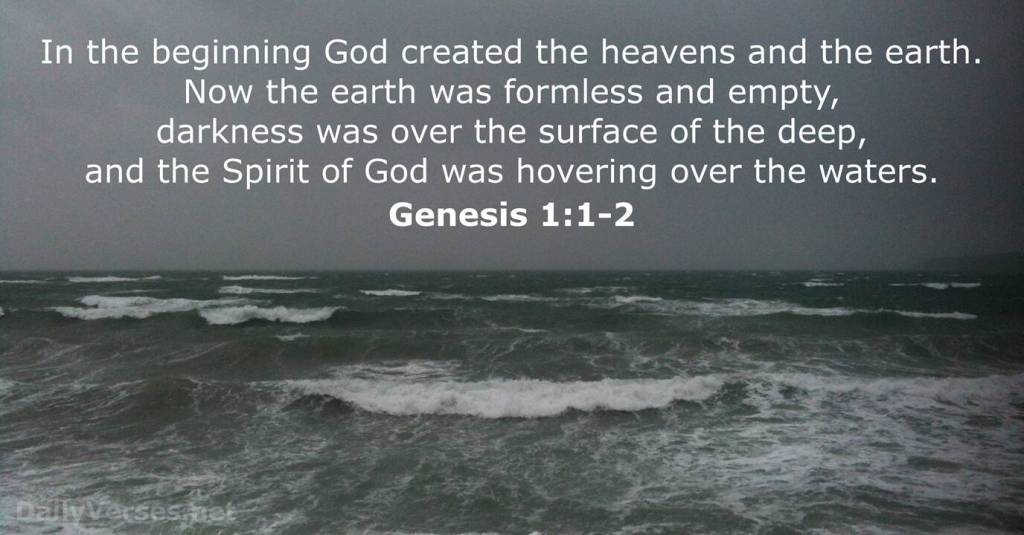
1 In the beginning God ([a]Elohim) [b]created [by forming from nothing] the heavens and the earth. 2 The earth was [c]formless and void or a waste and emptiness, and darkness was upon the face of the deep [primeval ocean that covered the unformed earth]. The Spirit of God was moving (hovering, brooding) over the face of the waters. 3 And God said, [d]“Let there be light”; and there was light. 4 God saw that the light was good (pleasing, useful) and [e] He affirmed and sustained it; and God separated the light [distinguishing it] from the darkness. 5 And God called the light day, and the darkness He called night. And there was [f]evening and there was [g] morning, one day.
The Word of God for the Children of God.
Adeste Fideles! Laeti Triumphantes! Venite Adoremus! Dominum.
Gloria! In Excelsis Deo! Alleluia, Alleluia, Alleluia, Amen.
“I believe in God,
the Father Almighty,
Creator of heaven and earth,”
The first verse of Genesis begins with the greatest observable fact known to man: the existence of the universe, the heavens and the earth,
(Genesis 1:1b); and it links to that the greatest fact made known by revelation:
“I Believe in the existence of a God who creates.”
There is thus brought together in this simple verse at the beginning of the Bible the recognition of the two great sources of human knowledge:
nature, which is discoverable by the five senses of our physical life; and revelation, which is discoverable only by a mind and heart illuminated and taught by the Spirit of God.
These things “are spiritually discerned,” says the Apostle Paul (1 Corinthians 2:14 Amplified).
14 But the natural [unbelieving] man does not accept the things [the teachings and revelations] of the Spirit of God, for they are foolishness [absurd and illogical] to him; and he is incapable of understanding them, because they are spiritually discerned and appreciated, [and he is unqualified to judge spiritual matters].
Both of these sources of knowledge are from God, and each of them is a means of knowing something about God.
The scientist who studies nature is searching ultimately for God.
One Christian scientist declared, “I am thinking the thoughts of God after him.”
That is an excellent way to describe what science basically is doing.
Also, those who seek to understand the Bible, to grasp its great themes and to understand the depths that are revealed there, are likewise in search of God.
Nature is designed to educate and teach humanity certain facts, truths, about God, but revelation is designed to lead us to the God about whom nature speaks.
So the two are ultimately complementary.
They are not contradictory in any sense, but definitively complete one another.
Genesis 1:3-5 – The First Day: “And God Said …”
Repeatedly throughout Genesis 1 we read those words, “God said,” followed by an act of creation.
God speaks and it is there.
God creates by speaking.
What does this mean?
In seeking an answer, we must be governed by what Scripture tells us.
Several passages come to mind.
One can think of Psalm 33:8 and 9. “By the word of the LORD, the heavens were made and all their host by the breath of His mouth … He spoke and it came to be; He commanded and it stood forth”
(compare also Psalm 148:5b, “…He commanded and they [His created works] were created”).
God created by His word.
What was involved with the creation by the Word is made clearer as we go to the New Testament.
As the reader of Scripture knows, “the Word” is a name for the Son who was involved in the work of creation!
“In the beginning was the Word, and the Word was with God, and the Word was God. He was in the beginning with God; all things were made through Him, and without Him was not anything made that was made … And the Word became flesh and dwelt among us full of grace and truth; we have beheld His glory, glory as of the only Son from the Father” (John 1:1-3, 14; cf. 1 John 1:1-3; 5:1; Revelation 19:13).
The reference to the Word in creating is further also illuminated by 1 Corinthians 8:8,
“Yet for us there is one God, the Father, from whom are all things and for whom we exist, and one Lord, Jesus Christ, through whom are all things and through whom we exist.”
One can also think of Colossians 1:17 and 18, “For in Him all things were created, in heaven and on earth, visible and invisible, whether thrones or dominions or principalities or authorities – all things were created through Him and for Him. He is before all things, and in Him all things hold together” (cf. Revelation 3:14).
If we read the words “and God said” in Genesis 1, in the light of Scripture, then what is not immediately obvious in Genesis 1, becomes more clear elsewhere.
God’s creating by the word involved the Son.
The word that God spoke was not without content.
It was a powerful and living word.
The word by which He called into being things from nothing was powerful for it was spoken in and through the Son.
I believe in God,
the Father almighty,
Creator of heaven and earth,
and in Jesus Christ, his only Son, our Lord,
“‘Let there be Light’ and there was Light”
After God’s creation of heaven and earth, His first work of creation was light.
Light as we know it is part of creation. It was made. God spoke and it was there.
The importance of light is evident, not only from its place in God’s work of creation, but also from our own experience.
Who can imagine the possibility of life without light?
It is significant that light was created independently of the sun, moon, and stars which were created on the fourth day.
Although I hope to be coming back to this in a future devotion, suffice it for now to note that I would have thought there was a time when men said that this was a scientific error, but I guess men do not, would not, speak like that anymore.
Rather than my trying to ridicule or dismiss this order, or try to explain it, or put it on “social media” trial we should carefully try, consider the implications of this sequence of God’s first creating light and later the sun, moon and stars.
This order of God’s creation work reveals to us that all light comes from God.
God spoke into the prevailing darkness, light was revealed, the light – made it.
Light does not come in the first instance from the sun, the moon or the stars.
Light is a gift of God, not of the sun!
What a tremendous revelation!
What a tremendous gospel revelation this is for our naturalistic age in which people speak so freely and so scientifically of the sun, moon stars, as if alone, in the absence or dismissal or ridicule of their Creator, makes all of life possible.
For this reason people can even fret about the future horror of a spent sun.
For Israel this order of God’s creating activity was also of great comfort over against the host of pagan religions which regularly worshipped the sun.
It is not the sun, which is a part of creation, but the Creator, the Creator’s Son, who alone gives light, who alone is the Light (John 8:12) who is to be adored.
Jesus Is the Light of the World
12 Once more Jesus addressed the crowd. He said, “[a]I am the Light of the world. He who follows Me will not walk in the darkness, but will have the Light of life.”
“And God saw that the light was good; and God separated the light from the darkness” (Genesis 1:4).
God’s work was pleasing in His eyes.
It was as He wanted it to be so that the light could serve the purpose for which it was made.
Notice that the phrase “God saw that… (it) was good” was not used with verse 2 where we read:
“The earth was without form and void and darkness was upon the face of the deep.”
God’s creation was not yet as He wanted it.
The earth was not yet suitable for the purpose for which God had summoned it away from the prevailing darkness of chaos, ultimately then called it into being.
The fact the created light was pleasing to God doesn’t mean an end to darkness.
No. God makes a separation between light and darkness.
Each gets its proper place in the Created order.
God had made both (Psalm 104:20 Amplified; Isaiah 45:7 Amplified).
20
You [O Lord] make darkness and it becomes night,
In which prowls about every wild beast of the forest.
7
The One forming light and creating darkness,
Causing peace and creating disaster;
I am the Lord who does all these things.
Both are absolutely needed.
Both are absolutely required.
Think, for instance, of how darkness helps in sleeping!
What the place of light and darkness is, is clear from verse 5.
“God called the light Day and the darkness He called Night” (Genesis 1:5a).
It appears from this verse that the light which God had made functioned in a way similar to the sun; that is, it was not always going, required to be daytime.
Also nighttime was to have its regular place.
It has been suggested that this could point to a light source outside and beyond the world with the earth rotating.
In any case, the fact that God assigned names to the periods of light and periods of darkness is significant.
This reveals God’s power and sovereignty.
Think of Psalm 74:18a, “Thine is the day; Thine also the night.”
God made the separation between light and darkness and God gave each their name and God made known to man of these names through His spoken Word.
“And there was evening and there was morning, the first day” (Genesis 1:5b); that is nighttime and daytime making one day.
From Exodus 20:11 Amplified we know God created heaven and earth in six days.
11 For in six days the Lord made the heavens and the earth, the sea and everything that is in them, and He rested (ceased) on the seventh day. That is why the Lord blessed the Sabbath day and made it holy [that is, set it apart for His purposes].
We may therefore probably assume that the first day began in darkness with God’s work of creation in the beginning (vv. 1, 2).
This darkness was followed by the creation of light.
The first day ended with the coming of evening, which was counted with the following day (Genesis 1:8; similarly with the other days, vv. 13, 18, 23, 31).
In view of the way the first day was made, it is understandable the Bible reckons a day from evening to evening (e.g., Leviticus 23:32; Psalm 55:17; Luke 23:53-54).
32 It is to be to you a Sabbath of complete rest, and you shall humble yourselves. On the ninth day of the month at evening, from evening to evening you shall keep your Sabbath.” (Amplified)
17
Evening and morning and at noon I will complain and murmur,
And He will hear my voice. (Amplified)
53 And [after receiving permission] he took it down and wrapped it in a linen [burial] cloth and laid Him in a tomb cut into the rock, where no one had yet been laid. 54 It was the day of preparation [for the Sabbath], and the Sabbath was dawning. (Amplified)
There was a Day When Everything Was New
Genesis 1:1-5 The Message
Heaven and Earth
1 1-2 First this: God created the Heavens and Earth—all you see, all you don’t see. Earth was a soup of nothingness, a bottomless emptiness, an inky blackness. God’s Spirit brooded like a bird above the watery abyss.
3-5 God spoke: “Light!”
And light appeared.
God saw that light was good
and separated light from dark.
God named the light Day,
he named the dark Night.
It was evening, it was morning—
Day One.
Once, the whole world was new.
Out of nothing, God spoke, God created the heavens and the earth.
The Bible describes the process of creation:
God spoke, and the world came into being.
And what God made was good.
It shone with delightful diversity, reflecting the richness of God’s character.
We do not always see the goodness and brilliance of God’s creation because sin and brokenness obscure our vision, bring decay to what was once brand-new.
Every day, our complete delight in the newness of God’s work just wears off.
So, daily, we need our attention called back to the character of the Creator.
Genesis tells us that God can and does bring goodness and light out of chaos, and in this way God blessedly assures us that the world is firmly in his control.
In all of the coming coming days and years ahead of us, we will all, without any exceptions, face times when the newness of our abundant blessings wears off, when the brokenness of our lives keeps us from receiving each day as a new gift.
When that happens, let’s remember that God spoke, God made all things good, and let’s just trust that He has the power to make all things new and good again.
In the name of God, the Father and God the Son and God the Holy Spirit,
Let us Pray,
Creator God,
As we are made in Your image, we give You thanks for the seed of creativity You planted within each person. We praise You for the clean lines of the sculpture, the complexity of the musical concerto, beauty, eloquence of the poet’s spoken words.
Grant us, we pray, the greater capacity to more fully appreciate creativity where we don’t always notice it: the perfectly clean and useful lines of a row of coat hangers with our wardrobes of praise hanging up neatly and orderly in our closets, say, or the complexity of a computer that brings the world to our doorsteps, crashes (some days) but most days does not, or the beauty in a text message carrying everyday news.
Forgive, us we pray, for those times when we have sadly squandered with aimless disregard our capacity to create, and for those times we have used our creativity as a force for destruction rather than reconciliation and reparation. Help us truly to live in deep appreciative awe of the creativity that you’ve already planted within each of us.
Give us the patience and courage to nourish that creativity, and the strength and truest persistence to express it, witness to it, everyday. In Your name we pray.
Adeste Fideles! Laeti Triumphantes! Venite Adoremus! Dominum.
Gloria! In Excelsis Deo! Alleluia, Alleluia, Alleluia, Amen.
 Loving God, Living God, Loving Hope, Living Hope, Loving Living Life His Way! "Many things are possible for the person who has hope. Even more is possible for the person who has faith. And still more is possible for the person who knows how to love. But everything is possible for the person who practices all three virtues." - Brother Lawrence (1605-1691), Practicing the Presence of God (1692).