Advent Week Two: For unto Us a Son is Given. The Hope of Our Salvation!

One day, God came into this world to become our Savior. So that He could be the blameless lamb who was slain for our sins. He who knew no sin, became sin, so we should be saved. One day God came into this world with the fullness of love.

Isaiah 9:6-7 AKJV

For unto us a child is born, unto us a son is given:
and the government shall be upon his shoulder:
and his name shall be called Wonderful, Counsellor,
The mighty God,
The everlasting Father,
The Prince of Peace.
Of the increase of his government and peace there shall be no end,
upon the throne of David, and upon his kingdom,
to order it, and to establish it with judgment and with justice
from henceforth even forever.
The zeal of the Lord of hosts will perform this.

The Word of God for the Children of God. In Excelsis Deo! Alleluia! Amen.

At Our Children’s Center at the church where I was a Lay Pastor, we were supervising the construction of a manger scene in a corner of the classroom. These 4- and 5-year-old students were excited as they set up the little stable and covered the floor with real hay, and then arranged all the figures of Mary, Joseph, the shepherds, the Wise Men, and all the animals. And in the middle was a tiny little crib, in which the tiny figure of the infant Jesus rested.

But one little boy walked up beside me and said he just couldn’t understand something. I asked him what that was as he was absolutely confused. He kept returning to the manger and stood there with his small, puzzled face. The teacher noticed him and asked, “Is anything wrong? Do you have a question?”

The boy replied, “What I’d like to know is: why is everything so small? What do you mean the teacher asked him? he said, “How will God fit in a small manger?” A very large and insightful question from such a small and very inquisitive boy!

How would we respond to such a question ourselves?

One day, all of God entered our teeny tiny world as a newborn baby in a manger.

But why did the God of heaven come down as a human infant? Could He have not come down from heaven with all His glory? The Book of Hebrews 5:8 says, “that though He was a Son, yet He learned obedience by the things which He suffered.” Jesus was made perfect and learned obedience through suffering.

This does not mean Jesus did not know obedience before His incarnation, or that his human flesh was not perfect. He is eternally perfect and always united, in will, with the Father. Rather, when Jesus left the throne of heaven and put on humanity, He experienced the frail and sinful nature of man.

He would have experienced all of the hunger, exhaustion, pain, sweat, and temptation any man did. He was tempted, but did not sin, for He was pure and filled with holiness. It was through this method, that Jesus became the lamb who was slain for our sins. A pure and sinless lamb who was slain for our sins.

Today, let us meditate on the day salvation was born on this earth. Jesus is the reason for the season. Let us meditate on 3 points: God came to the world as a tiny baby, God came to be our Savior, and God came with fullness of love.

God Came to be our Savior

Jesus came to the world as an infant, but He grew in wisdom and stature. He didn’t stay as a baby. He became a man; dedicated to sharing the good news of the Father for others. Just ask the angels what they think of Jesus, they will tell you: “A Savior has been born unto you, He is Christ the Lord.” Luke 2:11

• Ask John the Baptist and he will tell you, “Behold the Lamb of God who takes away the sins of the world.” John 1:29

Ask the apostle Paul, what do you think about Jesus? He will tell you, “That nothing compares to the surpassing greatness of knowing Christ Jesus my Lord.” Philippians 3:8

• Ask the Roman Centurion what he thinks of Jesus, he will tell you. “Surely this is the Son of God.” Matthew 27:57

• Ask Peter, what do you think about Jesus, and he will tell you. “God has made this same Jesus, whom you crucified, both Lord and Christ.” Acts 2:39

We celebrate the fact that God came to us as a tiny baby, but we also celebrate that this tiny baby became our Savior, who saved us from the chains of sins and death. The night Jesus was born, angels came to shepherds near Bethlehem, and one said, “I bring you good news of great joy.” That was a very happy greeting.

Since Thanksgiving, our shopping malls have been telling us that “It is the most wonderful time of the year.” And it surely is – for at least some of them. For many others, however, it can have many mixed emotions. Christmas is not the same as it was when we were those children in Sunday School. As an adult, we see it is different, sometimes it can be economically difficult, buying so many gifts. This year especially, because many people have lost their jobs due to the virus and the Pandemic. This year a lot of families have lost their loved ones.

Perhaps, this year, we have not been able to go on the plans we had for Christmas, due to Covid-19 safety. There are many family members working in the healthcare force. There are many people this year who have been affected, directly and indirectly, by Covid-19 and cannot see their family during Christmas. And sadly, there are many who have lost their loved ones this year. But even through all the struggles, God finds a way to put joy and peace in our hearts.

In this Christmas season, hopefully we should remember the good gifts that the Creator has given us: the sun, the moon, and this good earth. All the blessings of the earth: the sky, the waters, plants and animals. And shall we all glorify Him for this incredible gift of life: of flesh and blood and of breath and memory. Every moment we have lived in our lives, through both joy and sorrow, God yet gives us meaning to our lives and proves that we are fully human and fully alive. And, above all, we must remember the gift of when the Word became flesh and was sent to save us, to heal us, to bring us joy, and to bring us back unto God.

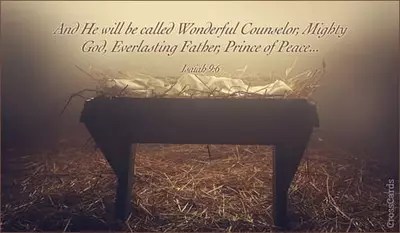
God’s prophet Isaiah, speaking on behalf of God, had prophesied hundreds of years before, in Isaiah 9:7 “For unto us a child is born, unto us a son is given, and the government will be on his shoulders. And he will be called Wonderful Counselor, Mighty God, Everlasting Father, Prince of Peace.”

And guess what? One day, an infant named Jesus came, just as God promised.

Those are magnificent descriptions of the long-awaited Messiah. “Wonderful Counselor, Mighty God, Everlasting Father, Prince of Peace.”

He is first called “Wonderful Counselor.” James 1:5 says, “If any of you lacks wisdom, you should ask God, who gives generously to all without finding fault, and it will be given to you.”

He is called “Mighty God.” Colossians 1:15-16, “He is the image of the invisible God, the firstborn over all creation. For by Him all things were created that are in heaven and that are on earth, visible and invisible, whether thrones or dominions or principalities or powers. All things were created through Him and for Him.”

He is called “Everlasting Father.” Romans 8:16-17, “The Spirit Himself bears witness with our spirit that we are children of God, and if children, then heirs—heirs of God and joint heirs with Christ, if indeed we suffer with Him, that we may also be glorified together.”

And He is called “Prince of Peace.” Philippians 4:6, “Be anxious for nothing, but in everything by prayer and supplication, with thanksgiving, let your requests be made known to God; and the peace of God, which surpasses all understanding, will guard your hearts and minds through Christ Jesus.”

Our Savior, our Messiah, and our redeemer was born to us. “For unto us a child is born, unto us a son is given, and the government will be upon his shoulders. (Isaiah 9:6)” Can there be a more perfect place to be on Christmas, than God’s house? Can there be a more perfect story than the story of the first Christmas?

God Came to the World as a Tiny Baby

The Creator of the universe loved us enough to come into our world. And He did it not in power, but in the most helpless disguise possible: that of an infant. The Bible says, in Acts 3:26 “Unto you first God, having raised up his Son (child) Jesus, sent him to bless you, in turning away every one of you from his iniquities.” KJV.

Now the way that God came into the flesh is a great marvel and mystery. The Apostle Paul himself called it that. “And without controversy great is the mystery of godliness: God was manifested in the flesh.” (I Tim. 3:16a) It is a marvelous event, a magnificent event, a majestic event.

John Phillips, the great English Bible scholar and Teacher, 1906-1982, (https://www.goodreads.com/author/show/5604570.J_B_Phillips) once said, “The great mystery of the manger is that God should be able to translate deity into humanity without discarding the deity or distorting humanity.”

One day, God came into this world to become our Savior. So that He could be the blameless lamb who was slain for our sins. He who knew no sin, became sin, so that we ought to be saved. God came into this world with the fullness of love.

However, there were a lot of trials and tribulations that laid between that the birth of Christ and the joy and salvation it promised. For the new-born child, trials and sufferings began almost immediately.

When He was just a baby, a jealous king tried to kill him.

When He grew up, the people of Nazareth threw Him out of their city.

He became a wandering teacher – homeless, often hungry, and weary, tempted and tried. He was hated, accused, denied, and betrayed.

At last, there came one Friday when a wreath of thorns was pressed down hard on his head, and He was spat upon, scourged with whips, nailed to a cross, and by mid-afternoon He was dead. Before sundown, His body was placed in a tomb.

However, through all the sufferings, the story does not end there. On the first Sunday following his burial, very early in the morning, Jesus met His friends outside the tomb, and His first word was this: the Greek word “Chairete.” Which means “All Hail” “Joy be to you!” “Be of good cheer!” Matthew 28:9

https://www.blueletterbible.org/kjv/mat/28/9/t_conc_957009 https://www.blueletterbible.org/lexicon/g5463/kjv/tr/0-1/

This greeting was a happy one. Jesus fulfilled the message of joy which angels had declared more than thirty years before. And now, here today, nearly 2,000 years later, we still echo that theme again: “Be of good cheer: we bring you good news of great joy!” God came to be our Savior.

We spend so much time on things from popular culture and old folk stories, that we may accidentally overshadow the true meaning of Christmas. Christmas is a time for celebrating the day when heaven came down for us. The day God sent His only son as a lamb for our sins, so that we may also be called His children.

One moment He lived in glory, then in another moment, but gave it all up to become a tiny baby, who then became a grown man who suffered and died for the sins of the world. That humble baby in that tiny manger became our Savior.

He Came with the Fullness of Love

“For unto us a Child is born, unto us a Son is given; And the government will be upon His shoulder (Isaiah 9:6).” As a child of man, Jesus was born; but as the Son of God, Jesus was given. Notice the Son was not born, the Son was given.

Let us read the greatest verse in the Bible, “For God so loved the world that He gave His only begotten Son, that whoever believes in Him should not perish but have everlasting life.” (John. 3:16) God’s very first Christmas gift to the world was a newborn baby boy of deity wrapped snuggly in a frail package of humanity.

This tiny baby gave Himself for us. He stepped down from the throne of glory to carry our burdens. And for only one reason: God loves us, ALL of us. So, today, continue to contemplate the Prophecy, and give God the glory due to His name.

Many of us may have experienced troubles and struggles this year. This year has been a hurdle for many of us. However, the seasons of Advent and Christmas are a faithful, faith-filled, a hopeful, hope-filled reminder of God’s love for you.

No matter what struggles you and I may face during these Pandemic times, God is there working in your midst. He came into this world, so that you may have salvation, that you may have eternal life, be a part of His family and kingdom.

Welcome the depths of this Prophecy of God. So that He, the baby can live within you. So that no matter what difficulties we face, we know we are not alone, and we are loved. We are loved by the creator of the heavens and earth.

One day, God came into this world to become our Savior. So that He could be the blameless lamb who was slain for our sins. He who knew no sin, became sin, so that we ought to be saved. God came into this world with the fullness of love.

God came into this world as a humble and helpless infant. He did not come into this world with all His glory but came through the humble form of humanity.

For the sake of an indescribable, immeasurable love, He took on the fragile and sinful nature of human flesh. God came into this world to become our Savior. So that He could be the blameless lamb who was slain for our sins. He who knew no sin, became sin, so that we may be saved. God came into this world with the fullness of love. For we did not deserve His mercy, but still, He gave it to us through His grace. And by His grace, our sins and darkness are washed away.

In the name of Yahweh, the Father, Yahweh the Son, Yahweh the Holy Spirit,

Let us enter His presence with this prayer, with fervent hope for our Salvation.

Psalm 24 The Message

24 1-2 God claims Earth and everything in it,
    God claims World and all who live on it.
He built it on Ocean foundations,
    laid it out on River girders.

3-4 Who can climb Mount God?
    Who can scale the holy north-face?
Only the clean-handed,
    only the pure-hearted;
Men who won’t cheat,
    women who won’t seduce.

5-6 God is at their side;
    with God’s help they make it.
This, Jacob, is what happens
    to God-seekers, God-questers.

Wake up, you sleepyhead city!
Wake up, you sleepyhead people!
    King-Glory is ready to enter.

Who is this King-Glory?
    God, armed
    and battle-ready.

Wake up, you sleepyhead city!
Wake up, you sleepyhead people!
    King-Glory is ready to enter.

10 Who is this King-Glory?
    God-of-the-Angel-Armies:
    he is King-Glory.

https://translate.google.com/

Advent Week Two: For a Child will be Born to us, a Son will be Given to us; the Prince of Peace. The Government Will Rest Squarely on His Shoulders.

Politics and government. We seem to see them as necessary evils, bringing ceaseless frustration in the present but still giving us hope for the future. Our contradictory attitudes about politics and government are most revealing. We recognize the failure of human solutions, but at the same time we surely know something must be done to fix what’s broken in our nations and the world. What man cannot do; what man could not do; God has done; He’s given the Messiah.

Isaiah 9:6-7 NASB

For a Child will be born to us, a Son will be given to us;
And the government will [a]rest on His shoulders;
And His name will be called Wonderful Counselor, Mighty God,
Eternal Father, Prince of Peace.
There will be no end to the increase of His government or of peace
On the throne of David and over [b]his kingdom,
To establish it and to uphold it with justice and righteousness
From then on and forevermore.
The zeal of the Lord of armies will accomplish this.

The Word of God for the Children of God. In Excelsis Deo! Alleluia! Amen.

Isaiah 9:6 may be the most familiar Old Testament prophecy about the birth of Christ. Handel included those words in one of the great choruses of his Messiah oratorio. Chances are excellent that sometime during this season of Advent you will either sing it or hear it several times on your radio this Christmas season.

Unfortunately, we only seem to pull this passage out of the box only during the Advent and Christmas season. It’s like one of the ornaments we use to decorate our houses. But have we ever truly thought about the rich truth this single verse teaches concerning the King of kings? Though we still await the full realization of His kingdom, the promised Messiah is the single greatest political ruler ever.

Do we remember that Isaiah wrote this prophecy at least a hundred years before Israel was taken into Babylonian captivity—nearly 600 years before the birth of Immanuel, God with Us, God within us, our Savior! Looking back at a litany of failed monarchs, and sitting in the rubble of Israel’s monarchy, Isaiah looked across the centuries to a time when God would rule on earth through His Son.

“A child will be born to us” underscores the Messiah’s humanity. He had to come to earth as a human being, from the depths of eternity, in the form of a child, so He could endure the temptations men face, yet be without sin (Hebrews 4:15).

“A son will be given to us” implies the Savior’s deity. He existed before His birth as the second Person of the Trinity: “Although He existed in the form of God, did not regard equality with God a thing to be grasped, but emptied Himself, of literally everything; taking the form of a bond-servant, and being made in the likeness of men” (Philippians 2:6-7). He came unto us as the Son of God—God in human flesh—to conquer sin and death forever (John 3:16-17), to live again!

“The government will rest on His shoulders” affirms His absolute lordship. This verse looks to a time still (God knows) somewhere in the future when Christ will reign over a literal, earthly, geopolitical kingdom that encompasses all of the kingdoms and governments of the world (Daniel 2:44; Zechariah 14:9).

In that day, the government of the entire world will rest on His shoulders. But until that time, His kingdom is unseen, an invisible form (Luke 17:20-21). The Messiah’s rule is over those who trust Him and obey Him as Lord. It’s currently an invisible kingdom but will one day become visible and universal as His rule extends even over those who do not acknowledge His lordship in their hearts.

What kind of kingdom is it? What distinguishes the Messiah’s kingdom from the other kingdoms of this world? The names Israel used for Christ each hint at four very distinct characteristics which make the Messiah’s kingdom—in all its manifestations—so welcomingly different from any other earthly government.

Pray and consider this, at this time when the world is weary and despairing of political solutions, when the political future looks bleak, this is welcome news.

No Confusion—He Is a Wonderful Counselor

First, this kingdom is free from confusion, because Christ is characterized as a “Wonderful Counselor.” The King James Version separates “Wonderful” and “Counselor” with a comma, but the words seem to go better together and appear that way in most modern versions and other translations of the Bible.

Every now and then, a politician, political affiliation notwithstanding, comes on the scene who “possesses”, according to some, messiah-like qualities. Whether it’s a reference to speaking their ability, charisma, or wisdom, it is certainly an ego massaging compliment. However, when you compare the greatest social or political leader with Jesus Christ, you will discover there is no comparison at all.

During His incarnation, Christ demonstrated His wisdom as a counselor. While I was writing The Gospel According to Jesus, I studied every major encounter Jesus had with individuals who came to Him for counsel. He always knew what to say, when to reach out to a seeking heart, and when to rebuke an impetuous soul.

Even his enemies testified, “Never did a man speak the way this man speaks” (John 7:45-46 NASB).

45 The officers then came to the chief priests and Pharisees, and they said to them, “Why did you not bring Him?” 46 The officers answered, “Never has a man spoken in this way!”

As God incarnate, Christ is the source of all truth. Jesus said, “I am 1000% the way, and the truth, and the life” (John 14:1-6). No politician can match that! It is He to whom we must ultimately turn and trust His loving rule of our lives.

Many of our politicians turn everywhere else but God for counsel. They go to one another; they listen to special interests; they have their own psychologists, psychiatrists, analysts, philosophers, spiritual advisors, gurus, astrologers, and other allegedly “highly educated subject matter expert” human counselors. But the King of kings keeps His own counsel. After all, “Who has directed the Spirit of the Lord, or as His counselor has informed Him?” (Isaiah 40:12-15 NASB).

12 Who has measured the [a]waters in the hollow of His hand,
And measured the heavens with a [b]span,
And [c]calculated the dust of the earth with a measure,
And weighed the mountains in a balance
And the hills in a pair of scales?
13 Who has [d]directed the Spirit of the Lord,
Or as His counselor has informed Him?
14 With whom did He consult and who gave Him understanding?
And who taught Him in the path of justice and taught Him knowledge,
And informed Him of the way of understanding?
15 Behold, the nations are like a drop from a bucket,
And are regarded as a speck of dust on the scales;
Behold, He lifts up the [e]islands like fine dust.

The Messiah is the Wonderful Counselor because He is God, the source of truth. When He rules the earth, there will be no uncertainty in his administration. He is the ultimate and only true answer to all manifestations of political confusion.

No Chaos—He Is the Mighty God

Second, the Messiah’s kingdom is singularly free from chaos because He is the Mighty God. He is the One who in creation brought perfect order out of chaos.

Scripture says, “God is not a God of confusion but of peace” (1 Corinthians 14:33). Chaos is antithetical to who He is. He is a God of order. Christ the King is orderly, and He brings order to the troubled lives of all who surrender to Him. In other words, He not only tells His subjects what to do as a Wonderful Counselor, but since He is the Mighty God, He can also energize them to do it.

Legislation can go only so far; it stops short of providing the power and the will to obey. Because of the sinful nature, people will always strain against law and order (Romans 7:7-13).

Add human fallibility to the inability to make people obey from the heart, and you can see the severe limitations of political and legislative solutions.

But when Jesus Christ comes to rule this earth, He’ll display His divine power by bringing order to the chaos. Those who do not submit to His leadership from the heart, He will subjugate with a rod of iron (Psalm 2:9; Revelation 2:27; 12:5 and 19:15). Those who humble themselves from the heart, bowing to Him as Lord and Savior, will find the power of the Mighty God unleashed in their lives to help them humble themselves in His presence and obey His commandments.

Because Christ is God, He can forgive sin, defeat Satan, liberate people from the power of evil, redeem them, answer their prayers, restore their broken souls, and reign as Lord— “Mighty God”—over their newly ordered lives.

That’s a politician this world has never seen and will never hope to witness to.

No Complexity—He Is the Father of Eternity

In comparison and contrast to human governments, the Messiah’s kingdom is uncomplicated because He is the “Eternal Father.” The phrase literally means, “Father of Eternity.”

That is a clear reference to the biblical truth that Christ is Creator of heaven and earth. In Hebrews 1:10-12 God the Father says to Christ the Son, “You, Lord, in the beginning laid the foundation of the earth, and the heavens are the works of Your hands; they will perish, but You remain; and they all will become old like a garment, and like a mantle You will roll them up; like a garment they will also be changed. But You are the same, and Your years will not come to an end.”

Nothing is too complex for the Creator and Sustainer of everything.

Infinity and all its intricacies and nuances are nothing to Him who is the Alpha and Omega, the First and the Last, the Beginning and the End.

Human life is getting more and more complex. Technology has so improved communication and transportation that commerce, culture, and religion have become global in nature. And rather than organizing and making sense of it all, governments of the world seem to exist primarily to make things more virtual, more complicated than it needs to be. We build bureaucracies to deal with the complexities of life—and consequently life only just grows more perplexing.

Messiah’s government, however, is simple and uncomplicated. He is the sole ruler—no bloated bureaucracy—and He knows the end from the beginning because He is the Father of Eternity.

Isaiah, prophesying about the kingdom, wrote of the highway of holiness: “The unclean shall not pass over it; but it shall be for those: the wayfaring men, though fools, shall not err therein” (Isaiah 35:8 KJV). His way is so free from the complexities of life that even the greatest of all fools cannot lose their way.

That kind of simplicity characterizes Messiah’s entire government. As the Father of Eternity, He alone comprehends the complexities of time and eternity. He requires no bureaucracy; He shoulders His government by Himself.

No Conflicts—He Is the Prince of Peace

Finally, in the Messiah’s kingdom there are no conflicts because He is the Prince of Peace.

He offers peace from God (Romans 1:7) to all who are the recipients of His grace. He brings peace with God (Romans 5:1) to those who surrender to Him in faith. He brings the peace of God (Philippians 4:7) to all of those who walk with Him.

There never really has been peace on earth in the sense we think of it. Wars and rumors of wars have always characterized these entire two millennia since the announcement at His birth of peace on earth (Luke 2:14).

Did you ever take the time realize that angelic announcement of peace on earth was a two-pronged proclamation? First, it proclaimed that God’s perfect peace is available to men and women and children right now. Read the words of Luke 2:14 much more carefully, diligently, and prudently: “Glory to God in the highest, and on earth peace among men with whom He is pleased” (my emphasis added.)

Who are those with whom He is pleased? They are those who have yielded their lives to the authority of His government: “The Lord taketh pleasure in them that fear him, in those that hope in his mercy” (Psalm 147:7-11 AKJV).

Sing unto the Lord with thanksgiving;
sing praise upon the harp unto our God:
who covereth the heaven with clouds,
who prepareth rain for the earth,
who maketh grass to grow upon the mountains.
He giveth to the beast his food,
and to the young ravens which cry.
10 He delighteth not in the strength of the horse:
he taketh not pleasure in the legs of a man.
11 The Lord taketh pleasure in them that fear him,
in those that hope in his mercy.

Why should we hope in His mercy? Because we are sinners who need His forgiveness (Romans 3:23). We must recognize that fact first of all if we are to place our lives under His government.

We must understand that He gave His own sinless, guiltless life on our behalf. He died for our sins to save us from God’s righteous wrath (Romans 5:6-9). And we must be willing to turn from our sins and embrace Him by faith, realizing that we can never earn His favor (Ephesians 2:8-10).

But secondly, the angel’s announcement of “peace on earth” declared the arrival of the only One who ultimately can bring everlasting peace on earth.

Jesus Christ will bring lasting peace in the final establishment of His earthly kingdom. As we already mentioned, He will ensure “peace on earth” over the rebellious at heart by wielding a “rod of iron.”

There will be no coup d’état, no insurrection, not even the slightest threat to disturb the peace He brings to the world.

Isaiah 9:7 continues, “There will be no end to the increase of His government or of peace.”

In other words, His government and peace will keep expanding and improving.

The hymn “Like a River Glorious” accurately speaks of peace that is “perfect, yet it floweth fuller every day, perfect, yet it groweth deeper all the way.”

How can anything perfect improve?

That’s one of the mysteries of Messiah’s government. It gets better and better, and the perfect peace flows deeper and deeper.

I absolutely look forward to the day when He returns to execute the final political solution which will truly bring world peace.

His is the greatest government because it’s ruled by the greatest ruler—the “Wonderful Counselor, Mighty God, Eternal Father, Prince of Peace.”

He is the only absolute and everlasting hope of mankind.

I also hope the government of your life rests securely and squarely upon His shoulders, that He rules and reigns even now in your heart. Only then will you experience the ever-growing peace that comes only from the Prince of Peace.

In the name of Yahweh, the Father, Yahweh, the Son, Yahweh, the Holy Spirit, let us now come together in an attitude of humility, reverence and prayer.

Thank You, Father, for sending Jesus as the Light of the world to enlighten everyone coming into the world. Thank You in Him is the light of the glorious gospel of grace that can never be quenched by the darkness of this world.

I praise and thank You His Light has come into my life and enlivened my spirit and enlightened my soul. Open my eyes more and more to see Jesus and to grow more like Him. Give me greater understanding of all You have achieved in my life, for without You I would remain in darkness and dead in my sin. Thank You for Your great salvation, to You be glory forever. In the name of Jesus, I pray, Alleluia! Alleluia! Alleluia! Amen.

Advent: “For Unto Us a Child is Born, and Unto Us a Child is Now Given.” A Glorious Messiah, the Messianic Age 

Jesus is our Prince of Peace. A prince is someone in a position of authority and responsibility. He has certain rights that simply no one else has. He takes his responsibility as representative of the people he represents seriously. A prince endeavors to be a person of good character so that those he represents will trust and follow him. Jesus is the ultimate prince of life. There is no flaw in His character, ability to lead, motives for leading, or ability to do good for others.

Jesus gives to us a peace that the world can never give. In the world there is turmoil everywhere. No matter what others may promise us, there can be no peace in the world. The world is governed by evil and will be until Jesus comes.

Looking into the world for peace is utter foolishness and forever futile. The only peace that 100% steadies the soul and enables us to handle life victoriously is the peace that Jesus gives when our sins are forgiven. If there is no peace in the soul, there can be no peace in the world. The promise of our Lord is His peace, a peace that no one can understand except those whose sins have been forgiven.

Unto the end of the ages, His Peace is forever enveloping and surrounding us!

Isaiah 9:6-7 AKJV

For unto us a child is born, unto us a son is given:
and the government shall be upon his shoulder:
and his name shall be called Wonderful, Counsellor,
The mighty God,
The everlasting Father,
The Prince of Peace.
Of the increase of his government and peace there shall be no end,
upon the throne of David, and upon his kingdom,
to order it, and to establish it with judgment and with justice
from henceforth even for ever.
The zeal of the Lord of hosts will perform this.

The Word of God for the Children of God. In Excelsis Deo! Alleluia! Amen.

In spite of all the advances of civilization, the world today is still consumed with a desire for peace and a fear of war. When people observe the conflicts and the rumors of wars, gloom and despair often engulf them like a thick darkness. Not the least of the trouble spots is the Middle East. Peace there has been the pursuit for eons. While there have been scores of efforts to bring about peace between those ancient nations, no one would be surprised if war broke out tomorrow.

Peace movements and peace negotiations proceed all over the world. Stronger countries believe peace must be negotiated from an elevated and lofty position of economic and military power; radical groups believe that terror will force the issue. But we are left with a more dangerous and more frightening world than ever before. And we are left wondering if anyone is really interested in peace and righteousness and justice for all, or just in securing their own interests?

The problem is still the indescribable and immeasurable presence of evil. It sets family members against family members, and it sets nations against nations. Ultimately, the world’s gloom and despair is linked to this spiritual darkness.

The Bible comforts and reminds those of us who have come to trust in Jesus Christ not to despair as if there was no hope. We have the revelation of our Lord that not only announces His sovereign reign but also charts the course of world events. One of the most significant revelations is found in Isaiah chapter Nine.

Against the background of the prophecy of war and destruction, darkness and gloom (chapter 8) Isaiah gave this prophecy about the Messiah—the glorious coming king.

“Messiah” is a Hebrew term that means “anointed one,” that is, the anointed king. In a sense, every king who was anointed in Jerusalem as a descendant of David would be called a mashiah” (pronounced mah-she-ack), a messiah.

But the Bible tells how ultimately a son of David would come who would be known as “the Messiah.” We believe that Jesus Christ is that Messiah.

The New Testament word “Christ” is the Greek translation of the Hebrew word “Messiah.” This Messianic Prophecy, then, holds out hope for both peace and righteousness through the reign of Jesus the Messiah.

The text can be divided into two sections: the Dawn of the Messianic Age (verses 1-5) and the Righteous Reign of the Messiah (verses 6 and 7).

Isaiah 9:1-7 AKJV

Nevertheless the dimness shall not be such as was in her vexation, when at the first he lightly afflicted the land of Zebulun and the land of Naphtali, and afterward did more grievously afflict her by the way of the sea, beyond Jordan, in Galilee of the nations.

The people that walked in darkness have seen a great light:
they that dwell in the land of the shadow of death,
upon them hath the light shined.
Thou hast multiplied the nation, and not increased the joy:
they joy before thee according to the joy in harvest,
and as men rejoice when they divide the spoil.
For thou hast broken the yoke of his burden, and the staff of his shoulder,
the rod of his oppressor, as in the day of Midian.
For every battle of the warrior is with confused noise, and garments rolled in blood;
but this shall be with burning and fuel of fire.
For unto us a child is born, unto us a son is given:
and the government shall be upon his shoulder:
and his name shall be called Wonderful, Counsellor,
The mighty God,
The everlasting Father,
The Prince of Peace.
Of the increase of his government and peace there shall be no end,
upon the throne of David, and upon his kingdom,
to order it, and to establish it with judgment and with justice
from henceforth even for ever.
The zeal of the Lord of hosts will perform this.

While the entire passage is instructive for the message, the verses which focus on the nature of the Messiah are undeniably critical for our devotional today, for therein lies our genuine hope for everlasting peace. So most of our attention will be given solely to the meanings of the name of the Son, showing how these description fit perfectly the nature of our Lord and Savior Jesus Christ.

I. PEACE WILL COME WITH THE DAWN OF THE MESSIANIC AGE (9:1-5).

Isaiah declares that in contrast to his present age of war, gloom, and despair, there is coming an age when peace will reign universally. It will begin with the coming of the Messiah, the promised future king. So we call that period the Messianic Age. The prophet Isaiah here shows how it will unfold.

A. THE CHANGE IN CIRCUMSTANCES WILL END THE DESPAIR (1,2).

The passage begins with the announcement of the change: there will be no more gloom for those in anguish; in the past the LORD humbled the northern lands of Zebulun and Naphtali, but in the future he will honor Galilee. Why? That is where the Messiah will first appear—Galilee of the Gentiles, a place looked down on for so long as less spiritual, less pure than Judea.

The explanation of this exaltation is found in verse 2. Those who walk in darkness have seen a great light, on those in the land of the shadow of death a light has dawned. The language is poetic: darkness signifies adversity, despair, gloom and evil, and the light signifies prosperity, peace, and joy. 

The language is used elsewhere of the Messianic Age—Malachi says that the “sun of righteousness will rise with healing in his wings” (4:2).

So the people in the north who have suffered so much have the prospect of a wonderful new beginning.

We should note in passing Isaiah’s verbs are in the past tense—he writes as if it has already happened. That is prophetic language. The prophet was a “seer” or visionary. He received divine revelation and recorded what he saw. As far as he was concerned, if it had been shown to him from God, it was as good as done. It was certain, even though it had not yet worked out in history.

So “light” will shine on people who were walking in “darkness.” The initial fulfillment of this prophecy is beyond doubt. Matthew quotes this text in conjunction with the beginning of Jesus’ ministry in Galilee. He is the true light of the world that lights every person. (Matthew 4:12-16) 

From the beginning of His ministry, Jesus brings to a darkened world grace and truth, and the sure promise of peace. When He began to minister in Galilee with His teachings, His Rabbinical leadership and His miracles, He demonstrated He was indeed this Messiah. His proclamation of the kingdom through salvation is what ends the despair, for believers in Him are not lost in gloom and despair, for they know that what He promised will come to pass at His second coming.

B. THE MESSIAH BRINGS JOY AND PROSPERITY (3).

The prophet turns to address the LORD directly. His words explain what it means that light will dispel the darkness—joy and prosperity will follow. The prophet gives no clue as to how soon this would happen.32 But we who have the full revelation of God know that Jesus made it clear that he was the Messiah, and that the age of peace and righteousness was yet future.

The joy described here is extravagant. It is the kind of joy that comes at the harvest, or at the dividing of the plunder. Harvest was a regular time of joy in Israel; after a long time of labor in the fields the people would gather to eat and drink and celebrate. The Bible often uses the analogy of the harvest to describe the coming of the LORD (see Matthew 3:12) for the harvest and winnowing imagery). It is a thanksgiving celebration for the completion of the harvest.

Dividing the plunder, the other image here, is a bit more poignant since wars will lead up to the end of the age. The image is about the victors after the battle is over, dividing up the booty. Such would be an almost delirious celebration of triumph that would usher in an age of peace.

C. JOY COMES THROUGH THE CESSATION OF WAR (4, 5).

The imagery of joy at the division of the plunder leads directly into the explanation: the prophet foresees the time when the LORD will break the oppression of the enemies. He draws the analogy with the time of Israel’s victory over Midian through Gideon by the power of the LORD. 

So shall it again be.

But this victory will be greater.

Verse 5 says that the implements of war will be burnt up. This will be no lull in the action, no temporary peace treaty.

War will end.

Elsewhere Isaiah has says, “They shall beat their swords into ploughshares,” that is, military weapons will not be needed in a time of lasting peace.

Isaiah 2:1-4 AKJV

The word that Isaiah the son of Amoz saw concerning Judah and Jerusalem.

And it shall come to pass in the last days,
that the mountain of the Lord’s house shall be established
in the top of the mountains,
and shall be exalted above the hills;
and all nations shall flow unto it.
And many people shall go and say,
Come ye, and let us go up to the mountain of the Lord,
to the house of the God of Jacob;
and he will teach us of his ways,
and we will walk in his paths:
for out of Zion shall go forth the law,
and the word of the Lord from Jerusalem.
And he shall judge among the nations,
and shall rebuke many people:
and they shall beat their swords into plowshares,
and their spears into pruninghooks:
nation shall not lift up sword against nation,
neither shall they learn war any more.

How can these things be, given the current world situation as we know it?

The answer to this question is found in the second half of the oracle which describes the nature of the Messiah who will bring in the reign of peace and righteousness.

If such an indescribable measure of peace is to come, someone must have the ability to produce it and maintain it and sustain it throughout all of the ages.

II. PEACE WILL FINALLY COME WITH THE RIGHTEOUS REIGN OF THE MESSIAH (9:6,7).

Isaiah now turns to introduce the One who will transform the gloom and despair of war into the joy and peace of a time of righteousness—the Messiah.

THE LORD WILL BRING ABOUT THE ADVENT OF THE MESSIAH (6A).

The first part of the prophecy is very familiar to Christians: “For unto us a child is born, unto us a son is given, and the government shall be upon his shoulders.” God’s Prophet Isaiah is very precise here, as we now know. A child will be born into the family of David, and that there was a birth in Bethlehem is beyond question; but the Messiah will also be a Son that is given, and that Jesus did not come into existence in Bethlehem is clear from the Bible.

According to the Davidic Covenant (2 Samuel 7:14), the term “son” is a title for the king. The same is true in the vision of Daniel where the expression “Son of Man” is used (Daniel 7:9-14). Daniel’s vision shows this glorious king in the presence of the Almighty, the Ancient of Days, and that he would be given the kingdom of peace. Isaiah announces that the child to be born will be this Son given. This idea is then further clarified by the Apostle Paul: “In the fullness of time, God sent forth His Son, born of a woman … .” (Galatians 4:1-5 AKJV).

4 Now I say, That the heir, as long as he is a child, differeth nothing from a servant, though he be lord of all; but is under tutors and governors until the time appointed of the father. Even so we, when we were children, were in bondage under the elements of the world: but when the fulness of the time was come, God sent forth his Son, made of a woman, made under the law, to redeem them that were under the law, that we might receive the adoption of sons.

The New Testament bears witness that Jesus is this Son who came into the world. In fact, Jesus Himself set about to prove His origin was in heaven, not in Bethlehem. When He was about to raise Lazarus from the dead, he prayed and included these words in His prayer: “that they might know that You sent Me” (John 11:42). By this Jesus meant that He was from above, and they were from below.

Or, in debating with the religious leaders Jesus asked how David could call his descendant his “Lord,” clearly showing that the “Son of David,” the Messiah, was greater than David (Mark 12:35-36), regarding Psalm 110 AKJV.

Psalm 110

A Psalm of David.

The Lord said unto my Lord, Sit thou at my right hand,
until I make thine enemies thy footstool.
The Lord shall send the rod of thy strength out of Zion:
rule thou in the midst of thine enemies.
Thy people shall be willing in the day of thy power,
in the beauties of holiness from the womb of the morning:
thou hast the dew of thy youth.
The Lord hath sworn, and will not repent,
Thou art a priest for ever after the order of Melchizedek.
The Lord at thy right hand shall strike through kings in the day of his wrath.
He shall judge among the heathen,
he shall fill the places with the dead bodies;
he shall wound the heads over many countries.
He shall drink of the brook in the way:
therefore shall he lift up the head.

And of course, to the woman at the well Jesus clearly revealed Himself: she said, “When the Messiah comes, He will declare all things to us.” Jesus said, “I that speak to you am He” (John 4:25-26).

It is clear, then, that Jesus claimed to be the Messiah, the Christ, the child born into the house of David, the Son given by God to be the long expected King.

The first advent of Jesus established His identity; it did not begin His reign, however, for He has yet to put down all enemies.

The prophecy that “the government will be upon His shoulder” will come to complete reality at His second coming—an aspect of the Messianic prophecies that the prophets did not see (see 1 Peter 1:10-11).

The reference to the shoulder is quite probably a reference to the wearing of an insignia of office on the shoulder (Isaiah 22:22)

There will be a time when this Son will rule as king.

We may say that Jesus now reigns above, and that is certainly true.

However, God’s Prophet Isaiah clearly envisions a time of universal peace and righteousness in this world. That has not happened yet. Hebrews 1 states that this exaltation will be complete when the Father again brings His firstborn into the world. So Isaiah does not know when all these things will take place; only that they will happen because the Word of the LORD has declared it, Because the mouth of the Lord has spoken it and God’s Word returns to God 1000% fulfilled!

Isaiah 55:10-11 AKJV

10 For as the rain cometh down, and the snow from heaven,
and returneth not thither, but watereth the earth,
and maketh it bring forth and bud,
that it may give seed to the sower, and bread to the eater:
11 so shall my word be that goeth forth out of my mouth:
it shall not return unto me void,
but it shall accomplish that which I please,
and it shall prosper in the thing whereto I sent it.

Jesus is our Prince of Peace amidst the stormy times of life. There is no storm that He cannot calm. There is never an obstacle too big for Him to overcome.

He calmly stands up and faces the angry storms of life and says, “Peace be still.” No storm can continue to rage when He takes control of it. In Christ we discover that no matter what the stormy season of our lives may be like, we can overcome them through Him. His presence reassures us that our storms do not determine or define our lives.

We can face positively our storms knowing we do not face them alone. He is our Immanuel, He is our forever “God With Us and Within Us!” and does for us what we cannot do on our own. Things may continue to be stormy for several times and for several seasons, but we know, undeniably so, that the storms do pass and on the other side of every storm there is calm, sunshine, peace, JESUS!!

We praise Him in the midst of the storm because we know that the victory is ours in Christ Jesus (1 Corinthians 15:50-58, Romans 8:31-39). No storm can take us away from our Lord when we let Him hold our hand in the storm.

In the name of Yahweh the Father, Yahweh the Son, Yahweh the Holy Spirit,

Let us Pray, (Psalm 24 The Message)

God claims Earth and everything in it,
    God claims World and all who live on it.
He built it on Ocean foundations,
    laid it out on River girders.

Who can climb Mount God?
    Who can scale the holy north-face?
Only the clean-handed,
    only the pure-hearted;
Men who won’t cheat,
    women who won’t seduce.

God is at their side;
    with God’s help they make it.
This, Jacob, is what happens
    to God-seekers, God-questers.

Wake up, you sleepyhead city!
Wake up, you sleepyhead people!
    King-Glory is ready to enter.

Who is this King-Glory?
    God, armed
    and battle-ready.

Wake up, you sleepyhead city!
Wake up, you sleepyhead people!
    King-Glory is ready to enter.

Who is this King-Glory?
    God-of-the-Angel-Armies:
    he is King-Glory.

In Excelsis Deo! Alleluia! Alleluia! Alleluia! Amen.

Advent Week Two: We Have Given our Joy a Name. Believe It or Not, We Can also Give our Peace a Real Name!

Names and descriptions tell us something, don’t they?

Isaiah 9:6-7 Authorized (King James) Version

For unto us a child is born, unto us a son is given:
and the government shall be upon his shoulder:
and his name shall be called Wonderful, Counsellor,
The mighty God,
The everlasting Father,
The Prince of Peace.
Of the increase of his government and peace there shall be no end,
upon the throne of David, and upon his kingdom,
to order it, and to establish it with judgment and with justice
from henceforth even for ever.
The zeal of the Lord of hosts will perform this.

The Word of God for the Children of God. In Excelsis Deo! Alleluia! Amen.

Names are important, aren’t they?

Most parents will spend a significant amount of time trying to decide what to name their children – first born children especially. Why is that? Because we know a name is more than just what someone goes by. It sets a tone for us. Some of us are very strategic and specific when it comes to choosing names.  

In Old Testament times, a name stood for a person’s “reputation, their fame and their glory.” The word translated “name” literally means “a mark or a brand.” Parents often gave children names to describe their hopes and future expectations regarding that child. Many are told by God what to name them.

A careful study of Bible names reveals much about the personality of the person bearing that name. For instance, David means “Beloved.” Abraham is “Father of a multitude.” Jacob is “Deceiver.” Isaac implies “laughter.” Moses means “drawn out.” And Jesus is “Jehovah saves.” All of these people proved true to their names!

Today we’re going to zero in on a four-fold name given to Jesus, 700 years before He was even born! We’re going to see that Jesus is indescribably unique.

From Gloom to Gladness

Isaiah’s primary purpose was to remind his readers of the special relationship they had with God as His covenant community. The nation had experienced prosperity but now Assyria was poised to pounce on them. In the midst of this impending threat, Isaiah gives a number of glorious promises.

Grab your Bibles and turn to the opening verses of Isaiah 9. We focused on this when we learned Jesus lights the way for those living in darkness. This original birth announcement was made in the midst of grief and gloom.

Look at verse 1: “But there will be no gloom for her who was in anguish. In the former time he brought into contempt the land of Zebulun and the land of Naphtali, but in the latter time he has made glorious the way of the sea, the land beyond the Jordan, Galilee of the nations.”

Zebulun and Naphtali are tribes from the north of Israel, making up the land of Galilee. For many years the people knew only grief because of the onslaught of enemies unleashed by the Almighty as a result of their sins. Isaiah tells of a time in the far distant future where gloom will be replaced with gladness in Galilee.

Verse 2 describes how the birth of Christ will bring brightness to a world of despair and darkness: “The people who walked in darkness have seen a great light; those who dwelt in a land of deep darkness, on them has light shone.”

In reflecting on this truth, when people are in the dark, they can’t see what is directly in front of them and end up stumbling through life with no sense of direction. In order to help those dwelling in the dark, those of us who are Christians must make sure we’re giving off a pleasing aroma. Someone might not be able to see but they can smell the fragrance of Christ coming from those who follow Him as 2 Corinthians 2:15 says: “For we are the aroma of Christ to God among those who are being saved and among those who are perishing.”

In Isaiah 9:4, we read the enemies of Israel had burdened the people with “the yoke of his burden, and the staff for his shoulder.” When the light of life comes, the heavy yoke will be shattered. Instead of wiping us out, Jesus says in the Gospel of Matthew Matthew 11:30, “My yoke is easy and my burden is light.” In the place of burdens, God wants to give blessings of joy, peace, hope and love.

With that as context, let’s get to our text. Read and then reread Isaiah 9:6: “For unto us a child is born, to us a son is given; and the government shall be upon his shoulder, and his name shall be called Wonderful Counselor, Mighty God, Everlasting Father, Prince of Peace.” (My emphasis)

A Child and a Son

We see here the indescribable uniqueness of Jesus and the core truth of Christianity. In the incarnation we notice both His humanity and His deity.

• “For to us a child is born.” This describes his birth as a baby (his humanity as a man)

• “To us a son is given.” Jesus is God’s son given as a gift (his humility as deity)

The child was birthed in Bethlehem and the gift of the eternal Son is given to us. I appreciate the insight of one commentator, “The Son wasn’t born, the Son eternally existed; the child was born, the Son was given.”

On top of that, the “government shall be upon his shoulder.” The Baby bundled ever so snugly in the straw just happens to hold the universe together. The One nestled on Mary’s shoulders, bears the weight of everything on His shoulders. He is redeemer and ruler of all. (John 1:1-5, Colossians 1:15-23, Hebrews 1:1-14)

Part of the reason we have been inoculated by the incarnation and even bored with the baby is because we tend to focus only on the infant Jesus.

The phrase, “and his name shall be called” means “He will justly bear this name…” Technically, all four of these descriptions make up His name. Do you see that it’s in the singular? It doesn’t say “names,” but rather “name.” This is similar to the “Fruit of the Spirit” in Galatians 5:22-23, which is sometimes mistakenly referred to as the “fruits” of the Spirit. We cannot just pick and choose like a buffet because it’s the whole meal deal.

Let’s look at His four-fold name now.

I should warn you ahead of time that you may break out into worship.

Do you remember what a preposition is?

Prepositions tells us where or when something is in relation to something else, indicating direction, time, location and spatial relationship.

I see a number of prepositions in our passage today

– Jesus speaks to us, He stands for us, He sits near us, and He satisfies within us. Jesus is indescribably unique.

1. He speaks to us as “Wonderful Counselor.” This title literally means “a wonder of a counselor.” The word “wonderful” means, “full of wonder, glorious, exceptional, astonishing, extraordinary.” In Judges 13:18, the Angel of the Lord says, “Why do you ask my name, seeing it is wonderful?” Isaiah 29:14: “…Behold, I will again do wonderful things with this people, with wonder upon wonder.” Psalm 77:14: “You are the God who works wonders; you have made known your might among the peoples.”

The adjective “wonderful” is coupled with the word “Counselor,” which refers to an “advisor” or “consultant.”

Life is filled with decisions, details, and disasters. That’s why we need a wonderful counselor. David wrote these words in Psalm 16:7: “I bless the Lord who gives me counsel.” Another example is found in Isaiah 11:1, which describes a shoot that will come out of the stump of Jesse. In the very next verse, the Messiah is referred to as having the “Spirit of counsel and might.”

What are some elements that make someone a good counselor? When we’re in need, we want a counselor that is available, gives undivided attention, able to provide comfort while remaining confidential, and can tell us the truth about ourselves while giving us what we need to make changes. In short, we want someone who has empathy, expertise and experience.

However, keep in mind that as our Wonderful Counselor, Christ is not just someone who makes suggestions. I appreciate what Reverend Dr. Tim Keller wrote in his book called, “Hidden Christmas.”

“When you come to Christ, you must drop your conditions. You have to give up the right to say, ‘I will obey you if…I will do this if…’ As soon as you say, ‘I will obey you if,’ that is not obedience at all. You are saying: ‘You are my adviser, not my Lord. I will be happy to take your recommendations. And I might even do some of them.’ No. If you want Jesus with you, you have to give up the right to self-determination. Self-denial is an act of rebellion against our late-modern culture of self-assertion. But that is what we are called to. Nothing less.”

I have a serious question for you to ponder and pray over: Is Jesus your Wonderful Counselor? Are you willing to follow Christ without conditions?

2. He stands for us as “Mighty God.” The word “mighty” means “strong one” or the “powerful, valiant warrior.” In Isaiah 9, the adjective “mighty” literally means, the “God-hero.” Jesus is the hero of the Scripture story!

David asks the question in Psalm 24:8: “Who is this King of glory? The LORD, strong and mighty, the LORD, mighty in battle.” He is profound in His counsel and He has the power to accomplish what He wills.

This facet of His name tells us Jesus is not only the Son of God; He is also God the Son. The Baby born in the feeding trough is also the King of glory. Or to say it another way: “The humble Carpenter of Nazareth is also the Mighty Architect of the Universe.”

Jesus can manage anything because He is mighty. He healed the lame, the blind and the sick. He calmed the storm. He brought Lazarus back from the grave.

Therefore, as much as He already did for them during His lifetime, He can do the impossible in our lives right now. He will give us the victory over whatever we’re struggling with today. Let Him fight our battles as we honor Him as your Holy Hero. Worship Him as your warrior, praise Him for His power. (Psalm 100)

Another question to seriously ponder and pray over: Are you and I trusting in our own finite strengths or are we now ready to make Him our Mighty God?

Jesus is indescribably unique.

3. He sits near us as “Everlasting Father.” When I was growing up, God always seemed so distant.

I had no trouble seeing Him as powerful; I didn’t know He was also personal. I had a sense of awe of Him, but never knew I could know Him personally. I saw Him as big and mighty and mad at me. In Jesus, He has come near. In this third facet of His name, we observe Jesus is “everlasting,” meaning He is before, above and beyond time. This literally means that He lives in the forever.

Isaiah 57:15: “For thus says the One who is high and lifted up, who inhabits eternity, whose name is Holy: ‘I dwell in the high and holy place, and also with him who is of a contrite and lowly spirit, to revive the spirit of the lowly, and to revive the heart of the contrite.’” He lives forever and He loves like a Father.

Christ is holy and human, dwelling on high while lying in the hay. And He sits near us.

Jesus is a child and a Son, and He is also eternally like a father to us. Some are fortunate to have a very good father, but some of us struggle because we did not or do not have a positive father image.

As you see the Savior lying there in the stable, focus on the fact that He is your forever Father, who cares for you with compassion. Psalm 103:13: “As a father has compassion on his children, so the LORD has compassion on those who fear him.”

If you are a mother with young children, listen to how tender the Savior is toward you in Isaiah 40:11: “He will tend His flock like a shepherd; He will gather the lambs in His arms; He will carry them in His bosom, and gently lead those that are with young.”

A third question for us to seriously ponder and pray over: Have you and I put our faith in the Everlasting Father? Will we ever allow Him to sit next to us?

4. He satisfies within as “Prince of Peace.”

Jesus comes into our desperation with the promise of peace within.

This phrase “Prince of Peace” can be translated, “The prince who’s coming brings peace.”

A prince in Bible times was the “General of the Army,” and describes leadership and authority. This title reverberated across the centuries and echoed through the hallways of Heaven, finally culminating in a melodic expression of angelic adoration in Luke 2:14: “Glory to God in the highest, and on earth peace among those with whom he is pleased.”

In the Old Testament, the word shalom was a state of wholeness and harmony that was intended to resonate in all relationships. When used as a greeting, shalom was a wish for outward freedom from disturbance as well as an inward sense of well-being.

To a people constantly harassed by enemies, peace was the premiere blessing. In Numbers 6:24-26 God gave Moses these words to use when blessing His people: “The Lord bless you and keep you; the Lord make His face shine upon you and be gracious to you; the Lord turn His face toward you and give you peace.”

Some of us are on an elusive search for peace. Hold on to Isaiah 26:3: “You keep him in perfect peace whose mind is stayed on You, because he trusts in You.”

The New Testament describes at least three spheres of peace:

• Peace with God – that’s the vertical dimension

• Peace of God – this takes place internally

• Peace with others – happens horizontally

Jesus has come to put us back together as Ephesians 2:14 states: “For He Himself is our peace…”

Even more serious questions for us to ponder and pray over:

Are you and I out of sorts with God? Receive the Prince of Peace into your life and be made right with Him immediately.

Are you and I all shaken up on the inside? Give all your anxiety to the Almighty and His unexplained peace will give you calm in the midst of chaos.

Are yours and mine relationships with others severed? Do the hard work of being a peacemaker. Do you and I TRULY know Him as our Prince of Peace?

There is much here which has been given and written for you and I to devote some serious time to in both prudent study and continuous diligent prayer.

May God bless you with His Peace in this time.

In the name of the Father and the Son and the Holy Spirit, Let us now Pray,

Loving Heavenly Father – no matter how many times I read of the wonder of Your incarnation as the Word made flesh it fills me with wonder and praise – and I worship You in the beauty of holiness – I bow down before Your throne of grace in wonderment – for holy in You name, Alleluia! Alleluia Alleluia! Amen

https://translate.google.com/

Advent: It is Our Season of Waiting for Who Knows What or Who Knows Who, Our Season of Making Choices!

“It is our choices, Harry, that show what we truly are, far more than our abilities.” ― J.K. Rowling, Harry Potter and the Chamber of Secrets

“As much money and life as you could want! The two things most human beings would choose above all – the trouble is, humans do have a knack of choosing precisely those things that are worst for them.”
― J.K. Rowling, Harry Potter and the Sorcerer’s Stone

“We are our choices.”
― Jean-Paul Sartre

“In any moment of decision, the best thing you can do is the right thing. The worst thing you can do is nothing.”
― Theodore Roosevelt, 26th President of the United States from 1901-1909

The Word of God for the Children of God says;

Life Or Death-It’s Your Choice, Please Choose Wisely!

Deuteronomy 30:11-20 Names of God Bible

11 This command I’m giving you today isn’t too hard for you or beyond your reach. 12 It’s not in heaven. You don’t have to ask, “Who will go to heaven to get this command for us so that we can hear it and obey it?” 13 This command isn’t on the other side of the sea. You don’t have to ask, “Who will cross the sea to get it for us so that we can hear it and obey it?” 14 No, these words are very near you. They’re in your mouth and in your heart so that you will obey them.

Choose between Life and Death

15 Today I offer you life and prosperity or death and destruction. 16 This is what I’m commanding you today: Love Yahweh your Elohim, follow his directions, and obey his commands, laws, and rules. Then you will live, your population will increase, and Yahweh your Elohim will bless you in the land that you’re about to enter and take possession of.

17 But your hearts might turn away, and you might not listen. You might be tempted to bow down to other gods and worship them. 18 If you do, I tell you today that you will certainly be destroyed. You will not live for a long time in the land that you’re going to take possession of when you cross the Jordan River.

19 I call on heaven and earth as witnesses today that I have offered you life or death, blessings or curses. Choose life so that you and your descendants will live. 20 Love Yahweh your Elohim, obey him, and be loyal to him. This will be your way of life, and it will mean a long life for you[a] in the land that Yahweh swore to give to your ancestors Abraham, Isaac, and Jacob.

The Word of God for the Children of God. In Excelsis Deo! Alleluia! Amen.

An aged Moses had some parting words for the Israelites who were getting ready to leave the desert and enter the promised land. He revealed to them that they had an important choice to make. We each have the same choice to make.

 Moses has thoroughly laid out all the points and sub-points about what it means for God’s chosen people to be holy and like God in all of their ways.

He says in Deuteronomy 30:11-14 that the commandment is not too hard for them, that it is very near, and they can do it, if only they will. Now he says that he calls “the heavens and the earth as witnesses against you.” This speaks to the eternal nature and fundamental truth of the commands of God.

If they disobey, the heavens are there as a witness to the fact that they knew right from wrong, good from evil, and they have chosen the wrong and evil. If there need be two witnesses, then the earth will back up the claim that if the Israelites choose to bow down to false God’s, to shun God’s good decrees, to fail to acknowledge him in all their ways, they will have absolutely zero excuses.

The Israelites were getting ready to leave the desert and enter the promised land-Canaan; the land of milk and honey. Moses had some words for his people as he was not going to be joining them but leaving them in the capable hands of his successor-Joshua. Joshua too would have to make good choices to lead such a mass of people. To succeed Moses, to lead God’s people forward was no small tasking from God. Moses had sandals no one could fill in exactly the same way, standards which Joshua would now have to carefully change to succeed for God.

What we can learn from these “choice” words of Moses. how they apply to us.

Moses makes it clear that the commands of God are not too difficult-they are not too difficult to understand nor too difficult to do (beyond your reach).

The commands of God can seem like they’re impossible to achieve, and they are-apart from him giving us the ability to do them. No one can be obedient to God without God giving him the ability to obey. No one can understand what God’s will is apart from him revealing it to us.

Except here, Moses is making it clear that this is what God has already done for us. He has made it so that the word of God is near and clear to us. We don’t have to wonder if we will somehow have the opportunity to hear and understand God’s will. No, through the ages, God has spoken his word to us so that it is close to us, not far away. God has made it possible for us to choose to place his word in our hearts so we would obey it. “Life or Death! Please Choose Wisely!”

God’s ways are life. Jesus is the life and the light of men (John 1:4). Every choice of whether to do good or evil always comes down to the choice between life and death. What makes a human who is created in the image of God choose death over life can only be that his or her nature is stained with sin. Because of this, God sent his one and only Son, Jesus to redeem us, and to fill us with his Holy Spirit, whereby we can actually choose to begin to change. Even Spirit-filled Christians can sometimes temporarily choose death. If they have been shaped for a long time by the evil choices they’ve made, the process of transformation to Christlikeness could be slow, but if it is genuine and true then it will be sure.

But, inevitably, some will make different choices, choosing not to understand.

Romans 10:1-11. 1-4: They were zealous for God but they were not righteous before God because their enthusiasm was not based in knowledge. They didn’t know the righteousness that came from God, not because they didn’t have the opportunity to know but because they chose that they did not want to know about the righteousness that came from God, which is salvation through Christ.

They chose to not submit to God’s righteousness. Instead, they wanted to claim a righteousness that was of their own making and their own doing-of their own works (law)-of their heritage as descendants of Abraham, moving God on out.

No matter how far wrapped up we get into the theological debates about the sovereignty of God, the inevitability of sinners to sin, and the election of the saints, God never stops saying to all flesh, “What I am commanding you today is not too difficult for you or beyond your reach” (Deuteronomy 30:11).  

Deuteronomy 30:19 Authorized (King James) Version

19 I call heaven and earth to record this day against you, that I have set before you life and death, blessing and cursing: therefore choose life, that both thou and thy seed may live:

Breaking Down the Key Parts of Deuteronomy 30:19

https://www.blueletterbible.org/kjv/deu/30/19/t_conc_183019

#1 “This day…”
The Bible is the living Word through which God never ceases to speak to us. Hebrews 3:13-15 says, “13 But encourage one another daily, as long as it is called ‘Today,’ so that none of you may be hardened by sin’s deceitfulness. 14 We have come to share in Christ, if indeed we hold our original conviction firmly to the very end. 15 As has just been said:‘ Today, if you hear his voice, do not harden your hearts as you did in the rebellion.’”

#2 “I call the heavens and the earth as witnesses against you…”
Here, Moses is the speaker and the author who called the heavens and earth as witness to what he has been teaching the Israelites who have been rescued from slavery in Egypt. This rhetorical device is clearly meant to show that the whole universe and heavenly realm will hold them accountable because the way of life he has shown them comes from the basic principles of how things are because they are exactly how, from the beginning, God created and ordered them to be.

#3 “…that I have set before you life and death, blessings and curses.”
God’s blessings equal life. His curses equal death. We choose whether to be blessed by God or cursed by God, choosing between life and death. God’s heart for the Israelites was to be conscious in their choices, rather than most who are only semi-aware of the choices that are either killing them or building them up.

#4 “Now choose life, so that you and your children may live.”
That they would do well to choose life has been made abundantly clear. Here, Moses reminds them that their children’s lives are also at stake. The choices the parents make do not negate that their children will have their own choices, but their choosing righteousness will definitely increase the likelihood that their children will do the same. (Psalm 78:5-6, Psalm 119:9-16, Proverbs 22:5-6)

How many choices do you make every day? [What time to get up / what to wear / breakfast? / way to drive to work / use my time etc.] 100’s? 1,000’s? every day? It was much simpler back in the 1920’s – Henry Ford’s famous quote – “Any customer can have a car painted any color that he wants so long as it is black.”

Now, we expect to have many choices made available to us– Skim milk, 1%, 2%, whole / white, chocolate, even strawberry! Our young children know this – Mom asks: “For your snack would you like an apple or a banana?” The child says, “Can I please have a cookie or a brownie or some of those potato chips?”

Some choices are a matter of life or death (e.g. band aid on a paper cut or call 911 at the signs of a heart attack! or a stroke)

God’s Word to us comes from some of the last words that God gave Moses to write just before his death, recorded for us in Deuteronomy 30. “This day I call heaven and earth as witnesses against you that I have set before you life and death, blessings and curses. Now choose life, so that you and your children may live…” Deuteronomy 30:19-20

That ought to be a rather easy choice to make and then live with, right? Surely if given the option of life and blessings or death and curses, we would naturally and enthusiastically and wisely choose life! But the command: “Choose life” is more than a decision to keep on breathing. God’s command to choose life is defined in Deuteronomy 30:16“For I command you today to love the Lord your God, to walk in God’s ways, and to keep God’s commandments.”

“Choosing Life” involves loving God. Not the grade school valentines kind of love; nor the infatuation or selfish kind of love that says, “I love you because you make me feel so good!” Rather, it is the Godly marriage kind of love – exclusive, whole-hearted love, Deuteronomy 6:5 “Love the LORD your God with all your heart and with all your soul and with all your strength.”

“Choosing Life” means to walk in God’s ways – At the very beginning of time, Adam and Eve had a choice – obey God or do what they wanted. To obey God meant life and perfection / to choose their own way meant rebellion, death and curses; and we know what happened – they DID IT THEIR WAY! “By one man, sin entered into the world and death through sin, and so death passed to all people, because all have sinned.” Romans 5:12 By nature, on our own – by our own standards of living out our humanity, we absolutely want it “our way!”

Therefore, to WISELY “Choose Life” we MUST WISELY have a change of heart!

And that change can ONLY come through faith in Jesus, who graciously teaches us: “I Am the Way, the Truth and the Life, no one comes to the Father (no one Chooses Life) except through Me.” (John 14:6) and again Jesus clearly teaches us: “You did not choose Me, but I chose you and appointed you to go and bear fruit…” John 15:16

“Bearing fruit” / “Choosing Life” / living wisely by God’s commands is God’s gracious wisdom at work in us, daily turning us away from sinful self and in true repentance “being turned back” to Jesus. Come back to Jesus and LIVE!

In the name of the Father and the Son and the Holy Spirit, Let us now PRAY,

Heavenly Father, thank You that in Your grace You offer the free blessings of salvation to all who will trust in Christ as Saviour. Thank You that You loved me so much that You became a curse for me and died in my place, so that by faith in Your finished work on Calvary, I might be born from above and receive the many unconditional blessing of Your resurrected Life – thank my Savior, thank You in Jesus ever living name, In Excelsis Deo! Alleluia! Alleluia! Alleluia! Amen.

Advent: It is Another Season of More Waiting. It is Another Season of More Preparation. It is Another Season out of our Lives. A Season of Nonsense?

The need to conduct a spiritual inventory of this place we are living in our lives.

The need to conduct an inventory of our immeasurable connection to the world.

The need to conduct an inventory of our immeasurable connection and our relationship with God the Father and God the Son and God the Holy Spirit.

Wherever we are in this exact moment, Has it reached the Time and Season to conduct our own inventory of An Age of Nonsense: “The Seasons of Our Life”

Ecclesiastes 3:1-11 Names of God Bible

Everything in God’s Own Time

Everything has its own time, and there is a specific time for every activity under heaven:

a time to be born and
    a time to die,
    a time to plant and
    a time to pull out what was planted,
a time to kill and
    a time to heal,
    a time to tear down and
    a time to build up,
a time to cry and
    a time to laugh,
    a time to mourn and
    a time to dance,
a time to scatter stones and
    a time to gather them,[a]
    a time to hug and
    a time to stop hugging,
a time to start looking and
    a time to stop looking,
    a time to keep and
    a time to throw away,
a time to tear apart and
    a time to sew together,
    a time to keep quiet and
    a time to speak out,
a time to love and
    a time to hate,
    a time for war and
    a time for peace.

God Gives Mortals a Sense of Eternity

What do working people gain from their hard labor? 10 I have seen mortals weighed down with a burden that Elohim has placed on them. 11 It is beautiful how Elohim has done everything at the right time. He has put a sense of eternity in people’s minds. Yet, mortals still can’t grasp what Elohim is doing from the beginning to the end of time.

The Word of God for the Children of God. In Excelsis Deo! Alleluia! Amen.

We have explored the futility of wisdom, of wealth, of laboring “under the sun” and now, as we steadily approach the appointed end of life’s journey, what can be said on our behalf? Have we made a difference in someone else’s life? Will we be able to say that over the short or long course of our we left this world better than we first found it? Or, are we being arrogant in assuming we can make one difference? Are we not just another jagged pebble in the shifting sands of time?

I pray! Allow me to share with you some of my own insights from the reading of Ecclesiastes. First of all, I believe that we have a magnanimous God. What do I mean by this? I believe our God, the exact same God who influenced Solomon’s thinking, is charitable. He is generous, He is patient; most of all, He is forgiving. On the other hand, this exact same God is not a doting grandfather-like figure who anxiously awaits our beckon call doling out everything we ask for. He is not the big “sugar-daddy” in the sky that ceaselessly begs for one ounce of praise.

Furthermore, I believe God is sovereign. Qoheleth “the Preacher” makes this point abundantly clear. The Name of God appears forty-one times in this book. Terms such as “the Creator” and “the Shepherd” as well as pronouns referring to God appear an additional five times. Phrases like “God made,” God judges,” “God does,” or God has done,” or God will do,” just jumps out of these pages.

In fact, it’s because God IS sovereign that Solomon come to grips with one of the most perplexing dilemmas about life. God alone holds the answers while feeble man has only questions and nagging doubts. Over the course of his life, Solomon succumbs to the understanding that man is virtually powerless and impotent before a sovereign God who creates, who orders, who directs, who orchestrates, who frustrates man’s vain efforts to be master of his own destiny.

Thank God we are made in HIS image! Thank God we are not robots who have no choice, no option, but to be obedient and compliant! Thank God we can make our own choices and but are not void of will. Thank God we are who we are! We are a creation of God, by God, and for God. We are uniquely and wonderfully made the Psalmist writes. We are not here by accident. We did not evolve from some organic plant life, fish or animal. These are feeble theories without fact or truth conjured up by cowards who are too afraid to recognize their own Creator.

From Ecclesiastes, I gain a sense of hope not hopelessness. I derive a sense of purpose not purposelessness. I don’t view the world as being in a free-falling, state of chaos. Instead, I see a world with profound meaning, profound purpose, direction, timing and orderliness in which I played so insignificant a part in.

What is the overriding theme of this book? It is this. We are here on earth for a reason and for a season. There is depth and significance to our existence. We are not a one-dimensional entity or a mere shallow remnant cruelly formed by a one-time creator who walked away after a failed experiment. Instead, we are each multi-dimensional; multifaceted. We possess a body, mind and spirit.

Solomon explains all this to us so that we will not repeat his own mistakes. He wants us to know that we worship a God whose ultimate desire is for us to be healthy in ALL the dimensions of our life … physically, mentally and spiritually.

It’s regrettable that most of the book of Ecclesiastes remains obscure. But there is this one portion from chapter three that is often quoted at funerals and weddings alike. It was even put to music in the 1960’s by Simon and Garfunkel although most people at the time did not even realize that they were actually hearing scripture. Sadly, these words “fall into deep silence,” are rarely preached from, and taught about and, tragically, few people live in accordance with them.

Success is not centered on looks. Success is not how much you or I have in our bank accounts. All this is sheer madness. This “chasing after the wind” is as old as the ages themselves. We keep searching for that “fountain of youth” a magic potion that will make us happy, successful, content and fulfilled. This quest could have, indeed should have ended three thousand years ago had man only read this book first before venturing out blindly, vainly. I believe Ecclesiastes is the finest work about any person’s insatiable search for their meaning to life. Solomon’s conclusions are some of the most critically profound ever written.

Yes, there are seasons of our lives and there are reasons for these seasons. First, THERE IS A SEASON FOR OUR PHYSICAL WELL-BEING. Secondly, THERE IS A SEASON FOR OUR MENTAL WELL-BEING and finally THERE IS A SEASON FOR OUR SPIRITUAL WELL-BEING.

If you look carefully, you will detect that the first eight verses of chapter three address these three vital aspects of our humanity: body, soul and spirit. Let’s try to inventory, to examine each of these human dimensions in closer detail.

First of all, THERE IS A SEASON FOR OUR PHYSICAL WELL-BEING.

Read the first three verses and then notice how applicable these words are in conjunction with our physical lives. None of us ever asked to be born. It was something done to us and yet apart from us. Likewise, none of us ask to die; it is an inevitable event that God has ordained. So, this is the way we should view this list of opposites, as a list of what God thinks we ought to have. It begins by pairing birth and death as being the boundaries of life “under the sun.”

The next verse deals with the supply of food for sustenance. “There is a time to plant and a time to harvest.” Everything must come at its own appointed time. If we get things out of sync, we’re in trouble; we cause disruption. For instance, try planting a crop in the middle of winter when the ground is hard and covered in snow. Many of the problems in our own life stem from our constantly trying to schedule and reschedule the timing of those things, which God has put in its own appointed place. Please know, there is an appropriate time for everything.

There is “a time to kill, and a time to heal.” Now, this may sound strange to us, but the process of dying goes right along with the process of living. Doctors tell us that every seven years and incidentally, the number seven is the Hebrew number for completion, all the cells in our bodies die. But our bodies do not die.

What you are now is not what you were seven years ago and yet you remain the same. That’s why I believe in “micro-evolution.” Evolution means “change” and change truly occurs. It is change that alters conditions. It is not the kind of Darwinian theory that we refer to as “macro-evolution.” Pray over, about the enormous complexity of our humanity. The fact that each human cell seems to pass on to the next cell that replaces it, the memory of the past so that, even though our brain cells have changed, the memory goes back beyond the life of the cell itself. Yes, there is a time to kill, a time to heal and God brings it to pass.

There is “a time to break down and a time to build up.” Youth is the time of building up. Muscles grow, abilities increase, coordination improves and senses are heightened. But then, as you begin to live long enough, things start falling apart … it’s “a time to break down.” And this, too, God ordained. Seasons come and seasons go. Growing older, getting older and old is not wrong nor is it evil. It is a natural course of events. As they say, “go with the flow,” because there’s no use fighting these currents. Things aren’t going to change “under the sun.”

The Teacher then delves into the realm of the soul. He determines that THERE IS A SEASON FOR OUR MENTAL WELL-BEING.

This aspect of our being has to do with thinking, feeling, choosing. It is the social concerns. It has to do with our interpersonal relationships. Verse 4 tells us that there is “a time to weep and a time to laugh; a time to mourn and a time to dance.” There is no escaping the hurts and sorrows of this life. God determined that these, too, will serve to benefit us. And the proof of that is when God’s own Son came to us. He was not granted any royalty and honor.

He was not afforded a comfortable lifestyle. Instead, Jesus the Christ was scorned and ridiculed; He was reviled and hated. He was persecuted and tortured; He suffered excruciating pain for hours only to be led away to succumb to a most heinous death. He was “a man of sorrows and acquainted with grief, by whose stripes we are now all healed” [Isaiah 53:3-6]. Yes, in a fallen world, it is apportioned for us, and even God’s Son, to weep and lament.

But, there are also times when it is healthy to laugh, to be happy and carefree. Grief and loss will surely have its day, but dancing and festive occasions are also appropriate in its time. Psalm 30 says our Lord “has been gracious unto me, for He has turned my mourning into dancing” [verse 11]. In this same Psalm we too learn that “His anger is but for a moment, His favor is for a lifetime; weeping may last for the night, but a shout of joy comes in the morning” [verse 5].

We would lose an invaluable connection to a wonderful aspect of our Lord’s humanity if we ourselves failed to see the merriment and the laughter that He provided for His disciples like the time at the wedding at Cana in Galilee where He performed His first recorded miracle by turning gallons of water into wine.

Then there is “a time to cast away stones and a time to gather them” [verse 5]. There is “a time to break things down and a time to build them up again.”

The Teacher here addresses our social customs, our deeply held traditions and our relationships with one another. There is a time to embrace others, to show support for them. But there comes a time when we ought to restrain ourselves. For example, if a friend commits an offense and refuses to acknowledge it, then we are correct in withholding an embrace for to do so would be tantamount to complicity with that which doesn’t edify, that is, build up, the faith community.

Verses 6, 7 and 8 address the last six opposites, which relate to our spiritual concerns: THERE IS A SEASON FOR OUR SPIRITUAL WELL-BEING.

These encompass our innermost thoughts. Our spirit being holds our core beliefs, our values and principles. There is “a time to seek [work, marriage, new friends, etc.], and a time to lose.” There comes a time in life when we should curtail certain friendships, seek new work, a new vocation or to move away. Circumstances in life change. Priorities in life sometimes warrant our having to give up which is familiar. It is both proper, appropriate for such times in our lives.

There is “a time to keep and a time to cast away” [verse 6]. There are values and standards, which must never be surrendered or compromised. There are other times when we need to “clean house.” There comes a time for us to remove the clutter; to sweep away the things of the past. This extends beyond discarding old clothes. This is also true of unhealthy habits and attitudes. Resentment and bitterness must forthwith be laid aside in order to allow forgiveness to enter.

There is “a time to tear apart and a time to sew together” [verse 7a]. Personal Relationships can become destructive and harmful. We must sometimes tear ourselves away from the past and move forward. Our Lord Himself said that new wine must be placed in new wineskins. At times, the past will not abide by what God has in store for you in the future. At other times, our Lord will want us to mend fences; to restore broken relationships for this, too, can be beneficial.

There is also “a time to keep silent, and a time to speak” [verse 7b]. There are times when we know something, perhaps a bit of gossip, and we should truly withhold comment. But, there are times when we must speak up, especially when we see wrongs committed. We must never hide the truth though the truth may prove painful. (The Teacher: Proverbs 3:3, 12:17-19, 20:28, 22:21, 23:23)

There is “a time to love, and a time to hate” [verse 8a]. When is it appropriate to hate? When we see abhorrent violence, the purging of whole peoples that we call “ethnic cleansing.” It is the destruction of the innocent, the killing of the unborn. Scripture tells us we are to hate the things that God hates. There are things in this world that are an abomination to our God (Proverbs 6:16-19) and they should cause us to shutter and recoil. They should lead to our inventories.

16 There are six things that Yahweh hates,
    even seven that are disgusting to him:
17 arrogant eyes,
    a lying tongue,
        hands that kill innocent people,
18 a mind devising wicked plans,
    feet that are quick to do wrong,
19 a dishonest witness spitting out lies,
    and a person who spreads conflict among relatives.

But, there is also a time to love. We should extend sacrificial love through auspicious actions of kindness, charity and goodwill towards our fellow man.

There is also “a time for war, and a time for peace” [verse 8b]. When tyranny strips away the dignity of man, evil is unleashed upon the world, when man’s inhumanity to man reaches a threshold, then war becomes necessary and this, too, God has ordained. Sometimes, the only way to prevent further bloodshed is to spill one’s own blood. There are times when war has been misappropriated. There are times when only peace should abide in the hearts and souls of men.

I point out that all of these seeming paradoxes are a part of God’s plan. The problem, of course, is that man inherently wants to take the course of least pain and resistance. If we truly had control of our destiny, we would avoid all kinds of unpleasantness. But, to live soft, comfortable lives would virtually ruin us spiritually in the end. God knows that those people who are shielded from the world invariably end up being miserable and utterly worthless. They become selfish, cruel, vicious, callous and unprincipled. Yes, there is a time for every season and there is a reason for every season “under the sun.”

So what gain is there to the worker from that which he toils? This probing question is asked three times in this book and finally, the Teacher discovers God’s purpose in all of this. God has made everything beautiful in its time. Everything is beautiful in accordance with God’s timing and not by man’s manipulation. For us: Genesis 1:1 through the Book of Revelation 22:21)

The circumstances in our life are ordered and directed by God. The difficult times are not to be viewed as curses, but rather as blessings in disguise for they strengthen us and they make us rely upon God for His provisions.

The Searcher also discovered that God has placed eternity in the hearts of man.

What does he mean by this? Mankind is the only animal that worships God. We are continually searching for the truth concerning the meaning of life here on earth and the life that is to come. We know instinctively that life does not end with our passing. There is something much more to life than our physical death.

C. S. Lewis once said, “Our heavenly Father has provided many delightful inns for us along life’s journey, but He takes great care to see that we do not mistake any of them for home.”

There is a longing for a secure place we can call home, a place like no other; a place that we know intuitively. We are not unlike the salmon that swims the world’s oceans only to return to struggle upstream in the same river and to the precise location where life began. They struggle against all barriers, they court, then they mate and then they lay their eggs and then become food for animals. The eggs then eventually hatch. The hatchlings swim out to the oceans. They learn how to survive and thrive until they too feel the irresistible urge to return. The cycle of all life continues in this way – precisely as God hath ordained it all.

The crux of the matter is that our God lives. He is active, He is vibrant, and so are the works of His creation. We are uniquely and wonderfully made. And God has a “no-nonsense” plan for your life, which includes the ebbs and flows that this world has to offer. Accept it, embrace it, rejoice in it and know that there is surely a God ordained “no-nonsense” reason for every season under heaven.

In the name of the Father and the Son and the Holy Spirit, let us now pray,

Father God,

I thank you for your limitless wisdom. I thank you for writing my story. Although I may not always understand why things are happening, you do. You go before me and keep me even my darkest hours. I thank you for using my moments of sadness as a starting point for a miracle to take place. Help me to embrace your process for me. Thank you, Lord, that you make all broken things new and beautiful. In Jesus Name. Alleluia! Alleluia! Alleluia Amen.

Advent: Our Season of Anticipation, Season of Waiting, Timely Patience! Redeem our Meaningless Life Time!

“Vanity, Vanity, It is all Vanity!” Life is far from meaningless when one serves in accordance with the will God. All times both good and bad can be redeemed!

Ecclesiastes 3:9-15 Names of God Bible

God Gives Mortals a Sense of Eternity

What do working people gain from their hard labor? 10 I have seen mortals weighed down with a burden that Elohim has placed on them. 11 It is beautiful how Elohim has done everything at the right time. He has put a sense of eternity in people’s minds. Yet, mortals still can’t grasp what Elohim is doing from the beginning to the end of time.

12 I realize that there’s nothing better for them to do than to be cheerful and enjoy what is good in their lives. 13 It is a gift from Elohim to be able to eat and drink and experience the good that comes from every kind of hard work.

14 I realize that whatever Elohim does will last forever. Nothing can be added to it, and nothing can be taken away from it. Elohim does this so that people will fear him.

15 Whatever has happened in the past is present now. Whatever is going to happen in the future has already happened in the past. Elohim will call the past to account.[a]

The Word of God for the Children of God. In Excelsis Deo! Alleluia! Amen.

“Life is just nothing but just one long agonizing expression of my Vanity!”

When we consider where we are and have been, and where we are likely going, being but one mere speck of dust in this vast universe one cannot help but ask ourselves the one unspoken question: how I live my life, does it actually matter?

After reading Scriptures that say that God “made us a little lower than the angels and crowned us with glory and honor” (Hebrews 2:7) and “gave His one and only Son” (John 3:16-17) to “die to sin once and for all” (Romans 6:10); one cannot help but prayerfully conclude that we are valuable in God’s sight!

But what does one do with Solomon’s statement that everything in life is meaningless (1:1)? Are not our life and our host of both good and bad and horrific accomplishments only temporary, here today and gone tomorrow?

After all, who amongst us can add anything to or take away anything from the will of God our Father (Isaiah 14:27) who controls this universe (Colossians 1:17)? Does this mean that trying to determine the best way to live our lives is nothing more than a vain attempt to become significant?

Should we just eat, drink and be merry for tomorrow we are all going to die? In this short devotional we are going to find out that what we do on this earth truly matters. After considering the long length of his life, Solomon concluded that his life had not been meaningless for those who serve God according to His will!

The Toils of Work

9 What do workers gain from their toil? 10 I have seen the burden God has laid on the human race.

Life can seem like one endless day of work after another! We get up early in the morning, shower, get dressed, eat breakfast, prepare our lunch, drive though rush hour traffic, work, drive home, feed ourselves and children, clean the house, wash the clothes, go to bed. That pretty much sums up our typical day.

It is no wonder that Solomon calls work a burden laid upon humanity. God has certainly come good on His promise in Genesis 3:19 that we would work by the sweat of our brow until we return to the dust in which we came from!

O to live in the garden of Eden! Work has not always been a burden. Adam was told to take care of a garden that had no sickness, pain, sorrow, death (Genesis 2:17) or violence (Genesis 1:29-30). Adam’s labour seems extremely easy in comparison to our – seemingly impossible fast paced day in and day out grind!

To have no need for shelter and to have all of the food one could eat at one’s fingertips, would that not be paradise for us in these our contemporary days? Because humanity did not want to submit to God’s authority but instead wanted control over their own destiny, the curse of hard work is come rightly upon us!

Beauty in Time

11a He has made everything beautiful in its time.

Even with the sweat of their brow rolling down their faces, Solomon steadily encouraged his readers to perceive everything as having beauty in its own time.

The events that occur during the span of one’s life are not “random happenings determined by the roll of the celestial dice” but happen in accordance with the will of our Creator (Romans 8:28). For example, in verses 1-8 of this third chapter Solomon outlined fourteen opposite activities to demonstrate that there is an ordered season, a proper time for all human activity on earth and under heaven.

Verse Couplet One Couplet Two

2 To be born – To die To Plant – To Uproot

3 To kill – To heal To Tear Down – To build up

4 To weep – To Laugh To Mourn – To Dance

5 To scatter stones – To gather To embrace – To refrain

6 To search – To give up To keep – To throw away

7 To tear – To mend To be silent – to speak

8 To love – To hate To war – To have peace

Human beings will spend their days living between the “poles of activity represented by these opposites.” Since humanity has no control over time, what makes these opposite activities beautiful is being able to discern the good works that God wants us to do during both the good and difficult times. While this might seem like an overwhelming task, do not forget that God created us in Christ Jesus for the express purpose of doing good works (Ephesians 2:8-10).

Weeping, scattering, searching, being torn down, uprooted, mourning and yes even death can be beautiful! While trials and tribulations are a heavy yoke for any human to bear, they are a source of great joy for it is through the testing of one’s faith and perseverance that one attains spiritual maturity (James 1:2-4).

It is one thing to go through difficult times and feel joy but in the face of death where does one find beauty? Birth and death are two ends of the spectrum of life of which we have little control over either. While we participate in the process of conception and birth, it is ultimately God that knits us in our mother’s womb (Psalm 139:13-18; Jeremiah 1:5).

While our choices can shorten our lifespan, who can add a single hour to one’s life beyond what God has ordained (Matthew 6:27)? Not being able to control death however, does not mean that it can not be beautiful. When God chooses to take someone home to be with Him is that not beautiful, especially when that person has been suffering a long time?

And is it not beautiful to see someone come to know Christ because they have seen a Christian take refuge in God (Psalm 46) in He who is the rock of their salvation (Psalm 18:1-2)? Yes, even in our death there can come great beauty!

Our Limited Knowledge of Time

11 He has made everything beautiful in its time. He has also set eternity in the human heart; yet no one can fathom what God has done from beginning to end.

While doing the right thing at the right time yields great beauty that does not mean that we as the creation are able to determine why both good and bad things happen in our lives. As His image-bearers (Genesis 1:27; James 3:9), God has placed an insatiable desire in our hearts to understand how events in our lives work together for the eternal good of both ourselves and that of others.

Even with a sense of time past, time present and time future we are still unable to answer the toughest questions relating to why certain events enter into our lives, those “Why Me, Lord?” inquiries. For example, answering questions such as why did a loved one die at an early age in life or why did I get this debilitating disease; are usually far beyond our ability to make any sense of His handiwork.

Like Job, God’s divine providence is often beyond the grasp of our limited minds. While we want to understand the significance of all events from the beginning to the end in our lives our awareness of things eternal will always be limited to what God decides to reveal to us. For an explanation as to why events have happened in our lives we will simply have to wait until we meet God face to face to have any of our most pressing questions answered (1 Corinthians 13:12).

Redeeming the Time

12 I know that there is nothing better for people than to be happy and to do good while they live. 13 That each of them may eat and drink, and find satisfaction in all their toil—this is the gift of God.

Even though we often do not know the reasons as to why events happen in our lives, by being happy and doing good in God’s sight we can find beauty in any circumstance. One does not need to know the “why” of God’s will to obey His will. Since “without God everything suffers in the futility of temporality,” there is no better way to live one’s life than doing the good works of God’s will that we have been prepared in advance to do (Ephesians 2:1-10).

One should take great joy in knowing that God-given, good works will survive the test of time (1 Corinthians 3:10-15) and will result in treasures being stored up in heaven (Matthew 6:20). Even when thoughts of mortality and difficult times occur we are to eat and drink and find satisfaction in our work for blessed is the name of the Lord who gives and takes away (Job 1:20-22)!

By counting our blessings, one can learn to be content and happy in all of life’s circumstances (Philippians 4:12-13). Redeeming time requires an act of faith in which one humbly walk the path set before oneself knowing that ultimately God does good to those who love Him (Romans 8:28).

Reverence of God

14 I know that everything God does will endure forever; nothing can be added to it and nothing taken from it. God does it so that people will fear him. 15 Whatever is has already been, and what will be has been before; and God will call the past to account.

The response God wants us to have to His immutable, inscrutable plan is one of fear, reverence and humble submission. Whatever the times come to pass, either good or bad, “inviolable steadiness” and security can be found knowing the Creator has grace and sovereignty overall things which are seen and unseen (Colossians 1:15-23).

To sum it up: The eternal perfection of God’s work overwhelms all human endeavors and mocks human aspirations to become eternally significant.

Knowing that all times are held in the hands of He who will call the past into account, should provoke fear of God in the human heart. This is not the kind of fear that comes from facing the monstrous or the unknown, but one in which we anticipate, we expect, we revere, respect, stand in awe of God’s awesome power and authority. When we fear God by seeking His will and following His commandments, our fast spinning treadmill of life and death is no longer any reference to vanity, instead an invitation to experience the hand of God at work.

In conclusion, what can we say? What ought we to say about this vanity of ours?

Our sovereign God, not mortal beings, controls the “times” that are ever before us! While many might claim to control the destiny of their respective lives, God alone is absolute sovereign and 100% in control of all things seen and unseen.

Ecclesiastes 12:9-14 Names of God Bible

Lifelong Duty—Fear God and Keep His Commands

Besides being wise, the spokesman also taught the people what he knew. He very carefully thought about it, studied it, and arranged it in many proverbs. 10 The spokesman tried to find just the right words. He wrote the words of truth very carefully.

11 Words from wise people are like spurs. Their collected sayings are like nails that have been driven in firmly. They come from one shepherd. 12 Be warned, my children, against anything more than these. People never stop writing books. Too much studying will wear out your body. 13 After having heard it all, this is the conclusion: Fear Elohim, and keep his commands, because this applies to everyone. 14 Elohim will certainly judge everything that is done. This includes every secret thing, whether it is good or bad.

Even the tiniest expenditure of our energies made toward trying to change one’s circumstances or “times” from bad to good is an exercise in futility, for nothing whatsoever can be added to or taken away from God’s sovereign plan.

The key to being “happy” or “significant” can only be found in praising God’s name and doing good in accordance with His will. Since one does not need to know the “why” of God’s will to obey, in reverence and awe we as Christians are to submit to the authority, and sovereignty of God by seeking His will and by obeying His commands. (Psalm 84, Psalm 103, Psalm 107, Psalm 118, Psalm 139)

When one comes to the acceptance of Jesus Christ as their personal Savior, one gets to experience the hand of God at work. Over time, through the ministry and works of the Holy Spirit, one knows the sweat of one’s brow is not vanity but the fulfillment of doing the good works God has prepared us in advance to do!

In the name of the Father, the Son and the Holy Spirit, let us take time to Pray,

Heavenly Father, you are the holder of the future. I worry about the future, and I want to know what you have in store for me. I am scared that I’m unprepared, but I trust in you. Please equip me so that your will is done when the future comes. In Jesus’ name, In Excelsis Deo! Alleluia! Alleluia! Alleluia! Amen.

Advent: Season of Anticipation. Season of Preparation, Waiting! Attitude Adjustment: About Time!

The scripture we will look at for today’s devotional effort was used in a song written by Pete Seeger and released October 1, 1965 by the Byrds called “Turn, Turn, Turn.” To everything there is a season. The writer is Solomon, considered to be one of the wisest of men to ever live. In fact God came to him in a dream.

Ecclesiastes 3:1-8 ESV

A Time for Everything

For everything there is a season, and a time for every matter under heaven:

a time to be born, and a time to die;
a time to plant, and a time to pluck up what is planted;
a time to kill, and a time to heal;
a time to break down, and a time to build up;
a time to weep, and a time to laugh;
a time to mourn, and a time to dance;
a time to cast away stones, and a time to gather stones together;
a time to embrace, and a time to refrain from embracing;
a time to seek, and a time to lose;
a time to keep, and a time to cast away;
a time to tear, and a time to sew;
a time to keep silence, and a time to speak;
a time to love, and a time to hate;
a time for war, and a time for peace.

The Word of God for the Children of God. In Excelsis Deo! Alleluia! Amen.

God came to a young Solomon in a dream when he became King of Israel and said to him, Solomon, ask for whatever you want and I will give it to you. If God said that to you what would you ask for? Solomon’s reply was this Lord, I am only a little child and I do not know how to carry out my job. The people will be serving are too numerous to even count so please give me wisdom.

So God said since you asked for wisdom and not long life or wealth and since you didn’t ask me to take care of your enemies I will do it. I will give you wisdom but I will also give you what you have not asked for-riches and in your lifetime there will be no equal. 1 Kings 3:5-14.

Solomon wrote down the book of Proverbs and also wrote down the book of Ecclesiastes. And by reading through both, God did carry out His promise.

I think that most of us would agree that when it comes to TIME and Time management most of us would say that we rarely have too much time on our hands that management becomes an issue. Instead we are pushed on a daily basis to get everything done…. To take care of our “to do” list. To keep all of the plates spinning. If there is any area where we need [GUARDRAILS] it is in the area of TIME. There are 4 things I see here that God has to say about time.

(1) God’s Timing is sovereign. We know that but every one of us, from time to time question his timing. We wonder why God doesn’t answer our prayers when we ask him to. How many of us have ever prayed for something-your prayer went unanswered or it wasn’t answered the way you wanted it or when you wanted it. And we start to wonder about God’s timing. They are hard questions.

But I know this. God’s timing is best. In fact, His timing is perfect. It’s sovereign. What does that mean? It means God is in total control. Notice v. 1. There is an (NASB) appointed time for everything. Not most things. Not convenient things. All things. There is an appointed time in God’s timetable for everything.

Now it may be obvious but I want to say a few things about His sovereignty.

(1) God’s timing and our timing are not the same. He does not view things in the same way as we do so until we learn to see things through God’s eyes we will never understand His timing.

(2) We see things one piece at a time. God sees the whole picture. When I was very young we would go out into a blizzard to stand in sub zero degree weather to shovel snow out of our driveways and off of neighbors sidewalks. But I could never really shovel enough. I was always curious about the arriving plow truck. And so I would look as far as I could down the street so I could see what was coming. But I still could never hope see as far into the blizzard as I wanted to.

God looks at things as though He is on top of the highest mountain. You know if you could get up high enough and get an aerial view, you would be able to see what has just passed by and you would see it clearly. You would see what is right in front of you and you would see who and what is coming and you would see it clearly and you would see it all at one time. What just went by me, who, what’s there, what’s coming. We call it a linear view of time, that is what God gives us.

But we’re always saying you know if I could just have known this was coming I could have been better prepared. God says “I know.” One things we can know about God is that He is never surprised. God’s timing is perfect. It’s sovereign.

(2) God’s timing is sufficient. He says in v. 3… there is a season for every activity under heaven. We may be in a place right now where we are wondering if God is ever going to show up. We are raising young children. We are raising teenagers. Our finances might be in trouble. Maybe we are on the brink of losing your job. Maybe we already have. Maybe our health is declining and we don’t know what the outcome will be. Whatever our difficulties may be I cannot promise you that God’s going to answer your prayer the exact way you may want Him to but I can promise that you will make it through at some point if you will hold on to Him.

Solomon says there is a time for every activity under Heaven. Everything! God literally has a time for everything. He is going to take care of you in everything. Not 99% but Everything. Why? God cares about every single detail of your life.

You see, another thing this verse does is it speaks directly to each and every one of us including me. You see I’m not the kind of person who is a list maker—I do not work with a to do list, I’ve got the plates spinning and when I see that one is slowing down or it’s wobbling, I want to fix it and then I read this scripture and God says I have got a season for every activity under Heaven. The paraphrased version of that is that God says, “Tom” you need to go chill out. Take a chill pill. God recommends let me bring every event into your life you need in my timing.

(3) God’s timing is seasonal. Look at the meat of what God says here. Vv. 2-8. Now I don’t know about you but I believe this passage is not really about weeping and mourning and laughing and dancing—it’s bigger than that. It’s about God’s timing. Notice this. Birth and death. Killing and healing. Tearing down and building up. War and peace. Do you happen to see the pattern here?

All of these are written in pairs and they are all opposites and they are also all seasonal. This is not just about picking up stones and throwing them back. This passage is describing all of the different seasons of life. Life comes in seasons.

There are seasons of loss and there are seasons of gain. And in whatever season we find ourselves we must learn to live life to the fullest. In other words I think God says to each of us here that “there’s only a period of time; a season of time in which I am going to do this in your life and then I’m moving on to something else in your life.” That’s why it’s so very important for us to be aware of God’s timing.

It’s that way in your life and it’s that way in mine and in the daily life of local communities, the church. And if we don’t live in His timing we’re not willing to change when God says change then He will move on and find someone who will.

4. God’s timing is surprising. Now one thing we can surely and certainly know about God is that He is never surprised. He didn’t create the universe and then say wow I can’t believe I did that. God never says the words, I can’t believe that happened. But you and I are often surprised daily. His timing 100% surprises us.

One man was taking it easy, lying on the grass and looking up at the clouds. He was identifying shapes when he decided to talk to God. “God” he said “how long is a million years?” God answered, “well to me it’s just about a minute.”

The man next asked “God how much is a million dollars?”

God said, “to me it’s like a penny.”

The man said well then God can I have a penny? God said sure, in a minute.

We are not always ready for what God is about to do. We can usually think of a thousand billion trillion reasons why we’re not ready to do what God wants us to do but when I look at these verses one of the things that jumps off the page at me is that our God is a very thorough God. Our God is a thoroughly creative God.

His ways are higher than our ways and His thoughts are forever higher than our thoughts and just about the time I think I have God figured out He surprises me and takes me into another season of life. He works in ways I never thought were possible. But then I’m not God. He is. And that would be a great thing for all of us to get hold of: we must stop trying to be God and learn to wait for His timing.

Let me try to give you 5 [GUARDRAILS] we all need to try to put in place.

[1] There is a time for everything but not for everything all at once. All of us need to learn how to focus and prioritize. We attempt too many things and then we do not do many or any of them properly. Paul said this one thing I do. Some of us need to fall in love with don’t do list. We must keep our priorities in place.

[2] There is a reason for the season. Keep in mind seasons are always and forever temporary – do not last forever. Let God do His work. Be patient.

[3] We cannot now what the future holds but we can know the One who holds the future.

[4] We must give up trying to be God. Trying to take care of everything and everybody.

[5] We must try to see the Big Picture. We are not God but we can trace His hand in our lives.

Ecclesiastes 3:1-8, So many verses and passages in scripture come back to the foundational truth God knows best and wants us to trust Him in all things and at all times. He made the world and governs the universe, and is never phased nor astonished at what is going on in the world at large, neither the troubling circumstances that are happening in the individual lives of all of His children.

This passage of text is an obvious, a simple, yet timely reminder, that we are to live by faith in the Word of Truth, and to trust God’s judgement in all things, for He sends blessings raining on the just and unjust alike, and He takes the foolish schemes and rebellious actions of men and turns them to His greater glory, in order to fulfil His ultimate plan and purpose, which is that Christ is all in all.

In the name of the Father, the Son and the Holy Spirit, Let us take time to Pray,

Thank You, Father, that You know the end from the beginning and that 100% everything under heaven is within Your authority. Thank You, that You are in control of all that is happening in my own individual life and the wider world in general. May I trust You through all the circumstances of life and as I seek Your face in prayer and praise, may I learn more and more to pray, “Thy will be done in my life and throughout the world.” In Jesus’ name I pray, Alleluia! Amen.

Advent, A Season of Anticipation! My Time, Your Time, are in God’s Hands!

Many of us can feel as if somehow we have been demoted and overlooked by life, when in fact, every step we take and every move we make is so carefully planned; God Himself is orchestrating all our circumstances and endeavors.

We are obsessive compulsive servants, sometimes slaves, to our electronic devices; we are slaves to our watches, smart phones, i-pods, alarm clocks, and calendars. And a few of us allow these man-made gadgets to rule our days, pushing us forward hurriedly, pressuring us to do more and do it faster.

Wherever we are we find ourselves watching the clock relentlessly tick away as reminders of how far we have yet to go and how little time we have to get there. No wonder people are so impatient. Our impatience has caused companies and corporations to invent and/or create different products that are designed to “over dramatically” assist us in maintaining and managing our time each day.

Yet with these brand new pretty and shiny gadgets designed to help maximize our time God’s children still appear at times to be stumbling through life. Many of us feel as if somehow we have been demoted and overlooked by life, when in fact, every step we take and every move we make is carefully planned; God Himself is orchestrating all our circumstances and endeavors.

When we need to stop for moment to realize God is in control (Psalm 46:10-11). Recall, No matter how bad things may look at any moment—God is in control!

Psalm 31:14-16 ESV

14 But I trust in you, O Lord;
    I say, “You are my God.”
15 My times are in your hand;
    rescue me from the hand of my enemies and from my persecutors!
16 Make your face shine on your servant;
    save me in your steadfast love!

The Word of God for the Children of God. In Excelsis Deo! Alleluia! Amen.

Here in the 31st Psalm, David is declaring that his entire life is in God’s hands. He makes it known in no uncertain terms that it is God’s timing and not his; it is God’s call upon his life goes according to God’s calendar and not his.

Notice that David says, “But I trust in you…” his life was being threatened, to have someone threatening your very life would be extremely scary, it would indeed place most of us on edge for sure—but David says I’m really worried about it because no one can harm me unless God allows it.

David seems to refer back to the 23rd Psalm a little bit when he says, “You are my God” just like you are my Shepherd, and because of this I shall fear no evil.

When we consider the all too often politically incorrect fact that our times are in God’s hands, we also need to try to understand that His time is never going to be our time. Because God often moves slower than we do, yet God always has us at the right place at the right time and absolutely nothing slips out of His hand.

With God, there is never a wasted moment—He knows beforehand what we will face and go through; He is there before we get there in order to work it out for us. This is why David was so confident, this is why he said, “But I trust in you…” What if we all could be like David in times of trouble? The answer is…we surely can. David was not the only one who knew that their time was in God’s hands.

Job 14:1-6 English Standard Version

Job Continues: Death Comes Soon to All

14 “Man who is born of a woman
    is few of days and full of trouble.
He comes out like a flower and withers;
    he flees like a shadow and continues not.
And do you open your eyes on such a one
    and bring me into judgment with you?
Who can bring a clean thing out of an unclean?
    There is not one.
Since his days are determined,
    and the number of his months is with you,
    and you have appointed his limits that he cannot pass,
look away from him and leave him alone,[a]
    that he may enjoy, like a hired hand, his day.

Have we ever been where Job walked? When it seems as if time is just wasting away—and we have not made the progress we thought we should have made by now? Job was suffering physically, mentally and spiritually and he had no idea what was happening to him and why it was happening to him or when it ends.

By the time we reach the 14th chapter of Job we see that Job was starting to panic. He panics not only because of what he was going through, he panics because time was passing by and there was no remedy in sight—now I did not say there was no remedy, but I did say that the remedy was not in sight. When we are walking through a dense dark valley and we do not see the Light at the end of the valley. It can and quite often does cause us to long to be in a panic.

Although Job was in his panic mode, although he was indeed suffering he never once blamed God for his suffering and he also knew that God provided his only hope for restoration. He knew whatever it was he was going through he still was in God’s hands. We ourselves simply need to get to a place in our lives where when pain, suffering, and trouble come we do not panic when we do not find all our answers on our “smart phones”. We have to say like, “But I trust in God…”

We must trust the providence of God and we must trust His timing. We all want good things to happen in our lives, but too often we want it right now…not later. When it doesn’t happen that way, we are tempted to ask, “When, God, when?”

Most of us need to grow in the area of trusting God instead of focusing on the “when” question. If you’re missing joy and peace, you’re not trusting God. If your mind feels worn out all the time, maybe you’re not trusting God enough. If we feel moved to take things into our own hands, are certainly not trusting God.

What if Job tried to handle his situation on his own? What if he had followed his wife’s and his so-called friends foolish advice? The devil would have been given bragging rights and God would have actually lost the challenge. But God knew Job; it was God who brought Job’s name up in the first place.

Question. Can God trust you and I in the manner he trusted Job do to the right thing? We who feel that the end of time is upon us do have a tendency to push things to force things and flail and fight in an attempt to make things happen.

You remember the often told story of the little boy who was playing outdoors and found a fascinating caterpillar. He carefully picked it up and took it home to show his mother. He asked his mother if he could keep it, and she said he could if he would take good care of it.

The little boy got a large jar from his mother and put plants to eat, and a stick to climb on, in the jar. Every day he watched the caterpillar and brought it new plants to eat. One day the caterpillar climbed up the stick and started acting strangely. The boy worriedly called his mother who came and understood that the caterpillar was creating a cocoon. The mother explained to the boy how the caterpillar was going to go through a metamorphosis and become a butterfly.

The little boy was so very thrilled to hear about the changes his caterpillar would go through. With great anticipation he watched his caterpillar every day, waiting for the butterfly to emerge. One day it happened, a small hole appeared in the cocoon and the butterfly started to struggle to come out.

At first the boy was excited, but soon he became concerned. The butterfly was struggling so hard to get out! It looked like it couldn’t break free! It looked desperate! It looked like it was making no progress! The boy was so concerned he decided to help. He ran to get scissors, and then walked back (because he had learned not to run with scissors…). He snipped the cocoon to make the hole bigger and the butterfly quickly emerged!

As the new butterfly came out the boy was surprised. It had a swollen body and small, shriveled wings. He continued to watch the butterfly expecting that, at any moment, the wings would dry out, they would enlarge and they would expand outward to support the swollen body. He knew that in time the body would shrink and the butterfly’s wings would expand. Except, it was not so.

But nothing happened. The butterfly spent the rest of its life crawling around with a swollen body and shriveled wings. It never had the chance to be what it was designed to be. It never was able to fly.

As the boy tried to figure out what had gone wrong he learned later from his mother that the butterfly was SUPPOSED to struggle. In fact, the butterfly’s struggle to push its way through the tiny opening of the cocoon pushes the fluid out of its body and into its wings. Without the struggle for life, the butterfly would never, ever fly. The boy’s good intentions badly hurt the butterfly—our good intentions can do the very same thing to us, when we decide to work on our time instead of God’s time. Job knew that his times was in God’s hands!

His Priestly Prayer, Jesus knew His time on earth was in His Father’s hands.

John 17:1-5 English Standard Version

The High Priestly Prayer

17 When Jesus had spoken these words, he lifted up his eyes to heaven, and said, “Father, the hour has come; glorify your Son that the Son may glorify you, since you have given him authority over all flesh, to give eternal life to all whom you have given him. And this is eternal life, that they know you, the only true God, and Jesus Christ whom you have sent. I glorified you on earth, having accomplished the work that you gave me to do. And now, Father, glorify me in your own presence with the glory that I had with you before the world existed.

Jesus knew His time on earth was in His Father’s hands. Three times Jesus prophesied that he would be betrayed, arrested, crucified and then buried. In the garden, when the soldiers came for him and Peter lopped off Malchus’ ear;

John 18:10-11 English Standard Version

10 Then Simon Peter, having a sword, drew it and struck the high priest’s servant[a] and cut off his right ear. (The servant’s name was Malchus.) 11 So Jesus said to Peter, “Put your sword into its sheath; shall I not drink the cup that the Father has given me?”

The truth of the whole matter is that Our lifetimes are 100% in God’s hands!

Ecclesiastes 3:9-15 English Standard Version

The God-Given Task

What gain has the worker from his toil? 10 I have seen the business that God has given to the children of man to be busy with. 11 He has made everything beautiful in its time. Also, he has put eternity into man’s heart, yet so that he cannot find out what God has done from the beginning to the end. 12 I perceived that there is nothing better for them than to be joyful and to do good as long as they live; 13 also that everyone should eat and drink and take pleasure in all his toil—this is God’s gift to man.

14 I perceived that whatever God does endures forever; nothing can be added to it, nor anything taken from it. God has done it, so that people fear before him. 15 That which is, already has been; that which is to be, already has been; and God seeks what has been driven away.[a]

Saying, “My times are in your hands.” David was expressing his belief that all of life’s circumstances are under God’s control. Knowing that God loves and cares for us enables us to keep steady in our faith regardless of our circumstances. It faithfully, hopefully, ever so prayerfully keeps us from our sinning foolishly by taking God’s matters into our own tiny hands or “resenting God’s timetable.”

We are suppose to serve God because He is God…Not just because He heals our sickness…not because He forgives us of our sins…not because He supplies our daily needs…but just like David, Job, and God’s own Son, Jesus. We are to 100% love Him and serve Him just because He is God. We should never have to worry about being in God’s will—in times of trouble, suffering and distress being in God’s will is the absolute best place to be. And what a blessing it is to know that your times, my times, our days, and our services are all in God’s hands. Amen.

In the name of the Father and the Son and the Holy Spirit, let us now Pray,

Heavenly Father, thank You for the encouragement and lessons I can lean from the beautiful pictures of Jesus that are found in the book of Psalms. I trust in You and pray mightily that day by day my soul may rest in Christ. Thank you for being my God and my my Father, My Lord and my Saviour, Alleluia! Amen.

Lead Me Forward from My Darkness! Show Me Your Ways, Lord! And Teach Me Your Paths. Lead Me in Thy Truth.

When we wait on God it shows a spirit of trust and humility, of loving obedience, of hope and confidence, of a most intimate friendship and of the deepest reverence for our Creator. 

Psalm 25:1-5 English Standard Version

Teach Me Your Paths

 Of David.

25 To you, O Lord, I lift up my soul.
O my God, in you I trust;
    let me not be put to shame;
    let not my enemies exult over me.
Indeed, none who wait for you shall be put to shame;
    they shall be ashamed who are wantonly treacherous.

Make me to know your ways, O Lord;
    teach me your paths.
Lead me in your truth and teach me,
    for you are the God of my salvation;
    for you I wait all the day long.

The Word of God for the Children of God. In Excelsis Deo! Alleluia! Amen.

Waiting on God was one of the reasons David was called “a man after God’s own heart”. God was his security and he trusted Him in every aspect of his life. He trusted Him for guidance and instruction (v. 5), for help and defense (Psalm 33:20), for victory over his enemies and vindication (Psalm 37:7-9), for deliverance from trouble and destruction (Psalm 40:1), and so much more.    

Nothing proves our measure of faith and hope like waiting on God for answers to prayer, because when we wait we are demonstrating our submission to Him. 

Waiting does not necessarily mean abstaining from all activity; it is obedience to God because He has the right plan for us. Waiting on God means that all of our life is brought under God’s authority and direction.

If we run ahead of God, we will experience anxiety, exhaustion, and failure. When we take matters in our own hands there can be some irreparable choices and then consequences and there are many examples in the Bible like Abraham and Sarah getting ahead of God and Saul’s usurping the role of a priest. 

The Word of God says, “Be still and know that I am God” (Psalm 46:10).

So what ought we to learn while we are “waiting”? We learn to trust in God in expectation of His revelation because God is in charge of every detail of our life. His timing is perfect if we really want Him to show and teach us His ways. He is omniscient, and gives us confirmation of His omnipresence through the indwelling of the Holy Spirit who guides us and teaches us if we let Him. 

God gives us sure and certain assurances of His real power and He gives the grace and spiritual gifts of patience and forbearance to await His purposes until the precise moment when He gives evidence that He was working all along. Without this faith, it is impossible to please Him, for all who come to God must believe that He rewards those who earnestly seek Him. (Hebrews 11:6) 

The answer to waiting is through prayer, with strength and courage (Psalm 27:14). And we rejoice and trust in His Holy Name and in His unfailing love (Psalm 33:18-24).  

Our greatest desire should be to learn to be patient and obedient, desiring to know God’s truth. We need to expectantly and faithfully believe His promise and know that if we ask and expect with the right motive we will receive. 

The Lord declared: “For I know the plans I have for you, plans to prosper you and not to harm you, plans to give you hope and a future. Then you will call on me and come and pray to me, and I will listen to you.” (Jeremiah 29:11-12) 

And Isaiah 40:31 tells us: “They who wait for the Lord shall renew their strength; they shall mount up with wings like eagles; they shall run and not be weary; they shall walk and not faint.” 

Waiting is not easy but, if we can 0.1% trust the hope we have in God, learn to wait on God we will live a more rewarding and stress free life. Having patience and trusting in the Lord is one of the greatest life principles we can ever learn.  

As wise King Solomon tried to teach all his children: “Trust in the Lord with all your heart and lean not on your own understanding; in all your ways submit to Him, and He will make your paths straight.” (Proverbs 3:5-6)

This psalm of David is a deeply heartfelt prayer for God’s presence and leading. It is the cry of a heart and deep longing from a soul which yearns to know more and more of God. A heart that wants to know and follow his truth. A heart whose living hope was not in residing in the power or strength of his arms, but in God.

For David, God was not just an impersonal national deity. He was infinitely and indescribably more. He was David’s personal Savior, one who had protected him from his youth and delivered him through numerous conflicts and battles. And he fervently expected him to continue to save him; his hope was always in God. So it was natural for David to want to know and follow and experience His God.

But this prayer of David’s should be the prayer of all believers. God is our savior, and our hope is in him. He will deliver us from all the attacks of the evil one, and safely bring us into his kingdom. So, like David, let’s seek to follow the Lord’s ways rather than the ways of the world. Let’s seek after his truth rather than the alleged “politically correct” truth of this world.

Let’s each learn to put our fullest measure of faith, hope and trust in God alone!

In the name of the Father and the Son and the Holy Spirit,

Let us now Pray;

My head is high, God, held high;
I’m looking to you, God;
No hangdog skulking for me.

I’ve thrown in my lot with you;
You won’t embarrass me, will you?
Or let my enemies get the best of me?

Don’t embarrass any of us
Who went out on a limb for you.
It’s the traitors who should be humiliated.

Show me how you work, God;
School me in your ways.

Take me by the hand;
Lead me down the path of truth.
You are my Savior, aren’t you?

In Excelsis Deo!

Alleluia! Alleluia! Alleluia! Amen.