In Christ, we are being Transformed into a New Creation! We are Helping More People Become God’s Friends!

One of my favorite past times involves watching the array of home renovation shows on television and you tube.  There is simply something magical about the transformation of a tired old room or tired old house into a cozy place of rest.  From dated, decrepit and broken to new, refreshed and restored.  From hideous and unsightly to beautiful and welcoming.  From useless to hopeful and useful.

Having participated through several renovation projects following the days of Hurricane Katrina, I can assure you there is nothing magical about the process itself!  Our Volunteer in Mission team I spent two years renovating old homes.  It was dirty, tedious and tiresome.  Many days were spent tearing down the old walls, pulling out nails, getting dirty, tired, and sometimes, frustrated.  But the results were homes that were beautiful, refreshing, functional, and welcoming.

Why is it that our human nature receives so much satisfaction in viewing the process of transformation?  We delight in watching this progression over and over again as is evidenced by the popularity of renovating shows on HGTV and similar channels.  We simply can’t get enough of seeing what was once old and ugly being changed and renewed into something our minds had not conceived.

Perhaps we are drawn into this reclamation process because it reflects the very work, we wish we could do on ourselves if we should be granted the chance to do it over again and differently. Perhaps it is the recognition what God longs to do in each of our hearts, souls and lives.  When we receive Christ as our Savior, scripture claims we “exchange our old life for a new one.”  We exchange sin for forgiveness, pride for humility, legalism for grace, fear for love, weakness for strength, immorality for morality, self-defeat for victory in God, anger for joy.

2 Corinthians 5:11-21 Easy-to-Read Version

Helping People Become God’s Friends

11 We know what it means to fear the Lord, so we try to help people accept the truth. God knows what we really are, and I hope that in your hearts you know us too. 12 We are not trying to prove ourselves to you again. But we are telling you about ourselves. We are giving you reasons to be proud of us. Then you will have an answer for those who are proud about what can be seen. They do not care about what is in a person’s heart. 13 If we are crazy, it is for God. If we have our right mind, it is for you. 14 The love of Christ controls us, because we know that one person died for everyone. So, all have died. 15 He died for all so that those who live would not continue to live for themselves. He died for them and was raised from death so that they would live for him.

16 From this time on we do not think of anyone as the world thinks of people. It is true that in the past we thought of Christ as the world thinks. But we don’t think that way now. 17 When anyone is in Christ, it is a whole new world. [a] The old things are gone; suddenly, everything is new! 18 All this is from God. Through Christ, God made peace between himself and us. And God gave us the work of bringing people into peace with him. 19 I mean that God was in Christ, making peace between the world and himself. In Christ, God did not hold people guilty for their sins. And he gave us this message of peace to tell people. 20 So we have been sent to speak for Christ. It is like God is calling to people through us. We speak for Christ when we beg you to be at peace with God. 21 Christ had no sin, but God made him become sin[b] so that in Christ we could be right with God.

The Word of God for the Children of God. Gloria! In Excelsis Deo! Alleluia! Amen.

“Therefore, if anyone is in Christ, the new creation is come; the old has gone, the new is here!”  2 Corinthians 5:17 NIV

There are those among us who are deeply pondering the questions: “can who I am now, can where I am now, can my future be brighter and more hopeful and hope-filled than it is right now?” What chance is there that the outlook on my life would be, could be, should be, will be changed if I had a chance to do it over again?” “What can I do to remove myself from my past choices, and decisions?” “There is no more of me which I can surrender, I have done all I know how to do!” “But I am still stuck, in my here and my now and I am going nowhere fast.

Who is it who is not asking themselves this series of questions in these times? We do not dare to surrender ourselves to the ravages of pandemic, we want to live, we want to be wholly alive healthy and wholly more prosperous than we were yesterday and the day before that. Someone once said we were promised a future filled with hope and prosperity, but who said it and where is it right now?

Jeremiah 29:10-14Easy-to-Read Version

10 This is what the Lord says: “Babylon will be powerful for 70 years. After that time, I will come to you people who are living in Babylon. I will keep my good promise to bring you back to Jerusalem. 11 I say this because I know the plans that I have for you.” This message is from the Lord. “I have good plans for you. I don’t plan to hurt you. I plan to give you hope and a good future. 12 Then you will call my name. You will come to me and pray to me, and I will listen to you. 13 You will search for me, and when you search for me with all your heart, you will find me. 14 I will let you find me.” This message is from the Lord. “And I will bring you back from your captivity. I forced you to leave this place. But I will gather you from all the nations and places where I have sent you,” says the Lord, “and I will bring you back to this place.”

Where we are now and where we have been and where our current outlook on our future is right now will definitely continue to have a powerful influence on who we are in this moment. We cannot escape our past, but we can refresh it. We can change our perspectives; we can re-interpret them and reframe them. We can choose to reassign, re-consign them into the waters of forgetfulness. We can give them their beach towels, their beach umbrellas and just walk away.

We take a chance; we exercise our God-given right to risk everything on the sure belief that there is an absolutely better future waiting for us to discover it and experience it. We take a chance; we risk it all in faith that God does in fact have the greater and greatest plan for our future than we did. Once we surrender our lives unto, into, God, He sends his Holy Spirit to dwell within us and begin a process of transformation.  But into what exactly are we all being transformed?

“And we all, who with unveiled faces contemplate the Lord’s glory, are being transformed into his image with ever-increasing glory, which comes from the Lord, who is the Spirit.” 2 Corinthians 3:18

GOD SLOWLY TRANSFORMS US

Transformed into the image of God.  Though we are created by God in His image, sin taints how we view God and, therefore, how we see ourselves. An incorrect view of God leads us into a warped view of ourselves.  But once His Spirit lives within us, God begins to peel back the layers of deceit and doubt that cloud our vision of Him, and which prevent us from reflecting His image in our lives.

Just as any home renovation takes time, our transformation is slow and steady. Day by day, God strips us off the old habits and old thoughts that keep us blind and replaces it with truth.  Though the echoes of our old life will come calling, we do not have to assign them any priority or relevance or any power over us.  Sometimes, we fear that we haven’t changed at all, but rest assured, if you are walking obediently in God’s Word, you are not the same person you used to be!

Exercising this personal risk of choosing God and choosing transformation does and will not come easily.  Though God does the internal work, we are called to surrender every inside and outside area of our life and live in obedience to His will. If it seems like hand-to-hand combat with an enemy you cannot see, it is because it is supposed to be internal hand to hand combat! We will Overcome!

Liken your experience to watching a jumbo jet soaring gracefully in the skies.  From the ground, the flight seems smooth and graceful.  We would never know, unless you are on the plane, the amount of turbulence the passengers could be or actually are experiencing.  In the same way, we feel every bump and bruise in our journey with Christ, and sometimes we get discouraged because it gets so very difficult.  But that’s not what others see.  They see your victories, your joy, your faithfulness, your hopefulness.  They see the light of Christ in your life.

Along with the old passing away, “the new has come!” Old, dead things are replaced with new dynamic, vibrant living things, full of an empowered life and the indescribable glory of God. The newborn soul delights in the things of God, abhors the past things of the world and the flesh. Our purposes, feelings, our desires, understandings are fresh and different. We see the world differently.

The Bible seems to be a new book, and though we may have read it before, there is a beauty about it which we never saw before, and which we wonder at not having perceived. The whole face of nature seems to us to be changed, and we seem to discover ourselves in a new world. The heavens and the earth are filled with new wonders, and all things seem now to speak forth the praise of God.

There are new feelings toward all people—a new kind of love toward family and a refreshed kind of love for neighbors, a new compassion never before felt for enemies, and a new love for all mankind. The things we once loved, we now detest. The sin we once held onto, we now desire to put away forever. We “put off the old man with his deeds” (Colossians 3:9), and put on the “new self, created to be like God in true righteousness and holiness” (Ephesians 4:24).

What about the Christian who continues to sin?

There is a substantial difference between continuing to sin and continuing to live in sin. No one reaches sinless perfection in this life, but the redeemed Christian is being sanctified (made holy) day by day, sinning less and hating it more each time he fails. Yes, we still sin, but unwillingly and less and less frequently as we mature. Our new self-hates the sin that still has a hold on us.

The difference is that the new creation is no longer a slave to sin, as we formerly were. We are now freed from sin, and it no longer has any measure or degree of power over us (Romans 6:6-7). Now we are Holy Spirit empowered by and for righteousness. We now have the choice to “let sin reign” or to count ourselves “dead to sin but alive to God in Christ Jesus” (Romans 6:11-12).

Best of all, now we have “holy boldness,” and the power to choose the latter.

The new creation is a wondrous thing, formed in the mind of God and created by His power and for His glory. When we reflect on the ways in which we have grown and matured, we can see how slowly, ever so slowly, God has been chipping away at places in our lives that needed restoring.  Be encouraged by the promise found in Philippians 1:6“Being confident of this, that he who began a good work in you will carry it on to completion until the day of Christ Jesus.”

In the name of God, the Father and God the Son and God the Holy Spirit,

Let us now pray,

Psalm 40 The Message

40 1-3 I waited and waited and waited for God.
    At last he looked; finally he listened.
He lifted me out of the ditch,
    pulled me from deep mud.
He stood me up on a solid rock
    to make sure I wouldn’t slip.
He taught me how to sing the latest God-song,
    a praise-song to our God.
More and more people are seeing this:
    they enter the mystery,
    abandoning themselves to God.

4-5 Blessed are you who give yourselves over to God,
    turn your backs on the world’s “sure thing,”
    ignore what the world worships;
The world’s a huge stockpile
    of God-wonders and God-thoughts.
Nothing and no one
    compares to you!
I start talking about you, telling what I know,
    and quickly run out of words.
Neither numbers nor words
    account for you.

Doing something for you, bringing something to you—
    that’s not what you’re after.
Being religious, acting pious—
    that’s not what you’re asking for.
You’ve opened my ears
    so I can listen.

7-8 So I answered, “I’m coming.
    I read in your letter what you wrote about me,
And I’m coming to the party
    you’re throwing for me.”
That’s when God’s Word entered my life,
    became part of my very being.

9-10 I’ve preached you to the whole congregation,
    I’ve kept back nothing, God—you know that.
I didn’t keep the news of your ways
    a secret, didn’t keep it to myself.
I told it all, how dependable you are, how thorough.
    I didn’t hold back pieces of love and truth
For myself alone. I told it all,
    let the congregation know the whole story.

11-12 Now God, don’t hold out on me,
    don’t hold back your passion.
Your love and truth
    are all that keeps me together.
When troubles ganged up on me,
    a mob of sins past counting,
I was so swamped by guilt
    I couldn’t see my way clear.
More guilt in my heart than hair on my head,
    so heavy the guilt that my heart gave out.

13-15 Soften up, God, and intervene;
    hurry and get me some help,
So those who are trying to kidnap my soul
    will be embarrassed and lose face,
So anyone who gets a kick out of making me miserable
    will be heckled and disgraced,
So those who pray for my ruin
    will be booed and jeered without mercy.

16-17 But all who are hunting for you—
    oh, let them sing and be happy.
Let those who know what you’re all about
    tell the world you’re great and not quitting.
And me? I’m a mess. I’m nothing and have nothing:
    make something of me.
You can do it; you’ve got what it takes—
    but God, don’t put it off.

Gloria! In Excelsis Deo! Alleluia! Alleluia! Alleluia! Amen.
https://translate.google.com/

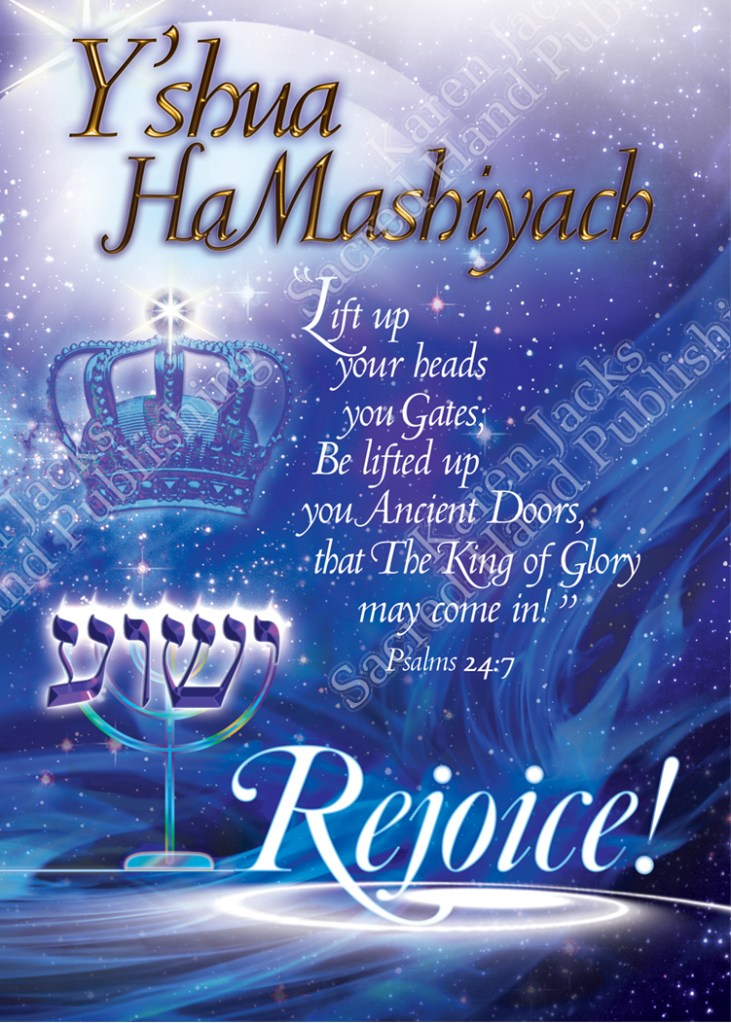
O’ Lift up your heads, O ye gates; And be ye lifted up, ye everlasting doors: And the King of glory will come in!

1 Rejoice, the Lord is King:
Your Lord and King adore!
Rejoice, give thanks and sing,
And triumph evermore.
Lift up your heart,
Lift up your voice!
Rejoice, again I say, rejoice!

2 Jesus, the Savior, reigns,
The God of truth and love;
When He has purged our stains,
He took his seat above;
Lift up your heart,
Lift up your voice!
Rejoice, again I say, rejoice!

3 His kingdom cannot fail,
He rules o’er earth and heav’n;
The keys of death and hell
Are to our Jesus giv’n:
Lift up your heart,
Lift up your voice!
Rejoice, again I say, rejoice!

4 Rejoice in glorious hope!
Our Lord and judge shall come
And take His servants up
To their eternal home:
Lift up your heart,
Lift up your voice!
Rejoice, again I say, rejoice!

Charles Wesley, 1744

Psalm 24 American Standard Version

The King of Glory entering Zion.

A Psalm of David.

24 The earth is Jehovah’s, and the fulness thereof;
The world, and they that dwell therein.
For he hath founded it upon the seas,
And established it upon the floods.
Who shall ascend into the hill of Jehovah?
And who shall stand in his holy place?
He that hath clean hands, and a pure heart;
Who hath not lifted up his soul unto falsehood,
And hath not sworn deceitfully.
He shall receive a blessing from Jehovah,
And righteousness from the God of his salvation.
This is the generation of them that seek after him,
That seek thy face, even Jacob. Selah

Lift up your heads, O ye gates;
And be ye lifted up, ye [a]everlasting doors:
And the King of glory will come in.
Who is the King of glory?
Jehovah strong and mighty,
Jehovah mighty in battle.
Lift up your heads, O ye gates;
Yea, lift them up, ye [b]everlasting doors:
And the King of glory will come in.
10 Who is this King of glory?
Jehovah of hosts,
He is the King of glory. Selah

The Word of God for the Children of God. Gloria! In Excelsis Deo! Alleluia! Amen.

Psalm 24 is a beautiful song of adoration and worship to our God.

I picture Psalm 24 as a raucous worship romp, the type of song David would have danced like an ecstatic man to the presence of the Ark of the Covenant (2 Samuel 6:12-22) as it is about to be reverently carried inside the Tabernacle. It has the feeling of crescendo behind it, particularly the last four verses. I can hear a modern-day array of drums of all sizes and shapes, the artists and their music pulsating out the question “Who is this King of glory?” over and over again with strength, triumph, sending electricity through a worshipful throng.

He is the Lord Almighty, and we can rest in him. So often we try to do God’s job. We put the weight of the world on our shoulders, thinking it’s our job to solve all of life’s problems. We forget that our only job is to worship and glorify the King, it’s God’s job to do everything else. The psalms have been clear that all of our problems in this life are not going to go away, but they are also clear that God defeats our greatest foes. God defeats evil. God is the ultimate victor, and we are on his team. We can rest, trust in him through all of the ups and downs of this life. Through the times we are drowning. Through the storm and the war.

Psalm 24 covenants us to seek God’s face. I love this picture. God wants us to see him. He wants us all to see his face shining upon you (Numbers 6:24-26).

God wants to see the expressions upon our faces, wants to hear each beat of our heart, and every thought from our souls as we encounter the power of God here,

A PSALM OF DAVID. THE EARTH IS THE LORD’S, AND ALL ITS FULLNESS, THE WORLD AND THOSE WHO DWELL THEREIN. (PSALM 24:1)

King David starts out this royal hymn by drawing our attention away from ourselves and to the One who owns it all. He does this by showing a contrast right at the beginning of the psalm, a contrast that should dramatically remind us of our place in the universe.

Starting with the title, the text literally reads, “Belonging to David, a psalm. Belonging to Yahweh, the earth.” As great as King David was, he was still only a mere mortal man. Even though he was a poet and prophet, wrote under the influence of the Holy Spirit, he was just a man. Anything he had and anything he accomplished was given to him by the grace of God (2 Samuel 12:7–8).

Fallen man oftentimes looks at the earth as if it belongs to him, or worse, as if the earth was just a lucky break in the evolutionary scheme of things. But “In the beginning God created the heavens and the earth” (Genesis 1:1).

The earth belongs to Him and to no one else. He is the rightful owner. There is only one name on the title deed to the universe, and it’s not yours and it most assuredly, not mine. It’s Yahweh’s. That awe factor, magnitude of that thruth should serve as the only essential foundation to everything else in our lives.

Not only does the earth belong to the Lord, but everything it contains. That includes your home “your castle,” your car, your cash. More specifically, every single human being, without exception, belongs to the Lord. That includes your neighbor, your family, the homeless person, even you. “Know that the LORD, He is God; it is He who has made us, and not we ourselves” (Psalm 100:3). We are stewards, good or bad, of what He has entrusted to us. It all belongs to God.

Since everything in the world belongs to God, why then do we spend so much time and energy accumulating and clinging onto the “rust prone” things of this world? Perhaps it’s because in the back of our minds we still believe they belong to us. We have not 0.01% yielded in submission to the sovereign ownership of God.

How are you and I doing in our perspectives of our place in the universe? Do you and I recognize and acknowledge the fact that you and I own exactly nothing in this world? Every one of our very life-breath comes from Him (Job 34:14–15)!

Psalm 24 proclaims the majesty and grandeur of God, but at the same time describes Him and His attributes in specific ways we can relate to. Let’s start with the first section of this beautiful Psalm and I will show you what I mean:

“The earth is the Lord’s, and all its fullness,
The world and those who dwell therein.
For He has founded it upon the seas,
And established it upon the waters.” (Verses 1-2)

God is so indescribably, immeasurably big and powerful that He created the whole of time and space. Genesis 1 lays out the story that the eternal God spoke and created light and everything else in the world as we know it. He molded man into His image from the dust. That is an awesome and powerful God!

Yet, with the mess we have continuously made of things, why does not God just start from the beginning again and create something else? Why will He create a new Earth when He comes back?

The answer lies in Genesis 1 when it says after each of His creations or artwork – And God saw that it was ALL good.” God loves the earth and the fullness of the earth; He just wants to redeem it from the fake hold the devil has placed on it.

The enemy is not the Creator or the Artist, he is just the usurper of the creation. God wants us to appreciate His earth from His eternal perspective, not despise it or destroy it.  He is after full redemption of our lives and the things around us.

On to the next section of Psalm 24…

Who may ascend into the hill of the Lord?
Or who may stand in His holy place?
He who has clean hands and a pure heart,
Who has not lifted up his soul to an idol,
Nor sworn deceitfully.
He shall receive blessing from the Lord,
And righteousness from the God of his salvation.
This 
is Jacob, the generation of those who seek Him,
Who se
eks Your face. Selah (verses 3-6)

Though God made the whole majestic earth, there is a place in Him and in His presence that goes echelons beyond Him just laying back, casually, passively, basking in the light He created, enjoying His creation here from a distance.  

His holy place is a place of revelation and love in His presence. It is a place of glory – a place where true peace, perfection, and extravagant love exists.

We always need to look at Hebrew Testament scripture in the light of New Testament revelation. I have heard this section of scripture preached from the pulpit as a “get your act together, so you can get into the presence of God” message. In the Hebrew Testament during the days of the tabernacle, the people would go through the outer courts, sacrifice their offerings, wash in the lavers and the pools of water, and come into the presence of God. They came in as instructed by God with formulas and patterns, but in the New Testament Christian life – this is a prophetic vision of what Jesus did for us on the cross. 

Through His death on the cross, He became our sacrifice, our ritual lamb, and our cleansing water. When we receive His blood and put our faith in the cross, our hands become clean, our hearts become pure, and we turn our faces from the idols of this world to the only true God. By faith, we receive the blessings and the righteousness of God through the sacrifice of the slain Son of God.

Only through Jesus can we enter into the presence of God. Nothing else can bring us in. Our responsibility in coming into the presence of God is simply this:

We have to acknowledge the truth of the absolute sovereignty of God and who exactly, exactingly we are without Savior Christ, receive the cleansing power of the blood, and walk in boldly into the throne of grace and into His presence.

Continuing on…. to another completely different section….

Lift up your heads, O you gates!
And be lifted up, you everlasting doors!
And the King of glory shall come in.
Who 
is this King of glory?ancient
The Lord strong and mighty,
The Lord mighty in battle.
Lift up your heads, O you gates!
Lift up, you everlasting doors!
And the King of glory shall come in.
Who is this King of glory?
The Lord of hosts,
He 
is the King of glory. Selah (verses 7-10)

Can you imagine how heavy old gates are? Or what about giant wooden doors like in ancient medieval times?  Imagine now, after all these years, how hard it must be to get those gates open or lifted up. I am imagining the big fortresses of the great castle complexes, how many men it took to penetrate those gates or those walls. It might take an unconventional army of men to pull them open.

We are commanded here in this Psalm to open up the gates and the doors of our lives regardless of how heavy they are…. and with that command comes a covenant promise that the “King of glory shall come in.”  

They may seem heavy or impossible at times to lift up, but God is mightier. The Lord is mighty in battle. He is the Lord of hosts. As we seek Him by making ourselves available to His presence and receiving the power of His blood, the gates of our hardened and stony hearts, our sin darkened souls, spring open and we find freedom. He comes rushing in and overwhelms our narrow world view. 

God is not just the King bounded by earthly borders and boundaries, but He’s the “King of glory” and His glory comes into our lives and changes us forever.

Then we pause like the word “Selah” implies here at the end of this Psalm. 

Selah literally means – Stop and think about it.

We ought to give our mirrored selves a break in His presence. We stand in His glory which is undeniably unmatched and is unmatchable in all respects. The whole earth, as it pertains to our temporary lives, is redeemed and the fullness of His glory changes everything. The earth is the Lord’s, and all its fullness”

Psalm 24 is a testament to the Sovereignty of over His creation and our lives.

As David did, as He sang and danced before the Ark of the Covenant, as he had the honor of welcoming the God of his salvation, before all of the people, we today have that self-same honor to welcome the Ark of the Covenant, the Ark of the King of all Kings and the Lord of all Lords into the Tabernacles of our souls.

In the name of God, the Father and God the Son and God the Holy Spirit,

Let us pray,

God, give me perspective. Help me to stop trying to carry the world on my shoulders. Help me to see and feel that you are already carrying me. Help me to rest in you. Help me to seek your face and worship you! You are the King of glory! You are the genuine conquering King who has defeated Satan and evil. You give hope for this life and on into eternal life. You have saved and rescued us Jesus and I thank you. Thank you for loving me. Thank you that your love is so real and so deep and so true. You are the Lord Almighty, the King of glory. Gloria! In Excelsis Deo! Alleluia! Alleluia! Amen.

Hear my cry, O God; attend unto my prayers. My heart is overwhelmed: God of my Salvation, I Pray! Lead me unto the Rock which is Higher than I!

One thing I love about reading, studying and praying and meditating through the book of Psalms is that each Psalm usually begins with a Psalmist’s heavy heart crying out, and ends in praise and rejoicing. Psalm 61 is no exception.

There are several reasons I love Psalm 61, and verse 2 is a bit part of that. Here are some of the reasons that Psalm 61:2 is such a huge encouragement for me:

  • No matter where we are on this earth, God hears us. There is no where we can go that God cannot reach (Psalm 139:7). This fact alone should provide comfort and encouragement to the heart and soul of the reader identifying with “alone”.
  • We all feel overwhelmed at some point or another. David says, “when my heart is overwhelmed”. Not if, when. It is completely normal for our hearts to feel overwhelmed on occasion. The key is that we each need to take it unto the Lord.
  • God is our rock. What an encouraging and reassuring fact, to know that we have a rock which cannot be moved (Psalm 62:6).

As much or as little you are in need of some major league encouragement today, just remember, God absolutely hears you when you cry, and when you are just overwhelmed; all you need to do is talk to Him. He will lead you and protect you!

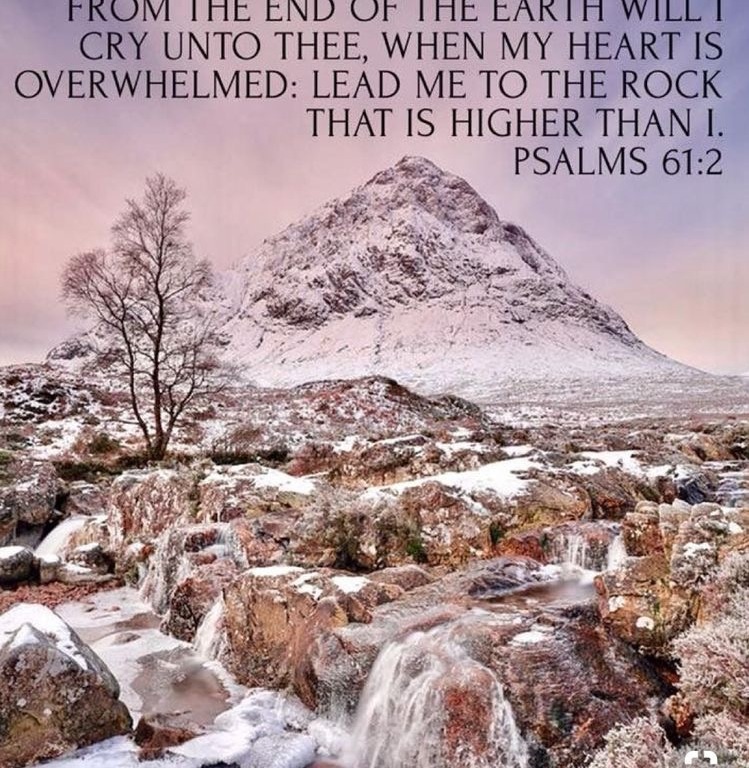
“From the end of the earth will I cry unto thee, when my heart is overwhelmed: lead me to the rock that is higher than I.” Psalm 61:2

Psalm 61 AKJV

Psalm 61

To the chief Musician upon Neginah, A Psalm of David.

Hear my cry, O God; attend unto my prayer.

From the end of the earth will I cry unto thee, when my heart is overwhelmed:
lead me to the rock that is higher than I.
For thou hast been a shelter for me,
and a strong tower from the enemy.
I will abide in thy tabernacle forever:
I will trust in the covert of thy wings. Selah.
For thou, O God, hast heard my vows:
thou hast given me the heritage of those that fear thy name.
Thou wilt prolong the king’s life:
and his years as many generations.
He shall abide before God for ever:
O prepare mercy and truth, which may preserve him.

So will I sing praise unto thy name for ever,
that I may daily perform my vows.

The Word of God for the Children of God. Gloria! In Excelsis Deo! Alleluia! Amen.

Hear my cry, O God

Attend unto my prayer

From the ends of the earth

My cry comes unto Thee

And when my heart is overwhelmed

Lead me to the Rock that is higher than I

That is higher than I

For Thou has been

A shelter unto me

A strong tower

From the enemy

And when my heart is overwhelmed

Lead me to the Rock that is higher than I

That is higher than I 

These are the words to a much beloved camp song, and they are also the words to Psalm 61. Hundreds, probably thousands, if not millions of campers have come and gone to summer camp or sat in the woods of a forest by some river or flowing stream and sat around the campfire, trying to quiet their souls from the harsh circumstances of life singing these words, reflecting upon their meaning.

For years upon years, more than they can remember, they have been gathering together both believers and non-believers, just to break away from mainstream civilization to give unto their taxed and tired hearts, bodies, minds, souls some much needed rest., to detoxify themselves from the hustles and bustles of life. And why not? we all need to take that time away to simply “chill out” from life. We can only take so much upon ourselves that we feel like we will just “burst.” For mental health and physical and safety reasons, we need to have that time.

When Life seems to go on forever and ever and ever …. without any end ….

David is recognized as the author of this psalm, and David frequently found himself in many situations where the entire world was against him. After being plucked from his father’s flocks and assigned to be a bodyguard and musician for King Saul, David was constantly sent out into battle and eventually hunted down by the king himself. Saul knew the favor of God had departed from him and had been given to David, and his own failures haunted him to the point of jealously and madness. Even after Saul spared his life and he ascended to the throne, David was assailed by warring nations and his very own sinful desires.

No matter the cause or reasons, we can all relate to David at times. It may seem like everything comes against you: a medical diagnosis, a lost job or loved one, another failure, a fall to temptation, or some other calamity. And it seems like they all just happen at once – when you assess your life and think you can stay steady under this new tension, another weight is dropped on your shoulders.

Psalm 61 was written by David at one of the many times when he was far from home and safety. It begins with his desperate cry to God. He is despairing, lost, and struggling. “My heart is crying, and it is overwhelmed!” he tells the Lord.

If we are rigorously and vigorously honest, with ourselves, and with others, many of us can truly relate to the feelings of David. We know what it is like to sit in darkness and wonder if light will ever come. In his sorrow, David calls out to God in prayer. He knows the only way he can rest and find safety in the Rock of Salvation is if God reaches down and, intercedes and places him atop the rock which is higher than he and everybody else is where only God can reach him.

Are Your Heart and Soul being Overwhelmed?

The depth of sadness described in this psalm is not an everyday sadness. The level of exhaustion and resignation is not the normal tiredness we feel at the end of the day. It is a profound, soul-rending sense of loss and fear. It is important not to make light of the deep struggles’ others may go through by comparing your heart felt soul felt pain, however legitimate, with theirs.

That being said, we will be worn down by the world. Jesus Himself promised us that even our loved ones could turn on us, and practically guaranteed that we would have trouble in this life. Our world is fallen and tainted by sin, and no amount of manmade goodness can cover the stain of evil that has scarred mankind. The weight of our sin weighs heavily upon our souls and shoulders.

Many things can contribute to an overwhelming sense of dread at the prospect of facing even one more day. A sudden and dangerous medical diagnosis, deep personal loss through financial hardships and or death can certainly be a valid reason to grieve and to mourn. On days when it seems that the whole world is against you, that sense of loneliness can be pretty overwhelming. Even in the face of the everyday evils that swarms over the earth devouring the innocent and preying on the weak can overwhelm a soul sensitive to the heart of God.

What Ought We to be Doing in such times as these?

First of all, know and accept that your grief is not being misplaced. When you reach the lowest point, know that your mourning has value, is not worthless. God surely and certainly wants to hear the deepest cries of your heart at all times, if your heart is only capable of producing tears, God accepts that honesty.

Next, we must always remember that God not only wants to hear our cries, but He also wants to heal our wounds. He wants to carve out the broken places in our lives, soothe them with His healing presence, and replace them with more of Himself. Only by inviting God into your hurt can you experience a peace that passes all understanding, regardless of what all else is happening around you.

It is healthy to grieve, but it is not healthy to wallow endlessly, assuming there is no hope. In all things, Jesus is the author of and ultimate place hope for the world. His grace is sufficient for every shortcoming, and His strength is made perfect in every weakness. While we should express our sorrow in healthy ways, we should also be willing to give our hurt to God and trust 1000% He will work something good from it. We will never fully understand the mind of God in this life, but faith can sustain us through the dark times when our walls come down.

In God, David has always found safe refuge and secure shelter. He has found rest, comfort, and retreat in places only God knows. So why would he not, in his darkest moments, cry out to the God who is his “rock,” his hiding place, and his fortress? And as he cries out, David finds 100% comfort in God’s grace and care.

Sometimes, when our hearts are overwhelmed, all we need do is cry out to God and ask that in our desperation and fear, God would place us on stable ground. God would comfort us and lead us to safety. God would shelter us and deliver us. Right in this exact and exacting moment or season, what is overwhelming you?

In this season of pandemic hot and cold, and summer and winter and job loss and only Lord knows the weight what of all those other activities, what weighs heavy, heavier and heaviest on your heart? Hopefully, the words of this Psalm will bring you comfort and a small amount of peace as you remember that when your heart is overwhelmed, YOU PRAY! you always find rest in God, your rock.

The next time your heart seems overwhelmed, try turning to God in worship.

You may not feel fully invested in that exact moment, but the Word of God never returns to God void. God will absolutely use even the smallest amount of faith to work miraculous things in our hearts. Psalms like this one are called psalms of lament, and they are in the Bible for a reason: they can be a model and an outlet for our worship when words simply will not come. Try reading through this entire psalm or another familiar passage and use those words to pour out your overwhelmed heart unto the God Who is never overwhelmed.

God the Father can NEVER be OVERWHELMED!

God the Son, Jesus can NEVER be OVERWHELMED!

God The Holy Spirit can NEVER be OVERWHELMED!

In the name of God, the Father and God the Son and God the Holy Spirit,

Let us pray, (PSALM 61 The Message)

61 1-2 God, listen to me shout,
    bend an ear to my prayer.
When I’m far from anywhere,
    down to my last gasp,
I call out, “Guide me
    up High Rock Mountain!”

3-5 You’ve always given me breathing room,
    a place to get away from it all,
A lifetime pass to your safe-house,
    an open invitation as your guest.
You’ve always taken me seriously, God,
    made me welcome among those who know and love you.

6-8 Let the days of the king add up
    to years and years of good rule.
Set his throne in the full light of God;
    post Steady Love and Good Faith as lookouts,
And I’ll be the poet who sings your glory—
    and live what I sing every day.

Gloria! In Excelsis Deo! Alleluia! Alleluia! Alleluia! Amen.
https://translate.google.com/

When Making our Life’s Investment in Jesus, Walk Worthy of the Calling!

Apostle Paul calls us all to be like-minded… having unity in the spirit and the love of Christ in our hearts – being of one accord; encouraging the saints and demonstrating tender-compassion in humility of heart, towards one another. But mercy, truth and unity will only come when we have the grace of the Lord Jesus Christ, the love of God and the fellowship in the Spirit flowing through our inner beings – for it is only as we are fully surrendered, yielded to the Holy Spirit, that He is enabled to work in us, conform us, into the likeness of Christ.

Ephesians 4:1-6 J.B. Phillips New Testament

Christians should be at one, as God is one

1-6 As God’s prisoner, then, I beg you to live lives worthy of your high calling. Accept life with humility and patience, making allowances for each other because you love each other. Make it your aim to be at one in the Spirit, and you will inevitably be at peace with one another. You all belong to one body, of which there is one Spirit, just as you all experienced one calling to one hope. There is one Lord, one faith, one baptism, one God, one Father of us all, who is the one over all, the one working through all and the one living in all.

The Word of God for the Children of God. Gloria! In Excelsis Deo! Alleluia! Amen.

Paul has written this letter to the Ephesians and God has preserved it for our reading so that we would learn who we are. God wants you to know who you are.

Each and every one of us an identity, and that identity has been given to you by God. Each and every one of us have been called to a great calling. We have been called to being something significantly more than mundane living on this earth.

Ephesians Chapter 3 covenanted that we are to display God’s wisdom and glory. This is what we have been called to do. We are chosen, redeemed, predestined, adopted, heirs, saved, and reconciled so that God would be glorified, and his wisdom would be on display. Ephesians 3:20-21 summarizes the calling. God would be glorified through us (His Body – the church) and through Jesus for all generations forever and ever. God being immeasurably glorified is our calling.

Ephesians 3:20-21 J.B. Phillips New Testament

20-21 Now to him who by his power within us is able to do far more than we ever dare to ask or imagine—to him be all glory in the Church through Jesus Christ for ever and ever, amen!

Walk Worthy (Ephesians 4:1)

Our covenant calling is that God is glorified by people for all generations.

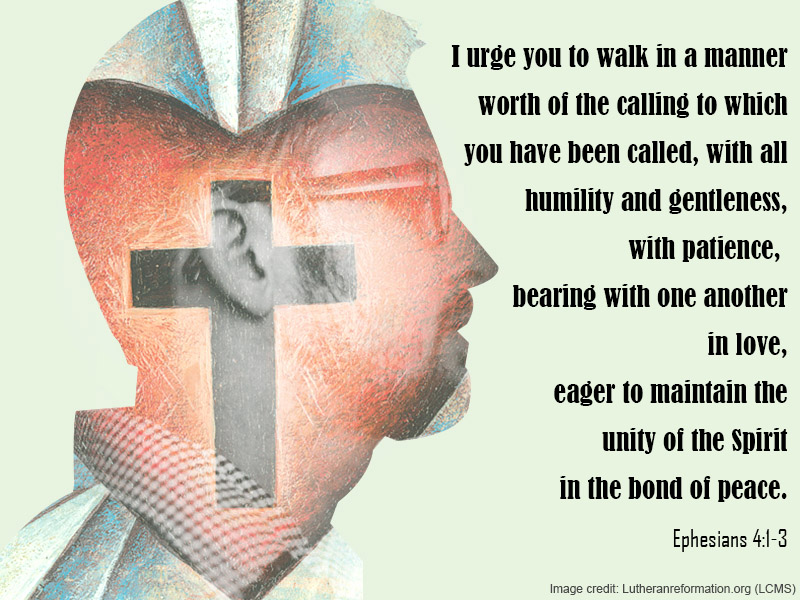
Therefore, Paul urges us “to walk in a manner worthy of the calling to which you have been called.”

If our purpose is to display God’s glory and God be glorified through us, then there is a particular way to covenant our lives for this calling. We do not get to be a Christian and act and behave how we want to act or do what we want to do. That is not our covenant calling. This walk is our response to all that God has done for us, which we read about throughout the first 3 chapters of Ephesians.

We are to live covenant lives reflecting this new identity. You and I have been called to something great and glorious. Walk worthy of it!

In Ephesians chapter 2 Paul condemned us because we were walking in a way that followed the ways of this world, following the plans of Satan, following the passions of our flesh, and carrying out the desires of the body and mind.

That is the former walk. Now you and I have a new walk. The new walk is not to go back carrying out your desires in your body and mind. The new walk is not following our passions. Our new walk is not following the ways of this world. Now you and I are to walk worthy of the calling to which you have been called.

Now Paul says something subtle, but very important in this first verse. Paul says, “I therefore, a prisoner of the Lord.” Paul starts there before he tells us to walk worthy of the calling. Why does Paul even bring up that he is a prisoner for Christ at this moment? Because we need to know up front, before we make a decision to follow in Christ’s covenant, our walking worthy is going to be costly.

Paul urges to walk in this way understanding that the walk is costly. You and I will not fit in with the world when we start making decisions for the sake of not ourselves but for all of those who God just declared have become our neighbors. Understand that trying to walk according to our calling is countercultural. How you will now behave is the opposite of what the world thinks is right or good.

The Character Which Brings Christian Unity (Ephesians 4:2)

Now, consider what you think would be the first command for walking worthy.

Of all the things God could command us first to consider in walking worthy of the calling, what do you think that command would be?

Read Ephesians 4:2-3. Notice the first point Paul makes is for Christian unity.

In verse 2 teaches us the character needed to maintain Christian unity.

Verse 3 gives us the charge to maintain this unity.

Ought that we should be overly surprised that the first quality Paul addresses for walking worthy is unity? Unity is very important to our Lord because a lack of unity can never bring any God glory. Disharmony wrecks God being glorified.

Paul begins with the attitudes necessary for unity. Too often there has been an attitude that we can have unity on doctrine alone. There is an attitude that as long as we agree that there is one Lord, one faith, one baptism, one body, one Spirit, one hope, and one God and Father of all, then we can be ugly to each other, have poor attitudes, be rude, attacking, and the like and still have unity.

Much to the great grief of God, we have each seen and heard far too many times supposed Christians attempt to defend the gospel and defend the truth by being angry, vicious, slanderous, condescending, and sometimes even being deceitful.

I unfortunately experienced this when I was training to preach. A preacher from another church decided that what we were doing was wrong, primarily because we were teaching and preaching the Gospel of our Lord and Savior Jesus Christ from a more traditional Bible Based approach and perspective. The ugly, hateful attitudes, words were just echelons beyond shocking and disappointing to me.

I want us to notice where Paul starts for Christian unity. “With all humility and gentleness with patience, bearing with one another in love” (Ephesians 4:2).

There cannot be any degree or measure of unity without these things. It does not matter how much doctrine we think we have right and correct. We have missed the gospel completely and do not know the calling to which we have been called when we are lacking humility, gentleness, patience, and forbearing.

Jesus exerted the power of God and defended the teachings of Christ without resorting to being ugly or hateful. I think we can get the idea of how we are to behave when we read humility, gentleness, and patience. People are going to say things and do things that are simply not right and unscriptural. We are to respond with humility, gentleness, and patience.

Any number of other Christians in the Body of Christ do not know what you and I know. They may not have studied the Bible as long as both you and I have.

They may not be as smart as you and I think you and I are. They may be confused on some teachings. They may have adopted some ideas that others have learned through culture have taught but are not found in the scriptures.

How are we going to handle important these things? A correcting response must be with humility, gentleness, and patience. Some of you simply will not accept some of the concepts from the scriptures I have taught while I have been studying and praying over the Scripture passages and writing these devotions.

How should I handle that? Should I be angry? Should I be more forceful with you? Should I put you down? Should I intimidate you? Should I make slanderous comments about you to you or to others? No! that’s very much wrong! When Christians are speaking, we must remember humility, gentleness, and patience.

If this was not enough, Paul says that we are to bear with one another in love. We are to endure patiently with one another because we love the soul of the person. We ought to love each other and will continue to work together without bitterness or anger. Think about how we talk to each other. Think about how we act toward each other. Think about each and every one of these things especially when we are too busy vigorously disagreeing. Why? Paul continues in verse 3.

The Charge To Maintain Christian Unity (4:3)

We are to be “eager to maintain the unity of the Spirit in the bond of peace.” Some translations rightly read that we are to make every effort to maintain the unity of the Spirit in the bond of peace. We are to desire unity and do all we can to continue it. Notice that we are not to create unity but to maintain it. We are to keep the unity that is already in existence that comes from the calling. We have been joined together in Savior Jesus Christ. Be eager to maintain that unity. Be diligent to maintain this unity. Make every effort to continue together in unity.

Consider: We do not have unity if it cannot be seen. Unity is not something that ought to be seen as only a concept. Unity is seen in behavior. A lack of unity in a marriage is evident. Unity in a marriage is evident. If we truly have unity in our marriage to Jesus Christ, then it will be evident. Peace is the bond that holds this unity together. We will see peace in our relationships and behaviors. We desire unity and will, by our marriage to Christ, make all effort to maintain that unity.

Look carefully at this image of a chain. Do you notice even for one hot fleeting moment the “red question mark” linking(?) the two ends of the chain together? This is not unity. Too often we think this is unity. Occasionally all the links sit in the same room. But this is not one chain. They are not unified. There is no unity. We do not have Christ-like unity unless we have participation and involvement.

As I have already said above,

The Apostle Paul calls us all to be like-minded… having unity in the spirit and the love of Christ in our hearts – being of one accord: encouraging the saints and demonstrating tender-compassion in humility of heart, towards one and another. But mercy, truth and unity will only come when we have the grace of the Lord Jesus Christ, the love of God and the fellowship in the Spirit flowing through our inner beings – for it is only as we are fully surrendered, yielded to the Holy Spirit, that He is enabled to conform us, into the likeness of Christ.

We have the mind of Christ – to think as He did; to speak as He did; to live as He did and to love all our neighbors and behave as He did. And so individually and collectively we have the means to walk and live and pray in spirit and truth.

In his letter to the Philippians the Apostle Paul gives this vital challenge to all believers – IF we have received any consolation in Christ; if therefore we have any comfort of love; if therefore we have any fellowship of the Holy Spirit and if therefore, we have any bowels and mercies in Christ, we are to demonstrate this in our lives by being of one same mind. (Philippians Chapter TWO)

If we, as children of God, have received His goodness and grace, comfort and hope, hope and compassion, then we are to maintain the same goodness, grace, comfort and love and be diligent to preserve the unity of the Spirit in the body of peace. There ought to be no question marks between any two-chain links!

The challenge to all believers is to faithfully and committedly and prayerfully develop a Christlike character, demonstrating the same love that He displayed.

We are to be united in spirit and fervent in love – looking to Jesus, the author and perfecter of our faith, who for the joy set before Him endured the cross.

We are to walk worthy of this glorious calling we have been given. Walking worthy means being eager and making every effort to maintain the unity of the Spirit in the bond of peace. As we make this walk with Christ, let us place a much higher priority on coming together in Christ, a greater focus on unity.

First, let us be more patient with each other. Let us be gentler with each other. Let us be humbler, not thinking so much of our abilities or knowledge. Let us patiently bear with one another because of the love we have through Christ.

Second, let us be eagerly maintaining the unity which is to be found only through God, the Father, God the Son and God the Holy Spirit. Unity is visible. Unity is not accidental. Unity requires us merging, weaving our lives together in God’s word regularly. Otherwise, we are individual links who have questionable proximity to one another proclaiming the “united chain” we are to be in Christ.

You will never see any question marks or any missing links between the link of God, the Father and God the Son and God the Holy Spirit. It can never ever exist!

In the name of God, the Father and God the Son and God the Holy Spirit, let us come together as One Body, “perfectly” united as Father, Son and Holy Spirit,

Heavenly Father I pray that I may show forth the grace of Christ, the love of the Father and the fellowship of the Holy Spirit – in thought word and deed towards all who are the called according to Your purpose, so that in unity of spirit we may honor Your name, through our earthly witness, in Jesus’ name I now pray, Alleluia! Alleluia! Alleluia! AMEN.

https://translate.google.com/

Making a Genuine Investment in our Futures. Investing in Self or in Jesus?

The 16th century German theologian, Martin Luther is credited with saying “A religion which gives nothing, which costs nothing, and which suffers nothing, is worth nothing.”

We understand the value of anything is determined by its investment, either in time, money, or personal sacrifice. When Savior Jesus Christ says, “follow me,” he is beckoning us, not just to go to the nearest trendiest outdoor cafe, hang out with him, or tag along, but instead unto a devout, different, and dedicated, life.

An old time, circuit riding preacher, Alex Johnson, in his sermon “It’s easy to become a Christian, but so very much harder to live as a Christian,” observed that “the mark of a great leader is the demands he makes upon his followers.”

In today’s devotional Bible passage from Luke, Jesus reminds us of the value of “future investments,” discipleship and its sacrificial demands upon the lives of those who choose and desire to follow Him to Follow Him EVERY SINGLE DAY!

Luke 9:23-27 The Message

23-27 Then he told them what they could expect for themselves: “Anyone who intends to come with me has to let me lead. You’re not in the driver’s seat—I am. Don’t run from suffering; embrace it. Follow me and I’ll show you how. Self-help is no help at all. Self-sacrifice is the way, my way, to finding yourself, your true self. What good would it do to get everything you want and lose you, the real you? If any of you is embarrassed with me and the way I’m leading you, know that the Son of Man will be far more embarrassed with you when he arrives in all his splendor in company with the Father and the holy angels. This isn’t, you realize, pie in the sky by and by. Some who have taken their stand right here are going to see it happen, see with their own eyes the kingdom of God.”

The Word of God for the Children of God. Gloria! In Excelsis Deo! Alleluia! Amen.

Master Rabbi Jesus had just finished His ministry in the Galilee area and set His face to Jerusalem. He started to prepare His followers for His fast-approaching death and resurrection. He earnestly started to train His disciples for their post resurrection mission and ministry and increasingly, He has made hints to his disciples about His person, His sacrifice on the cross and his coming kingdom.

Jesus not only started to explain privately to His disciples about His mission and ministry – His death and resurrection, but He has also talked to the gathering crowds about what it genuinely means for a believer, to become a true disciple of His – and we read that Jesus said unto all, if anyone would come after Me, let him deny himself and take up his cross daily and follow Me.”

All believers are children of God but there is a vital difference between being saved as a son and following the Lord as His disciple. (Ephesians 1:3-14)

We are saved from our sins because we trusted Jesus as Savior, who died on the cross – we are saved by grace through faith in Christ. (Ephesians 2:8-10)

But to become a true disciple we must make critical sacrifices in how we view and perceive the world and the circumstances we are daily presented through it.

We must look in the mirror and essentially believe that who and what we see looking back at us has quite a few and very different interpretations when seen only through the tainted eyes of mankind versus the eyes of Savior Jesus Christ.

From somewhere beyond our biases and prejudices, Jesus here covenants with us to not see the world as we see it – endless vistas of hopelessness and “see the world as He sees it,” with an everlasting hope for an eternal future far beyond our understanding, far, far beyond our time and season of living on this planet.

But to get to that ultimate place of hope, we have to ultimately sacrifice those “treasures we treasure beyond everything, and everyone else,” take up our own cross, daily, and follow the Lord Jesus – we are to walk the way of the cross. (Matthew 6:19-21, Matthew 13:44-52, Matthew 19:16-22, Luke 12:13-21)

James 1:19-25 ESV

Hearing and Doing the Word

19 Know this, my beloved brothers: let every person be quick to hear, slow to speak, slow to anger; 20 for the anger of man does not produce the righteousness of God. 21 Therefore put away all filthiness and rampant wickedness and receive with meekness the implanted word, which is able to save your souls.

22 But be doers of the word, and not hearers only, deceiving yourselves. 23 For if anyone is a hearer of the word and not a doer, he is like a man who looks intently at his natural face in a mirror. 24 For he looks at himself and goes away and at once forgets what he was like. 25 But the one who looks into the perfect law, the law of liberty, and perseveres, being no hearer who forgets but a doer who acts, he will be blessed in his doing.

To be a disciple it must not only be hearing the Word and being a listener, but it is also add doing the Word and sacrificially applying it to our everyday agendas.

Hebrews 12:1-2 ESV

Jesus, Founder and Perfecter of Our Faith

12 Therefore, since we are surrounded by so great a cloud of witnesses, let us also lay aside every weight, and sin which clings so closely, and let us run with endurance the race that is set before us, looking to Jesus, the founder and perfecter of our faith, who for the joy that was set before him endured the cross, despising the shame, and is seated at the right hand of the throne of God.

It is not only knowing that Christ has identified with our sins – (sonship) – but that we are to reciprocate in kind and identify with Christ – (discipleship)… We are to identify with His sacrifice and surrender, His crucifixion, His suffering.

We are covenanted to be like Christ in His humanity and to deny ourselves if we are to be His disciples – but to do so we are to surrender our lives to the Spirit, to give ourselves as a willing and living sacrifice to the Father and then to say as did Christ, thy will not mine be done. Self, the self-life and all that is connected with the old sin nature, must remain thoroughly consigned unto God’s Grace.

The world does not understand this kind of life and worldly Christians have opted to keep “self on the throne of their life” – but to follow the way of the cross we are to give our lives to the Lord. Our life is to be a life of surrender, suffering, sacrifice and service to the Him.

If you and I freely choose to give up your lives for the Lord, you and I will not lose it but rather, by making the choice for salvation through Christ to save it.

Following the Lord in sacrificing, surrendering and re-surrendering, suffering and service is a daily discipline – as Jesus said, “if anyone would come after Me, let him deny himself and take up his cross daily and follow Me.”

As the founder of Methodism Reverend John Wesley famously quipped in his well-considered advice about being a day-to-day Christian every single day.

“Do all the good you can,
By all the means you can,
In all the ways you can,
In all the places you can,
At all the times you can,
To all the people you can,
As long as ever you can.”

What are the kingdom implications for Christians in these days of pandemic?

Social Isolation, Quarantine, Social Distancing, Mask on Mask off, vaccination!!

The day-to-day challenge is even greater to be the Body of Christ, the Church in such a sacrificial way as not to risk the safety of others and to make others sick.

Jesus asks us to surrender ourselves, to deny ourselves. To just say “no” to our- selves. This is more than just denying oneself of personal comfort, pleasures or possessions. It is giving up, surrendering, re-surrendering, self-gratification. Self-indulgence. Self-centeredness. Self-interest, not cause harm unto others.

Denying self goes against the grain. It’s not what our self-seeking culture is about. In our technology driven, virtual reality existence, everything today is geared toward self- gratification, self-satisfaction. Self-love. Self-devotion.

Jesus calls for self-denial. Self-sacrifice. Self-abasement. Self-control. Self-surrender and re-surrender and a growing and a maturing self-discipline.

Discipleship calls for a covenant commitment

Jesus simply says, “Follow Me.” This is the natural result of self-denial and cross bearing. He is the motivation for what we do, who we are, and how we live.

Following Jesus leads to ministry and mission. Following Savior Jesus leads us to involvement in the lives of others. And not just the comfortable environment of fellow Christians. But it leads us to interact with the less fortunate who need our help. With sinners with whom we can share the Words of the Gospel. With opponents of Christianity to whom we can present a sure defense of the gospel.

Disciplined following of Jesus leads us to Bible study. Prayer. Worship. And fellowship. Following Jesus leads to an intimate relationship with the Father.

Ironically, following Jesus leads us to save ourselves by losing our ourselves as His disciple. The disciple’s questions to paraphrase Jesus is not “What can I get?” But “What can I give?” Not “What is the safe thing?” But “What is the right thing?” Not “What is the obvious thing?” but the “Love of Christ” thing!

In this time when we are “sequestered” to our homes, travel is limited and our public church assemblies are cancelled or curtailed for health and safety, we’re reminded that covenant discipleship is so much more than church attendance.

The day-to-day Christian life is a daily disciplined life, a devoted discipled life and a continual discipling life. It’s a disciplined life to surrendering it all to God.

“Give me one hundred preachers who fear nothing but sin, and desire nothing but God, and I care not a straw whether they be clergymen or laymen; such alone will shake the gates of hell and set up the kingdom of heaven on Earth.”
― The Right Reverend John Wesley, (1703-1791) Founder of Methodism

In the name of God, the Father, and God the Son and God the Holy Spirit,

Let us now pray,

Loving Father, more and more I want to surrender my life to You, to take up my cross daily as a willing sacrifice and to cry out, thy will not mine be done. I pray that my old self-life will remain firmly nailed to the cross as I submit to Your leading and guiding in all I say and do, in Christ’s name I pray, Alleluia! AMEN.

https://translate.google.com/

Prayer: The Promise of Praying Together (Matthew 18:19-20)

What Jesus Did! ‘The Lord Is There!’ What Hope is Given! “The Lord is There! What Mercy is Revealed! “The Lord is There!” What Assurance is Experienced! “The Lord is There!” What Grace is made Available to us! “The Lord is There!”

Our Lord and Savior Jesus Christ manifests His presence in a special way when two or more of His disciples meet to pray. The promise is “that if two of you shall agree on earth as touching anything that they shall ask, it shall be done for them of My Father which is in heaven. For where two or three are gathered together in My Name, there am I in the midst of them” (Matthew 18:19-20).

Matthew 18:18-20 The Message

18-20 “Take this most seriously: A yes on earth is yes in heaven; a no on earth is no in heaven. What you say to one another is eternal. I mean this. When two of you get together on anything at all on earth and make a prayer of it, my Father in heaven goes into action. And when two or three of you are together because of me, you can be sure that I’ll be there.”

The Word of God for the Children of God. Gloria! In Excelsis Deo! Alleluia! Amen.

How we ought to rejoice to know that where two or three are gathered together in the name of our Lord and Savior Jesus Christ, He has promised to be there among us – for He is the Head of our church, we are all members of His body!

Scripture is clear, as believers we are the corporate body of Christ and when two or more members of Christ’s body are united in prayer or praise, thanksgiving or worship – we are in a small way fulfilling Christ’s high priestly prayer: that we may be one, even as He is One with the Father. Christ is the Head of the body – and when as few as two or three members are united together in Him, they are one community of faith, one with Christ, who is the Head of His growing body.

What an indescribable joy it is to know that Jesus has promised to work in and through the prayer and praises of His people. What an immeasurable comfort to know He is with us as we unite together in fellowship around a shared meal or simply join together, we break bread, pass the cup of blessing, in remembrance of Him. How undeniably important to keep Jesus in His rightful place, as HEAD.

When we come to the Lord in prayer or praise, whether it be individually and corporately. I must decrease and He must increase, for there is one Lord; one faith; one baptism into the body of Christ and there is One Head, who is to guard and guide us individually and corporately. (John 3:27-30 AKJV)

He must completely increase, we must sacrificially decrease so that it is Christ’s beautiful Spirit of unity in the faith, which leads us and guides us as we come together in His name – for prayer and petitions; conversation and communion; a simple communal meal or a meeting of fellowship and church governance ‘for where two or three are gathered together in My name, I am there among them.’

This well beloved, oft quoted, oft prayed passage of Scripture must also be clearly understood in its proper historical context when Matthew wrote it.

We must also be aware of Several key understandings implicit in this passage:

  1. Because the Lord is present when two or three of his disciples are gathered together, his sovereign power and sovereign authority are present, too.
  2. The power of two or three to agree is not a general statement — in other words, this is not a blanket promise that if two Christians agree about something, God will have to carry it out. It is in the “legal” context of church discipline, sin, and fellowship that these verses apply. (Deuteronomy chapters 17 and 19)
  3. Because the sovereign power and the authority of the Lord are ever-present, the agreement between these gathered Christians is a reflection of what has already happened in heaven, not vice versa!

To understand exactly what Jesus means in Matthew 18:18-20 we have to look at the context, which includes the surrounding verses in the passage, and the passage before and after, the background of the book and author, including the original audience. Sometimes even just the heading of a passage can helps us.

The heading for Matthew 18:15-17 ESV is, “If Your Brother Sins Against You,” or “Dealing with Sin in the Church” in another translation.

Matthew 18:15-17 ESV

If Your Brother Sins Against You

15 “If your brother sins against you, go and tell him his fault, between you and him alone. If he listens to you, you have gained your brother. 16 But if he does not listen, take one or two others along with you, that every charge may be established by the evidence of two or three witnesses. 17 If he refuses to listen to them, tell it to the church. And if he refuses to listen even to the church, let him be to you as a Gentile and a tax collector.

Not all biblical translations and versions include the phrase “against you,” but either way we can and should clearly also gather that this passage is about sin and discipline in the Christian community, specifically His Body – the church.

Matthew’s original audience was likely comprised of mostly Jewish believers and some Gentile believers; his gospel was also an evangelistic tool for Jews who did not yet believe as well as good news for Gentiles who did not believe. The Jews reading Matthew’s gospel would have immediately known that this passage dealt with church discipline. Why? Because the passage would have clearly reminded them of the passages in Deuteronomy, concerning the law. 

Deuteronomy 17 and 19 speak of 2 or 3 witnesses gathered to testify in court. The witnesses were necessary to establish a case in court.

The Hebrew Bible (Hebrew [Old] Testament) was Jesus’ Bible, and He used it in preaching and teaching. Jewish readers or listeners would have been all too familiar with allusions to Hebrew Bible passages; they knew their Bible well. Unlike most modern Christians, they would not have needed cross-references. This is just another reason to know God’s Word well and to study both the Old Testament and New Testament, neglecting neither.

This does not in any way shape or form mean Savior Jesus does not hear our prayers when we pray alone or with two or three people etc. …He does. (John 14:13-14, John 15:16, John 16:23-25-27 Authorized King James Version) 

Our Lord and Savior is present when his people gather together. The fellowship they share is vital. The decisions that are made under the Lord’s guidance by the Christians gathered reflect the decisions in heaven. To put it succinctly: Jesus clearly wants all his disciples to be a redemptive community of Godly character.

When we come to our Lord and Savior Jesus Christ in prayer or praise, whether it be individually and corporately as the local church. We must each sacrificially decrease, and Savior Jesus Christ must then absolutely increase, for there is one Lord; one faith; one baptism into the body of Christ and there is One Head, who is to guard and guide us individually and corporately as communities of faith.

It is important to realize that inherent in the whole procedure is love for each member of the fellowship, including the fallen brother. It is the concern of a family. Where consuming love for truth and the church flow together, Jesus says that “whatsoever you shall bind on earth shall be bound in heaven, and whatever you loose on earth shall be loosed in heaven” (Matthew 18:18).

We must sacrificially decrease so that it is Christ’s beautiful Spirit of unity in the faith, which leads us and guides us in all things as we come together in His name – for prayer and petitions; conversation and communion; for a simple communal meal or a meeting of fellowship, and church governance, for ‘where two or three are gathered together in My name, I Jesus am there among them.’

What do you believe God for today? Not what you ask, but what do you expect that He will answer? This may well disclose our faith — and our likeness to Christ. Yet it may also urge us to rise to a higher life in the fullness of His Spirit.
Think of the potential, the unlimited vistas of prayer open to us! “If two of you shall agree on earth as touching anything that they shall ask, it shall be done for them by My Father which is in heaven. For where two or three are gathered together in My Name, there am I in the midst of them” (Matthew 18:19-20).

In the name of God, the Father, God the Son and God the Holy Spirit,

Let us now pray,

Loving Father, how glorious it is to know that the Lord Jesus is my living Head. May He lead and guide all my intercessions and prayers – my conversation and communion with others, both individually and corporately. As I gather together with other brothers and sisters, to pray and praise and worship You, I thank You that Christ is the Head in our midst. May all I say and do, both individually and corporately be honoring to You, in Jesus’ name I pray, Alleluia! Alleluia! AMEN.

https://translate.google.com/

We are Made in the Image of God – It is the very Basis for Our Significance!

What if we were, during a time of prayer, bible study and fellowship, suddenly challenge each other to take our crayons to paper and to do two self-portraits? The challenge is to look into a mirror, take a snapshot with our souls of who we see looking into and then back at us. First, look in the mirror for about a minute and then walk away, return to our living rooms and immediately start to draw what and who we remember seeing in that mirror and draw it as fast as you can. First draw it with a mindset of how you believe the world sees you. Finish it, set it aside. Then immediately start drawing yourself as you believe God sees you!

Now, or at your next gathering, present them to each other without comment. Then read a passage of Scripture, study and pray and reflect over that passage of text. Following this communion, do a comparison and contrasting of those drawings after discussing and praying over the passage of Scripture. Spend a quality of time fellowshipping with each other. What did you learn about your- self and each other from your self-portraits? What did you, could you, should you, learn about your significance to the world versus your significance to Father, Son, Holy Spirit?

Genesis 1:26-28 The Message

26-28 God spoke: “Let us make human beings in our image, make them
    reflecting our nature
So they can be responsible for the fish in the sea,
    the birds in the air, the cattle,
And, yes, Earth itself,
    and every animal that moves on the face of Earth.”
God created human beings;
    he created them godlike,
Reflecting God’s nature.
    He created them male and female.
God blessed them:
    “Prosper! Reproduce! Fill Earth! Take charge!
Be responsible for fish in the sea and birds in the air,
    for every living thing that moves on the face of Earth.”

The Word of God for the Children of God. Gloria! In Excelsis Deo! Alleluia! Amen.

Our self-worth is connected to our Creator. If God is genuinely, 100%, of great and inestimable worth, then human beings made in his image must be of great value, too. Do we celebrate and embrace that self-worth against what the world would have each of us believe is our self-worth or do we celebrate and embrace our self-worth against what God our Father reveals thru the inestimable love of Jesus Christ?

Our dignity, our significance is present from the very beginning creation when God spoke us into existence and gave us eternal stewardship over the animals. The world struggles mightily against God to assign each of us to our places in the communities we live, love and move and have our being. Too many people strive too hard to keep a status quo of who is large and in charge, who will be the great influencers who dictate who is what and when they are that what.

So, we are assigned to a certain socio-cultural, socio-economic status and told all about our significance and insignificance, we are we are supposed to be, and we should be happy and joyous all the live long day with that assigned measure of significance or insignificance because that we can ever hope for in our lives.

This is the “reality” of what the world has come to accept as a matter of nature, as a matter of unchangeable truth, as the best course of living a significant life. The world challenges all of us to either accept their assessment and evaluation. Somewhere along the way, every day we look into a mirror against that image. We have a choice to either accept that image and move on as if nothing of any significance will ever come of us – we are who we are – because the world says. We are powerless to change our mindsets – insignificant now and forever more.

Except, is that really the only significant or insignificant view we should give our fullest attention to, devote the maximum amount of self into believing? Is that mirrored view the only view available to us from which to draw ourselves? How deeply woven into our hearts, into our souls is this in our belief system? How readily do we accept its significance or its insignificance to challenge it? Do we accept it as the only significant Gospel available to us for our lives today? Only each of us as worldly individuals can significantly answer these questions.

However we might significantly or insignificantly give our responses to these questions, we ought to be made aware of the truth that the Gospel according to the world we live, love and move and have our being in, is not the only Gospel which has been made available to us. There is another perspective to consider when we are challenged to look in the mirror and draw who it is we actually see.

There is the Gospel of God, the Father, God the Son and God the Holy Spirit. It is worthy of our time and energies and efforts to assess, evaluate our significance. The question of who we are, just how significant we are, is asked and answered.

Psalm 8 New King James Version

The Glory of the Lord in Creation

To the Chief Musician. [a]On the instrument of Gath. A Psalm of David.

O Lord, our Lord,
How excellent is Your name in all the earth,
Who have set Your glory above the heavens!

Out of the mouth of babes and nursing infants
You have [b]ordained strength,
Because of Your enemies,
That You may silence the enemy and the avenger.

When I consider Your heavens, the work of Your fingers,
The moon and the stars, which You have ordained,
What is man that You are mindful of him,
And the son of man that You visit[c] him?
For You have made him a little lower than [d]the angels,
And You have crowned him with glory and honor.

You have made him to have dominion over the works of Your hands;
You have put all things under his feet,
All sheep and oxen—
Even the beasts of the field,
The birds of the air,
And the fish of the sea
That pass through the paths of the seas.

O Lord, our Lord,
How excellent is Your name in all the earth!

To which we can add these verses for the purpose of this devotional.

“O Lord, our Lord, How Significant am I in all of Your Kingdom?”

“O Lord, our Lord, How Insignificant am I in all the world I live in?”

We can safely say that our significance is measured against the standards which GOD has long since placed before the eyes, ears, and mouths of human beings.

But what does that all mean in the here and the now of the lives we live today?

Implications of Being Made in God’s Image

1. There are no ordinary people. 

One of my favorite quotes from C.S. Lewis appears in his book “The Weight of Glory:

There are no ordinary people. You have never met a mere mortal. 

The people you see every day, even the ones to whom you and I give little regard to, are the insignificant ones which are going to live forever either under God’s salvation or mankind’s worldly judgment. Even the most obscure person is not ordinary in God’s eyes. All lives are absolutely significant in the eyes of our God.

In light of this truth, how do we significantly move forward into the Kingdom of God to affirm and repeatedly reaffirm the dignity of all of the people around us?

2. We should not focus on our sin for long without also noting God’s grace and our own dignity. 

Ephesians 2:8-10 Amplified Bible

For it is by grace [God’s remarkable compassion and favor drawing you to Christ] that you have been saved [actually delivered from judgment and given eternal life] through faith. And this [salvation] is not of yourselves [not through your own effort], but it is the [undeserved, gracious] gift of God; not as a result of [your] works [nor your attempts to keep the Law], so that no one will [be able to] boast or take credit in any way [for his salvation]. 10 For we are His workmanship [His own master work, a work of art], created in Christ Jesus [reborn from above—spiritually transformed, renewed, ready to be used] for good works, which God prepared [for us] beforehand [taking paths which He set], so that we would walk in them [living the good life which He prearranged and made ready for us].

Today, some people focus on our dignity and self-worth without much mention of our sinfulness. On the other hand, in the past and in too many sectors of the present, the emphasis has been weighted down on our utter unworthiness and sinfulness without any note of our dignity and our significance or God’s grace.

The apostle Paul offers a different example. He never mentions the depth of his sin without also mentioning God’s grace:

  • 1 Corinthians 15:9-10 “For I am the least of the apostles and do not even deserve to be called an apostle… But by the grace of God, I am what I am, and his grace to me was not without effect.”
  • 1 Tmothy 1:16: Paul calls himself the “foremost of sinners,” but also notes, “yet for this reason I found mercy…that in me, Christ Jesus might display his immense patience…”.

We can say the same. No matter what we have done, God’s grace works in us. To deny or fail to acknowledge this significant truth is to say God’s grace is in vain.

Certainly, it is a right and good step to take quality time for self-examination, confession, and repentance. But we should always come back to God’s grace and our own dignity, significance, stemming from being made in the image of God.

3. The restored image of God looks like Christ. 

While the image of God remains after the fall, it is certainly marred and defaced. As we are redeemed, what will we look like when the process is completed?

Our individuality as created by God will shine even more brightly, and our gifts will reach their full potential. We will also look like Christ.

Romans 8:29 reminds us, our significance comes from our being “conformed to the image of his Son.” Jesus is the perfect representative of the image of God, and we are gradually being made and remade into the likeness of him.

Much more remains to be said on the image of God, but we need to begin to appropriate the meaning and experience of this idea. If we do, we will see a revolution in our relationships and in our vision of the “least of these.”

What This Means for Our Ministries, Our Missions and our Work

Being made in the image of God provides the basis for our work and vocation. If we are made in the image of God, we share his characteristics. For example, because God is creative, we can be creative in our ministries and in our work, and in fact, are called to such creativity – we draw ourselves in His significance!

Also, knowing the basis for our dignity and worth helps us believe we have gifts and talents to employ. I know many people who haven’t discovered their calling because they do not choose to believe they have anything to offer. They do not believe they have dignity and worth and fail to recognize their God-given gifts as a result. Their belief in their own significance does unexercised, unpracticed.

Rediscovering the biblical doctrine of work begins with understanding who we are and where we came from. It begins with knowing we are made in the image of God.

God reminds us through His Scripture that He has created us for eternity. This world is not our permanent home, this is a temporary place. This is transition, a prelude to what God has in mind for us. In our limited perspective we look at the present and ask Why. God keeps His eternal perspective, tells us to trust Him. He gives to each and every one of us tiny glimpses of what He has in store for us.

John 14:1-3 English Standard Version

“Let not your hearts be troubled. Believe in God; believe also in me. 2 In my Father’s house are many rooms. If it were not so, would I have told you that I go to prepare a place for you? 3 And if I go and prepare a place for you, I will come again and will take you to myself, that where I am you may be also.

He further paints a picture of this eternity thus.

“Behold, the dwelling place of God is with man. He will dwell with them, and they will be his people, and God himself will be with them as their God. 4 He will wipe away every tear from their eyes, and death shall be no more, neither shall there be mourning, nor crying, nor pain anymore, for the former things have passed away.” (Revelation 21:3-4)

So, God continues to answer us our Why am I Significant” questions, with Who answers all questions of significance and insignificance. (Exodus 3:1-6 ESV) Draw your self-portraits against that image. We are each God’s Masterpieces!!!

Today, this day, may God give us significant strength to accept the answer as it is. Know that our why questions are getting answered, but that there are several answers to the “Who is more Significant” question. Let us exercise significant faith to believe in the absolute significance of God, the Father, Son, Holy Spirit.

In the name of God, the Father, God the Son and God the Holy Spirit,

Let us pray,

Lord Jesus Christ, your power is beyond compare. You turned water into wine. You restored sight to the blind and made the deaf hear. You made the lame walk. You healed the sick and raised the dead. You died then revealed the significance of Your empty tomb and revealed yourself to mankind. You conquered death in your resurrection. Everything you touch is powerfully transformed. Pray, let me know that powerful touch in how I live my life. Lord, please bless me and keep me, make your face shine upon me.  Through your mighty name, Amen. Amen.

https://translate.google.com/

Embracing God as He is Embracing us! Celebrating as God Celebrates us!

Who is the Lord our God? What is His realm? Remember, we are talking of the God of creation; yet how quickly we reduce Him in our hearts to a person more like us. We are more comfortable with a God who is always there to help and guide us rather than a God of judgment, strength, and power over all the earth. 

Exactly how powerful is the voice of the Lord our God? Exactly how much can all that power influence our circumstances and transform who we are? Ought we not to be embracing all God’s potential? The voice of the Lord is over the waters; the God of glory thunders. . .. The voice of the Lord breaks the cedars, yes, the Lord splinters the cedars of Lebanon. . .. The voice of the Lord shakes the very wilderness . . .. The voice of the Lord makes the deer give birth and strips the forests bare.

Now, look at the Psalmists response to this God of power and might. In His temple everyone says, “Glory!” Are we to fear this God? Yes! For non-Christians this is a fear of quaking and trembling before a holy God who will judge all His people. For the Christian this is a fear of respect, of unyielding reverence, at the awesomeness of God who sits as King forever. The Lord will give strength to His people; the Lord will bless His people with peace. The Lord our God will do it all.

Pray today that God would fill you with a fear and respect toward God our true King, who alone can give you strength and peace. Who alone can speak into us!

Psalm 29 The Message

29 1-2 Bravo, God, bravo!
    Gods and all angels shout, “Encore!”
In awe before the glory,
    in awe before God’s visible power.
Stand at attention!
    Dress your best to honor him!

God thunders across the waters,
Brilliant, his voice and his face, streaming brightness—
God, across the flood waters.

God’s thunder tympanic,
God’s thunder symphonic.

God’s thunder smashes cedars,
God topples the northern cedars.

The mountain ranges skip like spring colts,
The high ridges jump like wild kid goats.

7-8 God’s thunder spits fire.
God thunders, the wilderness quakes;
He makes the desert of Kadesh shake.

God’s thunder sets the oak trees dancing
A wild dance, whirling; the pelting rain strips their branches.
We fall to our knees—we call out, “Glory!”

10 Above the floodwaters is God’s throne
    from which his power flows,
    from which he rules the world.

11 God makes his people strong.
God gives his people peace.

The Word of God for the Children of God. Gloria! In Excelsis Deo! Alleluia! Amen.

Jehovah GOD is the all-powerful Sovereign over all the earth and worthy of our praise. He is worthy to be celebrated each and every day! Celebrate GOD as GOD is celebrating you right in this exact moment. GOD is worthy to be embraced in every moment of every day! Embrace GOD as God is embracing you right now!

I love to think I am a pretty important person but when I am honest about it, I know my realm of importance extends (hopefully) to my family along with (maybe) a few close friends, that is about it. The importance of even the most powerful person on earth, now or in history, is infinitely smaller than an ant compared to God in heaven. We are who we are, where we are because of him.

We can never over the long and winding course of our lifetimes over emphasize the maximum majesty and greatness of GOD. Our worship to him is not about us, what abundance we get out of it (though it should lift us up and give us a genuine peace), but rather, our worship is about GOD and who He is. A better recognition of God and his majesty will affect our religion, our prayer life, our life at home, at work, at school, in our neighborhood. We are his and serve him.

How ought we to feel in our hearts and souls in the recitation of this psalm?

If you were to watch a man, take a gigantic tree of three feet in diameter and snap it in two, like a toothpick, you would most likely stand there for a moment in amazement. And if he, did it by simply speaking the word, you would be in absolute awe. We stand in awe of the authority, the majesty, the power, and the sovereignty of GOD. Some sports fans will roar with delight when a football player jumps six feet into the air to grab a ball, landing in the end zone. But how much more should we shake with thrill and raise our voices with praise at the greatness of our GOD who made and controls the swirling realms of nature!

What does this psalm teach us?

Verses 1–2. For some of our modern ball games, we find cadres of cheerleaders whose responsibility it is to whip the audience of fans into a fervor of praise and encouragement for the players on the field. In a similar way, David opens this psalm with an indescribable, encouragement to praise the One who can do infinitely more than toss a ball around a field. Here is a “high five” to praise.

Now generally speaking, powerful and proud men do not want to yell “bravo” celebrating the glory to GOD. They are so consumed with their own power; they cannot see their power is nothing in comparison to GOD. That is why this psalm instructs the even most powerful men in the world, including our president, to ascribe to GOD all glory and power and strength. Although one will rarely hear the presidents of modern countries acknowledge GOD’s power and sovereignty over their countries, that is precisely what the Psalmist says they ought to do.

Verses 3–10The following verses describe the GOD whom we worship, with a special focus upon His power working through natural phenomena. By merely speaking, powerful men can accomplish great things through their influence. With their words, they can greatly influence both great and small change. It might be they can influence national and world economies with a thought of what they might or might not do in a given situation. We assign that influence.

But even these acts of power and influence are a mere pittance when compared to what the voice of GOD accomplishes. When we hear the thunder, and the roar of humungous waves that too easily toss around the largest sailing ships in the world like they were made of paper, we know there is a GOD behind it. We can hear the very voice of GOD. In nature, we come face to face with the reality of the Creator. The power of nature harnessed by men through thermodynamic and atomic processes is borrowed power—borrowed from the GOD who created all matter and energy, holds absolute sovereign control over every atom of it.

Using powerful poetic language, the Psalmist continues to describe the power of God, snapping huge cedar trees in half, tossing them around like toothpicks, and sending earthquakes that make whole land masses skip like a calf. These tremendous earthquakes can move hundreds of thousands of square miles of land, and over (un)written history they have been known to level entire cities.

Thus, we see that God merely speaks and the inanimate and animate world obeys His voice. That is absolute authority. If He purposes an earthquake or the birth of another baby deer in a forest somewhere, He merely speaks the word, and there is an earthquake or there is another fawn to grace nature’s beauty.

Every doe wandering around in every forest in the world produces the miracle of new life solely on the command from the mouth of Yahweh Himself. He is intricately involved with every detail of His creation. Nothing is hiding from Him, right down to the tiny insect wandering about on the floor of the darkest and most remote forest on this globe. Nothing of mankind can be hidden either.

He sits as King over the vast oceans and the galaxies in this expansive universe. Kings control the land over which they rule, and our King maintains absolute control over every square inch of this universe. Surely, He is absolutely worthy of our praise and worship. He is worthy of our strongest embrace, celebration!

Verse 11The psalm ends with a comforting word for the people of GOD. The same power that moves the earth and causes a mother to bring forth new life will provide strength and salvation for the people of GOD. The Sovereign who brings about the turmoil of the raging volcanoes and earth-shaking quakes is the same Sovereign who blesses His people with the abundance of His peace.

As you and I meet with GOD in the light of the morning or the growing darkness of the evening and night skies, as our thoughts turn away from lies ahead of us or what just transpired over the long course of our 24-hour days, as we look to confidently move forth into the silent sanctuary on the Lord’s Day, please know that GOD will take His place upon the throne of our hearts and souls whenever we embrace Him as He embraces us, whenever we celebrate as He celebrates us.

Our bowed heads, our bent and bowed knees, our humbled hearts and humbled souls, our attentive spirit open for us the gateways unto our Father in Heaven. It is a gateway that swings both ways, for we can get to GOD and our GOD comes to unto us no matter who we are or where we are or why we are. Embrace that! Celebrate that with every last ounce of worship you can muster from within you.

The wonder of worship is the wonder of GOD’S very real presence. It is music from another place entirely. It is indescribable wonder and an undefinable awe which floods out all the darkness and the dust of sin and death our life contains.

We rediscover the innocence of children again as we embrace and celebrate and exalt GOD as GOD embraces, celebrates, exalts us every moment of every day. For our GOD opens Himself unto us. It is the most awesome moment of our life – more awesome than the greatest degree and measure of awesome we define.

Indeed, the whole of GOD’s glory is manifold, and this Psalm captures a great deal of how his glory is witnessed and worshiped in creation and salvation. To that end let us read and pray and remember, embrace and celebrate this, Psalm.

In the name of God, the Father, God the Son and God the Holy Spirit, let us pray,

Lord GOD, as I come to you today, I cry Glory, Glory, Glory! You alone are the only true and living God. You made everything and put it in its place. You give unto me strength and bless me with your peace. Yet, in your strength and majesty, you love me and care about me. Give me greater faith and a deeper commitment to live for you and to allow your Spirit to lead me, guide me and motivate me as he molds me into your image. Forgive me when I fail to be all you want me to be. Use me in your service in your own way. I pray in the name of Jesus my Savior. Alleluia! Amen.

https://translate.google.com/

Psalm 116: I Prayed and God Heard me! The Grace of Answered Prayers!

Understanding the Lord’s love, presence, and nearness should lead us to serve him and to deepen our relationship with him. While we love God for so many reasons, we want to express our love to him today especially for his personal concern for us. At this, the eve of a New Year, in a world where people hesitate to spend meaningful and quality time around or with anyone who might infect them, we ourselves are truly echelons beyond blessed with an incomparable God who draws near to us, listens to our every single cry, recognizes our very own distinct voice, tunes his ear to hear every one of our whispers. Yes! I will call on him, praise him, thank him, and I will speak with him as long as I live!

Psalm 116 Easy-to-Read Version

116 I love the Lord for hearing me,
    for listening to my prayers.
Yes, he paid attention to me,
    so I will always call to him whenever I need help.
Death’s ropes were around me.
    The grave was closing in on me.
    I was worried and afraid.
Then I called on the Lord’s name.
    I said, “Lord, save me!”
The Lord is good and merciful;
    our God is so kind.
The Lord takes care of helpless people.
    I was without help, and he saved me.
My soul, relax!
    The Lord is caring for you.
Lord, you saved my soul from death.
    You stopped my tears.
    You kept me from falling.
I will continue to serve the Lord
    in the land of the living.

10 I continued believing even when I said,
    “I am completely ruined!”
11 Yes, even when I was upset and said,
    “There is no one I can trust!”

12 What can I give the Lord
    for all that he has done for me?
13 He saved me,
    so I will give him a drink offering,
    and I will call on the Lord’s name.
14 I will give the Lord what I promised.
    I will go in front of all his people now.

15 Very dear to the Lord are the lives of his followers.
    He cares when they face death.
16 Lord, I am your servant!
    Yes, I am your slave, as my mother was.
    You set me free from the chains of death.
17 I will give you a thank offering.
    I will call on the Lord’s name.
18 I will stand before the gathering of his people
    and give the Lord what I promised.
19 I will do this in Jerusalem,
    in the courtyards of the Lord’s Temple.

Praise the Lord!

The Word of God for the Children of God. Gloria! In Excelsis Deo! Alleluia! Amen.

This psalm is a wonderful testimony of praise, giving glory to God for all the things He did to undertake for the psalmist. The Lord delivered him from grievous trouble, and he is not at all ambiguous about the fact that God is the one who did it. But in order to give thanks this way, we have to adjust some of our modernist assumptions about interpreting the events of history.

In his penetrating book about the theological crisis that resulted from the American Civil War, Mark Noll astutely pointed out the fact that the war badly rattled American faith in the intelligibility of God’s governance of the world. Both sides were praying to Him for victory over their enemies, were they not? And everyone retreated into the assumption that God’s ways are always and necessarily inscrutable. But how then can we pray as the psalmist does here?

Let us first try to unpack this amazing Psalm – verse by verse.

The psalm begins with a profession of love for the Lord, because He listens to prayers (v. 1). He inclined His ear to me, and that is why I call upon Him (v. 2).

As long as I live. The psalmist has been in deep trouble before, down to the point of death (v. 3)That is when I called upon His name (v. 4).

God is gracious, righteous, and merciful (v. 5). God preserves the simple, and it is a good thing too (v. 6). He helped when I was brought low. Calm down, soul, because God is bountiful (v. 7). God has delivered me in three ways—my soul from death, my eyes from tears, and my feet from falling (v. 8). I am going to walk around this place alive, and in the presence of the Lord (v. 9). Paul quotes this next verse in 2 Corinthians 4:13 and does so from a similar context. I believed, and therefore I have spoken (v. 10).

I said, too hastily, that all men are liars (v. 11). This appears to have something to do with men who were the instruments of the answered prayer. When I was in trouble I lashed out at men, but then God used such men to later deliver me.

How shall I pay the Lord back for all His benefits (v. 12)? I will take the cup of salvation, and then raise the glass (v. 13). The vows that I promised when I was in trouble are vows that I will pay in the presence of all God’s saints (v. 14).

As we saw earlier, God delivered the Psalmist from death, but here it says that the death of His saints is precious to Him (v. 15).

God loves bringing us home. In other words, it would have been an answer to the Psalmists prayer either way. Enslaved by our God’s answers to his prayers, God’s devoted servants are the ones for whom God has loosed the bonds (v. 16).

The sacrifice of thanksgiving is the only way to pay Him back, and so we call on His name (v. 17). Again, the vows that were promised will be vows paid—in the presence of all His people (v. 18). Thanksgiving for answered prayer will be offered in the courts of the Lord’s house (v. 19)Hallelujah.

You read a lot from me about trust from my blog. My fervent prayer is I want readers to experience trusting God and others with who you really are, creating authentic relationships with God and others where you are truly known, loved.

As we are about to enter into the New Year, or perhaps you are already there by the time you come to read these words. I want to us all to be able to collectively reflect on where each of us are spiritually following the events of the year 2021. Each of us experienced this past year differently and uniquely. Each of us has been both effected and affected by the circumstances and events of Pandemic. Each and every one of us has had their trust, hope, their faith severely tested.

With the greatest measure of his exhilarations, the Psalmist’s words declare his steadfast, immovable trust in God despite all the worst things he experienced. I am wondering right know, where are each and every one of us in those words of Psalm 116? How close are we to identifying with the events of the Psalmists life? How far away are we from identifying with those exhilarating words of praise? Could our hearts, our souls and our pens or computers or I Pads write even one word of them? Write them with any serious meaning, serious depths of truth?

Everyone absolutely matters to God! Everyone absolutely matters to Jesus, and everyone absolutely matters to the Holy Spirit. Everyone absolutely matters in the Kingdom of God – believers and even non-believers. God desires everyone! Everyone, without exception has a significant role to fill and a purpose to fulfill. God is not partial, Jesus excludes no one, the Holy Spirit reaches out to all of us.

Still now, this world is in the throes of pandemic. In the real and devastating throes of social distancing, quarantine and isolation. serious medical issues, serious socio-economic issues, serious socio-cultural issues we have never seriously expected to occur in our lifetimes or needed to be considered before. Business and leisure Travel is seriously impacted! Too much is just too much! We are looking at our families, friends and neighbors and complete strangers and seriously wondering, “Are they contagious?” “Should they breathe on me?”

Our sense of personal security is being tested. Our personal measures, intimate degrees of connection and personal relationships and trust are being seriously challenged. Trust is an essential characteristic and attribute in any relationship. Whether that trust is places in our fallow man or in God the Father, Son, Spirit. As man comes to trust in their fellow man, so goes their trust in their Creator! Trust not in the ways of man, erode that trust even .01%, so it connects to God!

Psalm 118:8-9 Authorized (King James) Version

It is better to trust in the Lord
than to put confidence in man.
It is better to trust in the Lord
than to put confidence in princes.

These two verses from Psalm 118 are believed to be the very center verses of the biblical canon. So, trust in the Lord taken together with trust in mankind are the very center of what we need to be extraordinarily mindful of in coming years.

Why?

But what if trust isn’t an easy thing for you?

We could easily argue it isn’t an easy thing for most of us, depending on our current and past experiences and how we come to view both ourselves and our relationships. There are a lot of reasons you and I might be finding it hard to trust people, but here are three of the big ones.

#1. You and I believe WE have to protect ourselves. 

 This one is a deep—and common—root. 

Many of us were taught from our early experiences that we need to protect ourselves from others. While serious issues of abuse and neglect are clearly deeply harmful, even the best-intentioned parents hurt their kids at times. They reply sharply, don’t notice distress, tell their kids how they “should” feel, or misunderstand what their child needs. All parents are humans too after all, with their own preoccupations, hang-ups and patterns.

Unfortunately, when we are young, we don’t have this perspective. Many of us quickly internalize the understanding that we need to look out for ourselves, protect ourselves, and not trust others—after all, they might just let us down or someone else will certainly, inevitably let us down This usually gets ingrained so early we don’t know there’s another way. This is just “how the world works.”

This belief stays with us into adulthood, and often gathers more evidence. We get more sophisticated about learning it—we learn how to have relationships with others that we keep “socially distant” at arm’s length, ensuring we can still protect ourselves. Our core relational template begins and ends with those others cannot be trusted, and we need to everlastingly look out for ourselves.

While understandable considering our current circumstances, this belief that others can’t be trusted doesn’t lead to deep, healthy, vulnerable relationships—and those relationships are what Jesus calls us to as one of the primary ways He weaves His joy, fulfillment, purpose and peace into the tapestries of our lives.

#2. Your hurt and mine is holding both you and me back.

We travel through this broken, beautiful world, we will be hurt. It’s a simple fact of living in a land of imperfect people and systems. We have too many reasons not to trust, based on our own experiences, relationships. If we don’t work through our hurt with Jesus, we let each one become a barricade to our hearts. Each experience with a flawed human becomes another reason not to trust.

 Unfortunately, all those barricades leave you alone—and it is not good for man to be alone (Genesis 2:18).

 We are called to forgive from the heart, clearing those barricades we’ve set up to guard ourselves. This might sound impossible, and depending on the very real pain you’ve experienced, this might sound unfair or unfeeling. But Jesus is the expert at this. He’s walked this road in order to get to us, and he can lead us both together along its winding and blind curves. You and I were not made to carry a hardened, barricaded heart within us. You and I were made to have a soft, compassionate, trusting heart is filled and protected by the Holy Spirit.

#3. You and I both have unspoken realistic and unrealistic expectations.

This one is more common than we realize. Most of us are walking around with unspoken, unclear, and potentially unrealistic expectations of those around us. We might not even be aware of our expectations, until someone breaks them! This is a recipe for hurt and broken relationships. One way this comes out is when we expect others to love or care for us in the same way we care for them. We get hurt when our friends or family don’t express their love for us in the same way we express it, we internalize that as “I can’t/won’t trust them.” 

 Let’s put an example to this. Say we are going through a hard time with a family conflict. You and I get together, and I never asks you specifically how that conflict is going. You expect that if I genuinely cared, we’d ask about it. I expect that if you genuinely want to share, you’ll bring it up on your own. Now your hurt, so, it feels as though you cannot trust me as much as you originally thought or believed, because I did not meet your (unspoken) expectations.

It’s awkward, and difficult, to have conversations about our expectations. It takes courage, and it takes self-awareness (because if we aren’t aware of our expectations, it’s pretty hard to convey them to someone else!). But if we carry around unspoken expectations, it’s only a matter of time before our trust feels flimsy, unbeknownst to the person on the other side. So, please, please, do pray, prayerfully choose to step out in courage, and communicate your expectations.

How can you and I prayerfully, biblically apply this today, the coming year?

Proverbs 3:5-8 English Standard Version

Trust in the Lord with all your heart,
    and do not lean on your own understanding.
In all your ways acknowledge him,
    and he will make straight your paths.
Be not wise in your own eyes;
    fear the Lord and turn away from evil.
It will be healing to your flesh[a]
    and refreshment[b] to your bones.

Proverbs 16:1-3 English Standard Version

16 The plans of the heart belong to man,
    but the answer of the tongue is from the Lord.
All the ways of a man are pure in his own eyes,
    but the Lord weighs the spirit.[a]
Commit your work to the Lord,
    and your plans will be established.

1.     Spend some time getting familiar with your past and your expectations. Some good questions to ask yourself are: What was modeled for me growing up? Where am I holding on to past hurts, and letting them affect my current relationships? What do I expect from those around me to keep my trust?

2.     Step out in courage and share some of these answers with those in your life. These past stories and wounds can surely help others understand us better and sharing them can actually build trust itself. Additionally, talking through your expectations can help get both and me on the same page, so both of us come to that place where we can both say; “I understand what trust looks like to you!”

In the name of God, the Father and God the Son and God the Holy Spirit,

Let us now pray,

Father, Son and Holy Spirit, you know each hair on my head and every thought on my heart. Thank you for hearing my prayers. Thank you for answering so many of them with the answer I sought from you. Give me patience when I cannot see your hand in the other answers that do not come as soon or do not bear the result that I request. I believe and trust that you are there and working for my good even when I can’t see it. I believe you always answer to your glory and my best interest. But please, dear Father, strengthen my faith so that I will never outlive my trust and faith in you. In the name of Jesus, I ask it. Amen.

https://translate.google.com/

I am Praising the Promise! “Who am I, O Lord God, and what is my house, that you have brought me thus far?”

Lutheran Theologian and Christian Martyr Dietrich Bonhoeffer, in a poem written in a concentration camp, asks the haunting question Who am I? Fellow believers outside those prison walls were celebrating Bonhoeffer’s spiritual endurance. But, sitting behind bars under Gestapo control, he felt like a bird caught in an inescapable cage, weak and powerless. But what was he, really?

The question of identity has always loomed and haunted us humans. Are we great and powerful beings—virtual gods and goddesses who stride the face of the earth? Or are we merely temporary creatures that occupy the highest rung on the ladder of the animal kingdom? Who Am I? Who Are You? Who Are We?

“Who am I?”

Bonhoeffer says the answer begins with a realization that he belongs to the God who made him. We cannot understand ourselves apart from God, for we bear God’s image. We are not gods and goddesses who fell from the heavens. Nor did we emerge from some primordial ooze without purpose or meaning. We are all God’s image bearers. Like our Maker, we are able to reason, love, make moral judgments, and enter into relationship with God and with all others around us.

As we enter into the New Year 2022, Equipped in these ways, we can fulfill our call to serve as God’s representatives on this planet, unfolding all the amazing potential of this world for the sake of God’s glory. That we have been given this awesome calling is our glory. Let’s not betray our Lord in this amazing mission!

From within the exhaustive efforts at surviving this pandemic, it becomes our efforts, finding the inner strength (Philippians 4:10-13), Praise God’s Promise!

2 Samuel 7:18-25 English Standard Version

David’s Prayer of Gratitude

18 Then King David went in and sat before the Lord and said, “Who am I, O Lord God, and what is my house, that you have brought me thus far? 19 And yet this was a small thing in your eyes, O Lord God. You have spoken also of your servant’s house for a great while to come, and this is instruction for mankind, O Lord God! 20 And what more can David say to you? For you know your servant, O Lord God! 21 Because of your promise, and according to your own heart, you have brought about all this greatness, to make your servant know it.  22 Therefore you are great, O Lord God. For there is none like you, and there is no God besides you, according to all that we have heard with our ears. 23 And who is like your people Israel, the one nation on earth whom God went to redeem to be his people, making himself a name and doing for them[a] great and awesome things by driving out before your people, [[b] whom you redeemed for yourself from Egypt, a nation and its gods? 24 And you established for yourself your people Israel to be your people forever. And you, O Lord, became their God. 25 And now, O Lord God, confirm forever the word that you have spoken concerning your servant and concerning his house, and do as you have spoken.

The Word of God for the Children of God. Gloria! In Excelsis Deo! Alleluia! Amen.

David has a desire to build a house for the Lord. But the Lord turns this around and tells David that he will build a house for David. God’s promise will extend past the life of David. The Lord will establish the kingdom of David’s offspring. The Lord will be a father to David’s offspring. When David’s offspring sins, the promise will not be removed. The promise will not depend on the righteousness of the people but on the righteousness of God. We noted the many ways that this promise would be fulfilled in Solomon and in the future of kings of Judah.

But all of these kings failed at accomplishing God’s purposes. One of David’s offspring perfectly fulfilled God’s will and these promises were fulfilled in an even greater way. In Jesus, the kingdom of the Lord was powerfully established and destroys all the enemies that come against it. In Jesus, we see him building a house for the Lord in that he is the means by which all the world will come to the Father. In Jesus, we see him to be the true Son of God. When we see Jesus, we see the Father. In Jesus, he lives a perfect life and does not sin so that all the promises are shown to be valid and guaranteed through him.

2 Corinthians 6:16-7:1 English Standard Version

16 What agreement has the temple of God with idols? For we are the temple of the living God; as God said,

“I will make my dwelling among them and walk among them,
    and I will be their God,
    and they shall be my people.
17 Therefore go out from their midst,
    and be separate from them, says the Lord,
and touch no unclean thing;
    then I will welcome you,
18 and I will be a father to you,
    and you shall be sons and daughters to me,
says the Lord Almighty.”

Since we have these promises, beloved, let us cleanse ourselves from every defilement of body[a] and spirit, bringing holiness to completion in the fear of God.

We read in 2 Corinthians 6:16-7:1 these promises also to come to down to us as the offspring of Abraham and the offspring of David through our connection to Jesus. We are children of God and God is our Father. We are the temple of the living God, and we are being built up into a spiritual house for the Lord (1 Peter 2:5). When we sin, our hope is not lost but God remains faithful to his promises. In short, our reading, studying, and claiming and praying the promises of 2 Samuel 7 is inescapably critical to our living forward to the Glory of God in New Covenant times, into all of scriptures. This promise is our hope for the world.

Who Am I? (7:18-21)

2 Samuel 7:18-21 ESV 

18 Then King David went in and sat before the Lord and said, “Who am I, O Lord God, and what is my house, that you have brought me thus far? 19 And yet this was a small thing in your eyes, O Lord God. You have spoken also of your servant’s house for a great while to come, and this is instruction for mankind, O Lord God!  20 And what more can David say to you? For you know your servant, O Lord God!  21 Because of your promise, and according to your own heart, you have brought about all this greatness, to make your servant know it.

David is going to respond in prayer with a number of different praises for the Lord. Notice in verse 18 that the king did after receiving God’s promise of an “everlasting and eternal house,” he went in and sat in the presence of the Lord.

David approaches the Lord and has so much to say. First, David asks, “Who am I, O Lord God, and what is my house, that you have brought me thus far?”

When we consider all that, the Lord has done, we must look at ourselves and just wonder to the Lord about who we are that the Lord would do this for us.

When we look at our Savior Jesus and how our Lord, His Father, sent him for us so that we could be his offspring and belong as his children, who are we that the Lord has done this for us? When we look into and upon God’s offer of eternity to rebellious sinners like us, who am I, who are we that the Lord has done this?

Coming out of our malignant pride, moving into this promise of indescribable magnitude, humility begins by looking at what the Lord has done. This is what David is doing. He is looking at the promises of God and exclaims, “Who am I, O Lord God!” David is praying, “My family does not have power or reputation and I am nothing. Yet God has given me and my house great and precious promises.”

But look carefully and diligently at the rest of the sentence. “Who am I, O Lord God… that you have brought me this far?” You and I have to stop and look at where you and I are and realize that God has brought us both here. Now we may not have expected where we would be right now. But God has brought us both here. We are right here in your lives and God has brought us unto this moment.

David realizes this. David has gone through years and years of both intrigue and suffering. David started simply by tending his father’s sheep and now he is the King over Israel. God brought David into, unto and through, impossible tasks. David’s heart was ignited by God’s acts of grace and salvation – Psalm 8 (ESV)!

How Majestic Is Your Name

To the choirmaster: according to The Gittith.[a] A Psalm of David.

O Lord, our Lord,
    how majestic is your name in all the earth!
You have set your glory above the heavens.
    Out of the mouth of babies and infants,
you have established strength because of your foes,
    to still the enemy and the avenger.

When I look at your heavens, the work of your fingers,
    the moon and the stars, which you have set in place,
what is man that you are mindful of him,
    and the son of man that you care for him?

Yet you have made him a little lower than the heavenly beings[b]
    and crowned him with glory and honor.
You have given him dominion over the works of your hands;
    you have put all things under his feet,
all sheep and oxen,
    and also the beasts of the field,
the birds of the heavens, and the fish of the sea,
    whatever passes along the paths of the seas.

O Lord, our Lord,
    how majestic is your name in all the earth!

The promise of God for us is this, as God brought David through, God will bring us through fire and flames to get you and me to this moment of humility to see the greatness of God and the lowliness of ourselves. We may not know what God is doing but he knows that he is with us and brought us here. What our God has done for David is a revelation and instruction for all people. The word translated “instruction” in the ESV is the Hebrew word torah. This is God’s teaching that all are to understand. God’s promises are spoken to us are from the beginning.

John 1:1-5 English Standard Version

The Word Became Flesh

In the beginning was the Word, and the Word was with God, and the Word was God. He was in the beginning with God. All things were made through him, and without him was not anything made that was made. In him was life, [[a]a] and the life was the light of men. The light shines in the darkness, and the darkness has not overcome it.

What happened to David is an instruction to us, which Apostle John here uses to reveal God has always done great things for his glory through your life, through my life. He has done them from the very beginning of all things. He spoke all things into existence and by His own spoken declaration, declared them to be all good (Romans 8:28). Who are we God would do such a thing? Sometimes we love to think and believe that we are simply too tiny, too insignificant for God to do anything. “Why bother with us, God? We are way too little. We are nothing. What can we possibly do?” Well, God loves to take nobodies and accomplish great things. 

Jesus came from literally everything and stepped directly and decisively into our insignificance to make sure we would come to know and experience that we were all quite literally worth everything to God, the Father, the Son, Holy Spirit. He thought nothing about everything all up! (John 3:16-17, Philippians 2:5-11)

How is it we should then respond to such an indescribable gift when we each are caught up in our eternal quandary “Who Am I?” “Who Are You?” “Who Are We?”

5-8 Think of yourselves the way Christ Jesus thought of himself. He had equal status with God but didn’t think so much of himself that he had to cling to the advantages of that status no matter what. Not at all. When the time came, he set aside the privileges of deity and took on the status of a slave, became human! Having become human, he stayed human. It was an incredibly humbling process. He didn’t claim special privileges. Instead, he lived a selfless, obedient life and then died a selfless, obedient death—and the worst kind of death at that—a crucifixion.

9-11 Because of that obedience, God lifted him high and honored him far beyond anyone or anything, ever, so that all created beings in heaven and on earth—even those long ago dead and buried—will bow in worship before this Jesus Christ and call out in praise that he is the Master of all, to the glorious honor of God the Father. (Philippians 2:5-11 The Message)

How many times do we have to see God use people who are “nothing” and do great things for Himself? We serve an amazing God who can 1000% use you and me to accomplish His purposes for His Kingdom. God doesn’t use the important people of the world. God uses all the people who see themselves as nothing to accomplish great things. God has brought us to this moment. Be humbled now before God who gives us these kinds of precious promises. God uses the humble. God uses all those who do not think much of themselves to accomplish much.

In the name of God, the Father and God the Son and God the Holy Spirit,

Let us now Pray,

A Prayer – May I Know Who I Am (by Debbie Ford)

Dear God,

On this day I ask you to grant this request –

May I know who I am and what I am, every moment of every day.

May I be a catalyst for light and love
and bring inspiration to those whose eyes I meet.

May I have the strength to stand tall in the face of conflict
and the courage to speak my voice, even when I’m scared.

May I have the humility to follow my heart.
And the passion to live my Soul’s desires.

May I seek to know the highest truth
and dismiss the gravitational pull of my lower self.

May I embrace and love the totality of myself –
my darkness as well as my light.

And may I be brave enough to hear my heart –
to let it soften so that I may gracefully choose faith over fear.

Today is my day to surrender anything that stands between
the sacredness of my humanity and my divinity.

May I be drenched in my holiness.
And engulfed by God.

May all else melt away.

And so it is, and it is so.

Amen

https://translate.google.com/