When You Struggle with Self-Worth, Always Try Hard to Remember this: You Are Somebody Special to God!!! 

From my very earliest of years, I have learned so much from just watching the birds. I was raised by my father in the rural country surrounded by the woods, and we also had access to seven sizable ponds, so birds were frequent visitors. One in particular was a Great Blue Heron which would stop there every year. And even to this day, forty some years after leaving the country, it still does!

Watching these birds teaches me so much about God’s love and provision. A variety of birds visit our trees and our yard in Maryland, included are Robins, cardinals, orioles, blue jays, and hummingbirds.  When I study how far some of these birds travel each year, I marvel at how God sustains them throughout their migrations. It’s a joy to scatter sunflower seeds to help meet their needs.

I’ve also seen graceful herons and colorful wood ducks visit the nearby water ways where I live. A few times, a bald eagle has swooped over the lake to grab a fish for supper. In the winter, I regularly hear owls calling to one another in our woods. Each bird’s personality reflects a different aspect of God’s creativity.

All the birds I see or hear inspire me to praise God for the beauty of his creation.

Yet as wonderful as all of these species of birds are, they pale in comparison to the value and importance we people, God’s Children, have in God’s kingdom.

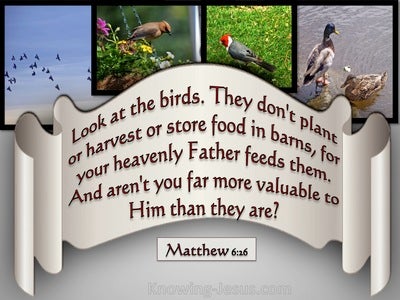
God, the Author and Creator of our life, through Jesus, affirmed our value with this verse: Matthew 6:26 Amplified 26 Look at the birds of the air; they neither sow [seed] nor reap [the harvest] nor gather [the crops] into barns, and yet your heavenly Father keeps feeding them. Are you not worth much more than they?

When You Struggle with Self-Worth, as all of humanity will from time to time, Pray! Always Try Hard to Remember this: You Are Somebody Special to God!!! 

Matthew 6:25-34 The Message

25-26 “If you decide for God, living a life of God-worship, it follows that you don’t fuss about what’s on the table at mealtimes or whether the clothes in your closet are in fashion. There is far more to your life than the food you put in your stomach, more to your outer appearance than the clothes you hang on your body. Look at the birds, free and unfettered, not tied down to a job description, careless in the care of God. And you count far more to him than birds.

27-29 “Has anyone by fussing in front of the mirror ever gotten taller by so much as an inch? All this time and money wasted on fashion—do you think it makes that much difference? Instead of looking at the fashions, walk out into the fields and look at the wildflowers. They never primp or shop, but have you ever seen color and design quite like it? The ten best-dressed men and women in the country look shabby alongside them.

30-33 “If God gives such attention to the appearance of wildflowers—most of which are never even seen—don’t you think he’ll attend to you, take pride in you, do his best for you? What I’m trying to do here is to get you to relax, to not be so preoccupied with getting, so you can respond to God’s giving. People who don’t know God and the way he works fuss over these things, but you know both God and how he works. Steep your life in God-reality, God-initiative, God-provisions. Don’t worry about missing out. You’ll find all your everyday human concerns will be met.

34 “Give your entire attention to what God is doing right now, and do not get all worked up about what may or may not happen tomorrow. God will help you deal with whatever hard things come up when the time comes.

The Word of God for the Children of God. Gloria! In Excelsis Deo! Alleluia! Amen.

Today, we are going to continue with the subject theme of “Who Am I,” but I believe it is time to discover who the Bible says we are. We have discovered who the Bible said the men of the bible were, but what does the Bible say about me?

Have you ever felt like a failure in life? Have you ever experienced insecurity? Some are insecure about your appearance, your abilities, your personality, your life, your choices? Have you felt unloved and worthless? Have you ever said the following words: “I am not attractive? I can’t do all the things that person can do. I am not good enough. Nothing good ever happens in my life. I am a failure.”

If your mind is filled or being overwhelmed with thoughts of worthlessness, shame, embarrassment and low self-esteem, valuelessness, then it is time this day to address all of that perceived insecurity. Some may ask; “how do I get rid of insecurity that has been there my whole life?” If you have ever felt that way, you need to listen to the messages for the next few weeks, because the only way we can address all those feelings is by realizing that WE are God’s most prized possession! If God had to choose the finest thing that He has ever created – He would choose you and me! We are somebody extraordinarily special to God!

Those thoughts and feelings of being worthless and devalued surround millions of people around the globe and they are the very worst kind of lies from the devil aimed at getting you so down on yourself that you will never experience God’s abundant best for your life. These thoughts try to get you to feel you are just not or never will be “good enough,” so why would God ever want to bless me?” God does not have one child who is not good enough to receive His love.

There are a whole lot of people who never learn how to enjoy victories in their lives because of such low self-esteem. Jesus said that we are to love one another even as we love ourselves. If you don’t like YOU, how are you ever going to like someone else? Low self-esteem is a result of a lack of knowledge, a lack of what I call “GOD-ESTEEM!”. I am absolutely convinced that the core reason so many Christians live way below their privileges as a child of God is because they don’t know that they are blessed and highly favored of the Lord. My favorite saying is, “I’m healthy, wealthy, wise, blessed and highly esteemed, favored of the Lord!!!”

AS WE STRUGGLE WITH OUR SELF-WORTH

We often spend too much of our time focusing on and prioritizing, losing sight of just exactly and exactingly, how absolutely valuable we are to God. Many of us see easily all of the most beautiful and valued things in God’s creation and in other people. Yet we somehow will refuse to value ourselves in light of how God 100% loves us. Some of us get stuck, struggle with feelings of low self-worth.

“Gee whiz, I have this physical or mental health challenge”, “I have a different standard of acceptability amongst my fellow human beings.” “My value and my self-worth are automatically assigned to me differently.” “As mankind assigns me my value, my self-worth, it automatically becomes my standard of living.”

If you struggle with any of these and similar sounding thoughts of self-worth, let Jesus’ words bring you comfort today. Look at the birds outside your window today, consider how wonderfully, automatically, God cares for them. Then pray about how much more he cares for you every day. How valuable you are to him. How much more could you value yourself when you realize, come to experience, echelons far above mankind’s standard of judgement IS God’s standard of care?

Isaiah 61:10-11 English Standard Version

10 I will greatly rejoice in the Lord;
    my soul shall exult in my God,
for he has clothed me with the garments of salvation;
    he has covered me with the robe of righteousness,
as a bridegroom decks himself like a priest with a beautiful headdress,
    and as a bride adorns herself with her jewels.
11 For as the earth brings forth its sprouts,
    and as a garden causes what is sown in it to sprout up,
so the Lord God will cause righteousness and praise
    to sprout up before all the nations.

As a change of pace, consider the greatest plans and purposes God has for you, in comparison to birds. Then take the risk and take one giant sized baby step out in a bolder more confident, greater faith, trusting in the value and worth which Jesus places on you, rather than choosing a negative thought pattern.

As you meditate on the truth of God’s Word from the Gospel of Matthew, you can begin to see your great value in God’s eyes. You can overcome feelings of low self-worth when you believe Jesus says you are greatly valuable to him. Slowly, and I believe surely and genuinely, those thoughts can be case aside into the vast, immeasurable expanse and depths of God’s great Sea of Forgetfulness!

CELEBRATE GOD DAILY EXACTLY AS GOD IS DAILY CELEBRATING YOU!!!

In the name of God, the Father and God the Son and God the Holy Spirit, PRAY!

Let us set aside what we perceive and believe to be our value is to the world,

Psalm 8 Names of God Bible

Psalm 8

For the choir director; on the gittith;[a] a psalm by David.

Yahweh, our Adonay, how majestic is your name throughout the earth!

Your glory is sung above the heavens.[b]
From the mouths of little children and infants,
    you have built a fortress against your opponents
        to silence the enemy and the avenger.

When I look at your heavens,
    the creation of your fingers,
    the moon and the stars that you have set in place—
        what is a mortal that you remember him
            or the Son of Man that you take care of him?
        You have made him a little lower than yourself.
        You have crowned him with glory and honor.
        You have made him rule what your hands created.
        You have put everything under his control:
            all the sheep and cattle, the wild animals,
            the birds, the fish,
            whatever swims in the currents of the seas.

Yahweh, our Adonay, how majestic is your name throughout the earth!
https://translate.google.com/

Asking and Answering the Questions: “Who Am I?” “What is My Purpose?” Finding your Place & Purpose in life.

1 Chronicles 17:16-21English Standard Version

David’s Prayer

16 Then King David went in and sat before the Lord and said, “Who am I, O Lord God, and what is my house, that you have brought me thus far? 17 And this was a small thing in your eyes, O God. You have also spoken of your servant’s house for a great while to come, and have shown me future generations, [a] O Lord God! 18 And what more can David say to you for honoring your servant? For you know your servant. 19 For your servant’s sake, O Lord, and according to your own heart, you have done all this greatness, in making known all these great things. 20 There is none like you, O Lord, and there is no God besides you, according to all that we have heard with our ears. 21 And who is like your people Israel, the one[b] nation on earth whom God went to redeem to be his people, making for yourself a name for great and awesome things, in driving out nations before your people whom you redeemed from Egypt?

The Word of God for the Children of God. Gloria! In Excelsis Deo! Alleluia! Amen.

People need and want to feel important and needed. They want to believe that their life has meaning, that their life matters muchly, and they are valuable. We need to know that, from birth to death, the lives we lived mattered to someone beyond ourselves. Our hopes, our dreams, our cherished aspirations mattered. We have a place and purpose in life which is something that comes to have a meaningful place in the course of life. Someone loves us, makes us valuable. A husband or a wife, children and grandchildren, friends, a great job, a career.

There are and always will be arguments in any workplace that the worker has because he feels he deserves more pay than what he is getting. People will tend to always feel unrecognized and that they deserve more than they are getting.

David had decided that he wanted to build a temple for God. God loved his heart but told him that he was not the one to do it, but his son would build the temple. God also promised him that he would always have a son sitting on the throne.

David was thoroughly overwhelmed with what God had said and asked who he was that God would do this for him. He did not get angry with God, but truly understood the favor that God was giving him and could not understand it.

It is common for believers to develop the same attitude that the world has. They often feel that they deserve to have the absolute best of everything, and then get far above, beyond upset when God does not give them something they desire.

The reality is that no person really deserves anything but painful death from God. From true paradise, Sin has brought death upon every person, including believers. Yet, God loved people so much that He provided a way out of that death. He has given every believer unmerited favor upon their lives. (John 3:16)

In every believer, God has poured out many blessings and His favor in ways that the world cannot understand.

Take a look at your own life. How has God blessed you over the days and years? Despite any situation you may be going through or have gone through, God has still given you great favor. God will continue to shower great favor upon you.

God has also spoken His abundance of blessings over your life and promised a great future. Your future includes eternal life with no more pain or suffering.

Over time God has already brought you through many things which you did not deserve to receive or then survive from. God did this because of His great love for you, not because you deserved anything. (Ephesians 2:8-10)

LIVING A LIFE OF PURPOSE: SELF – REFLECTION

David left his extravagant palace, went into the Tabernacle and sat down before the Lord and he asked God to enlighten his soul as to why he deserved anything like what he had just been promised – an eternal kingdom in all of the heavens.

David had been humbled more so than at any time in his life of successes and his life of vast and catastrophic failures. David realized that something beyond what he knew he deserved had just been guaranteed by God. David was asking himself many tough questions and he was not able to provide himself with any easy answers which made the least bit of sense to him. David was genuinely lost in the moment, this crossroads between his temporary Kingship and his death. Something just did not make any sense to him. He had great wealth; he had a reputation as the greatest King, he had incredible personal power to change the course of his nation’s history. Only now, God has called him away from himself.

Understanding yourself at a deeper level is essential to living a life with purpose.

So often we look outwards to find peace, contentment, comfort and compassion – for ourselves and for others. What if we could, instead, try to find these deeper feelings within ourselves, enhancing awareness, emotional intelligence, goal achievement and the ability to live a life with purpose?

Self-reflection is absolutely necessary if we are to be clear about our purpose in life. Being clear about one’s purpose brings meaning, perspective and adds enjoyment to life.

As part of my ministry, and because I am interested in what factors lead to confidence, happiness and success, I am always wondering to what measure, to what degree do people actually rely on external feedback for confidence and self-esteem, feeling good about themselves, feeling purposeful and valued.

While it’s always a wonderful feeling and confidence builder to receive positive feedback, indeed it is absolutely necessary, to receive both positive and negative feedback from others about how your actions influence the way others perceive you, it is also crucial to listen to your own inner voice. If you do not know who you are and what you’re abundantly passionate and purposeful about—and like it—it will be close to impossible for you to be express your best and most valued self to the world and to follow the route that matters most, works best for YOU.

5 benefits of reflection for living a life with purpose

  1. Reflection transforms thoughts into genuine learning about how beliefs and values affect happiness, life choices and goal achievement. Understanding how your beliefs and values affect you is the first step towards uncovering your life’s purpose.
  2. Taking time to reflect on challenges, approaches and options, increase self-awareness which is a key component of emotional intelligence. Emotional intelligence is a critical life and leadership skill.
  3. Improve empathy levels and understanding of others by reflecting on your relationships. Forming connections, building close relationships are key to a live well-lived.
  4. Spark your creativity by keeping a notebook handy for when ideas strike. Take time to reflect on the pro’s, cons, compromises and possibilities of your ideas so that you are reasonably clear on which ideas are those that matter to you.
  5. Increase focus, productivity and goal achievement by writing down your plans and goals – then reflecting in the presence of God, on just which strategies and activities that will lead to goal achievement, self-value and living with purpose.

With increasingly busy and stressful lives, it’s more important for your success levels than ever, to take time to yourself. Whether you’re an extrovert who may find alone-time challenging or an introvert who craves time by yourself, you can deliver the 5 benefits listed above – and more, by taking some time every day for self-reflection.

11 questions which will prayerfully help your “me and God” reflections be more effective

In the presence of God, the Lord, sit down, ask yourself open questions as you reflect, for example like the questions listed below, to find a way to explore your thoughts and feelings, to help you provide clarity and compassion for yourself.

  • How am I feeling today?
  • What is my intention today?
  • What about my life/this situation do I find challenging/worrying?
  • How did I contribute to this situation?
  • What are all my options?
  • Which parts of my life do I love the most?
  • What am I grateful for?
  • How can I show kindness to someone I care for?
  • What would I like to do more of?
  • How will I choose to show myself love and kindness today?
  • What’s great about me?

Life is always going to full of ups and downs, good times, not so good times. Remember that after darkness comes light. Time passes, feelings change.

Take time to think. Examine your thoughts and feelings. You may choose to keep your reflections private, using your notebook or journal as a trusted confidante without an agenda. Or you may discover as you process your reflections that you would like to ask someone for help and choose to share.

Sitting on a park bench, alone with Jesus, Reflections help create value, meaning, an essential element to living a life with purpose.

Isaiah 55:1-3, Matthew 11:28-30, Luke 24:13-35, John 15, 17, 21:15-19

Take quality time to come away from yourselves, just sit in the presence of God!

Realize who you are in Christ Jesus.

Even if the whole world refuses to acknowledge it,

You and I have value! You and I are valued! You and I absolutely matter!

Even when we cannot sense it or find no reason to accept it within ourselves,

We have purpose!

We have value!

We have an over-abundance of “God-Esteem!”

You and I are God’s child, because of what Jesus did for us for love, not because of you. Give God greatest praise for what He has done for you and made us to be.

In the name of God, the Father, and God the Son and God the Holy Spirit,

Let us pray,

Lord Jesus Christ, your power is beyond compare. You turned water into wine. You restored sight to the blind and made the deaf hear. You made the lame walk. You healed the sick, you fed the thousands and raised the dead. You conquered death in your resurrection. Everything you touch is powerfully transformed. Let me know and experience that powerful touch in my life. Lord, bless me and keep me, make your face shine upon me.  Through your mighty name, Alleluia! Amen

https://translate.google.com/

Life is not being fair? Getting your Heart and Your Soul under Control. The Importance Of 1 Peter 3:13-18.

An itinerant Rabbi Jesus once said that “in this world you will have tribulation,” and we all know that to be true. The fact that suffering exists doesn’t trouble us until we are the ones who are doing most of the suffering, when we are the ones who are the most vulnerable to experiencing that suffering and it is especially troubling when we feel the depth of our suffering is unjustified. While we know that one day God will make all things right, how are we to deal with injustices in our 21st century lives? How do we keep pressing on when life doesn’t seem fair? 

Our response to unfairness is greatly influenced by our perspective, or the lens through which we choose to view our “suffering” life. We either have a human perspective—one that seeks living victimization, retribution when it perceives unequal treatment; or a divine perspective—one that yields its rights to the Lord and trusts in Him to work all things together for good (Romans 8:28).  There is such an overwhelmingly strong message in 1 Peter 3:13-18. Lately, these verses have been standing out, so I thought we could dive into it together.

1 Peter 3:13-18 The Message

13-18 If with heart and soul you’re doing good, do you think you can be stopped? Even if you suffer for it, you are still [far] better off. Don’t give the opposition a second thought. Through thick and thin, keep your hearts at attention, in [full] adoration before Christ, your Master. Be ready to speak up and tell anyone who asks why you’re living the way you are, and always with the utmost courtesy. Keep a clear conscience before God so that when people throw mud at you, none of it will stick. They’ll end up realizing that they’re the ones who need a bath. It’s [far] better to suffer for doing good, if that’s what God wants, than to be punished for doing bad. That’s what Christ did definitively: suffered because of others’ sins, the Righteous One for the unrighteous ones. He went through it all—was put to death and then made alive—to bring us to God.

The Word of God for the Children of God. Gloria! In Excelsis Deo! Alleluia! Amen.

It is crucial to focus on the condition of your heart and soul. Our actions flow from these two things. Our thoughts and actions are altered by both as well.

Except this focus becomes blurred when life seems to focus too much on just exactly how vulnerable we are when life screams at us: “that is just not fair!”

We have all at one time or another been in that place where the only thing we seem to be able to focus on or prioritize is the “unfairness of our vulnerability.” Both ears of our hearts and our souls are deafened by all the piercing shrieks. Sometimes there appears to be no way to filter or screen out all the craziness. Our lives seem to become immobile frozen to an absolute zero temperature. “I cannot go up or down or to the right, and I cannot move off to the left either and I am certainly not going to jump off of the nearest cliff into the deepest rivers!”

So, what direction does that leave me to go, when there is seemingly nowhere? I will never hesitate to recommend turning to the Word of God for His children. I will never hesitate to recommend the Bible as the authority of God over every last ounce of the chaos which threatens to exploit my every single vulnerability.

And now, I grasp the authority of God from His Word found in 1 Peter 3:13-18! Reading and re-reading it, studying it and praying it, the only way to live a bold, demonstrative, spirit-filled life is to constantly redirect our attention to God, the Father. He shows us that His ways are better than ours. He shows us how to treat others and how to be light. When He is the center of every area of our lives, we live strongly. Souls are strengthened and hearts are filled. Following God does not guarantee an invincible path. We are not invincible, but He 1000% is.

When He gifted us with the Holy Spirit, He gave us supernatural strength to handle situations. He gave us understanding. We are always going to be human, but we are also conquerors. We will still face downfalls and heartaches, but if our eyes, hearts and souls are seeking Him, we will always rise. With constant reassurance of how great He is, why would we want to do our own thing? Our hearts and souls need to be fed in order to prosper. Without affirmation of faith through covenant and communication with Him, it’s impossible to be unselfish.

We recognize our source of life, but we cannot continue to develop without our exercising it every day. We must search for better understanding and know why we believe what we believe. We should be ready to tell anyone about how good God is to us. We must stand firm when people have tough questions and doubts.

They should not be able to distract us from the truth we have received from God and revealed through the ministry, mission and works of Jesus and Holy Spirit.

We should each be able to give explanations for the hope and faith within us with nothing but friendliness rather than aggravation. There will always be people who bash and disagree but let them. Jesus was mocked and tortured, but the glory of God overcame it all. Bad days will always come, but I would rather have bad days with a great God by my side than good ones without Him. The joy of the Lord is a lifestyle that cannot be described. It is well worth any sacrifice… After all, He did give the ultimate sacrifice. Because of this, I am forever His.

1 Peter 3:13-18 offers five-fold advice that will enable us to live in an unfair, inequitable world, and leads with a general rule that if you live a clean and honest and God-devout life, God, the Father, Son, Holy Spirit protect you. 

[1] When suffering, consider yourself to be blessed by God. When you patiently endure unfair treatment, you are fulfilling God’s purpose and plan for your life. (Genesis 22:1-19, Daniel chapter 3, James 1:1-18) It is understandably difficult to remain joyful when going through pain, but it’s important to remember one day you WILL be richly rewarded for your endurance of these undeserved trials. 

[2] Don’t panic or worry as it does nothing but undermine your trust in the Lord. God is aware of your struggle and He is your defense. He has your back. 

[3] Acknowledge that Jesus is Lord over this situation as He is Lord over all of creation itself. He is glorified when he’s given ultimate authority in the midst of your trial. He is absolutely sovereign and is allowing this trial for reasons that are all His, even if it does not make sense to you. (Job 1:20-22 and 19:23-27)

[4] Be ready to defend your faith when the opportunity arises. Crisis often presents an overwhelming platform for zealous gospel witness, especially when your actions match your talk. This is especially true if #5 is in place, so… ergo … 

[5] Be a person of honor, humility and integrity. Your honor, humility, and integrity are your greatest defenses against unjust criticism and the greatest evidence that there is a God in heaven who is powerfully working in your life. 

We should really not be the least bit surprised or overwhelmed when we are overlooked or persecuted by the world. It is, sadly, a natural part of walking in opposition to culture and standing firm for Jesus Christ, but we can take heart, because we know He has already overcome the world. And through Him alone, so can we also! (John 16:25-33, John Chapters 17 and 20, Romans 8:31-39)

APPLICATION / CHALLENGE

  • When you patiently endure unfair treatment, you are blessed. You are fulfilling God’s purpose and plan, and soon you will be rewarded for your endurance. Don’t panic or worry. Acknowledge that Jesus is Lord over this situation.
  • Be a person of integrity (it’s both your best defense against unjust criticism, and the greatest evidence that God in heaven is powerfully at work in you.)
  • Be ready to fully defend your faith as the opportunity arises. In a few concise statements, what would you share with someone who asks you about your beliefs? Finally, fashion your brief statements into an articulate paragraph that feels natural to speak – and regularly practice saying it until it is comfortable.
  • Then zealously seek out opportunities to put your hope and faith into practice.
  • In our success or in failure, Give God every last ounce of glory, honor or praise!

TO GIVE GOD PRIORITY IN LIFE – TAKE A FIRST STEP

Each day strive to write down one doable concrete step towards obedience, small or large, that you will then strive to put into regular practice. (James 1:22: “But prove yourselves doers of the word, not merely hearers who delude themselves.”)

In the name of God, the Father, God the Son and God the Holy Spirit,

Let us pray,

Psalm 23 The Message

23 1-3 God, my shepherd!
    I don’t need a thing.
You have bedded me down in lush meadows,
    you find me quiet pools to drink from.
True to your word,
    you let me catch my breath
    and send me in the right direction.

Even when the way goes through
    Death Valley,
I’m not afraid
    when you walk at my side.
Your trusty shepherd’s crook
    makes me feel secure.

You serve me a six-course dinner
    right in front of my enemies.
You revive my drooping head;
    my cup brims with blessing.

Your beauty and love chase after me
    every day of my life.
I’m back home in the house of God
    for the rest of my life.

Gloria! In Excelsis Deo! Alleluia! Alleluia! Alleluia! Amen.

https://translate.google.com/

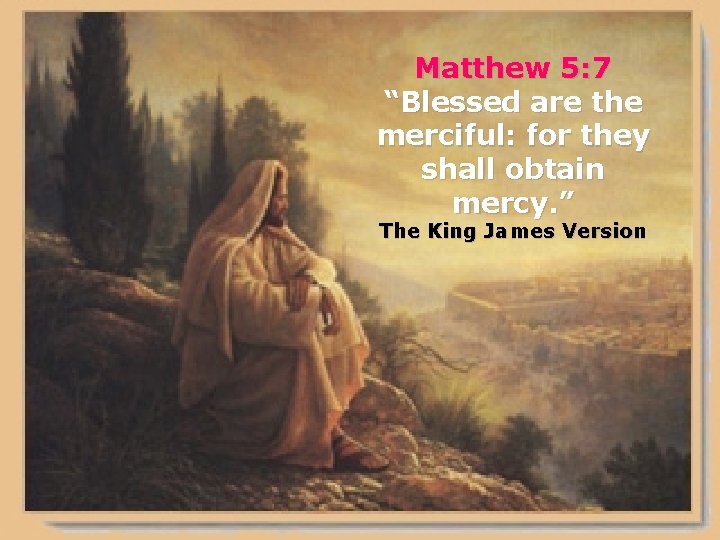
Matthew 5:7 AMP, “Blessed [content, sheltered by God’s promises] are the merciful, for they will receive mercy.

My Prayer is “Lord have Mercy! Christ, have Mercy! Lord have Mercy upon Me!!!”

Today, I am pondering how God treats us much, much better than we deserve.

Today, I am pondering just how much better we could be if we ourselves treated others, others being those whom God has called to be our neighbors, as God has treated us from the very beginning of all things. God mercifully created all of us. He gave us the responsibility to be care-full, care-filled stewards of each other. Yet, it is obvious even to the untrained, unobservant observer, there is failure! Even in the midst of all of our greatest failures to care for each other, God, in the single greatest act of mercy sent His Son Jesus to us to save, not condemn.

That fundamental, undergirding spiritual truth is the reality of grace. He has seen us in our very worst sins and had mercy on us because of his great love for us (see Romans 6:6-12). Even though we have repeatedly proved unfaithful and undependable, both individually and as a group, God has yet been gracious and profoundly merciful. He has repeatedly offered forgiveness, help, redemption, and salvation when we least deserved it. We have all been failures as stewards. We have had more than our fair share of success stories, but those failures ….!

Rather than dealing with us strictly as law would demand, God has dealt with us as a loving father does with his children. This conditioning reality must show up in us also. How can we truly claim to be his children and not be merciful as God has always been merciful with us? What about our mutual stewardship?

How can we call for retribution against our brothers and sisters, when fairness would demand we pay a great penalty for our sin? In the Kingdom family, mercy rules. When that mercy is so easily brushed aside, forgotten by us, then God has promised to judge our very own standard of mercilessness when he judges us. Matthew 7:1-2. Yet as long as we are merciful to others, God will show us mercy.

The Beatitudes are a description of the characteristics of people who belong to Christ’s kingdom. Matthew 4 we read Jesus was preaching, “Repent, for the kingdom of heaven is at hand.” Then Jesus went through Galilee proclaiming the gospel of the kingdom and is healing diseases and afflictions among the people. As Jesus goes up the mountain, he is reenacting the great law-giver Moses going up the mountain and receiving the Law from God’s own fingers. Jesus is now declaring the law, that is, the covenant of the kingdom of heaven.

In Matthew 5:7 Jesus said, “Blessed are the merciful, for they shall receive mercy.”

Matthew 5:7 The Message

“You’re blessed when you care. At the moment of being ‘care-full,’ you find yourselves cared for.

The Word of God for the Children of God. Gloria! In Excelsis Deo! Alleluia! Amen.

You are blessed when you care.

Someone else is being blessed when you care.

Your family is being blessed when you care.

Your friends are being blessed when you care.

Your next-door neighbors are being blessed when you care.

Your community is being blessed when you care.

Being across the globe as I am, I am blessed when you care.

The Body of Christ is being blessed when you care.

At the moment of being care – full you find yourselves cared for.

At the moment you are being care – full I find myself being cared for.

At the moment of being care – filled you find yourselves being cared for.

At the moment you are being care – filled, I find myself being cared for.

Jesus came to give us life, a life full of abundance.

Jesus came to give us life, a life filled with abundance.

Jesus came to care about our lives full of abundance.

Jesus came to care about our lives being filled to abundance

Jesus came to care for our lives filled with abundance.

In the single greatest act of mercy, God sent His Son to show He cares.

In the single greatest act of mercy, God sent His Son to care about us.

In the single greatest act of mercy, God sent His Son to care for us.

What else can be said here?

What else can God do here which He has not already done in abundance?

How much more will God continue to do for us through His Son Jesus?

What about this continuous revelation of mercy we have done nothing for?

Understanding God’s revelation of Mercy

The word “mercy” is used in the Gospel of Matthew to refer to showing compassion, pity, and favor toward the suffering and needy (Matthew 9:27; 15:22; 17:15; 18:33; 20:30).

We get a good experience for this word when we read the parable of the Good Samaritan (Luke 10). Remember that there was a man who fell among robbers and was suddenly beaten severely. A priest and a Levite pass by and do not offer assistance. But a Samaritan, someone the Israelites avoided at all costs, comes to his aid, takes him to an inn, and pays for his care. Jesus then asks, “Which of these three, do you think, proved to be a neighbor to the man who fell among the robbers?” (Luke 10:36) The lawyer responded, “The one who showed him mercy” (Luke 10:37). Here we see that mercy is showing compassion, pity, and favor.

Mercy, therefore, is not just a feeling. Mercy is not some detached feeling or a sentiment that does nothing. Mercy is a feeling that causes the individual to act.

Sometimes we describe mercy as not giving to others what they deserve. While there is truth to this declaration, we are going to see that this is not a complete definition for mercy. Mercy is not merely refusing to bring judgment on those deserving of judgment. Mercy is genuine compassion expressed in genuine help and selfless, sacrificial compassion and selfless concern shown in selfless acts.

The people in God’s kingdom are those who are free givers of mercy. Mercy is something that is freely shown, not merely felt. Later in Matthew, Jesus will call mercy one of the weightier matters of the law (Matthew 23:23).

Matthew 23:23 Amplified Bible

23 “Woe to you, [self-righteous] scribes and Pharisees, hypocrites! For you give a tenth (tithe) of your mint and dill and cumin [focusing on minor matters] and have neglected the weightier [more important moral and spiritual] provisions of the Law: justice and mercy and faithfulness; but these are the [primary] things you ought to have done without neglecting the others.

Mercy was not a characteristic of 1st century culture, nor ours today. A popular Roman philosopher called mercy, “The disease of the soul.” It was the sign of supreme weakness. The Roman world in Jesus’ day did not show a lot of mercy.

Jesus healed the sick, gave sight to the blind, made the lame to walk, the deaf to hear, and raised the dead. He was the friend of sinners. He forgave prostitutes, tax collectors, and religious rulers. He took children in His arms and blessed them. He showed mercy to everyone and in return they betrayed him, they repeatedly attempted to stone Him, throw him off cliffs and united to kill Him.

The ancient world then was a place of coercive violence and intimidation, but not mercy. The quality and quantity of Mercy was not very “politically correct.”

Just like the other beatitudes in which Jesus promises blessing for living in ways contrary to our nature, He climbs a hill, the people gather around him, and He says in Matthew 5:7, “Blessed are the merciful, for they shall obtain mercy.”

Matthew 5:43 records the saying was to love your neighbor and hate your enemy. We see in these cultures that mercy, if it was given, was reserved for those who had been merciful only to you. Our world today is not far removed spiritually from the Roman world when Jesus gave these blessed statements.

One too many world cultures say the same thing: “If you don’t look out for yourself, no one else will.” Another slogan today: “Don’t get mad, get even.” People are still treated like things, power is the supreme deity, and financial success is the most important thing in life. There is even the saying to, “Show no mercy ever.” Today, just as then, mercy is weakness in the minds of most.

The Standard of Mercy of God our Creator

We see Jesus showing mercy on many occasions. He looked on people and was moved with pity and compassion (Matthew 9:36; 14:14; 15:32). Jesus showed compassion on the sinful woman caught in adultery. Jesus always showed compassion and love toward the people. This is what attracts us to Jesus!

He truly cared for people. He had a legitimate concern for their needs and difficulties. In fact, we see the ugliness of the human heart with how the religious leaders treated Jesus. You will notice in the gospels the more Jesus showed mercy and compassion, the more the religious leaders hated Jesus and looked for opportunities to kill him.

The hatred grew so great that the people and leaders betrayed him, had Jesus arrested without cause, nailed to a cross. Yet, even while hanging on the cross, with nails driven through his outstretched hands, we see the mercy of Jesus. “Father, forgive them; for they do not know what they are doing” (Luke 23:34).

Notice in this we see a distinction between mercy and forgiveness. The mercy of our Lord is the basis for his desire to forgive us. “…he saved us, not because of works done by us in righteousness, but according to his own [standard of] mercy, by the washing of regeneration and renewal of the Holy Spirit, whom he poured out on us richly through Jesus Christ our Savior…” (Titus 3:5–6). 

Mercy was the basis upon which forgiveness was extended. God’s forgiveness of our sins flow from his abundant mercy.

But God, being rich in mercy, because of the great love with which he loved us, even when we were dead in our trespasses, made us alive together with Christ—by grace you have been saved— and raised us up with him and seated us with him in the heavenly places in Christ Jesus, (Ephesians 2:4–6 ESV)

Please notice that Ephesians makes the same distinction between mercy and forgiveness. Because God is rich in mercy with great love for us, he saved us by grace and made us alive together with Christ. While Jesus is on the cross, we see his full extent of mercy as he extends the opportunity of forgiveness to them.

We must be merciful because this is the very character of God. Jesus declared, “Be merciful, even as your Father is merciful” (Luke 6:36). The mercy of God should be renewed in our minds and hearts at least every Sunday as we partake of the Lord’s Supper. The Lord’s Supper reminds us of the mercy of God that we have experienced. God’s mercy is the covenanted basis of our own forgiveness.

This covenant teaches us something valuable. Our lack of forgiveness and our unwillingness to forgive others comes from a lack of mercy for others. Mercy drives forgiveness. If I am not driven to be forgiving, then I am not driven to be merciful. If I am not merciful, then I am not living in the kingdom of heaven.

The Challenge of God’s Standard of Mercy

Mercy is a challenge to develop in our character. Showing mercy means making ourselves vulnerable. We will be hurt by what other people do to us. We will extend ourselves to help people without reciprocation or thanks. We will give of ourselves unto those who need us without regard for receiving something in return. Compassion and pity are not often praised in our world, but it is the very heart of God, revealed through Jesus Christ, that we are showing to the world.

Mercy is not earned. Just like grace is no longer grace if it is earned, mercy is no longer mercy if it is deserved. Mercy is compassion that is undeserved. We are not to show mercy to whom we think deserve our mercy. We are to be like the character of God, extending mercy to all. Show mercy when people sin against us. The merciful expend a great measure of themselves to freely assist others.

But sometimes we misunderstand mercy. Mercy does not mean sin is ignored. We know this because God is merciful toward us but that does not mean our sins are ignored. Mercy recognizes the reality of sin. Mercy has the recognition of wrongdoing. Jesus did not show mercy by pretending that people were not sinning. Jesus did not show mercy by not convicting the people of their sins.

Jesus was being merciful by identifying sins and giving sinners the hope for forgiveness through him. Mercy identifies our sin but then shows the way to reconciliation with God. Mercy does good toward the other even in the face of opposition or evil.

Now think about what Jesus taught a couple times in the Gospel of Matthew: “I desire mercy, not sacrifice.” This declaration ought to be weighty to us and must not be emptied of its impact. God wants people who have a heart for him and for others. God does not want passive, heartless, soulless pew sitters.

We are people who help and heal. I am so troubled to hear how often Christians have an argument or a moment of an unkind word, and rather than showing mercy, there is division. People leave the congregation and go to another.

People get their feelings hurt and dwell in bitterness and leave. Going to church is not the test to know if you have received God’s mercy. Being merciful to others is the test to know if you have in truth experienced and received God’s mercy. Mercy is not desiring for other people to do good for others. Mercy is when we seek and act upon opportunities to be mercy givers, like the Good Samaritan in Luke 10.

Think about what the prophet Micah declared to the people:

And what does the Lord require of you? To act justly and to love mercy [kindness; ESV] and to walk humbly with your God. (Micah 6:8 NIV)

They Shall Receive God’s Standard of Mercy

The sinner’s plea can only be the words, “God, be merciful to me, a sinner” (Luke 18:13). God only shows mercy to the merciful. “Blessed are the merciful for they shall receive mercy.”

Listen to the chilling words of James:

For judgment is without mercy to one who has shown no mercy. Mercy triumphs over judgment. (James 2:13 ESV)

What terrifying words to hear! Judgment will be without mercy to the one who has shown no mercy.

We also have another saying: that person is getting what they deserve. But is that what we want to have happen to us? Do we want to get what we deserve for how we have treated others?

I know I have made many, many mistakes and I do not want to get what I truly deserve. for making them. You know others have been merciful toward you with your flaws and errors. Yet how often we will refuse to help people and refuse to be merciful because we think the person should not have put themselves in this mess in the first place! “They are only getting what they deserve.”

But we want others to be merciful toward us and not give us what we deserve. Further, we want God to be merciful toward us and not give us what we deserve. Do we seriously want to get what we deserve for how we have treated God?

Mercy toward others begins in our lives by having a penetrating awareness of our own desperate need of mercy from others, and especially from God.

It is mercy that shows compassion to the helpless (Luke 10:37) and extends forgiveness even to the one who gives repeated offense (Matthew 18:21-22). But this is what is important: mercy is not prompted by the appeal of certain qualities of the offender. We see this truth when God showed mercy to us through the cross (Romans 5:8-10).

Matthew 18:33 “And should not you have had mercy on your fellow servant, as I had mercy on you?” God’s standard of mercy compels us to be gracious, kind, compassionate, merciful toward others. We love God because He first loved us!

Blessed are the merciful for they shall receive mercy.

Oh, how we need this!

Oh, how we need to live this!

Oh, how we need to love this!

Oh, how we need to move on this!

Oh, how we need to go forth with this!

Oh, how we need to experience this!

Oh, how we need to reveal this!

Pray! Let God’s mercy transform your heart to be mercy givers to all people.

Let mercy flow like as an everlasting stream flowing from the heart of God!

In the name of God, the Father, and God the Son and God the Holy Spirit,

Let us pray,

Heavenly Father, how I praise and thank You for Your manifold mercy towards me, in that while I was yet a sinner, and at enmity with You… You did not give me what I deserve, but showed me mercy and love, by redeeming my life and clothing me in the righteousness of Christ. May I imitate the merciful way that Christ lived by bestowing Your mercy and compassion on all those with whom I come in contact. May I live as You would have me live in Jesus’ name – and for His glory, Alleluia! Alleluia! Alleluia! AMEN.

https://translate.google.com/

Psalm 19: Declare the Glory of God!

God our Creator, God the Author of our very lives reveals Himself to us in two ways—through the immeasurable expanse of nature and in His written Word.

What do we feel when we encounter God? How do we feel in recitation of this psalm?

We stand in awe of God’s creation and the God who is behind it all. At the same time, our hearts are filled with wonder, admiration, delight, and appreciation for the Word of God. Opening the Bible is like entering a cavern filled with gold, silver, and precious jewels. As we behold the glory, beauty, and holiness of our God, can we not help but be humbled? We hardly belong here. But yet we are all here by the grace of God for His glory. But that is where God’s salvation comes in to play. The psalm ends with confession of sins, a prayer for God’s cleansing, a prayer that our thoughts and our words are pleasing and glorifying unto God.

Psalm 19 The Message

19 1-2 God’s glory is on tour in the skies,
    God-craft on exhibit across the horizon.
Madame Day holds classes every morning,
    Professor Night lectures each evening.

3-4 Their words aren’t heard,
    their voices aren’t recorded,
But their silence fills the earth:
    unspoken truth is spoken everywhere.

4-5 God makes a huge dome
    for the sun—a superdome!
The morning sun’s a new husband
    leaping from his honeymoon bed,
The daybreaking sun an athlete
    racing to the tape.

That’s how God’s Word vaults across the skies
    from sunrise to sunset,
Melting ice, scorching deserts,
    warming hearts to faith.

7-9 The revelation of God is whole
    and pulls our lives together.
The signposts of God are clear
    and point out the right road.
The life-maps of God are right,
    showing the way to joy.
The directions of God are plain
    and easy on the eyes.
God’s reputation is twenty-four-carat gold,
    with a lifetime guarantee.
The decisions of God are accurate
    down to the nth degree.

10 God’s Word is better than a diamond,
    better than a diamond set between emeralds.
You’ll like it better than strawberries in spring,
    better than red, ripe strawberries.

11-14 There’s more: God’s Word warns us of danger
    and directs us to hidden treasure.
Otherwise, how will we find our way?
    Or know when we play the fool?
Clean the slate, God, so we can start the day fresh!
    Keep me from stupid sins,
    from thinking I can take over your work;
Then I can start this day sun-washed,
    scrubbed clean of the grime of sin.
These are the words in my mouth;
    these are what I chew on and pray.
Accept them when I place them
    on the morning altar,
O God, my Altar-Rock,
    God, Priest-of-My-Altar.

The Word of God for the Children of God. Gloria! In Excelsis Deo! Alleluia! Amen.

In his famous dissertation The End for Which God Created the World, Jonathan Edwards, the great American theologian, proclaimed God’s ultimate end is the manifestation of His glory. This glory is God’s unique excellence—the totality of His intrinsic perfections on display. We cannot pursue life’s ultimate purpose until we realize God created us to discover and declare His glory (1 Cor. 10:31).

The overarching theme of Psalm 19 is the glory of God displayed through the world He created (19:1–6) and the Word He spoke (19:7–14)—or through what we call natural and special revelation. All of creation declares the glory of God!

God’s Glory Is Declared Through His World

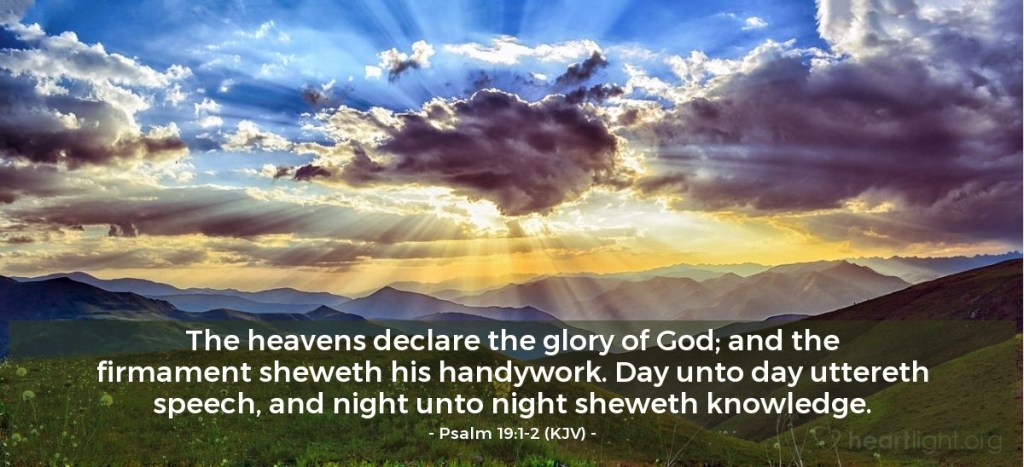
Psalm 19:1
The heavens declare the glory of God; and the firmament sheweth his handywork.

The Psalmist David begins by asserting that all of creation displays the glory of God. The entire heavenly panorama—the sun, stars and planets—is telling the story of His glory. The endless expanse of His creation is the work of His skillful hands. All nature shouts that God alone is divine, all-powerful, and all-wise.

Psalm 19:2–3 Authorized King James Version
Day unto day uttereth speech, and night unto night sheweth knowledge. There is no speech nor language, where their voice is not heard.

Every hour of everyday God’s message gushes forth like a mighty spring of water. Volumes are being communicated 24/7 about the knowledge of God. There is no language on earth that doesn’t hear God’s voice. He is not silent! If anyone claims to be an atheist, it is because he is deaf to the voice of creation.

Nevertheless, He left not himself without witness, in that he did good, and gave us rain from heaven, and fruitful seasons, filling our hearts with food and gladness. (Acts 14:17)

Psalm 19:4–6 Authorized King James Version
Their line is gone out through all the earth, and their words to the end of the world. In them hath he set a tabernacle for the sun, which is as a bridegroom coming out of his chamber, and rejoiceth as a strong man to run a race. His going forth is from the end of the heaven, and his circuit unto the ends of it: and there is nothing hid from the heat thereof.

The Psalmist David brilliantly uses the sun to illustrate how nature reveals God’s wisdom. The psalmist describes the heavens above the earth as a huge tent with the sun lighting the space like a torch. When the sun rises in the morning, its radiant brilliance is like a bridegroom who comes out of his tent beaming with happiness. And when the sun moves in its circuit around the earth, it is like an Olympic winner who genuinely enjoys running his course.

By pointing to the sun as God’s creative handiwork, David also dismantles the idol worship of the day represented in the sun gods. The Heavens declare the Glory of a living God not a god represented by our handiwork. (Acts 17:22-29)

God’s Glory Is Declared Through His Word

We can know that God exists through creation, but general revelation is insufficient for knowing the fullness of God’s character. It is only through Scripture that we are able to more fully comprehend the nature of God.

In Psalm 19:7–9 David gives us, as described by Spurgeon, “six descriptive titles of the word, six characteristic qualities mentioned, and six divine effects declared.” It is as if David picks up a diamond, turns in six different ways, and expresses the brilliance of each facet. https://archive.spurgeon.org/treasury/ps019.php

Psalm 19:7
The law of the Lord is perfect, converting the soul: the testimony of the Lord is sure, making wise the simple.

Authorized King James Version

The Hebrew word for law is Torah. It refers to the first five books of the Old Testament (Genesis through Deuteronomy). However, it doesn’t refer merely to laws, but rather to the doctrines or teachings emanating from these books. The law is fully sufficient (“perfect”) for all the needs of the spiritual life of God’s children and is effective to turn back and restore (“converting”) us when we sin and stray from God. (Exodus 15:22-26)

Psalm 19:7 Authorized King James Version
The testimony of the Lord is sure, making wise the simple.

testimony is a principle found in the law that requires obedience and serves as a warning if not kept. These regulations are pure, right and reliable. The Bible’s narratives consistently show what happens when people obey and disobey God. God gave His children these testimonies to guide the young and the naïve into and unto all God’s greater and greatest wisdom concerning our righteous living.

Psalm 19:8 Authorized King James Version
The statutes of the Lord are right, rejoicing the heart:

When a doctor gives you the right medicine to deal with your sickness, it makes you happy. In an even more important way, God’s precepts are true medicine for our souls. They are right for us and bring joy and happiness when followed.

Thy words were found, and I did eat them; and thy word was unto me the joy and rejoicing of mine heart. (Jeremiah 15:16)

Psalm 19:8
The commandment of the Lord is pure, enlightening the eye.

Authorized King James Version

God’s commands are pure, directing our lives morally and doctrinally into the light of God. Otherwise, we stumble along in darkness. As the psalmist prayed, “Thy word is a lamp unto my feet, and a light unto my path” (Psalm 119:105).

Psalm 19:9
The fear of the Lord is clean, enduring for ever:

When we spend quality time deep in the Word of God, it creates within us a reverential respect for God and a deep hatred for sin. This attitude toward sin is not hopelessly old-fashioned but eternally relevant for all people in all times.

Psalm 19:9
The judgments of the Lord are true and righteous altogether.

God’s declarations about what is right and wrong are reliable and trustworthy. You can build and mature your life on all the divine standards of the Scriptures.

Psalm 19:10–11
More to be desired are they than gold, yea, than much fine gold: sweeter also than honey and the honeycomb. Moreover by them is thy servant warned: and in keeping of them there is great reward.

David ends this section by stating the immeasurable value of the Word of God.

As we feed or souls on God’s truth, we discover that our souls are satisfied and delighted. It’s like having the sweet taste of honey perpetually in our mouths.

As we dig into God’s truth, we find that what we are mining is the purest gold possible. The Bible enriches those who engage in studying it and learning it. God’s Word too also protects us by admonishing us to avoid the destructive lifestyles and pathways of sin. Finally, God promises abundant, rewarding consequences if we but make a deliberate choice to strive to keep His Word by weaving it in and throughout our lives, preserving, protecting and obeying it.

Conclusion: Our Declaring the Glory of God

David’s eloquent conclusion to Psalm 19 links back to its introduction—God’s perfections have been put on display. He concludes with His desire to conform to that glory and not one single ounce of his own. As David turns his eyes from the world and the Word back to himself. Suddenly he becomes acutely aware of his own limitations and sinfulness. In light of this astonishing knowledge of God, David realizes what little knowledge he has of himself compared to God.

So the psalm concludes with a penetrating question and an earnest prayer.

Psalm 19:12
Who can understand his errors?

Ask yourselves these questions, as David came to question his place in the universe, and coming to the conclusion of his own insignificance, can anyone really comprehend God’s glorious perfections? Can anyone truly discern his own mistakes in the light of his ignorance of God’s glory? The starting point of conforming to God’s glory is our answering of David’s question with humility.

Psalm 19:12
Cleanse thou me from secret faults.

When we properly view ourselves in the light and glory of God’s perfections, we are “awakened” to the reality that we cannot hide our secrets. God knows, God comprehends, and God also judges everything about us. So, our earnest prayer should be for a deep, deeper still, cleansing of our own internal spiritual toxins.

Psalm 19:13
Keep back thy servant also from presumptuous sins; let them not have dominion over me.

Authorized King James Version

Knowing ourselves should also lead to fearing ourselves, just as Paul cried out, “O, wretched man that I am” (Romans 7:24). We must depend on God to protect us from ourselves! Knowing our flesh is weak, even when our spirit is willing (Matthew 26:41), we should echo what Christ taught us to pray, “Lead us [me] not into temptation, but deliver us [me] from evil” (Matthew 6:13).

Presumptuous sins are rooted in pride. The viewpoint of our flesh is “I can handle this. I can do this all on my own!” Self-reliance causes many failures. Therefore, our greatest protection from sin is glorious humility before God.

Psalm 19:14
Let the words of my mouth, and the meditations of my heart, be acceptable in thy sight, O Lord, my strength, and my redeemer.

David’s earnest prayer here is for internal spiritual transparency before God. Hypocrisy is the religious man’s favorite sin. It is disingenuous to live one way before man, another way before God. David, even through his great mistakes, was passionate about living sincerely before God. He prayed that his verbal communications and internal meditations would be pleasing in God’s sight!

In the end this would not be possible without God’s being our strength (rock), our deliverer and restorer (Redeemer).

Where can you rest your heart? Where can you find some respite for your own soul? Let me suggest that Psalm 19 helps. There are two voices, two qualities, and two responses that can bring the spirit of Psalm 19 to truest life for you.

1.  Seek the Two Powerful Voices of God

The first voice is the heavens or the firmamentPsalm 19:1-6 teach the heavens speak daily and speak every language on earth. There is not one person who does not hear the voice. It further describes the heavens as the tent for the sun.

Every person alive is under its influence as it daily makes its way across the sky.

So, what does it say? It declares the glory of God – it points people to God’s eternal power and divine nature (Romans 1:20).

Every day as we go outside and see or feel the effects of the sun on our faces, it is a blessed and true reminder to us of God’s eternal power, His divine nature.

Our response is to recognize the glory of God.

The second voice is the Word of God – the Bible. Psalm 19:7-9 states that as we read and study God’s Word, it transforms us. It restores us, makes us wiser, rejoices the heart, enlightens the eyes, helps us with truth and righteousness.

God’s Word tells us the story of mankind’s creation and fall, the possibility of redemption only in Jesus Christ, and future redemption. Through it we receive wisdom, grow in discernment, and are transformed into the image of God.

2. Explore the Two Qualities of God’s Word

The first quality is intrinsic valuePsalm 19:10 states, “They [God’s words] are of greater value than gold, than even a great amount of pure gold; they bring greater delight than honey, than even the sweetest honey from a honeycomb.”

The psalmist used two very valuable objects to describe the intrinsic value of the Bible. It is of far greater worth than a great amount of the finest gold. In addition, it is sweeter – and thus more desirable – than the finest honey. When the Bible was written, before modern times with all the sweets available today, honey was a delicacy. Here, the psalmist says that God’s words are even of greater delight than that.

The second quality is personal valuePsalm 19:11 teaches that by them you are warned (or in other words, reminded, instructed, and exhorted) and in keeping them through obedience there is a great reward.

So, the Bible provides you two incredible benefits – you receive a warning to help you guard your heart and life, plus you receive great rewards when you follow what the Bible teaches. This instruction and reward, of course, begins with Jesus – the warning of rejecting Him and the reward of accepting Him to receive forgiveness of sin. However, the instruction and reward are actually so much greater as the Bible’s teachings touch every part of life.
 

3. Respond Daily in Two Life-Changing Ways to God’s Word

The first response is the PRAYER of personal repentance. In Psalm 19:12-13 the psalmist prays the following prayer, “Who can know all his errors? Cleanse me for the sins I am unaware of. Plus, keep me from committing flagrant sins, and do not let those sins control me. Then I will be blameless and innocent of blatant rebellion.”

In this prayer, there is a sense of self-awareness and self-reflection. The idea is that you read God’s Word and then use its teachings to carefully consider your heart and life. You desire to follow God in every way. Therefore, you ask God to cleanse you from those sins you are unaware of that exist and to keep you from allowing the sins you are aware of to control and dominate you.

The second response is the prayer of personal surrender. The prayer of Psalm 19:14 is a PRAYER for all of us to pray each and every day after we have stopped to read and consider God’s voice in the Scriptures. “Let the words of my mouth, and the meditation of my heart be acceptable in Your sight, O Lord, my strength and my Redeemer.”

In this simple, yet ever so eloquent prayer, you essentially dedicate your words and your thoughts to God throughout your day.

Your goal is that God will be glorified and honored in all that you think and all that you say. By implication, this prayer means that there are no thoughtless moments or no idle words. Instead, you purposefully engage your mind throughout the day and intentionally use your words to bring honor to God.

Your thoughts reflect an unyielding spirit of worship (Psalm 42) that comes from your love of Christ; your words demonstrate a love of Christ and love of others as they seek to encourage, enrich, and embolden others.

Furthermore, this prayer reflects a humility that recognizes from Whom your strength actually comes – the power that only God provides in Christ through the indwelling Spirit. 

Feel Renewed in Your Response to Our World

As I personally, studiously reflect on Psalm 19, I want to live today in awareness of the two voices of God, two qualities of the Word, and the two responses to the Word. As you do this and daily become aware of God’s voice, the quality of God’s Word, and appropriate responses in prayer, your life will most definitely change.

It is impossible to reflect on God and His Word, to increasing desire His Word, and to pray in reflection of God’s Word without changing to become more like Christ. 

What are some helpful ways you can remind yourself of this?

Go outside at the crack of dawn and the darkest night and walk around some. Look at the sun, trees, grass, stars, sky. Remind yourself of God’s voice. Take along your Bible or your Bible app and read some of your favorite Scriptures.

Write out the prayer of Psalm 19:12-14. Try to read it every morning in prayer to God, try rehearsing it throughout your day, read it before bed as a nighttime prayer (at night you might add “and the dreams of my night” to the prayer).

Before long, you will have memorized it, and it will become a daily part of your prayer life. And along the way, will give all the glory you stored up for yourself and in turn heave it upon the God of all Creation, the Author of each of our lives.

In the name of God, the Father and God the Son and God the Holy Spirit,

Let us Pray,

Your work, O God, is glorious.
You light up the sunrise,
and spread out the sunset.
You place the distant stars throughout the universe,
and kindle the sun to warm the earth.
There is no work as wonderful as yours, Lord.
Nothing on earth compares with your craftsmanship.

Yet, in your inscrutable wisdom,
you have created human beings as workers,
as those who uniquely bear your divine image.
We have been honored to share in your divine work,
helping this world to be fruitful,
guarding it from damage and distress.

Indeed, I am a worker, made to be like you,
reflecting your image along with all people.
My work will never be anything as amazing as your work, O God.
But may what I do through my work, in some small way,
reflect your glory, your love, your truth, your beauty.

Gloria! In Excelsis Deo! Alleluia! Alleluia! Alleluia! Amen.


 https://translate.google.com/

The Beautiful Significance of “Let the Words of My Mouth and Meditation of My Heart” spoken in Psalm 19:14!

Exactly, what are our words? They are more than just what we speak from our mouths but they each originate from our mind as we think, and we ponder their meaning. As we reach a conclusion based on what we think and what influences us regarding the topic. It then becomes a seed we allow to be planted not only in our minds but also in our hearts and others. As these lifeless seeds get fed by outside circumstances, they begin to grow deep roots, are not easy to remove.

We cannot see what is inside these seeds. We cannot see their inherent beauty or their potential for bringing forth great fields of the very ugliest of weeds. I can only see the outside shell of the seed and know something will grow from it. I can’t control the measure of beauty or the indescribable potential for ugliness. I can only trust the care and compassion I use to plant it will bear all of its fruit. Watch my words, my thoughts become as the sunshine or become barrenness.

Psalm 19:11-14 The Message

11-14 There’s more: God’s Word warns us of danger
    and directs us to hidden treasure.
Otherwise, how will we find our way?
    Or know when we play the fool?
Clean the slate, God, so we can start the day fresh!
    Keep me from stupid sins,
    from thinking I can take over your work;
Then I can start this day sun-washed,
    scrubbed clean of the grime of sin.
These are the words in my mouth;
    these are what I chew on and pray.
Accept them when I place them
    on the morning altar,
O God, my Altar-Rock,
    God, Priest-of-My-Altar.

The Word of God for the Children of God. Gloria! In Excelsis Deo! Alleluia! Amen.

The Bible says we speak out of things stored in our hearts. If we are serving and seeking God on a consistent basis. And we are also taking every thought captive to the mind of Christ so that it’s all based and founded on the truths and sacred principles plumbed, discovered from the Word of God, we have nothing to fear.

In these times of prolonged social distancing, if we are basing our thoughts and decisions from the worldly point of views and ways established in darkness. We risk polluting the gardens of our heart with seeds that in time will only corrupt and badly tarnish the good seeds. Then the plants and roots will need to be dug up and burned as well as purifying the soil so new seeds will not be corrupted.

The Bible teaches that words are generative, and they wield great power and influence to transform, renew our minds. Science backs this up as we’re always learning more about the plasticity of our brains and how thinking new thoughts can have a profoundly positive or grievously negative impact on overall health.

Throughout the pages of Scripture, we also learn that what we meditate on in our hearts reveals what we treasure. Also, that the “words of my mouth” or what we choose to say, comes from what’s within the heart (Luke 6:45).

The Book of Psalms can be experienced as a literal outpouring of words on the hearts of those seeking and appreciating God. Offering us poetry and songs of praise, lament, and thanksgiving from Moses, David, Solomon, Asaph, Heman, Ethan—and a host of anonymous authors—psalms can feel like a window into our own deeply personal even intimate longings. The words bear witness and give a stark testimony deep inside the meditations in the hearts of humanity.

What the Psalmist Means by “Words of My Mouth and the Meditation of My Heart”

Psalm 19 is a psalm of praise, for all the glorious works of God in creation, and how they offer a “still small, nearly imperceptible voice” we all understand. As it opens, we see a beautiful portrait of the heavens declaring, and day and night pouring forth… refreshing us in the way the Law of the Lord refreshes the soul.

As David closes in Psalm 19:11-14, he is imploring God to make him blameless through meditating, seeking, searching and forgiving him, he seeks a right and righteous relationship with God. As he sings out to God “may these words of my mouth and this meditation on my heart be pleasing in your sight,” he is 1000% surrendering to God’s guidance, and praising him as his Rock and Redeemer.

The psalm relates the voice of God to a treasure infinitely more precious than gold, and infinitely more sweeter than honey straight from the honeycomb. David is asking in Psalm 19:11-14 for this God of unmatchable worth to warn, search, forgive, and keep him from thoughts and words that lead to sin.

It is by his own passionate confession that he needs his words to come from the Provider who moves the sun and earth…not from the sinful desires of his heart.

This psalm is praying for a power infinitely greater than ourselves to search, and cleanse our thoughts, reveal our errors, and hear our prayers. It is an act of relinquishing self-absorption and inviting God to direct us in ways that please and reflect his heart. In Psalm 19 we hear a song of celebration that when we ask God to guide our words and thoughts, there is great reward (Psalm 19:11).

Two ways to test the state of your heart is to

1.) record the words and thoughts you have on a particular day especially during times of stress when it’s easy to let it fly without giving it a second thought.

I understand we are not perfect and will make mistakes. But it’s during those moments I discover what’s in my heart by how I speak, react to those moments.

2.) the second way which is easier to do but harder to face, respond accordingly.

Be honest and bold enough to ask God to show you what’s in your heart.

Either way, things must be dealt with if we are to continue to grow and mature in our relationship with God. There is no shortcut to this process and the longer we put it off the more painful it will be to overcome.

God patiently waits for us to turn to him in these matters so that he can give us the keys to victory provided by the resurrection power of Christ. I believe this is what the Psalmist meant as he beautifully prayed to God in humility to examine his heart so that he might only speak life and not death to those around him.

Psalm 19:14 concludes that when we make the choice to come away from the world and move our whole beings, praise and meditate on the wonders of God’s creation and redemption, the gratitude we feel inevitably creates thoughts and words and deeds transforming the stark reality of our world, bringing forth joy.

The Context around Psalm 19:14

Having experienced a God who dictated the Law through Moses, David sings in Psalm 19 of how the Law of the Lord revives us. These first five books of the Bible that comprise the Pentateuch would have been well-known to David, as Jewish boys memorized the Torah.

What David knows so very well, and indeed, quite intimately, as he sings this psalm, is that God’s Law proves that God is the creator, rescuer, and father who has from the beginning been relational in the trinity and with his creation.

David trusts the Law of the Lord because he has seen his deliverance and the reality of his commandments. David not only desired to be fully pardoned and cleansed from the sins he had discovered and confessed, but also from any he may have overlooked that only God could see.

https://www.blueletterbible.org/study/parallel/paral18.cfm

One theological resource proposes Psalm 19 might have been inserted toward the end of David’s life, as was the beloved Psalm 23. It’s fitting then that David surrenders in Psalm 19 wholeheartedly in thought and speech to a God who has seen him through seasons of giant-conquering, adulterous sin, and terrifying persecution. This is definitely and definitively a psalm of a man who has no doubt in his mind that he met God in the wilderness, in a cave, and in victory.

According to David, exposing ourselves to the beauty of God, letting the beauty of God go to work inside of us, over the darkness of the revealed world, having our sins exposed by the light of truth of God, revives our souls, and brings sweet joy. And even though Christ would not restore us all on the cross for 1,000 years from the singing of this psalm, we know that every single word of Psalm 19 is God-breathed and directly points to the restoration of humanity through Jesus.

This means that no matter what state our heart is in, or what state our soul is finding itself wallowing in, or what words we’ve been spewing that may not be pleasing to God, we lift up our heart, soul and voice unto Him…and He restores.

How Might We Apply Psalm 19:14 Today?

The Bible teaches that our mouths speak of the things which fill our hearts.

…For the mouth speaks what the heart is full of. – Matthew 12:34

And when Psalm 19 concludes in verse 14 with “May these words of my mouth and this meditation of my heart be pleasing in your sight, Lord, my Rock and my Redeemer,” we sense from within the heart and soul of David an openness and selflessness which focuses squarely on God’s sight and might. It acknowledges that our very own thoughts and words can definitely be renewed in the light and power of the forgiveness of the Lord alone, not by our own wayward tendencies.

It admits that we need an unaltering, unshifting Rock and Redeemer to deliver us from our spoken and secret sins. And as with any and all of God’s word, we can ask, seek, explore, discover, find, experience new life in this song of David.

Here are three ways I suggest we try to apply Psalm 19:14 to our lives today:

1. Seek God in His creation.

There’s nothing quite like allowing yourself to be overwhelmed by the glory of God’s creation. Imagine, as the psalm suggests, that the heavens are pitched in the sky by God like a silken tent for the sun. Start with a heart of praise as you stary your day by inviting, weaving, Creator God into your thoughts and words.

2. Pray! Ask God to cleanse your heart.

Because the world is always warring for your attention, and troubles can stir up things in your heart that you wish weren’t there…remember you can always ask God for help. He can find and forgive your “hidden faults” (Psalm 19:12) and keep you from willful sins. Ask God to reveal what needs healing, and to keep you “blameless and innocent of great transgression.” (Psalm 19:13)

3. Ask God to give you the words He desires.

Although David emotes so beautifully and eloquently in Psalm 19, he gives glory ultimately to God in Psalm 19:14 for making his thoughts and words pleasing. When you feel shackled, imprisoned by your thoughts within, or afraid of what you will say or will do, God gives us this example of calling on him in Psalm 19.

God knows we all can misspeak, say hurtful things, or harbor ungratefulness in our hearts. He is showing us in Psalm 19 that he is absolutely faithful to save us from these things. And if we genuinely want what’s in our hearts to produce pleasing words, we can ask God to give us the words He desires for us to say.

Remember, God has given us his Word. His Word reveals the goodness of his heart. Let’s make an honest and humble effort to meditate on it, and let it purify the volume of words we share…so that they may draw others to the glory of God.

In the name of God, the Father and God the Son and God the Holy Spirit,

Let us pray,

Holy, Creating, Creative God,
We sing from the depths of our sorrow.
We sing from the abundance of our joy.
We sing in voices separate and unique.
We sing with one voice as your body.
May the words of our mouths, whether in speech or song,
and the meditations of our hearts, whether in prose or poetry,
be pleasing in your sight. Alleluia! Alleluia! Alleluia! Amen.

https://translate.google.com/

5 Powerful Lessons from Psalm 139 about God’s Truest Wonderfulness! 

I absolutely adore Psalm 139. The words bring me to tears almost every time I read them.  I have quoted sections of this Psalm over and over again in my life as it has become one of the most precious examples to me of how intimately the Lord knows and loves me. Yet, we get all too shy about expressing it There is no viable reason we should ever to ever try and hide from the love of God because God is not afraid of any darkness in me. He sees it and He know it intimately! We may play our children’s game of “Hide and Go Seek” but God never does!

Psalm 139 is an eloquent psalm of prayer, meant to be sung in praise at worship services. When we but seek to learn, when we look for help or healing, when we express gratitude or anxiety, and when we celebrate God’s blessings … we pray!

Prayer is conversation with God, layered upon layered with all of these intricate levels which contribute to our relationship with God our Creator and our Father.

The NIV Study Bible shares, “Nowhere (outside of Job) does one find expressed such profound awareness of how awesome it is to ask God to examine not only one’s life but also one’s soul.” Life deep within the unconditional love of Christ further amplifies what words the psalmist poured from his heart. We have been each created by God, purposefully. He knows us, intimately better than we know ourselves! He is mighty to save, He’s always mightily good. He is all-knowing and everywhere. Because of whom He is, we are always loved and never alone.

Let us now pick up our Bibles, dust off the dust covers and take the time to read the whole Psalm – not just separate the verses out individually or in groups of verses as I generally do when I am writing a devotional focused on one point.

Psalm 139 New International Version

Psalm 139

For the director of music. Of David. A psalm.

You have searched me, Lord,
    and you know me.
You know when I sit and when I rise;
    you perceive my thoughts from afar.
You discern my going out and my lying down;
    you are familiar with all my ways.
Before a word is on my tongue
    you, Lord, know it completely.
You hem me in behind and before,
    and you lay your hand upon me.
Such knowledge is too wonderful for me,
    too lofty for me to attain.

Where can I go from your Spirit?
    Where can I flee from your presence?
If I go up to the heavens, you are there;
    if I make my bed in the depths, you are there.
If I rise on the wings of the dawn,
    if I settle on the far side of the sea,
10 even there your hand will guide me,
    your right hand will hold me fast.
11 If I say, “Surely the darkness will hide me
    and the light become night around me,”
12 even the darkness will not be dark to you;
    the night will shine like the day,
    for darkness is as light to you.

13 For you created my inmost being;
    you knit me together in my mother’s womb.
14 I praise you because I am fearfully and wonderfully made;
    your works are wonderful,
    I know that full well.
15 My frame was not hidden from you
    when I was made in the secret place,
    when I was woven together in the depths of the earth.
16 Your eyes saw my unformed body;
    all the days ordained for me were written in your book
    before one of them came to be.
17 How precious to me are your thoughts,[a] God!
    How vast is the sum of them!
18 Were I to count them,
    they would outnumber the grains of sand—
    when I awake, I am still with you.

19 If only you, God, would slay the wicked!
    Away from me, you who are bloodthirsty!
20 They speak of you with evil intent;
    your adversaries misuse your name.
21 Do I not hate those who hate you, Lord,
    and abhor those who are in rebellion against you?
22 I have nothing but hatred for them;
    I count them my enemies.
23 Search me, God, and know my heart;
    test me and know my anxious thoughts.
24 See if there is any offensive way in me,
    and lead me in the way everlasting.

The Word of God for the Children of God. Gloria! In Excelsis Deo! Alleluia! Amen.

Let us ask the question, what truths were on David’s heart writing Psalm 139?

Psalm 139 reflects David’s prayerful meditation of God’s omnipresence and omniscience, and the effect those characteristics of God have on the human heart. Omnipresence means God is everywhere, simultaneously. Omniscience means that God is all-knowing, His knowledge is not limited. Knowing God creates gratitude and praise for who He is and what He does for us. We were made to glorify God. Our personal experience and knowledge of God directly affects our relationships, especially in times of hardship, injustice, and pain.

David’s heartfelt journey with God, through the good, bad, challenging, and unbelievable, remains alive and relatable throughout Psalm 139.

https://archive.spurgeon.org/treasury/ps139.php

“It sings the omniscience and omnipresence of God, inferring from these the overflow of the powers of wickedness,” Rev. Charles H. Spurgeon’s Treasury of David explains, “since he who sees and hears the abominable deeds and words of the rebellions will surely deal with them according to his justice.”

Who God is, allows us to understand who and Whose, we are. Life within the love of Christ Jesus, Immanuel (God with us), changes our hearts forever and continually until we finally arrive home in heaven. The journey of each human heart is truly unique, purposed, and intimately known by the One True God.

Here Are 5 critically essential truths from Psalm 139 to Strengthen Your Heart:

Critically Essential Truth # 1 — We Are Intimately Known!

Psalm 139:13 Amplified Version

13 
For You formed my innermost parts;
You knit me [together] in my mother’s womb.

Before we were known to our mothers, God was forming every intricate detail and fabric of who we are. We often default to a critical view of ourselves and others. Psalm 139 helps each of us to see ourselves and others through God’s perspective. Color, ethnicity, disability …every trait and characteristic were intricately crafted by our purposeful God. We are each God’s Masterpiece!

We are crafted personally and purposefully, to bring all glory to God. Nothing about us is the least bit accidental. God doesn’t simply allow us to be a certain way or to carry a certain trait – every cell of our being is intentional. When my wife became a mother, she experienced love on another level. Yet, she only could carry her son into this world in her womb. God alone gave them life and God alone cares for them infinitely more. We are all loved by God this way.

“God has perfect knowledge of us,” Theologian and Commentator Matthew Henry wrote, “and all our thoughts and actions are open before him.”

Matthew Henry’s Complete Commentary:

https://www.biblestudytools.com/commentaries/matthew-henry-complete/

We cannot control the thoughts popping into our minds all day long, every day. But we do have some say over what happens to them once they arrive.

Scripture advises to take our thoughts captive. Some of the rogue thoughts that enter our minds are absolutely crazy! God sees every last one of them. He knows all of our words before we let them exit our mouths. He knows what we will do. He’s numbered our days. We are intimately known by God, not just outwardly, but inwardly too. When the heart is mentioned in Scripture, it often refers to the seat of our souls, the place from which we make all decisions, and we harbor all our beliefs. God is there. He is not surprised by our physical or mental struggles!

Being intimately known by our sovereign God means we are not hidden, nor should we feel compelled or convinced by guilt or shame to hide from Him in any way. The sacrifice Jesus made on the cross negated 100% the shame which compelled Adam and Eve to hide from God in the garden. Though the curse of sin we live under compels us to do the same—run and hide when we sin—God made a way for us, through Jesus, to bring our sin to His feet and confess and repent of it. God’s faithfulness, God’s forgiveness, His mercies, and the grace available to us through our Lord and Savior Christ Jesus, are new every day!

Critically Essential Truth #2 — We Are Purposefully Made

Psalm 139:14 Amplified Version 14 

I will give thanks and praise to You, for I am fearfully and wonderfully made;
Wonderful are Your works,
And my soul knows it very well.

We were each made with purpose, to bring glory to God. Each talent, gift, and occupation have a place in the workforce of the Kingdom of God. Who we are is meant to bring fearful reverence to God! Not a fear to be anxious or afraid of, but a respectful, reverence for God. When people look at the lives of those who follow Christ, they should witness the life He shed dripping from our daily lives.

According to Biblestudytools.com, wonderfully means “to be distinct, marked out, be separated, be distinguished.” We aren’t made wonderful in the eyes of world, but from the heart of God, to bring glory to His name. We have each been intentionally set apart, different from the world. In the midst of their daily life, Christians do well to remind themselves of the Good Shepherd’s knowledge and provision, most of our doubts, anxieties, and fears that occupy our Christian soul can be attributed to our own lack of trust in Christ as the Good Shepherd.

Even though David penned this psalm at least a thousand years before Jesus walked the earth, everything in Scripture points to God’s greatest expression of love for us in the birth, life, ministry, crucifixion resurrection of Christ Jesus.

Living in these New Covenant times, we can read this psalm knowing Jesus has defeated death and is seated at the right hand of the Father. Those who follow God, the Father, Son and Holy Spirit will ultimately be welcomed into heaven for eternity upon death on this earth. God moves through the whole of our earthly lives to spread the gospel. His desire is not to leave behind even one!

Critically Essential Truth # 3 — God Is in absolute Control

Psalm 139:16 Amplified Version

16 
Your eyes have seen my unformed substance;
And in Your book were all written
The days that were appointed for me,
When as yet there was not one of them [even taking shape].

We may try to hide ourselves from the truth here is infinitely more happening in the world and our lives than we can plausibly see. But God’s view is limitless, transcending all time and space. He has numbered our days, and nothing can change or alter His good plan for our lives. His will overcomes what we want. 

It’s hard to genuinely grasp, comprehend God is in control of a world spinning far off its rails. So much injustice, unfairness, tragedy and heartbreak surround everyday circumstances world-wide. Even devout Christ-followers gaze up to the depths of the heavens to wonder where God is during tumultuous seasons.

“God’s sovereign control is complete, not partial,” Reverend Dr. John Piper explains on desiringGod.org, “Whether it’s more or less direct or more or less indirect, more or less by active intrusion or more or less by tactical permission- however it is, God controls it, and the control is complete and pervasive. Nothing in the universe is random without divine design and purpose.”

Critically Essential Truth # 4 — We Are Never Alone

Psalm 139:7 Amplified Version


Where can I go from Your Spirit?
Or where can I flee from Your presence?

One of the biggest tricks and deceits of our greatest adversary is to isolate and convince us we are alone. Especially in today’s society, as the world endures a global pandemic, isolation has become a reality we experience for long periods of time. Even when we are out in society, masks and plastic barriers isolate us from each other. Quarantine puts us in our rooms alone for half a month’s time!

But even when the physical presence of other people is socially distant, even absent from our lives for a designated time, we are never alone. God the Father, the Son, and the Holy Spirit are always and forever with us. God is impossible to escape from. And He is mighty to save. David knew these qualities of God well, as he was chased down by a very vengeful King Saul and exiled to hide in a cave!

God the Father, God the Son, and God the Holy Spirit encompass the One True, Triune God. God is everywhere, all at once. The Zondervan Illustrated Bible Dictionary explains, “Not a part but the whole of God is present in every place. This is true of all three members of the Trinity. They are so closely related that where one is the other can be said to be also.”

https://bibleandbookcenter.com/read/zondervan-illustrated-bible-dictionary/

Jesus sits at the right hand of the Father in heaven, interceding for us. Through His life’s sacrifice on the cross, the Holy Spirit dwells in every Christ-follower.

Critically Essential Truth # 5 — Judgment Belongs to God Alone

Psalm 139:19-20 Amplified Version

19 
[a]O that You would kill the wicked, O God;
Go away from me, therefore, men of bloodshed.

20 
For they speak against You wickedly,
Your enemies take Your name in vain.

Throughout his life, David experienced many “wicked men” who sought after his life. Yet he spared his greatest enemy King Saul when him and his best men were asleep in a cave. David knew, judgment belongs to God and to God alone. Much of the Psalms teach us to love our enemies, pray to God on their behalf.

What does David mean, then, when he wrote verses 15-22? David’s pen was divinely inspired by the Holy Spirit of God. God’s Word is Truth, and in its entirety points the devout follower decisively and directly unto Christ Jesus.

Sensibly, these verses are followed by: “Search me, God, and know my heart; test me and know my anxious thoughts. See if there is any offensive way in me and lead me in the way everlasting.” (Psalm 139:23-24)

When we genuinely and humbly pray this verse, God faithfully answers! We are to pray for all our enemies and the enemies of God and beseeching, He searches our souls as well. He knows our enemies, and ourselves, far better than we do.

Psalm 139 is a deeply personal and intimate prayer and song of praise to God.

Though Author and Creator of the entire universe, and each of us, God is 100% personally invested and in touch with every single one of our lives! He cares deeply and compassionately for us, not only as a whole but individually.

The NIV Study Bible relays, “This final Davidic collection contains the Psalter’s two most magnificent expositions of the greatness and goodness of God, one of them (Psalm 139) focusing on his relationship with an individual…” (emphasis added). https://www.biblica.com/resources/scholar-notes/niv-study-bible/

Because of Jesus Christ’s sacrifice on the cross and resurrection from the dead, we are able to come freely to God through Christ. In hope, in prayer, praise, and everyday life, He is our constant companion. Jesus calls us friends. What a God we serve! A God who 1000% saves! We are 1000% known, loved, never alone.

In the name of God, the Father and God the Son and God the Holy Spirit,

Let us pray,

Dear Father in heaven, your Son promised that we would see him again if we wait patiently and listen to what the Holy Spirit says to us. Illuminate our hearts and send your Spirit in. All that is yours will be ours through your Spirit. I pray that I learn to quiet my mind so I can hear the Holy Spirit. I pray that I am filled with the understanding to know how to follow its guidance for me. Amen.

https://translate.google.com/

Relationship with God, the Father! Our Relationship with God the Son! Our Relationship with God the Holy Spirit! God, You know me Perfectly!

As I read the Psalms I’m constantly struck by the power of the poetry.  It evokes strong emotions from deep within me, and indeed, when we truly consider the breadth of Imprecatory Psalms (those which invoke judgment, curses, and a call for action against one’s enemies or those who are seen to be the enemies of God), one can’t help but think that these words of Scripture were written both in the heat of and from the height of emotion.  But such a human expression of emotion is part of who we are.  It’s part of how we are created by our loving God.

When is it that we, ourselves consider the scope of God? Our God is quite big. He is all-wise and all-knowing and all-powerful. He knows us better than we know ourselves. He knows us from inside out. GOD KNOWS EVERYTHING ABOUT US!!! 

Psalm 139 New American Standard Bible

God’s Omnipresence and Omniscience.

For the music director. A Psalm of David.

139 Lord, You have searched me and known me.
You know [a]when I sit down and [b]when I get up;
You understand my thought from far away.
You [c]scrutinize my [d]path and my lying down,
And are acquainted with all my ways.
[e]Even before there is a word on my tongue,
Behold, Lord, You know it all.
You have encircled me behind and in front,
And placed Your hand upon me.
Such knowledge is too wonderful for me;
It is too high, I cannot comprehend it.

Where can I go from Your Spirit?
Or where can I flee from Your presence?
If I ascend to heaven, You are there;
If I make my bed in [f]Sheol, behold, You are there.
If I take up the wings of the dawn,
If I dwell in the remotest part of the sea,
10 Even there Your hand will lead me,
And Your right hand will take hold of me.
11 If I say, “Surely the darkness will [g]overwhelm me,
And the light around me will be night,”
12 Even darkness is not dark [h]to You,
And the night is as bright as the day.
Darkness and light are alike to You.

13 For You created my innermost parts;
You wove me in my mother’s womb.
14 I will give thanks to You, because [i]I am awesomely and wonderfully made;
Wonderful are Your works,
And my soul knows it very well.
15 My [j]frame was not hidden from You
When I was made in secret,
And skillfully formed in the depths of the earth;
16 Your eyes have seen my formless substance;
And in Your book were written
All the days that were ordained for me,
When as yet there was not one of them.

17 How precious also are Your thoughts for me, God!
How vast is the sum of them!
18 Were I to count them, they would outnumber the sand.
When I awake, I am still with You.

The Word of God for the Children of God. Gloria! In Excelsis Deo! Alleluia! Amen.

The 139th Psalm is yet another song within the Psalter which gives us insight into the truths about ourselves, including our emotions.  Verses 21-22 (outside of the scope for this devotional writing) expresses our all to obvious capacity for hatred.  And yet portions of the devotional reading, particularly verses 1-2 and 13-15, celebrate the awe and wonder of humanity while giving perspective on the awesomeness of Divinity.  “Lord, you have examined me.  You know me.  You created me.  You knit me together in my mother’s womb.”  Somehow our capacity for both hatred, and joyful emotions belongs to the mystery of our personhood. 

The Right Reverend John Wesley once commented “this psalm is, by many of the Jewish scholars, esteemed the most excellent in the whole book.”  He said this, in part, because of the crystal-clear testimony given within all its verses which genuinely demonstrate God knows what all of our thoughts will be long before we do, God discerns every step we take, with God’s all-seeing providence He keeps us 100% secure with His strong hands in His sight, under His power. 

And yet far from being a source of fear, worrying that we are so well known, and our emotions and lives are often not in line with God’s will, John Wesley saw this rather as a Psalm of the greatest assurance.  God knows us!!!  And yet, as the Scriptures point out time and time again, God loves us ALL, nonetheless.

Saint Ambrose, writing around the year 383, said of this passage that God is clearly “our supporter, for He has supported us with His hands.  He is called a supporter as the Creator of the human race.  And He is our supporter, for He has supported us by His visitation, that He may protect us.”

It ought to be for us, even in these days of pandemic and fear, a source of great comfort to know that God knows us so well, and yet loves us so much.  “Your eyes saw my embryo, and on your scroll every day was written what was being formed for me, before any one of them had yet happened (Verse 16).”  It can boggle the mind, “your plans are incomprehensible to me! (Verse 17),” and yet there can be a peace that comes from trusting in the One whose “knowledge is too much for me; it’s so high above me that I can’t fathom it (Verse 6).”  

When we look to our Lord and Savior Jesus, we see One who, because of His own self-awareness, was able to love selflessly and serve graciously even in the face of greatest and deadliest animosity.  He knew that He was God’s Son, beloved and well-pleasing.  He was secure within Himself and therefore could not be demeaned by any task or distracted by any temptation.  Knowing that God was 1000% with Him, that God loved Him, allowed Him to fulfill His mission for us.  

When we have that measure of 1:1 personal divine security it enables us to be freer in how we live and serve, too.  If I have assurance, security in my job, I can speak freely to my boss without fear of being fired.  If I have such security in my neighborhood, I can leave my car unlocked without fear of it being stolen. If I have such security in my relationship with God, I can express my questions thru prayer and my doubts without fear of losing His love or falling out of His grace.  

When we 1000% know God is with us, that God loves us, it allows us to live free lives in fulfillment of God’s calling.  If I have security in my relationship with my Lord, a 1000% assurance of my salvation, then I don’t have to fear what others may say or what life may bring (see Psalm 118:6 and Hebrews 13:6).  

Psalm 139, our Scripture text for today, makes outrageous claims about God.

  • God has searched every last inch of you and known every last centimeter of you.
  • God knows exactly when you sit down and exactly when you rise up again.
  • God knows every single one of your thoughts – not one escapes His notice!
  • God knows what every single word of what you’re going to say before you say it

We are absolutely known to God! God knows us yet loves us 1000%.  So, we can say with 1000% confidence, “I give thanks to you I was marvelously set apart.  Your works are 1000% wonderful, my soul knows that very well (verse 14).”

Psalm 139 is a glorious celebration of the multi-faceted splendor of God and the imminently practical implications that it bears for you and me. The treasures in this psalm concerning the nature and activity of God are timeless and priceless, 1000% knowable and genuinely deserve our prayerful, considerable attention.

In the name of God, the Father and God the Son and God the Holy Spirit,

Let us pray,

Psalm 100 The Message

100 1-2 On your feet now—applaud God!
    Bring a gift of laughter,
    sing yourselves into his presence.

Know this: God is God, and God, God.
    He made us; we didn’t make him.
    We’re his people, his well-tended sheep.

Enter with the password: “Thank you!”
    Make yourselves at home, talking praise.
    Thank him. Worship him.

For God is sheer beauty,
    all-generous in love,
    loyal always and ever.

https://translate.google.com/

My Soul Praises You, O’ Lord for I am So Fearfully and Wonderfully Made!

Praise the Lord, O my Soul! For I am fearfully and wonderfully made by God! You are made by God! I am made by God! Just as surely as ANY one has been made by God; we have been made by God. He knew us before anyone knew we were there. He had already devised plans for all of us before anyone planned our arrival. God made us well! How do we know? Look around at all God has made.

Psalm 139:13-16 The Message

13-16 Oh yes, you shaped me first inside, then out;
    you formed me in my mother’s womb.
I thank you, High God—you’re breathtaking!
    Body and soul, I am marvelously made!
    I worship in adoration—what a creation!
You know me inside and out,
    you know every bone in my body;
You know exactly how I was made, bit by bit,
    how I was sculpted from nothing into something.
Like an open book, you watched me grow from conception to birth;
    all the stages of my life were spread out before you,
The days of my life all prepared
    before I’d even lived one day.

The Word of God for the Children of God. Gloria! In Excelsis Deo! Alleluia! Amen.

14 
I will give thanks and praise to You, for I am fearfully and wonderfully made;
Wonderful are Your works,
And my soul knows it very well.

Psalm 139:14 is among the most quoted verses in the book of Psalms. However, not all of us really know what this verse really means. In this devotional, let me take some time to share with you 5 lessons for you to understand Psalm 139:14!

What can we learn from Psalm 139:14?

There are many important lessons we can learn from our verse for the day.

We can rather easily and quite eloquently turn it into a full Psalm 139:14 sermon because of the immeasurably, indescribably rich lessons this verse possesses.

This beautiful and inspiring verse gives us a glimpse of God’s creative work. He created us in a fearful and wonderful manner. Among God’s creation, it is only us that God personally hand made. He went down from His throne on high and step down to gather a handful of dirt and soil to form His most special creation.

God’s creation of man is intimate, personal, and most importantly, special.

We are the pinnacle of God’s creation and that means that you and I come with a great purpose devised and implemented by God Himself.

So, here are the five Psalm 139:14 lessons you should learn today.

Lesson Number 1: God’s wisdom is infinite

The Bible tells us we are created fearfully and wonderfully. As what we have already read, it takes a great measure of wisdom, I would say, supernatural wisdom and massive creative power beyond our imagination for a Being to create such a magnificent design.

Take a look at our human body, from the smallest subatomic unit to its biggest organ, is made with such intricate precision and complex design to support life.

No doubt: God our Creator is beyond our wildest imagination.

His ability is beyond us and is able to perform whatever He wishes.

He is sitting on His Majestic Throne on High and at the same time, playing out His great plan to bring forth as many children as possible to His Kingdom.

Lesson Number 2: Humans are not the product of evolution

It is really not the lack of evidence that is causing people to abandon their faith or deny the existence of God. The true reason is that people willfully ignore the evidence. If you have eyes to see, and ears to hear, then you will find a world of wonders that shouts the existence of an Intelligent Maker.

The human body, among the many amazing wonders on earth, is just a living testimony of the creative works of our heavenly Father. The human body is a super complicated creation, beyond words to simply just evolve from a single cell organism in a primordial soup.

When you carefully consider all scientific facts and studies, you will arrive at the conclusion that the universe is far too complex to be a product of random evolution. Indeed, it takes more faith in believing evolution than it does creation.

Lesson Number 3: God created you and me

Life is a miracle. Your very existence is a miracle itself.

The problem with us is that we get too accustomed to miracles that we don’t take the time to appreciate them anymore.

Genesis 1:26-27 Amplified Version tells us:

26 Then God said, “Let Us (Father, Son, Holy Spirit) make man in Our image, according to Our likeness [not physical, but a spiritual personality and moral likeness]; and let them have complete authority over the fish of the sea, the birds of the air, the cattle, and over the entire earth, and over everything that creeps and crawls on the earth.” 27 So God created man in His own image, in the image and likeness of God He created him; male and female He created them.

I want you to remember that God created you. Because of that, you are unique, special, and most importantly, have a purpose in life.

Don’t let other people tell you otherwise.

Nobody’s ugly, worthless, or not good enough. You are the child of the Living God and in your veins run the blood of a person created by God.

But what if you have physical challenges? Are you still a fearfully and wonderfully made person?

This is a hard question to answer especially for people who have those challenges or those people whose loved ones suffer from those conditions.

However, let me tell you. Even if you have such challenges, it doesn’t change the fact that you are still a child of God.

In such a situation, yes, it’s hard to understand why anyone is in a certain condition, that life seems to be unfair.

In God’s time, we will know the answer why, but don’t let your conditions be the cause of losing faith and hope. Instead, use it as a way to learn the lessons God wants you to learn. God will not give you a problem you cannot handle.

This might be a cliché, but still, I will say it: fear of the Lord is the beginning of wisdom. Just trust God’s timing, He will make all things beautiful in His time.

Lesson Number 4: We are made to give reverent praise and worship our Creator

In the realization of how awesome our human bodies are and how impressive the creation is, we must each bow down in humble adoration to God’s majesty.

Like David, when he fully and fearfully realized he was fearfully, wonderfully made, he praised God! He deeply recognized how marvelous God’s creation is.

God obviously does not need our praise. He is not a malignant narcissist who lives on an eternal chorus of flattery and adulation.

We need to worship God for our own sake. When we praise God, it helps us to remember YAHWEH and YAHWEH alone is our great Provider.

He is the Source of all good things that we have.

When we worship God, it helps us appreciate our great dependence on Him and His authority over us.

We ultimately submit to His will, do our best to fulfill His purpose in our lives.

Lesson Number 5: God is our Father

Do you know what’s really amazing that you should never forget?

It is that God is our Father.

King David knew we are created in the image of God and that we are His children.

It is comforting to note that God is genuinely our Father who takes care of us. He provides all our needs. He protects us, heals us, comforts us, listens to us, guides us, and most importantly, immeasurably and unconditionally loves us.

God already knew us even before we were born.

He wanted to build a close relationship with us.

He already knew us intimately.

Now, it is our turn to know Him deeper and better each day.

Final words

These are just but a few of the best lessons we can learn from Psalm 139:14.

Indeed, we are fearfully and wonderfully made.

This shows us how special we are in the sight of God.

No matter what problems you and I go through, just remember that God is our Creator and our Father.

He won’t leave you nor forsake you. He is always there to help us in times of needs, comfort us in times of suffering, and rejoice with us in times of our joy.

Because God loves us, we need to use this knowledge to encourage us and move us even closer to our Father. By doing so, we will then be able to experience the fearfully beautiful love, fearfully immense joy of God’s outpouring care for us.

Therefore, dear Christian, rejoice in the fearful wonder of your God. Rejoice in how he fearfully knit you and I together in our mother’s womb. From the very beginning he was taking care of us. Fearfully rejoice in how he knows all of our days. Nothing is beyond his knowledge or power.

He takes care of you and me each day of our lives until you and I wake up in the glory of heaven and are with our Lord Jesus forever. How fearfully, wonderfully our Creator and Father God works! All Praise to the Lord, the Almighty! Amen.

In the name of God, the Father and God the Son and God the Holy Spirit,

Let us pray,

Jeremiah 33:1-3 Amplified Version

Restoration Promised

33 Then the word of the Lord came to Jeremiah the second time, while he was still confined in the court of the guard, saying, “Thus says the Lord who made the earth, the Lord who formed it to establish it—the Lord is His name, ‘Call to Me and I will answer you, and tell you [and even show you] great and mighty things, [things which have been confined and hidden], which you do not know and understand and cannot distinguish.’

God my Creator and Father, teach me to do your will, for you are my God. May your Holy Spirit lead me on level ground. I see your faithfulness and goodness in what you have done for me throughout my life. I think about these things, and I thirst for you. Let me hear of your unfailing love every morning, for I am trusting you. Show me where to walk, for I give myself to you. Keep me on firm footing for the glory of your name. Alleluia! Alleluia! Alleluia! Amen.

https://translate.google.com/

Tell Your Heart to Beat Again! Facing, Confronting our Fears, Trusting God!

Jesus Christ was the Son of God from all eternity, but it is clear that his ministry and life was empowered by the Holy Spirit (Luke 3:22). The Holy Spirit led him, tested him, and empowered him. When he went into the wilderness to do battle with Satan, he went “full of the Spirit” (Luke 4:1). If Christ needed and relied on the Holy Spirit in his reliance on his Father, then ask yourselves, just how much more did his disciples rely on the Holy Spirit? He told them that they must wait for power to come upon them before setting off on his mission (Luke 24:49).

One sure and certain test of what spirit is working in us is the result that it has upon our hearts and our souls. Do we feel timid, fearful or do we feel the joy and strength of the Lord (Nehemiah 8:11)? Do we feel hate and indifference to God and others, or do we feel love? Do we feel out of control, led around by the lusts of the flesh (Philippians 3:19), or do we experience self-discipline? God did not leave us on our own, but gave us his powerful Spirit, so often underestimated and unappreciated and under taught, if even taught at all, by we, God’s people.

2 Timothy 1:1-7 The Message

1-2 I, Paul, am on special assignment for Christ, carrying out God’s plan laid out in the Message of Life by Jesus. I write this to you, Timothy, the son I love so much. All the best from our God and Christ be yours!

To Be Bold with God’s Gifts

3-4 Every time I say your name in prayer—which is practically all the time—I thank God for you, the God I worship with my whole life in the tradition of my ancestors. I miss you a lot, especially when I remember that last tearful good-bye, and I look forward to a joy-packed reunion.

5-7 That precious memory triggers another: your honest faith—and what a rich faith it is, handed down from your grandmother Lois to your mother Eunice, and now to you! And the special gift of ministry you received when I laid hands on you and prayed—keep that ablaze! God doesn’t want us to be shy with his gifts, but bold and loving and sensible.

The Word of God for the Children of God. Gloria! In Excelsis Deo! Alleluia! Amen.

This passage and these verses are extraordinarily powerful and empowering because within them God tells us that we do not have to be shy about glorifying God, Exalting Christ, or expressing, living, loving or being afraid of our faith.

Did you catch that, or did it fly right past you?

Let me say it again, God, through the Apostle Paul, tells us that you and I do not ever have to be the least bit shy or even the least bit afraid of living in and into our faith in the name of God, His Son, our Savior Jesus, and the Holy Spirit.

But what about in time of sudden or chronic or deadly sickness? What about at or approaching the point of death? What about that wavering economy? What about my keeping my job or retiring? What about my being able to maintain my house? What about supporting my family, loving my neighbors, community?

What about the current socio-cultural political climate in our country and in your own country? The list could go literally on and on ad infinitum because there is no limit to the wholly unique situations that’ll tempt us to be afraid.

While all of these things are undeniably important, none of these situations mentioned or not mentioned is cause for the Christian to fear or to shy away from his family or his or their faiths. Let’s discover together why this is true.

Not a Spirit of Fear

First, notice that God does not take credit for the spirit of fear.

“Spirit of fear” speaks of fearfulness and timidity.

It is cowardice in the face of hostility.

In Timothy’s case it was the fear of an unknown future, carrying on in ministry and mission with a new growing and maturing orthodoxy that did not include the brilliant guidance of his mentor and teacher Paul helping and guiding him.

Paul wrote this letter to Timothy shortly before he was executed in Rome by the Emperor Nero for advocating, preaching of the necessity of faith in Jesus Christ.

Timothy, no doubt, was incredibly fearful of losing his father in the faith, Paul.

He was afraid of ending up in a prison similar to Paul and perhaps he was afraid of receiving the same immediate, sudden, sentence of death as Paul received.

Timothy felt as if he had too much to fear and too little maturity to grow out of it and to lead and guide the new and growing and maturing Church he pastored.

Paul writes to Timothy, speaking the truth in love (Ephesians 4:15), to tell him the fear he is experiencing is not any spiritual gift from God therefore it must be rigorously, vigorously challenged, prayed through, using God’s Holy Scriptures.

Not a Spirit of Fear but instead an Inspired Spirit of Power and Empowerment.

God has not given us a spirit of fear, but the Holy Spirit (2 Corinthians 5:5).

One characteristic of the Holy Spirit is power.

This power is mighty and strong, and it is irresistible and forever available.

From the very beginning, the Holy Spirit was powerful at the moment of Creation as He “was hovering over the face of many waters” (Genesis 1:2).

It was “by the Spirit of God that [Jesus] cast out demons” (Matthew 12:28).

It was by the Spirit of God overshadowing Mary that she was able to conceive Jesus without ever knowing a man (Luke 1:35).

It was the Spirit of God that rushed upon the timid, fearful disciples and then transformed them into bold apostles that very first moment of the Pentecost.

Peter, for example, went from being fearful and refusing to acknowledge Christ in the presence of a servant girl in a courtyard to being bold and powerful before the Jewish religious leaders as he resoundingly, soberly proclaimed, “Let all the house of Israel therefore know for certain that God has made him both Lord and Christ, this Jesus whom you crucified” (Acts 2:36).

The Holy Spirit brings God’s power, passion and purpose not shyness nor fear.

Not a Spirit of Fear and Shyness but a Spirit of Unconditional Unwavering Love

God has not given us a spirit of timidity or fear, but the power of the Holy Spirit.

Another characteristic of the Holy Spirit is unconditional and unwavering love.

Jesus said in John 15:12, “This is my commandment, that you love one another as I have loved you.”

This point is very important, and 1 John 4:13-21 explains it perfectly:

By this we know that we abide in him and he in us, because he has given us of his Spirit. And we have seen and testify that the Father has sent his Son to be the Savior of the world. Whoever confesses that Jesus is the Son of God, God abides in him, and he in God. So, we have come to know and to believe the love that God has for us. God is love, and whoever abides in love abides in God, and God abides in him.

By this is love perfected with us, so that we may have confidence for the day of judgment, because as he is so also, we in this world. There is no fear in love, but perfect love casts out fear. For fear has to do with punishment, and whoever fears has not been perfected in love. We love because he first loved us. If anyone says, “I love God,” and hates his brother, he is a liar; for he who does not love his brother whom he has seen cannot love God whom he has not seen. And this commandment we have from him: whoever loves God must also love his brother.

Our hearts and our souls do not need to have any degree or measure of fear that God, the Father, God the Son and God the Holy Spirit does not love us in more ways we can ever hope to define or imagine or comprehend. (John 3:16 – 17)

The Holy Spirit, who is given to us, gives us certainty and confidence (not fear) in this world because He gives us His assurance, His 100% confidence in the Day of Judgment which is to come. This perfect love of God casts out all fear because “there is no condemnation to those who are in Christ Jesus” (Romans 8:1).

Not the Spirit of Fear and Shyness but the Spirit of Sound Mind & Self-Control

God has not given us a spirit of fear, but the Holy Spirit.

The last characteristic of the Holy Spirit mentioned here is Self-Control (or more easily understood as a Sound and Disciplined mind).

The Spirit of God gives power and love and also brings discipline, self-control by transforming you to become more like Christ. (Romans 12 whole chapter)

Romans 8:29 tells us that those who are foreknown by God are “predestined to be conformed into the image of His Son.”

The Holy Spirit works in us to preserve us daily and help us to live a life that is pleasing to God.

We now read in the words of St. Jude 1:24, “to him who is able to keep you from stumbling and to present you blameless before the presence of his glory with great joy.”

We are not to be shy nor be enveloped by being afraid, but we are to work boldly and confidently knowing that if we are united with Christ “we are more than conquerors” (Romans 8:37) who can never be separated from the Love of God (John 10:27-30, Romans 8:38-39)

because

“He who is in you is greater than he that is in the world” (1 John 4:4).

How about a contemporary application of this passage from 2 Timothy? ….

I have heard it repeatedly preached and taught that fear is

“Our failure to realize what God has given us, and is giving us, in giving us the gift of the Holy Spirit.”

Let’s be a wee bit more intentional in these coming days, weeks and months ahead in refusing to be afraid and having and living into and out of our faith.

Second Timothy 1:1–7 encourages Timothy to be brave in the face of hardships. Paul is reminding Timothy that he is being prayed for, and that he comes from a family of strong faith. Paul also reassures Timothy that they are both in service of the same God, who gave them a spirit of ”power and love and self-control.”

Timothy, like us all… need to be continuously, continually, reminded that we have the permanently, indwelling Holy Spirit of God, who has gifted us with Spiritual Gifts of God, and has empowered us with all that we need for life and godliness, no matter how difficult or dangerous life in this world may become.

We each have it within us to make a difference and be and become a difference!

God already knows what that difference is and will become when we move forth.

God, the Father, knows exactly what and who is holding us back!

God the Son knows exactly what and who is holding us back!

God the Holy Spirit knows exactly what and who is holding us back!

Do we know or even want to minimally know who or what is holding us back?

Dare any one of us too afraid to pray unto God, the Father, Son and Holy Spirit?

Psalm 139:23-24 The Message

23-24 Investigate my life, O God,
    find out everything about me;
Cross-examine and test me,
    get a clear picture of what I’m about;
See for yourself whether I’ve done anything wrong—
    then guide me on the road to eternal life.

In the name of God, the Father and God the Son and God the Holy Spirit,

Let us Pray,

Faithful Father, thank you that you are the resurrection and the life, death holds no power over you. The power that you used to conquer death now lives in me. Use your miracle-working power to bring a breakthrough in my life. May I truly and genuinely know your all-conquering power, today, Lord. Hear my prayer.  You have loved me, and you have freed me from my sins by your blood. To you be glory and power forever and ever. Through Jesus Christ our Lord, Amen.

https://translate.google.com/