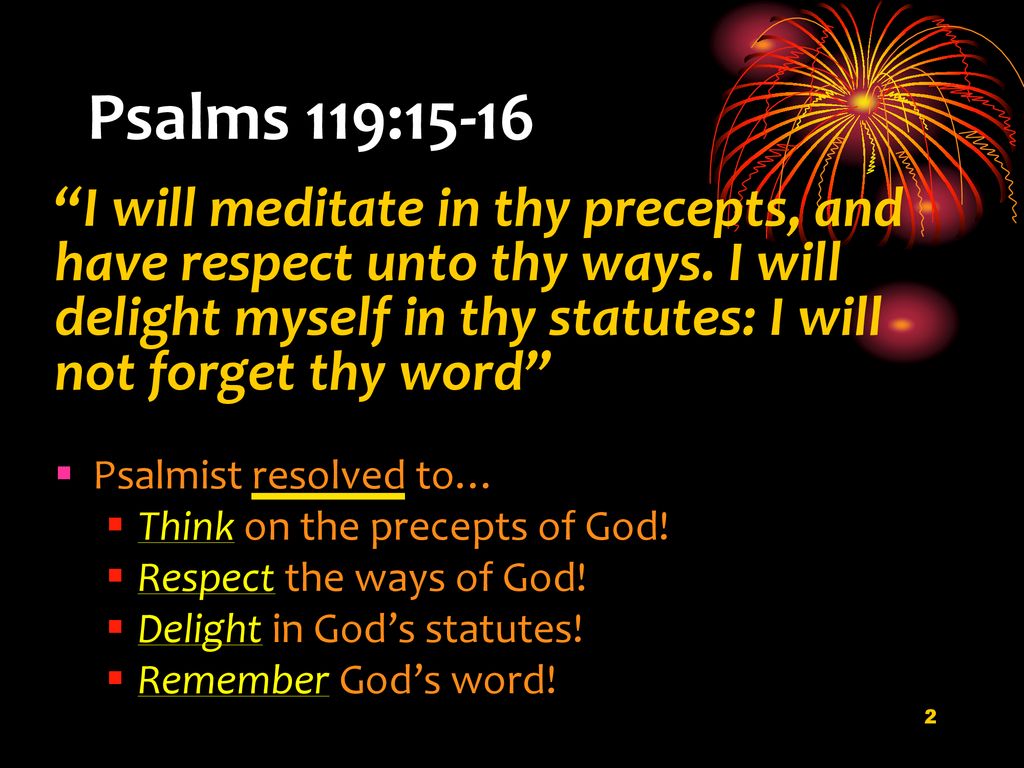
Walking Upon God’s Well-Trodden Path (Meditation on Psalm 119:15-16)

Psalm 119:9-16 The Message

9-16 How can a young person live a clean life?
    By carefully reading the map of your Word.
I’m single-minded in pursuit of you;
    don’t let me miss the road signs you’ve posted.
I’ve banked your promises in the vault of my heart
    so I won’t sin myself bankrupt.
Be blessed, God;
    train me in your ways of wise living.
I’ll transfer to my lips
    all the counsel that comes from your mouth;
I delight far more in what you tell me about living
    than in gathering a pile of riches.
I ponder every morsel of wisdom from you,
    I attentively watch how you’ve done it.
I relish everything you’ve told me of life,
    I won’t forget a word of it.

The Word of God for the Children of God. Gloria! In Excelsis Deo! Alleluia! Amen.

Have you ever had to walk a distance in the deep cold of winter or in the hottest hot of the summer months? It is a discipline to keep doing either one or even both depending upon the seasons where-ever you choose to call your home. I knew that if I had to discipline on learning how to do that – day in and day out – for the sake of I familiarity, I always tried to remember to take the same path.

It is easiest to walk a path that has been heavily tread, one in which the snow has already been compacted or the dried hard ground is hard, tamped down.

The Psalmist writes that he will fix his eyes on God’s ways. The word “ways” is translated from orach, referring to a well-trodden path. This is a path walked by many and clearly visible; having been taken many times before, the outcome is predictable. Author God makes His ways clearly known to us through scripture, including the quality of outcome for those who choose His well-trodden path.

Think about the flattened snow path: you don’t have to lift your legs as high to walk, and you don’t sink down into the powder with every step. Walking upon dry and compressed, well-trodden paths worn down over time, will take you to your destination, using less energy. Such is the discipline of “meditating” upon the Word of God for the Children of God. God has already done the hard work for you – He gave us His Word, fulfilled the law. His is the path you want to be on.

The phrase “fix my eyes” comes from the root word nabatmeaning to look intently at something, regarding it with pleasure, favor, or care. The Psalmist is determined to fix his eyes on the well-trodden path that God has provided for him. Just as a horse might wear blinders to keep it focused on the path ahead with no peripheral distraction, we should be looking so intently at God’s way, regarding it with so much favor and pleasure, that the cares of the world would disappear from our peripheral. Let our hearts and our souls, let our eyes be so utterly GOD fixed that no distraction could pull us off of the well-trodden path.

How can we keep our gaze affixed on God’s ways? First, the Psalmist states that he will mediate on God’s precepts. Meditate is translated from the word siyach and means to ponder or converse with oneself. Scripture calls us to meditate on the word day and night (Joshua 1:8, Psalm 1:2). The Psalmist’s daily goal (as ours ought, should be) is to fill his thoughts with scripture, with things above (Colossians 3:2), and with all that is good (Philippians 4:8).

Second, the Psalmist determines to 100% delight in God’s statutes. Delight is translated from sha’a’, which means to be fond of, or pleased with. We must renew our minds (Romans 12:2) and not to think of scripture as only a list of rules that we must strictly adhere to and follow. Instead, we can delight in the freedom of God’s way – the freedom to sin no more and the freedom to do what is right. His commandments are not burdensome (John 8:1-11, 1 John 5:3).

Lastly, the Psalmist declares that he will not forget God’s word. Forget can also be translated as “mislay” (as in misplacing your car keys) or “obliviousness due to lack of attention.”

When it is time to act, when there is a decision to be made, and even as day to day routines are being lived out, we do not want to be blatantly oblivious to God’s ways because we have each neglected (given no attention to) His word.

We want the sword of the Spirit, which is the word of God (Ephesians 6:17), ready at our side at all times. When it’s go-time we do not want to be searching for God’s word like misplaced car keys. We want it at the forefront of our mind and on the tip of our tongue. How can we obey the word if we do not know it?

How can we know God’s plan, intentions and purpose if we know not His Word?

“Do all the good you can,
By all the means you can,
In all the ways you can,
In all the places you can,
At all the times you can,
To all the people you can,
As long as ever you can.”

― John Wesley

Let us be equipped for every good work (2 Timothy 3:17).

Today I encourage you start disciplining yourself into beginning a new daily habit. That to daily examine whether you are on God’s well-trodden path or if you are trying to forge your own path through the snow or over the sunbaked ground, whether you are expending needless energy or learning stewardship of the Word of God. Either way, you can choose to follow the Psalmist’s example:

Day and night, fix your eyes on God’s way, study, mediate and pray on and over and above, through His word, delight in His word, and do not forget His word.

Why is quality meditation so important?  Joshua 1:8 tells us why: This book of the law shall not depart from your mouth, but you shall meditate on it day and night, so that you may be careful to do according to all that is written in it; for then you will make your way prosperous, and then you will have success. (NASB)

Our Christian responsibility and duty to each other? To ponder and meditate on God’s word for by it we become obedient to Him. We cannot hope to succeed without carefully doing all that is written in the Bible.  Now this does not mean that if we do not meditate on God’s word like this that we are somehow not saved, but I cannot stress enough how much fuller our lives will be if we give ourselves quality time to ponder what God is saying to us through His word.

Psalm 119:9-16 New American Standard Bible

Beth

How can a young man keep his way pure?
By keeping it according to Your word.
10 With all my heart I have sought You;
Do not let me wander from Your commandments.
11 I have treasured Your word in my heart,
So that I may not sin against You.
12 Blessed are You, Lord;
Teach me Your statutes.
13 With my lips I have told of
All the ordinances of Your mouth.
14 I have rejoiced in the way of Your testimonies,
[a]As much as in all riches.
15 I will meditate on Your precepts
And [b]regard Your ways.
16 I shall [c]delight in Your statutes;
I will not forget Your word.

The Word of God for the Children of God. Gloria! In Excelsis Deo! Alleluia! Amen.

In the name of God, the Father and God the Son and God the Holy Spirit,

Let us pray,

Jesus, Giver of peace, I so easily get distracted when I’m trying to focus and hear your Holy Spirit. Help me quiet my mind in the middle of my busy life. Help me to pause and to make space to listen to the most important voice of all. God, empower me to be a more disciplined listener to the gentle whispers of your Spirit. Help me follow the example of Jesus, who would slip away in the evening or the early morning to be alone with you. Teach me to abide in you. Amen.

https://translate.google.com/

The Beautiful Significance of “Let the Words of My Mouth and Meditation of My Heart” spoken in Psalm 19:14!

Exactly, what are our words? They are more than just what we speak from our mouths but they each originate from our mind as we think, and we ponder their meaning. As we reach a conclusion based on what we think and what influences us regarding the topic. It then becomes a seed we allow to be planted not only in our minds but also in our hearts and others. As these lifeless seeds get fed by outside circumstances, they begin to grow deep roots, are not easy to remove.

We cannot see what is inside these seeds. We cannot see their inherent beauty or their potential for bringing forth great fields of the very ugliest of weeds. I can only see the outside shell of the seed and know something will grow from it. I can’t control the measure of beauty or the indescribable potential for ugliness. I can only trust the care and compassion I use to plant it will bear all of its fruit. Watch my words, my thoughts become as the sunshine or become barrenness.

Psalm 19:11-14 The Message

11-14 There’s more: God’s Word warns us of danger
    and directs us to hidden treasure.
Otherwise, how will we find our way?
    Or know when we play the fool?
Clean the slate, God, so we can start the day fresh!
    Keep me from stupid sins,
    from thinking I can take over your work;
Then I can start this day sun-washed,
    scrubbed clean of the grime of sin.
These are the words in my mouth;
    these are what I chew on and pray.
Accept them when I place them
    on the morning altar,
O God, my Altar-Rock,
    God, Priest-of-My-Altar.

The Word of God for the Children of God. Gloria! In Excelsis Deo! Alleluia! Amen.

The Bible says we speak out of things stored in our hearts. If we are serving and seeking God on a consistent basis. And we are also taking every thought captive to the mind of Christ so that it’s all based and founded on the truths and sacred principles plumbed, discovered from the Word of God, we have nothing to fear.

In these times of prolonged social distancing, if we are basing our thoughts and decisions from the worldly point of views and ways established in darkness. We risk polluting the gardens of our heart with seeds that in time will only corrupt and badly tarnish the good seeds. Then the plants and roots will need to be dug up and burned as well as purifying the soil so new seeds will not be corrupted.

The Bible teaches that words are generative, and they wield great power and influence to transform, renew our minds. Science backs this up as we’re always learning more about the plasticity of our brains and how thinking new thoughts can have a profoundly positive or grievously negative impact on overall health.

Throughout the pages of Scripture, we also learn that what we meditate on in our hearts reveals what we treasure. Also, that the “words of my mouth” or what we choose to say, comes from what’s within the heart (Luke 6:45).

The Book of Psalms can be experienced as a literal outpouring of words on the hearts of those seeking and appreciating God. Offering us poetry and songs of praise, lament, and thanksgiving from Moses, David, Solomon, Asaph, Heman, Ethan—and a host of anonymous authors—psalms can feel like a window into our own deeply personal even intimate longings. The words bear witness and give a stark testimony deep inside the meditations in the hearts of humanity.

What the Psalmist Means by “Words of My Mouth and the Meditation of My Heart”

Psalm 19 is a psalm of praise, for all the glorious works of God in creation, and how they offer a “still small, nearly imperceptible voice” we all understand. As it opens, we see a beautiful portrait of the heavens declaring, and day and night pouring forth… refreshing us in the way the Law of the Lord refreshes the soul.

As David closes in Psalm 19:11-14, he is imploring God to make him blameless through meditating, seeking, searching and forgiving him, he seeks a right and righteous relationship with God. As he sings out to God “may these words of my mouth and this meditation on my heart be pleasing in your sight,” he is 1000% surrendering to God’s guidance, and praising him as his Rock and Redeemer.

The psalm relates the voice of God to a treasure infinitely more precious than gold, and infinitely more sweeter than honey straight from the honeycomb. David is asking in Psalm 19:11-14 for this God of unmatchable worth to warn, search, forgive, and keep him from thoughts and words that lead to sin.

It is by his own passionate confession that he needs his words to come from the Provider who moves the sun and earth…not from the sinful desires of his heart.

This psalm is praying for a power infinitely greater than ourselves to search, and cleanse our thoughts, reveal our errors, and hear our prayers. It is an act of relinquishing self-absorption and inviting God to direct us in ways that please and reflect his heart. In Psalm 19 we hear a song of celebration that when we ask God to guide our words and thoughts, there is great reward (Psalm 19:11).

Two ways to test the state of your heart is to

1.) record the words and thoughts you have on a particular day especially during times of stress when it’s easy to let it fly without giving it a second thought.

I understand we are not perfect and will make mistakes. But it’s during those moments I discover what’s in my heart by how I speak, react to those moments.

2.) the second way which is easier to do but harder to face, respond accordingly.

Be honest and bold enough to ask God to show you what’s in your heart.

Either way, things must be dealt with if we are to continue to grow and mature in our relationship with God. There is no shortcut to this process and the longer we put it off the more painful it will be to overcome.

God patiently waits for us to turn to him in these matters so that he can give us the keys to victory provided by the resurrection power of Christ. I believe this is what the Psalmist meant as he beautifully prayed to God in humility to examine his heart so that he might only speak life and not death to those around him.

Psalm 19:14 concludes that when we make the choice to come away from the world and move our whole beings, praise and meditate on the wonders of God’s creation and redemption, the gratitude we feel inevitably creates thoughts and words and deeds transforming the stark reality of our world, bringing forth joy.

The Context around Psalm 19:14

Having experienced a God who dictated the Law through Moses, David sings in Psalm 19 of how the Law of the Lord revives us. These first five books of the Bible that comprise the Pentateuch would have been well-known to David, as Jewish boys memorized the Torah.

What David knows so very well, and indeed, quite intimately, as he sings this psalm, is that God’s Law proves that God is the creator, rescuer, and father who has from the beginning been relational in the trinity and with his creation.

David trusts the Law of the Lord because he has seen his deliverance and the reality of his commandments. David not only desired to be fully pardoned and cleansed from the sins he had discovered and confessed, but also from any he may have overlooked that only God could see.

https://www.blueletterbible.org/study/parallel/paral18.cfm

One theological resource proposes Psalm 19 might have been inserted toward the end of David’s life, as was the beloved Psalm 23. It’s fitting then that David surrenders in Psalm 19 wholeheartedly in thought and speech to a God who has seen him through seasons of giant-conquering, adulterous sin, and terrifying persecution. This is definitely and definitively a psalm of a man who has no doubt in his mind that he met God in the wilderness, in a cave, and in victory.

According to David, exposing ourselves to the beauty of God, letting the beauty of God go to work inside of us, over the darkness of the revealed world, having our sins exposed by the light of truth of God, revives our souls, and brings sweet joy. And even though Christ would not restore us all on the cross for 1,000 years from the singing of this psalm, we know that every single word of Psalm 19 is God-breathed and directly points to the restoration of humanity through Jesus.

This means that no matter what state our heart is in, or what state our soul is finding itself wallowing in, or what words we’ve been spewing that may not be pleasing to God, we lift up our heart, soul and voice unto Him…and He restores.

How Might We Apply Psalm 19:14 Today?

The Bible teaches that our mouths speak of the things which fill our hearts.

…For the mouth speaks what the heart is full of. – Matthew 12:34

And when Psalm 19 concludes in verse 14 with “May these words of my mouth and this meditation of my heart be pleasing in your sight, Lord, my Rock and my Redeemer,” we sense from within the heart and soul of David an openness and selflessness which focuses squarely on God’s sight and might. It acknowledges that our very own thoughts and words can definitely be renewed in the light and power of the forgiveness of the Lord alone, not by our own wayward tendencies.

It admits that we need an unaltering, unshifting Rock and Redeemer to deliver us from our spoken and secret sins. And as with any and all of God’s word, we can ask, seek, explore, discover, find, experience new life in this song of David.

Here are three ways I suggest we try to apply Psalm 19:14 to our lives today:

1. Seek God in His creation.

There’s nothing quite like allowing yourself to be overwhelmed by the glory of God’s creation. Imagine, as the psalm suggests, that the heavens are pitched in the sky by God like a silken tent for the sun. Start with a heart of praise as you stary your day by inviting, weaving, Creator God into your thoughts and words.

2. Pray! Ask God to cleanse your heart.

Because the world is always warring for your attention, and troubles can stir up things in your heart that you wish weren’t there…remember you can always ask God for help. He can find and forgive your “hidden faults” (Psalm 19:12) and keep you from willful sins. Ask God to reveal what needs healing, and to keep you “blameless and innocent of great transgression.” (Psalm 19:13)

3. Ask God to give you the words He desires.

Although David emotes so beautifully and eloquently in Psalm 19, he gives glory ultimately to God in Psalm 19:14 for making his thoughts and words pleasing. When you feel shackled, imprisoned by your thoughts within, or afraid of what you will say or will do, God gives us this example of calling on him in Psalm 19.

God knows we all can misspeak, say hurtful things, or harbor ungratefulness in our hearts. He is showing us in Psalm 19 that he is absolutely faithful to save us from these things. And if we genuinely want what’s in our hearts to produce pleasing words, we can ask God to give us the words He desires for us to say.

Remember, God has given us his Word. His Word reveals the goodness of his heart. Let’s make an honest and humble effort to meditate on it, and let it purify the volume of words we share…so that they may draw others to the glory of God.

In the name of God, the Father and God the Son and God the Holy Spirit,

Let us pray,

Holy, Creating, Creative God,
We sing from the depths of our sorrow.
We sing from the abundance of our joy.
We sing in voices separate and unique.
We sing with one voice as your body.
May the words of our mouths, whether in speech or song,
and the meditations of our hearts, whether in prose or poetry,
be pleasing in your sight. Alleluia! Alleluia! Alleluia! Amen.

https://translate.google.com/