A Ransom Paid in Full: Reflecting, Understanding, the Justice of God. Matthew 20:24-28

Matthew 20:24-28 Amplified Bible

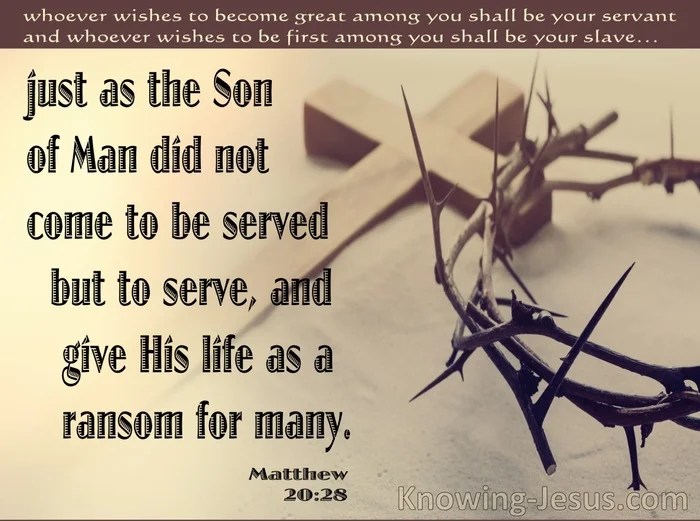
24 And when the [other] ten heard this, they were resentful and angry with the two brothers. 25 But Jesus called them to Himself and said, “You know that the rulers of the Gentiles have absolute power and lord it over them, and their great men exercise authority over them [tyrannizing them]. 26 It is not this way among you, but whoever wishes to become great among you shall be your servant, 27 and whoever wishes to be first among you shall be your [willing and humble] slave; 28 just as the Son of Man did not come to be served, but to serve, and to give His life as a ransom for many [paying the price to set them free from the penalty of sin].”

The Word of God for the Children of God.

Adeste Fidelis! Venite Adoremus! Dominum.

Gloria! In Excelsis Deo! Alleluia, Alleluia, Alleluia, Amen.
Background: He Who Has Ears, Let Them Hear …

Matthew 20:17-19Amplified Bible

Death, Resurrection Foretold

17 As Jesus was going up to Jerusalem, He took the twelve [disciples] aside, and along the way He said to them, 18 “Listen carefully: we are going up to Jerusalem; and the Son of Man will be handed over to the chief priests and scribes (Sanhedrin, Jewish High Court), and they will [judicially] condemn Him and sentence Him to death,  19 and will hand Him over to the Gentiles (Roman authorities) to be mocked and scourged and crucified, and He will be raised [to life] on the third day.”

On the journey to Jerusalem Jesus predicts that his death will take place there.

Jesus takes his disciples aside to report to them that it will include wholesale betrayal, humiliation and condemnation by the religious leaders of his people.

Those who should be welcoming him as the promised Messiah will instead sentence him to suffering and death, thoughtlessly handing him over to to a brutal time and season of mocking, flogging, and crucifixion by the Romans.

Then Jesus also shockingly predicted that he would rise again three days after!

But it seems that after hearing the predictions about Jesus’ suffering and death, the disciples somehow tuned out.

It’s as if they missed hearing the promise that “on the third day” he would be “raised to life!”

When the time came and Jesus died on a cross, the disciples were a despondent group of followers wondering about the suddenness what had just happened.

As predicted, in the Garden of Gethsemane they scattered in fear, at the arrival of the Temple Authorities unjustly leaving the burial, preparations to others. (See Matthew 26:56; 27:45-28:10.)

In this critical moment, there was no expectation of Jesus’ coming to life again!

In our own day and age, considering the number of years which have come, and passed us by since those events transpired, is our own “hearing” any different?

As we again, for the umpteenth time approach Jesus’ entry into Jerusalem, as we again come to the umpteenth recitation and those sermons of Palm Sunday, as we again try to come to realization of what we know is to come, has already transpired, has already been written and narrated – why is any of this relevant?

We have not heard with our own ears the actual voice of Jesus as the disciples.

We could not immediately begin the process of giving it our fullest attention.

We could not be stunned in the same way as the disciples were upon hearing it.

We could not be apathetic or excited or wondering or stunned or any of that.

We did not talk, or walk, hear or listen to and with Jesus in that moment – in a more contemporary colloquial sense of the moment – “walk and chew gum and do everything else (preparing ourselves for the Passover) all at the same time.

Nowadays, we do not all concern ourselves to prepare to celebrate the Passover.

We are not looking for donkeys or mules or horses to ride to be paraded about.

We are not looking for “Upper Rooms” – Just sanctuaries inside our churches.

No Gardens of Gethsemane …

It is doubtful to the utmost we are worried about our running away naked in the middle of the night with thoughts of running away, betraying our own Savior.

Jesus will not be arrested again.

He will not be betrayed, mocked and humiliated in such a horrible way again.

We will not have to subject ourselves to the sight, witnessing him dying again.

All these things have already come to pass and by faith we believe and accept it.

Now, what experiences do we have to substitute for those of what the disciples witnessed first hand, experienced to the utmost first hand, threatened by too?

We hear pandemic, dire economic warnings or a doctor’s frightening diagnosis, and we’ll soon forget Jesus’ words: “I am with you always” (Matthew 28:20).

We experience ridicule or rejection and forget that God’s Word warns that we may be called to share in Christ’s sufferings (John 15:18-20; Romans 8:17).

Facing them throughout the year is hard enough, but how much of that effort includes an intense time of self examination, reflection upon the Cross itself?

Facing them mutually, letting God work, let’s remember Jesus was raised to life.

We know what happened then to Jesus – three days later, as promised, he arose!

Our belief in the Resurrection of our Savior is core central to our Christian faith.

Yes! We absolutely love and live for and utmost sacrificially serve a risen Savior!

But the lingering question, the utmost intense question we probably devote so precious little of our time to study, reflecting upon: what relevance is the Cross?

A Personal Reflection: Why the Cross?

24-28 When the ten others heard about this, they lost their tempers, thoroughly disgusted with the two brothers. So Jesus got them together to settle things down. He said, “You’ve observed how godless rulers throw their weight around, how quickly a little power goes to their heads. It’s not going to be that way with you. Whoever wants to be great must become a servant. Whoever wants to be first among you must be your slave. That is what the Son of Man has done: He came to serve, not be served—and then to give away his life in exchange for the many who are held hostage.”

Why does Jesus take his disciples aside to shock, awe them with his prophecy?

Why are such momentous words and such miraculous history transforming events still to be read and found, studied and prayed over and celebrated too?

Why is such a detailed, embarrassing account of the failure of the disciples?

Why do we celebrate ourselves being re-subjected to these terrible moments?

To give us another opportunity to run away from Jesus, recoil from them, him?

To mostly learn and then relearn to repeatedly avoid re-living the indescribable intensity of those moments, to make them our own as God repeatedly call us to?

Why the ugliness of the Cross … to learn, to relearn to hug its wondrous beauty?

Why such an intense concentration, centralized focus on the Cross at Calvary?

Why such an ugly, not so gentle, intentional, purposeful, graphic reminder?

Why didn’t God simply say, “Look, everyone, I know you have sinned against Me, but I am going to pardon you right now. It’s okay. I forgive all of you!”

God didn’t do that because it doesn’t work with His nature and character.

The justice of God requires obedience and sacrifice.

He could not accept us into fellowship with Himself unless we paid the penalty—or someone paid it on our behalf.

Romans 3:25 tells us, “For God presented Jesus as the sacrifice for sin. People are made right with God when they believe that Jesus sacrificed his life, shedding his blood. This sacrifice shows that God was being fair when he held back and did not punish those who sinned in times past” (NLT).

The cross demonstrates the ultimate expression of the justice of God.

At the cross of Calvary, the love and justice of God met.

Yes, God had to satisfy His justice.

The Scriptures say, “The person who sins is the one who will die” (Ezekiel 18:20 NLT), “the wages of sin is death” (Romans 6:23 NLT), and “without the shedding of blood, there is no forgiveness” (Hebrews 9:22 NLT).

God was saying, “My righteous requirements must be met.

But I love humanity beyond their ability to acknowledge, fully measure and comprehend, and there is no way they can do it on their own.

So, I must, and I WILL help them.”

Therefore, He sent His only begotten Son Jesus to bridge the gap. (John 3:16-17)

This is why Jesus Christ is the only way to God.

People like to say that all roads lead to God.

People also like to say that the road to hell is paved with our good intentions.

It really concerns me when I hear Christians parrot statements to that effect.

There is only one path.

There is only one way.

If that were not true, then why did Jesus have to die?

If all roads lead to God, then why did Jesus go through the indescribable anguish, the immeasurable humiliation, torture, and pain of the cross?

Matthew 20:26-28 Amplified Bible

26 It is not this way among you, but whoever wishes to become great among you shall be your servant, 27 and whoever wishes to be first among you shall be your [willing and humble] slave; 28 just as the Son of Man did not come to be served, but to serve, and to give His life as a ransom for many [paying the price to set them free from the penalty of sin].”

The primary reason Jesus came to this earth was to save us, to die for our sins.

Paid in Full

Jesus’ mission was a matter of “search and rescue.”

He came to seek and save those who were lost (Luke 19:10).

He not come to be served but to serve, give his life as a ransom for many.

Mark 10:42-45 Amplified Bible

42 Calling them to Himself, Jesus said to them, “You know that those who are recognized as rulers of the Gentiles lord it over them; and their powerful men exercise authority over them [tyrannizing them]. 43 But this is not how it is among you; instead, whoever wishes to become great among you must be your servant, 44 and whoever wishes to be first and most important among you must be slave of all. 45 For even the Son of Man did not come to be served, but to serve, and to give His life as a [a]ransom for many.”

He fulfilled that mission by giving his life at Calvary “as a ransom for many.”

As Jesus hung on the cross and spoke the words “It is finished” (John 19:30), he was announcing that his mission was now accomplished.

Because he was obedient and faithful to His Father, offered his perfect life as the sacrifice for sin, God was pleased to welcome home all his lost children!

https://www.blueletterbible.org/esv/jhn/19/30/t_conc_1016030

https://www.blueletterbible.org/lexicon/g5055/esv/mgnt/0-1/

The brief sentence “It is finished” translates from just a single word teleō in the original Greek text.

The same word was used by shopkeepers to announce that someone’s bill was finally paid.

When the final payment was made on a purchased item, the merchant would say “Tetelestai” (“It is finished”) – in other words, the debt was paid in full.

When I made the last payment on the first car I ever bought, I remember how good it felt to see the bank teller stamp “Paid in Full” on my loan documents.

Never again would another payment be required!

As Jesus said “It is finished” on the cross, he was assuring us that his mission was complete.

He had paid in full all the costs required for our sin.

And when we faithfully focus our lives, when we centralize our lives now place our full faith-filled trust in him, our debt for sin is forever wiped off the books!

On that Hill far away, stood an Old Rugged Cross, the emblem of suffering and shame. And on that old cross Jesus suffered and died to pardon and sanctify me.

In the name of God, the Father and God the Son and God the Holy Spirit,

Let us Pray,

Loving Lord, I praise and thank You for Jesus, my Mighty Savior and Servant King. Lord, today I pour out my life as an offering to You. I pray that I would serve You wholeheartedly and my service would bless those around me and be a witness to bring many to the knowledge of salvation in Jesus. O God, thank you that Jesus has bought salvation for me! He has done everything needed for me to know you, love you, and serve you now and forever! Amen. Thank You that Jesus gave His life as a ransom for me and for all who would believe in His name. In Jesus’ name, AMEN.

Adeste Fidelis! Venite Adoremus! Dominum.

Gloria! In Excelsis Deo! Alleluia, Alleluia, Alleluia, Amen.

https://translate.google.com/

Imitating Jesus. Modeling Jesus. Learning to See Our Neighbors and Ourselves (Part 2). Ephesians 5:1-2

The Apostle Paul calls his fellow Christians to imitate God in order to live up to the reputation of God’s family.

He challenges generations of believers: “walk in the way of love,” as Christ did.

This is about our loving the way Jesus loved.

This is about our modeling love the way Jesus modeled love.

And Jesus always acted in line with the Father’s will.

The love of Jesus embraced outcasts, pardoned sinners, healed the hopeless, challenged the complacent, and willingly sacrificed everything so that we sinners could be reconciled with God.

Modeling Sacrificial love is our most visible and defining family trait.

The only reason we are in the family of God in the first place is because of God’s extravagant love.

As Paul calls us to imitate God’s love, he reminds us that we are defined by it—we are “dearly loved children.”

Our own love emerges from the depths of that eternal love.

Our love is an overflow of the love God has personally shown to each of us. Love is the DNA test that determines paternity with our Father God (1 John 4:7-8).

God loves you because you are his child, you are his child because he loves you.

Children of God are called: “be caught up into the infinite circle of God’s love.”

We are most like our Father in Heaven, most godly, when we allow that love to flow into us from above and flow like a river from us into the lives of others.

Ephesians 5:1-2 The Message

Wake Up from Your Sleep

1-2 Watch what God does, and then you do it, like children who learn proper behavior from their parents. Mostly what God does is love you. Keep company with him and learn a life of love. Observe how Christ loved us. His love was not cautious but extravagant. He didn’t love in order to get something from us but to give everything of himself to us. Love like that.

The Word of God for the Children of God. Gloria! In Excelsis Deo! Alleluia! Amen.

Theologian Brennan Manning spoke a challenging truth, when he wrote,

“How I treat a brother or sister from day to day, how I react to the sin-scarred wino on the street, how I respond to interruptions from people I dislike, how I deal with normal people in their normal confusion on a normal day may be a better indication of my reverence for life than the antiabortion sticker on the bumper of my car.”

Treating our neighbors and ourselves as eminently valuable is not easy.

And this leads us to the next thing we learn from Jesus ….

How could Jesus communicate the reality of what he saw?

Well… I think Jesus also teaches us to…

3. Ho to exercise the power of initiating.

Referring back to the Narrative Luke 19:1-10,

Jesus does not sit back to see if Zacchaeus will come out and express his hope.

He is high up in a Sycamore tree…. It’s sort of obvious that he is only hoping to “see” Jesus from an “untouchable” distance. So, Jesus takes the initiative.

Jesus calls out to Zacchaeus. (Luke 19:5 Amplified)

When Jesus reached the place, He looked up and said to him, “Zaccheus, hurry and come down, for today I must stay at your house.”

Can you sense how significant that is? So many people can seek attention by becoming shy or fearful or by becoming dramatic and demanding …. but our demanding attention is entirely different than simply being given attention.

There is nothing more powerful than our initiative

…because it expresses what is really within us

…not merely responding to what we HAVE to respond to

…but what we WANT to respond to.

Love never just does what is required.

Love doesn’t just see people as an obligation

Love does not just see people … as a duty to fulfill when it is “required.”

Love initiatives: (1 Corinthians 13:4-8 Amplified)

Love endures with patience and serenity, love is kind and thoughtful, and is not jealous or envious; love does not brag and is not proud or arrogant. It is not rude; it is not self-seeking; it is not provoked [nor overly sensitive and easily angered]; it does not take into account a wrong endured. It does not rejoice at injustice but rejoices with the truth [when right and truth prevail]. Love bears all things [regardless of what comes], believes all things [looking for the best in each one], hopes all things [remaining steadfast during difficult times], endures all things [without weakening]. Love never fails [it never fades nor ends].

Our initiative speaks…… Are we risking it all trying to climb the Sycamore Tree?

Jesus makes a significant point of this when there is conflict in a relationship.

We won’t venture outside of our “comfort zones” into all that he teaches…

but the one striking element is that when… either … we should decide to stay on the ground, battle the crowds or should go… immediately, directly, to the tree.

And while we are deciding on whether we will “climb the Sycamore Tree” or if we will do what is always customary, stay on the ground battling the crowds,

If Christ is on our minds, if we reflect on our own…we realize he is teaching us how we treat another amidst life’s conflict… reflects how we will honor them… whether we can be trusted to care for their good and not just our protection.

It communicates whether they really matter to us.

The key word is “go” … we are to go pursue setting things right.

Do we realize we have the power of initiative with some people who are afraid?

And finally…we see from Jesus… the power to…

4. Embody the reality of grace with our presence.

If we step back and look at this scene… it was loaded for Zacchaeus.

The scene was full of hatred…. animosity … and judgment…

and Jesus took the initiative and stepped decisively, directly, into that space.

Imagine the awesome significance of Jesus looking beyond the crowds and calling out Zacchaeus…. then announcing he would be coming over for lunch.

Imagine what it communicated to everybody.

In essence… Jesus took the initiative, stepped into the line of fire… directly into harm’s way, he brought the power of his presence into the space of judgment.

And isn’t this the example Jesus was setting for us by doing it so frequently?

He was accused of being a friend of sinners…. because he didn’t join in practice and purpose of one group riling itself up, condemning, canceling one another.

It was the space he was unhesitatingly chose to be seen by everyone standing in.

When a woman was brought before him who had been caught in adultery.

When those who were disabled or diseased were shinned… or children told to be quiet… or a Samaritan woman deemed ethnically unclean.

It could lead some to think Jesus was either ignoring their sin… or ignorant of it.

The presence of Jesus was never one of ignorance…but of divine insight… he didn’t see less… he intentionally, innately saw more of our neighbors than us.

He didn’t worry about condoning their behavior…because he wasn’t.

Never with the slightest compromise of his own righteousness

In fact, what spoke volumes was he never saw these moments as a podium to speak about tax collecting… prostitution… or politics or government because the point was not that he didn’t see the outworking of sin…but that he saw more than the working of sin – but saw sinners for whom salvation was good news.

Some may recall that when he spoke to the Samaritan woman who had come out in the middle of the day to get water at the nearby well…

She said… “how is it that you a Jew speak to me a Samaritan… and a woman?”

She’s saying, “Don’t you see me like everyone else?”

She is saying, “Aren’t you as biased and prejudiced as everyone else?”

She is saying, “Are you here to try and cancel my life like everyone else is?”

Are you just that blind and ignorant …unaware of who I am, what I have done?

Jesus would answer that by asking her to go get her husband. And that opened up her heart to know he saw so much more… yet he did not simply reject her.

It was always clear if one looked… that Jesus was not PARTICIPATING in the behaviors of others…nor was he giving PERMISSION or CREDENCE to the behaviors of others…. He was simply being among, present, with such people.

What we can learn from Jesus …

is that our willingness to move away from what is “customary prejudices and biases” is simply to be among and present with those who presume judgment… can speak of our “above and beyond” efforts of imitating Jesus seeing “more.”

Jesus always risked his own reputation. In a world in which people rarely defy the obvious power of social reputation… Jesus showed the power to be trusted to truly, selflessly, serve the interest of others more than his own social interests.

If we want to love God, our neighbors and ourselves like Jesus… we will have to mature in being trustworthy… of being those who won’t just serve our social status… who will come be with someone who our friends may look down upon.

Are we or are we not someone who someone else can share their fears and failures with…and know that we won’t use it to serve our own personal gain?

This is essential to becoming safe people.

So, we would do well and better to imitate and model Jesus: embrace the Love of the Father and power of our presence. We may need to enter the space of grace.

Luke 19:1-10Amplified Bible

Zaccheus Converted

19 Jesus entered Jericho and was passing through. And there was a man called Zaccheus; he was a chief tax collector [a superintendent to whom others reported], and he was rich. Zaccheus was trying to see who Jesus was, but he could not see [a]because of the crowd, for he was short in stature. So he ran on ahead [of the crowd] and climbed up in a sycamore tree in order to see Him, for He was about to pass through that way. When Jesus reached the place, He looked up and said to him, “Zaccheus, hurry and come down, for today I must stay at your house.” So Zaccheus hurried and came down and welcomed Jesus with joy. When the people saw it, they all began muttering [in discontent], “He has gone to be the guest of a man who is a [notorious] sinner.” Zaccheus stopped and said to the Lord, “See, Lord, I am [now] giving half of my possessions to the poor, and if I have cheated anyone out of anything, I will give back four times as much.” Jesus said to him, “Today salvation has come to this household, because he, too, is a [[b]spiritual] son of Abraham; 10 for the Son of Man has come to seek and to save that which was lost.”

That day… so many people could not fully see all that was going on around them. When someone (Jesus) saw more… someone came down from a tree….

I believe that each of us have a desire to help people both climb up to see Jesus, come down from hiding in the trees… where they hope nobody will see them.

The visual exchange between Zacchaeus and Jesus is unique in some respects…

People aren’t looking at us as the Messiah… if they did, they may not be so quick to look for us or to receive us… or to change with us…. but it DOES capture what our world needs. It captures how we can climb, mature grow in loving like Jesus.

It speaks to how we receive God.

It speaks to how we receive our neighbors.

It speaks to how we receive ourselves.

It speaks to how we experience God’s love through resurrected Jesus Christ.

It speaks to how we experience the love of God and model it for our neighbors.

It speaks to how I experience the Love of God and become inspired to share it.

it speaks to how others approach God,

It speaks to how willing our neighbors are to approach God and approach us.

It speaks to how our neighbors are to approach the Christ in us

It speaks to how willing our neighbors are to experience the Christ in us.

It speaks to how approachable we are… how safe we are.

It speaks to how approachable God is.

It speaks to how approachable Jesus is.

It speaks to exactly how worthy Jesus is to be the model of our maturing lives.

Ephesians 5:1-2Amplified Bible

Be Imitators of God

Therefore become imitators of God [copy Him and follow His example], as well-beloved children [imitate their father]; and walk continually in love [that is, value one another—practice empathy and compassion, unselfishly seeking the best for others], just as Christ also loved you and gave Himself up for us, an offering and sacrifice to God [slain for you, so that it became] a sweet fragrance.

Christ as Our Only Example …

When we read a passage like the one in our Scripture for today, we recognize that God is totally different from us.

Christian teachers sometimes talk of God as being “wholly other.” That teaching reflects the words of God himself through Isaiah the prophet:

“To whom will you compare me?

Or who is my equal?” says the Holy One…

“I am the LORD,

and there is no other.” (Isaiah 40:25; 45:18)

Although the Spirit works in us to make us more like Christ (2 Corinthians 3:18), believers do not become divine. We cannot become God, but in God’s strength alone we can become godly. Sadly, in this life we still remain sinful, but through God’s charity, forgiveness and redemption we are reconciled to our Maker.

Except for the example of Jesus, who is divine as well as human, there is no human achievement that provides an adequate example for us.

So, we must rely on what God himself has done in Christ by his Spirit.

He showed us what love is.

God the Father has provided for our salvation, and Jesus, the Son of God, has given himself as the penultimate sacrifice in our place to be our Savior.

The Holy Spirit helps us to receive and live out that love.

So, all three persons of the Trinity work together for our salvation, for our good.

I imagine that there is someone in each of our lives…. who we can help climb up and come down from a tree… out of the place of not feeling safe in how we live.

Is there someone in your life that may need to know that you see more than others see….

More than they can, see?

Are there people in your life that need to experience that you are safe?

And how about ourselves?

Do we know that we can both climb up, come down from the Sycamore Tree?

In the name of God, the Father and God the Son and God the Holy Spirit,

I want to offer all of us a short prayer that has been serving me to take hold and stay ahold of life in God.

God, I see the Sycamore Tree Zacchaeus Climbed.

What should I do now? Climb into its heights or chop it down for my firewood?

If I choose to Climb, … what then?

Do I hide in it, remain anonymous or make myself known to Jesus from it?

I know Jesus is coming down the road …

I see the dust rising up from where he is approaching the crowds and me.

Do I fight against the crowds to see him, to touch the fringes of his garment?

I see the Sycamore Tree again ….

I see its branches inviting me to come forward ….

Do I stay on the ground or do I risk everything to climb into its heights?

God, I belong to you.

May your will become my will.

May your love become my love.

May your neighbor become my neighbor.

Today, may I be a better imitator and model of the life your Son has given to me.

Lord, grant us the love to serve others with such selfless devotion that our kindness will help transform their lives and draw them to Jesus, the source of all love. In his name we pray. Gloria! In Excelsis Deo! Alleluia! Alleluia! Alleluia! Amen.

https://translate.google.com/