Romans 5:6-8 |The Surprise Gospel | I am so Struggling with the Surprise!

The Patriarch Job wrote in Chapter Seven verses 1 – 6 (Message) these words.

There’s Nothing to My Life

1-6 “Human life is a struggle, isn’t it?
    It’s a life sentence to hard labor.
Like field hands longing for quitting time
    and working stiffs with nothing to hope for but payday,
I’m given a life that meanders and goes nowhere—
    months of aimlessness, nights of misery!
I go to bed and think, ‘How long till I can get up?’
    I toss and turn as the night drags on—and I’m fed up!
I’m covered with maggots and scabs.
    My skin gets scaly and hard, then oozes with pus.
My days come and go swifter than the click of knitting needles,
    and then the yarn runs out—an unfinished life!

The Bible tells us that even believers struggle with trusting God because life is hard and cruel at times. But we know there is hope and that joy is 100% possible because of the eternal life we have with Christ. Therefore, God wants us to be full of faith and grow in His divine direction, comforted by the Holy Spirit. In this complete trust of our Lord and Savior, we can live with true peace and joy.

Today, we have the opportunity to renew our perspective. Be encouraged, learn to walk through each day with a Romans 5:8 joyful spirit and a refocused mind.

  • Remember the Gospel hope found in God’s promises.
  • Take comfort in God’s divine plan for your life.
  • Rejoice in God’s presence.
  • Reconnect with the true Gospel life-changing hope found in the Bible.
  • Share with others the answer to their deepest problem and greatest need.

The Struggle is Absolutely Real ….

But GOD is also absolutely 100% REAL!

Romans 5:6-8 Easy-to-Read Version

Christ died for us when we were unable to help ourselves. We were living against God, but at just the right time Christ died for us. Very few people will die to save the life of someone else, even if it is for a good person. Someone might be willing to die for an especially good person. But Christ died for us while we were still sinners, and by this God showed how much he loves us.

The Word of God for the Children of God. Gloria! In Excelsis Deo! Alleluia! Amen.

God’s people have been struggling for millennia to understand the love of God.

They have misunderstood him, taken him for granted, ignored him, and sinned against him, but he has never stopped showing his love to them.

Ultimately, Jesus left his throne in heaven to come and show us once and for all exactly how deep the love of God is for us. You and I have to 100% believe that.

You and I have to acknowledge the love of God for us.

That’s my greatest prayer.

The way to your salvation is by trusting the God of all Life that tells this story.

You and I can have love like this, and it does not even matter we’re a sinner, because Christ died for sinners. In fact, he died only for sinners. So, if we see our need for a love like this, we 100% qualify for that love. We can all come to him, and he will not cast us out because God shows his love to a surprising people.

God shows his Gospel love unto a surprising people.

The kind of person that God shows his love to is surprising. He shows his love to sinners. The text is plain and simple, Paul writes, “while we were still sinners”.

If we had the all-seeing eye of God, we would be appalled at not only the sin we see in each other but the sin we see in our own hearts.

I’d venture to say we are aware of about 5% of our sin. But God sees all of it.

We need to understand what our sin looks like to God. Our sins aren’t mistakes.

We like to use that word. It softens it. But the Bible uses words like evil and wickedness in regard to our sin. How often have we called ourselves evil or wicked? But you and I are! We are all one big hot mess. Our sin has ruined us.

Every one of us has experienced this. Every one of us has done something that we do not even want to think nor talk about. And yet God looks down at us in that condition, God sees everything in us! God knows everything of that sin, and says I’ve died for that sin. You are free. For freedom Christ has set us free.

In fact, our sin is our only qualification.

Look at the verse again. God shows his love for us in that while we were still sinners, Christ died for us. It is in the midst of our sin that Christ saves us.

Our sin is the ONLY qualification, and we must still be in that sin to qualify, which of course we are.

But this is insane.

Look at the way Paul writes this phrase.

https://www.blueletterbible.org/kjv/rom/5/8/t_conc_1051008

God shows [commendeth], present tense. Christ died, past tense.

The death of Savior Jesus Christ still shows the love of God. That one event was enough to show us for all time his love because of the magnitude of the one who died and who he died for. God died for his enemies. Our sin qualifies us, and our faith justifies us through the redeeming work of Christ on the cross at Calvary.

Even the way Paul words this is both fascinating and surprising.

What Paul is saying here is there has been a changing of the guard.

Something has come in and something has gone out.

The Greek text here is saying that in the death of Christ, we sinners have been redeemed.

Even the syntax of the sentence is showing the gospel!

Not just the words, but how the words are arranged.

God shows his love to us in that while we were still sinners, Christ died for us.

God shows his love to us at a surprising cost.

Why did Jesus die for us?

The simple answer is because he loved us, to love us till the end he had to die.

But you may say, “There must have been another way. Surely someone didn’t have to die in order to save me!”

The Bible says God saves sinners and the only way to save sinners is for the sin to be paid for by someone.

And the Bible later says that the wages of sin is death. (Romans 6:20-23)

Therefore, there are 2 options: either we die for our sins or someone else does.

In God’s mercy, the gospel tells us that someone else has died in our place.

But what does this look like? Is the Father an angry God who only wants blood while Jesus is the loving, kind-hearted Son who desperately wants his Father’s heart to change? By no means! God is not unjust, and he is not unloving. But for God’s justice and God’s love to remain 1000% compatible a death had to occur.

It hurts the Father to lose his Son, but he does it because he loves us.

The death of Jesus was costly. He is the most glorious person in existence.

He was there from the beginning – not the beginning of the world, but from the beginning of eternity past. It was he through whom and by whom and for whom all things were created. It is he who upholds the universe by the word of his power. It is he who is seated at the right hand of the Father in heaven. It is he who was promised, and he who has come, and he who has died, and he who is reigning now and will reign forever. (John 1:1-5, Colossians 1:5-20, Hebrews 1)

It is he to whom every knee shall one day bow.

It is he, of whom the prophet Isaiah says, “he who is splendid in his apparel, marching in the greatness of his strength.”

It is also he of whom Isaiah says, “He was pierced for our transgressions; he was crushed for or iniquities; upon him was the chastisement that brought us peace, and with his wounds we are healed.”

It is he that has given us access to the throne of grace.

This is Jesus, the King of kings and Lord of Lords.

The Son of God, the Son of man, the Alpha and the Omega, the one who was and is and is to come, the Messiah, the Christ.

This is your Savior! This is God.

And there was no greater pain in the universe than the exact moment Jesus died on the cross for the sins of the elect.

In that moment the Father turned his face away from the Son and gave him over to death so he might bring us who believe to glory.

It cost something to gain us back.

It cost the most valuable person in all existence.

It cost God himself.

You are bought with a price.

God isn’t angry with you because he has done everything, he needs to do to be happy with you forever. The price has already been paid in the midst of your sin so that you can be free from the consequences of your sin.

That is surprising!

THAT IS LOVE!

That is the surprising gospel!

So, if you are prone to think you are too good for God’s love: can you now see that you are a sinner in need of Christ’s saving work? Only when you see, only when you acknowledge this need can you have the righteousness you long for.

And if you are prone to think you are too unworthy for God’s love: can you now see that God saves sinners and sinners alone? Only when you and I see that, only we acknowledge that, then will we be able to have the joy we all long for.

Let’s all lean into the third way of the gospel:

God shows his love for us in that while we were still sinners (we are worse than we think), Christ died for us (we are more loved than we imagined).

Let me close with these words from Charles Spurgeon, 19th century preacher,

“If today you feel that sin is hateful to you, believe in Him who has said, ‘It is finished.’  Let me link your hand in mine.  Let us come together, both of us, and say, ‘Here are two poor naked souls, good Lord; we cannot clothe ourselves,’ and He will give us a robe, for ‘it is finished.’ . . . ‘But must we not add tears to it?’  ‘No,’ says He, ‘no, it is finished, there is enough.’ Child of God, will you have Christ’s finished righteousness today, and will you rejoice in it more than you ever have before?”

Receive this good news.

Come to Christ.

See what he has done for you. 

Come and live.

God shows his love for us in that while we were still sinners, Christ died for us. (5:8)

In the name of God, the Father and God the Son and God the Holy Spirit,

Let us Pray,

Lord Jesus Christ, your power is beyond compare. You turned water into wine. You cleansed the Leper, restored sight to the blind and made the deaf hear. You made the lame to walk. You healed the sick and raised the dead. You conquered death in your resurrection. Everything you touch is powerfully transformed. Let me know that powerful touch in my life. Lord, bless me and keep me, make your face shine upon me.  Through your mighty name, Gloria! Alleluia! Amen.

https://translate.google.com/

Romans 5:8 |The Surprising Gospel of God: What does the Surprise Look Like? “I Loved You at Your Darkest!”

The Love of God. It’s a complicated thing. Every generation tries to understand love, fall in love, and explain love. People have gone to extremes to display their love for others, and thousands of years ago God did just that for each one of us.

In Romans 5:8, Paul tells us God demonstrated His love for us this way: “While we were still sinners, Christ died for us.” Out of the abundance of God’s great love for us He sent His only Son to pay the debt for our sins, even though we were all His enemies, powerless and ungodly. God’s display of love was not conditional.

It was not based on anything we had done or could ever do for Him. God knew that without His timely intervention we would be forever separated from Him.

Jesus’ obedience displayed grace in an amazing way. Jesus poured out His life for the forgiveness of our sins so we could be reconciled with God. Each of us, through faith, can have the opportunity to enter into a relationship with Jesus Christ and experience peace with God, hope in every situation, and eternal life.

Having a relationship with Jesus doesn’t mean life is always easy. Rather, it provides us with the ability to face anything that comes our way. We can have hope in all situations, confident of God’s grace, His faithfulness, and His 100% willingness to do whatever it takes to fully restore our relationship with Him. 

Romans 5:6-8 Amplified Bible

While we were still helpless [powerless to provide for our salvation], at the right time Christ died [as a substitute] for the ungodly. Now it is an extraordinary thing for one to willingly give his life even for an upright man, though perhaps for a good man [one who is noble and selfless and worthy] someone might even dare to die. But God clearly shows and proves His own love for us, by the fact that while we were still sinners, Christ died for us.

The Word of God for the Children of God. Gloria! In Excelsis Deo! Alleluia! Amen.

The Apostle Paul tells us here in Romans 5:8 that God has shown us his love in the death of Christ. The One who created the heavens and the earth, the One who rules overall, the One who is in the heavens and does whatever he pleases—this One has shown his love to us in the death of his only Son. John 3:16 rings gracefully in our ears, “For God so loved the world that he gave his only Son.”

This verse explains what Jesus said in John 15:13 when he told his disciples, “Greater love has no one than this, that someone lay down his life for his friends.”

What Jesus says in John 15 he accomplishes at the cross in John 19 and Paul explains it to us here in Romans 5:8. This is the single most important story the world has ever known. The scale of this sacrifice is still being weighed today.

In fact, for all eternity we will see that the cost and the prize do not seem to balance, but there is glory in this gospel that fills up the throne room of heaven and shoots joy down to our hearts like lightening. This is a surprising gospel.

Romans 5:8 explains this surprising gospel by revealing how God shows his love to us in a surprising way, to a surprising people, and at surprising cost.

God shows his love in a surprising way.

I want us to linger here for quite a few minutes. Let this sink in, because this is abundantly and completely glorious. God shows. God is not a quiet, reserved, no-big-deal king. He’s not afraid to shake the world. He’s ambitious and he’s bold, he loves radically. The very expanse of heaven declares the glory of God.

Why else do stars exist? Why are sunsets as beautiful as they are? What purpose do they serve outside of lighting your heart on fire? God puts on display his love.

These two words, “God shows”, speak to both camps of people, those who think they are too good, those who believe they are too unworthy for the love of God.

From every which direction of our circumstances, we are confronted here with what God does. He shows. He is a relentless lover. He is always inviting us, not just so that we will agree on a limited intellectual level that we are loved, but also beckoning all of us to feel deep in our hearts we are both invited and loved.

It’s as if he is speaking to each one of us from the depths of eternity, “Look. I know some of you think you don’t need me. Some of you think you can’t have any part of me. What made you doubt my love?” “What can I do to change your mind?”

Do we realize the surprising ways in which God loves each and everyone of us?

He doesn’t stop with mere words we may never read or study, he does not stop with parting seas, he doesn’t stop at pillars of fire, or clouds of glory, he doesn’t stop with breaking down walls at the sounds of hundreds of great trumpets, he doesn’t stop with voices from heaven or angels standing before us. He doesn’t stop with a promise we’re just as likely as not to completely, abundantly ignore.

He doesn’t stop with a great or lesser earthly king. He doesn’t stop with one nation, mighty or weak. He doesn’t stop with only one people group. He doesn’t stop with “just good enough”. He doesn’t stop with perfect teaching or with amazing miracles. No, he stops with the death of the Son on the cross. God the Father loves so intensely that he could not give anything less than the absolute best that he had to offer himself in the person of Jesus Christ, the Son.

God shows his love to us in a multitude of ways but the supreme way he shows his love to us is in the death of Christ for us. What greater love is there?

We, in all our sin and all our messiness – WE – were loved enough by God that he would die for you. He did not just tell us that. He showed it two thousand years ago at 3:00 in the afternoon on a hill called Calvary outside of Jerusalem.

And, even more surprising, he yet, he still shows his love in the death of Christ.

These words are in the present active tense. God, today, now in this moment, is showing us the love, he has for us through the death of his Son, Jesus Christ.

What we see right here in our Bibles – this black text on a white page – is lifting Jesus up before us right now so that we can see with the eyes of our heart the very love of God for us. Do you see it? Oh, I pray you do! Father, open our eyes!

Now, in this exact and exacting moment, that’s the kind of Gospel love we need, the kind of surprise we each need, that’s the unrelenting kind of love God has.

Is not that even 0.01% surprising to you?

Today, surprise yourself and surprise a friend or two or three and Reflect:

  • Have you ever seriously asked Jesus into your life? If so, take some time to thank God for His grace. If not, please surprise God, learn more about His salvation. 
  • How can you surprise someone – show grace to someone today?
  • Do you have hope God can get you through any situation? Why or why not?

In the name of God, the Father and God the Son and God the Holy Spirit,

Let us Pray,

God, from the beginning, you were the word. You sent your only son to save us all and he even allowed himself to be tortured and crucified to obey you. Bless me with the gift of understanding and of unshaken faith in you. Let me know the meaning of your words in the Bible and how to live accordingly. Open the door of my heart, fill me with your light and understanding. Alleluia! Amen.

Another Part Tomorrow …… Struggling with the Surprise

https://translate.google.com/

Romans 5:8 | The Surprising Gospel |

Interestingly, the Bible does not ever just say that God loves us.

Instead, it says: “When we were at our very darkest moment, God demonstrated MAX his love…” “In this is MAX love, not that we loved God, but that God loved us [TO THE MAX] and gave…” “For God so MAX loved the world that he gave…”

Do we see Love is more than an emotion or intention? True love, redemptive love, God-styled love is active; it does something. For us, Jesus did more than something; he sacrificed everything. What’s more, he did it when we most needed it. He demonstrated the core of his love when we were yet sinners!

Romans 5:6-8 The Message

6-8 Christ arrives exactly right on time to make this happen. He did not, and doesn’t, wait for us to get ready. He presented himself for this sacrificial death when we were far too weak and rebellious to do anything to get ourselves ready. And even if we had not been so weak, we would not have known what to do anyway. We can understand someone dying for a person worth dying for, and we can understand how someone good and noble could inspire us to selfless sacrifice. But God put his love on the line for us by offering his Son in sacrificial death while we were of no use whatever to him.

The Word of God for the Children of God. Gloria! In Excelsis Deo! Alleluia! Amen.

But God commendeth his love toward us, in that, while we were yet sinners, Christ died for us. Romans 5:8 (AKJV)

This short verse from Paul’s letter to the Romans gives us insight into the core Gospel love of God.

What is God’s love like?

How does God love?

Who does God love, anyway?

Does he love you?

Does he love me?

Does he really love the world?

There are some verses in the Bible that hold more power than the very sun.

This is one of those verses. These 18 words are some of the most glorious in the entire Bible. If you’re wondering about the love of God, this verse explains it.

The primary goal of my devotionals is to preach the gospel wherever I can.

Martin Luther, the great reformer, said, “I preach the gospel to my people every week because they forget it every week.”

Reverend Dr. Timothy Keller, a pastor in New York City, said recently, “One of the signs you may not grasp the unique radical nature of the gospel is that you’re certain you think you do.”

The truth is: We are forgetful people. We are a proud people. But we have a God who humbles himself to remind us of his love. He is not far from any of us. Let’s say our prayers, coming to him and asking for his blessing on our time together.

What Jesus did to save us is the most loving action that has ever taken place in the universe. What took place on the cross was a once in history-type event.

It has happened but the effects of it are forever ongoing. It didn’t just change history; history was created for it. It didn’t just accomplish something in the past but has penultimate power to change the future. There is nothing like it.

But let us not lose the wonder of it. Let us not lose the vision for the beauty in the hideous death of Christ on our behalf. Let us never lose the meaning of the cross. Let it be always treasured by our hearts. We must fight against losing the truth of this verse, because the apex of all history has already happened, and we have seen the maximum love of God for us on a scale that should blow us away.

What do you genuinely believe about the maximum love of God?

Most often we think about the love of God in two categories: either we are too good for it (“Of course God loves me, he’s God! God loves all of his creation. But I’m not sure whether I actually need his love. I do just fine on my own.”)

or we are too unworthy for it (“I’ve sinned my way out of God’s love. Perhaps I could try and get it back, but my sin has overtaken me. I’m really a lost cause at this point. I want to love God but I’m just not sure he could love me.”)

But the Gospel truth is we are all actually worse than we think we are and yet we are more loved than we could ever truly imagine. That’s what the Bible says about us.

So, there is a third way to think about the love of God. It’s the gospel way, which tells us we are too bad for his goodness, but we can have him anyway through the life, death, and resurrection of Jesus.

The gospel humbles the proud and exalts, lifts up the humble. The love of God is transformative.

We do not deserve it, yet we can have it. We need it to live, and yet he gives it to us without cost. What we think about the love of God will determine everything about how we live. What kind of love does God have for us? “But God shows his [maximum] love for us in that while we were still sinners, Christ died for us.”

Your life, my life, includes the story of sacrificial death on your behalf. God died for you. and he died for me! You are loved so much, I am loved so much, we all are loved, that God was willing to nail his own Son to a cross to gain you back.

My fervent prayer for each of us today is that every single one of us walks out from reading this devotion fully convinced that God loves each and every one of us. Truly, the way to salvation is not in what we do, but in whom we trust. What do you believe about the MAX love of God? Your answer determines your fate.

Stay tuned for Part 2 tomorrow —–

In the name of God, the Father and God the Son and God the Holy Spirit,

Let us Pray,

Father God, I thank you for loving me. I love you. I love you for what you have done. I love you for who you are. I love you for your promises. I love you for your faithfulness. Most of all, dear Father, help me to remember I love you because of Jesus who showed me just how much you love me. Please empower me to show my love by serving and giving to others as Jesus did. In his name I pray. Gloria! In Excelsis Deo! Alleluia! Alleluia! Alleluia! Amen.

https://translate.google.com/

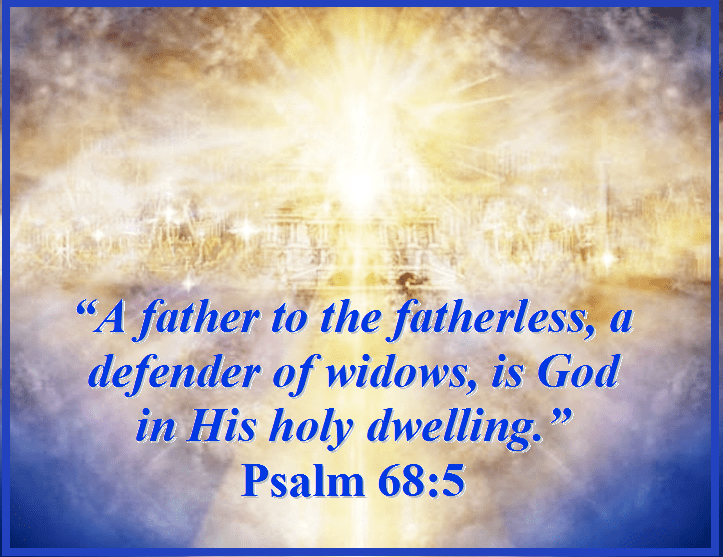
A Father to the Fatherless. What to Believe When “Dad” Walks Away? What to Believe of God, our Father?

I remember back to my earliest days of Sunday School when the subject of the day was Prayer. The question was raised by one of the other children who asked the teacher: “How do you converse with God?” The Sunday School teacher said, “As you talk with your daddy and your daddy talks to you, you talk with God.”

At five years old, I responded in return, “When I talk to my daddy, my daddy always removes both of his hearing aids, and then he stops talking to me.”

Psalm 68:5 has recently taken on a whole new meaning to me. The God of the universe–The one who created me, knitted me together in my mother’s womb, and despite all of my gravest faults and failures and also my father’s faults and failures, preserved me through my “fatherless” empty childhood–is also a true father to the fatherless! Let’s think about that for a second; I can probably think of so many other things that He could be doing, seeing that He is God and all.  

But no, He’s a model dad! He’s the one who kisses every boo-boo, cradles us in the big, perfect hug that only a genuine father has and can, and always has the best stash of band-aids and words to make the pain of an empty childhood go away. It’s probably a good thing Iam not God because I highly doubt, I would take time for knowing of those simple things. But I am very thankful He does.

Psalm 68:5 Holman Christian Standard Bible

God in His holy dwelling is
a father of the fatherless
and a champion of widows.

The Word of God for the Children of God. Gloria! In Excelsis Deo! Alleluia! Amen.

Reverend Dr. A.W. Tozer says, “What comes into our minds when we think about God is the most important thing about us” (The Knowledge of the Holy). What we think about our heavenly Father says a whole lot about who we are.

But what if our thoughts about our heavenly Father are entangled with and stained by the abuse and abandonment of our earthly father? Anyone who has experienced the acute pain of dad walking out knows it can be all-consuming.

I have, and I know. Dad, greatly afflicted by the harsh memories of the Korean War, copious amounts of alcohol and severe hearing loss made worse by war, stole the thing I believed to be indestructible, superhuman even: my family.

But family turned out to be more fluid than I once thought . . . and hoped. Like a permanent smudge on the lens through which we see the world, the dissolution of the family distorts all that we know and all that we are. Our hearts beat out of rhythm. Our thoughts weigh heavier upon our minds. Our tears flow faster. The only voice that once calmed us in the middle of the night is suddenly silent. The picture frame that preserved our family on the wall is either gone or it is empty.

Instinctively human beings have a need of a loving and compassionate father, who will feed us when we are hungry, love us when we are lonely, and care for us when we are crying. We long for a “smiling” dad, who will listen to us when we have questions, encourage us when we are discouraged, and discipline us when we do wrong. A father who cares and also takes time with the little things, who extends wisdom when we are concerned, and who most of all prays and seeks to know, understand God’s will and direction before acting on his own.  

God placed within us a desire to be loved by our father. Some fathers do well, and others do not. Some are extremely successful, and others fail miserably. 

Warped by such confusion and despair, just how do we paint accurate, biblical portraits of our Father’s goodness and faithfulness? When our fathers turn off their hearing aids or remove them from their ears instead of listening to their children, we’ve a very much harder time seeing who God promises to be for us.

The Bible articulates the truth we need, but believing the Bible isn’t always so easy either. When advice seems too thin, though, and life too cruel, God’s word is the only truly reliable brush for the suffering, painting fresh strokes of God’s character onto the marred canvas of our hearts and experience.

He draws near unto, the brokenhearted and ready to care for you, his precious son or daughter. (Psalm 34:18)

Fortunately, God is the perfect model of a faithful father, and He fills the gaps left by our earthly father as we seek Him each day. Therefore, we should listen to Him and honor Him in everything that we think, say and do.

Fathers need to learn to have a relationship with God, even if they did not or do not have a relationship with their earthly father. This is fully realized through the reading, studying and understanding of the Scriptures, where a father will gain and grow in wisdom, grace and the ability to raise kids to the glory of God.

Fathers, who accept God as their #1 penultimate Father, which also have made Jesus Christ their Lord and Savior are God’s children and learn from Him and in turn, unhesitatingly, teach their children the truths and treasures of the Bible.

1. Your Father will never leave you.

No one wants to suffer through the absence of a father who might walk away or remove their hearing aids from their ears at any moment. It’s agonizing riding the bus home from school wondering if dad’s truck will be in the driveway, if his clothes will still be in the closet, he will listen to you with both hearing aids.

God does not leave us in that suspense. God is deeply, unshakably committed to fathering you. You never have to ask whether he will stay or leave or listen. God himself promises, “I will never leave you nor forsake you” (Hebrews 13:5). He will hear our cries, our pleas from the furthest reaches of eternity (Psalm 18:6-19).

No matter what you’ve been through with your father, if you are God’s child through faith, he promises to never pack up his suitcase and leave you peering out from the kitchen window. In the middle of your loneliness, God is 10000% right there with you (John 14:16–18). Even when your earthly dad is somewhere else, God will not forget or neglect the commitment He has made unto you.

2. Your Father will protect you, not hurt you.

Sadly, some fathers hinder and hurt, rather than help. They bring pain, rather than protection. As a child, even into adulthood, you may have suffered both physical and emotional pain because of your dad. Your home wasn’t a safe place for you. Instead, it was a “Roman” arena of anger, tears, fears and uncertainty.

Pray! Take hope: your Father in heaven will never hurt you like this.

He will always protect you, keeping you safe from attacks against you. His hand of protection is unmoved and never tires.

Even when he must discipline us, he introduces pain in grace and love, and for our greatest good (Proverbs 3:12).

No matter what dangers you face, God remains an unparalleled source of safety and help. He will not let danger overtake you (Isaiah 43:2–3). 

He is a Father of ceaseless comfort and protection, not of terror and abuse.

3. Your Father knows what you need.

In a single-parent home, provision for the family can be a daily struggle and anxiety. Meals uncertain. Clothes borrowed. Aren’t our parents supposed to provide for our basic needs? When dad is gone, and with him a major source of income, when dad stops hearing and listening to their children, we must fight to see through the fog and fight to trust that God remains faithful to provide.

His resources never end (Psalm 50:10). He loves to provide for you, because you are a great delight to him. Your most fundamental needs will always ultimately be met in your heavenly Father (Philippians 4:19), not your earthly parents.

Even when Adam and Eve, God’s very first children, disobeyed, not only did God clothe their nakedness and also cover their shame, he promised us the ultimate provision of Christ for their sin, as well as for our sin (Genesis 3:1521). In Jesus, the Father has not left us wanting. He promises to eventually provide an eternal home, one where his children will never be crying or wanting (John 14:1–3).

4. Your Father takes great delight in you.

Without any love or encouragement from our dad, we can too easily question whether we are even loved at all. It’s normal to wonder how much we are worth, whether we’re a source of pleasures or problems for others.

But where our dad might be absent and silent, God has spoken. God affirms that we always and forever bring him great delight. He says, “You are precious in my eyes” (Isaiah 43:4). As His Children, we are a unique source of pleasure for him.

Rest in this: you and I are a constant delight to God, not because you, I, bring something to him, but because he loves us freely. He showers us with shouts of deliverance, love, and gladness (Zephaniah 3:17).

Questioning whether you are a delight to your dad is a real insecurity for many. It may be excruciatingly hard to believe that you are loved, but your heavenly Father does not ever leave us in doubt. If we are his, we are infinitely loved!

5. Your Father does not love you because of you.

Those of us who have watched dad remove his hearing aids, watched dad walk away have wrestled with trying to earn our father’s love and affection. Maybe we fight for the merits of academic or athletic success. This was my hardest fight as a young son, deeply desiring the unhindered love and affection of my dad. Whatever the perceived standard may be, it’s no way to live as a child.

Thankfully, our heavenly Father’s love for us is not conditional.

He does not love us based on our successes. Instead, God loves us because he loves us. That’s who he is. Even when we’re disobedient and rebellious, his love covers us. Even when we run away from him, he patiently waits for us to come home — a Father ready to wrap his arms around you, kiss you, and shower you with forgiveness and grace (Luke 15:20–24).

As it is truly written somewhere, there is more mercy in God than sin in you.

God reached out to you in great love when you were at your worst, not your best (Romans 5:6–8).

Child of God, LIVE! Run freely into your heavenly Father’s embrace, trusting the Father’s arms to hold you because his Son’s arms were stretched out for you on the cross. He is a living hope for the defeated, abandoned and forsaken, a refuge and a haven like no other can ever be for the fearful, a Father to the fatherless.

Our earthly fathers deserve respect. Our heavenly Father deserves our respect, commands our maximum love because He is always there, totally trustworthy.

What God says, He does. God our heavenly Father, will not let us down, He knows what we need and when we need it. At times it may feel as if He is not with us, but He is. He is probably speaking but we are not listening. Or is it maybe He is silent because He wants to grow our faith and our trust in Him?

In the name of God, our Father, God the Son and God the Holy Spirit,

Let us Pray,

Great is thy faithfulness, O God my Father; …... Thomas O. Chisolm, 1923

Father may my life, my compassion and my ministry reflect your heart for those who need care and protection and love. Give me eyes to see this need more clearly and a heart to responded more certainly so that your love may be demonstrated through me. In the precious name of my Savior Jesus, I pray.

Lord, today we pray specifically for fathers and fatherhood across our land.

Your Word faithfully teaches fathers to bring up their children in the discipline, instruction of the Lord (Ephesians 6:4). God, we do thank You for the men who are leading their families according to Your statutes and the ones that are laying their lives down for Your purposes.

We pray You will continue to use these men to lead their families and other men. We pray You will strengthen the fathers of our nation and that You will continue to empower churches, organizations, and individuals to 100% invest in fathers, fatherhood for the sake of Your children. Gloria! In Excelsis Deo! Alleluia! Alleluia! Alleluia! Amen.

 https://translate.google.com/

Why “Faith, Hope, and Love” Are So Important and WILL Last Forever. 

Faith, Hope and Love. These three things will last forever. Love as described in 1 Corinthians 13 is best understood as being a way of life, lived in imitation of Jesus Christ, as focused not on oneself but on the “other” and his or her good.

Love is about action, how a person lives for the Lord and obeys him and how a person lives for others and serves them.

Yet it is also about being. This is because its foundation is in God who is love, and in Christ who shows that love and the Holy Spirit. The sense that this is about more than simply how people behave is seen in passages like Paul’s prayer of Ephesians 3:14–19, particularly as he prays that Christians will be “rooted and grounded in love.” To “know the love of Christ” is to experience his presence “through faith” in their “hearts.” God’s people are to look and become more and more like Christ, and it is this for which Paul prays here.

It is because being and actions are so closely tied together in God and in Christ, first, but then also in his people, that Paul calls love a “more excellent way” (12:31b). It is the way of the new kingdom which has been ushered in with the appearance of the Messiah, who has shown it in his life, passion, and death, but who has also exhibited it in his coming, in his being, His death and resurrection.

Love is the way of existence in the heavenlies. As this break into the present in Christ, his people, filled with the Spirit of Christ, are to take on this way of existence and develop a life where love guides their approach to all things. Of course, this will immediately be seen in how they live and speak and think. Even so, when all that is mentioned here is done, the meaning of love for the believer is by no means diminished, minimized, defeated, exhausted in its importance!

1 Corinthians 13:13 AKJV

13 And now abideth faith, hope, charity, these three; but the greatest of these is charity.

The Word of God for the Children of God. Gloria! In Excelsis Deo! Alleluia! Amen.

In 1 Corinthians, the Apostle Paul describes various spiritual gifts and ways we can demonstrate Godly living in the world. He touches on the gift of tongues, prophecy with understanding, and faith that could move mountains.

Yet somehow, he passes all of these things for just one thing: Love. 

In 1 Corinthians 13:13 he says, “Three things will last forever: faith, hope, and love-and the greatest of these is love.” 

I have found myself skipping over this verse with a thought of “Yep, got that one down.” I have heard it and read it so often that I forget the application and power of it. What is this for? Why are these the things – faith, hope, love – that last forever? The greatest power of our lives is contained in this verse. We just have the high task of unfolding the purpose behind it in order to connect to it.

The Purpose of Faith

Faith is one of the first things we learn about as Christians.

It often starts with the quote from Jesus in Luke 17:6 where He says, “If you had faith even as small as a mustard seed, you could say to this mulberry tree, ‘May you be uprooted and thrown into the sea,’ and it would obey you!” Hebrews 11:1 gives this clear definition of faith: “Faith is the confidence that what we hope for will actually happen; it gives us assurance about things we cannot see.”

In my maturing years of my Christianity, I genuinely believed these Scriptures to be that I had the power and authority to believe something “as hard as I could” and it would be done, even if it meant defying the physical realm. I did this patiently for months before I started to lose hope and I began weeping to God. “Why! I truly believe you could deny this from me! Why won’t you do it!?” 

The purpose of faith is not to influence my own comfort. The purpose of faith is to lead forward to know the heart of God and then trust His ways to guide us. It is practical exercise reminding us of our place on the vine. We are the branches, and we can do nothing apart from the vine (John 15:5).

Hebrews 11:1 is a great definition of faith, but I believe Hebrews 11:6 gives us the life application of it. It states, “For we come to God in faith knowing that He is real and that He rewards the faith of those who passionately seek Him.” (TPT)

The Purpose of Hope

Hope is defined by Google as “a feeling of expectation and desire for a certain thing to happen.” It can also be defined as “a feeling of trust.” So, faith is the belief that there is something significantly better to seek and to discover, while hope is the expectation, or the certainty, that it is absolutely there. Hope is the 100-octane fuel that keeps our faith alive in our quest to seek and find love.

The way that faith, which is the seeking of the Lord, connects with hope, which is the expectation of finding Him, is through wisdom. 

Proverbs 24:14 says, In the same way, wisdom is sweet to your soul. If you find it, you will have a bright future, and your hopes will not be cut short.”

Jesus is our model of constantly seeking after wisdom. Often in our spiritual development, we hit a place of complacency where we are good with what we have. It is a great thing to be grateful, but there is more for your life when you continually seek wisdom. At each level we should be graduating, moving, and growing, constantly adding to what we understand.

This is what keeps hope alive. As we seek more, we learn more, and we store up confidence in who we are on the vine. In Luke 2:52 we get a subtle, yet powerful, picture of Jesus’ character that reveals the deep foundation of his influence and confidence. It says, Jesus kept increasing in wisdom and stature, and in favor with God and men.” Jesus is our only true King! Jesus is our Savior! We should follow his authority, lead by constantly seeking wisdom and relationship with others.

The Purpose of Love

Paul makes it very clear in 1 Corinthians 13:13 that the greatest of all spiritual gifts is love. Based on this, we know that love is the MAX result that we see of our faith and our hope. Love is the pen-ultimate goal. How wonderful is it to understand the goal! When you start a new game, the biggest hurdle is often obtaining an understanding more than physical limitations. If you understand the goal, you can use what gifts and graces you have been gifted to get there.

The purpose of love is evident in 1 John 4:7-8 that it is the clearest picture of God that we have. It states, Dear friends, let us love one another, for love comes from God. Everyone who loves has been born of God and knows God. Whoever does not love does not know God, because God is love. It goes on to say in verse 19 that we love because God first loved us.” So, the purpose of love is twofold. First, it is revelation of identity. It tells us who God is and who we are in God, God alone.

Second, it is the very power that allows us to do the work of Jesus and even unto greater works as Jesus described in John 14:12. He says, Whoever believes in me will also do the works I have done, and even greater works, because I am going to be with the Father.” Love has the power to help us believe again and restore hope in others. It is the ultimate momentum engine that drives all of our spiritual lives.

Faith, Hope, and Love: The Perpetual Cycle of Life

If faith, hope, and love are the things that last forever, it becomes clear these are the things we should pursue with our lives. Some may feel concerned at the thought of knowing what the end goal is, that perhaps there is no point to life if there is nothing left to discover. But there is life in these things that will never be diminished, defeated, minimized, exhausted or drowned or burned out!

In the beginning, we are born with no other understanding besides faith.

As newborn babies, we instinctively, naturally, reach out to our parents, seek care and to be nurtured. We confidently look for someone to give us the care that we need. As we earn the badges of life, we become scarred by experiences which can strip our faith and our hope away, and in turn, we forget our natural instinct to love as we become too consumed with finding a new starting point.

Finding faith, hope, and love for ourselves does not mark the end of anything.

It can, however, mark the exact beginning for someone else. If you have ever been in a broken place, you have spent time trying to find “bottom” then you know the power of someone else showing you kindness or believing in you.

It is a true progression of divinely orchestrated events. When you are shown love, you ignite a new belief of what you could be. Then you become hopeful that there is still good in this world. Then you love yourself. Then you share love with others and spark this cycle over and over again. This is our beginning, our new beginnings, and our forever and ever amen, both for us and fellow man.

Imitating Christ’s love

A further explanation why love comes to function as the marker par excellence of the true believer lies in the imitation of Christ. Christ stands as the supreme example of love through the whole of his life, but specially in his death.

In 1 Corinthians 1 the death of Christ was at the center of Paul’s understanding of God’s wisdom (his plan) to save his people. It was the “word of the cross” that was the power of God to those “being saved” (1:18). Supremely in Christ’s death the love of God and of Christ was shown. The link is explicit in Romans 5:8: “God shows his love for us in that while we were still sinners, Christ died for us” (ESV). It is also clear in Ephesians 5:2: “Walk in love, as Christ loved us and gave himself up for us, a fragrant offering and sacrifice to God” (ESV).

Finally, perhaps the great surprise of chapter 13 is the MAX depth of intimacy of the love relationship Paul described. It is surely infinitely more than could have been imagined, especially as Paul looks forward to seeing “face to face” and writes, “Then I shall know fully even as I have been fully known” (v. 12).

Through a disciplined devotion to prayer, reading, studying Scripture, we shall know God, not in the sense of having the same omniscience as God has, but “even as” he has known us personally with such extraordinary depths of love.

But this life is the first step into an eternity of love with God; the love of God and our love for God, and these three graces of faith, hope and love must of necessity all continue beyond this mortal sphere, for the attributes of God are incomparable in their beauty, His perfections are unlimited in their number, His excellence is everlasting in its duration, splendour is absolute in its span.

In the name of God, the Father and God the Son and God the Holy Spirit,

A Prayer for Faith, Hope, and Love

We can start with this prayer from 2 Corinthians 1:3-4“All praise to God, the Father of our Lord Jesus Christ. God is our merciful Father and the source of all comfort. He comforts us in all our troubles so that we can comfort others. When they are troubled, we will be able to give them the same comfort God has given us.”

God, thank you for loving me. Thank you for starting my cycle of life and giving me the wisdom needed to walk with you. I pray I will continually be interested in wisdom so that my faith and my hope cannot be cut off. I pray that as I stay full, I will look for ways to carry out your work to help someone else in need. Gloria! In Excelsis Deo! Alleluia! Alleluia! Alleluia! Amen.

https://translate.google.com/

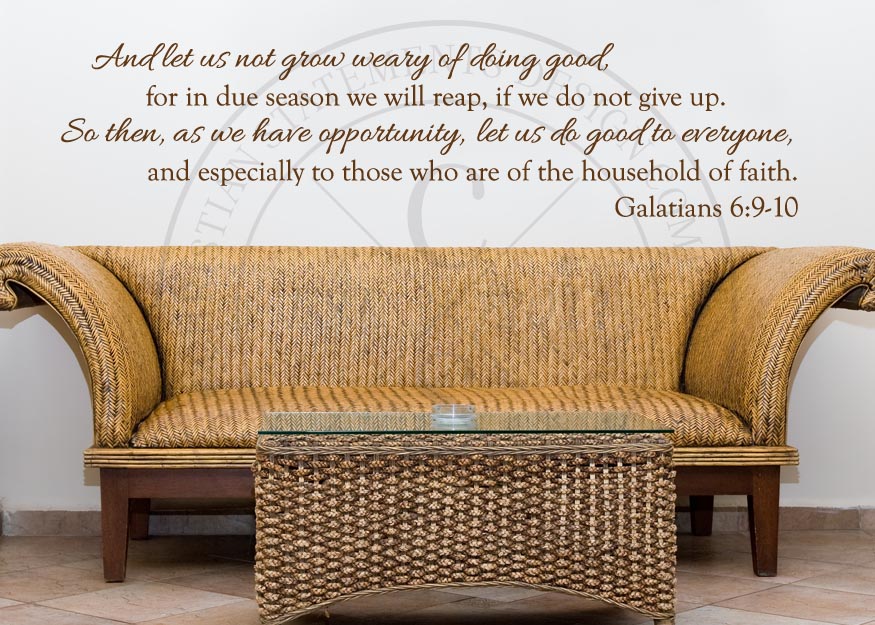
Living for Jesus: Don’t Grow Weary in Doing Good to All – Galatians 6:9-10

God’s tireless Prophet Jeremiah enduringly wrote some 2650 years ago; blessed is the man who trusts in the Lord, and whose hope is in the Lord. For he shall be like a tree planted by the waters, which spreads out its roots by the river, and he will not fear when heat comes; but its leaf will be green and will not be anxious in the year of drought, nor will cease from yielding fruit. (Jeremiah 17:7-8 NKJV)

The person who loves God is like a tree with deep roots. During a drought, when all the other trees are perishing, the single tree planted by the river will remain healthy and strong – drawing its nourishment from all the waters flowing by it. There is no anxiety, for the commitment of that single tree reaches far beyond the circumstances, life threatening effects, of the drought which surrounds it.

If we are to succeed in the midst of the swirling circumstances which threaten to continually define and continuously overwhelm our day-to-day existence, and if we are not trying to quit on God or our neighbors or ourselves when the going gets tough, we need to get our roots planted by the rivers of living water steadily flowing forever down unto us from the very throne room of God itself.

We need to set a covenant goal to commit our life unto our Savior Jesus Christ. A covenant commitment which plants, then grows stronger, matures far beyond than what overwhelms us, until only the commitment to Christ remains known.

Galatians 6:9-10 The Message

9-10 So let’s not allow ourselves to get fatigued doing good. At the right time we will harvest a good crop if we don’t give up or quit. Right now, therefore, every time we get the chance, let us work for the benefit of all, starting with the very people closest to us in the community of faith.

The Word of God for the Children of God. Gloria! In Excelsis Deo! Alleluia! Amen.

The major theme of Paul’s letter to the Galatians is that we are saved by faith, and not by works. Yet what I do as a believer is important. True salvation is not just my accepting Jesus into my heart with an eye toward heaven in the future. It is an ongoing relationship with Jesus as my Lord. And that is what is reflected clearly in this closing instruction in Paul’s letter to the churches of Galatia.

Do not become weary in doing good to all. Especially to other believers. We are summoned, “Called to Do Good” But what does that mean to ‘Do Good’?

What Does it Mean to Do Good?

‘Doing good’ is not the same thing as doing no harm. Doing no harm is a quiet passive activity – it is staying seated upon our couches in our living rooms. But doing good is all active. It is something that takes effort on my part. Something that I could grow weary of. And something that is directed toward other people.

Doing good means that when I see an opportunity to help another person, I take it. It may be something simple and with little cost. Or it may be more costly and time consuming too. Doing good simply means that I do what I can to help you.

For God so loved the world, He sent His Son to us to continually love us, not to continuously condemn us. He came unto us that we might find goodness and abundance beyond our ability to comprehend or to receive in one lifetime. This instruction to do commit to a lifestyle of being abundantly good, sharing all of God’s abundant goodness is all inclusive, all of the time, has all people in mind.

Even those who are not believers. And even those that I may not get along with. If I can do good for someone, regardless of my relationship to them, I should.

But it is especially true for those within the family of believers. They are the ones I should care most about. I should actively seek out, look for ways to do good; to be helpful and hopeful and joyous to them. As you live your life with Christ, be doing good to all people, especially within the community of faith.

The simple gospel of grace is to come to Christ and believe – for we are saved by grace alone and not by doing good works, lest any may should boast. But once we do believe and are saved, we should then become a true disciple and take up our cross, follow daily after Jesus – for this is God’s desire for all His children.

If we are going to root ourselves in Christ, if we are to truly grow in grace and mature in the faith, we are to do the good works that God has already prepared for us to do. If we are to mature in the faith and press onward to the goal of our calling, we ought to be living our lives as unto the Lord – and “not lose heart in doing good, for in due time, God’s time, we will reap, if we do not grow weary.”

“Give me one hundred preachers who fear nothing but sin, and desire nothing but God, and I care not a straw whether they be clergymen or laymen; such alone will shake the gates of hell and set up the kingdom of heaven on Earth.”
― John Wesley

“Do all the good you can,
By all the means you can,
In all the ways you can,
In all the places you can,
At all the times you can,
To all the people you can,
As long as ever you can.”
― John Wesley

In the name of God, the Father and God the Son and God the Holy Spirit,

Let us pray,

Loving Father, I want to press on in my Christian life, to become more and more like the Lord Jesus. I know that it will require me to put my hand to the plough and press on, with the patient endurance that only comes from You. I pray that I may not lose heart or fatigue or growing weary in doing the good works which You have prepared for me to do. Thank You that in due time I may reap a fruitful reward, if I do not give up on you. In Jesus’ name, Alleluia! Alleluia! AMEN.

https://translate.google.com/

How To Test the Practical Reality of Your ‘Real’ and ‘Practical’ Religion. They Will Know We are Christians by Our (__________) James 1:26-27

An anthropologist once visited a primitive village in Western Africa to study the customs of the very primitive people who lived there. When he returned to the U.S., he sent back a sun dial to those people to express his real thanks for their practical cooperation. The natives were delighted with their gift, and they were concerned that nothing happen to it, so they immediately built a thatched roof over it to protect it. In so doing, however, they made it of no practical value.

The foolishness of this is obvious to us all, but James says the foolishness is not always obvious to Christian people when they do the very same thing with their religion. They will take it home after church on Sunday, and they hang it in the closet with their Sunday clothes, and there it stays until the next week. It is as worthless as a sun dial under a roof. James warns us that if our Christianity is not practical, and we only hear and do not do, then we are deceiving ourselves.

James 1:26-27 Easy-to-Read Version

The True Way to Worship God

26 You might think you are a very religious person. But if your tongue is out of control, you are fooling yourself. Your careless talk makes your offerings to God worthless. 27 The worship that God wants is this: caring for orphans or widows who need help and keeping yourself free from the world’s evil influence. This is the kind of worship that God accepts as pure and good.

The Word of God for the Children of God. Gloria! In Excelsis Deo! Alleluia! Amen.

A Christianity that is not real or practical is not a real, practical Christianity. If it does not control your conduct, and it does not change your character, and make you more sensitive to the will of God and the world’s need, then you better stop and ask some very serious questions about the practical reality of your religion.

In these last two verses of chapter 1 James has a lesson for us on how to test the reality of our religion. If your religion does not really change you, then you had better change the practical applications of your religion. James implies there are three questions that we must be able to answer with a definite “yes” if we are to be confident that our religion is not vain, but of real and practical value to God, to the real world, and to our real and practical selves living in the “real” world.

The first question that grows out of what James says is-

I. AM I PRUDENT IN MY SPEECH? Verse 26.

James is saying in a different way what Jesus said when He made the statement, “It is not what goes into a man but what comes out of him that defiles him.”

Jesus was referring to the tongue just as James is.

The Bible makes it quite clear that one of the greatest responsibilities which men have is the wise use of their tongue.

Jesus said, “By your words you shall be justified and by your words you shall be condemned.” (Matthew 12:37)

A real Christian is one who does not say, “I have freedom of speech, and so I can use my tongue as I please.” A real and practical Christian – He is one who will freely present his body a living sacrifice unto God, and that includes his tongue. He is one who is truthful with his tongue, and practical and wise with his words.

A man who can go to church on Sunday and then curse on Monday and tell a few dirty stories at the office or plant on Monday is only deceiving himself, “for out of the abundance of the heart the mouth speaks.”

If that is what comes out of his mouth, we know his heart is filled with the language of the world and not that of the Word of God.

James is saying that the man’s religion is vain, and it has no real value to anyone. He is a double minded man who will receive nothing from the Lord.

It is amazing how many people are deceived at this point. Out of the very same mouth comes both sweet and bitter. I have known men who could talk about their church work, and of how they help the church in so many ways, and then a few minutes later hear them using filthy language and do so with no respect for others in their presence.

He thinks he is very religious, but James would say because he cannot bridle his tongue, he fails the test of real religion. A foul and filthy tongue characterized the ancient world, the Christians who were won out from this type of society had a difficult time in keeping their tongues committed to the glory of Christ.

This same problem exists today, where foul language is even very common in the public schools, in modern so-called movies, as well as the workplace. It is easy for the Christian to get caught up in the common expressions of the world and thereby cease to be different from the world.

This can totally ruin your real and practical testimony and witness, make your religious commitment of no real or practical value.

The Apostle Paul was concerned about this problem also, and he wrote to the followers at Colossians and said in 3:8-10,

“But now you must rid yourselves of all such things as these: Anger, rage, malice, slander and filthy language from your lips. Do not lie to each other, since you have taken off your old self with its practices and have put on a new self, which is being renewed in knowledge in the image of its Creator.”

This brings us to the basic idea that James is getting at. It has to do with the use of our tongue in relationship to other Christians. When Paul says we are to put away anger, wrath, malice, and lie not to one another, he is saying what James means when he says we must bridle our tongue.

William Penn put it this way: “Men who fight about religion have no religion to fight about.”

We mentioned before that the Christians to whom James is writing were caught up in a great deal of real religious controversy. And real unbridled tongue could cause much damage. A tongue not under the control of reason and the Holy Spirit will race wildly across the field of a man’s character, kicking, bucking, and trampling it without pity, and the result will be a real victory for Satan.

Most all great men of God suffer much sorrow because of the severe criticism they receive from Christians. The speed with which Christians are ready to blast out at other Christians is the speed by which they make themselves useless to God, the world, themselves. All the good a person may do vanishes rapidly when the tongue is filled with malice and contempt for a brother or sister in Christ.

A critical and malicious tongue is a sign of self-righteousness. When a Christian becomes satisfied with his own attainment, he really tends to become critical of others. He feels if only others could be as wonderful as he is the church could get somewhere.

So, he builds a fence around his religion to protect it. He becomes narrow and bigoted, and he sets out to straighten the world according to his standard. The end result is that he does more harm than good, and his religion is as worthless as a sun dial covered over by a thatched hut without the sun and its real light.

He is trying to be a Christian without the spirit of Christ. There are many more areas where the unbridle tongue is a curse. It is clear what James is getting at, and we must be able to say that we are aware of the power of the tongue, and that we will strive to use its power according to the will of God.

If we cannot say that we had better, ask God really quick to forgive us and help us to gain the victory in this area, or our life will count for practically nothing in the kingdom of God. We may still be saved by faith in Christ, but it will be sad that all of our works will be consumed by fire, for they will not stand the test.

The second question is

II. AM I PRACTICAL IN MY SERVICE? v. 27

Before we can answer this question, we must understand what James means by religion. This is one of the most misunderstood verses in the Bible. Many have used it to deny the basic truths of Christianity itself.

They say that religion is really and practically about our real, and practical good works, and so we can start an orphan or widow’s home, or do social work for the needy and widows, and we will get to heaven according to the Bible.

But though this seems to be logically based on this verse, we know it contradicts the rest of the Bible, and the rest of the letter of James itself. Realize, there is no salvation apart from faith in Christ.

James knows that, and in Chapter 2 verse 1 he speaks of the faith of our Lord Jesus Christ. In Chapter 1:1, he is the servant, and all through the chapter he stresses prayer and the Word of God which is able to save souls. Why is all this left out when he tells us what pure religion is? We would expect him to include all these fundamental truths.

The problem is not with James, but with our context and with our language.

The practical words that James used really meant “The external service of God, and not one’s inner state before God.”

I believe James here is referring to the real and practical results of our faith in Christ, prayer, and fellowship with Christ. He is saying that if these things are real, we will be able to know it because it will show itself in our practical service. True religion is not seen in ritual observance but is deeply inside our real trust of our Savior Jesus and inside our own practical obedience to the Word of God.

What James is saying can be illustrated by really saying the same thing about a mother’s love. If I said, “Pure motherly love and undefiled before God is to wash and feed her child.” I would not mean by this that love is merely a matter of keeping a child clean and fed. I would mean that if the love of a mother is real it would show itself in a practical way in her care for her child’s basic need.

This is not the whole of love, but it is the practical result that proves the love is real. So, to really have a sympathetic concern for human need is not the whole of being a Christian, but it is the real and practical result that must be seen to know that the vital factor of faith in Christ is real.

In other words, being real and practical and good will show itself in doing good. As John said, if you can see a brother in real need and have no real compassion, how does the love of God dwell in you?

The world was filled with impractical religion then, and it always has been.

Christianity is the only pure and undefiled religion, for if God’s Word is obeyed and put into practice it will lead to the compassion of God, which, in turn, leads to vital service that makes a difference in this world of endless needs. People can come to a temple offer sacrifices, burn incense, bow and pray, and lay in “real and true” submission before God, or go through any number of practices of ritualistic religion, but if they do not go out and serve God in a real practical manner, all of this is vain and worthless.

Masses of people think they are religious because of their ritual before God, but they never show the compassion of God in the real world. Here, James says that if there is no real and practical service that grows out of one’s religion, it is not the Christian religion, but is instead a really cheap and impractical imitation.

The particular examples that James used to illustrate Christian service are the two that are used all through the Bible. In the ancient world the orphans and widows were the subjects of great injustice. There were no orphan homes, and no social security to help widows. They were often at the mercy of anyone who sought to do them harm or take their property by any means necessary.

Jesus sharply rebuked all the Pharisees who thought of themselves as the most religious of persons. He said, “Woe unto you Scribes and Pharisees, hypocrites! For you devour widows’ houses, and for a (real) pretense make long prayers.” (Matthew. 23:14). This was a long-time practice, and they were blind to how really inconsistent it was with the nature of God.

It is really amazing to me how often people in the Old Testament had to be commanded, reminded, not to oppress the widows and the fatherless. They were constant victims of an ungodly world.

One of the characteristics that God proclaims of Himself over and over is His concern for the orphans and widows.

In Deuteronomy. 10:17-18, “For the Lord your God is God of gods and Lord of lords, the great God, mighty and awesome, who shows no partiality and accepts no bribes. He defends the cause of the fatherless and the widow….”

Keep in mind that James was the brother of Jesus, and his mother Mary was a widow. Joseph died leaving her to raise her family as a single parent. James was using the most common examples of human need in the world of his day.

He does not limit Christian compassion to these examples, but he uses them to illustrate that a religion that does nothing to help the needs of those who are in need of help is not any religion but can be called Christian. Throughout history, real Christians have been shown the greatest source of compassion in history.

 If we keep our “real and practical” Christianity a matter of theology, feelings, and ideas, and never get “genuinely real and genuinely practical,” we are not real nor practical nor spiritual from God’s point of view.

We have looked at two test questions:

Are we prudent in our speech and are we practical in our service? If we can say yes to the first, but not to the second, our religion is not realistic enough to even minimally please God. And if we can say yes to both, but not to the third, we are still seriously and severely and catastrophically falling short of the glory of God,

and the third test is this-

III. AM I PURE IN MYSELF? v. 27.

To make our real religion practical we have to get out into the world to meet its needs, but James wants to make it clear we must be in the world but not of it. In other words, don’t become contaminated by the world as you seek to lift it. This means we need a constant reliance upon God.

The sacrifices of the Old Testament were to be without spot or blemish, and so in the New Testament we are to present our bodies a living sacrifice, holy and acceptable and without blemish unto God. The only way we can keep from being spotted by the world is by a careful walk and constant confession.

The Christian who is careless about the purity of his or her life has not quite understood the price that was paid to redeem him from the present evil world. There is a lack of realism in his and her religion, and it does not ring true.

The only one who can ever lift the world is the one who is above it. This does not mean to shut self-off from the world, but, like Christ, to be so busy doing good there is no time to get involved with the real world on its level of corruption.

As Phillips Brooks said, “The life of Christ was like an open stream that keeps the sea from flowing up into it by the eager force with which it flows down into the sea.” What a real masterpiece of what the practical Christian life should be-a real stream of practical activity flowing into the ocean of the world’s needs with none of the salinity of the world’s ocean waters getting near or into the stream.

True purity is gained by being “real” and genuinely positive, and not by doing nothing so as to avoid doing wrong. He who stays pure by doing nothing is evil, nonetheless, for he is a hearer and not a doer, and only deceives himself if he thinks he pleases God. God demands of us all a positive and practical purity.

We have asked three questions: Am I prudent in my speech? Am I practical in my service? Am I pure in myself? These questions test the reality of our religion. If we pass this test, it means we represent the only religion that is from above.

God does not and will not ever lower his standard to fit man. He promises His grace and power to help them grow to His standard if they hunger and thirst after His righteousness. We could never fully reach that standard. Christ was the only perfect Christian. Paul never attained it, but he kept pressing on.

All of us, without one exception, are, and will forever remain really imperfect and impractical Christians, but if our life is a constant striving to be able to say yes to the three questions we have looked at, we are real Christians, and we are practical Christians, and our religion is really, genuinely pleasing to our Lord.

In the name of God, the Father and God the Son and God the Holy Spirit,

Let us pray,

Father, my Guide and Guardian, illuminate my mind so I can understand how you want me to live. Your word tells me that people of integrity who follow your instructions are joyful. You have said that those who obey your laws and search for you with all their hearts are blessed and happy. I want that joy! Holy Spirit, please guard me against allowing evil to influence what I believe and do. Help me walk only in your paths. May my real actions (Acts 3:1-10) consistently reflect what you have said is right and good. Alleluia! Alleluia! Alleluia! Amen.

https://translate.google.com/

Seeing Yourself Through the Eyes of God? – Remember! One Passion! One Devotion! One Love! Exactly One God!

The world is all too often a hostile place for believers. Goliaths no longer try to hide themselves from public view or from public judgement. They stand tall in their perceived invulnerability; surround, abound around every street corner. Goliath says, “you cannot touch me! “You cannot beat me!” “You are nothing!” We are intimidated by the sheer force of their size, their strength, their words. We shake and we quake in our boots – too easily accept unconditional defeat!

God wants his spiritual children to know, however, that they are not alone. He lives in us with His Son, our Savior Jesus, through his Spirit. We can be assured, therefore, that no matter what evil design someone else may have, the Holy Spirit of God is greater, more powerful, and more glorious. The victory is ours because God’s presence in us is infinitely greater than any force we will ever face. We have our victory assured over all forces, powers, spirits, or opponents.

The Question remains to be answered – if we are to claim such an overwhelming victory through God, the Father and God the Son and God the Holy Spirit, if we are to claim it and own it and possess it as the greatest gift, treasure, there is, to fully live into everything God has set aside for those who believe and conquered, then whose eyes do we look through whose perspective do we make all our own?

Our perspective through our finite eyes and limited wisdom and understanding?

Defined by our shame? Our Guilt? Our brokenness? Our weaknesses? Mistakes? Someone else’s opinion thrust upon us by those rampaging, ranting Goliaths?

God’s perspective through God’s eyes, knowledge and wisdom? (Psalm 139)

1 John 4:4-6 Authorized (King James) Version

Ye are of God, little children, and have overcome them: because greater is he that is in you, than he that is in the world. They are of the world: therefore, speak they of the world, and the world heareth them. We are of God: he that knoweth God heareth us; he that is not of God heareth not us. Hereby know we the spirit of truth, and the spirit of error.

The Word of God for the Children of God. Gloria! In Excelsis Deo! Alleluia! Amen.

Whether we like it or not, or realize, admit it or not, in our humanity, we are finite. We have a beginning; we have an end. It is the natural flow of our lives and is seen in everything from a good day’s work to a bedtime story for our kids. But when we brush up against eternity, we find that it has neither beginning, nor an ending. It always was, and it always will be. Such is the nature of love.

Scripture tells us in 1 John 4 that God is love. Therefore, since we know that God is eternal, we can reasonably assume that God’s love is also eternal. Love begins and love ends with God. But God is not stingy with this love. He longs to share Himself with every person on the face of the earth, and the tangible expression of that love is His Church, redeemed by the blood of His Son, our Savior, Jesus.

When you and I go to the source of love and find that we are indeed beloved by the God of the universe, it changes everything. Once our hearts are filled with His love and truth, we are given new eyes for others, and can’t help but want to share the priceless treasure we have found!

In his groundbreaking book, The Life of the Beloved: Spiritual Living in a Secular World, Henri Nouwen says this,

“When we claim and constantly reclaim the truth of being the chosen ones, we soon discover within ourselves a deep desire to reveal to others their own chosenness. Instead of making us feel that we are better, more precious or valuable than others, our awareness of being chosen opens our eyes to the chosenness of others. That is the great joy of being chosen: the discovery that others are chosen as well. In the house of God there are many mansions. There is a place for everyone – a unique, special place. Once we deeply trust that we ourselves are precious in God’s eyes, we are able to recognize the preciousness of others and their unique places in God’s heart.”

Whatever you and I are facing in life, or whatever is coming in your future, God has already given you the steadfast faith, the living hope and deepest love for it. It may not look like it now, and you may not feel like you have what it takes to overcome, but faith in God is never based on our circumstances or how we feel.

The enemy would like for you to believe that you don’t have a chance in life, that you’re a loser, too weak, too poor, too whatever. But God has a different perspective of you (Psalm 139). God sees you through the eyes of love. He sees not what you can be, but what He has invested in you, not what you or others may see from the egregiously limited perspective we have “worldly” learned.

Seeing yourself the way God sees you leads to a life of overwhelming victory. Living into that vision God has always had of us offers to us many challenges.

But it takes faith. You can’t just hear that God loves you and sees you as His child, you have to believe it. It takes faith to move forward and overcome the challenges of life. And faith does you no good if you don’t know how to release it, how to unleash it. You have to release your 100% faith in order for it to work.

We release faith through our words, actions and, of course, through prayer. It’s up to us to act.

1 John 4:4 is a scripture we quote a lot, and almost anytime I say this verse in a church or meeting, everybody claps and cheers. But how many people really do believe these words; “He who is in you is greater than he who is in the world?”

The truth is, the One in you is greater and He loves you. So, stretch your faith today, stretch your hopes today and stretch your love today and see yourself the exact way God sees you. It doesn’t matter what the enemy wants you to see or how things might look. Our faith overcomes through the One who lives in us!

In the name of God, the Father and God the Son and God the Holy Spirit,

Let us pray,

Father, my Guide, illuminate my mind so I can understand how you want me to live. Your word tells me that people of integrity who follow your instructions are joyful. You have said that those who obey your laws and search for you with all their hearts are blessed and happy. I want that joy! Holy Spirit, please guard me against allowing evil to influence what I believe and do. Help me walk only in your paths. May my actions consistently reflect what you have said is right and good. Alleluia! Alleluia! Alleluia! Amen.

https://translate.google.com/

What Jesus Did! ‘Beyond Mourning’ ‘Beyond our Grieving’— Matthew 5:4

The Apostle Paul wrote to the Christians at Rome, at the very center of greatest human sufferings, where Christians were subject to great, sudden persecution, where they could be randomly arrested, separated from their families, arrested as whole families and thrown into prison. A prison which all too often would result in their being a part of the “gladiatorial spectacle” Christians versus Gladiators, Christians versus wild animals, Christians versus fiery Crucifixion.

He wrote in the midst of all that: Romans 12:9-13 Amplified, 9 Love is to be sincere and active [the real thing—without guile and hypocrisy]. Hate what is evil [detest all ungodliness, do not tolerate wickedness]; hold on tightly to what is good. 10 Be devoted to one another with [authentic] brotherly affection [as members of one family], give preference to one another in honor; 11 never lagging behind in diligence; aglow in the Spirit, enthusiastically serving the Lord; 12 constantly rejoicing in hope [because of our confidence in Christ], steadfast and patient in distress, devoted to prayer [continually seeking wisdom, guidance, and strength], 13 contributing to the needs of God’s people, pursuing [the practice of] hospitality.

Paul told Christians in Rome, “Weep with those who weep” (Romans 12:15).

Mankind faces sadness and suffering from every which direction. Disciples face great sadness for many reasons. Discipleship is not about always being happy.

It’s about following the path of Jesus who was “a man of sorrows, acquainted with deepest grief” (Isaiah 53:3). He surrendered his rights in order to bless others. He surrendered his life in order to forgive the very ones crucifying him. He saw through the facades of his culture and felt the indescribably real needs of people whether they were ill, possessed, or simply blind or lame to the truth.

To be a Christian — a disciple of Jesus — means to care about people, their problems, and to “weep with those who weep.” Such mourning means comfort. Our sufferings, hardships, and struggles will melt away in the eternal light of God’s presence and grace. Our heartbreak for those broken in our world will be replaced with rejoicing when many we love to join us at God’s side eternally. Those who mourn, who are deeply sad, they will be immeasurably comforted!

Matthew 5:4Amplified Bible

“Blessed [forgiven, refreshed by God’s grace] are those who mourn [over their sins and repent], for they will be comforted [when the burden of sin is lifted].

The Word of God for the Children of God. Gloria! In Excelsis Deo! Alleluia! Amen.

God cares about you and me with an unmatchable intensity.

God loves you and me with an unmatchable intensity.

God cries with you and me with an unmatchable intensity.

God collects yours and mine tears in a bottle against the day we meet Him.

Jesus cries with you and me with an intensity we cannot match.

Jesus cries the tears we cannot cry but long to cry with an unmatchable intensity.

Jesus mourns over you and me with an intensity we cannot ever hope to match.

God the Holy Spirit grieves with you, and alongside of you, intercedes on your behalf with unmatchable intensity.

What won’t the Father, Son and Holy Spirit do to demonstrate their unmatchable, unequivocal capacity to absolutely care, have absolute compassion for you and me?

You mourn and I mourn with an intensity that longs to be unleashed, and unmatchable.

What won’t we do to return that unmatchable, unequivocal compassion toward us?

God, our Father Cares,

Our Savior Jesus Cares,

God the Holy Spirit Cares,

We care too – there is never to be any question about “Christian” measures of caring. Our desired measure is to care and have compassion for others on God’s level. This is not achievable nor even reachable, but it is still the struggle of our struggles to care for all others as God, the Father, God the Son and God the Holy Spirit the same way, with the same unmatchable intensity as He cares for us all.

O’ for the grace to Love God More!

O’ for the Grace to Love our neighbors as we Love God before we love ourselves.

O’ for the grace to have uncompromising, unyielding, unmatchable compassion on our fellow man as God has uncompromising, unyielding compassion for us.

Matthew 5:4 Amplified Bible

“Blessed [forgiven, refreshed by God’s grace] are those who mourn [over their sins and repent], for they will be comforted [when the burden of sin is lifted].

The prerequisite to receiving God’s comfort is that we mourn. It’s not wrong to grieve and we need to give ourselves permission to feel the pain of our losses.

Yet we don’t mourn “like the rest of men, who have no hope” (1 Thessalonians 4:13). Our mourning is different because of our hope in Jesus who has overcome the power of death. And also, because Jesus is our High Priest who has shared our humanity and is able to sympathize with us (Hebrews 4:15). At Lazarus’ graveside, Jesus entered into the pain of the moment, and wept. He showed us that tears and grief are part of the process of coming to terms with our losses.

Even when we experience smaller losses, we still need to acknowledge the pain and mourn. The “stiff-upper-lip mentality” isn’t God’s idea. I once heard a worship leader make this comment, “Let the hurts of a lifetime flow into his nail-scarred hands.” Once we have felt the pain, we are then free to let it go. Even then it’s a marathon process of navigating between a level ground and “vehicle swallowing” potholes and pitfalls and is never an instant painkiller.

Being a Christian doesn’t guarantee us a life without tragedy but being a Christian means we have access to God’s resources. He promises us his comfort when we mourn, but if we don’t mourn, we can’t receive God’s comfort.

God encourages us to come to his “throne of grace with confidence so that we may receive mercy and find grace to help us in our time of need” (Hebrews 4:16).

We mourn with an unmatched intensity for those not in covenant relationship with Father, Son and Holy Spirit. We grieve, we cry for those who God cried for.

Psalm 130 The Message

130 1-2 Help, God—I’ve hit rock bottom!
    Master, hear my cry for help!
Listen hard! Open your ears!
    Listen to my cries for mercy.

3-4 If you, God, kept records on wrongdoings,
    who would stand a chance?
As it turns out, forgiveness is your habit,
    and that’s why you’re worshiped.

5-6 I pray to God—my life a prayer—
    and wait for what he’ll say and do.
My life’s on the line before God, my Lord,
    waiting and watching till morning,
    waiting and watching till morning.

7-8 O Israel, wait and watch for God—
    with God’s arrival comes love,
    with God’s arrival comes generous redemption.
No doubt about it—he’ll redeem Israel,
    buy back Israel from captivity to sin.

Blessed Are the Mourners

What is the type of mourning that Jesus is looking for as characteristics of people who enter into the kingdom of heaven?

Is God saying that we all just need to be sad all of the time to be citizens of his kingdom? Sadness is not the concept that we see in the scriptures. There is a time and season of mourning that is needed but it is not being sad for sadness’ sake. The scriptures give us a clear picture of the mourning that Jesus desires.

Draw near to God, and he will draw near to you. Cleanse your hands, you sinners, and purify your hearts, you double-minded. Be wretched and mourn and weep. Let your laughter be turned to mourning and your joy to gloom. (James 4:8–9 ESV)

My eyes shed streams of tears, because people do not keep your law. (Psalm 119:136 ESV)

God wants a mourning over sin.

The first statement of blessing in the Sermon on the Mount was the blessed were those who were poor in spirit. These are people who recognize their sinfulness. These are people who see their sin and know that there is nothing they can do before God to redeem themselves. They are the people like the tax collector who simply say, “God, be merciful to me, a sinner!”

Those who are in the kingdom of heaven are those who are stripped of all self-righteousness, self-sufficiency, and self-security. Now let us consider for a moment: if we are doomed because of our sins with nothing that we can offer to God to save ourselves or redeem ourselves, then what does God desires but those who mourn over their sinfulness.

When someone comes to me and they have done something wrong, it matters greatly if they are sorrowful for what they have done. If they do not care about their violation, then that will receive a very different response from me as a parent than if the children 1000% care about their violation and is remorseful.

This is the kind of mourning that God desires of his people. Notice again that the Beatitudes follow Isaiah 61, a prophecy about the coming Messiah and what he would do.

The Spirit of the Lord God is upon me, because the Lord has anointed me to bring good news to the poor; he has sent me to bind up the brokenhearted, to proclaim liberty to the captives, and the opening of the prison to those who are bound; to proclaim the year of the Lord’s favor, and the day of vengeance of our God; to comfort all who mourn; to grant to those who mourn in Zion— to give them a beautiful headdress instead of ashes, the oil of gladness instead of mourning, the garment of praise instead of a faint spirit; that they may be called oaks of righteousness, the planting of the Lord, that he may be glorified. (Isaiah 61:1–3 ESV)

Notice that Christ has come to “bind up the brokenhearted” and “to comfort all who mourn.” The grace of God is to melt our hearts in the face of our sins, causing us to be sorrowful and full of shame. True mourning focuses on what we have done to our God, how we have violated his very nature and character.

We mourn because we grasp the profound loss in our lives because we have separated ourselves from God because of our sins. Think about the faithful people of God that we read about in and throughout the scriptures. Think about some of the powerful confessions of sin contained in the Psalms. These people do not excuse their sins. They do not belittle their sins or ignore their sins. They cry with an unmatched remorse over their sins. They do not make excuses but deeply mourn over what they have done. This is what God has always wanted.

The sacrifices of God are a broken spirit; a broken and contrite heart, O God, you will not despise. (Psalm 51:17 ESV)

All that God has wanted was for people to recognize their sinfulness (poor in spirit) and then mourn over those sins. Listen how God declared this truth through the prophecy of Jeremiah.

Also, on your skirts is found the lifeblood of the guiltless poor; you did not find them breaking in. Yet in spite of all these things you say, ‘I am innocent; surely his anger has turned from me.’ Behold, I will bring you to judgment for saying, ‘I have not sinned.’ (Jeremiah 2:34–35 ESV)

Go, and proclaim these words toward the north, and say, “’Return, faithless Israel, declares the Lord. I will not look on you in anger, for I am merciful, declares the Lord; I will not be angry forever. Only acknowledge your guilt, that you rebelled against the Lord your God and scattered your favors among foreigners under every green tree, and that you have not obeyed my voice, declares the Lord. (Jeremiah 3:12–13 ESV)

Notice what Jeremiah says the problem was. In Jeremiah 2 God says he will bring them into judgment, not because they have sinned, but because they refuse to acknowledge that they have sinned. The same plea is made in Jeremiah 3. They just needed to acknowledge their guilt and rebellion and God would be merciful toward them. But they refused to mourn over their sins.

You will notice that the mourning over sins is tied very closely with confession of sins and repentance. Listen to Ezekiel’s prophecy and then Joel’s prophecy.

And the Lord said to him, “Pass through the city, through Jerusalem, and put a mark on the foreheads of the men who sigh and groan over all the abominations that are committed in it.” (Ezekiel 9:4 ESV)

“Yet even now,” declares the Lord, “return to me with all your heart, with fasting, with weeping, and with mourning; and rend your hearts and not your garments.” Return to the Lord your God, for he is gracious and merciful, slow to anger, and abounding in steadfast love; and he relents over disaster. (Joel 2:12–13 ESV)

God gave the same message in Ezekiel and Joel. In Ezekiel, the people who are mourning over the sins of the city are marked for spiritual protection, but the rest are doomed. In Joel, God tells the people to tear their hearts!

Come to God in mourning, weeping, and fasting and God will receive you.

Jesus is teaching the same principle of the kingdom in Matthew 5:4.

In Dr. Luke’s account, Jesus taught what happens to those who do not mourn over their sins now. Woe to you who laugh now, for you shall mourn and weep. (Luke 6:25 ESV) If you will not be broken by your sins and weep for them now but take pleasure in your sins now, you will be made to mourn and weep in the coming judgment.

Blessed, For They Shall Surely Be Comforted

Rather than ignoring our sins or excusing our sins, God wants mourning for our sins. God does not want fake contrition, but heart wrenching pain over our sins. But notice the blessing that comes to those who truly mourn over their sins. They shall be comforted. If we return to Isaiah’s prophecy we see this imagery.

The Spirit of the Lord God is upon me, because the Lord has anointed me to bring good news to the poor; he has sent me to bind up the brokenhearted, to proclaim liberty to the captives, and the opening of the prison to those who are bound; to proclaim the year of the Lord’s favor, and the day of vengeance of our God; to comfort all who mourn; to grant to those who mourn in Zion— to give them a beautiful headdress instead of ashes, the oil of gladness instead of mourning, the garment of praise instead of a faint spirit; that they may be called oaks of righteousness, the planting of the Lord, that he may be glorified. (Isaiah 61:1–3 ESV)

The brokenhearted are healed. The mourners are comforted. The mourners are granted a beautiful headdress or crown and the oil of gladness. They are given the garment of praise and called oaks of righteousness that are planted by the Lord. Jesus’ purpose is to come with comfort for those who are crushed by their sins. Notice this point was made when baby Jesus was brought into the temple.

Now there was a man in Jerusalem, whose name was Simeon, and this man was righteous and devout, waiting for the consolation of Israel, and the Holy Spirit was upon him. (Luke 2:25 ESV)

Jesus came to bring comfort and consolation to sinners. There is no comfort to those who deny their sins. There is no consolation to those who act like their sins are no big deal. Comfort is to those who are broken by sins.

Think about Luke 7:36-50 where we see the sinful woman weeping over the feet of Jesus. Jesus said to her, “Your sins are forgiven.” To the woman caught in adultery in John 8 Jesus said to her, “Neither do I condemn you. Go and from now on sin no more.” Do you see that Jesus is the comfort to the sinners?

Christian maturity is a growing and maturing sorrow over our sins. We do not deny our weakness or our sinfulness.

Rather, we accept our guilt, confess our sins, and mourn over our actions. The mourners are comforted because only they will have their sins forgiven.

Understanding the unyielding grace of God will only lead us to a greater sorrow over our sins. It is our sins that caused Jesus to go to the cross and die for us.

We mourn our sinfulness and then stand amazed at the grace of God to comfort us with forgiveness because we love him so much. Forgiveness is given to the brokenhearted. Forgiveness is offered to the contrite. Forgiveness is extended to those who are crushed by their sins. Mercy and Compassion are all available.

What is it we mourn as God mourns over today?

What is it which causes us to cry with an unmatched intensity?

Ponder the words: Beyond Grieved, Beyond Mourning, Beyond Blessed, Beyond Comforted, Echelons Beyond my tears …. Beyond my perceived hopelessness ….

Bring Christ your broken life today and submit to his sovereignty and ways.

In the name of God, the Father and God the Son and God the Holy Spirit,

Let us Pray,

Heavenly Father, I have just been diagnosed with an incurable disease called ‘sin’. I am worn out, long scared, and depressed from fighting against it. I don’t know where to turn to, but I know you’re with me always. Fight my battles, dear Lord rescue me from this pit and help me to walk in the divine health that Jesus died on the cross for me to have. Uproot fear from my heart and help me to walk in boldness, knowing that the final report comes only from You. In Jesus’ name, I grieve! I mourn! I plead and cry unto You and I want to believe and pray, Amen

https://translate.google.com/