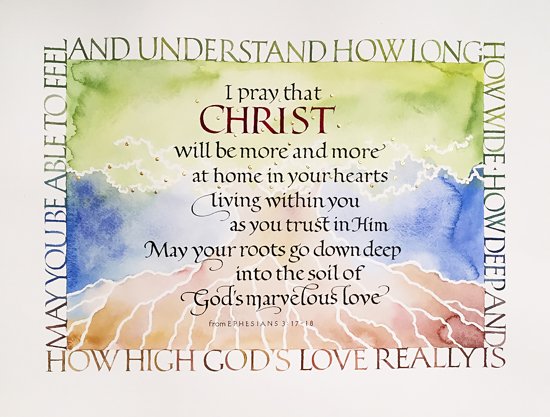
Utterly Unconventional Love of God and Saint Valentine’s Day. Ephesians 3:17-19

Ephesians 3:14-21Amplified Bible

14 For this reason [grasping the greatness of this plan by which Jews and Gentiles are joined together in Christ] I bow my knees [in reverence] before the Father [of our Lord Jesus Christ], 15 from whom every family in heaven and on earth [a]derives its name [God—the first and ultimate Father]. 16 May He grant you out of the riches of His glory, to be strengthened and spiritually energized with power through His Spirit in your inner self, [indwelling your innermost being and personality]17 so that Christ may dwell in your hearts through your faith. And may you, having been [deeply] rooted and [securely] grounded in love, 18 be fully capable of comprehending with all the saints (God’s people) the width and length and height and depth of His love [fully experiencing that amazing, endless love]; 19 and [that you may come] to know [practically, through personal experience] the love of Christ which far surpasses [mere] knowledge [without experience], that you may be filled up [throughout your being] to all the fullness of God [so that you may have the richest experience of God’s presence in your lives, completely filled and flooded with God Himself].

20 Now to Him who is able to [carry out His purpose and] do superabundantly more than all that we dare ask or think [infinitely beyond our greatest prayers, hopes, or dreams], according to His power that is at work within us, 21 to Him be the glory in the church and in Christ Jesus throughout all generations forever and ever. Amen.

The Word of God for the Children of God.

Adeste Fidelis! Venite Adoremus! Dominum.

Gloria! In Excelsis Deo! Alleluia! Alleluia! Alleluia! Amen.

God gave us Jesus as a way of saying, “I love you and you are special to me.”

That is a really great gift, isn’t it?

Much better than Valentine’s cards, or candy, or flowers.

Still, we have those special people in our lives whom we need to give our fullest possible attention to – our wives, our sweethearts, our very good friends, those co-workers who work with us and beside us and those whom we may supervise.

Treat them special because they are special – who and what and why they are is absolutely 100% irreplaceable – every single one of their lives utterly matters.

They need to know that they are truly respected, loved and deeply appreciated.

God’s Unconventional Love versus Valentine’s Day

Ephesians 3:14-19The Message

14-19 My response is to get down on my knees before the Father, this magnificent Father who parcels out all heaven and earth. I ask him to strengthen you by his Spirit—not a brute strength but a glorious inner strength—that Christ will live in you as you open the door and invite him in. And I ask him that with both feet planted firmly on love, you’ll be able to take in with all followers of Jesus the extravagant dimensions of Christ’s love. Reach out and experience the breadth! Test its length! Plumb the depths! Rise to the heights! Live full lives, full in the fullness of God.

Everyday is a special day when we open our eyes, take that next breath, set our feet upon the floor, walk forth into the kitchen get that very first cup of coffee.

We look outside, greet the morning, are welcomed by the dawn’s new sun.

A hand that raises the blades of a Venetian blind to look out the window at the sky of a sunny day.

Tomorrow, however, is a wee bit more of a special day.

Yes, it is Valentine’s Day.

But does everyone know the origin of this day?

It is a very old tradition which started because of a Bishop named Valentinus.

He lived back in the days of the Roman Empire.

Long ago, Roman officials were against young people getting married in the church.

Many young Christians wanted to be married by the priest, in the church, with God’s blessing.

Valentinus was sympathetic to these people and continued to help marry them, even though he was often threatened by the government authorities.

Sadly, he was taken to Rome and put to death for his faith and his defiance of the Emperor’s rule.

In memory and honor of Saint Valentinus, young couples started talking about choosing a Valentine, when they were actually talking about choosing a bride.

Now we call this day, Saint Valentine’s Day.

In the modern era, many people give their sweethearts Valentine’s Day cards with hearts all over them.

Some people give candies or flowers.

A red carnation or a red rose means “I love you.”

These are all ways that people show their love.

But God also gave us a gift to show us that He loved us.

It was Jesus. God gave us Jesus as a way of saying, “I love you and you are special to me.”

That is a really great gift, isn’t it?

Much better than cards, or candy, or flowers.

Today, let us meditate on biblical love, the greatest love of all time.

There once was a very old pastor, who was suffering from a long battle with cancer.

A few days before his death, he continued to hold on to a special verse that was the source of his inspiration.

He placed a bookmark where his favorite scripture passage was written:

“Who shall separate us from the love Christ? Shall tribulation, or distress, or persecution, or famine, or nakedness, or peril, or sword?” (Romans 8:34-35 KJV).

Despite facing such a trail in his life, the old pastor was most certainly blessed with the power “to grasp how wide and long and high and deep is the love of Christ;” a love that surpasses knowledge.

As children of God, we understand the fact that the root and foundation of creation is love.

It “surpasses knowledge.”

We know about human love.

Human love comes with the understanding that love comes as a reward for being good, for being faithful, being trustworthy and true, for being kind, for giving gifts, and for acting and for responding with appropriate behavior.

But this is not the same as the love which is embedded in the foundation of creation.

This is not the love that surpasses knowledge.

This is not the love that Paul prays we might have the power to grasp.

God’s love flows freely, without consideration of reward or any plan of equal or unequal or non-existent compensation.

This is a love that is not inherent to human nature.

We are more inclined to return love for love.

But the Scripture says,

“… how is it to your credit if you receive a beating for doing wrong and endure it? But if you suffer for doing good and you endure it, this is commendable before God. To this you were called, because Christ suffered for you, leaving you an example that you should follow in his steps” (1 Peter 2:20-21).

If we are to approach love in the way of biblical love, we must meditate on what it means when the Bible says, we must love God and each other as ourselves.

“Greater love has no one than this: to lay down one’s life for one’s friends. You are my friends if you do what I command. I no longer call you servants, because a servant does not know his master’s business. Instead, I have called you friends, for everything that I learned from my Father I have made known to you. You did not choose me, but I chose you and appointed you so that you might go and bear fruit–fruit that will last–and so that whatever you ask in my name the Father will give you. This is my command: Love each other.” (John 15:13-17)

Today, I would like to meditate on 3 questions about this amazing kind of love.

The first question is this:

Where does Love come from?

Where Does Love Come From?

Now some of you would answer, ‘that’s easy–it comes from within.’

Some may say, ‘It’s something that happens naturally as we mature as human beings.’

However, remember how hard it is to teach children to share?

That sharing instinct is not natural to them, but it is taught.

A human instinct is: self-survival.

C.S. Lewis, the famed English scholar, studied the various Greek words for love.

He came to distinguish the difference between what he called “needed love” and “gift love.”

Needed love is described as self-evident.

It is the most common kind of love in our world.

It is a mortal and human concept of love.

I love you, BECAUSE you love me.

I love you, because you provide for me, because you support me, and because you meet my needs.

Mr. Lewis illustrates that when we humans say to another, “I love you,” what we are really meaning is, “I need you, I want you. You hold value in my life.”

Now in contrast to “needed love” Mr. Lewis describes “gift love.”

This form of loving is born of fullness and wholeness.

The goal of gift love is to enrich and enhance the person whom it loves.

It does not require anything in return, nor does it hold requirements.

“Gift love moves out to bless and to increase rather than to acquire or to diminish. Gift love is more like a bountiful, artesian well that continues to overflow than a vacuum or a black hole. (C.S. Lewis)”

Mr. Lewis concludes this is what God’s love is all about. God’s love is gift love, not needed love.

This, of course, is the meaning of agape love; unconditional love.

Are we capable of agape love– loving as God loves?

To an extent we are.

But, we must go to the source of love, and the source of all love is God.

Jesus says in John’s narrative today, “As the Father has loved me, so have I loved you. (John 15:13)”

Perfect love does not come from within, it only comes from above.

And when God lives within us, we become capable of expressing perfect love.

Please take secure hold of your BIBLES and turn with me to 1 John 4:7-11.

In his first epistle, John writes,

“Dear friends, let us love one another, for love comes from God. Everyone who loves has been born of God and knows God. Whoever does not love does not know God, because God is love.” So, that is the answer to the first question: where does love come from? It comes from God. Then John adds, “This is how God showed his love among us: He sent his one and only Son into the world that we might live through him. This is love: not that we loved God, but that he loved us and sent his Son as an atoning sacrifice for our sins.” (1 John 4:7-11).

The Second Question is ….

What does this Love look like?

A young girl came home one day bursting with good news.

“Mom, Dad, I know why we had to learn grammar!” she exclaimed.

“It is so we can understand God.”

Her mom and dad gave her a puzzled look, so the young girl explained.

“God is love, and love can be a noun, an adjective, an adverb, or a verb.”

What a powerful concept!

Now doesn’t that preach a sermon or three lasting all the live long day!

Love isn’t just a vague feeling.

It is an action, an attitude, a spirit, and a character trait.

Since Jesus was filled with the Spirit of God, his every attitude, thought, word, action and deed was motivated by the love of God for Him and too, vice versa.

He was motivated completely and without reservation by love.

So, what does love look like?

Gift love is best illustrated with Jesus, a blameless man, hanging on a cross simply and solely because of God’s love for us.

We cannot meet any of God’s needs or even all of God’s commands.

But God’s nature is to give love, unconditionally, unconventionally, even at times when we do not deserve it.

As John writes,

“This is how God showed his love among us: He sent his one and only Son into the world that we might live through him. This is love: not that we loved God, but that he loved us and sent his Son as an atoning sacrifice for our sins.” (1 John 4:9-10)

God’s gift love is a pure and perfect love.

It is an unconventional, never-ending, and everlasting kind of love.

It does not ask for you to meet up to requirements, and it does not ask for compensation.

No matter how many times we sin or fall short of the Glory of God, His love never left us.

No matter how many times the world rebuked Him, His love never left us.

What does love look like?
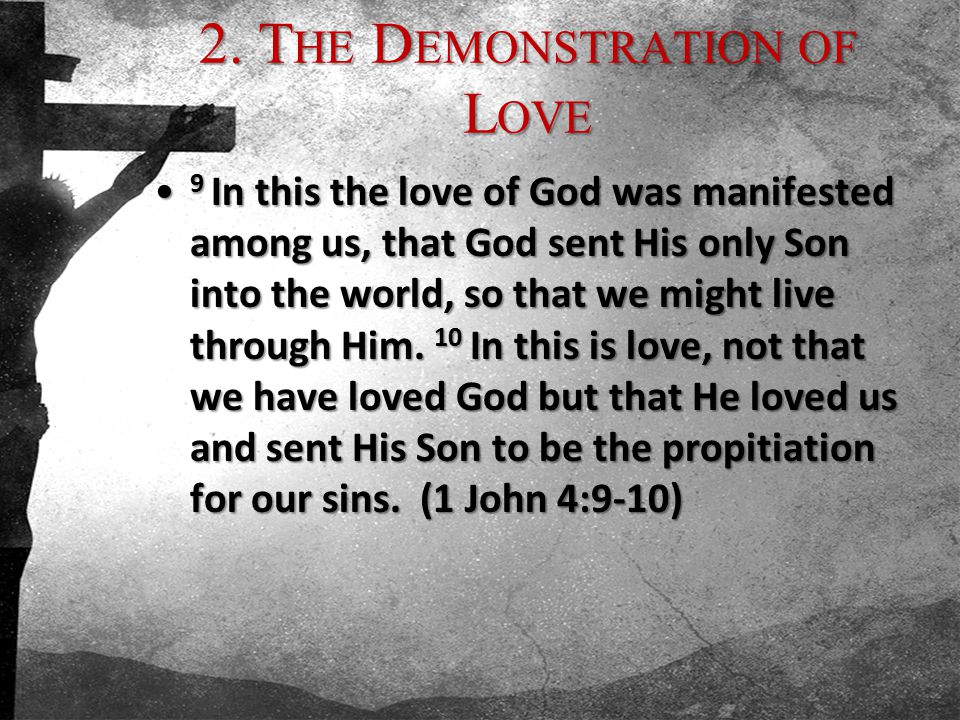
There is no Greater and more Powerful image than Jesus on the Cross.

That is perfect love.

Perfect love looks like God, for He is love.

God and love are not two realities; they are one.

God’s infinite power of being is: the infinite power of love.

In every movement of love we are dwelling in God and God in us.

And when we accept the Holy Spirit into our lives, we allow God’s perfect love to be pictured through us.

We can also illustrate perfect love through the way we live.

Through every attitude, thought, word, and deed, we have.

Christians are called to be a reflection of the image of God.

We reflect God’s perfect love so that others can also see what true perfect love looks like.

Love unconditionally, unconventionally to all.

Now, the third and last question is:

What does such love require from us?

Jesus answers this question in John 15:13-17,

“My command is this: Love each other as I have loved you. Greater love has no one than this: to lay down one’s life for one’s friends. You are my friends if you do what I command. I no longer call you servants, because a servant does not know his master’s business. Instead, I have called you friends, for everything that I learned from my Father I have made known to you. You did not choose me, but I chose you and appointed you so that you might go and bear fruit–fruit that will last–and so that whatever you ask in my name the Father will give you. This is my command: Love each other.”

Jesus has issued the command: “Love each other as I have loved you.”

We are required by God’s command to love others as he has loved us–not with needed love, but with gift love.

Not because of anything they can or have done for us, but because of what our Lord and Savior Jesus Christ has done for us.

Luke 6:27-32Amplified Bible

27 “But I say to you who hear [Me and pay attention to My words]: [a]Love [that is, unselfishly seek the best or higher good for] your enemies, [make it a practice to] do good to those who hate you, 28 bless and show kindness to those who curse you, pray for those who mistreat you. 29 Whoever [b]strikes you on the cheek, offer him the other one also [simply ignore insignificant insults or losses and do not bother to retaliate—maintain your dignity]. Whoever takes away your coat, do not withhold your shirt from him either. 30 Give to everyone who asks of you. [c]Whoever takes away what is yours, do not demand it back. 31 Treat others the same way you want them to treat you. 32 If you [only] love those who love you, what credit is that to you? For even sinners love those who love them.

The world lives by the philosophy: “Scratch my back and I’ll scratch yours.”

To do good for people who are incapable of doing anything for you in return.

This is gift love, agape love. It is the love of God.

And of course, dear brother and sisters, this is the hardest form of love to give.

It is hard to love someone unconventionally when they cannot or will not or refuse to do the same for you.

But when the Spirit of the Lord is within, He will give you the strength to love.

The strength to be patient and compassionate.

The strength to reflect agape love to others who do not know God.

For the greatest command was to love God, and the second greatest command was to love one another.

Concluding Reflection’s: Love That Surpasses Knowledge

Ephesians 3:16-19Easy-to-Read Version

16 I ask the Father with his great glory to give you the power to be strong in your spirits. He will give you that strength through his Spirit. 17 I pray that Christ will live in your hearts because of your faith. I pray that your life will be strong in love and be built on love. 18 And I pray that you and all God’s holy people will have the power to understand the greatness of Christ’s love—how wide, how long, how high, and how deep that love is. 19 Christ’s love is greater than anyone can ever know, but I pray that you will be able to know that love. Then you can be filled with everything God has for you.

Love is commonly considered an emotion—a feeling, inclination of the heart.

Love involves knowing the person we love, and yet even that knowledge is not the end of love.

Paul reminds his readers of this basic truth when he prays that they may “know this love that surpasses knowledge.”

Paul is talking here about the love of God, and he’s saying that it’s not enough to know about God without having love for God.

The standard of love that believers strive for is to “be filled to the measure of all the fullness of God.”

That’s a high standard indeed!

God is, in every way, far beyond what our minds can comprehend or our hearts can contain.

We will never achieve this total fullness!

But what a powerful prayer this is—and what a wonderful goal to guide us in living our life!

To be continually growing in this “fullness of God” and his love is the delight of discipleship.

This is a wonderful prayer offered for us—but it’s also a prayer to offer on behalf of others.

What a transformation of our relationships when an entire community of Christ’s disciples experiences together a growing fullness of God’s love.

It’s beyond our ability to imagine!

Valentines Day is known as the day of love.

But God’s love lasts for eternity.

It is a perfect LOVE that loves unconditionally and unconventionally.

Where does perfect love come from?

It comes from God alone, and works within us when we become His children.

What does perfect love look like?

It looks like Jesus, a blameless man, hanging on a cross, for a world which did not deserve Him.

And as His children we reflect that image through our actions, our attitudes, thoughts, words, and deeds.

And what does such perfect love require out of us?

It requires us to move beyond “needed love” and give “gift love”.

To look around at others who are in need of God’s love and to give it to them–not asking what they can do for us, remembering what Christ has done for us.

In the name of God, the Father and God the Son and God the Holy Spirit,

Let us Pray,

We bow our hearts before You, Father God. You are the Creator of everything we see in heaven and on earth. We pray that out of Your glorious, unlimited resources, You would strengthen our hearts and minds through the power of Your Holy Spirit. May Your love be the rich soil in which our lives are rooted. May Your love be the only firm foundation upon which we build, so that, together with all Your people everywhere, we would come to truly understand how long, how high, how wide and how deep Your love really is—how it far surpasses anything we can imagine. God, fill us with the fullness and the power that comes from You alone, so that our lives would reflect your goodness and grace to the world around us.  Lord, fill us to overflowing with the knowledge and the wisdom of your fullness so that we love you more and serve you better. Help us to keep offering this prayer for others, that we may all grow in you.

Adeste Fidelis! Venite Adoremus! Dominum.

Gloria! In Excelsis Deo! Alleluia! Alleluia! Alleluia! Amen.
https://translate.google.com/

My Personal Faith. Social Justice and our God’s Call for Justice. Isaiah 1:10-26.

Probably most of us have heard people speaking about their faith in humanity as a very intimate and private thing, something you feel in your heart, in your soul, with all of your might, all of your strength something you don’t talk about.

Sometimes you hear politicians say that they have a deep personal faith in God, but they assure us that they won’t let their religion, or lack of it, have any sway or influence on the decisions they make in office on behalf of the people served.

Corporate executives are expected to toe the line of maximizing profits above all else and not worrying about the impact that their decisions have on society.

And they might just face severe backlash and stockholder lawsuits if they stray.

Social commentator, Glen Beck has said if you are in a church and the pastor is about to teach or sermonize about social justice, quickly get out of that church.

He felt rather strongly that talk of social justice has no place in church.

I must confess right here and right now, that until rather recently, I would have readily agreed with the Social Commentator, avoided such teaching, sermons.

Right now, my attitude about “social justice” and the Body of Christ, the Church in God’s neighborhood, God in God’s own neighborhood, is being re-written by my intentional and my purposeful engagement with our God’s Holy Scriptures.

My own deeply held personal beliefs wrought through the fires and floods and furnaces and crucibles of my lifetime of experiences, I now find were informed by biases and prejudices I was not wholly aware of nor would ever acknowledge.

My information was faulty and based almost exclusively on my floods, my fires, my crucibles and my furnaces.

My purposeful, intentional engagement with the “deepest truths” of my God’s Word is now being weaved into and throughout my heart, my soul, by my God.

I am learning to ask questions – learning to challenge my biases, my prejudices, and where God, the Father, God the Son and God the Holy Spirit inform my soul differently through His Scriptures, I repent of the former, to seek out the latter.

Isaiah 1:10-26Amplified Bible

God Has Had Enough

10 
Hear the word of the Lord [rulers of Jerusalem],
You rulers of [another] Sodom,
Listen to the law and instruction of our God,
You people of [another] Gomorrah.
11 
“What are your multiplied sacrifices to Me [without your repentance]?”
Says the Lord.
“I have had enough of [your] burnt offerings of rams
And the fat of well-fed cattle [without your obedience];
And I take no pleasure in the blood of bulls or lambs or goats [offered without repentance].
12 
“When you come to appear before Me,
Who requires this of you, this trampling of My [temple] courts [by your sinful feet]?
13 
“Do not bring worthless offerings again,
[Your] incense is repulsive to Me;
[Your] New Moon and Sabbath [observances], the calling of assemblies—
I cannot endure wickedness [your sin, your injustice, your wrongdoing] and [the squalor of] the festive assembly.
14 
“I hate [the hypocrisy of] your New Moon festivals and your appointed feasts.
They have become a burden to Me;
I am weary of bearing them.
15 
“So when you spread out your hands [in prayer, pleading for My help],
I will hide My eyes from you;
Yes, even though you offer many prayers,
I will not be listening.
Your hands are full of blood!

16 
“Wash yourselves, make yourselves clean;
Get your evil deeds out of My sight.
Stop doing evil,
17 
Learn to do good.
Seek justice,
Rebuke the ruthless,
Defend the fatherless,
Plead for the [rights of the] widow [in court].

“Let Us Reason”

18 
“Come now, and let us reason together,”
Says the Lord.
[a]Though your sins are like scarlet,
They shall be as white as snow;
Though they are red like crimson,
They shall be like wool.
19 
“If you are willing and obedient,
You shall eat the best of the land;
20 
But if you refuse and rebel,
You shall be devoured by the sword.”
For the mouth of the Lord has spoken.

Zion Corrupted, to Be Redeemed

21 
How the faithful city has become a prostitute [idolatrous, despicable],
She who was full of justice!
Right standing with God once lodged in her,
But now murderers.
22 
Your silver has turned to [b]lead,
Your wine is diluted with water.
23 
Your rulers are rebels
And companions of thieves;
Everyone loves bribes
And chases after gifts.
They do not defend the fatherless,
Nor does the widow’s cause come before them [instead they delay or turn a deaf ear].

24 
Therefore, the Lord God of hosts,
The Mighty One of Israel, declares:
“Ah, I will be freed of My adversaries
And avenge Myself on My enemies.
25 
“And I will turn My hand against you,
And will [thoroughly] purge away your dross as with lye
And remove all your tin (impurity).
26 
“Then I will restore your judges as at the first,
And your counselors as at the beginning;
Afterward you will be called the city of righteousness,
The faithful city.”

The Word of God for the Children of God. Gloria! In Excelsis Deo! Alleluia! Amen.

For our scripture text this morning we are still in Isaiah chapter 1.

Will God ever let us get out of chapter 1?

It takes 66 chapters to save all of Isaiah’s writings; will we ever get out of chapter 1?

Yes, eventually, by God’s grace alone we will be released from chapter 1.

But first, there are still many important lessons we can take with us into 2022.

But please remember, chapter 1 introduces many of the themes developed in the following 65 chapters, so I’m happy to hang out in chapter 1 for a while longer.

Our scripture lesson is Isaiah 1:10-26. After I read it, and then re-read it, I now challenge you to read it and re-read. You tell me whether Isaiah saw religion as an inward thing, related to the realms of personal faith and feelings, or whether he saw religion as something impacting all of life, even including social justice.

Yesterday we talked about God’s complaint against the people of Judah, which was a very personal complaint. They were his beloved children and he wanted them to love him as He loved them, but we read they were rebelling and getting themselves into serious trouble and he really wanted them all to come back.

By reading and re-reading these verses, I hope and pray you heard that for God, being a Christian, even in 2022, can never stop with just a heart relationship with God. It also includes a right-relationship with our fellow human beings.

And this day, which the Lord hath made for you and me and all of His children, I want to try to look quickly at 5 commands in verse 17 that make that concrete.

God told His Children, the people of Israel to “always learn how to do good.”

In the New Testament the apostle Paul repeatedly told the early Christians to do good works, and when he specifies what he’s talking about, often the context is clearly the good work of sharing with others in need.

That’s a Christianity that goes many echelons beyond feeling good and secure inside. It’s a Christianity that purposely, intentionally, reaches out for others.

Then, also in verse 17, Isaiah tells the people of Judah to “always learn how to seek out justice and learn how to always walk humbly with your God.”

Now there are a lot of different ways of defining justice.

There’s a kind of justice which says,

“I’ve got mine, and nobody’s going to take it from me.”

And we believe in protecting personal and property rights.

We are against theft and criminal behavior.

That’s kind of, sort of, a start to defining, writing, an encyclopedia of justice.

But Isaiah tells the people of Judah, and he tells us, too, that we need to go beyond that encyclopedia.

“I’ve got mine” justice can be content to look at a kid whose lost his parents or is born into a one parent situation where one party felt incapable of meeting the demands of parenthood and maybe feel sorry for the kid but feels no obligation to go “the extra mile or two or three or more if necessary” to volunteer, “help.”

And that’s no justice at all. It’s not fair to that kid at all.

The kid has very little chance in life. The kid is really hurting inside. Justice shouts out to us, “When the parents aren’t there, we need to help that kid.”

“I’ve got mine” justice can build a really nice life for itself, but it takes upon itself limited accountability, personal. professional, responsibility for others.

The Word of God revealed through Isaiah in chapter 1 tells us that justice is about more than me. And our responsibilities in life never stop with just me.

These verses from the first chapter of Isaiah calls for God’s kind of justice that intentionally, purposely watches for the oppressed, those who are held down.

And what are we supposed to do when we see them?

Are we supposed to feel sorry for them?

Are we supposed to analyze whose fault it is that they are in that shape?

Are we supposed to argue about whose job it is to help them, the government, the church, business or private charity?

God’s Prophet Isaiah does not let those arguments distract him.

What do we do if we see someone oppressed? Strive to Rescue them?

And who is that talking about?

The idea is someone who is weighed down, held down, doesn’t have a fair chance. How does one, in 2022, define what “have a fair chance” means?

If we’re talking about people who are oppressed, how about the people whose homes and businesses and livelihoods were just wiped out by “Acts of God?”

UMCOR is there.

FEMA will carry the bulk of the assistance, but UMCOR is great about finding the people who fall between the cracks and for sending in teams long after the immediate emergency to help people clean up, rebuild, restore what can be.

UMCOR goes straight to the United Methodist Churches who have been on the spot, who know the needs, who know who is hurting, so it can intentionally do the most good, efficiently, purposely, conscientiously, serve the most people.

Isaiah gives another example of what biblical justice looks like by calling us to defend the orphan.

What theory of justice in this world could say “I’ve got mine, too bad about that orphan”?

For Example ….

Today, it is estimated that Africa has some 17 million children who have lost their parents to AIDS.

How big a number is 17 million orphans?

Take the entire population of metro Chicago, some 8.9 million, and then add to that population the entire population of San Antonio, Texas being 2.413 million plus the population of the Baltimore, Maryland metro area being 2.845 million plus the population of the Portland Oregon Metro area being 2.5 million plus the population of the Buffalo, New York metro area being 1.137 million people.

That’s approximately how many children are AIDS orphans in Africa today.

What chance do they have as orphans in villages where there isn’t much hope of healthy food, clean water, quality healthcare for kids who have both parents?

https://www.unicef.org/eap/press-releases/child-was-infected-hiv-every-two-minutes-2020-unicef#:~:text=In%202020%2C%20sub%2DSaharan%20Africa,were%20in%20sub%2DSaharan%20Africa.

What justice would there be in a world that does “not nearly enough” to defend, place greater value on the sanctity of the lives and wellbeing of those children?

Well, Praise and thank God for volunteers, organizations like World Vision and UMCOR and many others who are there. And let us do all we can to help them.

But there are a lot of vulnerable children and adults in all areas, too.

What about underserved kids whose parents are failing them, in jail or even abusing them so badly that the court needs to take them out of their home?

We have dedicated social workers to help them, but as budgets have been cut their ability to give the kids the support they need is really, really stretched.

What about the Homeless populations? The Homeless Veteran populations?

Right now, our nation is in a major crisis as we have spent a whole lot more money out of the national treasury than we could afford, and we are desperately looking for places to more efficiently, more intentionally, purposely, love our God in His Neighborhood, serve our communities, our neighbors in some way.

Let’s remember that Isaiah calls us, that God calls us through these timeless and most ancient of words from Isaiah chapter 1, to defend the orphans.

And I think it’s exceedingly, abundantly fair to expand that to include children who have both parents, and those single parent households where economically parents can’t provide proper nutrition or proper medical care for their children.

And in all the talk of needing to cut our government deficits, too often it is programs to defend vulnerable children that people want to cut. I think that rigorous and vigorous advocacy is most definitely appropriate ‘social justice.’

And, finally, the words of Isaiah chapter 1 tell us to plead for the widow.

Isaiah lived long before social security, in a time when women may not have even had clear property rights.

And if their husband died, they could be in big trouble. Today our government has stepped in with social security and Medicare and they really, really help.

But any sense of God’s justice calls us to watch out for our widows, to comfort, advocate and support them as they grieve, to support them as they may struggle with maintaining their homes, providing meals, and to visit them when lonely.

While we are engaging God in His neighborhood, what more can be done here?

But still, the lingering questions always remain when we engage our Faith in Humanity with our Faith in an Engaging and Intimate and Loving and God.

1 John 4:7-21Amplified Bible

God Is Love

Beloved, let us [unselfishly] [a]love and seek the best for one another, for love is from God; and everyone who loves [others] is born of God and knows God [through personal experience]. The one who does not love has not become acquainted with God [does not and never did know Him], for God is love. [He is the originator of love, and it is an enduring attribute of His nature.] By this the love of God was displayed in us, in that God has sent His [One and] only begotten Son [the One who is truly unique, the only One of His kind] into the world so that we might live through Him. 10 In this is love, not that we loved God, but that He loved us and sent His Son to be the propitiation [that is, the atoning sacrifice, and the satisfying offering] for our sins [fulfilling God’s requirement for justice against sin and placating His wrath]. 11 Beloved, if God so loved us [in this incredible way], we also ought to love one another. 12 No one has seen God at any time. But if we love one another [with unselfish concern], God abides in us, and His love [the love that is His essence abides in us and] is completed and perfected in us. 13 By this we know [with confident assurance] that we abide in Him and He in us, because He has given to us His [Holy] Spirit. 14 We [who were with Him in person] have seen and testify [as eyewitnesses] that the Father has sent the Son to be the Savior of the world.

15 Whoever confesses and acknowledges that Jesus is the Son of God, God abides in him, and he in God. 16 We have come to know [by personal observation and experience], and have believed [with deep, consistent faith] the love which God has for us. God is love, and the one who abides in love abides in God, and God abides continually in him. 17 In this [union and fellowship with Him], love is completed and perfected with us, so that we may have confidence in the day of judgment [with assurance and boldness to face Him]; because as He is, so are we in this world. 18 There is no fear in love [dread does not exist]. But perfect (complete, full-grown) love drives out fear, because fear involves [the expectation of divine] punishment, so the one who is afraid [of God’s judgment] is not perfected in love [has not grown into a sufficient understanding of God’s love]. 19 We love, because [b]He first loved us. 20 If anyone says, “I love God,” and hates (works against) his [Christian] brother he is a liar; for the one who does not love his brother whom he has seen, cannot love God whom he has not seen. 21 And this commandment we have from Him, that the one who loves God should also [unselfishly] love his brother and seek the best for him.

Before we begin to or continue engaging with God in God’s Neighborhood,

Before making a personal decision about where we engage our neighbors,

Many, Many Examples of Essential Questions to ponder with God about:

Decisions, Actions, and Consequences

  1. What is the relationship between decisions and consequences?
  2. How do we know how to make good decisions?
  3. How can a person’s decisions and actions change his/her life?
  4. How do the decisions and actions of characters reveal their personalities?
  5. How do decisions, actions, and consequences vary depending on the different perspectives of the people involved?

Social Justice

  1. What is social justice?
  2. To what extent does power or the lack of power affect individuals?
  3. What is oppression and what are the root causes?
  4. How are prejudice and bias created? How do we overcome them?
  5. What are the responsibilities of the individual in regard to issues of social justice?
  6. How can literature serve as a vehicle for social change?
  7. When should an individual take a stand against what he/she believes to be an injustice? What are the most effective ways to do this?
  8. What are the factors that create an imbalance of power within a culture?
  9. What does power have to do with fairness and justice?
  10. When is it necessary to question the status quo? Who decides?
  11. What are the benefits and consequences of questioning / challenging social order?
  12. How do stereotypes influence how we look at and understand the world?
  13. What does it mean to be invisible? (context: minorities)
  14. In what ways can a minority keep their issues on the larger culture’s “radar screen?”
  15. What creates prejudice, and what can an individual overcome it?
  16. What are the causes and consequences of prejudice and injustice, and how does an individual’s response to them reveal his/her true character?
  17. What allows some individuals to take a stand against prejudice/oppression while others choose to participate in it?
  18. What are the causes and consequences of prejudice and how does an individual’s response to it reveal his/her morals, ethics, and values?

Culture: Values and Beliefs, Traditions and Rituals

  1. How do individuals develop values and beliefs?
  2. What factors shape our values and beliefs?
  3. How do values and beliefs change over time?
  4. How does family play a role in shaping our values and beliefs?
  5. Why do we need beliefs and values?
  6. What happens when belief systems of societies and individuals come into conflict?
  7. When should an individual take a stand in opposition to an individual or larger group?
  8. When is it appropriate to challenge the beliefs or values of society?
  9. To what extent do belief systems shape and/or reflect culture and society?
  10. How are belief systems represented and reproduced through history, literature, art, and music?
  11. How do beliefs, ethics, or values influence different people’s behavior?
  12. How do individuals reconcile competing belief systems within a given society (e.g., moral beliefs conflicting with legal codes)?
  13. When a person’s individual choices are in direct conflict with his/her society, what are the consequences?
  14. What is morality and what are the factors that have an impact on the development of our morality?
  15. What role or purpose does religion / spirituality serve in a culture?
  16. What purpose or function do ethics / philosophy have in governing technological advances?
  17. How do our values and beliefs shape who we are as individuals and influence our behavior?

There are undoubtedly many more questions to ponder as anyone individually seeks to engage God side by side with His Words of hard truth and harder love.

In such weighty matters, be patient with God and be patient with yourself ….

Matthew 6:25-33Amplified Bible

The Cure for Anxiety

25 “Therefore I tell you, stop being worried or anxious (perpetually uneasy, distracted) about your life, as to what you will eat or what you will drink; nor about your body, as to what you will wear. Is life not more than food, and the body more than clothing? 26 Look at the birds of the air; they neither sow [seed] nor reap [the harvest] nor gather [the crops] into barns, and yet your heavenly Father keeps feeding them. Are you not worth much more than they? 27 And who of you by worrying can add one [a]hour to [the length of] his life? 28 And why are you worried about clothes? See how the lilies and wildflowers of the field grow; they do not labor, nor do they spin [wool to make clothing], 29 yet I say to you that not even Solomon in all his glory and splendor dressed himself like one of these. 30 But if God so clothes the grass of the field, which is alive and green today and tomorrow is [cut and] thrown [as fuel] into the furnace, will He not much more clothe you? You of little faith! 31 Therefore do not worry or be anxious (perpetually uneasy, distracted), saying, ‘What are we going to eat?’ or ‘What are we going to drink?’ or ‘What are we going to wear?’ 32 For the [pagan] Gentiles eagerly seek all these things; [but do not worry,] for your heavenly Father knows that you need them. 33 But first and most importantly seek (aim at, strive after) His kingdom and His righteousness [His way of doing and being right—the attitude and character of God], and all these things will be given to you also.

This morning I want to affirm, with Isaiah, that our faith in God is not just an awkward, inward, personal thing. Our God is very concerned we “do good; seek justice, rescue the oppressed, defend the orphan, plead for the widow.” AMEN?

1 Corinthians 15:58Amplified Bible

58 Therefore, my beloved brothers and sisters, be steadfast, immovable, always excelling in the work of the Lord [always doing your best and doing more than is needed], being continually aware that your labor [even to the point of exhaustion] in the Lord is not futile nor wasted [it is never without purpose].

In the name of God, the Father and God the Son and God the Holy Spirit,

Let us Pray,

Father, Son and Holy Spirit ……

“I am no longer my own, but thine.
Put me to what thou wilt, rank me with whom thou wilt.
Put me to doing, put me to suffering.
Let me be employed by thee or laid aside for thee,
exalted for thee or brought low for thee.
Let me be full, let me be empty.
Let me have all things, let me have nothing.
I freely and heartily yield all things
to thy pleasure and disposal.
And now, O glorious and blessed God,
Father, Son, and Holy Spirit,
thou art mine, and I am thine. So be it.
And the covenant which I have made on earth,
let it be ratified in heaven. Amen.”

https://translate.google.com/

Servanthood in God’s Neighborhood: I Serve for the JOY of Accomplishing the Goal which God has Placed before me.

It’s been said that “there’s no faster track for your soul to find satisfaction than on the path of servanthood.”

In truth, Jesus himself said, “Whoever wants to become great among you must be your servant” (Matthew 20:26).

Followers of Jesus should have a servant spirit that always looks “not to the best interest of themselves but to the greatest interests of others.”

Sometimes servanthood is poorly understood.

While everyone is equal in Christ, not everyone’s roles are equal. A servant-minded mother still has authority over her child. A servant-minded CEO never abandons the responsibility to lead. Ultimately, the attitude and actions of the Christian are characterized by servanthood, not the position that person holds.

A believer in Christ desires to imitate the servant spirit of Christ.

Since Jesus said, “Come to me, all you who are weary and burdened” (Matthew 11:28), God’s Goal for us: reach out to people who need rest, comfort, and help.

Their Goal? They serve as a channel of his grace to people who are lost in the cycle of poverty, or alcohol, drug addiction, violence, victims of violence, or devalued because of their skin color. If the quest for hope is universal, doesn’t it make great sense to share the joy and satisfaction we have received from Jesus?

Jesus served for the joy set before him. Christians too delight that other people will be privileged to taste heaven’s enduring grace through their service to God in God’s own backyard! Service to all of God’s Children in God’s neighborhood.

Hebrews 12:1-2 Amplified Bible

Jesus, the Example

12 Therefore, since we are surrounded by so great a cloud of [a]witnesses [who by faith have testified to the truth of God’s absolute faithfulness], stripping off every unnecessary weight and the sin which so easily and cleverly entangles us, let us run with endurance and active persistence the race that is set before us, [looking away from all that will distract us and] focusing our eyes on Jesus, who is the Author and Perfecter of faith [the first incentive for our belief and the One who brings our faith to maturity], who for the joy [of accomplishing the goal] set before Him endured the cross, [b]disregarding the shame, and sat down at the right hand of the throne of God [revealing His deity, His authority, and the completion of His work].

The Word of God for the Children of God. Gloria! In Excelsis Deo! Alleluia! Amen.

When a person initiates a new, huge endeavor, his passion to succeed in that endeavor strengthens him to keep his eye on the goal in front of him.

For example, as an athlete starts a race, their desire and their goal to win that race helps them keep both of their eyes and feet fixed on the finish line.

While constructing a building, workers who keep their eyes on the architect’s finalized rendering are encouraged to sustain the momentum of the building process.

While we are reading and studying this book called the Bible, which we hold in our hands and our hearts, I have a daily goal of encouraging myself by keeping my sight fixed on God, my Creator and Jesus, the Author and Finisher of my faith!

With every new daily devotional entry I complete, I move closer and closer to that goal, and it gives me courage to keep writing every morning. As a result of my writing, staying on track, you are prayerfully reading this devotional today.

But what do you think Jesus focused on when He was hanging on the Cross and enduring the agony and shame?

You can imagine that He must have had moments when He thought, I don’t have to do this! I could call on legions of angels to deliver me! I could come down from this Cross! What do you think motivated Him to remain there until the job was done?

Hebrews 12:2 is clear what was motivating Jesus – Joy!

The Joy of Accomplishing the Goal set before Him by His Father.

The Goal: Revealing the Deity of His Father, His Authority, the Completion of the Work which God sent His Son into the World (John 3:16-17) to achieve.

[looking away from all that will distract us and] focusing our eyes on Jesus, who is the Author and Perfecter of faith [the first incentive for our belief and the One who brings our faith to maturity], who for the joy [of accomplishing the goal] set before Him endured the cross, [b]disregarding the shame, and sat down at the right hand of the throne of God [revealing His deity, His authority, and the completion of His work].

This verse says Jesus focused on “the joy” that was set before Him as He endured the Cross.

Just like a runner focuses on the finish line, like a builder forges ahead to view the completed building project, and an author anticipates the last written page of a book, Jesus was looking forward to “the joy” of finishing God’s work

I’m sure that somewhere in all of that indescribable agony, as Jesus hung on the Cross, He looked out across eons of time and saw the faces of people who would be saved because of what He was doing. He saw you! He saw me — but what else did He see that motivated Him to stay faithful to the end?

The word “joy” in Greek has a definite article, which means this wasn’t just joy in general, but it was a specific joy.

https://www.blueletterbible.org/kjv/heb/12/2/t_conc_1145002

https://www.blueletterbible.org/lexicon/g5479/kjv/tr/0-1/

What was it?

The verse goes on to describe that joyous “finish line” that Jesus set His face like flint toward: “…who for the joy that was set before him endured the cross, despising the shame, and is set down at the right hand of the throne of God.”

Jesus had His eyes of faith fixed on the empty throne at the right hand of the Father that was reserved for Him once His victory was complete.

Upon that throne, all enemies would be His footstool, and He would commence the next part of His high priestly ministry to intercede for everyone who would ever come to Him in time of need (see Hebrews 4:16).

Jesus had His eyes, His heart, His mind — His whole being — fixed on that highly exalted place.

That was the joy set before Him.

When sin and hell were defeated and Jesus was resurrected, that was the seat of authority He ascended into Heaven to occupy.

Ever since that time, from that highly exalted position, Jesus has been serving as Lord of the Church and as the High Priest and Intercessor for every believer.

What is the goal in front of you that keeps you motivated to move ahead even when things are difficult?

If you have no goal, it’s likely you’ll give up.

That’s why it is so important to know exactly where you are headed, what will happen when you get there, and what kind of victory you’ll experience when you attain that long-awaited position.

Just as Jesus had a joyous outcome set before Him, I guarantee that you and I have a joyous outcome placed before us too.

STRENGTH TO RUN THE RACE, FAITH, HOPE AND LOVE WHICH PERSEVERE

The Joy of the Lord is our Strength and our Stronghold: Nehemiah 8:9-10

Psalm 18:1-2: “I love You [fervently and devotedly], O Lord, my strength.”

The Lord is my rock, my fortress, and the One who rescues me;
My God, my rock and strength in whom I trust and take refuge;
My shield, and the horn of my salvation, my high tower—my stronghold.

BY OUR LOVE AND THROUGH OUR OBEDIENCE: THE ABUNDANT LIFE

Deuteronomy 30:19-20 Amplified 19 I call heaven and earth as witnesses against you today, that I have set before you life and death, the blessing and the curse; therefore, you shall choose life in order that you may live, you and your descendants20 by loving the Lord your God, by obeying His voice, and by holding closely to Him; for He is your life [your good life, your abundant life, your fulfillment] and the length of your days, that you may live in the land which the Lord promised (swore) to give to your fathers, to Abraham, Isaac, and Jacob.”

How does all of this speak to our 2022 hearts. our souls and our servanthood?

Hebrews 12:2 Amplified Bible

[looking away from all that will distract us and] focusing our eyes on Jesus, who is the Author and Perfecter of faith [the first incentive for our belief and the One who brings our faith to maturity], who for the joy [of accomplishing the goal] set before Him endured the cross, [a]disregarding the shame, and sat down at the right hand of the throne of God [revealing His deity, His authority, and the completion of His work].

Looking away from all that will distract us and focusing our eyes on Jesus who is the Author and Perfector of faith ….

What are those distractions from which we need to avert our 2022 eyes?

What are those divisions we need to set aside, from which we need to Unite?

How do we come together in the Gospel, to grapple with, to debate, to discuss, challenge comprehend, understand, teach, preach – God’s Joy in our Koinonia?

God’s Goal which is Koinonia – “for the Joy of the Lord which is before us …”?

We are the Body of Christ – We are the Church in the World,

For the “JOY OF THE LORD” which is ever BEFORE US ….

  • What are you and I building with our lives?
  • What keeps you and I motivated to stay on “God’s track?”
  • What will it look like when you and I finish it?
  • What are you and I “writing” with our faith, our hope and our “love”?
  • What will the final chapter of our lives look like because you and I have come together, eyes focused on Jesus alone, done what Jesus has asked us to do?
  • What is the specific joy that is set before you and me?
  • Is there any genuine strength in our Koinonia goal of “Joy of the Lord?”

Sometimes when you are working hard to do what God has asked you to do, it can seem overwhelming, but progress is gained one step at a time.

The increments of forward movement might seem tiny, but no matter how big or small the steps, you can know that you are inevitably progressing toward the goal that God has set for our lives.

When I was a young man of 41, God showed me the purpose of my life, and that purpose has been in front of me ever since.

In times of hardship, I’ve kept my eyes focused on that goal which God set before me, because fulfilling that divine purpose is what my life is all about.

Sometimes it seemed like all I could do was take baby steps — yet each step has been a step in the right direction. That’s the way I have lived these last twenty years focused, moving in the direction of the purpose God has revealed to me.

If you get your eyes off the goal, start focusing on how small your steps are along the way, it is probable you’ll get discouraged, give up before you arrive.

So today I want to encourage you to lift your eyes and look beyond to the joy, the victory, and the utter fulfillment of what God has planned for your life.

Even Jesus possessed a goal to help Him stay focused as He underwent intense suffering and hung on that Cross.

So today I exhort everyone who koinonias, by the leading of the Holy Spirit, to make a fresh consecration before the Lord to submit to His will for your lives.

Then exercise your authority in Jesus’ name and resist the devil (see James 4:7)!

And as you and I move forward in obedience to the Lord’s voice, keep our eyes of faith, hope and love fixed on the prize Jesus has set before both you and me.

That is what will sustain our determination to stay in God’s place and stay on God’s track until we can finally shout, we have reached our God-ordained goal!

In the name of God, the Father and God the Son and God the Holy Spirit,

Let us Pray,

At the starting line of this day,
we call on your name, God of grace.
As we run the race you have set before us,
help us to keep our eyes on your goals, not our own.
When we falter, give us fresh strength and courage.
When we are fleet-footed, let us give you the glory.
Keep us from wanting to win at other’s expense
or to count ourselves better than those at our side.
All runners are your children.
In the race You imagine,
each one is a winner. Alleluia! Amen.

https://translate.google.com/