
Genesis 1:1-5 Names of God Bible
The Creation
1 In the beginning Elohim created heaven and earth.
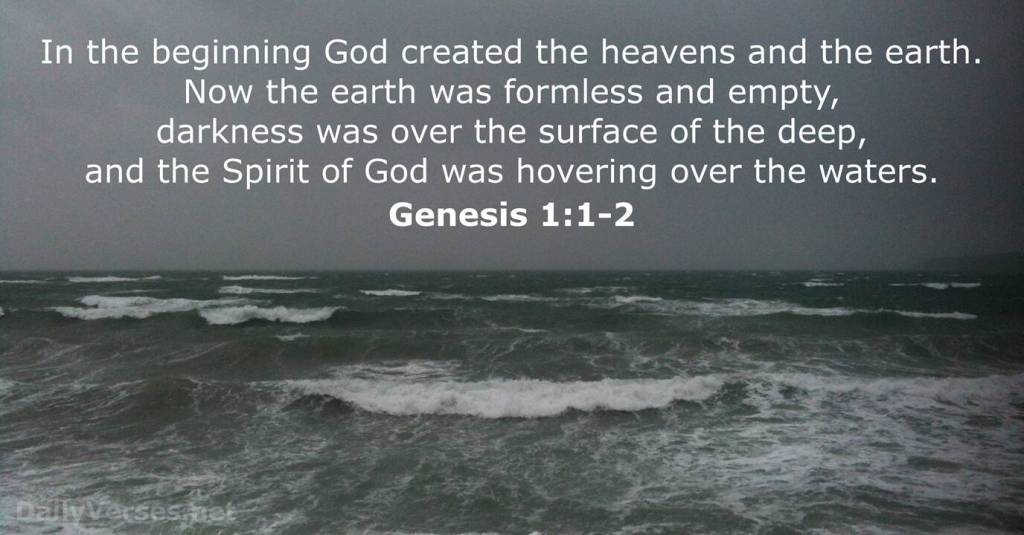
2 The earth was formless and empty, and darkness covered the deep water. The Ruach Elohim was hovering over the water.
3 Then Elohim said, “Let there be light!” So there was light. 4 Elohim saw the light was good. So Elohim separated the light from the darkness. 5 Elohim named the light day, and the darkness he named night. There was evening, then morning—the first day.
The Word of God for the Children of God.
Adeste Fideles! Laeti Triumphantes! Venite Adoremus! Dominum.
Gloria! In Excelsis Deo! Alleluia, Alleluia, Alleluia, Amen.
Each of us has exactly one thing in common, we all began life as a baby, and we were all unaware of what was going on around us or what the world was like.
But as we grew older, we started to take note of the world—the sky, the sea, the winds, the birds, the flowers, the animals, the trees, and all of life around us.
As we became aware of the world, we inevitably asked some questions about it.
Just a few weeks ago, our Pastor began a lengthy study on the Apostle’s Creed.
The first line of the Apostle’s Creed is;
“I believe in God, the Father Almighty …”
In my own short 20+ years of Christian experience, this is the very first time I actually sat down and considered the enormous brevity and depths of the Creed.
“All Christians believe more than is contained in the Apostles Creed, but no one can believe anything less.” writes the Rev. Dr. Albert Mohler the studies author.
“What is this all of this about?
“Who is it all about?”
“When did it all begin?”
“Where did it all begin?
“How did it all begin?
“Who started it all?”
“Who is all of this for?”
Those questions, undoubtedly more will come to mind, are the ones answered for us in the brief compass here in the opening verse of the Book of Genesis.
Genesis 1:1 Amplified Bible
The Creation
1 In the beginning God ([a]Elohim) [b]created [by forming from nothing] the heavens and the earth.
Again, what are the questions we are asking of this opening verse of the bible?
First, we ask ourselves,
“What is all this?”
Driven by an insatiable curiosity to know, humans have been attempting to answer that most basic of questions ever since they first appeared on earth.
Driven forward, they seek to push themselves into great, greater and greatest boundaries and limits, to explore the universe and the world in which they live.
Another question, we ask, “How did it begin?”
This question is the emphasis of science.
Then we ask, “When did it all start?”
How long has ‘Creation’ been going on like this?”
How long has the world been going on like this?
Finally, we come to the great philosophical question, “Who is behind it?”
“Who is back of these indescribably mysterious and remarkable processes?
“
These questions are answered in the first verse, and thus it serves for us as a tremendous introduction to the great themes weaved in and through the Bible.
Take the first question,
the one most obvious to us—the wonder of the universe itself.
In the beginning,
we read, God created the heavens and the earth
(Genesis 1:1).
Someone has said that this phrase is the beginning of true science, because a fundamental part of the task of science is to observe and classify all that can be observed in the makeup of the world of nature.
Here is an early and primitive attempt at classification.
What do you see around you?
You see two great classes of things—the heavens and the earth.
One of the marvels of the Bible is that it uses language that communicates with people of the most primitive and limited understanding, while at the same time it still has significance and inexhaustible meaning for the most erudite and too, learned scholars and addresses itself with equal ease to all classes of humanity.
That is the beauty of Bible language.
The Bible avoids the philosophies of some of the early myths about creation found in other religions.
It was the Bible that first said the number of the stars is beyond computation.
It declares that God stretched out the heavens
(Isaiah 51:13) into limitless expanse that can never be measured and God filled it with stars that are as numerous as the uncountable grains of sand upon the seashore (Genesis 22:17).
15 The [a]Angel of the Lord called to Abraham from heaven a second time 16 and said, “By Myself (on the basis of Who I Am) I have sworn [an oath], declares the Lord, that since you have done this thing and have not withheld [from Me] your son, your only son [of promise], 17 indeed I will greatly bless you, and I will greatly multiply your descendants like the stars of the heavens and like the sand on the seashore; and your seed shall possess the gate of their enemies [as conquerors]. (Genesis 22:15-17)
Modern science has now established this to be true.
It is also the Bible that says the earth is suspended over nothing (Job 26:7).
7 “He stretches out his heavens[a] over empty space.
He hangs the earth on nothing whatsoever.
In that eloquently poetic way it describes the mysterious force of gravity that no one even yet completely understands.
It was the Bible that said that what is seen was not made out of what was visible
(Hebrews 11:3 Amplified), thus predating by many centuries the discoveries of science that finally recognized that all matter is made up of invisible energy and that matter and energy are interchangeable.
3 By faith [that is, with an inherent trust and enduring confidence in the power, and wisdom and goodness of God] we understand that the worlds (universe, ages) were framed and created [formed, put in order, and equipped for their intended purpose] by the word of God, so that what is seen was not made out of things which are visible.
Why Ponder “In the Beginning, God” Today?
Matthew 1:1 English Standard Version
The Genealogy of Jesus Christ
1 The book of the genealogy of Jesus Christ, the son of David, the son of Abraham.
Luke 3:23-38 New King James Version
The Genealogy of Jesus Christ
23 Now Jesus Himself began His ministry at about thirty years of age, being (as was supposed) the son of Joseph, the son of Heli, 24 the son of Matthat, the son of Levi, the son of Melchi, the son of Janna, the son of Joseph, 25 the son of Mattathiah, the son of Amos, the son of Nahum, the son of Esli, the son of Naggai, 26 the son of Maath, the son of Mattathiah, the son of Semei, the son of Joseph, the son of Judah, 27 the son of Joannas, the son of Rhesa, the son of Zerubbabel, the son of Shealtiel, the son of Neri, 28 the son of Melchi, the son of Addi, the son of Cosam, the son of Elmodam, the son of Er, 29 the son of Jose, the son of Eliezer, the son of Jorim, the son of Matthat, the son of Levi, 30 the son of Simeon, the son of Judah, the son of Joseph, the son of Jonan, the son of Eliakim, 31 the son of Melea, the son of Menan, the son of Mattathah, the son of Nathan, the son of David, 32 the son of Jesse, the son of Obed, the son of Boaz, the son of Salmon, the son of Nahshon, 33 the son of Amminadab, the son of Ram, the son of Hezron, the son of Perez, the son of Judah, 34 the son of Jacob, the son of Isaac, the son of Abraham, the son of Terah, the son of Nahor, 35 the son of Serug, the son of Reu, the son of Peleg, the son of Eber, the son of Shelah, 36 the son of Cainan, the son of Arphaxad, the son of Shem, the son of Noah, the son of Lamech, 37 the son of Methuselah, the son of Enoch, the son of Jared, the son of Mahalalel, the son of Cainan, 38 the son of Enosh, the son of Seth, the son of Adam, the son of God.
The opening words of Matthew’s Gospel narrative presents us with a list of historical names in the family line of Jesus to the Patriarch Abraham.
Some readers skip over such lists, seeing them as boring or only filled with names that are hard to pronounce, and mostly not mentioned anywhere else.
The Gospel Narrative account of Dr. Luke has a long list of names like this too.
These lists are selective genealogies of Jesus—and in them, God is saying,
“See, I have kept my word; the promised Messiah and Savior has come through my chosen people.”
The list in Luke’s gospel includes many names different from those in Matthew, possibly because Luke lists the ancestors of Mary, the mother of Jesus and also goes back to Adam the first human – “The son of God.”
The list in Luke’s Gospel Narrative is also longer than the one in Matthew’s, going back all the way to the beginning, to connect Jesus with God himself.
This helps us see that the story of salvation—indeed, the story of the whole world—is really all about God.
God created a good, amazingly complex perfect world, only to have it scarred by sin because our very first human parents disobeyed God’s command (Genesis 3).
But God did not sit idly by.
In the beginning, from the beginning, God got personally, intimately involved.
He immediately set out to redeem and restore His Creation – including us!
From the beginning, God planned to renew us through his Son, Jesus. And when Jesus, the Savior, was born in Bethlehem, God’s plan took a major step forward.
So as we look ahead to pondering God and Jesus, let us join with the angels who announced Jesus’ birth, singing out, “Glory to God in the highest” (Luke 2:14)!
In the name of God the Father and God the Son and God the Holy Spirit,
Let Us Pray,
Lord, I praise You as the Creator and Sustainer of all things. From the very beginning of time, You have not changed, and I am grateful to know You as the One who has made all things. Creator God, thank you for your true and everlasting faithfulness unto all future generations in sending your Son, our Savior, Christ the Lord! Amen.
Adeste Fideles! Laeti Triumphantes! Venite Adoremus! Dominum.
Gloria! In Excelsis Deo! Alleluia, Alleluia, Alleluia, Amen.
 Loving God, Living God, Loving Hope, Living Hope, Loving Living Life His Way! "Many things are possible for the person who has hope. Even more is possible for the person who has faith. And still more is possible for the person who knows how to love. But everything is possible for the person who practices all three virtues." - Brother Lawrence (1605-1691), Practicing the Presence of God (1692).