
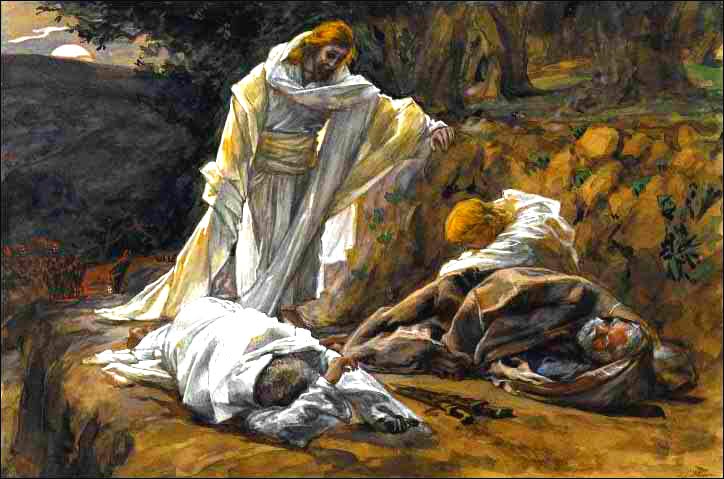
Matthew 26:36-45 New King James Version
The Prayer in the Garden
36 Then Jesus came with them to a place called Gethsemane, and said to the disciples, “Sit here while I go and pray over there.” 37 And He took with Him Peter and the two sons of Zebedee, and He began to be sorrowful and deeply distressed. 38 Then He said to them, “My soul is exceedingly sorrowful, even to death. Stay here and watch with Me.”
39 He went a little farther and fell on His face, and prayed, saying, “O My Father, if it is possible, let this cup pass from Me; nevertheless, not as I will, but as You will.”
40 Then He came to the disciples and found them sleeping, and said to Peter, “What! Could you not watch with Me one hour? 41 Watch and pray, lest you enter into temptation. The spirit indeed is willing, but the flesh is weak.”
42 Again, a second time, He went away and prayed, saying, “O My Father, [a]if this cup cannot pass away from Me unless I drink it, Your will be done.” 43 And He came and found them asleep again, for their eyes were heavy.
44 So He left them, went away again, and prayed the third time, saying the same words. 45 Then He came to His disciples and said to them, “Are you still sleeping and resting? Behold, the hour [b]is at hand, and the Son of Man is being betrayed into the hands of sinners.
The Word of God for the Children of God.
Adeste Fidelis! Venite Adoremus! Dominum.
Gloria! In Excelsis Deo! Alleluia, Alleluia, Alleluia, Amen.
Well, it is now Good Friday in the year of our Lord and Savior 2023 and it seems to me the Gospel of our Lord and Savior Jesus Christ is coming to its full circle.
AGAIN …. FOR THE UMPTEENTH TIME
Not so long ago in our Christian calendar we were contemplating and then we were celebrating His Advent, His quiet coming into the world of sinful mankind.
We read and studied and prayed for the umpteenth time in our own Christian experience over the birth narratives from Gospels of Matthew, Luke and John.
As I sit here in my dining room contemplating what this devotional effort might become from the Word of God for His Children, from me, then through the Holy Spirit, then unto you, the current and future readership of this blogging effort,
the inspiring words to one of my most beloved, favorite hymns, came rushing from some recessed place in my memory banks and into my mind and my soul.
O Come, All Ye Faithful [text by John F. Wade 1743; trans. by Frederick Oakeley 1841 and others
1. O come all ye faithful, joyful and triumphant,
O come ye, O come ye, to Bethlehem.
Come and behold him, born the King of angels;
Refrain:
O come let us adore him, O come let us adore him,
O come let us adore him, Christ the Lord.
2. True God of true God, Light from Light Eternal,
lo, he shuns not the Virgin’s womb;
Son of the Father, begotten not created;
(Refrain)
3. Sing, choirs of angels, sing in exultation;
O sing, all ye citizens of heaven above!
Glory to God, all glory in the highest;
(Refrain)
4. See how the shepherds, summoned to his cradle,
leaving their flocks, draw nigh to gaze;
we too will thither bend our joyful footsteps;
(Refrain)
5. Child, for us sinners poor and in the manger,
we would embrace thee with love and awe.
Who would not love thee, loving us so dearly?
(Refrain)
6. Yea, Lord, we greet thee, born this happy morning,
Jesus, to thee be all glory given.
Word of the Father, now in flesh appearing:
(Refrain)
Or in the Latin (verse 1) which is my preferred way of singing the verse;
1. Adeste Fideles laeti triumphantes,
Veníte, veníte in Bethlehem.
Natum vidéte, Regem Angelorum:
Veníte adoremus,
Veníte adoremus
Veníte adoremus Dóminum
Everyone it seems gets all hyped up to rush from where ever they are, from whatever it is they were quietly going about their everyday activities doing,
In the middle of the night when they were awakened out of their hum drums, regular local news cycles by a great chorus of angels shouted “joy to the world.”
to rush to some manger in the city of Bethlehem to witness God’s triumph, His most triumphant return straight to the messed up internal affairs of mankind.
The remainder of the Gospel Narratives takes us through His early growing up years, through His dedication at the Temple, through His baptism, through His Temptation Narratives, through His triumphant entry into His earthly ministry.
We read of all the great crowds of people who surrounded him, came from miles and miles from every possible direction to hear his teachings, receive healings.
To witness great miracles of thousands of people being fed from what amounts to a the meager offerings of bread and fish small boys lunchbox from his mom.
Crowds followed Him everywhere during all times of the day and night and the middle of the night, they saw His power over the winds and over all the waters.
All through the Gospel narratives God has delicately, indelibly weaved the song:
1. O come all ye faithful, joyful and triumphant,
O come ye, O come ye, to Bethlehem.
Come and behold him, born the King of angels;
Refrain:
O come let us adore him, O come let us adore him,
O come let us adore him, Christ the Lord.
2. True God of true God, Light from Light Eternal,
lo, he shuns not the Virgin’s womb;
Son of the Father, begotten not created;
(Refrain)
3. Sing, choirs of angels, sing in exultation;
O sing, all ye citizens of heaven above!
Glory to God, all glory in the highest;
(Refrain)
4. See how the shepherds, summoned to his cradle,
leaving their flocks, draw nigh to gaze;
we too will thither bend our joyful footsteps;
(Refrain)
5. Child, for us sinners poor and in the manger,
we would embrace thee with love and awe.
Who would not love thee, loving us so dearly?
(Refrain)
6. Yea, Lord, we greet thee, born this happy morning,
Jesus, to thee be all glory given.
Word of the Father, now in flesh appearing:
(Refrain).
And the people were listening intently to the song of God for they were coming!
Palm Sunday – His Humble Yet Triumphant Entry.
Matthew 21:1-11 New King James Version
The Triumphal Entry
21 Now when they drew near Jerusalem, and came to [a]Bethphage, at the Mount of Olives, then Jesus sent two disciples, 2 saying to them, “Go into the village opposite you, and immediately you will find a donkey tied, and a colt with her. Loose them and bring them to Me. 3 And if anyone says anything to you, you shall say, ‘The Lord has need of them,’ and immediately he will send them.”
4 [b]All this was done that it might be fulfilled which was spoken by the prophet, saying:
5 “Tell the daughter of Zion,
‘Behold, your King is coming to you,
Lowly, and sitting on a donkey,
A colt, the foal of a donkey.’ ”
6 So the disciples went and did as Jesus commanded them. 7 They brought the donkey and the colt, laid their clothes on them, [c]and set Him on them. 8 And a very great multitude spread their clothes on the road; others cut down branches from the trees and spread them on the road. 9 Then the multitudes who went before and those who followed cried out, saying:
“Hosanna to the Son of David!
‘Blessed is He who comes in the name of the Lord!’
Hosanna in the highest!”
10 And when He had come into Jerusalem, all the city was moved, saying, “Who is this?”
11 So the multitudes said, “This is Jesus, the prophet from Nazareth of Galilee.”
1. Adeste Fideles laeti triumphantes,
Veníte, veníte in Bethlehem.
Natum vidéte, Regem Angelorum:
Veníte adoremus,
Veníte adoremus
Veníte adoremus Dóminum
1. O come all ye faithful, joyful and triumphant,
O come ye, O come ye, to Bethlehem.
Come and behold him, born the King of angels;
Refrain:
O come let us adore him, O come let us adore him,
O come let us adore him, Christ the Lord.
Oh …. Really?
Matthew 21:12-17 New King James Version
Jesus Cleanses the Temple
12 Then Jesus went into the temple [a]of God and drove out all those who bought and sold in the temple, and overturned the tables of the money changers and the seats of those who sold doves. 13 And He said to them, “It is written, ‘My house shall be called a house of prayer,’ but you have made it a ‘den of thieves.’ ”
14 Then the blind and the lame came to Him in the temple, and He healed them. 15 But when the chief priests and scribes saw the wonderful things that He did, and the children crying out in the temple and saying, “Hosanna to the Son of David!” they were [b]indignant 16 and said to Him, “Do You hear what these are saying?”
And Jesus said to them, “Yes. Have you never read,
‘Out of the mouth of babes and nursing infants
You have perfected praise’?”
17 Then He left them and went out of the city to Bethany, and He lodged there.
Are the Chief Priests, the Scribes, the experts in the Law of Moses, Temple Authorities singing this self same tune with the self same fervor as God is?
As the Merchants in the Temple Courtyards who will soon, now very soon have all of their livelihoods upset, turned over and destroyed by their coming King, who will soon openly, visibly and quite angrily accuse them all of being a den of profiteers, thieves and robbers with no regard for the sanctity of God’s House?
Let’s take some time to discover, then to re-discover what Jesus is trying very hard to communicate, to connect us, to teach us, by his cleansing of the temple.
When Jesus entered the temple area after his triumphal entry into Jerusalem, he began overturning carts driving out everyone who was buying and selling there.
What had stoked the fires of his divine wrath and anger?
Jesus became angry because religious hucksters were inside the Temple grounds and they were not praying nor were they worshiping God.
Instead, with the full permission of the Temple Leaders they were using God to make extra money, to fleece the people of their wages and ability to meet those sacrificial requirements set aside, covenanted by God in the Levitical Codes.
You see, people traveling into Jerusalem for the Passover needed to buy animals for the sacrifices they would offer to God during this festival.
Most of those people also needed to exchange their money for temple currency in order to buy the animals.
The trouble, though, was the money changers and sellers, not to mention the Temple Leaders, were often dishonest and took advantage of those travelers.
And their corruption was INSIDE THE SACROSANCT TEMPLE GROUNDS!
What had been so commonplace and “grudgingly accepted” by the everyone was, in fact, an abomination before the eyes of the Lord – and Jesus acted!
So, who inside those Temple grounds, with all of their wares and livelihoods and authority “before God,” were triumphantly singing or uttering the words;
“O’ Come all Ye Faithful?”
“Adeste Fidelis”
“O’ Come Let Us Adore Him?”
“Venite Adoremus”
“Christ, the Lord.”
“Dominum.”
We Came and Went With Him to the Garden Alone
Matthew 26:36-45 New King James Version
The Prayer in the Garden
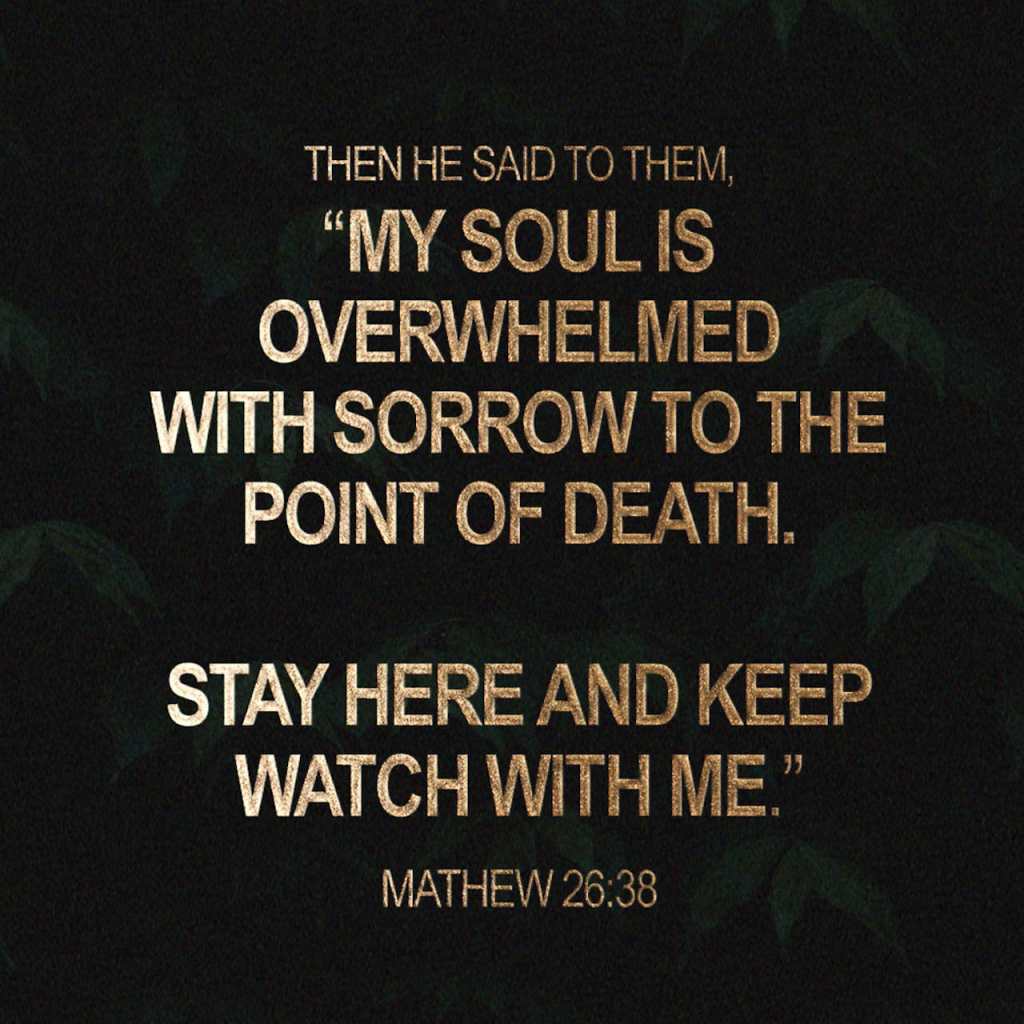
36 Then Jesus came with them to a place called Gethsemane, and said to the disciples, “Sit here while I go and pray over there.” 37 And He took with Him Peter and the two sons of Zebedee, and He began to be sorrowful and deeply distressed. 38 Then He said to them, “My soul is exceedingly sorrowful, even to death. Stay here and watch with Me.”
39 He went a little farther and fell on His face, and prayed, saying, “O My Father, if it is possible, let this cup pass from Me; nevertheless, not as I will, but as You will.”
40 Then He came to the disciples and found them sleeping, and said to Peter, “What! Could you not watch with Me one hour? 41 Watch and pray, lest you enter into temptation. The spirit indeed is willing, but the flesh is weak.”
42 Again, a second time, He went away and prayed, saying, “O My Father, [a]if this cup cannot pass away from Me unless I drink it, Your will be done.” 43 And He came and found them asleep again, for their eyes were heavy.
44 So He left them, went away again, and prayed the third time, saying the same words. 45 Then He came to His disciples and said to them, “Are you still sleeping and resting? Behold, the hour [b]is at hand, and the Son of Man is being betrayed into the hands of sinners.
Jesus Retreats Before His Last Battle
There were no crowds now.
Jesus and His disciples had celebrated the Passover in the Upper Room.
Now, Jesus with His Disciples have retreated from public view to Gethsemane.
Matthew 26:37-38 Amplified Bible
37 And taking with Him Peter and the two sons of Zebedee [James and John], He began to be grieved and greatly distressed. 38 Then He said to them, “My soul is deeply grieved, so that I am almost dying of sorrow. Stay here and stay awake and keep watch with Me.”
This last retreat took place as Jesus prepared for his last battle with Satan’s forces, just as he had done before his first battle with Satan (Matthew 4:1-2).
In this last retreat Jesus combined community, solitude, and prayer.
He went to Gethsemane with his disciples and then retreated in solitude to pray.
Matthew 26:39-40 Amplified Bible
39 And after going a little farther, He fell face down and prayed, saying, “My Father, if it is possible [that is, consistent with Your will], let this cup [a]pass from Me; yet not as I will, but as You will.” 40 And He came to the disciples and found them sleeping, and said to Peter, “So, you men could not stay awake and keep watch with Me for one hour?
He returned three times for community support from his friends, who for one reason and rationale or another, had all slept instead of praying with, for, him.
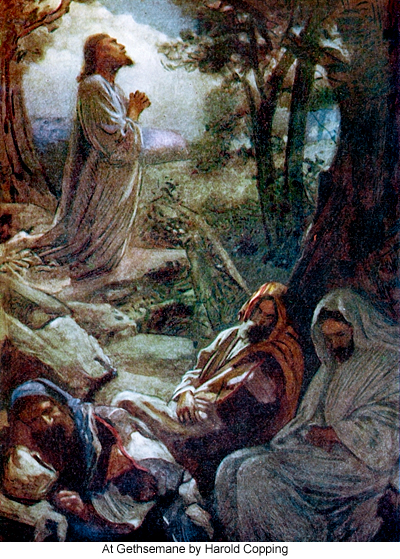
Have you ever been stretched out on your sofa watching the big game or a favorite movie and you suddenly fall asleep and miss how it ends?
Oh, the frustration!
You missed the best part.
You slept and the best parts of the movie just passed right on by you!
Peter, James and John had a similar experience because they fell asleep.
There were no crowds now except for those betrayer Judas would soon bring.
It was in the Garden of Gethsemane.
Jesus had told his disciples to stay and pray while He went to pray nearby.
But on the precipice of the greatest moment in history, they dozed off.
They missed the moment—a once-in-a-lifetime opportunity for discipleship.
God wants us awake and alert, not only to serve Him, but for Him to equip us to serve others.
Awakened to the “God moments” and “God opportunities” He will make us go, and move more like Jesus, and send us out so His work can be done through us.
He calls us to actively hear, listen pray for His direction, to readily to say “yes.”
When asked by Jesus to do something, have you ever fallen asleep?
I know I have.
He calls, and I’m often snoozing.
But the real question is: have we learned and grown from such experiences in order to become more committed disciples?
Let’s learn from the disciples’ mistake and stay alert so we can follow our master more deeply.
1. O come all ye faithful, joyful and triumphant,
O come ye, O come ye, to Bethlehem.
Come and behold him, born the King of angels;
Refrain:
O come let us adore him, O come let us adore him,
O come let us adore him, Christ the Lord.
Let’s not miss out on the joyful and triumphant things He wants us to see in His earthly ministry, His life, His death and His resurrection, to do in and through us.
In the name of God, the Father and God the Son and God the Holy Spirit,
1. Open my eyes, that I may see
glimpses of truth thou hast for me;
place in my hands the wonderful key
that shall unclasp and set me free.
Silently now I wait for thee,
ready, my God, thy will to see.
Open my eyes, illumine me, Spirit divine!
2. Open my ears, that I may hear
voices of truth thou sendest clear;
and while the wavenotes fall on my ear,
everything false will disappear.
Silently now I wait for thee,
ready, my God, thy will to see.
Open my ears, illumine me, Spirit divine!
3. Open my mouth, and let me bear
gladly the warm truth everywhere;
open my heart and let me prepare
love with thy children thus to share.
Silently now I wait for thee,
ready, my God, thy will to see.
Open my heart, illumine me, Spirit divine!
~~ Clara H. Scott, 1841-1897 ~~
Adeste Fidelis! Venite Adoremus! Dominum.
Gloria! In Excelsis Deo! Alleluia, Alleluia, Alleluia, Amen.
 Loving God, Living God, Loving Hope, Living Hope, Loving Living Life His Way! "Many things are possible for the person who has hope. Even more is possible for the person who has faith. And still more is possible for the person who knows how to love. But everything is possible for the person who practices all three virtues." - Brother Lawrence (1605-1691), Practicing the Presence of God (1692).