Romans 15:4 "For whatever was written in earlier times was written for our instruction, so that through perseverance and the encouragement of the Scriptures we might have hope."
When I survey the wondrous cross on which the Prince of Glory died; my richest gain I count but loss, and pour contempt on all my pride. Author: Sir Isaac Watts, 1674-1748
Does anyone find it kind of ironic that when we set off to find happiness or joy or significance or meaning or purpose or passion, we seldom find it? Instead, when we zealously pursue opportunities to love God, to declare our love of God and then to serve others and we seemingly find ourselves zealously pursuing every opportunity for giving our whole selves wholeheartedly to the Lord and his work, it is then we find what we most need? What is this zealous pursuit?
Proverbs 21:21 New American Standard Bible
21 One who pursues righteousness and loyalty Finds life, righteousness, and honor.
The Word of God for the Children of God. Gloria! In Excelsis Deo! Alleluia! Amen.
What are we pursuing in life? It is not unusual to hear someone say that they are pursuing a career in some field of endeavor. When we hear someone say this, we know that they are putting their energies and their time into study and practice of that discipline. It means that they have a goal in front of them and that goal is what guides them in much of what they do. Thus, the question begs to be asked, “What exactly are we pursuing when it comes to spiritual things?”
God points us to wisdom by telling us that there are two things that are very worthy of pursuit when it comes to spiritual matters. These two things are righteousness and loyalty. Today we will take a closer look at what it means to pursue these two things. We will also see in the rewards that God says come to those to zealously follow this pursuit the reason why this is exceedingly wise.
When God says to pursue these things He uses the word, “radaph.” This word means to chase or to follow after closely and with great effort and energy. The idea is that one is not just to pursue – but one is to overtake these things.
The mindset is that we will not be content with a life without righteousness and without loyalty. These are things we absolutely must have – and thus in our pursuit we are to be passionate and totally committed. This is not a hobby or just something to add to our resume. This is a hot pursuit that is pleased only with the eventual ‘catching’ or ‘having’ of these things. Nothing else will do.
We pursue righteousness – which in Hebrew is “tsedequah.” This word means righteousness abstractly – but when applied to how we live our lives it speaks of moral rectitude – of an over-zealous desire to have our lives measure up to a standard of right and good and moral that is found in God and in His Word.
It speaks of living a life of justice in how we relate to others and especially how we relate to the poor and unfortunate. The word refers to a moral standard that is not set according to the world and its views. The moral standard and ethical sentiment we embrace is that which is found only in the pages of Scripture.
Yet the righteousness we seek is not by law. The Scriptures which speak of this righteousness say that we obtain it by faith. It is not a set of rules – it is a person – the Lord Jesus Christ. Ultimately, we over-zealously pursue Him for only He can transform us and make us righteous.
We also pursue loyalty. The Hebrew word used here is “chesed” which refers to more than just a loyalty. This is the word that most closely relates to the New Testament word grace. It is the word that is used to describe God’s love and commitment to His covenant people. It is easily translated, “covenant-love.”
Apostle Paul repeatedly says to us in the New Testament to grow in the grace and knowledge of Jesus Christ.
What we are to pursue in life is the grace of God. We live by the grace of God – and advance in life by the grace of God. In pursuing grace – we are kind of pursuing the One who is waiting for us to come back to our senses. We pursue love and we pursue commitment. We pursue a selflessness that is evidenced by the unconditional love of God in Christ Jesus. Kind of cool here to see that even in an Old Testament proverb we are told to pursue righteousness by faith and a God who gives us such a righteousness by His loving, matchless, selfless grace.
What will we find when we give ourselves to such a pursuit?
We are told of three things.
First is that we will receive life.
“Chayim” is the word for life here – and it simply means life itself. We are made alive when we pursue these two wonderful things.
Consider the New Testament call to us – that when we pursue Christ, Who is the ultimate source of life – the ultimate way of life – and who is the life itself – we receive eternal life. This is the life of our God, Who alone is eternal. We have an unmatchable quality of life that can only be received from God Himself.
Second in our set of three blessings is “righteousness.”
This is the same word as was used earlier – and it simply means that in seeking and pursuing righteousness – we receive our righteousness as a gift by faith – only through the grace of God.
This does not mean we attain righteousness by our own choice of lifestyle. The fact is we are given righteousness by a gift of God’s grace through faith in Jesus Christ. We are stunned to learn that when God gives us this gift – we are just as righteous as Jesus Himself – by God’s wonderful gift – and as a result of that – we can be transformed to reflect that righteousness in all our ways.
The third in this list of glorious benefits is honor.
The word for honor here is “kavod” and it is the word God uses for glory.
When we pursue the proper things – it is to the glory of God – and we receive from it the honor of His working in our hearts. What a glorious gift is ours – to receive the glory of salvation – the glory of God’s righteousness – the glory of being at peace with God – the glory of His marvelous transformation of our lives. This is ours when we pursue the One Who in His mercy still waits for us.
Want to know what to pursue in life? Pursue God our Heavenly Father!
Want to know what to pursue in life? Pursue His only Begotten Son, Jesus!
Want to know what to pursue in life? Pursue our great helper, Holy Spirit!
That is the ultimate answer when all is said and done with today’s proverb.
It is an immeasurably wise thing to pursue God, Jesus and Holy Spirit – and to pursue His righteousness by His grace. This is both the ultimate pursuit in life and the ultimate prize! Oh, the glories of pursuing the One Who waits for us! Oh, the joy of hugging the One Who by grace captures all our hearts. Pursue, ye dearest saints – pursue for you will find as you do – you are gloriously hugged by the One Who loves you more than you could ever dream of being loved by!
In the name of God, the Father and God the Son and God the Holy Spirit,
Let us pray,
Father God, my Guide and Guardian, illuminate my mind so I can understand how you want me to live. Your word tells me that people of integrity who follow your instructions are joyful. You have said that those who obey your laws and search for you with all their hearts are blessed and happy. I want that joy! Holy Spirit, please guard me against allowing evil to influence what I believe and do. Help me walk only in your paths. May my daily actions consistently reflect what you have said is right and righteous, good, moral and ethical. Alleluia! Amen.
My Prayer is “Lord have Mercy! Christ, have Mercy! Lord have Mercy upon Me!!!”
Today, I am pondering how God treats us much, much better than we deserve.
Today, I am pondering just how much better we could be if we ourselves treated others, others being those whom God has called to be our neighbors, as God has treated us from the very beginning of all things. God mercifully created all of us. He gave us the responsibility to be care-full, care-filled stewards of each other. Yet, it is obvious even to the untrained, unobservant observer, there is failure! Even in the midst of all of our greatest failures to care for each other, God, in the single greatest act of mercy sent His Son Jesus to us to save, not condemn.
That fundamental, undergirding spiritual truth is the reality of grace. He has seen us in our very worst sins and had mercy on us because of his great love for us (see Romans 6:6-12). Even though we have repeatedly proved unfaithful and undependable, both individually and as a group, God has yet been gracious and profoundly merciful. He has repeatedly offered forgiveness, help, redemption, and salvation when we least deserved it. We have all been failures as stewards. We have had more than our fair share of success stories, but those failures ….!
Rather than dealing with us strictly as law would demand, God has dealt with us as a loving father does with his children. This conditioning reality must show up in us also. How can we truly claim to be his children and not be merciful as God has always been merciful with us? What about our mutual stewardship?
How can we call for retribution against our brothers and sisters, when fairness would demand we pay a great penalty for our sin? In the Kingdom family, mercy rules. When that mercy is so easily brushed aside, forgotten by us, then God has promised to judge our very own standard of mercilessness when he judges us. Matthew 7:1-2. Yet as long as we are merciful to others, God will show us mercy.
The Beatitudes are a description of the characteristics of people who belong to Christ’s kingdom. Matthew 4 we read Jesus was preaching, “Repent, for the kingdom of heaven is at hand.” Then Jesus went through Galilee proclaiming the gospel of the kingdom and is healing diseases and afflictions among the people. As Jesus goes up the mountain, he is reenacting the great law-giver Moses going up the mountain and receiving the Law from God’s own fingers. Jesus is now declaring the law, that is, the covenant of the kingdom of heaven.
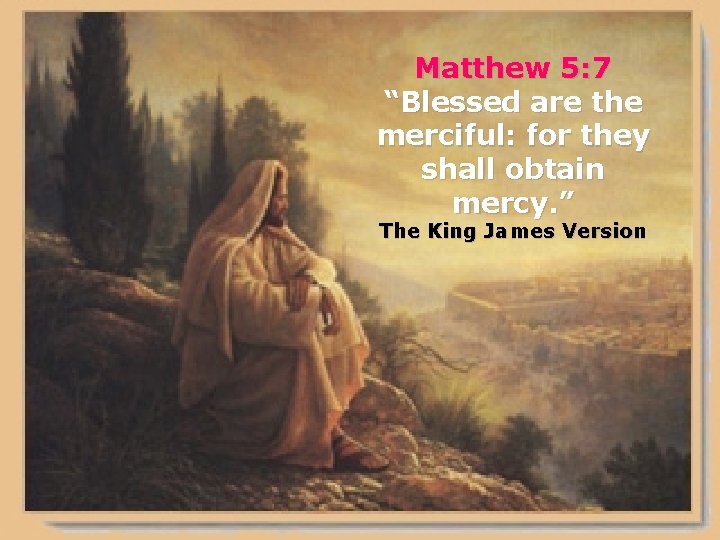
In Matthew 5:7 Jesus said, “Blessed are the merciful, for they shall receive mercy.”
Matthew 5:7 The Message
7 “You’re blessed when you care. At the moment of being ‘care-full,’ you find yourselves cared for.
The Word of God for the Children of God. Gloria! In Excelsis Deo! Alleluia! Amen.
You are blessed when you care.
Someone else is being blessed when you care.
Your family is being blessed when you care.
Your friends are being blessed when you care.
Your next-door neighbors are being blessed when you care.
Your community is being blessed when you care.
Being across the globe as I am, I am blessed when you care.
The Body of Christ is being blessed when you care.
At the moment of being care – full you find yourselves cared for.
At the moment you are being care – full I find myself being cared for.
At the moment of being care – filled you find yourselves being cared for.
At the moment you are being care – filled, I find myself being cared for.
Jesus came to give us life, a life full of abundance.
Jesus came to give us life, a life filled with abundance.
Jesus came to care about our lives full of abundance.
Jesus came to care about our lives being filled to abundance
Jesus came to care for our lives filled with abundance.
In the single greatest act of mercy, God sent His Son to show He cares.
In the single greatest act of mercy, God sent His Son to care about us.
In the single greatest act of mercy, God sent His Son to care for us.
What else can be said here?
What else can God do here which He has not already done in abundance?
How much more will God continue to do for us through His Son Jesus?
What about this continuous revelation of mercy we have done nothing for?
Understanding God’s revelation of Mercy
The word “mercy” is used in the Gospel of Matthew to refer to showing compassion, pity, and favor toward the suffering and needy (Matthew 9:27; 15:22; 17:15; 18:33; 20:30).
We get a good experience for this word when we read the parable of the Good Samaritan (Luke 10). Remember that there was a man who fell among robbers and was suddenly beaten severely. A priest and a Levite pass by and do not offer assistance. But a Samaritan, someone the Israelites avoided at all costs, comes to his aid, takes him to an inn, and pays for his care. Jesus then asks, “Which of these three, do you think, proved to be a neighbor to the man who fell among the robbers?” (Luke 10:36) The lawyer responded, “The one who showed him mercy” (Luke 10:37). Here we see that mercy is showing compassion, pity, and favor.
Mercy, therefore, is not just a feeling. Mercy is not some detached feeling or a sentiment that does nothing. Mercy is a feeling that causes the individual to act.
Sometimes we describe mercy as not giving to others what they deserve. While there is truth to this declaration, we are going to see that this is not a complete definition for mercy. Mercy is not merely refusing to bring judgment on those deserving of judgment. Mercy is genuine compassion expressed in genuine help and selfless, sacrificial compassion and selfless concern shown in selfless acts.
The people in God’s kingdom are those who are free givers of mercy. Mercy is something that is freely shown, not merely felt. Later in Matthew, Jesus will call mercy one of the weightier matters of the law (Matthew 23:23).
Matthew 23:23 Amplified Bible
23 “Woe to you, [self-righteous] scribes and Pharisees, hypocrites! For you give a tenth (tithe) of your mint and dill and cumin [focusing on minor matters] and have neglected the weightier [more important moral and spiritual] provisions of the Law: justice and mercy and faithfulness; but these are the [primary] things you ought to have done without neglecting the others.
Mercy was not a characteristic of 1st century culture, nor ours today. A popular Roman philosopher called mercy, “The disease of the soul.” It was the sign of supreme weakness. The Roman world in Jesus’ day did not show a lot of mercy.
Jesus healed the sick, gave sight to the blind, made the lame to walk, the deaf to hear, and raised the dead. He was the friend of sinners. He forgave prostitutes, tax collectors, and religious rulers. He took children in His arms and blessed them. He showed mercy to everyone and in return they betrayed him, they repeatedly attempted to stone Him, throw him off cliffs and united to kill Him.
The ancient world then was a place of coercive violence and intimidation, but not mercy. The quality and quantity of Mercy was not very “politically correct.”
Just like the other beatitudes in which Jesus promises blessing for living in ways contrary to our nature, He climbs a hill, the people gather around him, and He says in Matthew 5:7, “Blessed are the merciful, for they shall obtain mercy.”
Matthew 5:43 records the saying was to love your neighbor and hate your enemy. We see in these cultures that mercy, if it was given, was reserved for those who had been merciful only to you. Our world today is not far removed spiritually from the Roman world when Jesus gave these blessed statements.
One too many world cultures say the same thing: “If you don’t look out for yourself, no one else will.” Another slogan today: “Don’t get mad, get even.” People are still treated like things, power is the supreme deity, and financial success is the most important thing in life. There is even the saying to, “Show no mercy ever.” Today, just as then, mercy is weakness in the minds of most.
The Standard of Mercy of God our Creator
We see Jesus showing mercy on many occasions. He looked on people and was moved with pity and compassion (Matthew 9:36; 14:14; 15:32). Jesus showed compassion on the sinful woman caught in adultery. Jesus always showed compassion and love toward the people. This is what attracts us to Jesus!
He truly cared for people. He had a legitimate concern for their needs and difficulties. In fact, we see the ugliness of the human heart with how the religious leaders treated Jesus. You will notice in the gospels the more Jesus showed mercy and compassion, the more the religious leaders hated Jesus and looked for opportunities to kill him.
The hatred grew so great that the people and leaders betrayed him, had Jesus arrested without cause, nailed to a cross. Yet, even while hanging on the cross, with nails driven through his outstretched hands, we see the mercy of Jesus. “Father, forgive them; for they do not know what they are doing” (Luke 23:34).
Notice in this we see a distinction between mercy and forgiveness. The mercy of our Lord is the basis for his desire to forgive us. “…he saved us, not because of works done by us in righteousness, but according to his own [standard of] mercy, by the washing of regeneration and renewal of the Holy Spirit, whom he poured out on us richly through Jesus Christ our Savior…” (Titus 3:5–6).
Mercy was the basis upon which forgiveness was extended. God’s forgiveness of our sins flow from his abundant mercy.
But God, being rich in mercy, because of the great love with which he loved us, even when we were dead in our trespasses, made us alive together with Christ—by grace you have been saved— and raised us up with him and seated us with him in the heavenly places in Christ Jesus, (Ephesians 2:4–6 ESV)
Please notice that Ephesians makes the same distinction between mercy and forgiveness. Because God is rich in mercy with great love for us, he saved us by grace and made us alive together with Christ. While Jesus is on the cross, we see his full extent of mercy as he extends the opportunity of forgiveness to them.
We must be merciful because this is the very character of God. Jesus declared, “Be merciful, even as your Father is merciful” (Luke 6:36). The mercy of God should be renewed in our minds and hearts at least every Sunday as we partake of the Lord’s Supper. The Lord’s Supper reminds us of the mercy of God that we have experienced. God’s mercy is the covenanted basis of our own forgiveness.
This covenant teaches us something valuable. Our lack of forgiveness and our unwillingness to forgive others comes from a lack of mercy for others. Mercy drives forgiveness. If I am not driven to be forgiving, then I am not driven to be merciful. If I am not merciful, then I am not living in the kingdom of heaven.
The Challenge of God’s Standard of Mercy
Mercy is a challenge to develop in our character. Showing mercy means making ourselves vulnerable. We will be hurt by what other people do to us. We will extend ourselves to help people without reciprocation or thanks. We will give of ourselves unto those who need us without regard for receiving something in return. Compassion and pity are not often praised in our world, but it is the very heart of God, revealed through Jesus Christ, that we are showing to the world.
Mercy is not earned. Just like grace is no longer grace if it is earned, mercy is no longer mercy if it is deserved. Mercy is compassion that is undeserved. We are not to show mercy to whom we think deserve our mercy. We are to be like the character of God, extending mercy to all. Show mercy when people sin against us. The merciful expend a great measure of themselves to freely assist others.
But sometimes we misunderstand mercy. Mercy does not mean sin is ignored. We know this because God is merciful toward us but that does not mean our sins are ignored. Mercy recognizes the reality of sin. Mercy has the recognition of wrongdoing. Jesus did not show mercy by pretending that people were not sinning. Jesus did not show mercy by not convicting the people of their sins.
Jesus was being merciful by identifying sins and giving sinners the hope for forgiveness through him. Mercy identifies our sin but then shows the way to reconciliation with God. Mercy does good toward the other even in the face of opposition or evil.
Now think about what Jesus taught a couple times in the Gospel of Matthew: “I desire mercy, not sacrifice.” This declaration ought to be weighty to us and must not be emptied of its impact. God wants people who have a heart for him and for others. God does not want passive, heartless, soulless pew sitters.
We are people who help and heal. I am so troubled to hear how often Christians have an argument or a moment of an unkind word, and rather than showing mercy, there is division. People leave the congregation and go to another.
People get their feelings hurt and dwell in bitterness and leave. Going to church is not the test to know if you have received God’s mercy. Being merciful to others is the test to know if you have in truth experienced and received God’s mercy. Mercy is not desiring for other people to do good for others. Mercy is when we seek and act upon opportunities to be mercy givers, like the Good Samaritan in Luke 10.
Think about what the prophet Micah declared to the people:
And what does the Lord require of you? To act justly and to love mercy [kindness; ESV] and to walk humbly with your God. (Micah 6:8 NIV)
They Shall Receive God’s Standard of Mercy
The sinner’s plea can only be the words, “God, be merciful to me, a sinner” (Luke 18:13). God only shows mercy to the merciful. “Blessed are the merciful for they shall receive mercy.”
Listen to the chilling words of James:
For judgment is without mercy to one who has shown no mercy. Mercy triumphs over judgment. (James 2:13 ESV)
What terrifying words to hear! Judgment will be without mercy to the one who has shown no mercy.
We also have another saying: that person is getting what they deserve. But is that what we want to have happen to us? Do we want to get what we deserve for how we have treated others?
I know I have made many, many mistakes and I do not want to get what I truly deserve. for making them. You know others have been merciful toward you with your flaws and errors. Yet how often we will refuse to help people and refuse to be merciful because we think the person should not have put themselves in this mess in the first place! “They are only getting what they deserve.”
But we want others to be merciful toward us and not give us what we deserve. Further, we want God to be merciful toward us and not give us what we deserve. Do we seriously want to get what we deserve for how we have treated God?
Mercy toward others begins in our lives by having a penetrating awareness of our own desperate need of mercy from others, and especially from God.
It is mercy that shows compassion to the helpless (Luke 10:37) and extends forgiveness even to the one who gives repeated offense (Matthew 18:21-22). But this is what is important: mercy is not prompted by the appeal of certain qualities of the offender. We see this truth when God showed mercy to us through the cross (Romans 5:8-10).
Matthew 18:33 “And should not you have had mercy on your fellow servant, as I had mercy on you?” God’s standard of mercy compels us to be gracious, kind, compassionate, merciful toward others. We love God because He first loved us!
Blessed are the merciful for they shall receive mercy.
Oh, how we need this!
Oh, how we need to live this!
Oh, how we need to love this!
Oh, how we need to move on this!
Oh, how we need to go forth with this!
Oh, how we need to experience this!
Oh, how we need to reveal this!
Pray! Let God’s mercy transform your heart to be mercy givers to all people.
Let mercy flow like as an everlasting stream flowing from the heart of God!
In the name of God, the Father, and God the Son and God the Holy Spirit,
Let us pray,
Heavenly Father, how I praise and thank You for Your manifold mercy towards me, in that while I was yet a sinner, and at enmity with You… You did not give me what I deserve, but showed me mercy and love, by redeeming my life and clothing me in the righteousness of Christ. May I imitate the merciful way that Christ lived by bestowing Your mercy and compassion on all those with whom I come in contact. May I live as You would have me live in Jesus’ name – and for His glory, Alleluia! Alleluia! Alleluia! AMEN.


 Loving God, Living God, Loving Hope, Living Hope, Loving Living Life His Way! "Many things are possible for the person who has hope. Even more is possible for the person who has faith. And still more is possible for the person who knows how to love. But everything is possible for the person who practices all three virtues." - Brother Lawrence (1605-1691), Practicing the Presence of God (1692).