Ask for Anything You Wish! A Prayer, Praying, to Encourage those Fathers Who Feel Like Failures. John 15:5-10

John 15:5-10 Amplified Bible

5 [a]I am the Vine; you are the branches. The one who remains in Me and I in him bears much fruit, for [otherwise] apart from Me [that is, cut off from vital union with Me] you can do nothing. If anyone does not remain in Me, he is thrown out like a [broken off] branch, and withers and dies; and they gather such branches and throw them into the fire, and they are burned. If you remain in Me and My words remain in you [that is, if we are vitally united and My message lives in your heart], ask whatever you wish and it will be done for you. My Father is glorified and honored by this, when you bear much fruit, and prove yourselves to be My [true] disciples. I have loved you just as the Father has loved Me; remain in My love [and do not doubt My love for you]. 10 If you keep My commandments and obey My teaching, you will remain in My love, just as I have kept My Father’s commandments and remain in His love.

The Word of God for the Children of God.

Glory be to the Father,
and to the Son, and to the Holy Ghost;
as it was in the beginning,
is now, and ever shall be,
world without end. Amen, amen.


Happy Father’s Day 2024: Father is the backbone of the family who plays a significant role. He sacrifices his everything in the upbringing of their children and other members of the family. To provide him honor, let’s celebrate Father’s Day to make the incredible man feel special. It is a special occasion dedicated only to the father, whether he is a father figure, grandfather, or the stepfather.

Father’s Day is celebrated all over the world to show extreme love and care for the father’s efforts and support.

In 2024, Father’s Day will be celebrated on 16th June 2024 and of course, it is the best time to show appreciation to the father.

If you are looking for a moment to show your inner feelings to your father, it is the most recommended day when you can open your heart and explain how you feel about having your father in your life. So, try to make that honest effort to plan your whole day to celebrate Father’s Day with your father, loving family.

Unless, of course …

When You Feel Like You Are Failing Your Children As A Father? Here’s Why It is Probably Not True.

John 15:9-10 The Message

9-10 “I’ve loved you the way my Father has loved me. Make yourselves at home in my love. If you keep my commands, you’ll remain intimately at home in my love. That’s what I’ve done—kept my Father’s commands and made myself at home in his love.

Parenting is a journey filled with ups and downs, and it’s not uncommon to feel like you’re failing as a father at times.

The pressure to be the perfect parent can be overwhelming, and it’s easy to compare yourself to other fathers and feel like you’re not measuring up.

But the truth is, no one is a perfect parent, and the most important thing is that you love and care for your children.

In this devotional effort, we will explore the common challenges fathers face, the misconceptions about parental failure, and suggest practical strategies to overcoming those feelings you may now be experiencing of failing as a father.

What are You Understanding about Parental Failure? Separating Fact from Fiction.

Many fathers who feel like they are failing may not actually be experiencing parental failure.

Parental failure refers to situations where a parent causes significant trauma, neglect, or harm to their child through their actions or behavior.

This can include abuse, neglect, abandonment, or involvement in harmful behaviors such as substance abuse or violence. It’s important to differentiate between experiencing a rough patch in parenting and actual parental failure.

When fathers feel like they are failing, it is often due to temporary challenges and stressful situations.

Parenting is a demanding and complex role, and it is normal to struggle and make mistakes along the way.

It’s crucial to recognize that these struggles are part of the journey and not indicative of parental failure.

Fatherhood and Its Challenges

Acknowledge that managing the day to day the role of Fatherhood is a significant aspect of family life, and it comes with its own set of challenges.

For some men, the responsibilities of being a father can exacerbate underlying anger issues, leading to a stressful relationship dynamic within the family.

The day to day pressure to provide, protect, and be a role model can sometimes lead to wide feelings of inadequacy and frustration, especially when faced with unexpected difficulties.

It’s so very important to acknowledge that fatherhood isn’t always portrayed accurately in the media, and societal expectations can contribute to a sense of acute, chronic failure when reality doesn’t align with these idealized depictions.

Understanding and addressing these challenges is crucial in separating fact from fiction when it comes to parental failure.

Seeking support, whether through therapy, counseling, or support groups, or clergy can be instrumental in navigating the complexities of fatherhood and addressing any underlying anger issues that may impact family dynamics.

Fatherhood Struggles Are Normal

Feeling like you’re failing as a father is a common experience shared by many men.

The responsibilities of parenting can be overwhelming, and it’s natural to face challenges and difficulties.

From maintaining patience during disciplining to feeling like you have little control over your child’s behavior, these struggles are completely normal.

As a new parent, it’s especially common to feel uncertain and inexperienced.

It takes time to adjust to the responsibilities and demands of parenthood.

Remember that every parent has moments of self-doubt and feels like they could have done something better. It’s important to give yourself grace and mercy and forgiveness and acknowledge that you’re doing the best you can.

The Fear of Parental Failure

The fear of parental failure often stems from our own childhood experiences and the desire to be better parents than our own.

We may have set high expectations for ourselves and fear disappointing others and ourselves.

However, it’s crucial to recognize that parenting is a learning process, and it’s okay to make mistakes, sometimes even grievous mistakes have their purpose.

Instead of dwelling, obsessing, on the fear of failure, focus on personal growth and improvement.

Self-criticism can also contribute to the feeling of failing as a parent.

It’s important to have self-compassion and empathy towards yourself as a parent. Remember that you are human and prone to making mistakes.

Instead of being overly critical, focus on the grace of God, finding opportunities for bible study with other fathers, growth and learning from your experiences.

How to Overcome the Feeling of Failing as a Father

John 15:9-10 The Message

9-10 “I’ve loved you the way my Father has loved me. Make yourselves at home in my love. If you keep my commands, you’ll remain intimately at home in my love. That’s what I’ve done—kept my Father’s commands and made myself at home in his love.

  1. Recognize and Reframe: Instead of viewing yourself as a failure, reframe your thoughts to acknowledge that you’re struggling. Recognize that parenting is challenging, and it’s normal to have difficult moments. Reframe your mindset to focus on growth and improvement rather than dwelling on perceived failures.
  2. Identify Areas for Improvement: Take the time to identify specific areas of your parenting that you would like to work on. This could include managing frustration, improving communication, setting boundaries, or practicing patience. Jot down these areas and reflect on why they are important to you.
  3. Prepare for Change: Once you’ve identified areas for improvement, create a game plan for how you will address them. Consider specific strategies or techniques that you can implement in challenging situations. Having a plan in place will help you stay focused and better equipped to handle difficult moments.
  4. Take Purposeful Action: Commit to actively working on the strategies you’ve identified. Remember that change takes time and effort. Be patient with yourself and celebrate small victories along the way. Consistency is key in implementing positive changes in your parenting approach.
  5. Apologize When Necessary: It’s important to model empathy and taking responsibility for our actions. If you make a mistake, don’t hesitate to apologize to your child. This teaches them valuable lessons about forgiveness, conflict resolution, and making amends. Apologizing shows that you are human and willing to learn from your mistakes.
  6. Reflect on Your Own Experiences: Be mindful of your own childhood experiences and how they may influence your parenting. Recognize any negative patterns or tendencies that you may have adopted and work towards breaking those cycles. Seeking therapy or counseling can provide valuable support in processing past traumas and improving self-worth.
  7. Practice Self-Care: Remember that taking care of yourself is essential for being a present and effective parent. Prioritize self-care activities that help you manage stress and improve your mood. This could include exercise, hobbies, spending time with friends, or seeking professional support when needed.
  8. Set Boundaries: Recognize when you’re feeling overwhelmed and need to establish boundaries. It’s okay to ask for help and delegate responsibilities when necessary. Taking care of yourself allows you to be a better parent and role model for your children.
  9. Focus on the Positive: Instead of dwelling on perceived failures, shift your focus to the positive aspects of your parenting. Celebrate your successes, no matter how small they may seem. Remember that being present and showing love to your children is what truly matters.
  10. Seek Support: Don’t hesitate to reach out for support when you need it. Connect with other fathers who may be experiencing similar challenges. Join parenting groups or seek professional guidance from therapists or counselors specializing in family dynamics. Remember, you are not alone in your parenting journey.

A Prayer to Encourage Fathers Who Feel Like Failures 

Matthew 11:28-30 The Message

28-30 “Are you tired? Worn out? Burned out on religion? Come to me. Get away with me and you’ll recover your life. I’ll show you how to take a real rest. Walk with me and work with me—watch how I do it. Learn the unforced rhythms of grace. I won’t lay anything heavy or ill-fitting on you. Keep company with me and you’ll learn to live freely and lightly.”

In today’s internet and technology driven culture, many careers require employees to be on the job for more than 40 hours a week, taking more and more time away from men who want to spend time with their families.

As well, the vast array of economic challenges, rising interest rates, the rising consumer costs, mortgages are keeping a family’s breadwinner from being able to cut back hours, working as much as possible just to keep ahead of inflation.

Sadly, the pressure from employers, along with an escalating economy, causes fathers who long to be present and involved in their kids’ lives to put time with their families on the back burner, stress out, and keep focusing on keeping their households afloat with housing, health insurance, clothes, food, and more.

But in in the day to day management of house and home, providing for their families, fathers are missing out on valuable time with their kids, losing vast measures of time being involved in their lives in a personal way, knowing what their kids are thinking and doing, and what’s spiritually going on in their lives.

Feelings of Fatherhood Failure

All of the above can make a father feel like a failure in their children’s lives.

Add to it the number of broken families, where fathers or mothers don’t live in the same home with their kids and have marriage issues coupled with limited time to spend and connect together with them the sense of failure increases.

As well, recall that the enemy of our souls prowls around every corner works double hard to the convince kids that their fathers don’t really love them, don’t really want to spend time with them, and just don’t care enough to be around.

Likewise, he also works triple hard to convince dads their kids don’t want them around or need them, together, causing some fathers to walk away completely.

What’s A Father to Do?

God understands fatherhood.

Even though He is the perfect, flawless Father, He’s experienced the hardcore sorrow that comes with having children who greatly struggle with believing He truly loves and cares for them unconditionally.

The Gospel story of the prodigal son offers fathers three steps in restoring relationships with children who have rejected them, turned away from them.

Luke 15:11-32 Amplified Bible

The Prodigal Son

11 Then He said, “A certain man had two sons. 12 The younger of them [inappropriately] said to his father, ‘Father, give me the share of the property that falls to me.’ So he divided the estate between them. 13 A few days later, the younger son gathered together everything [that he had] and traveled to a distant country, and there he wasted his fortune in reckless and immoral living. 14 Now when he had spent everything, a severe famine occurred in that country, and he began to do without and be in need. 15 So he went and forced himself on one of the citizens of that country, who sent him into his fields to [a]feed pigs. 16 He would have gladly eaten the [carob] pods that the pigs were eating [but they could not satisfy his hunger], and no one was giving anything to him. 17 But when he [finally] came to his senses, he said, ‘How many of my father’s hired men have more than enough food, while I am dying here of hunger! 18 I will get up and go to my father, and I will say to him, “Father, I have sinned against heaven and in your sight. 19 I am no longer worthy to be called your son; [just] treat me like one of your hired men.”’  20  So he got up and came to his father. But while he was still a long way off, his father saw him and was moved with compassion for him, and ran and embraced him and kissed him.  21 And the son said to him, ‘Father, I have sinned against heaven and in your sight; I am no longer worthy to be called your son.’ 22 But the father said to his servants, ‘Quickly bring out the best robe [for the guest of honor] and put it on him; and give him a [b] ring for his hand, and sandals for his feet. 23 And bring the fattened calf and slaughter it, and let us [invite everyone and] feast and celebrate; 24 for this son of mine was [as good as] dead and is alive again; he was lost and has been found.’ So they began to celebrate.

25 “Now his older son was in the field; and when he returned and approached the house, he heard music and dancing. 26 So he summoned one of the servants and began asking what this [celebration] meant. 27 And he said to him, ‘Your brother has come, and your father has killed the fattened calf because he has received him back safe and sound.’ 28 But the elder brother became angry and deeply resentful and was not willing to go in; and his father came out and began pleading with him. 29 But he said to his father, ‘Look! These many years I have served you, and I have never neglected or disobeyed your command. Yet you have never given me [so much as] a young goat, so that I might celebrate with my friends; 30 but when this [other] son of yours arrived, who has devoured your estate with immoral women, you slaughtered that fattened calf for him!’ 31 The father said to him, ‘Son, you are always with me, and all that is mine is yours. 32 But it was fitting to celebrate and rejoice, for this brother of yours was [as good as] dead and has begun to live. He was lost and has been found.’”

1. Love your children unconditionally.

In the story of the prodigal son, fathers can learn how to love their children unconditionally, even when their kids seem to reject them and want nothing to do with them.

Luke 15:11-12 tells of a father who had two sons. “The younger one said to his father, ‘Father, give me my share of the estate.’ So he divided his property between them. Not long after that, the younger son got together all he had, set off for a distant country and there squandered his wealth in wild living.”

Still, after losing everything, he returned to his father, who greeted him with open arms. “So he got up and went to his father. But while he was still a long way off, his father saw him and was filled with compassion for him; he ran to this son, threw his arms around him and kissed him” (Luke 15:20).

2. Entrust your children to God.

The father in the prodigal son’s story released his son to God’s care and discipline, entrusting Him to speak into his heart and lead him back to him.

Even though the father didn’t want his son to leave, he didn’t force him to stay by withholding inheritance or by some other form of control or manipulation.

Although it must have been heartbreaking for the father to let him go, he trusted God to be with and deal with his son.

3. Forgive your children freely, even if others disagree.

As the story goes, the son spent all his inheritance and returned to his father broken and repentant. When he did, his brother, who had stayed at home, didn’t think it was fair and disagreed with his father’s forgiving heart.

But the father didn’t waiver in his forgiveness for his wayward son. “My son,’ the father said, ‘you are always with me, and everything I have is yours, but we had to celebrate and be glad, because this brother of yours was dead and is alive again; he was lost and is found’” (Luke 15:31-32).

Before Assigning Yourself as failure; First Foremost

The standards of success and failure as a father are set by God, the Father alone.

Matthew 6:33-34 Amplified Bible

But first and most importantly seek (aim at, strive after) His kingdom and His righteousness [His way of doing and being right—the attitude and character of God], and all these things will be given to you also. 34 “So do not worry about tomorrow; for tomorrow will worry about itself. Each day has enough trouble of its own.

In the name of God, the Father and God the Son and God the Holy Spirit,

Let us Pray,

Dear Father,
We ask You to speak to fathers’ hearts today who are feeling like failures. Forgive them for the ways they may have let You and their children down. Guard their hearts from the heaviness of regret. Soften their hearts to receive Your forgiveness and to freely offer forgiveness to their children who may have rejected and hurt them in return. Bring forgiveness and compassion, too, oh Lord, to the hearts of their children, who may have felt unloved and abandoned by their fathers. Lead these fathers in finding restoration and reconciliation with their children. In Jesus’ name, Amen
.

Glory be to the Father,
and to the Son, and to the Holy Ghost;
as it was in the beginning,
is now, and ever shall be,
world without end. Amen, amen.
https://translate.google.com/

Best Fatherly Practices, Learning From His Examples: “Our Father, Who Art in Heaven, Will You Reveal Who You Are?” Matthew 6:7-13

What comes to mind when you hear the term Father’s Day? Maybe you think about stereotypical gifts like neckties or #1 Dad t-shirts. Perhaps you have memories of the sights and smells of grilling together. Or maybe—like many people—the holiday provides an opportunity for you to celebrate your Father in heaven.

On this Father’s Day—and every day—I pray that your spirit would be refreshed, refocused, and renewed as you “see what great love the Father has lavished on us, that we should be called children of God!” (1 John 3:1).

Matthew 6:7-13 The Message

7-13 “The world is full of so-called prayer warriors who are prayer-ignorant. They’re full of formulas and programs and advice, peddling techniques for getting what you want from God. Don’t fall for that nonsense. This is your Father you are dealing with, and he knows better than you what you need. With a God like this loving you, you can pray very simply. Like this:

Our Father in heaven,
Reveal who you are.
Set the world right;
Do what’s best—
    as above, so below.
Keep us alive with three square meals.
Keep us forgiven with you and forgiving others.
Keep us safe from ourselves and the Devil.
You’re in charge!
You can do anything you want!
You’re ablaze in beauty!
    Yes. Yes. Yes.

The Word of God for the Children of God.

Adeste Fideles! Laeti Triumphantes, Venite Adoremus! Dominum.

Gloria! In Excelsis Deo! Alleluia, Alleluia, Alleluia, Amen.

A Father’s Day Message to You … Set The Example.

Our Father in heaven,
Reveal who you are.
Set the world right;
Do what’s best—
    as above, so below.
Keep us alive with three square meals.
Keep us forgiven with you and forgiving others.
Keep us safe from ourselves and the Devil.
You’re in charge!
You can do anything you want!
You’re ablaze in beauty!
    Yes. Yes. Yes.

Many of us approach Father’s Day with mixed emotions.

Some people have hands-on fathers who are available and deeply interested in their children’s lives; while others will have a somewhat distant, disinterested father; while still some others still were abandoned by their fathers altogether.

And like me, some have fathers who have died.

But one thing we all have in common, no matter what kind of dad or step dad we are or currently have or have had, is that we have an authentic Father in heaven.

And regardless of how your father, my father on earth has treated us, we have a Father in heaven who has always been there, always will, 100%, be there for us.

The Bible says that God is a “father of the fatherless” (Psalm 68:5 NKJV).

And David wrote,

“When my father and my mother forsake me, then the Lord will take care of me” (Psalm 27:10).

We have an authentic heavenly Father, and the way in which we authentically communicate with him is through prayer.

The greatest prayer that was ever prayed is often called the Lord’s Prayer, where Jesus taught us to pray:

“Our Father in heaven, hallowed be Your name.
Your kingdom come. Your will be done On earth as it is in heaven.
Give us this day our daily bread.
And forgive us our debts, as we forgive our debtors.
And do not lead us into temptation, but deliver us from the evil one. For Yours is the kingdom and the power and the glory forever. Amen.” (Matthew 6:9–13)

To address God as “Father” was a revolutionary thought to the Jewish mind.

The Hebrews feared God and attached such sacredness to His name, they would not even utter it.

In the Old Testament, God is referred to as “Father” fewer than seven times.

And when He is, it is either indirectly or rather remotely.

In fact, when Jesus referred to God as his father, he was accused of blasphemy.

One of the reasons Jesus was crucified was because he spoke of this radically special relationship he had with his father – not his earthly one, but heavenly.

Now, because of his death and resurrection, we can have that relationship, too.

After rising from the dead, he said to Mary Magdalene, “I am ascending to My Father and your Father, and to My God and your God” (John 20:17).

As you are now, were growing up, if your father was disengaged, disinterested and passive, you might think of God, talk to God, in exactly that self same way: disconnected, 100% oblivious to what is going on in your life, not really caring.

Then again, if your father was a thoroughly involved, nurturing and affirming dad, you might naturally apply those same qualities to your perception of God.

Whatever our experience was or currently is, we need to view God not the way we view an earthly dad; we need to view God as He is presented in Scripture.

Not only does the Bible tells us to address him as Father, but we are to do so in an intimate way.

The apostle Paul wrote, “So you have not received a spirit that makes you fearful slaves. Instead, you received God’s Spirit when he adopted you as his own children. Now we call him, ‘Abba, Father’” (Romans 8:15 NLT).

The word Abba speaks of intimacy, like calling your father “Daddy” or “Papa.”

The idea is that of an affectionate relationship.

My grandson call me “Papa.”

My sister’s granddaughters, when they were just starting to talk, would lift her hands up and say, “Nema” when they wanted to be picked up or get out of their highchairs. (How can parent or grandparent resist the innocent sound of that?)

If you want an accurate snapshot of God, a proper portrait of the Father, just look at the story Jesus told about the prodigal son (see Luke 15).

The story isn’t all just about the son, however; it is also about the loving father who stayed at home – anticipating, expecting, waiting, praying for that one day.

And who is more qualified to talk about a loving father than His own Son, Jesus?

In this story, Jesus presents him as an engaged, loving, affectionate father who loves his sons.

The father has two sons, the youngest of whom demanded his portion of the estate before the father has died.

The son went off to a distant land and lived like a fool – as a prodigal – blowing his money, consorting with prostitutes, literally ending up in a pig pen, and as he was finally coming to his senses, turned around and began returning home.

Back at home we see a father who stayed home, who longed for his son’s return and then ran to throw his arms around him, kissing him over and over again.

The conclusion of the story from a modern paraphrase goes this way:

The son started his speech: “Father, I’ve sinned against God, I’ve sinned before you; I don’t deserve to be called your son ever again.

But the father wasn’t listening. He was calling to the servants, “Quick. Bring a clean set of clothes and dress him. Put the family ring on his finger and sandals on his feet. Then get a grain-fed heifer and roast it. We’re going to feast! We’re going to have a wonderful time! My son is here – given up for dead and now alive! Given up for lost and now found!” And they began to have a wonderful time. (Luke 15:20–24 The Message)

That is your Heavenly Father. Although He is our God, there is an undeniable intimacy, there is relationship, there is closeness, there is 10000% affection.

If you want to know what kind of Father we have in heaven, just look at Jesus.

Because Jesus said, “He who has seen Me has as also seen the Father” (John 14:9 NKJV).

He also said, “If you had known Me, you would have known My Father …” (John 8:19).st look at Jesus with the little children in his arms, blessing them.

Look closely, with a father’s eyes, and a father’s broken heart, shattered soul at Jesus with tears streaming down all his face at the grave of his friend, Lazarus.

Just look at Jesus, washing his disciples’ feet in the Upper Room.

That is what our Father in heaven is like – if we will still let him set the example.

Best Practices, Learning From Our Fathers Example

Philippians 4:8-9 The Message

8-9 Summing it all up, friends, I’d say you’ll do best by filling your minds and meditating on things true, noble, reputable, authentic, compelling, gracious—the best, not the worst; the beautiful, not the ugly; things to praise, not things to curse. Put into practice what you learned from me, what you heard and saw and realized. Do that, and God, who makes everything work together, will work you into his most excellent harmonies.

Most parents learn the best way to teach their children is by setting an example.

In healthy families, we learn a lot about right and wrong, good and bad, by simply watching our parents, grandparents or older “grandparent” siblings.

Ephesians 6:1-4 The Message

1-3 Children, do what your parents tell you. This is only right. “Honor your father and mother” is the first commandment that has a promise attached to it, namely, “so you will live well and have a long life.”

Fathers, don’t frustrate your children with no-win scenarios. Take them by the hand and lead them in the way of the Master.

Do you, Do I, do we, have a strong relationship with our (step) children?

The way we first think about God has much to do with how we were parented—especially by our father.

What image of the Lord are you portraying?

Many men will suffer alone, struggle in their role as dads because their own fathers were either absent—physically or emotionally— or poor examples.

But regardless of what a person experienced in the past, the #1 best thing any parent can do is first look to the Scriptures to imitate God the heavenly Father.

But how do we know who He really is?

We get our best glimpse of what the heavenly Father is like by looking at His Son.

Do we learn, do we see and witness and testify unto the Father’s Authority?

Speaking with the disciples, Jesus said, “I am the way, and the truth, and the life; no one comes to the Father but through Me . . . He who has seen Me has seen the Father” (John 14:6, 9).

Not only is Christ our path to relationship with God; He is also the way we come to know the Father’s true character.

When we look at Jesus’ life, what do we see?

He was revealed to be merciful, patient, gentle, compassionate, merciful, forgiving, kind, and full of goodness toward all people (Matthew 9:10-13).

He was revealed to be a hard worker and a family provider – Matthew 13:1-9

The Savior healed the sick, provided for needs, and offered forgiveness—regardless of the offense (Matthew 14:14-21; Luke 23:34).

But in love, He didn’t hesitate to discipline or correct others when required.

Hebrews 12:4-11 The Message

4-11 In this all-out match against sin, others have suffered far worse than you, to say nothing of what Jesus went through—all that bloodshed! So don’t feel sorry for yourselves. Or have you forgotten how good parents treat children, and that God regards you as his children?

My dear child, don’t shrug off God’s discipline,
    but don’t be crushed by it either.
It’s the child he loves that he disciplines;
    the child he embraces, he also corrects.

God is educating you; that’s why you must never drop out. He’s treating you as dear children. This trouble you’re in isn’t punishment; it’s training, the normal experience of children. Only irresponsible parents leave children to fend for themselves. Would you prefer an irresponsible God? We respect our own parents for training and not spoiling us, so why not embrace God’s training so we can truly live? While we were children, our parents did what seemed best to them. But God is doing what is best for us, training us to live God’s holy best. At the time, discipline isn’t much fun. It always feels like it’s going against the grain. Later, of course, it pays off big-time, for it’s the well-trained who find themselves mature in their relationship with God.

More than a solid education or material possessions, your child’s greatest need is a role model of devotion to God, a steady revealing of their Heavenly Father through prayer, Bible reading, Bible Teaching and by steadfast and holy living.

Matthew 16:17-18 The Message

17-18 Jesus came back, “God bless you, Simon, son of Jonah! You didn’t get that answer out of books or from teachers. My Father in heaven, God himself, let you in on this secret of who I really am. And now I’m going to tell you who you are, really are. You are Peter, a rock. This is the rock on which I will put together my church, a church so expansive with energy that not even the gates of hell will be able to keep it out.

If you make knowing and following the heavenly Father your first priority, you won’t have to worry about what kind of parent you will be – the child will see it.

It’s our privilege, responsibility as as parents, grandparents, fellow believers to be Godly, to teach Godly, and and live and model, set Godly examples to others.

Paul’s own life must have shown joy and gentleness for him to use himself as an example to follow.

It’s not a matter of just learning what the Bible teaches about such attitudes.

What counts is putting them into practice.

Like Paul, we’ve got to live in such a way that we can say,

“Learn what I teach—by example!”

A disciplined sense of what’s right and disciplined conviction of what’s wrong is a wonderful and necessary “GOD WHO IS OUR FATHER” thing to live into, to teach our children, to our grandchildren the way they should and should not go.

Proverbs 22:6 The Message

Point your kids [grandkids – my emphasis] in the right direction—
    when they’re old they won’t be lost.

What kind of “HEAVENLY FATHER” example are we exactly right now?

In the name of God, the Father and God the Son and God the Holy Spirit,

Let us Pray,

Our Father who art in Heaven, hallowed be thy name, we come before you today humbled and in awe of Your grace and mercy. Lord, we thank You for the way You have designed what a family is supposed to look like and the specific roles You have ordained to a mother and a father of how to lead their children. Yet Lord, through our sinful ways we have taken what You have made holy and created our own version of today’s families. Because of this, our children are suffering. It is for the fathers, families, and children of our nation that we do pray today. 

Lord, we pray specifically for fathers and fatherhood across our land. Your Word clearly instructs fathers to bring up their children in the discipline and instruction of the Lord (Ephesians 6:4). God, we thank You for the men who are leading according to Your statutes and the ones that are laying their lives down for Your purposes. We pray that You will continue to use these men to lead their families and other men. We pray You will strengthen the fathers of our nation and that You will continue to empower churches, organizations, and individuals to invest in fathers and fatherhood for the sake of our children.  

We pray for the single fathers out there; whether they are raising their children alone or even if they are doing the best they can with the time and gifts they have. We pray for strength, protection, wisdom, and discernment to help them through whatever trials they may be facing. Thank You Lord for these men and please guard their hearts and minds in Christ Jesus, help meet all of their needs, that they may experience Your maximum peace that surpasses all of their comprehension. 

We pray for the dads out there who are being alienated from their children right now. We pray, oh Lord, that You would shield and shelter them from the pain and possibly the anger that may be rising up in them, for You to strike down the barriers that are hindering these dads from seeing their children. God, do not let this destroy them as men, fathers, or in their relationship with You. They need You in a mighty way and we pray You would show Yourself strong on behalf of anyone that is being alienated from their children and that You would reunite these families together. 

Lord, we lift up the dads right now that are not stepping up to the plate as fathers, for whatever reason. Once again, we have allowed the evil one to get into our lives and wreak havoc on what You have said is good. We pray for these men to come to their knees and repent, that they would turn from their ways, seek You, and come to the saving knowledge of Jesus Christ. Father, we pray for their children and the moms who are parenting alone because of these men’s decisions. We pray You would step in as a father to the fatherless and a defender of widows in these situations, that their story would be another testimony that nothing is too hard for You. 

Finally, Father we lift up the men and women that are on the front lines in the battle for fatherhood and the war against fatherlessness. God, You clearly put leaders of all skills, gifts, calibers in positions of influence: from the highest ranks to the least of these. However we know with men these initiatives would fall short, but with You all things are possible. We pray for everything from the right funding for the programs to continue, to godly leadership from beginning to end. We pray for a revival of manhood, for fathers to lead their families by beginning each day on their knees. God Your Word says You will turn the hearts of the fathers to their children and the hearts of the children to their fathers (Malachi 4:6). As our Creator, Savior, and heavenly Father, we believe this will bear eternal fruit- that generational curses will become generational blessings, restoring our families back to the way that You intended. 

We come into agreement as we read and speak this prayer out loud that this is a nation that is desperate not only for our earthly fathers to rise up to the challenge, but more importantly, that they need to follow You, Father, as their ultimate guide and example. It is in the wonderful, precious, matchless name of Jesus Christ we pray.


Adeste Fideles! Laeti Triumphantes, Venite Adoremus! Dominum.

Gloria! In Excelsis Deo! Alleluia, Alleluia, Alleluia, Amen.

https://translate.google.com/

Our Celebration of Father’s Day 2022. Honor in the Home. Exodus 20:12

Most Christians are very familiar with the verse “honor your father and mother”, but few actually know of its origin in the Bible.

The command to honor your father and mother actually comes from the Old Testament book Exodus 20 in God’s writing, giving of the 10 Commandments.

However, it is also a command that is repeated several times in both the Old and New Testament. 

Chapter 20 of the Book of Exodus serves as a powerful reminder of the intimate relationship God has with humankind.

This passage specifically reveals the intense care and concern that God shows toward His followers.

Today this chapter remains popular because of a very special occurrence – the Ten Commandments.

After venturing up to Mount Sinai, Moses brought down from God’s own hand the Ten Commandments, rules given Him directly from God.

The Ten Commandments described ten precepts for how God expected His people to behave.

This monumental moment follows after the Israelites fled Egypt. 

Chapter 19 in the Book of Exodus details how the Israelites camped in the wilderness, now living a life outside of slavery for a few months.

God informs Moses that He desires to bless the nation of Israel.

However, He also wants them to keep a covenant with Him (Exodus 19:5-6).

The Ten Commandments serve as part of that covenant.

One of these commandments spoke to the relationship between a child and parent and is a foundational guideline we as Christians still follow today.

The reason this commandment in addition to the other nine is still relevant today is because Jesus indicated such to later believers (Matthew 5:17-20).

Jesus did not come to abolish the law, but rather came to fulfill it.

We are to do our part in abiding by these commandments.

Today, there is a growing measure of controversy about whether or not the Ten Commandments are still relevant.

What is up for debate in the meaning of “honor” in the context of parents and children.

Exodus 20:12Amplified Bible

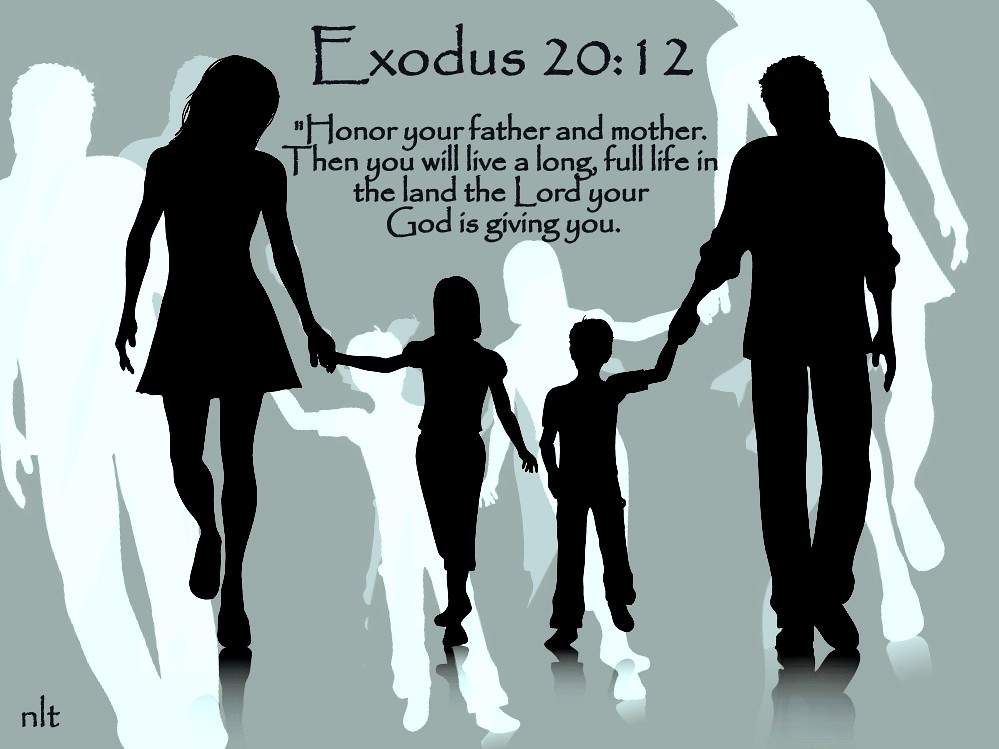
12 “Honor (respect, obey, care for) your father and your mother, so that your days may be prolonged in the land the Lord your God gives you.

The Word of God for the Children of God. Gloria! In Excelsis Deo! Alleluia! Amen.

This week I saw a posting on social media which asked these questions:

“What’s the #1 thing you want from your children?”

“What’s the #1 thing you want from your mom and dad?”

I was struck by the depth of answers along with the longing in the hearts of the children for their parents, parents for their children to love and serve the Lord.

• To know God and make Him known.

• To have the ability to see God’s presence in all circumstances.

• Respect and obedience to God.

• I want them to love God deeply in their heart leading to serving and glorifying Him with their lives.

• To be sold out to Jesus.

• For them to taste and see that the Lord is good, thus causing them to love the Lord with all that they are.

• Love and respect.

• To love and obey Jesus for themselves.

After all these thoughtful responses, one person answered the question, “What’s the #1 thing you want from your children?” this way…

• To be quiet.

One person responded to him this way, “He didn’t ask what wives want from their husbands!”

Another one quickly commented, “Sir, you know going get criticized for that!” To which that ‘father’ replied, “I am counting on it.”

He further shared his insight into his response.

He redeemed himself when he wrote,

“Being quiet isn’t obviously the #1 thing but I think it’s something as you get older you see the value in being quiet. Sit still! Be quiet when God is telling you something. Be quiet when someone with more experience is talking.”

All I could think to myself was;

“Right on!”

Behind each of these posts from parents is a longing for their children to honor them, and to honor God.

In the fifth commandment, recorded in Exodus 20:12, we discover the #1 thing God wants from His children: “Honor your father and your mother, that your days may be long in the land that the LORD your God is giving you.”

Deuteronomy 6:6-7 tells us these commands are to be inscribed on our hearts so we can impress them upon our children.

Today, as a way to get these commandments into our heads and into our hearts,

I am encouraging families in the course of their celebrations today, to spend a little bit of “Father to Children” “Children to Father” time to make a bookmark and work together at reading and sharing and memorizing these short phrases.

1. One God

2. No idols

3. Revere His Name

4. Remember to Rest

5. Honor Parents

6. No murder

7. No adultery

8. No stealing

9. No lying

10. No coveting

Listen again to the command from Exodus 20:12:

“Honor your father and your mother, that your days may be long in the land that the LORD your God is giving you.”

Our main idea is this: Honoring your parents is always proper.

After making some observations, we’ll contemplate the precept. Then, we’ll consider the promise and conclude with how to practice this commandment.

Observations

1. This is a hinge commandment.

The first four commands deal with our relationship with God. The final six relate to our relationships with others.

The fifth commandment establishes that loving our neighbor starts at home.

When we’re out of step at home we’ll be out of whack with God and others. “The relationship between parent and child is the first and primary relationship, the beginning of all human society.”

2. This is the first commandment dealing with the family.

The fifth commandment focuses on the parent-child relationship while the seventh commandment calls us to marital fidelity. Family life is the bedrock of a culture. As the family goes, so goes the nation, and the church.

3. This is given to children of all ages.

The atmosphere of the home is in large part related to the response of the children, not just to the loving leadership of the parents.

4. This command is a present imperative, which means we are to be in the habit of honoring continually.

This is not a suggestion but rather an uncompromising command.

5. This command is directed to each of us.

The word “your” is used four times and “you” is used once.

The Precept

This precept is relatively simple to understand and yet fierce in its force: “Honor your father and mother…” “Kavod” is the Hebrew word for honor and respect. The word “honor” literally means a “heavy weight.”

To “honor” is to assign the greatest possible weight to a person in terms of respect by holding them in “high regard.”

We say of someone we really respect: “She’s worth her weight in gold” or, “he’s a heavyweight.”

On the other hand, to “dishonor” means to treat someone as if they were “light or insignificant.”

To honor is to treat with distinction; to dishonor is to treat someone like dirt.

The opposite of honor is “in vain,” which means “empty, useless, and of no value.”

To honor our parents is to give them their full due weight. We’re to honor our parents because of their position, not necessarily because of their performance.

Scripture tells us eight times to “honor your father and mother.” It’s repeated so much because it doesn’t come naturally to us.

The word “honor” is the same word translated “glory” in reference to the Lord.

To glorify the Lord is to assign Him the highest and heaviest place because He deserves it.

Interestingly, the only entities we’re to honor, according to the first five books of the Bible, are the Lord and our parents.

The Dictionary of Biblical Imagery offers a helpful definition:

“To show honor entails an affective side (a feeling of respect or reverence) and a set of outward manifestations, such as gestures (bowing before or being attentive) or actions (conferring titles or privileges). All these ways of showing honor elevate the person that is honored.”

The emphasis here is on the attitude, not merely the act.

We’re to show honor in both our attitudes and in our actions.

To honor is to elevate and to esteem and to live it out in experience.

Let’s consider how this word is used in two other passages.

• Honoring the elderly is linked to honoring the Almighty. Leviticus 19:32:

“Stand up before the gray head and honor the face of an old man, and you shall fear your God: I am the Lord.”

I wonder if this verse will be in someone’s Father’s Day card this year!

• We prioritize honor according to what we prize highly.

Speaking of wisdom, Proverbs 4:8 says: “Prize her highly, and she will exalt you; she will honor you if you embrace her.”

I came across a simplified definition of honor you could use with your kids or grandkids.

It’s from the book, Say Goodbye to Whining, Complaining, and Bad Attitudes in You and Your Kids by Turansky and Miller.

• Treating people as special.

• Doing more than what’s expected.

• Having a good attitude.

The Promise

We see a promise connected to this command in the second half of verse 12: “…that your days may be long in the land the Lord your God is giving you.”

When the Apostle Paul quoted this command in Ephesians 6:2 he added, “this is the first commandment with a promise.”

Actually, this is the only commandment which spells out the benefits of keeping it. Honor is so honorable God Himself underscored it with a promise.

God is a promise-making and promise-keeping God.

It’s been estimated there are over 30,000 promises in the Bible, which 2 Peter 1:4 calls, “…His precious and very great promises…”

These promises help us see honoring your parents is always proper.

Here’s a list of positive promises from the Bible associated with this command.

1. Your life will generally be longer.

This ultimately refers to the duration of the nation of Israel in the land but also has personal application for believers as we see in Ephesians 6:3: “That it may go well with you and that you may live long in the land.”

The phrase, “live long in the land” was identified with the fulfillment of God’s blessings, not a blanket promise for a long life.

2. You will experience blessing. 

Deuteronomy 5:16: “Honor your father and your mother, as the LORD your God commanded you, that your days may be long, and that it may go well with you in the land that the LORD your God is giving you.”

The word “well” is an adverb meaning “fine, well, good, or beneficial.”

3. It is the right thing to do. It’s always right to honor our parents. 

Ephesians 6:1: “Children, obey your parents in the Lord, for this is right.”

The Puritans taught that a child should be the parent’s echo. When the parent speaks, the child should echo back with honorable obedience.

4. It teaches respect for authority.

When honor is taught in the home, it will spread to other areas of a child’s life.

Jen Wilken writes: “This life is the lab in which God’s children learn to submit to heavenly authority by submitting to earthly authority.” 

Romans 13:1-2: “Let every person be subject to the governing authorities. For there is no authority except from God, and those that exist have been instituted by God. Therefore, whoever resists the authorities resists what God has appointed, and those who resist will incur judgment.”

Billy Graham said, “A child that is allowed to be disrespectful to his parents will not have respect for anyone else.”

5. God provides protection for those who honor their parents. 

Proverbs 6:20-23: “My son, keep your father’s commandment, and forsake not your mother’s teaching. Bind them on your heart always; tie them around your neck. When you walk, they will lead you; when you lie down, they will watch over you; and when you awake, they will talk with you.”

6. You will bring peace and joy to your parents. 

Proverbs 15:20: “A wise son makes a glad father, but a foolish man despises his mother.”

7. You will grow in wisdom and insight. 

Proverbs 4:1-4: “Hear, O sons, a father’s instruction, and be attentive, that you may gain insight, for I give you good precepts; do not forsake my teaching. When I was a son with my father, tender, the only one in the sight of my mother, he taught me and said to me, ‘Let your heart hold fast my words; keep my commandments, and live.’”

8. God is pleased when you honor your parents. 

Colossians 3:20: “Children, obey your parents in everything, for this pleases the Lord.”

9. God will turn your heart back home.

We see this promise in Malachi 4:6, the last verse of the Old Testament, when God will

“turn the hearts of fathers to their children and the hearts of children to their fathers, lest I come and strike the land with a decree of utter destruction.”

The Dangers of Dishonoring

Disobedience to parents is listed along with other heinous sins in

Romans 1:30-32: “Slanderers, haters of God, insolent, haughty, boastful, inventors of evil, disobedient to parents, foolish, faithless, heartless, ruthless. Though they know God’s righteous decree that those who practice such things deserve to die, they not only do them but give approval to those who practice them.”

One of the signs of the end times will be the increasing disobedience of children according to 2 Timothy 3:1-2: “But understand this, that in the last days there will come times of difficulty. For people will be lovers of self, lovers of money, proud, arrogant, abusive, disobedient to their parents.”

Today, families are under attack, with parental authority being questioned and disregarded.

Years ago, the Duke of Windsor observed,

“The thing that impresses me about America is the way parents obey their children.”

The Bible says it’s dangerous for children to disobey.

While there are beautiful blessings for obedience, there are also some negative promises associated with breaking this command.

God has a deep revulsion toward anyone who revolts against their parents.

1. A shortened life. Cursing a parent was a capital offense and punishable by death. 

Exodus 21:15, 17: “Whoever strikes his father, or his mother shall be put to death. Whoever curses his father, or his mother shall be put to death.”

Proverbs 20:20 adds, “If one curses his father or his mother, his lamp will be put out in utter darkness.”

2. An uncomfortable life.

Parents, you might want to quote Proverbs 30:17 the next time your teenager rolls their eyes at you:

“The eye that mocks a father and scorns to obey a mother will be picked out by the ravens of the valley and eaten by the vultures.”

3. A cursed life. The word “diss” means to disrespect. If you diss or dishonor your parents, 

Deuteronomy 27:16 says God will bring punishment: “Cursed be anyone who dishonors his father or his mother…”

4. An exiled life. Are you aware one of the reasons the Jews were sent into Babylonian exile was a failure to honor their parents? 

Ezekiel 22:7, 15: “Father and mother are treated with contempt…I will scatter you among the nations and disperse you through the countries…”

Honoring your parents is always proper.

Years ago, I read an article from Focus on the Family and still reference it today.

The basic idea is our parenting roles change as our children grow.

I don’t have time to explain it fully but here are the four phases:

• Commander

• Coach

• Counselor

• Consultant

If you want to learn more,

Go to Focus on the Family.com to the article “The Four Phases of Parenthood.”

Putting it into Practice

As always, Jesus provides the best model of how to obey this command.

1. Jesus honored His parents by being submissive to them.

We read this about Jesus as a preteen in Luke 2:51: “And He went down with them and came to Nazareth and was submissive to them. And his mother treasured up all these things in her heart.”

2. Jesus honored His earthly mother by providing care for her.

It’s incredible that while He was on the cross, about to pay the price for all of our sins, He took the time to keep the fifth commandment by making sure His mom would be cared for when He was gone. 

John 19:26-27: “When Jesus saw His mother and the disciple whom He loved standing nearby, He said to His mother, ‘Woman, behold, your son!’ Then He said to the disciple, ‘Behold, your mother!’ And from that hour the disciple took her to his own home.”

3. Jesus honored His Heavenly Father by becoming a sacrificial servant.

Philippians 2:7-8: “But emptied Himself, by taking the form of a servant, being born in the likeness of men. And being found in human form, He humbled himself by becoming obedient to the point of death, even death on a cross.”

The fifth commandment applies to everyone, no matter your age or stage in life.

We are called to honor our parents, whether they’re alive or not. As a way to help us to put this commandment into practice, let’s focus on five questions.

Questions to Ponder

1. How are you doing showing honor to others?

According to Romans 12:10 we’re to “outdo one another in showing honor.”

2. In what specific ways are you honoring or dishonoring your parents?

Have you been treating them as distinguished or like dirt?

Do you consider their advice and their role in your life as weighty or worthless?

Proverbs 1:8 challenges us to hear and heed what our parents tell us: “Hear, my son, your father’s instruction, and forsake not your mother’s teaching.”

Proverbs 23:22: “Listen to your father who gave you life, and do not despise your mother when she is old.”

You may be asking a couple questions at this point.

Do I still need to obey my parents now that I’m an adult?

How do I honor my parents even if I disagree with them on some things?

Here’s my short answer:

The biblical command to obey your parents, when you become an adult, and the biblical command to honor your parents never expires.

Obeying your Parents and Honoring your parents is always proper.

Here are 10 practical pointers to help us honor our parents:

• Take initiative to improve the relationship in whatever increments you can.

• Recognize your parents have done some things right and some things wrong.

• Forgive them, even as God in Christ has forgiven you.

• Thank your parents for the sacrifices they have made for you.

• See your parents as Christ sees them.

• Treat them with kindness.

• Support and care for them.

• Always speak well of them, whether they are alive or not.

• Esteem them publicly and privately.

• Don’t forsake them.

3. Parents, in what ways are you showing honor to your kids? 

Colossians 3:21 says, “Fathers, do not provoke your children, lest they become discouraged.”

Let’s make sure we’re being good examples and not exasperating our children.

Do all that you can to make it easier for them to honor you.

Ray Fowler writes: “You can’t change your ancestors, but you can do something about your descendants!”

4. Adults, how are you honoring your aging parents today? Are you looking for ways to demonstrate care and concern?

 1 Timothy 5:8: “But if anyone does not provide for his relatives, and especially for members of his household, he has denied the faith and is worse than an unbeliever.”

I’m reminded of the Grimm’s Fairy Tale about a family with two children and an elderly grandfather.

The grandfather could no longer eat neatly at the table. At first the parents rebuked him; then made him sit in the corner; eventually took away his knife, fork and spoon, placed food in a trough where he would eat with his fingers.

One day the dad saw his children playing outside with some wood, a hammer, and a saw.

“What are you building?” he asked.

They replied: “A trough for you when you get old!”

Are you taking care of your elderly parents?

What are you teaching your children right now about honoring the elderly?

5. In what ways are you showing honor to God, Your Father?

Is God weighty to you or do you regard Him as worthless? 

Psalm 29:2: “Ascribe to the Lord the glory due His name; worship the Lord in the splendor of His holiness.”

God blesses the people when their parents are honored, but the people are punished when they do not.

To honor is to hold someone in high regard or reverence.

The word honor does not mean agree with or even obey but does suggest in this context that a child should hold respect for their parent.

Now as we better understand the scriptural context and interpretation of the 5th commandment to honor thy mother and father, we can discern how this precept applies to modern-day life.

Ways we can appropriately honor our parents include:

Expressing Gratitude

Parents invest time and effort into raising children.

Those reasons alone are enough to show them gratitude for the sacrifices they make.

Parents provide shelter, food, clothing.

For every action they do in support of the child is itself a reason for appreciation.

Spending Time Together

When physically possible, children can and should get together with their parents.

This acknowledges their existence and places a level of importance upon the relationship.

If being together physically is not an option, calling a parent on the phone for a check-in is also beneficial. 

Serve

Another way to honor parents is to find ways to serve their wants and needs, much like parents perform on behalf of children.

To Honor or Not to Honor

Modern parenting is not equivalent to the parenting in biblical Jewish culture.

Children today learn differently and have certain responsibilities such as owning a cell phone, which was not true for past generations.

No matter the time, parents should always be honored.

One concern some followers and nonbelievers have with the commandment is the issue of bad parents, individuals who have abused their children by various means.

The Bible does not qualify which parents deserve honoring.

Additionally, Jesus mentions we are to love others as ourselves (Matthew 22:39) and to bless those who persecute us (Romans 12:14).

We, therefore, know that even when seemingly impossible, we should do our best to express love.

This commandment, however, does not advocate for putting ourselves in danger with bad parents.

Applying this commandment for children who have been abused may look different in terms of how they show their honoring.

Spending time together may be an impossibility but talking on the phone or writing a letter could be an option depending on the circumstance.

Sometimes we have to set boundaries in relationships, and whenever that is the case we can pray to God for wisdom, so that we may honor His commandment and honor our parents while keeping ourselves safe (James 1:5).

https://www.biblestudytools.com/bible-study/topical-studies/a-biblical-command-we-never-outgrow-honor-your-father-and-mother.html

In the name of God, our Father and God the Son and God the Holy Spirit,

Let us pray,

Father God thank you for your perfect fathering –

I praise you because I am fearfully and wonderfully made;

shepherded and nurtured; disciplined and challenged

so I can flourish in your purpose and plan for me

and bear my Father’s image more fully still.

Father God, thank you for your perfect example.

I praise you because you show all fathers how to love;

to shepherd and nurture; discipline and challenge

so their sons and daughters can flourish in this world as you have planned,

and carry your presence to all they meet.

Father God, bless all fathers today –

   with wisdom, with patience, with courage –

and above all with love for their children.

Father God, bless all children today –

   with openness to correction, with eagerness to learn –

and above all with love for their fathers.

Father God bless all who are fatherless today –

   surround them with godly men to teach, affirm and guide –

and above all to love with the love of a father – in your strength.

Amen.

https://translate.google.com/