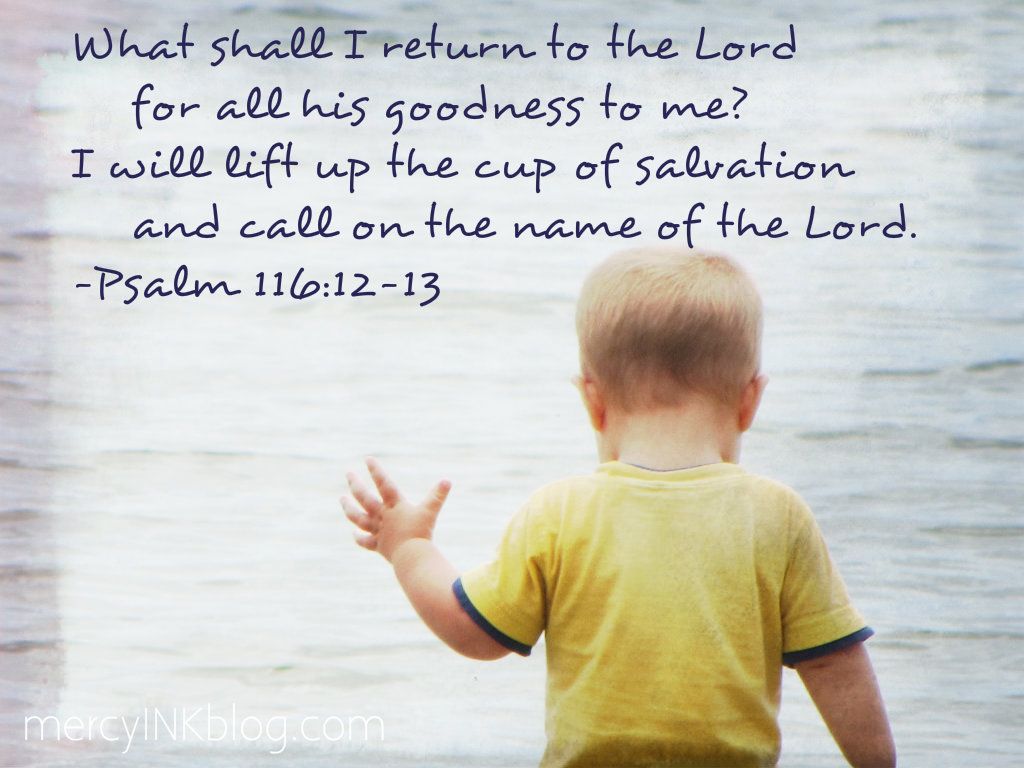
How Can We Use All Our Creative Talents to Thank and Glorify God? Psalm 116:12-19

When in our music God is glorified,
And adoration leaves no room for pride,
It is as though the whole creation cried:
Alleluia!

How often, making music, we have found
A new dimension in the world of sound,
As worship moved us to a more profound
Alleluia!

So has the Church, in liturgy and song,
In faith and love, through centuries of wrong,
Borne witness to the truth in every tongue:
Alleluia!

And did not Jesus sing a Psalm that night
When utmost evil strove against the light?
Then let us sing, for whom he won the fight:
Alleluia!

Psalm 116:12-19 The Message

12-19 What can I give back to God
    for the blessings he’s poured out on me?
I’ll lift high the cup of salvation—a toast to God!
    I’ll pray in the name of God;
I’ll complete what I promised God I’d do,
    and I’ll do it together with his people.
When they arrive at the gates of death,
    God welcomes those who love him.
Oh, God, here I am, your servant,
    your faithful servant: set me free for your service!
I’m ready to offer the thanksgiving sacrifice
    and pray in the name of God.
I’ll complete what I promised God I’d do,
    and I’ll do it in company with his people,
In the place of worship, in God’s house,
    in Jerusalem, God’s city.
Hallelujah!

The Word of God for the Children of God.

Adeste Fideles! Laeti Triumphantes! Venite Adoremus! Dominum.

Gloria! In Excelsis Deo! Alleluia, Alleluia, Alleluia, Amen.

What Shall I Render Unto the Lord?

The Psalmist expresses the depths of his love for the Lord because God hears and God answers unto His children when they call to Him.

In this Psalm, his song of deepest praise, the Psalmist recalls the many troubles and sorrows he has already encountered, then unleashes upon all his readership exactly how gracious and exactly how compassionate the Lord has been to him.

The Lord heard his cry for help, the Lord rescued him from death and despair.

And as the Psalmist remembers the merciful kindness and patient grace of the Lord towards him, he cries out,

“How can I repay the LORD for all the good He has done for me?

What can I give to the LORD for all he has done for me?

What shall I render to the LORD For all His benefits toward me?”

The Psalmist knows there is so much he wants to do to say “Thank You, God!”

Yet also within this psalm, the Psalmist knew, as we do, that there is nothing that we can do to exactly repay the Lord for all His grace and love towards us.

There is no amount of payment or reward that we can offer to God that could possibly pay Him back for the miraculous, wonderful things He has done for us.

There is nothing we can do, but we can surely offer Him our sacrifice of praise.

We can pour out our whole heart of gratitude to Him for our great salvation.

We can tell others, we can shout and sing to others of the wonders of His grace and mercy, and we can render unto God our hearts, to seek to do His will with a willing and obedient heart that is overflowing with love for our gracious Savior.

Oh! I wish I could influence God, but God is never influenced by man’s foolish attempts to repay Him for what He has freely given as an eternal gift of grace.

There is nothing we can do to repay the Lord for all His goodness and loving-kindness He has shown towards us, but we can live a life that is pleasing to Him by trusting His Word and seeking in all that we say and do to live a godly life.

We can render unto God our gifts and our talents, to walk in spirit and truth, submitted to the guidance and the leading of the Holy Spirit, and letting the love of Christ shine through us in thought and deed, to the glory of the Father.

We Can Use All Our Creative Talents to Glorify God

Psalm 138:4-6 The Message

4-6 When they hear what you have to say, God,
    all earth’s kings will say “Thank you.”
They’ll sing of what you’ve done:
    “How great the glory of God!”
And here’s why: God, high above, sees far below;
    no matter the distance, he knows everything about us.

It is written in the very first line of the Bible: “In the beginning God created…” (Genesis 1:1, emphasis added).

Creativity begins with God.

He had a plan and had a good design for the cosmos and spoke it into being.

We have a written account of how creation came to be, and how the very first people were made by God. God spoke, made, and revealed it all through the written word – He was behind the entire creative order that we see around us.

When we look at the intricacy of a snowflake or a leaf or a spider web, the symmetry of a butterfly, or the perfect location of the earth’s position in the rest of the solar system, we witness to all the handiwork of our Creator God.

He also planned that we would be made in His image (Genesis 1:26), so it is no surprise that we get to experience the wonder and joy of creativity ourselves.

With all of the wonders and miracles of this creative potential surrounding us every single day we live, how can we use our creative talents to glorify God?

Give All the Glory to God Alone

Whatever we do, we are to do it to the glory of God (1 Corinthians 10:31).

That includes our creative endeavors.

As the apostle Paul shared,

“Whatever you do, work at it with all your heart, as working for the Lord, not for human masters, since you know that you will receive an inheritance from the Lord as a reward. It is the Lord Christ you are serving” (Colossians 3:23-24).

In Colossians 1:16 it says: “For in him all things were created: things in heaven and on earth, visible and invisible, whether thrones or powers or rulers or authorities; all things have been created through him and for him.”

It is through Jesus that everything has been made and it is all for Him (John 1:3).

God made the universe through His Son (Hebrews 1:2) and it is by faith that “we understand the universe was formed at God’s own spoken command, so what is seen was not made out of what was visible” (Hebrews 11:3).

It’s right, it’s good, it is an abundantly authentically joyful thing, to always give all of the glory to the only One who made it all, for whom it is all for.

It also fulfills the command to “love the Lord your God with all your heart, and with all your soul, and with all your mind, and with all your strength” (Luke 10:27).

What we create should not ever be worshiped, nor should we glorify ourselves or others in ours or theirs creative pursuits.

That does not mean that we do not enjoy or appreciate what we create, what they create but we remember to keep our love, affections in their rightful place.

Participate in God’s Masterpiece

We have the immense privilege of joining with God in His creative purposes for the world.

It was God’s wonderful idea to create people and to get the first man to name the livestock, the birds and the wild animals (Genesis 2:20).

God “brought them to the man to see what he would name them; and whatever the man called each living creature, that was its name” (Genesis 2:19).

This was God’s idea to involve us, not an idea of our own making.

God made the first woman as a helper, creating her from the rib of the man, and he named her too (Genesis 2:21-23).

They would work together in the world.

God invites us to participate in His grand design on earth, and invites us into actively participating in mission and ministry for His own kingdom purposes.

We are made in His image and formed by Him, God has a plan and a purpose, establishing our steps (Proverbs 16:9).

We can use our creative talents for good or for ill, but as we look to Jesus, our desires will become more and more like His.

Using our gifts of creativity enables each of us to singularly, uniquely, express a critically important part of who God has designed us all to be (Psalm 139:13-16).

That will definitely look different for each person, as we are all individuals with unique gifts, talents and abilities, yet we are, each and every single one of us, all “fearfully and wonderfully made” shaped, by Him in His Image (Psalm 139:14).

Love Others with Our Creativity

It is important to remember the first two commandments as we create: love the Lord your God and love your neighbor as yourself.

Loving the Lord always comes first.

We need to spend time with Him regularly; it is vital to build and nurture a relationship with our Heavenly Father.

As we do this, it will transform our longings, desires to love and serve others. 

God loves the people whom He created, and He designed us to be in community together.

As we create to the glory of God and out of love for Him, it will spill over into how we use our gifts, talents, time and creative resources for edifying others.

This might look like caring for those in need, volunteering our skills, designing something to the best of our ability with utmost integrity, photographing or painting beautiful landscapes to show God’s work on display, so much more.

There are endless opportunities to be creative.

The people in our homes, communities and the wider world can be unbelievably and miraculously blessed, truly uplifted, inspired by our God-given creativity.

Manage Our Creative Talents Well

We are to steward what God has given us and remember that all good gifts come from Him (James 1:17).

Even as we are diligent and disciplined with our time, resources and creative talents, we can continue to learn and develop and mature in our creativity.

As we look to Him who is the giver and provider of all we need, we worship Him alone, rather than anything that we create.

Throughout the Bible, there are examples of humans using their gifts and abilities to create things to worship other than God.

We saw it when the Israelites created a golden calf to worship (Exodus 32) and in the construction of the Tower of Babel (Genesis 11:1-4).

In both cases, they made a god or a name for themselves, demonstrating the skill, but also the deep-rooted malignant pride too characteristic of mankind.

Even idolizing people made in the image of God lends itself to the worship of the creation rather than the Creator (Romans 1:25).

There is risk and temptation to pursue and follow created things and step into idolatry, rather than to the single minded single directed worship of our God.

Therefore, we must bring our creativity before the Lord, knowing it is Him that we are serving, and we should use our gifts and talents respectfully and wisely.

Embrace the Skills Given to Us

God gives skills to different people.

We are all given certain abilities, even if it may take us a little while to discover or develop what they are.

In the building of the Tabernacle, there were many who had different skills given to them by God which would be used to complete it:

“All who are skilled among you are to come and make everything the Lord has commanded” (Exodus 35:10).

It is a beautiful picture of some of God’s people who were “willing and whose heart moved them” and brought materials and offerings to God for this work (Exodus 35:21-22).

Men and women all participated together, and there was a fervent willingness, highly developed skill involved to make what God had commanded come to be.

Are we also willing to offer our skills in whatever way is needed for God’s glory and purpose?

God Equips Those Who He Calls

God also equips those whom He calls to a specific task.

In the building of the Tabernacle, the Lord chose Bezalel of the tribe of Judah, and filled him with the Spirit of God, with wisdom, understanding, knowledge and all kinds of skills, to make artistic designs (Exodus:35:30-34).

He also equipped him and Oholiab of the tribe of Dan to be able to teach others. God is the one who fills us with the skills for the tasks that He has called us to.

The creative process means walking through trials and frustrations at times, but can also develop our perseverance and character.

God can use our creativity to shape and transform us into the likeness of Jesus as we seek to use our creative talents for His glory.

He is interested in our hearts.

As we create, we can ask Jesus to help us honor Him in our pursuits.

We can use our gifts and talents and our creativity to build up believers, spread the good news to those who do not know Jesus, support those in need, and use it as a way to provide an income for our families and programs of our churches.

As we surrender, yield to God, continually thinking “not my will but yours be done,” He takes our creative offering, transform it for His glory and purposes.

God saw the two loaves and five fish, and He was the One who filled the crowd.

Give Him your imagination, your creative talents, your need to express your gratitude, no matter how big or small, let Him deeply satisfy your every need.

As pastor and theologian Reverend Dr. John Piper said:

“God is most glorified in you when you are most satisfied in him.”

In the name of God, the Father and God the Son and God the Holy Spirit,

Let us Pray,

My dear loving Heavenly Father, I just want to thank You for loving me so much that You sent Your Son to die for me so that I might live with You forever. Thank You, Father, for the innumerable ways that You demonstrate Your love, protection, and provision toward me. I pray that I may have an attitude of gratitude toward You in all I say and do so that You are praised and glorified in my life. Remember all those artists, inspire their diverse creative gifts, those whom you have placed among us, for are they not, O Lord, the fellows of your inspiration? Do they not, Lord God, bring to your people great proof of your divinity and our part in it? In Jesus’ name, AMEN.

Adeste Fideles! Laeti Triumphantes! Venite Adoremus! Dominum.

Gloria! In Excelsis Deo! Alleluia, Alleluia, Alleluia, Amen.
https://translate.google.com/

Pondering my Christianity! When I am “Called to Account.” When I “know” that only One Whopper of an Excuse will get ME through a Crisis. Exodus 32

Exodus 32:1-5Amplified Bible

The Golden Calf

32 Now when the people saw that Moses delayed coming down from the mountain, they gathered together before Aaron and said to him, “Come, make us a [a]god who will go before us; as for this Moses, the man who brought us up from the land of Egypt, we do not know what has become of him.” So Aaron replied to them, “Take off the gold rings that are in the ears of your wives, your sons and daughters, and bring them to me.” So all the people took off the gold rings that were in their ears and brought them to Aaron. And he took the gold from their hands, and fashioned it with an engraving tool and made it into a molten [b]calf; and they said, “This is your god, O Israel, who brought you up from the land of Egypt.” Now when Aaron saw the molten calf, he built an altar before it; and Aaron made a proclamation, and said, “Tomorrow shall be a feast to the Lord!”

Exodus 32:21-24Amplified Bible

21 Then Moses said to Aaron, “What did this people do to you, that you have brought so great a sin on them?” 22 Aaron said, “Do not let the anger of my lord burn; you know the people yourself, that they are prone to evil. 23 For they said to me, ‘Make us a god who will go before us; as for this Moses, the man who brought us out of the land of Egypt, we do not know what has become of him.’ 24 I said to them, ‘Let whoever has gold [jewelry], take it off.’ So, they gave it to me; then I threw it into the fire, and out came this calf.”

The Word of God for the Children of God. Gloria! In Excelsis Deo! Alleluia! Amen.

Accountability is absolutely essential for any society to function, and Christian accountability is no different. We are all held accountable in one way or another.

For example, there are laws to obey and if we fail to be obedient, we may have to be called to account and suffer the consequences set by the officials who hold us accountable. One’s accountability is simply being responsible for one’s actions.

Pathological excuse making (lying) is not a clinical diagnosis, though it can sometimes be a very definitive symptom of many other underlying issues.

Some people get so accustomed to lying they do so even when there is no clear purpose, and when their lies are easily disproven, leaves everyone scratching their heads over the point of their efforts at so easily creating the deceptions.

Over the years, I’ve experienced a large number of these people — and I have gained some insight into the ways they initially think, react and they speak.

Believe it or not, their rationales and reactions make some “obvious” sense, when you look at it through their eyes and listen to them try to explain them.

Here are some of the reasons behind their ‘rational’ reactionary excuse making.

1. The lie does matter to them. The number one reason people make excuses when it just doesn’t matter is because they actually do think it does matter.

While everyone around them thinks it’s an inconsequential issue, the liar believes it is critically important. They may be putting undeserved emphasis or pressure on themselves, or on the issue, but you won’t know unless you ask something like, “It seems like this issue is really important to you — why?”

2. Telling the truth feels like giving up control.

Often, people tell make excuses because they are trying to control a situation and exert influence toward getting the decisions or reactions they want. The truth can be “inconvenient” because it might not conform to their narrative.

3. They make their excuses because they don’t want to disappoint or harm you.

It may not feel like it to you, but people who tell one excuse after the other are often worried about their losing the respect of those around them. They want you to like them, be impressed, believe and value them. And they’re worried that the truth might lead you to rejecting or shaming them.

4. Lies lead to more lies.

I am sure we all saw the movie Pinocchio where his nose grew every time he lied. We tell a little bitty lie, but then to cover that lie, we have to tell another one, then another, and another — each gets bigger and bigger.

Finally, we’re arguing about senseless points because to admit anything correct creates the real (but unwanted) potential of the entire house of cards tumbling.

If a chronic liar admits to any single lie, they feel like they’re admitting to being a liar, and then you’ll have reason to distrust them and just cast them aside.

5. it’s not a lie to them.

When under pressure, our thinking about the big picture can be challenged.

Our memory of things is actually quite unreliable.

Our memories are influenced by many things, that they change over time, and that they are essentially reconstructed each time we think about them.

Often, repetitive liars feel so much pressure in the moment that their memory becomes simply unreliable. When they say something, it’s often because they genuinely believe, at that moment, that it is the truth.

Their memory has been overwhelmed by stress, current events, and their desire to find a way, find any way, to make this particularly stressful situation work.

Sometimes, this can become so severe that the person almost seems to have created, generated and then fully manifested, a complete alternate world in their head, one that conforms to their moment-by-moment beliefs and needs.

6. They desperately need and want it to be true.

Finally, the excuse maker might want their excuse to be true so badly that their desire and needs again compel and overwhelm their instinct to tell the truth.

Sometimes, excuse makers hope that they can make something come true by “sheer will” saying it over and over, and by believing it as hard as they can.

In today’s environment of “alternative facts and weaponized narratives,” it’s hard particularly hard not to see this as somewhat justified.

Please remember this – People, by and large, are accountable, honest by default.

Most people tell the truth most of the time.

Our very capacity for language is built on an assumption of honesty — we agree the words we use mean the very same thing consistently, and we do not seek to deliberately use words deceptively because this would render language and the very communication of ideas would become “weaponized” and implausible.

Some people lie more than others, but even frequent liars are actually honest most of the time. But it stands out dramatically when their deceptions are so blatant, so easily disproven, and seemingly implausible and unimportant.

As frustrating as it is when people tell whoppers, we can begin to understand the motivations behind them.

Asking the person, “Why is this situation so important to you?” or,

“Why do you need me to see this the same way you do?” can be a useful, non-threatening way to get at the foundations of stress and desperation that often underlie deceptions.

Don’t ask, “Why are you lying?”

We need to remember that the person is often motivated by not being seen as a liar, and this question paints them into a corner they are going to fight against.

Of course, understanding a “Whopper of an Excuse” makers motivations and having empathy in such situations is valuable.

But to function effectively in the real world, we also need people to learn to be more honest and accountable to their actions and ever apparent dishonesty.

Communicating empathy for a person’s desperation can be a valuable tool to give them permission to tell the truth.

And then, recognizing and reinforcing when a person does tell the truth is a powerful way to get more truth-telling. It shows people that the truth is not actually scary, and that the world won’t end when the real truth comes out.

Exodus 32:21-24Amplified Bible

21 Then Moses said to Aaron, “What did this people do to you, that you have brought so great a sin on them?” 22 Aaron said, “Do not let the anger of my lord burn; you know the people yourself, that they are prone to evil. 23 For they said to me, ‘Make us a god who will go before us; as for this Moses, the man who brought us out of the land of Egypt, we do not know what has become of him.’ 24 I said to them, ‘Let whoever has gold [jewelry], take it off.’ So, they gave it to me; then I threw it into the fire, and out came this calf.”

Today we are going to learn how Moses’ brother Aaron when confronted for making a molten calf communicates to Moses that “Whopper of an Excuse.”

Let’s jump into today’s scripture to find out all the details.

We have in this chapter an interesting contrast between man’s way of worship and God’s way of worship.

Moses was in the Mount receiving from God careful instruction as to how future worship was to be conducted.

Its aim was in order to prevent any misconception of God.

But here at ground level, the people, assisted by Aaron, worked out their own way of worshipping God.

A way that could only have led them back into idolatry and rejection of all that was good and right in what the only living true God Yahweh had given them.

The chapter begins with the people being fearful of what has happened to Moses and rebelling against Yahweh.

Moses was in the Mount for forty days and forty nights receiving his written instructions from Father God Yahweh.

The people waiting in the plain below became restless, uneasy to worship.

They had somewhat fearfully seen him ascend and disappear into the cloud and then they had waited and waited, and he had not returned.

After that a whole moon period had passed and he had still not returned.

They knew personally the fearful nature of this God Who was in the Mountain and the warning of what would happen to any who approached the Mountain (Exodus chapter 32 verses 19.21).

Thus, they began to feel certain that they would not see Moses anymore.

By now they were most likely not sure whether they wanted to have anything more to do with this terrible God Who revealed Himself in the way that He had and had made such terrible threats against their lives if they dare approached.

They had agreed a covenant with Him out of a combination of gratitude and fear, but now they were not so sure that that was what they wanted.

They preferred gods with whom they could be more familiar, like the gods they had known in Egypt whom others worshipped.

Exodus 32:1 Amplified

The Golden Calf

32 Now when the people saw that Moses delayed coming down from the mountain, they gathered together before Aaron and said to him, “Come, make us a [a]god who will go before us; as for this Moses, the man who brought us up from the land of Egypt, we do not know what has become of him.”

It is understandable that the people would become alarmed.

In their minds, their very nerves had reached a breaking point at some of the revelations from the mountain. And Moses had now been gone for a long time.

Yes, the God Yahweh had delivered them, but they decided they wanted nothing to do with this God of the mountains whom unseen and who frightened them.

Does this “worship” sound like something straight out of our 21st century?

Worshipping a “God who was threatening and punitive versus all about “love?”

If one feels they have to choose between an always “threatening” and an always “punitive” versus an always “loving” and always “empathetic” God, which pew do you believe people will feel more compelled towards ‘visibly’ worshipping?

Rather would the Israelites like to approach Yahweh through the kind of images they were familiar with in Egypt, awe inspiring, but without causing trouble?

They wanted a god which was created by human hands to human standards and made to their socio-cultural, their own working socio-economic requirements.

As you know up to this point it was Yahweh Who had gone before them in the pillar of cloud and fire.

But that pillar had disappeared onto the mountain along with Moses.

Now they wanted visible representations of Yahweh instead, so that He could go before them in a way that was controllable.

They wanted Yahweh’s power on their behalf, they wanted to feel comfortable with Him.

They had had enough of this fierce God of the mountains, who fortunately for them and their personal security and physical safety, seemed to remain in the Mountain. They wanted to be on their way, and quickly, so that they could get away from Him. Thus, they demanded of Aaron to make their man-made God.

Now to see this in 2022, in a way, you have to consider the pressure on Aaron.

The people gathered together and sought him out. They were in an ugly mood and Aaron felt threatened. – Does this sound .1% familiar to our 2022 church?

Their confrontation with Aaron was a serious mixture of contempt and anger.

And here is where all the vitriolic excuses start flying in every which direction.

…. “After all he and Moses were the ones who “brought all this upon them.””

But their resentment is loud and clear, filled with high potential for violence.

No sympathy with Moses, only enmity.

Yes, he had delivered them from Egypt, but what had happened to him now?

He had trusted this mountain God, who surely was not the Yahweh Who had delivered them out of Egypt.

And look what good it had done him.

Where was he?

He had disappeared and they did not know where he was.

Indeed, in their minds he was most probably dead – never to be seen again.

And he deserved it. What they wanted was immediate help and assurance from someone they knew and relied on, and to return to the old compromising ways.

32:2 And Aaron said to them, “Break off the golden earrings which are in the ears of your wives, your sons, and your daughters, and bring them to me.”

It is clear from this that both men (‘your sons’) and women in Israel wore earrings.

And Genesis 35.4, where their earrings are closely connected to their false gods and have to be disposed of, makes clear these had strong religious significance.

They were thus very suitable for the making of ‘their standardized gods’ and would automatically give maximum credence to all the gods which were made.

32:3 So all the people broke off the golden earrings which were in their ears and brought them to Aaron.

The people responded willingly.

This demonstrates how concerned they were and how urgently they felt the need to escape. After the extraordinary events of a month previously they felt a religious need, and that they had been deserted, and so they were willing to offer their valuables if it meant that they could have a god whom they could see.

32:4 And he received the gold from their hand, and he fashioned it with an engraving tool, and made a molded calf. Then they said, “This is your god, O Israel that brought you out of the land of Egypt!”

Aaron received the earrings from them, melted them down and fashioned a golden calf.

Notice how specific this is.

Later he will make the excuse that it just somehow happened.

Please take note that it is never described as ‘the golden calf’. It is a ‘molted calf’.

One fashioned and shaped.

The use of ‘calf’ rather than ‘bull’ is probably deliberate in order to put it in proper perspective. Before God this great bull was but an infant.

The significance of this raises complicated questions which are linked to today.

We demand immediate results from our politicians when we feel we are being threatened by highly stressful, “catastrophic events” and as radical changes are being “thrust” into our psyche’s, we react highly emotionally, highly irrational.

We want our “ordered way” – the way we ourselves believe we should have our lives ordered – according to our biblical view versus our worldview standards.

We highly demand of our ‘leadership” a suitable way that immediately moves us forward toward the future where we alone believe our God wants us to go.

No other way is acceptable to us. No other view of the future becomes tolerable.

It is no bother whatsoever to us to leave “Moses” behind – on the Mountain top.

Along the way, we leave YAHWEH behind to – “deal with a dead, dying Moses.”

“Find us our ‘Aaron!’ We will gladly turn over our ‘riches’ to fashion our “God!”

“We’ll gladly “worship” the “God” which is fashioned by Aaron’s great skills!”

“Moses had his chance, clearly he was never truly strong enough for the task!”

“YAHWEH had His chance too – but, seriously folks, He was just too harsh, too judgmental, much too threatening to our physical and spiritual well-beings!”

So, we the Christians of these times of crisis and seasons of great adversity of this, the 21st century we must minister and unto, fashion our “Golden Calves!”

“Our Golden Calves” according to our “worshipful” standards of our ‘future’ in our living, our moving, ministering to our neighbors in “God’s neighborhood.”

Our 2022 “Christian” response to the enormous spiritual pressure Aaron felt?

We fervently hope, we thrice fervently pray our YAHWEH sees “it our way!”

We fervently hope, we thrice fervently pray YAHWEH won’t get ‘too mad’?

Our “”Way?” – through our “we versus them” uncompromisingly divided eyes?

1 Corinthians 1:10-15Amplified Bible

10 But I urge you, believers, by the name of our Lord Jesus Christ, that all of you be in full agreement in what you say, and that there be no divisions or factions among you, but that you be perfectly united in your way of thinking and in your judgment [about matters of the faith]. 11 For I have been informed about you, my brothers and sisters, by those of Chloe’s household, that there are quarrels and factions among you. 12 Now I mean this, that each one of you says, “I am [a disciple] of Paul,” or “I am [a disciple] of Apollos,” or “I am [a disciple] of Cephas (Peter),” or “I am [a disciple] of Christ.” 13 Has Christ been divided [into different parts]? Was Paul crucified for you? Or were you baptized into the name of Paul? [Certainly not!] 14 I thank God that I did not baptize any of you except Crispus and Gaius,15 so that no one would say that you were baptized into my name.

1 Corinthians 3:1-9Amplified Bible

Foundations for Living

3 However, brothers and sisters, I could not talk to you as to spiritual people, but [only] as to [a]worldly people [dominated by human nature], mere infants [in the new life] in Christ! I fed you with milk, not solid food; for you were not yet able to receive it. Even now you are still not ready. You are still [b]worldly [controlled by ordinary impulses, the sinful capacity]. For as long as there is jealousy and strife and discord among you, are you not [c]unspiritual, and are you not walking like ordinary men [unchanged by faith]? For when one of you says, “I am [a disciple] of Paul,” and another, “I am [a disciple] of Apollos,” are you not [proving yourselves unchanged, just] ordinary people?

What then is Apollos? And what is Paul? Just servants through whom you believed [in Christ], even as the Lord appointed to each his task. I planted, Apollos watered, but God [all the while] was causing the growth. So neither is the one who plants nor the one who waters anything, but [only] God who causes the growth. He who plants, and he who waters are one [in importance and esteem, working toward the same purpose]; but each will receive his own reward according to his own labor. For we are God’s fellow workers [His servants working together]; you are God’s cultivated field [His garden, His vineyard], God’s building.

Struggling mightily and vitriolically against the constant prodding of the Holy Spirit to remember a central tenet of our living, moving and being, ministering to our “neighbors” for the sake of God’s Kingdom in God’s own neighborhood:

By Jesus’ own Words spoken to us – as He confronted His own eternal destiny:

John 10:11-18Amplified Bible

11 [a]I am the Good Shepherd. The Good Shepherd [b]lays down His [own] life for the sheep. 12 But the hired man [who merely serves for wages], who is neither the shepherd nor the owner of the sheep, when he sees the wolf coming, deserts the flock and runs away; and the wolf snatches the sheep and scatters them. 13  the man runs because he is a hired hand [who serves only for wages] and is not concerned about the [safety of the] sheep. 14 I am the Good Shepherd, and I know [without any doubt those who are] My own and My own know Me [and have a deep, personal relationship with Me]— 15 even as the Father knows Me, and I know the Father—and I lay down My [very own] life [sacrificing it] for the benefit of the sheep. 16 I have [c]other sheep [beside these] that are not of this fold. I must bring those also, and they will listen to My voice and pay attention to My call, and they will become [d]one flock with one Shepherd. 17 For this reason the Father loves Me, because I lay down My [own] life so that I may take it back. 18 No one takes it away from Me, but I lay it down voluntarily. I am authorized and have power to lay it down and to give it up, and I am authorized and have power to take it back. This command I have received from My Father.”

We have “our ways” and YAHWEH has His and Moses and Aaron are long dead.

The Apostle Paul is also long since dead as are all of the Apostles ….

But JESUS IS 100% STILL VERY MUCH ALIVE AND SITTING WITH HIS FATHER!

So, what about pondering our accountability to God & 21st Century Christianity?

In the name of God, the Father and God the Son and God the Holy Spirit,

Let us dare to Pray,

God of all truth, Author of all Wisdom, Author of my Life, sometimes I not so sure if I’m actually hearing your voice, or if it’s just my own thoughts or even another spirit. Please Sharpen my spiritual hearing, Lord, so I can recognize your words when you are speaking to me. Help me know it’s really you, with no doubt or second-guessing. When I’m asking for your guidance in important decisions, give me your peace that surpasses understanding with your answer. Help me remember that your words to me will never go against your written word in the Bible. Give me a clear mind and push out all my confusion. Alleluia! Alleluia! Amen.

https://translate.google.com/