Best Fatherly Practices, Learning From His Examples: “Our Father, Who Art in Heaven, Will You Reveal Who You Are?” Matthew 6:7-13

What comes to mind when you hear the term Father’s Day? Maybe you think about stereotypical gifts like neckties or #1 Dad t-shirts. Perhaps you have memories of the sights and smells of grilling together. Or maybe—like many people—the holiday provides an opportunity for you to celebrate your Father in heaven.

On this Father’s Day—and every day—I pray that your spirit would be refreshed, refocused, and renewed as you “see what great love the Father has lavished on us, that we should be called children of God!” (1 John 3:1).

Matthew 6:7-13 The Message

7-13 “The world is full of so-called prayer warriors who are prayer-ignorant. They’re full of formulas and programs and advice, peddling techniques for getting what you want from God. Don’t fall for that nonsense. This is your Father you are dealing with, and he knows better than you what you need. With a God like this loving you, you can pray very simply. Like this:

Our Father in heaven,
Reveal who you are.
Set the world right;
Do what’s best—
    as above, so below.
Keep us alive with three square meals.
Keep us forgiven with you and forgiving others.
Keep us safe from ourselves and the Devil.
You’re in charge!
You can do anything you want!
You’re ablaze in beauty!
    Yes. Yes. Yes.

The Word of God for the Children of God.

Adeste Fideles! Laeti Triumphantes, Venite Adoremus! Dominum.

Gloria! In Excelsis Deo! Alleluia, Alleluia, Alleluia, Amen.

A Father’s Day Message to You … Set The Example.

Our Father in heaven,
Reveal who you are.
Set the world right;
Do what’s best—
    as above, so below.
Keep us alive with three square meals.
Keep us forgiven with you and forgiving others.
Keep us safe from ourselves and the Devil.
You’re in charge!
You can do anything you want!
You’re ablaze in beauty!
    Yes. Yes. Yes.

Many of us approach Father’s Day with mixed emotions.

Some people have hands-on fathers who are available and deeply interested in their children’s lives; while others will have a somewhat distant, disinterested father; while still some others still were abandoned by their fathers altogether.

And like me, some have fathers who have died.

But one thing we all have in common, no matter what kind of dad or step dad we are or currently have or have had, is that we have an authentic Father in heaven.

And regardless of how your father, my father on earth has treated us, we have a Father in heaven who has always been there, always will, 100%, be there for us.

The Bible says that God is a “father of the fatherless” (Psalm 68:5 NKJV).

And David wrote,

“When my father and my mother forsake me, then the Lord will take care of me” (Psalm 27:10).

We have an authentic heavenly Father, and the way in which we authentically communicate with him is through prayer.

The greatest prayer that was ever prayed is often called the Lord’s Prayer, where Jesus taught us to pray:

“Our Father in heaven, hallowed be Your name.
Your kingdom come. Your will be done On earth as it is in heaven.
Give us this day our daily bread.
And forgive us our debts, as we forgive our debtors.
And do not lead us into temptation, but deliver us from the evil one. For Yours is the kingdom and the power and the glory forever. Amen.” (Matthew 6:9–13)

To address God as “Father” was a revolutionary thought to the Jewish mind.

The Hebrews feared God and attached such sacredness to His name, they would not even utter it.

In the Old Testament, God is referred to as “Father” fewer than seven times.

And when He is, it is either indirectly or rather remotely.

In fact, when Jesus referred to God as his father, he was accused of blasphemy.

One of the reasons Jesus was crucified was because he spoke of this radically special relationship he had with his father – not his earthly one, but heavenly.

Now, because of his death and resurrection, we can have that relationship, too.

After rising from the dead, he said to Mary Magdalene, “I am ascending to My Father and your Father, and to My God and your God” (John 20:17).

As you are now, were growing up, if your father was disengaged, disinterested and passive, you might think of God, talk to God, in exactly that self same way: disconnected, 100% oblivious to what is going on in your life, not really caring.

Then again, if your father was a thoroughly involved, nurturing and affirming dad, you might naturally apply those same qualities to your perception of God.

Whatever our experience was or currently is, we need to view God not the way we view an earthly dad; we need to view God as He is presented in Scripture.

Not only does the Bible tells us to address him as Father, but we are to do so in an intimate way.

The apostle Paul wrote, “So you have not received a spirit that makes you fearful slaves. Instead, you received God’s Spirit when he adopted you as his own children. Now we call him, ‘Abba, Father’” (Romans 8:15 NLT).

The word Abba speaks of intimacy, like calling your father “Daddy” or “Papa.”

The idea is that of an affectionate relationship.

My grandson call me “Papa.”

My sister’s granddaughters, when they were just starting to talk, would lift her hands up and say, “Nema” when they wanted to be picked up or get out of their highchairs. (How can parent or grandparent resist the innocent sound of that?)

If you want an accurate snapshot of God, a proper portrait of the Father, just look at the story Jesus told about the prodigal son (see Luke 15).

The story isn’t all just about the son, however; it is also about the loving father who stayed at home – anticipating, expecting, waiting, praying for that one day.

And who is more qualified to talk about a loving father than His own Son, Jesus?

In this story, Jesus presents him as an engaged, loving, affectionate father who loves his sons.

The father has two sons, the youngest of whom demanded his portion of the estate before the father has died.

The son went off to a distant land and lived like a fool – as a prodigal – blowing his money, consorting with prostitutes, literally ending up in a pig pen, and as he was finally coming to his senses, turned around and began returning home.

Back at home we see a father who stayed home, who longed for his son’s return and then ran to throw his arms around him, kissing him over and over again.

The conclusion of the story from a modern paraphrase goes this way:

The son started his speech: “Father, I’ve sinned against God, I’ve sinned before you; I don’t deserve to be called your son ever again.

But the father wasn’t listening. He was calling to the servants, “Quick. Bring a clean set of clothes and dress him. Put the family ring on his finger and sandals on his feet. Then get a grain-fed heifer and roast it. We’re going to feast! We’re going to have a wonderful time! My son is here – given up for dead and now alive! Given up for lost and now found!” And they began to have a wonderful time. (Luke 15:20–24 The Message)

That is your Heavenly Father. Although He is our God, there is an undeniable intimacy, there is relationship, there is closeness, there is 10000% affection.

If you want to know what kind of Father we have in heaven, just look at Jesus.

Because Jesus said, “He who has seen Me has as also seen the Father” (John 14:9 NKJV).

He also said, “If you had known Me, you would have known My Father …” (John 8:19).st look at Jesus with the little children in his arms, blessing them.

Look closely, with a father’s eyes, and a father’s broken heart, shattered soul at Jesus with tears streaming down all his face at the grave of his friend, Lazarus.

Just look at Jesus, washing his disciples’ feet in the Upper Room.

That is what our Father in heaven is like – if we will still let him set the example.

Best Practices, Learning From Our Fathers Example

Philippians 4:8-9 The Message

8-9 Summing it all up, friends, I’d say you’ll do best by filling your minds and meditating on things true, noble, reputable, authentic, compelling, gracious—the best, not the worst; the beautiful, not the ugly; things to praise, not things to curse. Put into practice what you learned from me, what you heard and saw and realized. Do that, and God, who makes everything work together, will work you into his most excellent harmonies.

Most parents learn the best way to teach their children is by setting an example.

In healthy families, we learn a lot about right and wrong, good and bad, by simply watching our parents, grandparents or older “grandparent” siblings.

Ephesians 6:1-4 The Message

1-3 Children, do what your parents tell you. This is only right. “Honor your father and mother” is the first commandment that has a promise attached to it, namely, “so you will live well and have a long life.”

Fathers, don’t frustrate your children with no-win scenarios. Take them by the hand and lead them in the way of the Master.

Do you, Do I, do we, have a strong relationship with our (step) children?

The way we first think about God has much to do with how we were parented—especially by our father.

What image of the Lord are you portraying?

Many men will suffer alone, struggle in their role as dads because their own fathers were either absent—physically or emotionally— or poor examples.

But regardless of what a person experienced in the past, the #1 best thing any parent can do is first look to the Scriptures to imitate God the heavenly Father.

But how do we know who He really is?

We get our best glimpse of what the heavenly Father is like by looking at His Son.

Do we learn, do we see and witness and testify unto the Father’s Authority?

Speaking with the disciples, Jesus said, “I am the way, and the truth, and the life; no one comes to the Father but through Me . . . He who has seen Me has seen the Father” (John 14:6, 9).

Not only is Christ our path to relationship with God; He is also the way we come to know the Father’s true character.

When we look at Jesus’ life, what do we see?

He was revealed to be merciful, patient, gentle, compassionate, merciful, forgiving, kind, and full of goodness toward all people (Matthew 9:10-13).

He was revealed to be a hard worker and a family provider – Matthew 13:1-9

The Savior healed the sick, provided for needs, and offered forgiveness—regardless of the offense (Matthew 14:14-21; Luke 23:34).

But in love, He didn’t hesitate to discipline or correct others when required.

Hebrews 12:4-11 The Message

4-11 In this all-out match against sin, others have suffered far worse than you, to say nothing of what Jesus went through—all that bloodshed! So don’t feel sorry for yourselves. Or have you forgotten how good parents treat children, and that God regards you as his children?

My dear child, don’t shrug off God’s discipline,
    but don’t be crushed by it either.
It’s the child he loves that he disciplines;
    the child he embraces, he also corrects.

God is educating you; that’s why you must never drop out. He’s treating you as dear children. This trouble you’re in isn’t punishment; it’s training, the normal experience of children. Only irresponsible parents leave children to fend for themselves. Would you prefer an irresponsible God? We respect our own parents for training and not spoiling us, so why not embrace God’s training so we can truly live? While we were children, our parents did what seemed best to them. But God is doing what is best for us, training us to live God’s holy best. At the time, discipline isn’t much fun. It always feels like it’s going against the grain. Later, of course, it pays off big-time, for it’s the well-trained who find themselves mature in their relationship with God.

More than a solid education or material possessions, your child’s greatest need is a role model of devotion to God, a steady revealing of their Heavenly Father through prayer, Bible reading, Bible Teaching and by steadfast and holy living.

Matthew 16:17-18 The Message

17-18 Jesus came back, “God bless you, Simon, son of Jonah! You didn’t get that answer out of books or from teachers. My Father in heaven, God himself, let you in on this secret of who I really am. And now I’m going to tell you who you are, really are. You are Peter, a rock. This is the rock on which I will put together my church, a church so expansive with energy that not even the gates of hell will be able to keep it out.

If you make knowing and following the heavenly Father your first priority, you won’t have to worry about what kind of parent you will be – the child will see it.

It’s our privilege, responsibility as as parents, grandparents, fellow believers to be Godly, to teach Godly, and and live and model, set Godly examples to others.

Paul’s own life must have shown joy and gentleness for him to use himself as an example to follow.

It’s not a matter of just learning what the Bible teaches about such attitudes.

What counts is putting them into practice.

Like Paul, we’ve got to live in such a way that we can say,

“Learn what I teach—by example!”

A disciplined sense of what’s right and disciplined conviction of what’s wrong is a wonderful and necessary “GOD WHO IS OUR FATHER” thing to live into, to teach our children, to our grandchildren the way they should and should not go.

Proverbs 22:6 The Message

Point your kids [grandkids – my emphasis] in the right direction—
    when they’re old they won’t be lost.

What kind of “HEAVENLY FATHER” example are we exactly right now?

In the name of God, the Father and God the Son and God the Holy Spirit,

Let us Pray,

Our Father who art in Heaven, hallowed be thy name, we come before you today humbled and in awe of Your grace and mercy. Lord, we thank You for the way You have designed what a family is supposed to look like and the specific roles You have ordained to a mother and a father of how to lead their children. Yet Lord, through our sinful ways we have taken what You have made holy and created our own version of today’s families. Because of this, our children are suffering. It is for the fathers, families, and children of our nation that we do pray today. 

Lord, we pray specifically for fathers and fatherhood across our land. Your Word clearly instructs fathers to bring up their children in the discipline and instruction of the Lord (Ephesians 6:4). God, we thank You for the men who are leading according to Your statutes and the ones that are laying their lives down for Your purposes. We pray that You will continue to use these men to lead their families and other men. We pray You will strengthen the fathers of our nation and that You will continue to empower churches, organizations, and individuals to invest in fathers and fatherhood for the sake of our children.  

We pray for the single fathers out there; whether they are raising their children alone or even if they are doing the best they can with the time and gifts they have. We pray for strength, protection, wisdom, and discernment to help them through whatever trials they may be facing. Thank You Lord for these men and please guard their hearts and minds in Christ Jesus, help meet all of their needs, that they may experience Your maximum peace that surpasses all of their comprehension. 

We pray for the dads out there who are being alienated from their children right now. We pray, oh Lord, that You would shield and shelter them from the pain and possibly the anger that may be rising up in them, for You to strike down the barriers that are hindering these dads from seeing their children. God, do not let this destroy them as men, fathers, or in their relationship with You. They need You in a mighty way and we pray You would show Yourself strong on behalf of anyone that is being alienated from their children and that You would reunite these families together. 

Lord, we lift up the dads right now that are not stepping up to the plate as fathers, for whatever reason. Once again, we have allowed the evil one to get into our lives and wreak havoc on what You have said is good. We pray for these men to come to their knees and repent, that they would turn from their ways, seek You, and come to the saving knowledge of Jesus Christ. Father, we pray for their children and the moms who are parenting alone because of these men’s decisions. We pray You would step in as a father to the fatherless and a defender of widows in these situations, that their story would be another testimony that nothing is too hard for You. 

Finally, Father we lift up the men and women that are on the front lines in the battle for fatherhood and the war against fatherlessness. God, You clearly put leaders of all skills, gifts, calibers in positions of influence: from the highest ranks to the least of these. However we know with men these initiatives would fall short, but with You all things are possible. We pray for everything from the right funding for the programs to continue, to godly leadership from beginning to end. We pray for a revival of manhood, for fathers to lead their families by beginning each day on their knees. God Your Word says You will turn the hearts of the fathers to their children and the hearts of the children to their fathers (Malachi 4:6). As our Creator, Savior, and heavenly Father, we believe this will bear eternal fruit- that generational curses will become generational blessings, restoring our families back to the way that You intended. 

We come into agreement as we read and speak this prayer out loud that this is a nation that is desperate not only for our earthly fathers to rise up to the challenge, but more importantly, that they need to follow You, Father, as their ultimate guide and example. It is in the wonderful, precious, matchless name of Jesus Christ we pray.


Adeste Fideles! Laeti Triumphantes, Venite Adoremus! Dominum.

Gloria! In Excelsis Deo! Alleluia, Alleluia, Alleluia, Amen.
https://translate.google.com/

The Compelling Truth: What is the Importance of Family Devotions? Deuteronomy 6:4-9

Deuteronomy 6:4-9 Amplified Bible

“Hear, O Israel! The Lord is our God, the Lord is one [the only God]! You shall love the Lord your God with all your heart and mind and with all your soul and with all your strength [your entire being]. These words, which I am commanding you today, shall be [written] on your heart and mind. You shall teach them diligently to your [a]children [impressing God’s precepts on their minds and penetrating their hearts with His truths] and shall speak of them when you sit in your house and when you walk on the road and when you lie down and when you get up. And you shall bind them as a sign on your hand (forearm), and they shall be used as [b]bands (frontals, frontlets) on your forehead. You shall write them on the [c]doorposts of your house and on your gates.

The Word of God for the Children of God.

Adeste Fidelis! Venite Adoremus! Dominum.

Gloria! In Excelsis Deo! Alleluia, Alleluia, Alleluia! Amen.

Parents, Grandparents and God’s Children of all ages and walks of and among life, what first comes to our mind when we meditate about “family devotions”?

Does it include regular times set apart for your family read Scripture? Prayer? Worship in song? Formal Bible instruction with age-appropriate resources?

Yes, all these things and quite a few things more characterize family devotions.

And all serve to glorify and honor God and too will definitely come to benefit our children and our families as we instruct them in what is most important.

I don’t think there’s a mandate to be found in sacred Scripture that is more solemn than this one. That we are to teach our children the truth of God’s Word is a sacred, holy responsibility that God gives to His people. And it’s not something that is to be done only one day a week in Sunday school. We can’t abdicate the responsibility to the church. The primary responsibility for the education of children according to Scripture is the family, the parents.

(R. C. Sproul, “The Most Solemn Mandate in the Bible for Parents,” ligonier.org)

God instructed the nation of Israel in Deuteronomy 6:6–9,

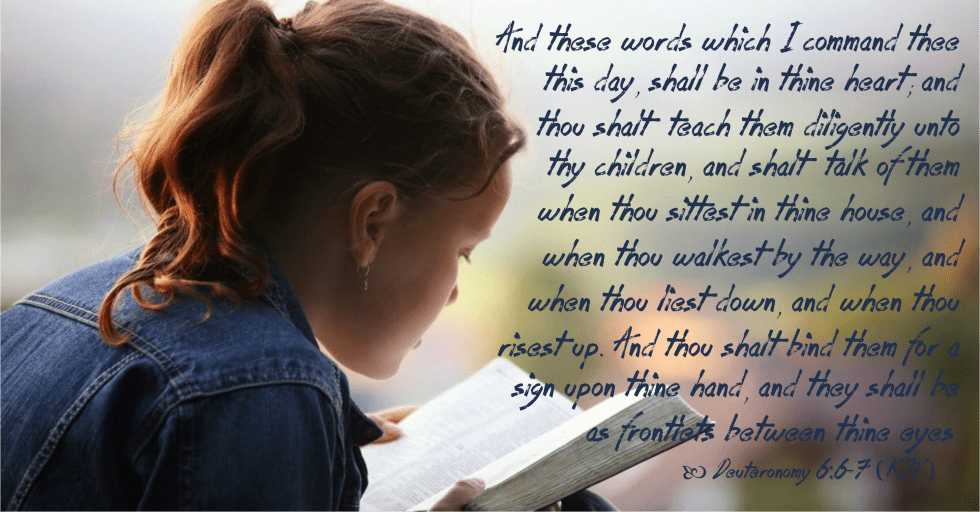
“And these words that I command you today shall be on your heart. You shall teach them diligently to your children, and shall talk of them when you sit in your house, and when you walk by the way, and when you lie down, and when you rise. You shall bind them as a sign on your hand, and they shall be as frontlets between your eyes. You shall write them on the doorposts of your house and on your gates.”

This ancient passage of text makes it abundantly clear that God’s forever intent is for parents to teach their children and each other about God and His ways.

God’s Word should be at the forefront of our lives and the center of our homes.

Thousands of years later, Apostle Paul echoes the importance of these words.

Ephesians 6:4 says, “Fathers, do not provoke your children to anger, but bring them up in the discipline and instruction of the Lord.” One way we teach our children this truth is by coming together as a family to be in God’s Word and praying together.

The wisest of the wise King Solomon: Proverbs 22:6 gives this wisdom: “Train up a child in the way he should go; even when he is old he will not depart from it.”

As parents who love God and who deeply believe and cherish Him, we want to help our, and future generations of children also come to love and believe Him.

Deliberately, Intentionally, Purposefully, our setting aside time for our family devotions each day will show our children that God is the very center of our lives, and spending time with Him is our priority, and we desire to do His will.

We want to show them that it’s okay, God can be the center of their lives, too.

We also want them to be taught, see how God guides them through life in their community, schools, family, and decisions – so they may teach their children.

To raise them up with critically important biblical values that they may one day, as might be needed, to emphasize these values before school board authorities.

Advocate, Communicate, Educate, the highest values of acceptance and sanctity of all life which God indelibly places upon everyone – without any exceptions.

Living, Loving, Moving, Being enveloped in the Word feeds us with everything we need from advice, to wisdom, to morals and ethics and unto His salvation.

It sets us up with a rock solid, sure and certain and steadfast and immovable foundation, a place for all to turn to in times of trials, tribulations, and praise.

Family devotions are a wonderful time for discussions with your children.

As you and your family read through God’s Word together, you can discuss the ways in which it is inescapably relevant to their lives.

For example, some of your discussions might include the ways in which God’s character applies to our understanding of our morals, attitudes and behaviors.

Be sure to not only discuss troublesome behaviors, but positive ones as well.

Your discussions might also include questions about how and why the world works the way it does.

You might just find yourselves talking about your relationships with others and all the ways in which God’s character and His commands help transform those.

These discussions can help your children see that God’s Word is “living and active” (Hebrews 4:12) and “profitable for teaching, for reproof, for correction, and for training in righteousness, that the man of God may be complete, equipped for every good work” (2 Timothy 3:16b–17).

Family devotions help create a firm foundation for your children’s spiritual growth.

In diligently and prudently practicing the spiritual disciplines of reading and studying God’s Word of fellowship and praying together, you help train your children to incorporate and carry these “God” practices with them through life.

You’re also helping them to learn the immeasurable dimensions, the infinite applications of the truth of God’s Word and to come to know, love, Him better.

When we dive into God’s Word, we are teaching our children that God loves and cares about them and us relentlessly.

When we come together to God to pray, to seek Him, we are showing our children we have access to a God who is holy, loving, able to meet our needs.

Our family devotions will likely challenge our faith and contribute infinitely to our spiritual growth as well.

Family devotions also help us meaningfully connect with our children in the midst of a sometimes hectic world.

Taking time to pause to focus on God together is the sweet intimacy of Christian fellowship.

A family time that is deliberately, intentionally, personally, purposely set apart can also serve as a time to honor God and each other, to relate with one another.

As we share our joys and our concerns, our struggles and trials, prayer requests or discuss how God’s Word applies to our lives, we are sharing God in our lives.

Dedicating this time to focus on your children and on God can help strengthen your relationships with your child.

Family devotions do not have to be elaborate.

You can keep them as simple as reading through a passage that pertains to issues you might be facing in your family, to reading through a certain book of the Bible, or purchasing age-appropriate devotional books.

You can include time for worshiping with music if you desire.

Psalm 139:23-24 Amplified Bible

23 
Search me [thoroughly], O God, and know my heart;
Test me and know my anxious thoughts;
24 
And see if there is any wicked or hurtful way in me,
And lead me in the everlasting way.

There is no set time-length that family devotions have to last, but you can be assured that you will soon find this experience to be a joyful time together.

At the conclusion of your time together, pray for God’s goodness in your family, any requests of friends and family, and for His abundant guidance in your lives.

Psalm 139:1-18 Amplified Bible

God’s Omnipresence and Omniscience.

To the Chief Musician. A Psalm of David.

139 O Lord, you have searched me [thoroughly] and have known me.

You know when I sit down and when I rise up [my entire life, everything I do];
You understand my thought from afar.

You scrutinize my path and my lying down,
And You are intimately acquainted with all my ways.

Even before there is a word on my tongue [still unspoken],
Behold, O Lord, You know it all.

You have enclosed me behind and before,
And [You have] placed Your hand upon me.

Such [infinite] knowledge is too wonderful for me;
It is too high [above me], I cannot reach it.


Where can I go from Your Spirit?
Or where can I flee from Your presence?

If I ascend to heaven, You are there;
If I make my bed in Sheol (the nether world, the place of the dead), behold, You are there.

If I take the wings of the dawn,
If I dwell in the remotest part of the sea,
10 
Even there Your hand will lead me,
And Your right hand will take hold of me.

11 
If I say, “Surely the darkness will cover me,
And the night will be the only light around me,”

12 
Even the darkness is not dark to You and conceals nothing from You,
But the night shines as bright as the day;
Darkness and light are alike to You.

13 
For You formed my innermost parts;
You knit me [together] in my mother’s womb.

14 
I will give thanks and praise to You, for I am fearfully and wonderfully made;
Wonderful are Your works,
And my soul knows it very well.
15 
My frame was not hidden from You,
When I was being formed in secret,
And intricately and skillfully formed [as if embroidered with many colors] in the depths of the earth.

16 
Your eyes have seen my unformed substance;
And in Your book were all written
The days that were appointed for me,
When as yet there was not one of them [even taking shape].

17 
How precious also are Your thoughts to me, O God!
How vast is the sum of them!
18 
If I could count them, they would outnumber the sand.
When I awake, I am still with You.

Remember to always praise God for His answers to your prayers, too.

Create an environment that is calm, loving, and memorable, one that your children will want to foster, nurture, impress, upon the lives of their children.

“But grow in the grace and knowledge of our Lord and Savior Jesus Christ. To him be the glory both now and to the day of eternity. Amen” (2 Peter 3:18).

Family devotions are a crucial means of declaring, living out family priorities.

By turning to God’s Word and prayer together every day (or most days, at least), we model the uncompromising centrality of these practices in our Christian life.

These daily times together will also prove an important means of our building closeness within our family…

Our devotions call us to a family experience each day.

Hebrews 6:19-20 Amplified Bible

19 This hope [this confident assurance] we have as an anchor of the soul [it cannot slip and it cannot break down under whatever pressure bears upon it]—a safe and steadfast hope that enters within the veil [of the heavenly temple, that most Holy Place in which the very presence of God dwells],20 where Jesus has entered [in advance] as a forerunner for us, having become a High Priest forever according to the order of [a]Melchizedek.

Our time away with God, the Father, Son and Holy Spirit and each other gives expression to this “confident assurance” we have all an anchor for our souls.

We each have our own hopes and dreams we desire to see lived in each other.

And while few of them are remarkably miraculous on their own, it is their gradual and steadfast accumulation which will add up to something special.

And then there is the benefit of building a habit that adds structure and stability to the family’s shared life.

As we have emphasized family devotions, we will gradually find out it becomes a kind of disciplined, organizing structure to the God life we all share together…

Through disciplined family devotions we model our own discipline of personal devotions, for the two closely, inextricably, inescapably, resemble one another.

By relating to the Lord as a family, we teach how to relate to him as individuals.

Growing up in a prayer-filled home is a beautiful and powerful thing.

Parents can pray over their children from the moment they are conceived through adulthood.

Children can learn alongside their parents how to pray to the Lord themselves.

Siblings can pray for and with one another as they resolve conflict and build strong relationships.

Extended family can cover loved ones in prayer through both joyful and challenging seasons.

Families can pray together more often than just before dinner, and it can be a life-changing and spiritually transformative experience that not only brings family members closer to God, but blessedly, ultimately closer to one another! 

It is the kind of disciplined habit, perhaps like eating and praying together, and attending church together, that anchors family to the centrality of Jesus Christ.

In the name of God, the Father and God the Son and God the Holy Spirit,

Let us Pray,

“Let the message of Christ dwell among you richly as you teach and admonish one another with all wisdom through psalms, hymns, and songs from the Spirit, singing to God with gratitude in your hearts. And whatever you do, whether in word or deed, do it all in the name of the Lord Jesus, giving thanks to God the Father through him.” Colossians 3:16-17

Lord, I pray that the message of Christ and his sacrifice is the root of gratitude in my and my family’s heart. That His gracious gift leads me and my family into thankful living, setting a timeless example for the rest of my family and their children. That they will have their own truly abiding relationship with Jesus one day, and that You would grow gratitude in their hearts out of the acceptance of Jesus as their Savior. Lead us to do everything in the name of Jesus and give thanks to You through Him.

Adeste Fidelis! Venite Adoremus! Dominum.

Gloria! In Excelsis Deo! Alleluia, Alleluia, Alleluia, Amen.

https://translate.google.com/

Parenting by Faith. Why is Faith in God so vitally important to today’s Families? Deuteronomy 6:4-9, Ephesians 6:1-4.

“UNLESS THE LORD BUILDS THE HOUSE, THEY LABOR IN VAIN WHO BUILD IT” – PSALM 127:1

Families are to be built upon loving and worshiping the Lord God with all our hearts, with all of their strength, with all of their bodies, minds and souls.

In our marriages, raising children, building up and edifying our families, are “cultural icons, technological idols” undermining such a genuine worship?

Are there practices and values we need to confess, repent of, and forsake?

As Parents, are there priorities we need to faithfully reevaluate?

Is there a place for genuine “faith in God” in our homes and in our families?

Are there “faith-filled” “faith-testing” matters we need to prayerfully discuss with our spouses and then frankly share the results with our children?

“Therefore, my beloved, flee from idolatry” (1 Corinthians 10:14).

Is there such a thing as “Painless Parenting?

Pain – even excruciating pain – is a natural part of the family process in our broken world.

Women know better than anyone that pain is how the family got started. And the aches and the pains, the hurts and the hassles, will continue to intrude into the parenting pathways through the years – whether we like it or not.

That is why a vital faith in Jesus Christ is so utterly crucial to a ‘happy’ family.

God equips us through faith to meet all of the challenges of parenting and raising a ‘Godly’ family in these 2022 days of idolatry and brokenness.

Even in the most toxic of environments which constantly challenge “Faith” in the context of faithfully holding together faithful, faith-filled mom, dad, kids.

Deuteronomy 6:4-9Amplified Bible

“Hear, O Israel! The Lord is our God, the Lord is one [the only God]! You shall love the Lord your God with all your heart and mind and with all your soul and with all your strength [your entire being]. These words, which I am commanding you today, shall be [written] on your heart and mind. You shall teach them diligently to your [a]children [impressing God’s precepts on their minds and penetrating their hearts with His truths] and shall speak of them when you sit in your house and when you walk on the road and when you lie down and when you get up. And you shall bind them as a sign on your hand (forearm), and they shall be used as [b]bands (frontals, frontlets) on your forehead. You shall write them on the [c]doorposts of your house and on your gates.

The Word of God for the Children of God. Gloria! In Excelsis Deo! Alleluia! Amen.

WHY IS FAITH IMPORTANT TO FAMILIES?

Researchers at the Harvard School of Public Health recently published a paper that concludes that a religious upbringing is linked to better health and well-being during early adulthood.

At first, when I read this, I thought this was great news, since we’ll literally do anything to improve our kids’ chances of being happy and healthy adults, right?

Then I started considering the real-world reasons why we think faith in God is important to our family.

It’s a lot more complicated than our, as parents, or stepparents, just wanting, willing, them to be well-adjusted adults, though that’s apparently of a great benefit and blessing too.

So why is it important to us to raise our kids in the Christian faith?

The 2022 fact is that a lot of young people take a break from their church-going habits as young adults, “stretch their wings,” explore their life” then return to their Christian roots and practices when they get married and have children.

There’s something about raising families, bringing kids up in a church, with the habits and lessons of Sunday School, worship and service that we, as adults, feel is good for our families and pleasing in the sight of the Lord our God. (Verse 7)

Maybe part of that “something” is knowing that the Christian faith has truly provided billions of Christians for thousands of years the spiritual tools for approaching our earthly lives with courage, peace, community, hope and love.

Modern bookshelves are filled with books about how to lead healthy, happy lives (and how to raise well-adjusted kids) and the lessons look similar to those the bible has taught for millennia.

Scripture teaches us lessons about love, forgiveness, compassion, community, loyalty, praise, grace, trust, overcoming adversity, gratitude and perseverance.

We are given commandments that help us, and our communities stay on course.

We are taught to take time to pray, providing important moments of praise, and very desperately needed moments of peace, reflection, conversations with God, our Creator and our Father, which are physically and spiritually edifying and ethically and morally healing to our bodies and our souls.

And our Christian identity provides a powerful framing to understand self-worth rooted in God’s unconditional love and purpose.

These are just some of the foundational elements of our faith that create fertile ground for cultivating a life well lived.

Certainly, our faith does not guarantee an easy life.

Growing and cultivating that “most perfect of Roses” still comes with thorns.

As adolescents, teenagers, emerging adults and throughout our adult lifetimes, we will face severe, even catastrophic adversity, cultural opposition, deep loss, betrayal, societal conflict and suffering that will challenge and test our beliefs.

God’s message from thousands of years ago, from that barren wilderness is still incredibly relevant, perhaps even more so in the year of our Lord 2022.

There is no shortage of “complexities” which today’s families must navigate.

Considering our socio-economic, socio cultural, counter-cultural complexities, Families in all stages desperately need a strong faith foundation to live through the challenges and the questions, return to scripture, consult our mentors, lean deeply, heavily into our Christian communities, and recall the power of prayer.

So, we can consider faith-building as an essential part of our job as parents and stepparents “to faithfully prepare the child for the path, not the path for the child.”

Our own journey of faith gives us an enduring, perhaps even wiser, relationship with an ever-present Father, Son and Holy Spirit, along with a whole toolbox of “soft and hardcore” lessons, resources that helped us through our earthly lives.

And it gives us the gift of a community of believers who share our commitment to each other and the teachings of Jesus to love God and serve the world.

And finally, it gives us the sacred promise and Shalom of eternal life when we have faithfully’ done all we believe we can when we come to the end of this one.

It is our responsibility to pass on these awesome gifts to the next generation.

So, we faithfully try to keep our kids closely by our sides upon our own more experienced Christian journeys, teaching them the gifts of a relationship with God along with the responsibility to care for and minister to others as Jesus did.

Verse 7 We teach, lead, pray, show and then hopefully send them out into the world with their Christian toolbox abundantly filled with faith, hope and love.

And along the way, the wisdom of God, from God, becomes abundantly clear to them that “it’s not what you leave for them, it’s who and what you leave in them.”

Deuteronomy 6:5 speaks of the central truth for developing a godly family:

“You shall love the Lord your God with all your heart, with all your soul, and with all your strength.”

Ephesians 6:1-4 Amplified Bible

Family Relationships

6 Children, obey your parents in the Lord [that is, accept their guidance and discipline as His representatives], for this is right [for obedience teaches wisdom and self-discipline]. Honor [esteem, value as precious] your father and your mother [and be respectful to them]—this is the first commandment with a promise— so that it may be well with you, and that you may have a long life on the earth.

Fathers, do not provoke your children to anger [do not exasperate them to the point of resentment with demands that are trivial or unreasonable or humiliating or abusive; nor by showing favoritism or indifference to any of them], but bring them up [tenderly, with lovingkindness] in the discipline and instruction of the Lord.

Consider Ephesians 6:1, for example: Children, obey your parents in the Lord [that is, accept their guidance and discipline as His representatives], for this is right [for obedience teaches wisdom and self-discipline].

Children, obey your Parents – How? IN THE LORD!

That means Children of God, Mom and Dad obey God, your Father –

How? IN THE WORD OF THE LORD!

Or Husbands read Ephesians 5:25-30

25 Husbands, love your wives [seek the highest good for her and surround her with a caring, unselfish love], just as Christ also loved the church and gave Himself up for her, 26 so that He might sanctify the church, having cleansed her by the washing of water with the word [of God], 27 so that [in turn] He might present the church to Himself in glorious splendor, without spot or wrinkle or any such thing; but that she would be holy [set apart for God] and blameless. 28 Even so husbands should and are morally obligated to love their own wives as [being in a sense] their own bodies. He who loves his own wife loves himself. 29 For no one ever hated his own body, but [instead] he nourishes and protects and cherishes it, just as Christ does the church,  30 because we are members (parts) of His body.

Or Wives read Ephesians 5:22-24

Marriage Like Christ and the Church

22 Wives, be subject [a]to your own husbands, as [a service] to the Lord. 23 For the husband is head of the wife, as Christ is head of the church, Himself being the Savior of the body. 24 But as the church is subject to Christ, so also wives should be subject to their husbands in everything [respecting both their position as protector and their responsibility to God as head of the house].

HUSBANDS, WIVES BE SUBJECT TO ONE ANOTHER AS SUBJECT TO THE LORD!

All of these instructions to the family wrap around the central core of faith in:

God, the Father and God the Son and God the Holy Spirit!

Do not try to build your family without faith in Father, Son and Holy Spirit!

Throw yourselves upon the full weight of His grace and mercy and say to Him:

“Lord! I know, We know, that apart from You, I, We, can do nothing but mess this gift of family up. So, I am, We are, going to hang on to You, with all of our hearts, with all of our souls, with all of our bodily and spiritual strength, with all of our minds, with both hands, with both sets of our aching and tired feet. Together, with You, I, We, will make this family work unto Your glory alone!”

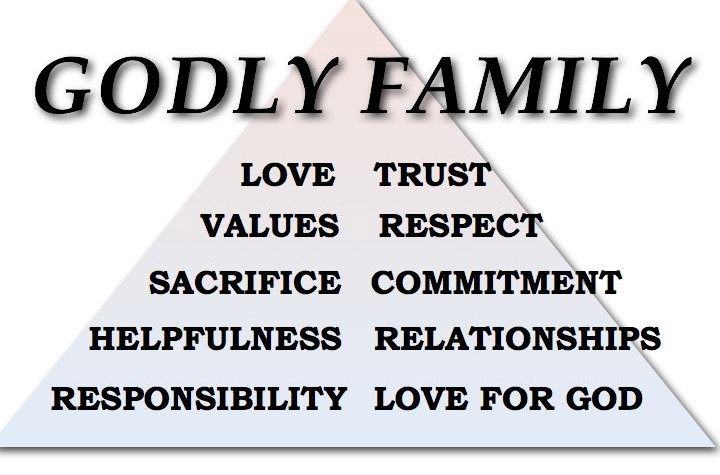
Being a “Godly” family is such a big responsibility.

A family’s love, emotional presence, approval, and support for their children—from their early lives, through their teenage years, and beyond—is a significant factor in helping them to become secure, able to love and give to others.

On the other hand, a lack of love from a family can contribute to various kinds of anxiety and insecurity in relationships and in life functioning.

Fatherhood and Motherhood matters so much.

Yet, obviously, painfully, neither is an easy task.

That’s why the words of God from Deuteronomy 6:4-9 and the apostle Paul in Ephesians 5:22-30 and 6:1-4 are so foundational, edifying helpful for us.

Moses and Paul here give instructions to fathers and mothers. It’s not a detailed manual for exactly what to do in every situation. But what Moses says, and Paul says, here is fundamental, goes a long way to helping us see how to be a family.

In the name of God, the Father and God the Son and God the Holy Spirit,

Let us Pray,

God, our Father, show us your children loving devotion and grant us your deliverance. As Mothers and Fathers and Families, incline your ear and answer us, for we are challenged by great hardship. Restore us, O God of our salvation.

We ask for a miracle from heaven for our families, that we may rejoice in you. Surely your rescue is near to those who reverently fear you. O Lord, we praise you that your righteousness looks down from heaven. We praise you that you will indeed provide our families what is good, and we will see increase. Amen.

https://translate.google.com/