
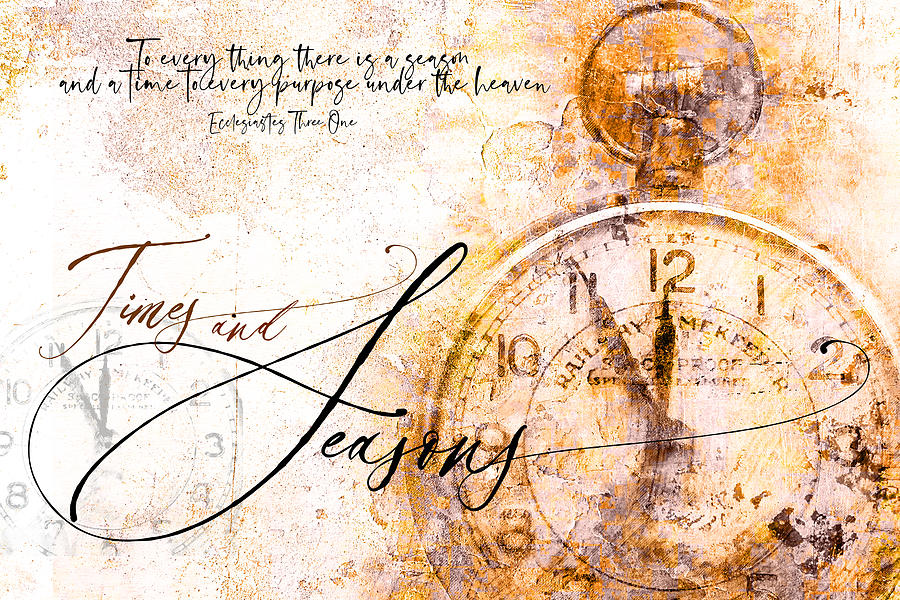
Ecclesiastes 3: Bible
A Time for Everything
3 There is a season (a time appointed) for everything and a time for every delight and event or purpose under heaven—
The Word of God for the Children of God.
Glory be to the Father and to the Son and to the Holy Ghost; as it was in the beginning; is now and ever shall be, worlds without end, Amen, Amen.
“God allows us to experience both the high and low points of life in order to teach us lessons that we could learn in no other way.” – C.S. Lewis
Contemplating the greatest part of God’s great design to this earth: its seasons.
We experience wet and dry seasons, the typical four seasons of winter, spring, summer, and fall, and there are planting seasons and harvesting seasons.
We see creation moving through seasons each year, and we ourselves live through seasons, as well.
In these seasons we learn to depend on and come to anticipate, expect things.
So, too, we find in the Bible that our lives go through seasons.
Seasons of happiness and sadness, loss and joy, hope, newness, and growth.
Seasons of health and seasons when acute and chronic illness seems to prevail.
All of these life seasons are intentional and God’s influence in them should be acknowledged and counted on.
We find this often quoted verse in the book of Ecclesiastes, which is believed to have been written by Solomon, the son of King David.
When Scripture declares that for everything there is a season, this means that the various circumstances we go through in life are not by incident, but they are orchestrated or allowed by God with His great purpose and His intentionality.
What Does The Bible Mean ‘For Everything There Is a Season’?
Ecclesiastes 3 verse 1 affirms two important reminders.
- The things we go through in life are not in vain.
- Our situations will not last forever.
If we are in a certain season of life, we can be confident the season will come to an end at some point.
This verse serves as a reminder that our circumstances will change and that is something we can come to reliably anticipate and expect in life.
Whatever God takes us through has a definitive purpose, perhaps that purpose is to deepen our faith or to help us to achieve a breakthrough in an area of life.
We will have our sorrows.
We will get over our sorrows.
We will enter the valley by some means.
We will get out of the valley by another means.
We will go through hardships.
And whatever season of life we find ourselves in, it will always have a beginning and it will always have an end.
We will always leave the old seasons behind.
We will always enter new seasons, too.
Ones that bring relief, hope, or a deeper sense of faith.
I believe it’s helpful to also read other translations of this verse to get a better idea of its meaning:
- “Everything that happens in this world happens at the time God chooses”. – Good News Translation
- “Everything has its own time, and there is a specific time for every activity under heaven” – God’s Word
- “There’s an opportune time to do things, a right time for everything on the earth” – The Message
- “There is a time for everything, and a season for every activity under the heavens” – NIV
- “There is a right time for everything, and everything on earth will happen at the right time.” Easy to Read Version
What Is the Verses’ Context: ‘For Everything There Is a Season’?
As you read the book of Ecclesiastes, you may get the impression that Solomon had somewhat of a grave, pessimistic outlook on life.
The book begins with Solomon’s declaration that everything is meaningless (see verse 1:1).
He had seen the ups and downs of life, yet could not quite make sense of life.
Why was there so much suffering?
Where was God in the midst of life?
What is the meaning of the mundane days we live?
In this book, Solomon reflected on his understanding of God and how that fits with what he knew and the life he was experiencing.
Perhaps you have found yourself wondering or reflecting like Solomon did.
In the third chapter, we find perhaps some clarity around the mysteries of life.
When nothing in life seems to make sense anymore, if we dare to look, to find God’s presence in life, that’s when real meaning and satisfaction will emerge.
Life without God is hopeless, but a life lived for God and in acknowledgement of his divine presence, sovereignty, is one marked by fruitfulness and significance.
In this third chapter, Solomon affirmed the seasons of joys and the seasons of hardships, the high and low seasons, the valleys of despair and peaks of honor.
This is the natural ebb and flow of life that we can anticipate, and when we keep God at the center, purpose will emerge and refining of our hearts will take place.
Why Is There always a Time for Bad Things?
The basic reality is that life always gets hard.
As we know, bad things happen even to those who follow Jesus as their Lord and Savior.
Sinful nature has left nothing untouched, and this is why we await the second coming of Jesus.
But until then, we know that we will always enter tough seasons, go through tough seasons, leave tough seasons as much as we go through joyful seasons.
Even Jesus reminded us that we will always have troubles, but we can still have peace in him (see John 16:33).
The hope found in this Ecclesiastical passage is that these seasons of suffering, hate, and death will come to us but they will also come to an end. (Psalm 23)
God will bring us through to better days marked by comfort, love, and new life.
Through it all, we can rest in the peace Jesus has given us.
Regardless of what seasons we face, we can fully and completely trust that God always remains in absolute control and is the author of our days.
How Does God Make Everything Beautiful in Its Time?
Ecclesiastes 3:11 Amplified Bible
God Set Eternity in the Heart of Man
11 He has made everything beautiful and appropriate in its time. He has also planted eternity [a sense of divine purpose] in the human heart [a mysterious longing which nothing under the sun can satisfy, except God]—yet man cannot find out (comprehend, grasp) what God has done (His overall plan) from the beginning to the end.
God is our Redeemer.
To redeem something means to offset its negative traits.
In a biblical sense, redemption means that Jesus’ work on the cross has covered our sin.
His sacrificial love has offset and delivered us from sinfulness, death, and guilt.
God’s redemptive work makes us beautiful and it makes all things beautiful.
This concept of redemption that we find in Scripture teaches us that God will redeem us from despair and work all things together for the good of those who love him (see Romans 8:28).
We find this promise written that God will make everything beautiful in its due season.
God will judge right from wrong and bring about justice (Ecclesiastes 3:16-17).
16 Moreover, I have seen under the sun that in the place of justice there is wickedness, and in the place of righteousness there is wickedness. 17 I said to myself, “God will judge both the righteous and the wicked,” for there is a time [appointed] for every matter and for every deed.
God will make things right.
We may not always know how or when or where he will make things beautiful or when he will do that, but we can 100% count on it, pray for it to happen, and put all of our trust fully in God to redeem even the worst of our circumstances.
What to Learn from Ecclesiastes 3:1 about Change and Timing?
Solomon, author of Ecclesiastes, goes to great lengths to preach that we must put our trust in God’s sovereignty which means he is in control of all things.
God is always with us in the hardest battles.
He guides our steps from one season to the next.
He sees what is coming ahead for us and will provide what we need to get through.
No matter what seasons lay behind us or ahead of us, God is always present and always leading us through each – for the purpose of His glory.
The greatest hope we have in seasons of trouble or change is that God will never leave us nor forsake us (see: Hebrews 13:5).
5 Let your character [your moral essence, your inner nature] be free from the love of money [shun greed—be financially ethical], being content with what you have; for He has said, “I will never [under any circumstances] desert you [nor give you up nor leave you without support, nor will I in any degree leave you helpless], nor will I forsake or let you down or relax My hold on you [assuredly not]!”
We may experience God’s timing as difficult, or late, or hard to understand, or different than what we’d expect or hope for.
But truly, over time, we will learn that all of God’s timing is perfect and always comes to pass in a way that will bring us goodness rather than hopelessness.
How Can We Learn to Apply “For Everything There is a Season” to Everyday Lives?
When we wake up, we can trust that whatever season we are in is not by accident, nor will God allow it to unfold without bringing out a grander purpose and drawing us closer to him.
Every season is purposeful in leading us into a deeper relationship with God and creating unshakeable faith.
We can hope that the Lord will give us seasons of joy, and know that he wants us to enjoy life (see Ecclesiastes 3:12-13).
12 I know that there is nothing better for them than to rejoice and to do good as long as they live; 13 and also that every man should eat and drink and see and enjoy the good of all his labor—it is the gift of God.
We should savor the goodness of life and the ways God has gifted us with his favor.
Through fellowship, disciplined reading, studying, and praying, apply this verse to your life by trusting that God knows the seasons in your life in which you will relish and endure, and God will be with you every step of the way.
Therefore, we should lean into God regardless of the situation because he loves us and will journey with us each moment, each day, and each season.
Like Solomon, we can go through our seasons, and take the opportunity to pause to reflect on our lives and how we see God’s presence and direction.
God is the author of our time and the seasons we go through.
Though life does not always make sense, or may even feel insignificant at times, rather than getting lost in despair, we can find comfort and hope in God.
God brings us to new seasons, changes our circumstances, and adds fullness to our existence.
God alone creates and sustains and God alone will make all things beautiful in due season and God alone will cause all our lives to be abundant in meaning.
In the name of God, the Father and God the Son and God the Holy Spirit,
Let us Pray,
Psalm 16 The Message
16 1-2 Keep me safe, O God,
I’ve run for dear life to you.
I say to God, “Be my Lord!”
Without you, nothing makes sense.
3 And these God-chosen lives all around—
what splendid friends they make!
4 Don’t just go shopping for a god.
Gods are not for sale.
I swear I’ll never treat god-names
like brand-names.
5-6 My choice is you, God, first and only.
And now I find I’m your choice!
You set me up with a house and yard.
And then you made me your heir!
7-8 The wise counsel God gives when I’m awake
is confirmed by my sleeping heart.
Day and night I’ll stick with God;
I’ve got a good thing going and I’m not letting go.
9-10 I’m happy from the inside out,
and from the outside in, I’m firmly formed.
You canceled my ticket to hell—
that’s not my destination!
11 Now you’ve got my feet on the life path,
all radiant from the shining of your face.
Ever since you took my hand,
I’m on the right way.
Glory be to the Father and to the Son and to the Holy Ghost; as it was in the beginning; is now and ever shall be, worlds without end, Amen, Amen.
 Loving God, Living God, Loving Hope, Living Hope, Loving Living Life His Way! "Many things are possible for the person who has hope. Even more is possible for the person who has faith. And still more is possible for the person who knows how to love. But everything is possible for the person who practices all three virtues." - Brother Lawrence (1605-1691), Practicing the Presence of God (1692).