Romans 15:4 "For whatever was written in earlier times was written for our instruction, so that through perseverance and the encouragement of the Scriptures we might have hope."
Personal evangelism is sharing the message of Jesus Christ with others.
It is showing and telling and serving others— with, through both word and deed — who Jesus is and how it’s possible to have a relationship with Him.
Think of individual evangelism in light of our own and everyone else’s life’s journeys.
Personal evangelism is simply the privilege of entering into the spiritual journey of another person, living into and out from God’s summons, and discovering how God is at work, and the undeniable role that we can play.
Genesis 24:1-9 GOD’S WORD Translation
Abraham Instructs His Servant
24 By now Abraham was old, and the Lord had blessed him in every way. 2 So Abraham said to the senior servant of his household who was in charge of all that he owned, “Take a solemn oath. 3 I want you to swear by the Lord God of heaven and earth that you will not get my son a wife from the daughters of the Canaanites among whom I’m living. 4 Instead, you will go to the land of my relatives and get a wife for my son Isaac.”
5 The servant asked him, “What if the woman doesn’t want to come back to this land with me? Should I take your son all the way back to the land you came from?”
6 “Make sure that you do not take my son back there,” Abraham said to him. 7 “The Lord God of heaven took me from my father’s home and the land of my family. He spoke to me and swore this oath: ‘I will give this land to your descendants.’
“God will send his angel ahead of you, and you will get my son a wife from there. 8 If the woman doesn’t want to come back with you, then you’ll be free from this oath that you swear to me. But don’t take my son back there.” 9 So the servant did as his master Abraham commanded and swore the oath to him concerning this.
Gloria! In Excelsis Deo! Alleluia, Alleluia, Alleluia, Amen.
And Father Abraham Said Unto His Servant, “GO!”
Abraham’s wife Sarah has died (Genesis 23:2).
Isaac is the only son left through whom God will make a great nation of people.
So, the question naturally arises,
“Does not Isaac need a wife if he’s going to have children, bless generations ?”
Abraham is old, and he knows he won’t live much longer.
There is one more thing he needs to take care of – get a wife for his son Isaac.
Of one thing he is very sure: he cannot let Isaac take a bride from the Canaanite women who worship false gods.
Abraham calls on his most trusted servant and commissions him to find a wife for Isaac from among his kin.
Abraham is very clear that Isaac is not to go; he must stay in the land the Lord has promised them.
So, the loyal servant of Abraham swears an oath to Abraham and “Goes Forth.”
That’s the story we come to next.
In Genesis Chapter 24, however, we must first take careful note in our text that we have four main persons: the father, the son, the servant, and the bride.
This is very meaningful.
As we move forward in time and come to the writings of the New Testament, we should see that the Triune God is working, laboring together to obtain a bride for the Son….The subject of the New Testament is the Triune God, the Father, the Son, the Spirit, working, laboring together to obtain the bride for the Son.
From the start, The Father made the plan, the Spirit carries out the Father’s plan, the Son enjoys what the Father has planned, what the Spirit carries out.
Who is the bride?
The bride is that chosen part of the human race which will marry the Son and become His counterpart .
Upon Closer Scrutiny-With One Eye Towards Eternity
If we read this chapter through carefully, we will find that the central character in the text is not Rebekah, who is to become the bride of Abraham’s son Isaac.
Very little of her reaction is actually recorded here; she has a secondary part.
The spotlight of the story really follows Abraham and Abraham’s unnamed senior and most trusted, most faithful servant, who is the central character.
For us, this is a picture of the Holy Spirit’s work.
But remember, the Spirit of God chooses to do His work largely through men and women, through those of us who are His.
This is especially true in the work of the calling out a people for God’s name.
God has given us the responsibility and the privilege of being His instruments to go into the world and faithfully seek out and call His bride out of the world.
So this whole story from Genesis chapter 24 becomes for us a precursor, an ancient beautiful picture of the whole process of PERSONAL EVANGELISM.
PERSONAL EVANGELISM: The process of we, Father God’s loyal and trusted servants bringing others to Christ begins with the command of God the Father.
Genesis 24:1-4 New American Standard Bible
A Bride for Isaac
24 Now Abraham was old, advanced in age; and the Lord had blessed Abraham in every way. 2 Abraham said to his servant, the oldest of his household who was in charge of all that he owned, “Please place your hand under my thigh, 3 and I will make you swear by the Lord, the God of heaven and the God of earth, that you shall not take a wife for my son from the daughters of the Canaanites, among whom I live; 4 but you will go to my country and to my relatives, and take a wife for my son Isaac.”
The initiative here is with Father Abraham, he knew he was advanced in age and his length of years would soon end, and he knew well God blessed in every way.
Abraham sends his most senior and trusted servant, who has authority over everything Abraham owns, to do this work, binds him to the task with an oath.
When the servant puts his hand under Abraham’s thigh, he is simply practicing an oriental custom that recognized the loins of the thigh were the source of life.
For the trusted servant, it was a representation of being bound in a solemn oath.
As we apply this to our own situation and see God the Father standing in the place of Abraham here, He is asking every servant to give himself to this task.
The servant is unnamed here so that you and I can put our own names here.
The Father calls us His servants, commands us to go and take a wife for His Son.
This is not an option for a believer in Jesus Christ.
God has said, not only in the fashion we see here but also in direct statements in the Word of God, the obligation rests upon believers to give themselves over to the sacred task of reaching to others for the coming Bride Groom Jesus Christ.
God has commanded, us, His most trusted servants, to take a wife for my Son.
And so unto this end, the Holy Spirit of God has come into our hearts to dwell.
His whole purpose of coming into your life and mine is that He might be what He is and do what He came to do – send us out into the world to find a “Bride.”
Our Lord Jesus is the one dwelling within, and we are told what He came to do.
45 It’s the same way with the Son of Man. He didn’t come so that others could serve him. He came to serve and to give his life as a ransom for many people.”Mark 10:45
He said, For the Son of Man came to seek and to save what was lost(Luke 19:10).
If this is what He came to do, we will find Him doing exactly that in our lives, if we give Him the opportunity – we authentically become that “Trusted Servant.”
Do we recognize and live by our servant mandate as disciples of the Lord Jesus?
Are we being .01% authentically responsive to the prompting of the Holy Spirit?
Are we being .01% authentic, responsive to Acts 1:8 “go forth into the world?”
In the name of God, the Father and God the Son and God the Holy Spirit,
Let us Pray,
A Prayer for Opportunity
God, My Father, Like Abraham’s loyal servant I long to be sent forth, the chance to serve you, for the opportunity to proclaim the goodness of Your name. I long to seek others, engage with them, pray with them, be a servant unto them, draw them closer to you, for service in your Kingdom. As I go out today, please bring me into contact with those who have been given eyes to see, ears to hear. Direct my steps and lead me into those conversations You want me to have today, Jesus. In Jesus’ name, I pray.
15 So when they had finished breakfast, Jesus said to Simon Peter, “Simon, son of John, do you love Me more than these [others do—with total commitment and devotion]?” He said to Him, “Yes, Lord; You know that I [a]love You [with a deep, personal affection, as for a close friend].” Jesus said to him, “Feed My lambs.” 16 Again He said to him a second time, “Simon, son of John, do you love Me [with total commitment and devotion]?” He said to Him, “Yes, Lord; You know that I love You [with a deep, personal affection, as for a close friend].” Jesus said to him, “Shepherd My sheep.” 17 He said to him the third time, “Simon, son of John, do you love Me [with a deep, personal affection for Me, as for a close friend]?” Peter was grieved that He asked him the third time, “Do you [really] [b]love Me [with a deep, personal affection, as for a close friend]?” And he said to Him, “Lord, You know everything; You know that I love You [with a deep, personal affection, as for a close friend].” Jesus said to him, “Feed My sheep.
Our Times Are in His Hand
18 I assure you and most solemnly say to you, when you were younger you dressed yourself and walked wherever you wished; but when you grow old, you will stretch out your hands and arms, and someone else will dress you, and carry you where you do not wish to go.” 19 Now He said this to indicate the [c]kind of death by which Peter would glorify God. And after saying this, He said to him, “Follow Me [walk the same path of life that I have walked]!”
Gloria! In Excelsis Deo! Alleluia, Alleluia, Alleluia, Amen.
(Psalm 144:4) Man is like a mere breath; His days are like a shadow that passes away.
Perhaps there exists something so natural to us we take it too much for granted.
Perhaps that something which so very natural to us is our time alive, our time allotted to us by God to simply breathing and moving and living on this earth.
Do we take the time to ponder exactly how Time is so precious — time with our families, children, parents, friends, brothers and sisters in Christ – With God?
How do we invest our time?
When do we invest our time?
Where do we invest our time?
With whom do we invest our time?
Why do we invest our time with whomever we invest our times?
You know, when it comes right down to it, getting back to the basics of life, our time with God and each other is really more valuable than the money we invest.
Once the present time and its opportunities are gone, they can’t be reclaimed.
So as we begin each day, as we look at the sunshine through the rain, perhaps contemplate “time management” “thought management,” ask God we will be able to “know His time,” to see it for what it is, to use it for its greatest good.
Irretrievably so, time – God’s Time” passes quickly, like the shadows of early evening, it’s not long before it is absorbed into the gathering darkness of night.
When We Feel “Forever Stuck” In The Moment?
From time to time, while in the process of drafting a new devotional, I find myself in a deep mental conundrum – my mind and my spirit seem to go blank.
The kind of blankness I so desperately want to escape, but as every cliched movie villain always says, “escape is futile, resistance to change is futile”
Sometimes the same conundrum affects me on an emotional level, even spiritually – what difference is anything I write about a particular subject I believe the Holy Spirit provides, going to make in anyone I truly care about?
I feel a certain way and don’t want to, but the villain tells me yet again, escape is futile – In other words, I’m feeling stuck in my moment- or so I tell myself.
The first kind of hindrance is writer’s block, something every author eventually faces during his or her artistic pursuits.
Then there’s the kind of barrier we can all relate to, where we’re looking for a change on an emotional or spiritual level, but find ourselves confused, maybe even miserable – we are longing for answers but find none – That’s a life block.
We encounter them in our relationship with God, with each other.
We find them on the job and at home and on vacations.
We find them in ourselves and of ourselves.
In other words, we contend with a seemingly insurmountable problem; but only to us, the problem is not seemingly, but definitely perceived as insurmountable.
We’re stuck in a moment of time, or in a memory, or so we will take great pains to try to sell it that way to ourselves.
Escape is futile, we keep talking to ourselves and therefore we come to believe.
Yet, the reality is, deep down, we know the movie villain is 100% exaggerating.
For the dramatic effect and for their audiences, they will always exaggerate.
There is a way through the barrier, a way to get unstuck, a way back to writing those stories, transforming perspectives, having the right perspective of God.
Though the frustration and confusion may be too deep, ceaseless, unrelenting, too aggravating, too anger provoking, the solution is simple and two-fold.
First, take a break; not in the sense of giving up, but in the sense of ending your striving.
There’s only so much we can control in our lives.
The sooner we realize this, the more peace we will find.
After you take a break, either wait or look for inspiration.
Sometimes finishing a devotional requires that I stop writing for ten minutes so that I can go for a walk or have a quick moment to wander around my home.
Sometimes finishing a devotional requires me to temporarily set it aside, to pray to God and then as God will’s it, come back after a day or longer.
That time off from the writing effort is useful for conjuring up, discerning new ideas, letting the Holy Spirit work and gaining insight from God or other people.
Creating distance from the problem at hand often helps with developing a more objective perspective.
The same applies when we’re navigating relational conflict, battling addiction, battling mental health issues, family issues or just trying to discern God’s will.
After we take a break from all the struggles of doing things our own way, we can find “Father, Son and Holy Spirit” inspiration for tackling our circumstances.
Proverbs 16:1-4 Amplified Bible
Contrast the Upright and the Wicked
16 The plans and reflections of the heart belong to man, But the [wise] answer of the tongue is from the Lord. 2 All the ways of a man are clean and innocent in his own eyes [and he may see nothing wrong with his actions], But the Lord weighs and examines the motives and intents [of the heart and knows the truth]. 3 [a]Commit your works to the Lord [submit and trust them to Him], And your plans will succeed [if you respond to His will and guidance]. 4 The Lord has made everything for its own purpose, Even the wicked [according to their role] for the day of evil.
Inspiration comes only through our connection to God, sometimes through people, sometimes through nature, and sometimes through so much more.
Inspiration also finds us through God’s Word, the wisdom of the Cross, and a visit from Jesus helping us see with a perspective that doesn’t come naturally.
Stuck in His Guilt, Peter is Restored to Discipleship
John 21:18-19 Amplified Bible
Our Times Are in His Hand
18 I assure you and most solemnly say to you, when you were younger you dressed yourself and walked wherever you wished; but when you grow old, you will stretch out your hands and arms, and someone else will dress you, and carry you where you do not wish to go.” 19 Now He said this to indicate the [a]kind of death by which Peter would glorify God. And after saying this, He said to him, “Follow Me [walk the same path of life that I have walked]!”
On the night Jesus was arrested, Peter had instantly revoked his discipleship.
Under threat of arrest and exposure and potential death sentence, by those in the courtyard he had denied three times that he was a follower of Jesus – each time he publicly proclaimed his denials more desperate than the previous one.
Luke 22:54-62 Amplified Bible
Peter’s Denials
54 Then they seized Him, and led Him away and brought Him to the [elegant] house of the [Jewish] [a]high priest. And Peter was following at a [safe] distance. 55 After they had kindled a fire in the middle of the courtyard and had sat down together, Peter sat among them. 56 And a servant-girl, seeing him as he sat in the firelight and looking intently at him, said, “This man was with Him too.” 57 But Peter denied it, saying, “Woman, I do not know Him!” 58 A little later someone else saw him and said, “You are one of them too.” But Peter said, “Man, I am not!” 59 After about an hour had passed, another man began to insist, “This man was with Him, for he is a Galilean too.” 60 But Peter said, “Man, I do not know what you are talking about.” Immediately, while he was still speaking, a rooster crowed. 61 The Lord turned and looked at Peter. And Peter remembered the word of the Lord, how He had told him, “Before a rooster crows today, you will deny Me three times.” 62 And he went out and wept bitterly [deeply grieved and distressed].
Again, to emphasis, the power of the moment, its deep significance, when he realized what he had done, he went out and wept bitterly (Matthew 26:69-75).
In that moment frozen forever in time, He was indescribably overwhelmed by incalculable shame and immeasurable guilt.
Luke 24:36-43 Amplified Bible
Other Appearances
36 While they were talking about this, Jesus Himself [suddenly] stood among them and said to them, “Peace be to you.” 37 But they were startled and terrified and thought that they were seeing a spirit. 38 And He said, “Why are you troubled, and why are doubts rising in your hearts? 39 Look at [the marks in] My hands and My feet, [and see] that it is I Myself. Touch Me and see; a spirit does not have flesh and bones, as you see that I have.” 40 After saying this, He showed them His hands and His feet. 41 While they still did not believe it because of their joy and amazement, He asked them, “Do you have anything here to eat?” 42 They gave Him a piece of broiled fish, 43 and He took it and ate it in front of them.
Even as Peter with the other disciples in the Upper Room, heard the words from the resurrected Jesus – “Peace be To You,” the question – “why are you troubled and why are doubts rising in your hearts,” having been offered the opportunity to look at the marks in His hands and feet, to even touch them for his own self,
We can say that Peter’s heart, despite all of the irrefutable evidence offered by the resurrected Jesus to the contrary, Peter kept significant doubts of himself.
He looked directly into his Messiah’s eyes when he betrayed Him and wept bitterly and inconsolably – only an exchange of words with eye to eye contact would make any significant and lasting difference which did not happen here.
Such a moment required utmost discretion couples with the utmost presence of God in Christ and the utmost intimacy and the utmost compassion, forgiveness.
Jesus comes to the lakeshore.
After breakfast, Jesus and Peter together, go much further down the beach.
Jesus quietly looked into Peter’s eyes and quietly asked Peter a few questions.
But the questions were not “What were you thinking?” “Why did you abandon me when I needed you?” or “Why didn’t you have the guts to stick up for me?”
It was simply “Do you love me?”
Jesus had died on the cross for Peter’s sins.
What Jesus wanted to know now was only whether or not Peter still loved him.
Peter’s sins were in the past; Peter’s expression of love would shape his future.
When Peter said, “Yes, Lord, you know that I love you,”
Jesus, the conqueror of sin and death and the Lord of life, graciously invited him to take up his discipleship again and forgiven, follow him into the future.
Doing the same with us, Jesus is astonishingly gracious.
He doesn’t bring up our past sins, betrayals, or infidelities.
He simply wants to know if we love him.
He simply wants to know, to hear He can still make a difference in Peter’s life.
He simply wants to hear Peter acknowledge he still believed in himself, in his ability to move through and beyond his transgressions, to make a difference in the lives he will come to engage with until his own death at some future point.
Did Peter believe, though still being stuck in the brutality of his mistakes, he could still make a significant difference, significant impact in God’s kingdom?
Forward through the Ages for Christ’s sake – for that makes all the difference.
Whatever horrendous mess you might be stuck in now, are you seeking Jesus?
Forward in His Forgiveness, Forward through the Ages,
Do you Still love Him as He still loves you?
Will you still serve Him as He first Served you (Mark 10:35-45, Luke 19:9-10)?
Micah 6:6-8 Amplified Bible
What God Requires of Man
6 With what shall I come before the Lord [to honor Him] And bow myself before God on high? Shall I come before Him with burnt offerings, With yearling calves? 7 Will the Lord be delighted with thousands of rams, Or with ten thousand rivers of oil? Shall I present my firstborn for my acts of rebellion, The fruit of my body for the sin of my soul? 8 He has told you, O man, what is good; And what does the Lord require of you Except to be just, and to love [and to diligently practice] kindness (compassion), And to walk humbly with your God [setting aside any overblown sense of importance or self-righteousness]?
He invites us to go out and serve him today!
Steadfast and Immovable Gracious and Compassionate In Him.
In the name of God, the Father and God the Son and God the Holy Spirit,
Let us Pray,
Eternal God, please give me the wisdom to use the time given me today to do what is best, right, good, and profitable for Your Kingdom. I want to better invest my time in what is truly enduring and redemptive and transformative, living in and loving out from the depths of resurrection, from the depths of your mercy and forgiveness for all my sins. Please help me use my time to influence and bless all those with whom I may interact with so that they too are brought closer to you. In Jesus’ name, I pray.
1 1-2 I, Paul, have been sent on special assignment by Christ as part of God’s master plan. Together with my friend Timothy, I greet the Christians and stalwart followers of Christ who live in Colossae. May everything good from God our Father be yours!
Working in His Orchard
3-5 Our prayers for you are always spilling over into thanksgivings. We can’t quit thanking God our Father and Jesus our Messiah for you! We keep getting reports on your steady faith in Christ, our Jesus, and the love you continuously extend to all Christians. The lines of purpose in your lives never grow slack, tightly tied as they are to your future in heaven, kept taut by hope.
5-8 The Message is as true among you today as when you first heard it. It doesn’t diminish or weaken over time. It’s the same all over the world. The Message bears fruit and gets larger and stronger, just as it has in you. From the very first day you heard and recognized the truth of what God is doing, you’ve been hungry for more. It’s as vigorous in you now as when you learned it from our friend and close associate Epaphras. He is one reliable worker for Christ! I could always depend on him. He’s the one who told us how thoroughly love had been worked into your lives by the Spirit.
Gloria! In Excelsis Deo! Alleluia, Alleluia, Alleluia, Amen.
It is wonderful when someone comes into the kingdom of God.
That person receives God’s gift of grace through faith in Jesus, and they begin a new life of walking with the Holy Spirit.
The new believer realizes that their old life of selfish pursuits offers nothing that will ever satisfy.
They have turned their back on the darkness and are enjoying the light of the world, Jesus. Praise God for his love!
Paul is filled with thanks to hear that the people of Colossae have come to faith in Christ Jesus and are showing their love for all God’s people.
He even says, “We always thank God . . . when we pray for you . . .”
They have become wonderful examples of living by faith in Jesus.
They believe and trust, they love, and they hope in what God has already stored up in heaven for them.
Drawing all this together, we can witness and testify with Paul that the faith of the new Colossian believers was rooted in Jesus Christ.
But What of the Root Witness and Testimony of a More Mature Community of Faith Such as Today’s?
John 15:15-17 Amplified Bible
15 I do not call you servants any longer, for the servant does not know what his master is doing; but I have called you [My] friends, because I have revealed to you everything that I have heard from My Father. 16 You have not chosen Me, but I have chosen you and I have appointed and placed and purposefully planted you, so that you would go and bear fruit and keep on bearing, and that your fruit will remain and be lasting, so that whatever you ask of the Father in My name [as My representative] He may give to you. 17 This [is what] I command you: that you love and unselfishly seek the best for one another.
John 15:16-17 The Message
16 “You didn’t choose me, remember; I chose you, and put you in the world to bear fruit, fruit that won’t spoil. As fruit bearers, whatever you ask the Father in relation to me, he gives you.
17 “But remember the root command: Love one another.
The Bible is often referred to as a love letter or love story; an incomparable history of hearts laid bare, broken, hurting and taking great pains, believing.
Filled with incomparable songs of love, promises of love, and commands to love, God’s Word is clear – Love, rooted in Christ is our purpose, our mission.
I believe we embrace the Bible as a love story in no small part because the Bible shows us, testifies to us exactly and exactingly who, whose we are—sins and all.
It pulls us up by our roots, from the dirt and dust in Genesis through a far off cataclysm of warfare unto final victory through our Savior Christ in Revelation.
And yet, at the heart of it is still the refrain that God so loves the world, anyway.
It’s most interesting to note that although Jesus talks about loving God, your neighbor, enemies and more all throughout Scripture, he wraps his message of love in John 15 in that of abiding in him, even though the world may not love us.
He begins with the image of himself as the vine we draw sustenance from His roots and yet ends with the reality that the world will hate those who love him.
As he paints a picture of humanity stretching forth into the Kingdom of God, bearing fruit only by the power of the vine rooted securely in Christ, he says in John 15:12, “My command is this: Love each other as I have loved you.”
To be sure the importance of his command is felt, he says it again in John 15:17, with greater clarity:
This is my command: Love each other.
Or as the Message Bible states it:
“Remember the Root Command: Love One Another.
John 15:1-10 The Message
The Vine and the Branches
15 1-3 “I am the Real Vine and my Father is the Farmer. He cuts off every branch of me that doesn’t bear grapes. And every branch that is grape-bearing he prunes back so it will bear even more. You are already pruned back by the message I have spoken.
4 “Live in me. Make your home in me just as I do in you. In the same way that a branch can’t bear grapes by itself but only by being joined to the vine, you can’t bear fruit unless you are joined with me.
5-8 “I am the Vine, you are the branches. When you’re joined with me and I with you, the relation intimate and organic, the harvest is sure to be abundant. Separated, you can’t produce a thing. Anyone who separates from me is deadwood, gathered up and thrown on the bonfire. But if you make yourselves at home with me and my words are at home in you, you can be sure that whatever you ask will be listened to and acted upon. This is how my Father shows who he is—when you produce grapes, when you mature as my disciples.
9-10 “I’ve loved you the way my Father has loved me. Make yourselves at home in my love. If you keep my commands, you’ll remain intimately at home in my love. That’s what I’ve done—kept my Father’s commands and made myself at home in his love.
Let’s note some general observations about how we each grow as Christians.
Let’s consider how our spiritual growth is gracious, gradual, and guaranteed.
One of the most important things we ought to notice about spiritual growth and wellness is that spiritual growth and wellness is the result of God’s work in us.
Though we each definitely have a critically important role to play, even our determination to flourish with the fruit of the Spirit is evidence of God’s grace.
The Holy Spirit is the one who empowers, inspires, stimulates our inner desire to grow in Christ, to stay rooted in Christ and to branch out from Christ alone.
Growth is gracious.
Growth is slow and steady and sometimes painful to watch and to experience.
As we watch the new sprouts emerge from the cold of winter into the spring, it takes a great deal of time and effort for that sprout to emerge from the branch.
But those new sprouts will emerge, will grow, will be nourished to full bloom only from the truest quality and quantity of the trees centralized root system.
We water the ground under the tree to give it a chance to grow deep and strong.
We fertilize the ground around the tree to provide additional growth nutrients.
Creator God does the rest underground where we cannot see, have any control.
Jesus is offering himself here, as he does for eternity, as our unseen root source of true, abundant life when our winterized lives requires us to re-emerge in the spring season, to choose to reach for the “Son-light”, choose love over death.
He is assuring us that we draw our ability to draw our nourishment, our love from Him—the only vine that makes our inept winterized branches bear fruit.
Without him, we wither and amount to nothing as he describes in verse 6.
The one who loves us so much that he gives his very lifeblood to reconcile us to our Creator knows…that as his followers, we’re up against a world of hatred.
So, he commands us: root ourselves to hatred or to love, to choose love anyway!
How?
Remain in him.
Remember His words. And, as he says in John 15:10, “keep my commands.”
So, What Did This Look Like In That Upper Room?
Luke 24:36-43 New King James Version
Jesus Appears to His Disciples
36 Now as they said these things, Jesus Himself stood in the midst of them, and said to them, “Peace to you.” 37 But they were terrified and frightened, and supposed they had seen a spirit.38 And He said to them, “Why are you troubled? And why do doubts arise in your hearts? 39 Behold My hands and My feet, that it is I Myself. Handle Me and see, for a spirit does not have flesh and bones as you see I have.”
40 [a]When He had said this, He showed them His hands and His feet. 41 But while they still did not believe for joy, and marveled, He said to them, “Have you any food here?” 42 So they gave Him a piece of a broiled fish [b]and some honeycomb. 43 And He took it and ate in their presence.
What does this “Stay Rooted in the Vine” “Stay Rooted in Christ” look like for an imperfect human, a group of imperfect human beings, in a hurting world?
It often takes surrendering your perceptions of what being rooted in an agenda really means – rooted to the Kingdom of God versus the kingdom of our enemy.
The resurrected Jesus Himself came and stood among His frightened disciples.
And the first words out of His mouth were: “Peace to You!”
Then to further settle the moment further: He asks, “Why are you troubled?”
The resurrected Jesus takes immediate command of the moment.
Immediately turns everyone’s eyes, ears, hearts spirits and souls to Him alone.
Away from their fear of everything external over which they have zero control.
40 [a]When He had said this, He showed them His hands and His feet. 41 But while they still did not believe for joy, and marveled, He said to them, “Have you any food here?” 42 So they gave Him a piece of a broiled fish [b]and some honeycomb. 43 And He took it and ate in their presence.
For the disciples to respond, it definitely required a willingness to claim utter dependence on a love supply greater than any of them, and perfect in its plan.
It definitely required them to step away from themselves in moment of their gravest doubts and concerns over their futures – to consider sharing with their resurrected Messiah, a meal of fish and honeycomb, then to watch Him eat it!
We have to give our doubts and our fears and our brokenness permission to see the entrance of our resurrected Savior, hear His words of peace and of comfort over our paralyzing words of anxiety, our self-deprecating words of abject fear.
When Peace Like a River Attendeth our Ways and Sorrows like Sea Billows Roll, Welcome His Presence, Welcome His Words, Welcome His offer of a good meal.
Remaining Rooted in the Love of Christ, remembering to remain rooted in His Love involves our consciously seeking Him in our prayers when hatred prowls around, like a crouching lion seeking to rip away and to burn up our branches.
It means our crying, asking God for the wisdom to choose love, instead of hate.
It means overcoming, our seeing even those who hate us as needing love, too.
Does Jesus say to set those haters straight?
Does Jesus say to bear a grudge, go passive -aggressive, angry, rotten fruit?
Not at all. He later says in John 15:27 that in presence of hate, we testify.
By judging?
By dividing and conquering and failing at both?
By divisiveness?
By poking “sharp sticks” into each other’s eyes?
By casting stones and sometimes even boulders at each other?
Performing on a stage whose audience is waiting for the “last one standing?”
Well, In this passage, there’s only way – By remaining rooted in Christ’s loving.
Philippians 2:1-4 New King James Version
Unity Through Humility
2 Therefore if there is any [a]consolation in Christ, if any comfort of love, if any fellowship of the Spirit, if any affection and mercy, 2 fulfill my joy by being like-minded, having the same love, being of one accord, of one mind. 3 Let nothing be done through selfish ambition or conceit, but in lowliness of mind let each esteem others better than himself. 4 Let each of you look out not only for his own interests, but also for the interests of others.
So, rather than get our branches in a twist, and risk breaking off from the One strong enough to grow us, let’s not respond to the reality of hate with hate.
Let’s abide, by asking what the vine would have us do to show His love instead.
Friends, my prayer is we will have faith in Christ Jesus; my hope for us is, that in Jesus’ name we are loving others, giving ourselves up for them, and growing in hope in all that God has promised and Christ is storing up for us in heaven.
Remember the Root Command: Stay rooted in Christ,
Let’s abide, by asking what the vine would have us do to show His love instead.
Anticipating the reality of God’s kingdom on earth as it is in heaven.
In the name of God, the Father and God the Son and God the Holy Spirit,
Let us Pray,
Psalm 46 The Message
46 1-3 God is a safe place to hide, ready to help when we need him. We stand fearless at the cliff-edge of doom, courageous in sea storm and earthquake, Before the rush and roar of oceans, the tremors that shift mountains.
Jacob-wrestling God fights for us, God-of-Angel-Armies protects us.
4-6 River fountains splash joy, cooling God’s city, this sacred haunt of the Most High. God lives here, the streets are safe, God at your service from crack of dawn. Godless nations rant and rave, kings and kingdoms threaten, but Earth does anything he says.
7 Jacob-wrestling God fights for us, God-of-Angel-Armies protects us.
8-10 Attention, all! See the marvels of God! He plants flowers and trees all over the earth, Bans war from pole to pole, breaks all the weapons across his knee. “Step out of the traffic! Take a long, loving look at me, your High God, above politics, above everything.”
11 Jacob-wrestling God fights for us, God-of-Angel-Armies protects us.
13 Now before the Feast of the Passover, when Jesus knew that His hour had come that He should depart from this world to the Father, having loved His own who were in the world, He loved them to the end.
2 And [a]supper being ended, the devil having already put it into the heart of Judas Iscariot, Simon’s son, to betray Him, 3 Jesus, knowing that the Father had given all things into His hands, and that He had come from God and was going to God, 4 rose from supper and laid aside His garments, took a towel and girded Himself. 5 After that, He poured water into a basin and began to wash the disciples’ feet, and to wipe them with the towel with which He was girded. 6 Then He came to Simon Peter. And Peter said to Him, “Lord, are You washing my feet?”
7 Jesus answered and said to him, “What I am doing you do not understand now, but you will know after this.”
8 Peter said to Him, “You shall never wash my feet!”
Jesus answered him, “If I do not wash you, you have no part with Me.”
9 Simon Peter said to Him, “Lord, not my feet only, but also my hands and my head!”
10 Jesus said to him, “He who is bathed needs only to wash his feet, but is completely clean; and you are clean, but not all of you.” 11 For He knew who would betray Him; therefore He said, “You are not all clean.”
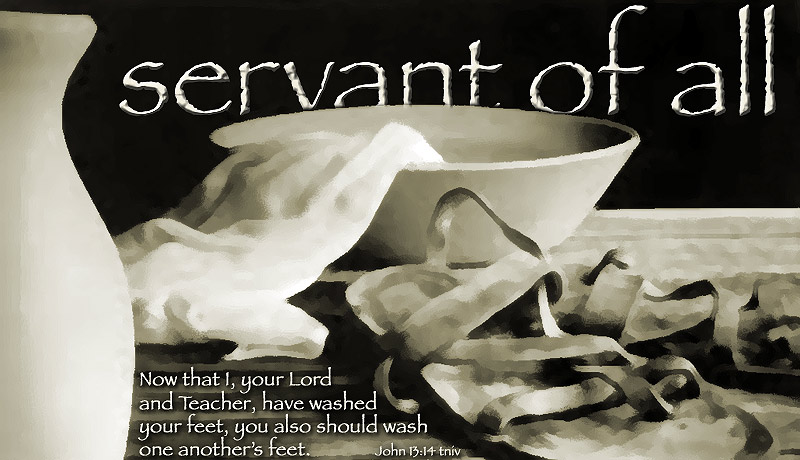
12 So when He had washed their feet, taken His garments, and sat down again, He said to them, “Do you [b]know what I have done to you? 13 You call Me Teacher and Lord, and you say well, for so I am. 14 If I then, your Lord and Teacher, have washed your feet, you also ought to wash one another’s feet. 15 For I have given you an example, that you should do as I have done to you. 16 Most assuredly, I say to you, a servant is not greater than his master; nor is he who is sent greater than he who sent him. 17 If you know these things, blessed are you if you do them.
The Word of God for the Children of God.
Adeste Fidelis! Venite Adoremus! Dominum.
Gloria! In Excelsis Deo! Alleluia, Alleluia, Alleluia, Amen.
Jesus came to model for us, show us what the Kingdom of Heaven is so we could become a dynamic, functional and living part of it.
Spending time reading the Gospels and studying and praying about who he was is a great way to remind ourselves that of all the rich and transformational ways Jesus is never what we expect but, in every way, is better than our expectations.
The story of Jesus redefining kingdom expectations, of kneeling to the floor and as host, gently handing his disciples feet so all could comfortably dine together is truly one of the most profound pictures of our Savior’s heart of love for us!
Jesus, like His Father in Heaven, cared so very much about the minutest details of his followers’ lives!
He was willing to completely surrender himself to the moment His Father set aside, to move into his destiny, to not shy away from God’s plan, get messy, to reach, teach, and show undeserved compassion to his ragtag group of disciples.
This is still true today!
Jesus cares about even the most minute details of your life and still come to us, still willing to model, set the example get messy to show you that you are loved.
None of your fears are too small, too inconsequential, needs much too silly, or stresses too insignificant or too great that God does not care about them all.
He cares about it all… even our stinky feet!
Jesus’ actions in this passage set an example of what it means to imitate him with our lives.
We are called to be more and more like Jesus every day, without exception, the servant of others, selflessly to live with humility, and love in every situation.
Christ-Followers are called to a selfless life as servant, conduct themselves in a very radical counter-cultural fashion – in unity, healing, instead of dividing.
Let’s learn more about what we can learn from the story of Jesus washing his disciples’ feet at Passover.
Where Does the Bible Talk about Jesus Washing the Disciples’ Feet?
The story of Jesus washing his disciples’ feet is recorded in John 13:1-17.
This event occurred in the upper room during the Last Supper.
In the biblical account, we read that when Jesus’ disciples arrived at a special gathering Jesus took the role of the ultimate servant of the house and humbly surrendered to His Father’s will and began washing each of his disciples’ feet.
This gathering, this time of communion, of the breaking and sharing of the bread, fruit of the vine, would later come to be known as the Last Supper.
It was the last time Jesus and his disciples broke bread together before his death on the cross.
It was during this Passover meal that Rabbi Jesus served as host, took the first communion with the disciples and also quietly identified Judas as his betrayer.
The act of feet washing was a necessary custom during this time period when gathering to have a communal meal.
The men would have come in with their feet dust-covered and dirty from their walking the undoubtedly, the decidedly unhygienic sun baked Roman roads.
Cleaning of the feet would have been necessary because the group would have likely been reclining together at a low table and dirty feet would not be the least bit welcomed so close to their food.
It was the servant of a household’s job to wash the feet of incoming guests.
Why Did Jesus Do This and What Was the Significance of Washing Their Feet?
In the Old Testament, priests performed and received ceremonial foot washings before they entered the temple for worship.
Foot washing was a serious matter: a basin for foot washing would have been placed between the Tent of Meeting and the altar so Aaron and his sons could wash before entering the Tent of Meeting,“Whenever they enter the Tent of Meeting, they shall wash with water so that they will not die”(Exodus 30:20).
Disregarding the ritual cleansing meant death to a priest.
In John 13:4-5, Jesus “got up from the meal, took off his outer clothing, and wrapped a towel around his waist. After that, he poured water into a basin and began to wash his disciples’ feet, drying them with the towel that was wrapped around him.”
Jesus has placed the basin between the disciples and the altar, His cross.
Through the witness of His death and the testimony of His resurrection, Jesus makes holy all who do come to the cross through the power of the Holy Spirit.
Through Christ’s atoning work on the cross the disciples and all believers are made holy and righteous before God and then cleansed of their sin and set apart by GOD for service in His body, the Church, a holy priesthood of believers.
Jesus set himself aside, washes his disciples’ feet to purify and cleanse them for their service to God: “Unless I wash you, you have no part with me” (John 13:8).
Jesus, knowing his coming destiny, washing the feet of his disciples came with so much significance for both his disciples in this intimate moment and for all Christians who strive to live, to love, to follow Jesus’ example and teachings.
This selfless act displayed Jesus’ amazing humility!
He took the role of a servant to wash the dusty and dirt-covered feet of his disciples.
Rabbi Jesus was setting an incredible example of what it is to be “Christ-like” through his decidedly humble actions.
Status, pride, or even dirt did not stop him from rolling up his sleeves to serve the men who had been at his side throughout the duration of his ministry.
Prior to this encounter, the disciples had been fighting amongst themselves trying to determine who was the “greatest” among them (Luke 22:24).
Jesus was in a very hands-on way showing them that in his Kingdom the last shall be first and the first shall be last (Matthew 20:16).
Jesus even prompts his disciples to show the same heart of service for each other (John 13:15).
He is clear that servanthood is essential to what it means to be his follower.
This washing also is symbolic of the cleansing power of the blood of Jesus to wash away our sins.
Peter objects to Jesus’ actions but then Jesus rebukes him by saying that unless he washed him, Peter had no part in him (John 13:7-8).
Peter then in a display of passion for the Lord asks him to then wash him from head to toe!
Jesus explains Peter does not need to be washed from head to toe because his actions were symbolic of the cleansing power that being a Christ-follower has in our lives (John 13:10).
Once washed by the blood of a lamb you are free from the stains of sin!
Jesus anoints the disciples for their new role as priests in the new temple that God Himself will raise up.
Jesus ordains them so they can serve His church when He leaves this world, returning to the Father.
Through the act of purification, Jesus imparts His holiness to the disciples so they will be set apart from the world even though they will remain in the world.
Jesus teaches his disciples that His holiness, salvation, and purity will all come through Him and His suffering.
Through the cleansing blood of our Savior – No repeat washing is necessary.
Our Healing is in our Becoming a Servant
John 13:14-15 New King James Version
14 If I then, your Lord and Teacher, have washed your feet, you also ought to wash one another’s feet. 15 For I have given you an example, that you should do as I have done to you.
In our culture today, sadly we don’t have an automatic equivalent to Jesus’ instruction to wash one another’s feet.
But we can figure out that it’s mainly about showing hospitality and serving one another.
The roads of Palestine were unpaved, and with sandals as common footwear, people’s feet would get really dirty—sometimes caked with dust and mud.
As a result, before you entered someone’s home, a servant would come with a pitcher of water, a basin and a towel and wash your feet, an act of hospitality.
It was a customary act of hospitality—like someone offering to hang up your coat and scarf on a cold day as you entered their warm home.
On the night of the last supper, Jesus took the role of a servant as he got up from the meal and began washing his disciple’s feet.
In doing this, Jesus was teaching his disciples an important spiritual principle.
We come to Jesus with nothing of our own, and we must receive from him and be ministered to by him before we have anything to give.
Then, having been served, we go and do the same, we surrender ourselves to God, serving, sharing with others the fullness God has poured into our hearts.
In this example, Jesus provided a profound symbol of his call to servanthood.
Following him is not about position, power, or prestige.
We serve because Jesus Christ came to us as sinners, yet he has served us first.
Jesus shows no squeamishness: He performs this ceremonial washing of His disciples’ feet with a solemn purpose – so others may be prepared to serve.
Setting aside their squeamishness to serve all others as Jesus first served all.
Jesus’ determination made me want to explore the Scriptures more deeply.
What Does Jesus Show When He Washes the Disciples’ Feet?
Through this simple act of foot washing, Jesus demonstrates to His disciples His eternal role as God’s High Priest and Mediator and the disciples part in the priesthood.
Even though He, Jesus must suffer and die and be raised again, the disciples can by faith in the empty tomb be certain He will never leave them or forsake them.
Scripture says, “During the days of Jesus’ life on earth, he offered up prayers and petitions with loud cries and tears to the one who could save him from death, and he was heard because of his reverent submission. Although he was a son, he learned obedience from what he suffered and, once made perfect, he became the source of eternal salvation for all who obey him and was designated by God to be high priest in the order of Melchizedek”(Hebrews 5:7-10).
Jesus is the High Priest of Heaven.
Through the foot washing, He ordained His disciples to be priests of the church in the world.
1 Peter 2:4-10 New King James Version
The Chosen Stone and His Chosen People
4 Coming to Him as to a living stone, rejected indeed by men, but chosen by God and precious, 5 you also, as living stones, are being built up a spiritual house, a holy priesthood, to offer up spiritual sacrifices acceptable to God through Jesus Christ. 6 Therefore it is also contained in the Scripture,
“Behold, I lay in Zion A chief cornerstone, elect, precious, And he who believes on Him will by no means be put to shame.”
7 Therefore, to you who believe, He is precious; but to those who [a]are disobedient,
“The stone which the builders rejected Has become the chief cornerstone,”
8 and
“A stone of stumbling And a rock of offense.”
They stumble, being disobedient to the word, to which they also were appointed.
9 But you are a chosen generation, a royal priesthood, a holy nation, His own special people, that you may proclaim the praises of Him who called you out of darkness into His marvelous light; 10 who once were not a people but are now the people of God, who had not obtained mercy but now have obtained mercy.
Christ, our permanent High Priest, sitting at the right hand of the Father;
He will offer up prayers on their behalf, “he always lives to intercede for them” (Hebrews 7:25), and will empower them through the Holy Spirit to perform their priestly duties to the glory of God.
3 Lessons from Jesus Washing the Disciples’ Feet
1. God’s Kingdom Works In Reverse Order
Matthew 18:4 says, “Therefore, whoever takes the lowly position of this child is the greatest in the kingdom of heaven.”
Humility, trust, simplicity, joy, full of wonder, and playfulness are all words that could be used to characterize children.
In Jesus’ Kingdom what seems logical to adults oftentimes goes against the way God works. Jesus calls the last to be first (Matthew 20:16).
His Word prompts us to serve one another in love (Galatians 5:13).
The Bible teaches us to humble ourselves before the Lord (James 4:10).
In Matthew 5:38-40, Jesus teaches that when we are wronged not to fight back but to offer our offenders more of ourselves!
All of these ideas go against everything that seems logical, right, or justified in our world!
We live in a world where pride, greed, and ambition rule our systems.
Money talks, looking out for yourself is prized, and caring for those who are hurt so you can get ahead is not often considered.
Jesus intentionally sets an example of how we are to live as his followers through his actions at the Last Supper.
He makes it clear that we are called to be the feet washers of our community.
Our mission as Believers is to be those who love beyond reason every chance we get.
2. Jesus Washes Us Clean
Isaiah 1:18 says, “Come now, let us reason together, says the Lord: though your sins are like scarlet, they shall be as white as snow; though they are red like crimson, they shall become like wool.”
The prophet foretold of the cleansing power of Jesus years before Jesus physically walked the earth.
His followers would have seen the feet washing and the breaking of bread and sharing of wine at the first communion that happened at the Last Supper as symbolic of Jesus’ cleansing power.
When we bring our sins to the Lord he is willing and able to wash us clean.
All Jesus did led up to the work of the cross, where he took the weight of our sins onto himself, so we could be forgiven.
Don’t be ashamed of your “dirty feet” bring all that you are to the Lord and he is willing and able to set you free.
3. Jesus Was Not What the World Expected
Peter was shocked by Jesus’ actions and asked him to stop because in his mind his king and Savior wouldn’t stoop to the level of a feet-washing-servant.
Jesus was not what the world expected.
They were looking for a political liberator, someone who would help restore power to the Jewish people, and they thought their Messiah would be powerful in the same way the world measures power.
Jesus was full of heavenly ability and did many miracles but he never strove for a place of worldly power or influence.
Jesus rebuked the Pharisees (Matthew 23), avoided political confrontation (John 18:10-11), and took the posture of a servant throughout his ministry.
Meanwhile, his disciples were concerned about who would get the best seat in Heaven next to Jesus.
It wasn’t until Jesus’ death and resurrection that the full picture of Jesus as a Messiah as their foretold Savior was fully understood because while on Earth he never did as they were expecting.
When we think of what it means to be a Christ-Follower do our expectations line up with the example of Jesus?
It is easy to put God in a box, thinking he should work in ways that make sense to our worldly sensibilities.
The Bible reminds us that God rarely plays by our rules.
Jesus came to show us what the Kingdom of Heaven is so we could become a part of it.
Spending time reading the Gospels and studying and Praying over who he was is a great way to remind ourselves of all the ways Jesus is never what we expect but, in every way, abundantly, utterly, infinitely better than our expectations.
In the name of God, the Father and God the Son and God the Holy Spirit,
Let us Pray,
“Unless I wash you
you have no share with me.”
If only it were otherwise.
If only I could present my credentials,
show my record of service,
get some kind of unlimited pass.
In every area of my life
I am more used
to proving how adequate I am,
presenting a polished image,
gaining certain privileges.
But you, Lord,
you bring me down
to where you are kneeling,
and take hold
of the feet I prefer to hide.
We are here together,
near the ground,
and in this humble position
I am touched by you
and made clean.
Adeste Fidelis! Venite Adoremus! Dominum.
Gloria! In Excelsis Deo! Alleluia, Alleluia, Alleluia, Amen.




 Loving God, Living God, Loving Hope, Living Hope, Loving Living Life His Way! "Many things are possible for the person who has hope. Even more is possible for the person who has faith. And still more is possible for the person who knows how to love. But everything is possible for the person who practices all three virtues." - Brother Lawrence (1605-1691), Practicing the Presence of God (1692).