
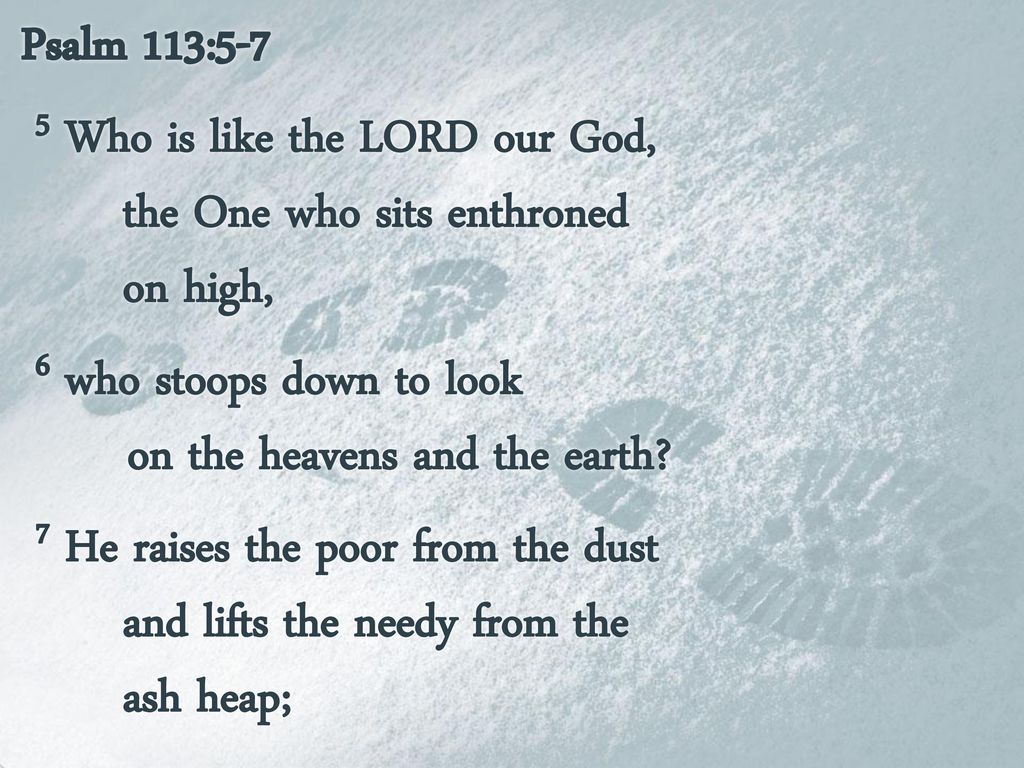
Psalm 113 Complete Jewish Bible
113 Halleluyah!
Servants of Adonai, give praise!
Give praise to the name of Adonai!
2 Blessed be the name of Adonai
from this moment on and forever!
3 From sunrise until sunset
Adonai’s name is to be praised.
4 Adonai is high above all nations,
his glory above the heavens.
5 Who is like Adonai our God,
seated in the heights,
6 humbling himself to look
on heaven and on earth.
7 He raises the poor from the dust,
lifts the needy from the rubbish heap,
8 in order to give him a place among princes,
among the princes of his people.
9 He causes the childless woman
to live at home happily as a mother of children.
Halleluyah!
Glory be to the Father,
and to the Son, and to the Holy Ghost;
as it was in the beginning,
is now, and ever shall be,
world without end. Amen, amen.
A Day of Praise, Prayer, Beginning and Ending with ‘Halleluyah‘
Psalm 113 AKJV
1 Praise ye the Lord.
Praise, O ye servants of the Lord,
praise the name of the Lord.
2 Blessed be the name of the Lord
from this time forth and for evermore.
3 From the rising of the sun unto the going down of the same
the Lord’s name is to be praised.
4 The Lord is high above all nations,
and his glory above the heavens.
5 Who is like unto the Lord our God,
who dwelleth on high,
6 who humbleth himself to behold the things that are in heaven, and in the earth!
7 He raiseth up the poor out of the dust,
and lifteth the needy out of the dunghill;
8 that he may set him with princes,
even with the princes of his people.
9 He maketh the barren woman to keep house,
and to be a joyful mother of children.
Praise ye the Lord.
When I pray with people and for people, I often like to give them words of encouragement in the form of a spiritual challenge. For example, I’ll invite them to begin each morning with praise as the first activity of the day. Like the psalmist, they can sing and shout a hallelujah praise to recognize who God is.
I wonder, as I write this devotional, why didn’t I, just before I started writing this, why I did not apply and then practice what I am now about to write about?
Thus, I have been humbled, this first thing this morning, by the LORD my God who sits enthroned on high in the heavens and took some time from His eternal vigil over all the universe He created, to give me a divine nudge in my ribcage.
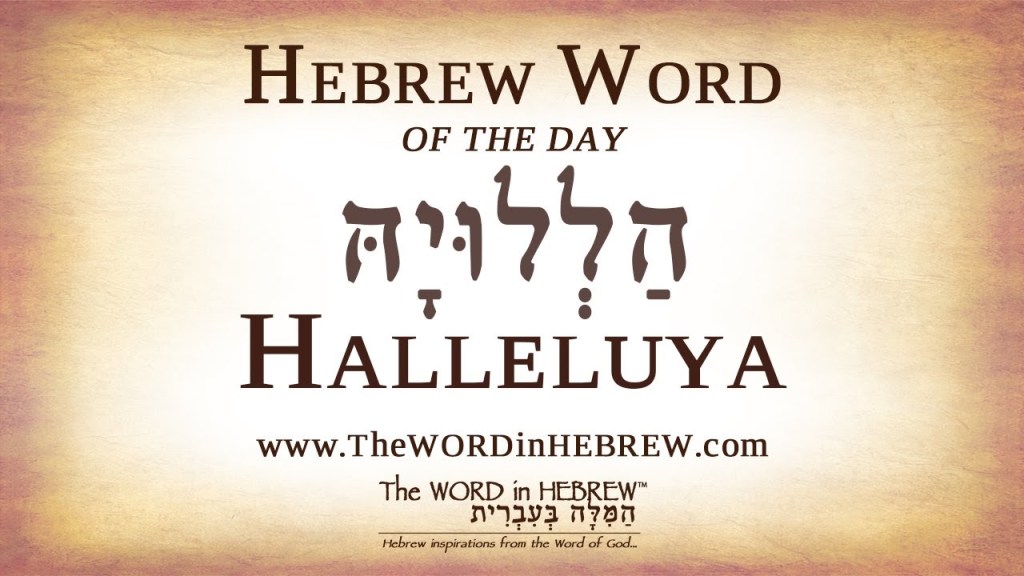
This much beloved psalm was often sung just before people took up the first cup of wine at the Passover meal. They were praising, remembering, the goodness and faithfulness of God to the people of Israel when delivered from bondage.
It is the first of the Hallel Psalms.
Psalms 113—118 are known as the Hallel Psalms, or simply the Hallel (Hallel means “praise”).
While many psalms praise God, this set of psalms became associated with the Passover due the mention of the deliverance from Egypt in Psalm 114.
The focus on the exodus is the reason these psalms are also sometimes referred to as the Egyptian Hallel.
These psalms were recited at Jewish feasts, especially Passover.
Depending upon which tradition was being followed, one or two of the psalms were recited before the meal, and the rest after.
Here is a brief description of each of the Hallel Psalms:
Psalm 113 is a short psalm of praise without reference to any historical context.
Verse 3 may be the best known from this psalm: “From the rising of the sun to its setting, the name of the Lord is to be praised!” (ESV).
The Bible verse Psalms 113:5, from the King James Version, reads: “Who is like unto the Lord our God, who dwelleth on high.” This verse is found within the larger text of Psalm 113, which is a psalm of praise and thanksgiving to God.
Verse 5 of this psalm exclaims the greatness and uniqueness of the Lord our God. It presents a rhetorical question, “Who is like unto the Lord our God?”
This question implies that there is no one like God, and the answer is obvious – no one is like Him.
The verse further emphasizes the exalted position of God stating “who dwelleth on high.”
This phrase speaks to the transcendence and sovereignty of God, highlighting the idea He is above all creation and rules from a position of ultimate authority.
The theme of the greatness and uniqueness of God is central to this verse.
It conveys the idea that there is no comparison to God, no one can match His power, glory, and sovereignty, a central theme as echoed throughout the Bible, emphasizing the indelible truth of omnipotence and unmatched nature of God.
In the context of the larger Psalm 113, this verse is part of a hymn of praise to God.
The psalmist begins by exalting the name of the Lord and blesses it from that time forth and forevermore (verse 2).
The focus point of the psalm then shifts unto the character and actions of God, specifically the way He stoops down to look upon the earth and lift the poor and needy from the dunghill (verse 6-7).
This psalm likewise celebrates God’s magnificence, care for His people, verse 5 serves as a heart grabbing, powerful declaration of God’s unmatched greatness.
Symbolically, the phrase “who dwelleth on high” conveys the idea of God’s exaltation and position of authority.
It refers to the heavenly realm where God dwells as the transcendent ruler of the universe.
This stunning imagery reflects the belief in God’s divine kingship, reinforces the idea of His sovereignty. It also speaks to the idea of God’s elevation above all earthly concerns and His ability to govern all creation from His lofty position.
The verse also symbolizes the comparison and contrast between the nature of God and the limitations of humanity. It highlights the insufficiency of human power and the inability of any mortal being to compare to the greatness of God.
This vivid symbolism serves to inspire us, to highly both exalt God, humble humanity, emphasizing the vast difference between the Creator, His creation.
Overall, Psalm 113:5 is a powerful declaration of the greatness and uniqueness of God. It encapsulates the theme of divine sovereignty and transcendent authority, while serving as a reminder of God’s unmatched power and majesty.
The verse is a profound expression of praise and adoration for the Lord our God, recognizing His unparalleled position, acknowledging an unmatched greatness.
Psalm 114 is also a short psalm that poetically relates the Hebrews’ deliverance from Egypt: “The sea looked and fled. . . . The mountains skipped like rams. . . . [the Lord] turns the rock into a pool of water” (verses 3–4, 8).
Psalm 115 is slightly longer and contrasts those who trust in the Lord with those who trust in the idols of the surrounding nations.
“Their idols are silver and gold, the work of human hands. They have mouths, but do not speak; eyes, but do not see. They have ears, but do not hear; noses, but do not smell. They have hands, but do not feel; feet, but do not walk; and they do not make a sound in their throat. Those who make them become like them; so do all who trust in them” (verses 4–8, ESV).
Psalm 116 is written from the perspective of an individual who has been freed, delivered, from a dire situation.
“I love the Lord, because he has heard my voice and my pleas for mercy. Because he inclined his ear to me, therefore I will call on him as long as I live” (verses 1–2 ESV).
Psalm 117 is both the shortest psalm and the shortest “chapter” in the Bible, with only 2 verses (although psalms are not technically chapters).
This is the whole psalm:
“Praise the Lord, all nations! Extol him, all peoples! For great is his steadfast love toward us, and the faithfulness of the Lord endures forever. Praise the Lord!” (ESV).
Psalm 118 is the longest of the Hallel Psalms.
It admonishes both the nation and the individual to praise the Lord and expresses confidence that the Lord will save those who call on Him.
It begins and ends with the well-known exhortation, “Oh give thanks to the Lord, for he is good; for his steadfast love endures forever!” (ESV).
Also well-known is verse 14: “The Lord is my strength and my song; he has become my salvation” (ESV).
Also well known is verse 24: “This is the day that the Lord has made;
let us rejoice and be glad in it. (ESV)
Taken as a group, the Hallel Psalms focus on deliverance, both nationally and individually.
It is quite possible when Jesus finished the Last Supper and He and His disciples sang a hymn (Mark 14:26), the hymn they sang was this group of Hallel Psalms.
At the Last Supper, Jesus took the Passover meal and infused it with a deeper, newer meaning. The salvation that He promised was not deliverance from physical danger or human bondage but salvation from spiritual bondage and the grave eternal dangers of the penalty of sin.
In the conclusion to the great chapter on salvation, Paul in Romans 8:31 asks, “If God is for us, who can be against us?”
This may be an allusion to one of the Hallel Psalms: “The Lord is with me; I will not be afraid. What can mere mortals do to me?” (Psalm 118:6).
The Hallel Psalms were a fitting passage to be included in Passover celebrations and a deeply significant fitting for today’s New Covenant believer to praise God the whole day long and celebrate salvation from the power, the penalty of sin.
Saying “Praise the Lord” (Hebrew: “Hallelujah”) is also the perfect way for us to start the day, remembering the goodness and faithfulness of God.
It helps to set the tone for the day, and it puts our attitude in the right place.
It also reminds us that God is always and forever going to be infinitely bigger than our worst of circumstances and that no one else is like the Lord our God.
We can also sing God’s praises before going to sleep at the end of the day.
When we praise someone, it means we know something significant about that person and what they have done. The more we experience the fullness of God in our Savior Jesus Christ and deep in our lives, the easier our praise of God will be.
Now, in this exact moment, as we recall God, renew our practice, morning and evening, sing praises to God’s name, we are reminded that we have a heavenly Father and a best friend who is always with us and provides everything we need.
In the name of God, the Father and God the Son and God the Holy Spirit,
Let us Pray,
Psalm 19 Complete Jewish Bible
19 (0) For the leader. A psalm of David:
2 (1) The heavens declare the glory of God,
the dome of the sky speaks the work of his hands.
3 (2) Every day it utters speech,
every night it reveals knowledge.
4 (3) Without speech, without a word,
without their voices being heard,
5 (4) their line goes out through all the earth
and their words to the end of the world.
In them he places a tent for the sun,
6 (5) which comes out like a bridegroom from the bridal chamber,
with delight like an athlete to run his race.
7 (6) It rises at one side of the sky,
circles around to the other side,
and nothing escapes its heat.
8 (7) The Torah of Adonai is perfect,
restoring the inner person.
The instruction of Adonai is sure,
making wise the thoughtless.
9 (8) The precepts of Adonai are right,
rejoicing the heart.
The mitzvah of Adonai is pure,
enlightening the eyes.
10 (9) The fear of Adonai is clean,
enduring forever.
The rulings of Adonai are true,
they are righteous altogether,
11 (10) more desirable than gold,
than much fine gold,
also sweeter than honey
or drippings from the honeycomb.
12 (11) Through them your servant is warned;
in obeying them there is great reward.
13 (12) Who can discern unintentional sins?
Cleanse me from hidden faults.
14 (13) Also keep your servant from presumptuous sins,
so that they won’t control me.
Then I will be blameless
and free of great offense.
15 (14) May the words of my mouth
and the thoughts of my heart
be acceptable in your presence,
Adonai, my Rock and Redeemer.
Glory be to the Father,
and to the Son, and to the Holy Ghost;
as it was in the beginning,
is now, and ever shall be,
world without end. Amen, amen.

 Loving God, Living God, Loving Hope, Living Hope, Loving Living Life His Way! "Many things are possible for the person who has hope. Even more is possible for the person who has faith. And still more is possible for the person who knows how to love. But everything is possible for the person who practices all three virtues." - Brother Lawrence (1605-1691), Practicing the Presence of God (1692).