
Genesis 15 GOD’S WORD Translation
The Lord’s Fourth Promise to Abram
15 Later the Lord spoke his word to Abram in a vision. He said,
“Abram, don’t be afraid.
I am your shield.
Your reward will be very great.” [a]
2 Abram asked, “Almighty Lord, what will you give me? Since I’m going to die without children, Eliezer of Damascus will inherit my household. 3 You have given me no children, so this member of my household will be my heir.”
4 Suddenly, the Lord spoke his word to Abram again. He said, “This man will not be your heir. Your own son will be your heir.” 5 He took Abram outside and said, “Now look up at the sky and count the stars, if you are able to count them.” He also said to him, “That’s how many descendants you will have!” 6 Then Abram believed the Lord, and that faith was regarded as the basis of Abram’s approval by the Lord. 7 Then the Lord said to him, “I am the Lord, who brought you out of Ur of the Chaldeans to give you this land so that you will take possession of it.”
8 Abram asked, “Almighty Lord, how can I be certain that I will take possession of it?”
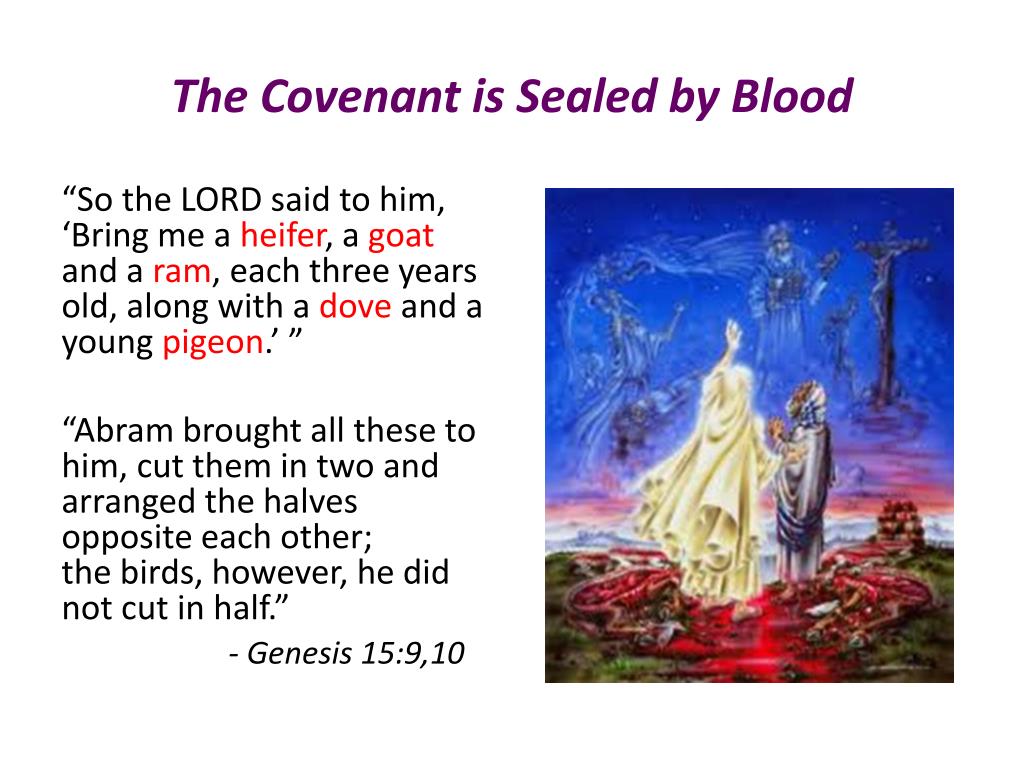
9 He answered Abram, “Bring me a three-year-old heifer, a three-year-old female goat, a three-year-old ram, a mourning dove, and a pigeon.” 10 So Abram brought all these animals to him. He cut each of them in half and laid each half opposite the other. However, he did not cut the birds in half.
11 When birds of prey came down upon the carcasses, Abram drove them away. 12 As the sun was just about to set, a deep sleep—a dreadful, deep darkness—came over Abram.
13 God said to Abram, “You can know for sure that your descendants will live in a land that is not their own, where they will be slaves, and they will be oppressed for 400 years. 14 But I will punish the nation they serve, and after that they will come out with many possessions. 15 But you will die in peace and be buried at a very old age. 16 In the fourth generation your descendants will come back here, because the sin of the Amorites will not have run its course until then.”
17 The sun had gone down, and it was dark. Suddenly a smoking oven and a flaming torch passed between the animal pieces. 18 At that time the Lord made a promise [b] to Abram. He said, “I will give this land to your descendants. This is the land from the river of Egypt to the great river, the Euphrates. 19 It is the land of the Kenites, the Kenizzites, the Kadmonites, 20 the Hittites, the Perizzites, the Rephaim, 21 the Amorites, the Canaanites, the Girgashites, and the Jebusites.”
The Word of God for the Children of God.
Glory be to the Father,
and to the Son, and to the Holy Ghost;
as it was in the beginning,
is now, and ever shall be,
world without end. Amen, amen.
Our Biblical text for today’s devotion, Genesis 15, may well be one of the most important chapters in the entire Hebrew [Old] Testament.
And since the Old Testament is foundational to the New Testament, since we cannot fully understand the New Testament without understanding the Old Testament, Genesis 15 is one of the most important chapters in the entire Bible.
Recently in one of my online chat forums, several people became quite engaged and also quite enraged, in discussing what it meant to to them to submit to God.
Using capital letters some of them argued that it wasn’t appealing and that it might cause many people to agree to things that could be harmful for them.
In their staunchly held views, submission to God is potentially dangerous.
And as I followed the debate, in a way, they were right – submitting is risky.
As I followed the back and forth of their words – submitting is dangerous too!
Today’s story about Abram believing God’s word and submitting to God’s promise is complex, has many cultural layers that can be hard for us to grasp.
For example, in our contemporary context we do not make covenant promises today by cutting up and dividing animals and then walking through the pieces.
In those days that meant, “If I break my promise, may the same be done to me.”
Notice, however, that Abram does not walk barefoot through the blood of the divided animals, as would have been the custom of the day.
Instead, Abram goes into a deep sleep, and God passes through the pieces.
The emphasis if our text here is on God making and keeping the promise.
Abram’s sole task will be to believe God’s promise and to live according to it.
As Abram, in complete faith believed, our faith in believing that God will keep his promises challenges us to submit and invite him to take control in our lives.
And, rather than “reducing our power”, as some people are fearful of, this way of living brings us to live fully in the strength of God’s faithfulness and power.
Genesis 15:9-10 New American Standard Bible
9 So He said to him, “[a]Bring Me a three-year-old heifer, a three-year-old female goat, a three-year-old ram, a turtledove, and a young pigeon.” 10 Then he [b] brought all these to Him and cut them [c]in two, and laid each half opposite the other; but he did not cut the birds.
In the passage God is forming the Abrahamic covenant.
This was called a blood covenant.
In ancient times when two individuals made a contract, they would take an animal and cut it in half and separate the two halves a few feet from each other.
Then they would sprinkle the blood between that separation.
The two individuals entering into a contract would join hands, walk the path between the two separated parts of the animal over the blood.
At the end of this path the priest would stand and listen to the conditions, vows or promises each person would make in the contract.
The two entering into the contract would have 10 witnesses standing on either side – it was their job to listen to the terms or conditions of the contract.
These were the adjudicators -if either party broke a condition of the contract it would be the job of these ten witnesses to “adjudicate” “remove” the one who broke the strict conditions of the blood covenant both parties had just made.
Abraham himself did not walk on the bloodied path between the animals.
Instead, God put Abraham into a deep sleep and then God passed through the center of the sacrifices by Himself – God Himself was the final adjudicator.
God knew his people would not keep their end of the covenant bargain, so He did not make His people a party to the final penalty but instead He chose to bare the final, ultimate penalty Himself for their breaking of the blood covenant.
At a time of His choosing, God sent His Son to redeem us, that penalty was paid for 2000 years ago when He sent His son to die on the cross and shed his blood.
What did God teach you today about the way He establishes His covenants?
What did God teach you today about the way He administers His covenants?
What did God teach you today about His Son Jesus submitting to His covenants?
What did God teach you today about personally submitting to His covenants?
How has the covenant God first made with Abraham and now made with you, through our Lord Jesus Christ, changed the way you submit, live each day now?
In the name of God, the Father and God the Son and God the Holy Spirit,
Let us Pray,
Psalm 61 New American Standard Bible
Confidence in God’s Protection.
For the music director; on a stringed instrument. A Psalm of David.
61 Hear my cry, God;
Give Your attention to my prayer.
2 From the end of the earth I call to You when my heart is faint;
Lead me to the rock that is higher than I.
3 For You have been a refuge for me,
A tower of strength against the enemy.
4 Let me [a]dwell in Your tent forever;
Let me take refuge in the shelter of Your wings. Selah
5 For You have heard my vows, God;
You have given me the inheritance of those who fear Your name.
6 You will [b]prolong the king’s [c]life;
His years will be like generations.
7 He will [d]sit enthroned before God forever;
Appoint faithfulness and truth that they may watch over him.
8 So I will sing praise to Your name forever,
That I may pay my vows day by day.
Promise-keeping God, your plans for us are way beyond what we can imagine for ourselves. Help us to trust in you always. Through the life blood of my Jesus, Amen.
Glory be to the Father,
and to the Son, and to the Holy Ghost;
as it was in the beginning,
is now, and ever shall be,
world without end. Amen, amen.

 Loving God, Living God, Loving Hope, Living Hope, Loving Living Life His Way! "Many things are possible for the person who has hope. Even more is possible for the person who has faith. And still more is possible for the person who knows how to love. But everything is possible for the person who practices all three virtues." - Brother Lawrence (1605-1691), Practicing the Presence of God (1692).