
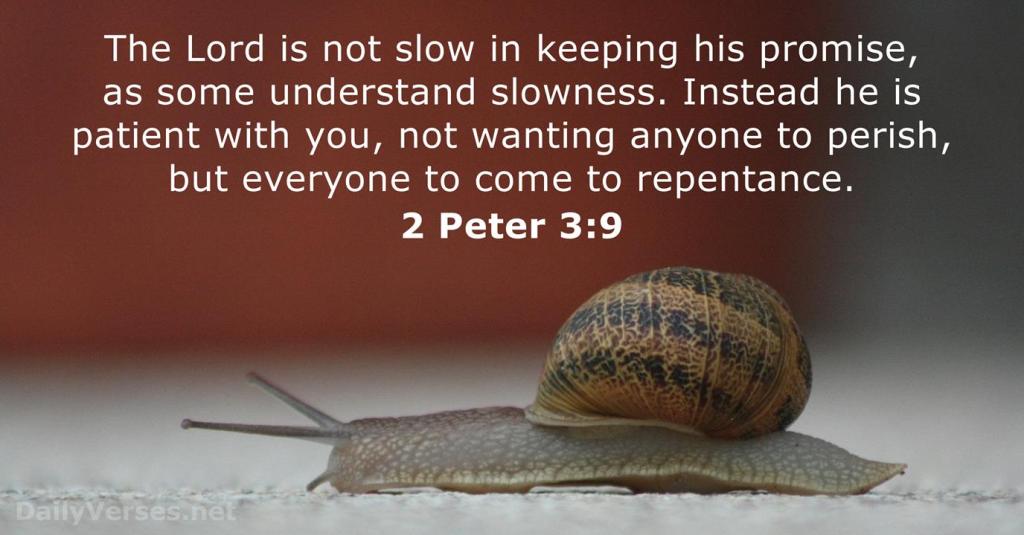
2 Peter 3:8-9 New King James Version
8 But, beloved, do not forget this one thing, that with the Lord one day is as a thousand years, and a thousand years as one day. 9 The Lord is not slack concerning His promise, as some count slackness, but is longsuffering toward [a]us, not willing that any should perish but that all should come to repentance.
The Word of God for the Children of God.
Glory be to the Father,
and to the Son, and to the Holy Ghost;
as it was in the beginning,
is now, and ever shall be,
world without end. Amen, amen.
The Bible is the best interpreter of itself, and when we come across passages which confound us, we first need to see what else Scripture has to say about the matter.
2 Peter 3:9 has proven to be a confusing verse to many, but we will investigate God’s Word for the correct interpretation of this verse.
What does 2 Peter 3:9 mean?
What is the Context of 2 Peter 3:9?
To better understand the verse, we need to examine the context of the passage, starting with 1 Peter.
In his first letter, Peter wrote encouragement to his readers who underwent suffering and persecution (1 Peter 1:6-7; 2:18-20; 3:9, 13-17; 4:1-4, 12-19; 5:9).
Peter called the long-suffering believers to look toward Christ’s return with the hope of being proven in their faithfulness.
He exhorted them to remain true to the Lord Jesus Christ in the midst of such hardship.
Peter highlights who these believers are in Christ,
“But you are a chosen race, a royal priesthood, a holy nation, a people for His own possession, that you may proclaim the excellencies of Him who called you out of darkness into His marvelous light” (1 Peter 2:9).
No matter how secular society viewed them, they were called by God for His purposes, and just as Jesus lived a life of righteousness, they were to follow His example.
As such, they were to live righteous lives in the presence of others so their opponents would see their godly behavior and perhaps be won to the faith.
Since this is Peter’s second letter to his audience (1 Peter 1:1; 2 Peter 3:1), he was probably writing from his prison cell in Rome (2 Peter 1:12-15) to the exiled believers (1 Peter 1:1; 2:11) in Pontus, Galatia, Cappadocia, Asia, and Bithynia.
2 Peter follows the encouragement of the first letter with warnings to the believers against false teachers and to practice godliness as they anticipate Christ’s return.
They were hit with remonstrances from unbelievers who sought to bring doubt with questions such as, “Where is the promise of His coming?” (2 Peter 3:4).
Peter reminded his audience of the words of the prophets who said, “scoffers will come in the last days with scoffing, following their own sinful desires” (2 Peter 3:3).
The environment in which the believers lived was full of the false teachers’ heresies, greed, sensuality, lust, wicked actions, rejection of God’s authority. (2 Peter 2:1-22)
These false teachers promised freedom but instead were slaves to their sinful desires.
The CEV renders 2 Peter 2:3 as, “Those false teachers only want your money, so they will use you by telling you lies. Their judgment spoken against them long ago is still coming, and their ruin is certain.”
Our theological environment reeks of the same sinful actions by false teachers.
Peter confronted the false teachings with the truth of God’s character (2 Peter 2:4-10a), the absolute authority of Christ, the veracity of God’s Word, the authority of the apostles’ words (2 Peter 1:16-21), and the last things to come.
What does this Verse Mean?
The immediate context of this last chapter of 2 Peter has to do with the last days, especially the Day of the Lord (2 Peter 3:3, 10).
The exiled elect were anxiously waiting for the Lord to return, and some had lost hope, especially amid the persecution and scoffing they endured.
Just as we now long for vindication for our faithful obedience, so too did they.
Peter urges the believers to remember what the prophets said throughout the Old Testament, the command of the Lord Jesus (the Gospel) as given through the apostles (2 Peter 3:2).
Let’s start with the first part of the verse,
“The Lord is not slow (to fulfill His promise) as some count slowness, but is patient toward you,” (parentheses added).
1. “The Lord is not slow… as some count slowness, but is patient toward you,”
In 2 Peter 3:8, the verse which immediately precedes our key verse, Peter says, “But do not overlook this one fact, beloved, that with the Lord one day is as a thousand years, and a thousand years as one day.”
What does this mean but time — all time — is according to the Lord.
Time did not exist until God created the sun and the moon (Genesis 1:16; Psalm 104:19).
God Himself is timeless, and all moments are as the present to Him.
Christianity.com writer Alyssa Roat explains, “He (God) is simultaneously in the past, present, and future. When He tells what is to come, He isn’t making a prediction; He is already there” (John 4:24; Revelation 1:8).
Slowness is a subjective condition, and God is not subjective regarding humans, nor does He show partiality (Acts 10:34; Romans 2:11).
God is accountable to no one’s idea of what His timing should be because He alone is the Lord, and He is perfect and holy (Leviticus 18:4; 2 Samuel 22:31; Revelation 6:10).
Trusting Him is an obedient action.
As an example, in Malachi 4:5, the Lord spoke through His prophet,
“Behold, I will send you Elijah the prophet before the great and awesome day of the LORD comes.”
When?
The prophet did not utter words of when; he spoke the words God gave him.
Four hundred years of silence followed Malachi’s pronouncement.
No further word came from the Lord during that time between the Old and New Testament times.
What the people were left with was the prophecy, “I will send you Elijah the prophet before the great and awesome day of the LORD comes” (Malachi 4:5).
Voiced in Malachi’s time, that was according to God’s timing, and while the people waited, the geo-political landscape changed big time and the Jewish people then formed the Pharisees and Sadducees and built on their tradition.
Through all of history, we see God’s patience displayed.
In the Garden of Eden, God could have wiped out the first humans because of their sin, but He initiated His plan of redemption by His promise to Adam and Eve (and all humankind) (Genesis 3:15).
All of Scripture points to Christ, and history will be culminated in His return.
God was patient with the rebellious Israelites, the men He used to bear the good seed, men whose lives were touched by God as lessons for us (Job, Jonah, etc.), and with Jesus’ disciples as they walked with Him for three years on this earth.
Peter held all of this history, relayed the truth of God’s character to his readers.
2. “to fulfill His promise…”
This parenthetical phrase speaks of God’s character.
What God promises, God fulfills.
Our Bible’s New Testament begins with Matthew. Matthew launches his Gospel with the supreme fulfillment of God’s promises, the genealogy and birth of Christ (Matthew 1:1-25), an immediate look back at His lineage and a look forward as He is described as the long-awaited Messiah (Isaiah 7:14).
God’s promise was fulfilled in Jesus Christ.
As we saw, God’s timing is perfect according to His standards, not ours, and it’s His standards alone which matter.
Why Do We Sometimes Think God Is Slow?
Our view of God and His timing is from a human perspective.
Most of us have been conditioned to a fast-paced life, from daily activities to our needs and wants, we want it all now – so any waiting, therefore, is hard.
God’s promises are the height of excitement for us because we know He will bring about what He says He will do.
Yet, we grow weary of this sin-sick world, where society has skewed God’s moral principles beyond any measure of recognition.
Babies are murdered.
Immature children aren’t only permitted but are encouraged to change genders.
Wicked immoral incomprehensible lifestyles are plastered on media outlets as today’s “chic” entertainment at least and an example to be followed to utmost.
The devil is hard at work seeking people to devour (1 Peter 5:8).
He is the father of all lies from the beginning (John 8:44) and he knows his time is short (Revelation 12:12)
Christians have the peace of Jesus within them, but we long for a peaceful world as soon as possible – we must just trust God to enact His will in His perfect time.
What Does the Second Part of 2 Peter 3:9 Mean?
2 Peter 3:9b tells us, (God) “not wishing that any should perish, but that all should reach repentance.”
Since chapter 3 is about the coming Day of the Lord, judgment is at hand.
The church Peter writes to in his epistles was in we would say were dire straits.
They longed for the Lord to return to institute His kingdom on earth and exact vengeance on His enemies (2 Peter 3:7).
They were under severe persecution and feared they would perish before He returned.
Peter explained God was not acting in reluctance or slowness to save them; He was being patient in His dispositional will.
In a long yet well-defined article on God’s will, Dr. R. C. Sproul clarifies,
“We should understand God’s will as it is discussed in 2 Peter 3:8–9 as describing His will of disposition. Here, Peter speaks about God’s will through anthropomorphic expressions that describe God’s will and affections in a manner that we can understand by describing them in a way analogous to our experience. In this way, “God does not delight in the death of the wicked — He doesn’t get some great, personal thrill out of sending people to hell, even though He wills to do it.” He is just, and must serve His justice.
How Do We See God’s Patience and Love in This Verse?
God knows who belong to Him in Jesus Christ and who will be His (Matthew 24:22, 24, 31; Luke 18:7).
There will come a day of reckoning for the wicked when God will judge and God will condemn those who have refused His Son.
That time and action does not belong to sinful man; it rightfully belongs to our sovereign Lord.
We petition our merciful God to make everything right, and we are eager to see “His kingdom come and His will be done on earth as it is in heaven” (Matthew 6:10).
As of this devotions writing, more will be added to the Lamb’s Book of Life, for when the laborious work of men as the Lord’s ambassadors (2 Corinthians 5:20) is finished (by God’s personal timetable), Jesus will return and Jesus will judge.
All who are elect will be saved and ushered into eternity with Christ.
Those who are not will be forever in hell, apart from the goodness of God (Matthew 13:47-50).
When we think, we ponder, of when we came to the Lord in repentance and faith and surrendered to Him, we are sternly reminded of God’s patience with us and our receivership of it thankful for His everlasting love (Psalm 103:17).
How Does this Verse Encourage Us in Our Daily Walk?
Just as Peter reminded his ancient audience to remember what the prophets, Jesus, and His apostles said, we as contemporaries, can immerse ourselves in the Bible and read about God’s provision, protection, and fulfilled promises.
All Scripture is for our use and betterment (2 Timothy 3:16-17) and through the Holy Spirit we are able to understand (1 Corinthians 2:1-16; 2 Peter 1:21), exalt (Psalm 34:3), and glorify the Lord (Psalm 86:12) when we obey His commands (2 Peter 3:2).
We thank God for His patience with us as we are being sanctified and conformed to His image (Romans 8:29).
We daily reflect His goodness when we display patience with others within and outside the church.
As Peter spoke of his ancient audience’s godliness perhaps winning some to the Lord, so too God may use our contemporary walk with our Savior Christ to spur others forward to repent in faith and to love and obey Him. (Psalm 32)
Even today, Christians all over the world undergo persecution, some to very small degrees of censure when families, friends, and/or others mock our faith.
And Christians in countries either politically ruled or culturally driven by false religions may suffer torment and even death.
Peter’s message to persevere and remain steadfast in our hope mimics Christ’s magnificent promise spoken to the disciples while Messiah Jesus was yet alive:
“I have said these things to you, that in Me you may have peace. In the world you will have tribulation. But take heart; I have overcome the world” (John 16:33).
Our Patient and Active Missionary God
In his mission, God exercises a patient love as well as a vigorous engagement to defeat Satan and the forces of evil.
Already in Genesis 3:15 God’s promise looks ahead to Jesus’ victory over Satan.
We grow impatient and sometimes despair of evil and its effects in the world around us.
But the apostle Paul writes, “The God of peace will soon crush Satan under your feet” (Romans 16:20).
The final, great victory of Jesus over evil is described in Revelation 20:10: “The devil … was thrown into the lake of burning sulfur” to remain there forever.
In the meantime, be aware, says Paul, that
“our struggle is not against flesh and blood, but against the rulers, against the authorities, against the powers of this dark world and against the spiritual forces of evil in the heavenly realms” (Ephesians 6:12).
That is why we need to “be strong in the Lord and in his mighty power” (6:10).
God is not forgetting us.
Our merciful, patient, and powerful God is moving forward with his mission for the salvation of the people he loves.
Hold on to Jesus’ promise: “In this world you will have trouble. But take heart! I have overcome the world” (John 16:33).
In the name of God, the Father and God the Son and God the Holy Spirit,
Let us Pray,
Creator and Creating God. Heavenly Father, I praise Your wonderful name for your long-suffering attitude toward me, Your errant child, and toward the whole world. I am sorry for those times when I have wondered why Jesus has not returned yet. Help me see the unsaved world through Your eyes of love, that You want all to be saved. Give me a hunger to spread Your saving gospel of grace to a lost world. I know that my Lord and Savior Jesus lived, ministered, and suffered and crucified and died, was resurrected at the right time, seated with You and is coming back at the right time. I pray many may come to faith in You, while there is still time. In Jesus’ name, AMEN.
Glory be to the Father,
and to the Son, and to the Holy Ghost;
as it was in the beginning,
is now, and ever shall be,
world without end. Amen, amen.

 Loving God, Living God, Loving Hope, Living Hope, Loving Living Life His Way! "Many things are possible for the person who has hope. Even more is possible for the person who has faith. And still more is possible for the person who knows how to love. But everything is possible for the person who practices all three virtues." - Brother Lawrence (1605-1691), Practicing the Presence of God (1692).