Romans 15:4 "For whatever was written in earlier times was written for our instruction, so that through perseverance and the encouragement of the Scriptures we might have hope."
The world is all too often a hostile place for believers. Goliaths no longer try to hide themselves from public view or from public judgement. They stand tall in their perceived invulnerability; surround, abound around every street corner. Goliath says, “you cannot touch me! “You cannot beat me!” “You are nothing!” We are intimidated by the sheer force of their size, their strength, their words. We shake and we quake in our boots – too easily accept unconditional defeat!
God wants his spiritual children to know, however, that they are not alone. He lives in us with His Son, our Savior Jesus, through his Spirit. We can be assured, therefore, that no matter what evil design someone else may have, the Holy Spirit of God is greater, more powerful, and more glorious. The victory is ours because God’s presence in us is infinitely greater than any force we will ever face. We have our victory assured over all forces, powers, spirits, or opponents.
The Question remains to be answered – if we are to claim such an overwhelming victory through God, the Father and God the Son and God the Holy Spirit, if we are to claim it and own it and possess it as the greatest gift, treasure, there is, to fully live into everything God has set aside for those who believe and conquered, then whose eyes do we look through whose perspective do we make all our own?
Our perspective through our finite eyes and limited wisdom and understanding?
Defined by our shame? Our Guilt? Our brokenness? Our weaknesses? Mistakes?Someone else’s opinion thrust upon us by those rampaging, ranting Goliaths?
God’s perspective through God’s eyes, knowledge and wisdom? (Psalm 139)
1 John 4:4-6 Authorized (King James) Version
4 Ye are of God, little children, and have overcome them: because greater is he that is in you, than he that is in the world. 5 They are of the world: therefore, speak they of the world, and the world heareth them. 6 We are of God: he that knoweth God heareth us; he that is not of God heareth not us. Hereby know we the spirit of truth, and the spirit of error.
The Word of God for the Children of God. Gloria! In Excelsis Deo! Alleluia! Amen.
Whether we like it or not, or realize, admit it or not, in our humanity, we are finite. We have a beginning; we have an end. It is the natural flow of our lives and is seen in everything from a good day’s work to a bedtime story for our kids. But when we brush up against eternity, we find that it has neither beginning, nor an ending. It always was, and it always will be. Such is the nature of love.
Scripture tells us in 1 John 4 that God is love. Therefore, since we know that God is eternal, we can reasonably assume that God’s love is also eternal. Love begins and love ends with God. But God is not stingy with this love. He longs to share Himself with every person on the face of the earth, and the tangible expression of that love is His Church, redeemed by the blood of His Son, our Savior, Jesus.
When you and I go to the source of love and find that we are indeed beloved by the God of the universe, it changes everything. Once our hearts are filled with His love and truth, we are given new eyes for others, and can’t help but want to share the priceless treasure we have found!
In his groundbreaking book, The Life of the Beloved: Spiritual Living in a Secular World, Henri Nouwen says this,
“When we claim and constantly reclaim the truth of being the chosen ones, we soon discover within ourselves a deep desire to reveal to others their own chosenness. Instead of making us feel that we are better, more precious or valuable than others, our awareness of being chosen opens our eyes to the chosenness of others. That is the great joy of being chosen: the discovery that others are chosen as well. In the house of God there are many mansions. There is a place for everyone – a unique, special place. Once we deeply trust that we ourselves are precious in God’s eyes, we are able to recognize the preciousness of others and their unique places in God’s heart.”
Whatever you and I are facing in life, or whatever is coming in your future, God has already given you the steadfast faith, the living hope and deepest love for it. It may not look like it now, and you may not feel like you have what it takes to overcome, but faith in God is never based on our circumstances or how we feel.
The enemy would like for you to believe that you don’t have a chance in life, that you’re a loser, too weak, too poor, too whatever. But God has a different perspective of you (Psalm 139). God sees you through the eyes of love. He sees not what you can be, but what He has invested in you, not what you or others may see from the egregiously limited perspective we have “worldly” learned.
Seeing yourself the way God sees you leads to a life of overwhelming victory. Living into that vision God has always had of us offers to us many challenges.
But it takes faith. You can’t just hear that God loves you and sees you as His child, you have to believe it. It takes faith to move forward and overcome the challenges of life. And faith does you no good if you don’t know how to release it, how to unleash it. You have to release your 100% faith in order for it to work.
We release faith through our words, actions and, of course, through prayer. It’s up to us to act.
1 John 4:4 is a scripture we quote a lot, and almost anytime I say this verse in a church or meeting, everybody claps and cheers. But how many people really do believe these words; “He who is in you is greater than he who is in the world?”
The truth is, the One in you is greater and He loves you. So, stretch your faith today, stretch your hopes today and stretch your love today and see yourself the exact way God sees you. It doesn’t matter what the enemy wants you to see or how things might look. Our faith overcomes through the One who lives in us!
In the name of God, the Father and God the Son and God the Holy Spirit,
Let us pray,
Father, my Guide, illuminate my mind so I can understand how you want me to live. Your word tells me that people of integrity who follow your instructions are joyful. You have said that those who obey your laws and search for you with all their hearts are blessed and happy. I want that joy! Holy Spirit, please guard me against allowing evil to influence what I believe and do. Help me walk only in your paths. May my actions consistently reflect what you have said is right and good. Alleluia! Alleluia! Alleluia! Amen.
A godly character that reflects the likeness of Christ, is one that loves others as Christ loved us. The love about which the Bible speaks, is different from every other type of human love, and is uniquely imparted to the child of God from the indwelling Spirit of truth and love. It is comparatively easy to love in word and tongue. It is reasonably simple to say, ‘I love you’ to other people, but the test of genuine love is expressed in-deed and in truth. It is much harder to actually do!
1 John 3:18-20 The Message
When We Practice Real Love
18-20 My dear children, let’s not just talk about love; let’s practice real love. This is the only way we’ll know we’re living truly, living in God’s reality. It’s also the way to shut down debilitating self-criticism, even when there is something to it. For God is greater than our worried hearts and knows more about us than we do ourselves.
The Word of God for the Children of God. Gloria! In Excelsis Deo! Alleluia! Amen.
True or False?
“Actions speak louder than words.”
“True or False?” “Actions speak louder than words!” These are very familiar questions and phrases and words you can and do hear from people who are in a relationship or are spoken from the hearts, mouths of people who expect other people’s affection and love. These are also the very words we will hear in our surroundings and the very thought preached in movies, books and fairytales.
Good news is, it is not only preached in the movies we see or the books we read, but God also wants us to do this in actual practice. In our verses today, He is telling us to love not just in thoughts and words but with actions and in truth.
The Bible is talking about so many types of love and this time God is referring to the love He gave to us— His agape love. Jesus Christ laid His own life for His friends and enemies. He sacrificed His life for us all, so we don’t have to receive God’s wrath. Therefore, it is just right and righteous for us all to do the same.
We are directed to lay down our lives to our brothers and sisters and sacrifice for them. However, though sometimes true, God does not want us to literally die for them, but He wants us to serve one another to the highest level.
It is just very easy to say “I love you” to many people and to the people we hold most dear. It is easy to love in thoughts and in words, but the truest test of genuine love is expressed through our actions and in truth. Loving does not mean only expressing it through our feelings or words but through giving up ourselves in complete service for others, no matter what the cost is, may it be money, time, reputation, and everything we can offer. (John 19:30, Acts 3:1-10)
An act of true love should be like the love of Jesus. It is all about “dying to self” and “living in Christ”. The love of Jesus is the complete and perfect example of loving in deeds and in truth and as we receive this love, this will manifest in our lives, and we will be able to actually reveal it, genuinely show it to others too.
To love in words and in thoughts means expressing how much we love that specific person, but it should be accompanied with actions and truth. It can never be true if it is without action. For our true love can only be found in our Savior Jesus, now, we can also give this love to others through Him. As the Bible said, this saving faith we have can produce good deeds. By Grace, we are saved through faith and with this it can produce good works. (Ephesians 2:8-10)
Through this good work that is produced by our faith in Jesus Christ, it will mirror His love and we will be able to shine it onto others too. For in the book of Romans said that we are living sacrifices, and this is our true act of worship.
Therefore, as we worship the Lord, let us also become like Lady Wisdom people who have mirrored God’s love unto the people who have not known, nor have they seen yet what God has in store for their whole lives. (1 Corinthians 2:6-16)
However, let us always remember we can never do this no matter how hard we try. We can never give what we do not have, and we can never give this through our own finite stores of strength. So first, we must be able to recognize where this unconditional love came from and submit everything to Jesus and through this, we will, with continuous, continual practice, will soon be able to love the grand diversity of people around us not just in words but in actions and truth.
Living in spirit, loving and moving in spirit, in truth, in-deed is a manifestation of someone who died from self-preservation nature has become made new in Christ. It is true evidence of someone who lives in Christ and abides with Him.
Are Deeds a Better Sign of Love Than Words?
The same apostle who said, “Let us not love in word or talk but in-deed and in truth” (1 John 3:18), also recorded Jesus saying, “These things I speak . . . that they may have my joy fulfilled in themselves” (John 17:13), and “The words that I have spoken to you are spirit and life” (John 6:63).
If the “speaking” of Jesus imparts joy, and the “words” of Jesus give spiritual life, then surely such speaking is love.
It has always troubled me that 1 John 3:18 could also easily be taken to imply that what we do with our mouths is a less real or less frequent form of love than what we do with our hands. “Little children, let us not love in word or talk but in-deed and in truth.” It seems to me that we each have practical and biblical reasons for saying that the muscle of the tongue is much more frequently the instrument of true love than any other muscle throughout the entire body.
So, let’s step back and see what John is saying in 1 John 3:18 and to take some quality time to examine and discover what the wider witness of Scripture is.
Notice the context, the structure of his words, and what other witnesses say.
1. The Context
The preceding verses give us a clue what John means:
By this we know love, that he laid down his life for us, and we ought to lay down our lives for the brothers. But if anyone has the world’s goods and sees his brother in need, yet closes his heart against him, how does God’s love abide in him? (1 John 3:16–17)
Sometimes, as on an actual battlefield, in an actual combat situation, if it comes down to choosing your life over my life, and I take the bullet meant for someone else, and I am actually wounded or even killed, no demonstration of friendship, or exercise of truest love, could ever possibly be greater. “Greater love has no one than this, that someone lay down his life for his friends” (John 15:13).
Then John draws out a principle of love which is more pervasive and less dramatic: “If anyone has the world’s goods and sees his brother in need, yet closes his heart against him, how does God’s love abide in him?” In other words, true love not only gives its life for the loved ones, but also its goods.
This is what James was saying: “If a brother or sister is poorly clothed and lacking in daily food, and one of you says to them, ‘Go in peace, be warmed and filled,’ without giving them the things needed for the body, what good is that?” (James 2:15–16). This is what John is criticizing: Saying, “Be warmed and be filled,” but giving no food and clothing when you have them to give?!? NO!
So, the first thing John has in mind is people who say they love others, but when it comes down to practical sacrifices, and actual and genuine acts of self-denial, they do not do them. That’s what John means by loving “in word or talk.” It’s not real, its only superficial lip service. Deeds of sacrifice validate words of love.
2. The Structure of His Words
But there are even more clues. You can’t see this one in the English translation, but the contrasting pairs of words (“word or talk” vs. “deed and truth”) are not exactly parallel. The first two are dative, and the second two are objects of the repeated preposition ‘en‘. Hence literally what is being said here is this: “Little children, let us not love by word or by talk but in-deed and in truth.”
The difference may be incidental. Or perhaps there is a sound theological reason for it: “Let us not think nor believe of love as only the actions of instruments like tongues and the guttural sounds, they make (words). Let us rather think and believe of love as a reality that is happening in our deeds and in truth.”
In other words, love can never be reduced to sounds (words) or muscle movements (whether the tongue or any other muscle). Rather, love is always something real within and beneath those actions. Something true.
That’s why Paul said, “If I give away all I have, and if I deliver up my body to be burned but have not love . . .” (1 Corinthians 13:3). Deeds by themselves are never love. Never. Love is “in” the deeds. So, John’s point is: Don’t identify love with words or tongue-acts. Love is deeper. It is active in muscle actions but is never identical with such instruments. The words, “in truth,” push the issue deeper.
But even more important than the grammar is the surprising contrast between “tongue” and “truth.” “Little children, let us not love by word or talk but in deed and in truth.” We expect the contrast between “word” and “deed.” But not “talk” and “truth.” We might have expected something like “not by talk but by hand.”
The simplest lesson to draw from this is: Don’t make loving promises with your tongue that don’t come true in actual “in the moment” reality. If you say you are going to come to help, come. The promise is encouraging, therefore loving. But encouragement dies when you don’t show up. Tell the truth. Love in truth.
A second lesson to draw from the contrast between tongue and truth is that truth itself is a wonderful gift. “You will know the truth, and the truth will set you free” (John 8:32). Speaking the truth to others, whether they like it or not, is a great gift. “The words that I have spoken to you are . . . life” (John 6:63). That was true for Jesus and for the apostles: “Speak to the people all the words of this Life” (Acts 5:20).
Which means that when the tongue and its sounds (words) are “in truth,” they become acts of love. The line of lovelessness is not drawn between speaking and doing, but between speaking and doing in the truth, and speaking and doing in emptiness. Truth turns word-love into deed-love.
3. What Other Witnesses Say
The concern I raised at the beginning was that 1 John 3:18 could also be taken to imply that what we do with our mouths is a less real or less frequent form of love than what we do with our hands and feet. I don’t believe John was saying that.
Here is how real and frequent and important mouth-love is.
With the mouth everlasting joy is imparted:
“These things I speak in the world, that they may have my joy fulfilled in themselves.” (John 17:13)
With the mouth faith is awakened:
Faith comes from hearing, and hearing through the word of Christ. (Romans 10:17)
With the mouth courage imparts profitable things:
“I did not shrink from declaring to you anything that was profitable.” (Acts 20:20)
With the mouth blessing comes:
Bless those who persecute you; bless and do not curse them. (Romans 12:14)
With the mouth grace is given:
Let no corrupting talk come out of your mouths, but only such as is good for building up . . . that it may give grace to those who hear. (Ephesians 4:29)
We will be judged according to our mouth-deeds as much as by our hand-deeds:
“On the day of judgment people will give account for every careless word they speak, for by your words you will be justified, and by your words you will be condemned.” (Matthew 12:36–37)
Two Ways we tend to Get it Wrong
When John says, “Little children, let us not love in word or talk but in deed and in truth,” he does not diminish the reality or frequency or importance of loving with our words.
In fact, even though the most dramatic and decisive expression of love may be the deep sacrifices we make for those we love, two things remain true.
One is that there are sacrifices which have ulterior motives and are not real love (again, 1 Corinthians 13:3 says, “If I deliver up my body to be burned . . .”). Love is not identical to deeds. Ever. It is always “in” the deeds, or not.
The other is, “Out of the abundance of the heart the mouth speaks” (Matthew 12:34).
Therefore, the most frequent witness to the love of our hearts is what comes out of our mouths.
In this sense, our words are deeds. And God knows when they are true.
But let us never treat the mouth-deed or the hand-deed with neglect, or preference. Many fails as lovers by thinking they can replace words with deeds. And many fail, thinking words are enough. Rather let us always think: Both! Both word and work! Mouth-work and handwork! Both!
Whatever you do, in word or deed, do everything in the name of the Lord Jesus. (Colossians 3:17)
I will not venture to speak of anything except what Christ has accomplished through me to bring the Gentiles to obedience — by word and deed. (Romans 15:18)
May God . . . comfort your hearts and establish them in every good work and word. (2 Thessalonians 2:16–17)
Living, Loving and actually moving forth in spirit, in word, in deed, and in truth is evidenced in, evidenced through, the life of one who has died to the self-life, abides in Christ, and is able to say with the apostle Paul, “It is not I that live my life, but Christ, whose life is in me and living through me.”
In the name of God, the Father and God the Son and God the Holy Spirit,
Let us pray,
Heavenly Father, thank You that I am Your child and that Christ died to pay the price for my sin. Thank You that He rose again so that I could become a new creation in Christ, receiving my new life in Him. May the love of the Lord Jesus so flood and fill my being, that it not only flows out to others in thought and word, but in spirit, in truth, and in my every action and attitude. This I ask in Jesus’ name, Alleluia! Alleluia! Alleluia! AMEN.
When one faithfully looks to God’s word to find guidance about how to know who your soulmate will be for the rest of your life, who will be the best wife and mother and true and faithful, faith-filled and genuine servant of God they can be, we simply cannot escape the words of Proverbs 31. Who wouldn’t want to be married to as talented, productive, strong, caring, and fearless as this woman?
But as normal human beings, many of us are more likely to cringe when this seemingly perfect woman is set before us as the example. Who can find her, indeed! Not everyone has good business sense or opportunities. Many do not have the gifts and creativity to provide for the home, make the clothes for the family and household. I don’t know if I’ve met anyone who is both a morning person and a night person like this woman. I know my wife is the closest for me.
But who is it who is even closer to us than even our own God-gifted soul mates?
Proverbs 31:10-31The Message
Hymn to a Good Wife
10-31 A good woman is hard to find, and worth far more than diamonds. Her husband trusts her without reserve, and never has reason to regret it. Never spiteful, she treats him generously all her life long. She shops around for the best yarns and cottons, and enjoys knitting and sewing. She’s like a trading ship that sails to faraway places and brings back exotic surprises. She’s up before dawn, preparing breakfast for her family and organizing her day. She looks over a field and buys it, then, with money she’s put aside, plants a garden. First thing in the morning, she dresses for work, rolls up her sleeves, eager to get started. She senses the worth of her work, is in no hurry to call it quits for the day. She’s skilled in the crafts of home and hearth, diligent in homemaking. She’s quick to assist anyone in need, reaches out to help the poor. She doesn’t worry about her family when it snows; their winter clothes are all mended and ready to wear. She makes her own clothing, and dresses in colorful linens and silks. Her husband is greatly respected when he deliberates with the city fathers. She designs gowns and sells them, brings the sweaters she knits to the dress shops. Her clothes are well-made and elegant, and she always faces tomorrow with a smile. When she speaks she has something worthwhile to say, and she always says it kindly. She keeps an eye on everyone in her household, and keeps them all busy and productive. Her children respect and bless her; her husband joins in with words of praise: “Many women have done wonderful things, but you’ve outclassed them all!” Charm can mislead and beauty soon fades. The woman to be admired and praised is the woman who lives in the Fear-of-God. Give her everything she deserves! Adorn her life with praises!
The Word of God for the Children of God. Gloria! In Excelsis Deo! Alleluia! Amen.
Lady Wisdom is compared to the virtuous woman in this closing poem of the book of Proverbs: the very personification of our Savior Jesus Christ, and of all that we all should be in Him.
The book of Proverbs closes with an acrostic poem which commends the virtues of a certain (literally) “strong woman” (Proverbs 31:10).
If we have been reading through the book up to this point, we will find that we have met her already. This woman of worth, whose “price is above rubies” – is Lady Wisdom itself (cf. Proverbs 3:13-15).
We find Lady Wisdom is like Jesus. Wisdom, like Savior Jesus, is to be sought after; to be most highly valued and desired and treasured: to be found. Wisdom, like Jesus, is to be trusted; and will do us good (Proverbs 31:10-12).
This efficient homemaker and provider for her household (Proverbs 31:13-15) is one and the same as the Wisdom who furnishes a table before us and calls us to ‘Come and eat’ (Proverbs 9:1-6). In fact – viewed in this light – we can see in her the LORD our shepherd, who prepares a table before us (Psalm 23:5).
We can hear Jesus’ summoning, who cries ‘Come unto me’ to the broken in spirit, the weary soul and heavy laden (Matthew 11:28-30; cf. Isaiah 55:1-3).
This lady’s perfect industriousness stands as an upstanding, beyond reproach, ever living example to all of us, both women and men (Proverbs 31:16-19).
Yet behind the imagery we see that the LORD God is the landowner, and that we are His vineyard (cf. Matthew 21:33).
We also perceive that Jesus is the true vine (John 15:1).
The Lord strengthens His arm for our salvation (cf. Proverbs 31:17).
Wisdom stretches out her caring and compassionate and merciful and forgiving hand unto the poor, as should we when we are called, and able (Proverbs 31:20).
In like manner, the needy find their solace in Jesus: He is the LORD our provider (cf. Proverbs 31:21).
There is great honor in being attached to Wisdom (Proverbs 31:23).
We are not the least bit foolish to follow Christ. When we walk with Him, talk with Him we’ll be prayerfully respected, even by those who don’t agree with us.
We read of this woman’s coverings (Proverbs 31:22), and merchandise (Proverbs 31:24): but her greatest adornment is her strength and honor (Proverbs 31:25).
We, like her, will have assurances as to the future when we are ‘clothed’ with Christ.
We have put on Christ (Galatians 3:27); we must put on Christ (Romans 13:14).
In the poem, this woman opens her mouth with wisdom, and speaks truest kindness (Proverbs 31:26).
In this, as in so much else that we can discover, she is the very personification of Wisdom (cf. Proverbs 4:5-6).
If the law was our tutor, pointing us to Christ (Galatians 3:24); then Wisdom serves us in the same way: steering us away from worldly folly, and pointing us towards Jesus who is the Word of God, the ultimate manifestation of Wisdom (1 Corinthians 1:24).
Just as Lady Wisdom looks to the way of her household (Proverbs 31:27), so the LORD also is industrious (John 5:17).
The Father continually watches over His people (Psalm 121:5); and the Son feeds His flock and tends the lambs with the tenderness of a good shepherd (Isaiah 40:11). The Holy Spirit preserves us in a living hope, even in adverse circumstances beyond human description and understanding (Galatians 5:5).
The person who is married to Wisdom safely trusts in her (Proverbs 31:11) and is honored to be associated with her (Proverbs 31:23).
In a similar way the people of Jesus (Hebrews 2:12-13) deem Him to be blessed and praise His holy name (cf. Proverbs 31:28).
Wisdom is the principal thing, so by all means get wisdom (Proverbs 4:7) – and wisdom will teach you that ‘there is no other name under heaven given among men whereby we must be saved’ apart from the name of Jesus (Acts 4:12).
There is a kind of beauty which is only skin-deep.
We find this personified in the woman whom I call Mistress Folly (Proverbs 6:25). Yet Lady Wisdom’s attraction is of a spiritual order: she fears the LORD (Proverbs 31:30).
Our ministries, our works stand as the evidence of wisdom’s virtue (Proverbs 31:31).
The works the Father was doing in the Son stood as a verification of Jesus’ words (John 14:10-11). Works are evidence of faith in the believer (James 2:18-20), who is ‘called unto good works which the Father has before determined’ (Ephesians 2:10).
Proverbs 31:20-31 Authorized (King James) Version
20 She stretcheth out her hand to the poor; yea, she reacheth forth her hands to the needy. 21 She is not afraid of the snow for her household: for all her household are clothed with scarlet. 22 She maketh herself coverings of tapestry; her clothing is silk and purple. 23 Her husband is known in the gates, when he sitteth among the elders of the land. 24 She maketh fine linen, and selleth it; and delivereth girdles unto the merchant. 25 Strength and honour are her clothing; and she shall rejoice in time to come. 26 She openeth her mouth with wisdom; and in her tongue is the law of kindness. 27 She looketh well to the ways of her household, and eateth not the bread of idleness. 28 Her children arise up, and call her blessed; her husband also, and he praiseth her. 29 Many daughters have done virtuously, but thou excellest them all. 30 Favour is deceitful, and beauty is vain: but a woman that feareth the Lord, she shall be praised. 31 Give her of the fruit of her hands; and let her own works praise her in the gates.
The virtuous woman has more on her mind than just her family. Her ambitions, energy, and plans extend to the poor and needy that God has placed in her path. Rather than be content with having her husband, children, and home well cared for and happy, she has a conscience that drives her to take care of others who cannot provide for themselves.
Her thoughts toward the poor and needy are more than wishful thinking or kind words. Her thoughts result in diligent and personal action, which are the only thoughts that count in the sight of God and men (Proverbs 3:27-28; 20:11; James 2:15-16). She knows that true love is in-deed and truth, not merely in word and tongue (I John 3:16-18). Moved by God’s love for her, she has bowels of compassion to share her ability and substance with the needy.
The charitable giving here is not easy or passive action. “She stretcheth out her hand,” and, “She reacheth forth her hands.” These words do not convey casual donations or convenient acts of charity. A virtuous woman goes out of her way to meet the poor and needy and help them, even if it requires strenuous effort to accomplish the service. She is not merely available for charity; she volunteers and does the work without any prodding.
The virtuous woman has sympathy for the truly poor and needy (James 1:27).
She does not exchange mock charity with friends, subdivision neighbors, or peers at work. She knows that giving to the rich will bring God’s judgment (Proverbs 22:16). Neither does she care or worry about the foolish, lazy, or wasteful (Proverbs 13:23; 20:4; II Thessalonians 3:10). She, like the Good Samaritan, waits for the Lord to put an act of God in her path (Luke 10:25-37).
A man with a virtuous wife should allow her a budget for this good use of money, and it will later praise her and him (Proverbs 31:23,31; II King 4:8-10). It will also bring God’s blessing on the couple for their charity (Proverbs 11:24-27; 19:17; 28:27). Stingy husbands can discourage their wives and deprive the poor, and they will suffer for it now and later.
A virtuous woman is loved by all and praised by husband and children (Proverbs 31:28-31; Acts 9:36-42), and this affection and honor is a great blessing and comfort. But her greatest glory is yet to come, when the High King of heaven will take special notice of her godly charity before the universe (Isaiah 32:8; Matthew 10:40-42; 25:31-40; I Timothy 6:17-19; Hebrews 6:10).
It stands to reason, then, that she would want to be generous with what she has and to go forth, to help those who are less fortunate. I might be walking way out on a limb here, but when I see that she “opens her arms” to the poor, I believe she is gifting them with money to get their necessities. Here’s where I’m out on a limb: the next portion of the verse says she “extends her hands to the needy.”
When someone we know is fallen down into a hole, or needs help climbing out of a low place, what do you do? You extend your hand for them to grab hold of and pull up — you are giving them “a hand up.” (Acts 3:1-10) I believe that may be what this Spirit-filled, God-fearing woman of Proverbs 31 is doing; she not only gifts them financially, but she helps them in sensible, practical ways.
Ways that help them stay out of that tight spot, that low place. Perhaps she is going far out of her way, teaching them a skill or giving them encouragement from her own experience. Perhaps she is giving them what they need to move forward and keep moving. Perhaps she knows of a job for them to apply for and to do. Maybe it is just the perfect example that she sets, for them to imitate.
This Spirit-filled woman is truly challenging us to be the best that we can be!
In the name of God, the Father and God the Son and God the Holy Spirit,
Let us pray,
Father, faithful One, teach me your divine wisdom. Empower me to understand wise teaching. Give insight to my simple mind. Help me to live a life that is disciplined and successful, based on the wise teachings of your word. Give me the knowledge I need to make smart decisions. I know that reverence for you is the beginning of wisdom. Help me listen when you correct me, and not neglect your instruction. I know when I take heed of wisdoms voice and to follow your wisdom, I will receive grace and honor. Alleluia! Alleluia! Alleluia! Amen.
“If you believe what you like in the Gospel, and reject what you don’t like, it is not the Gospel you believe, but yourself.” ― St. Augustineof Hippo
“And men go abroad to admire the heights of mountains, the mighty waves of the sea, the broad tides of rivers, the compass of the ocean, and the circuits of the stars, yet pass over the mystery of themselves without a second thought.” ― St. Augustine of Hippo
“The truth is like a lion; you don’t have to defend it. Let it loose; it will defend itself.” ― St. Augustine of Hippo
“Some people, in order to discover God, read books. But there is a great book: the very appearance of created things. Look above you! Look below you! Read it. God, whom you want to discover, never wrote that book with ink. Instead, He set before your eyes the things that He had made. Can you ask for a louder voice than that?” ― St. Augustine of Hippo
“The Bible was composed in such a way that as beginners mature, its meaning grows with them.” ― St. Augustine of Hippo,
Matthew 4:1-11 New American Standard Bible
The Temptation of Jesus
4 Then Jesus was led up by the Spirit into the wilderness to be tempted by the devil. 2 And after He had fasted for forty days and forty nights, He [a]then became hungry. 3 And the tempter came and said to Him, “If You are the Son of God, command that these stones become bread.” 4 But He answered and said, “It is written: ‘Man shall not live on bread alone, but on every word that comes out of the mouth of God.’”(Emphasis is my own for this devotional reflection)
5 Then the devil *took Him along into the holy city and had Him stand on the pinnacle of the temple, 6 and he *said to Him, “If You are the Son of God, throw Yourself down; for it is written:
‘He will give His angels orders concerning You’;
and
‘On their hands they will lift You up, So that You do not strike Your foot against a stone.’”
7 Jesus said to him, “[b]On the other hand, it is written: ‘You shall not put the Lord your God to the test.’”
8 Again, the devil *took Him along to a very high mountain and *showed Him all the kingdoms of the world and their glory; 9 and he said to Him, “All these things I will give You, if You fall down and [c]worship me.” 10 Then Jesus *said to him, “Go away, Satan! For it is written: ‘You shall worship the Lord your God, and [d]serve Him only.’” 11 Then the devil *left Him; and behold, angels came and began to serve Him.
The Word of God for the Children of God. Gloria! In Excelsis Deo! Alleluia! Amen.
Today’s Gospel
But he answered and said, It is written, Man shall not live by bread alone, but by every word that proceeds out of the mouth of God. – Matthew 4:4
4 Jesus answered by quoting Deuteronomy: “It takes more than bread to stay alive. It takes a steady stream of words from God’s mouth.” (The Message)
Have you ever read the Bible but felt overwhelmed?
Have you ever read the Bible and felt underwhelmed?
Maybe the book seems really big.
Maybe the book seems too heavy to lift off of the dusty bookshelf.
Maybe the book seems really small.
Maybe the book looks too much like your smart phone.
Perhaps you simply don’t like reading “books” but looking at smart phones.
After all those “small screen tiny letter” technological things can make Bible reading seem really hard. However, the study of the Word of God is critical.
Today’s verse from Matthew’s “Temptation Narrative” shows us that we aren’t to just eat “bread” for food and that’s all we need for growth. Instead, it tells us that we also need also need to feast on the Word of God. Feeding on God’s word might sound 21st century weird, but it’s really helpful for your spiritual growth.
The Bible helps us learn right from wrong. It helps us to make good decisions and makes us wise.
God’s word is a powerful tool in our lives. Your heart was made for God’s word.
The Word of God for the Children of God is a seed that produces growth and life in your life. So, if you have not picked up or planted any new seeds lately, find ways to make time for God’s word. It might or could be something simple like picking up or looking up a small devotional book reading every day, listening to a YouTube sermon or Podcast. Even if you just don’t like to read there are many ways to get God’s word in your heart. Simply look up into the starry night sky!
Matthew 4:4 Complete Jewish Bible
4 But he answered, “The Tanakh says,
‘Man does not live on bread alone, but on every word that comes from the mouth of Adonai’”
This verse should be many Christians’ motto.
God’s Word IS the truth and the daily bread of our life.
Because of God’s word, we are supplied and sated in our spirit; so that we have “fed” faith to stand testimony when we encounter failure and defeat, trials and refinement, just as God’s word says, “Jesus (the man, the Rabbi, teacher) said, ‘Man shall not live by bread alone,’ which means that, although man lives in a physical body, what gives him real life, what allows his physical body to live and breathe, is not physical food, but all the words uttered by the mouth of God are.
On the one hand, man regards these words as truth. The words give him faith, make him feel that he can depend on God, that God is truth. On the other hand, is there a practical aspect to these words?
Yes! There is! Why? Because the man, Rabbi Jesus had fasted for 40 days and nights and He is still standing there, still alive. Is this a healthy illustration?
The point here is that He had not eaten anything, any food for 40 days and nights. He is still alive. This is the powerful evidence behind His phrase.
The phrase is simple, but, as far as our Rabbi Jesus is concerned, was His phrase taught to Him by someone else, or did He think of it only because of what Satan had said to Him trying to play him for a fool? Think about it. God is truth. God is life. God is the Way. Was God’s truth and God’s life and God’s Way a late Gospel add-on? Was it born of experience? No!! It is innate in God, meaning that truth and life already reside in God’s very abundance, in God’s abundant substance.
Whatever befalls Him, what He reveals is truth. This truth, this phrase—whether its content is long or short—it can let man live, give him life; it can enable man to find, within itself, truth, clarity about life’s journey, and enable him to have that well-nourished, well-sustained, faith and hope in God alone.
This is the source of God’s use of this phrase. The source is positive, so is this positive thing holy? (Yes.)” Thank God for bestowing His word to us so that we can each know God from His word and also understand the meaning of life and pursue the nourishing growth of life (Psalm 23:5-6) in God’s word every day.
“I have read in the writings of Plato and Cicero sayings that are wise and very beautiful; but I have never read in either of them: Come unto me all ye that labor and are heavy laden.” ― Saint Augustine of Hippo
“The Bible was composed in such a way that as beginners mature, its meaning grows with them.” ― St. Augustine of Hippo
In the name of God, the Father and God the Son and God the Holy Spirit,
Let’s Pray
“Oh, God, to know you is life. To serve You is freedom. To praise you is the soul’s joy and delight. Guard me with the power of Your grace here and in all places. Now and at all times, forever. Amen.” ― St. Augustine of Hippo
The prophet Joel had a broken heart, troubled soul, for the people of his day.
They had gone far too long with their hearts turned away from God. God had sent judgment on them and continued to do so until they turned back to Him.
The word that is used to describe their turning back to Him is repentance. It is a “turning away from something, a changing of directions.” Many times, in our walk with God we ask for forgiveness, but we don’t repent. We do not turn away from the sin. We ask God to forgive us, but we do not turn from our sin. Our God wants our whole hearts to be turned from their sin and to be turned to Him. The people had gotten away from God and God is asking them to return to Him with fasting and weeping and mourning. They should be broken because of their sin.
Joel 2:12-14 New American Standard Bible
12 “Yet even now,” declares the Lord, “Return to Me with all your heart, And with fasting, weeping, and mourning; 13 And tear your heart and not merely your garments.” Now return to the Lord your God, For He is gracious and compassionate, Slow to anger, abounding in mercy And relenting of catastrophe. 14 Who knows, He might turn and relent, And leave a blessing behind Him, Resulting in a grain offering and a drink offering For the Lord your God.
The Word of God for the Children of God. Gloria! In Excelsis Deo! Alleluia! Amen.
We have all had moments when we became angry. A lot has been said about driving lately, but many things can push us towards this emotion. At work, we might experience something that isn’t justified, and we get angry. At home one of our children or our spouse might say something that, while true, hurts and causes anger. Or perhaps a friend misses a get-together with us, and we are angry. Perhaps this has happened between you and God. You wanted something to go one way, and it went a different way, and anger at God was the result.
While our anger may seem justified, in the end what does it hide? This emotion can really put some major blinders on us and cause us to miss out on something indescribably exciting and special which God’s planned for us. While we are in this emotional condition, we just might not see, hear, or otherwise experience something good for us. More than likely, we’ve all had this experience. It’s as if our anger has closed our senses off to life and we became focused on its cause.
Perhaps today, even today, try stopping, consider taking another approach, consider staying a little longer in an attitude of prayer, reflecting on the times when you have been angry in the last few days, and confessing them to Jesus.
Throughout your time of self-reflection, confession, recite the Jesus Prayer: “Lord Jesus, Son of God, have mercy on me a sinner.” My hope for you is that this time will be uplifting and will give you freedom! Then, as you go through your day, and that feeling begins to come, focus on what we read in Philippians 4:8, and change your focus from anger to what’s given in the passage of Joel.
8 Finally, brothers and sisters, whatever is true, whatever is honorable, whatever is right, whatever is pure, whatever is [a]lovely, whatever is commendable, if there is any excellence and if anything, worthy of praise, think about these things.
God only wants to make our hearts whole
Yes! We can absolutely trust God with our whole hearts. Joel writes: “He is gracious, merciful, slow to anger, and abounding in steadfast love.
Abounding in steadfast love – When I hear that phrase, I picture overflowing love that floods out from our God, envelops and surrounds and covers us.
That is the God we serve. One who slows His anger, embraces and heals hearts.
Joel chapter 2, Verse 13 is such an encouragement.
We are to have a broken heart on the inside. God doesn’t want us to appear broken and put on some sort of show, but He wants us to have a broken heart. The encouraging thing is that we can turn back to Him and that He is gracious and compassionate. He is not sitting there waiting for us to return to Him so that He can make our lives miserable. He is so gracious and compassionate.
When we turn back to Him and turn away from our sin, His love for us is so incredible. As Joel says in verse 14, “who knows…He may leave behind a blessing.” What a great thought. We can turn from our sin and turn back to our loving God, and He might even bless our lives for that! God wants to bless us. God wants to do amazing things in our lives. Sometimes, we have to turn from our sin and turn our hearts back to Him and allow Him to be God in our lives.
Spend some quality time reflecting back up on yourself in prayer and ask God if there are things in your life you need to repent from. (Psalm 51 and 139:23-24)
Priorities? Have you started chasing after sin and stopped chasing after God?
Change Directions? Do you need to return back to God with all of your heart?
Today, try to make it your practice to keep your eyes open to things in your life that have caused you to turn away from God and to look for ways to turn your heart and your soul and your strengths back to Him. Repent. He is gracious!! Repent. He is slow to anger!! Repent. He is abounding in His steadfast mercy!!
Come to the Well where the Waters of God’s Life wait to refresh, restore you.
Leave behind what absolutely needs to be left behind at the foot of the Well.
Then turn around. Leave it all behind!! Leave it all behind!! Leave it all behind!!
In the name of God, the Father and God the Son and God the Holy Spirit,
Let us pray,
My Lord and Savior Jesus Christ, your power is beyond compare. You turned water into wine. You restored sight to the blind and made the deaf hear. You made the lame walk. You healed the sick and raised the dead. You conquered death in your resurrection. Everything you touch is powerfully transformed. Let me know that powerful touch in my life. Lord, bless me and keep me, make your face shine upon me, be gracious unto me. Through your mighty name, Amen.
In the overwhelming, hair-raising, and the all too often depressing prophecies of God’s (weeping) Prophet Jeremiah, God repeatedly told his people he would destroy them for their obstinate and hardened hearts. Yet in the middle of these all powerful and scorching warnings, God also slips in passages that roar, that soar, that shouts out with God’s hope and grace, refreshment and satisfaction.
Can you think of anything more reassuring, more spiritually refreshing than God’s promise to “refresh the weary and (to) satisfy the faint”? For seventy years, that’s all Israel had — God’s promise. But when God’s time came, God “showed up!” made good on his word. I believe he will do the same for us all!
Jeremiah 31:25 Authorized (King James) Version
25 For I have satiated the weary soul, and I have replenished every sorrowful soul.
Jeremiah 31:25 Holman Christian Standard Bible
25 for I satisfy the thirsty person and feed all those who are weak.”
Jeremiah 31:25 New Living Translation
25 For I have given rest to the weary and joy to the sorrowing.”
Jeremiah 31:25 Young’s Literal Translation
25 For I have satiated the weary soul, And every grieved soul I have filled.’
The Word of God for the Children of God. Gloria! In Excelsis Deo! Alleluia! Amen.
Do you feel drained or spiritually empty? You know you’re saved, but you’re “bone weary and “soul tired” and discouraged with no perceived end to that continual state of weariness. What do we do when we want to serve the Lord with all of your heart, with all of your soul and all of your mind and with all of your strength, to just energetically live for only Him, but we’re weary and feel like there’s nothing left for us to give? The Word of God for the Children of God comes into remembrance, answers our question. In Jeremiah 31:25, God says,
I satisfy the weary ones and refresh everyone who languishes.
The only one who can truly satisfy our weary souls is the one who created them.
In chapter 31 of Jeremiah, Israel is promised refreshment and restoration and satisfaction. Even wandering in the wilderness, Israel experienced God’s grace.
“The Lord hath appeared of old unto me, saying, Yea, I have loved thee with an everlasting love: therefore, with lovingkindness have I drawn thee.” verse 3
With everlasting love, God draws us to Him. He can give our weary souls rest, and hope but only if we listen, come to Him. Verse 25 says I have replenished every sorrowful soul as if it is already done. All we ever need do is to accept.
God has promised to heal our sun-parched and cracked lips, fill the cracks in our “dehydrated” hearts and lives with His goodness. Nothing can satiate us the way God’s love can. No amount of money, fame, or relationship can. Only God.
Every hunger and longing we have that the world cannot fix, God can.
For I will satisfy the weary soul, and every languishing soul I will replenish. Jeremiah 31:25 ESV
Looking up key words in a passage can help bring new meaning to the verse.
Satisfy – fulfill desire, expectation, need; to put an end to
Languishing – (languish) lacking in spirit or interest; indifferent
Replenish – to make full or complete again; to supply with fresh fuel
Using these definitions, reading and re-reading, studying, praying this Word of God, we can surely see how this verse comes alive with new meaning and depth.
For I will put an end to the weary soul and to every indifferent lacking soul I will supply fresh fuel.
The Septuagint, ancient Greek translation, reads thirsty and hungry rather than weary and sorrowful.
The LORD is our refresher!
Master Rabbi Jesus echoes this in his Sermon on the Mount, Matthew 5:3-6.
Are we poor in spirit? Are we indeed mourning? Are we hungry and thirsty for righteousness? If so, we can go to the ever-flowing river of Life in the LORD. We can drink deeply of His Word and Spirit. We can be refreshed, and our energy renewed to do what calling He places into our hearts. What a joy. What a God!
Reflect
God will supply with fresh fuel – a fresh word – when we are weary and worn down. He will fill us! He will satisfy us completely, so we will lack for nothing.
Relate
Spending time with His Word is the way God will speak and fulfill a dry and worn-out spirit. We must discipline ourselves, make spending time with His word our highest priority. Continually dwelling in His Word and presence will help us prevent our souls being depleted and working inside our own strength.
WOW! So incredibly powerful!
AWESOME! So incredibly inspiring!
FINALLY! So hopeful, so hope-filled, so absolutely refreshing and satisfying!
In the name of God, The Father and God the Son and God the Holy Spirit,
Let us refresh our souls through prayer,
Great Shepherd, I am bone tired and soul weary. Please refresh my Spirit and my body. Please help me find satisfaction in the abundance you have already so graciously shared with me. To you belongs all glory, honor, strength and power. I joyously submit my whole and entire self in faith, in hope, waiting for the rest and satisfaction you have promised. In Jesus’ name I pray. Alleluia! Amen.
At the beginning of the year, I sensed the Lord’s urging for me to grow in the area of prayer. To set aside focused time to pray expectantly. Since this time, I have been praying with and for those who dare to show, share the same passion for growing and maturing into the image of God by praying. We pray for each other, twice a week first thing in the morning for people we both know, and we do not know, for (un)believers around the world as well as many other things.
One of the beautiful things that has come from our time together is that our prayer has morphed into a time of being directed by the Lord rather than us bringing a grocery list of items to petition Him with. In other words, we have definitely gotten very bold and have grown in our ability to pray as He directs.
We gather together with our Pastor. We hear, and we listen as we read Scripture text together. I deeply believe that the things we have learned and experienced together can clearly be gleaned from this short simple verse in Colossians,“Be earnest and unwearied and steadfast in your prayer [life], being [both] alert and intent in [your praying] with thanksgiving” (Colossians. 4:2 AMPLIFIED).
Colossians 4:2-4 Amplified Bible
2 Be persistent and devoted to prayer, being alert and focused in your prayer life with an attitude of thanksgiving. 3 At the same time pray for us, too, that God will open a door [of opportunity] to us for the word, to proclaim the mystery of Christ, for which I have been imprisoned; 4 that I may make it clear [and speak boldly and unfold the mystery] in the way I should.
The Word of God for the Children of God. Gloria! In Excelsis Deo! Alleluia! Amen.
Throughout the length and breadth of our Christian life, we are entreated to continue steadfastly in prayer, to pray continuously, to present our needs before our heavenly Provider, to lift up others to the eternal throne of grace, and to bend our ear to His gentle promptings.
This is entreaty proposed by the Apostle Paul to the followers of Colossae whom he has never met, as a duty and responsibility, and yet it is the greatest privilege given to the believer – to come, gather before the throne of grace with petitions, prayers, and pleas for our fellowman and for our brothers and sisters in Christ.
When Jesus died on the cross, the curtain between man and God had been torn, and we are called upon to enter the holy place. We are to bring, in our hands, our hearts, our hopes, the needs of others, together with our grateful thanks, and to offer them in humble reverence before the feet of our Father in heaven.
The Apostle Paul was a man who devoted himself to pray for the saints and to continue steadfastly in prayer. In this verse, he calls the believers in Colossae to continuously, continually discipline, devote themselves into becoming prayer warriors, “devote yourselves to prayer…” he writes, “keeping alert in prayer, with an attitude of thanksgiving.” Open hearts! Open Souls! Open God’s doors!
Discipline! Devotion to prayer meant to continue steadfastly in prayer by their coming to the throne of grace for mercy to find help in times of need. We are to persevere in prayer… to commit to pray and not to give up, especially when the answer seems a long time in coming. We are to persist in prayer, even when we are faced with mounting difficulties and discouragements, we are to pray daily – to pray without ceasing, to take up our cross daily and to saturate it in prayer.
Prayer is to become as regular as our breathing, but too often prayer is the first Christian ‘duty’ to be dropped when life starts to close-in on us, or time seems to be at a premium. Often, an irregular prayer life is the first slippery step on the downward path to complacency, carnality, and an ineffective Christian witness.
Our discipline and devotion to Prayer is our means to maintain an unbroken and continual fellowship with our heavenly Father, His Son and the Holy Spirit and unless we develop persistence in prayer and devote ourselves to praying, we are in serious danger of becoming lazy, disinterested, compromised in our faith.
Personal discipline and devotion to prayer is to ensure that every piece of our spiritual armor has been prayerfully strapped on. In Ephesians, Paul calls us to, “Pray always with all prayer and supplication in the Spirit, and stay alert in prayer, with all perseverance and intercession for all the saints.”(Ephesians 6:18-19)
Prayer is not sitting for a few minutes with hands folded, and eyes shut tight.
Prayer is the tool we have been given to prepare us for the work God has called us to do and to ensure that we are well-prepared when faced with a crisis.
Prayer is not meant to be saved solely for a rainy or snowy day or only used in case of an emergency. Prayer is our connection; it is our lifeline to the Lord, we should continually discipline ourselves, develop an attitude of ceaseless prayer.
Continuous, ceaseless, prayer is not being engaged in a prayer closet 24/7 but is developing an addiction of prayer. It is our initiating a mindset of prayer… of keeping the lines of communication to the heavenly throne-room open and clean, as we walk in spirit and truth and abide in Christ, moment by moment.
During Christ’s ordeal in Gethsemane, a number of the disciples fell asleep when their prayer support would have been so welcome, and they had to be admonished to, “watch and pray – that ye enter not into temptation.” We live in fallen bodies with an inherent sin nature and hindering the prayer-life of the saints is a top priority for the enemy of our soul. “Keep alert in prayer,” we are all charged, “Watch and pray, with an attitude of thanksgiving.”(Luke 22:39-46)
Throughout this epistle, we are challenged to pray, “with thanksgiving”.
Paul opened his letter to the Colossians by telling them, “I give thanks to God, the Father of our Lord Jesus Christ, praying always for you,” and later he gave thanks to the Father for their great salvation and inheritance of the saints in the light. In chapter 2 we read the saints were, “firmly rooted and being built up in Him and established in your faith – just as you were instructed and overflowing with gratitude and thanksgiving.”
In chapter 3 Paul exhorts the Colossians, “whatever you do in word or deed, do all in the name of the Lord Jesus, giving thanks to God the Father through Him,” and here in chapter 4 we are instructed to, “Continue earnestly in prayer, being vigilant in it with thanksgiving.”
Prayer is warmed by worship, petitions are perfected by praise, promises are claimed through a grateful heart, and intercessions are offered in the solemn acknowledgement that we have an everlasting audience with the King of kings and Lord of lords. Prayer should not be the “hit and miss” quick afterthought of a busy believer, but a deeply humbled attitude that permeates one’s whole life.
Prayer should be the in-breathing of our Lord into the inner core of our being and prayer should be the out-breathing of our utter devotion to our Saviour and Lord. Let us try to discipline ourselves to remember that when the prayers of the saints are offered up to the Lord in steadfast faith, combined with grateful thanks and a trusting heart, we have the authority of heaven behind all that we carry into/unto the throne of grace – through His nail-pierced hands and feet.
Be Disciplined and Be Devoted to Prayer
Prayer is a skill; it takes time and discipline and practice to develop. To grow one must practice, which means growth comes from praying regularly. Paul said,“Pray continually”(1 Thessalonians. 5:17).Pray without ceasing, pray perseveringly. James said, “The prayer of a righteous man is powerful and effective” (James 5:16b).So, the first key is placing importance on praying. If it is not something you envision as important, you will never be devoted to it.
Prayer carries with it a great promise from God—an answer, when the prayer is offered in faith according to God’s will.“This is the confidence we have in approaching God: that if we ask anything according to his will, he hears us. And if we know that he hears us—whatever we ask—we know that we have what we asked of him” (1 John 5:14-15). This is incentive to pray; learn what God’s will is and pray in faith. When you do you will see results, He will answer your prayers.
Be Watchful! Be Alert and Intent in Prayer
I steadfastly believe God wants all of His Children to pray, because in it is the ability for Him to move and act in and throughout our 21st century world. He has given authority on earth to believers (Matthew. 18:18; Luke 10:17-19) which carries with it a great responsibility. Prayer is truly one of our greatest weapons (Ephesians. 6:18-19) in other words, a prayerless Church is a weak Church.
Here’s a few thoughts from great men of faith…
“Only God can move mountains, but faith and prayer move God” E.M Bounds; The Necessity of Prayer.
“God does nothing but in answer to prayer” John Wesley.
“The prayer closet is the arena that produces the overcomer” Paul E. Billheimer; Destined for the Throne.
Pauls instructions are that we are to be watchful, alert and intent in prayer. It is not a last resort, it is our first line of defense.
Be Thankful in Prayer
If devotion and intention get us to the true place where we are praying than gratitude and thankfulness is the key that unlocks the power of prayer. Why?
Because praise elevates you into a different realm of praying. Praise turns the focus off you and onto God; the result is faith and remember the prayer of faith is powerful (James 5:16b); the prayer of faith is answered (I John 5:14-15) and the prayer of faith moves mountains (Mark 11:23-24).
“Praise is the detergent that purifies faith and purges doubt from the heart. The secret of answered prayer is faith without doubt (Mark 11:23). And the secret of faith without doubt is praise—triumphant praise, continuous praise, praise that is a way of life” Paul E. Billheimer; Destined for the Throne.
Let’s Open our Hearts! Let’s Open up our Souls! Come, Let’s Have a Heart-to-Heart Conversation with our Jesus … Let us Open up a brand-new Door!
In the name of God, the Father, God the Son and God the Holy Spirit,
Let us pray,
Heavenly Father, I deeply bless You for Your grace and mercy to us. Thank You Jesus that I have the right to lay at Your feet my own needs and those of others. Increase my understanding of the great privilege of prayer which has now been granted to me and all Your children, and I pray that I increasingly devote my life to You in prayer, praise, and grateful thanks. This I ask in Jesus’ name, AMEN.
Do you ever feel like there’s not enough time in the day?
Do you ever feel like there are not enough days on the calendar to get done what needs to be done – to accomplish what everyone expects must be accomplished? So much to do, too much for us to do and there is so precious little time to do it.
Time management is the process of our organizing and planning how to divide our time between different activities. Get it right, and we’ll end up working smarter, not harder, to get more done in less time – even when time is tight, pressures are high. The highest achievers manage their time exceptionally well.
The Benefits of Good Time Management
When you know how to manage your time effectively, you can unlock many benefits. These include:
Greater productivity and efficiency in your ministries.
Less stress in your relationship with God.
A better professional reputation and more glory for God.
Increased chances of Kingdom advancement.
More opportunities to achieve your life and career goals.
Overall, being “on the clock with God” you start feeling more in control, with the confidence to choose how best to use your time to edify our neighbors.
And by feeling happier, more relaxed, and better able to think, and better able to act for God, you are in a great place to help others reach their targets, too.
How well do we Manage our Time with God?
Start by assessing your existing approach, our existing relationship. How good are we at disciplining, organizing our time so that we get the important things done well? Can we balance our time between different activities? And when we do make time to do something, are we able to focus – and still get it finished?
Ecclesiastes 3:1 Holman Christian Standard Bible
The Mystery of Time
3 There is an occasion for everything, and a time for every activity under heaven:
There is a Time for Everything under the sun– Time Management Tips for 21st Century Christian Leaders
Time management is always going to be an issue for everyone but especially those whose heart is to show God’s love to those in spiritual or practical need.
Imagine, as I am sure you can, outside your front door at this very moment is everyone who, in the last week, has sent you a text, an email, called you on the telephone, written you a letter, spoken to you about seeing them for a pastoral visit, invited you to a meeting and those you have chosen to spend time with….
How far around your neighborhood would that queue stretch and just how long would it take you to see them if you saw them one after the other, even without a break? How many times slots, appointments are being overbooked right now?
Perhaps you feel overwhelmed by the demands you and others place on your use of time? Upon your achieving a balance between accomplishing your worldly tasks so you can feed your family, pay the bills and so on and upon achieving those spiritual callings of God now upon your life in edifying God’s Kingdom?
Maybe the full weight of effectively and efficiently balancing all the issues you face in making the best use of your time are masked by the technology or the lack pf technology you use to manage your problem or perhaps you are working far too many hours in the day to cope with all these demands on your ministry?
A Time for Everything
The writer of Ecclesiastes 3 v1-6 communicates unto us that there is a time for everything under the sun, moon and stars, describing the endless ebb and flow of actions that sweep us up in an endless flurry of activity that leads to stress.
There is definitely a time for everything, but that does not mean we have to do everything immediately right NOW, as much as we or others might want us to do. Nor should we simply succumb to all the demands others place on our time.
Although we cannot manage time the same as God, as we are not in control of its passage, time management skills enable us to manage the way we and others use our own time. As a servant leader we all need to role model a healthy use of time for our own benefit and for those to whom we minister, for God’s glory.
Time Management Suggestions to balance and also manage our time with God better
1. Review how you use your time.
Spend a week keeping a diary of your use of time, (including coffee breaks, telephone calls, travel time etc.) and with whom. Then review the diary, looking for recurring patterns and highlighting where you have not used your time as you would have liked and/or as effectively as you could.
For example, if you split your day into morning, afternoon and evening: do you regularly work all three sessions? Would it help or hinder you if for all or part of the week you only worked 2 of those sessions per day?
2. Review your diary with a trusted friend
Discuss the various areas in and then agree to take steps to address a couple of the issues it highlights.
3. Prioritize your use of time.
Steven Covey in his book “The 7 Habits of Highly Effective People” introduces a simple four box time management model to help us use our time effectively.
On one axis is “urgent” and “not urgent” and on the other what is “important” and “not important”. Our issue is often twofold: firstly, that we spend our time meeting the demands of others in what they see as being urgent and important. Secondly, that in failing to deal with the important but not urgent tasks, that the tasks soon become urgent and lead us into feeling and being overwhelmed.
Populate each quadrant of the diagram with your view of what fits where. Next decide, and agree with others what are the important but none urgent issues for you to be an effective leader and resolve to spend most of your time on these. Where would regular hospital visits or home communion come? What about the article for the church newsheet? Personal retreat?
4. Set expectations
Set expectations about response time and considerations of urgent and none urgent issues. My experience in working with ministers is that when people use the phrase “this needs doing urgently”, this can mean anything from in the next 10 minutes to the next 3 days”. When we and others understand what we all mean we can respond appropriately and prioritise our time effectively.
5. Take a team approach with God and your people
Pray to God to begin your day. Open your day with a devotional and a bible and a quiet place with which to establish your mindset, the tone and atmosphere of your coming day. Quality time in private with God sets all your days priorities in their proper order, importance and relevance. Sit in conference with your Jesus.
Talk to your team workers about your joint use of time and the challenges you each face and how you can support one another e.g., do we all need to be copied into emails about every little detail we have nothing to do with? Sifting through which emails to read or not all takes time when we have large numbers of them.
6. Use Meetings effectively
Do meetings have to happen the way they always have? Do you have to be there for all of the time or just the part that needs your input or when you need to hear vital information? Can other technologies help reduce the time and frequency of your regular meetings? Can you have an on-line discussion of some agenda items before the deacons meeting?
7. Give God Control! Don’t let technology control you
Take control of the technology. It is easy to respond to the ring of the telephone or the bleep of the mobile phone or the ping of the email arriving in the in box. Turn off the bleep of the email and only check your emails twice a day (see also “Taming the Email Dragon”). Silence or just turn off your smart phones during devotional times and meals, use your answering machine or call divert on a mobile phone when you should not be interrupted. God is always our #1!
Would we ever pause in the middle of a conversation with a bereaved couple to suddenly turn away to respond to a text message? Why do we then allow other “kingdom-oriented” situations to be interrupted by the call of technology?
8. Let Go and Let God Manage interruptions
Research suggests it takes approximately 8 minutes to recover from being interrupted when you are in the middle of a task. Be ruthless with time, but gracious with people when handling interruptions and try to keep interruptions to a minimum. Find a time and a space where you won’t be interrupted, use technology or another “gatekeeper” to help e.g., your wife. Often when we are struggling with the task, we find our own interruptions to distract us from the difficulty of the task e.g., that third cup of coffee, social chat with a colleague.
9. Avoid procrastination
Procrastination: “putting off the doing of something that should be done—intentionally, habitually and reprehensibly”. (John Adair). Do the worst jobs first – once you have got them over with you will feel a sense of relief and will not be dreading them for the rest of the day/week. If it’s a big job that you are putting off, break it up into bite size chunks: it’s easier to think of repainting one room in a house than having to prepare and repaint the whole house.
10. Pray, ask God, what should it take to be much more like you and significantly much less like me?
It is easy to fall into the trap of thinking “If I don’t do it, it won’t happen or be done as well”. Give God your “shout” time and space when you know you need it. Allocate some of those inevitable “I’m too busy right now” tasks, meetings to others. Pray them directly up to God, might they become a good development opportunity for others? It may take longer to do this at the outset as you have to explain what is needed but is so 100% worthwhile time saving in the long term.
Use GOD’S Time for our Personal Reflection
How much of your use of time is driven by your personality and that of others? Do you thrive on being with people generally and certain people in particular? Does spiritual discipline, preparation get crammed into your remaining time?
Do you feel or believe you absolutely have to push yourself to leave the solitude, preparation time spent in the study for those kingdom-oriented ministries?
Whatever your personality, time spent with God and a coach reflecting on how your personality impacts on your use of time, supported by the completion of personality inventories that highlight our own issues, can be extremely helpful.
Commit to completing devotional time with God and your personal time diary
Set up an appointment with someone to review and pray through it together
Try out one of the tips from scripture and see how it works for you: Today!
100% ABOVE ALL ELSE – GIVE UNTO GOD ALL OF YOUR WORSHIP TIME!
In the name of God, the Father and God the Son and God the Holy Spirit,
Let us pray,
Thank You, Father, You know the end from the beginning and that everything under heaven is within Your authority. Thank You, that You are in control of all that is happening in my own individual life and the wider world in general. May I trust You through all the circumstances of life and as I seek Your face in prayer and praise, may I learn more and more to pray, “Thy will be done in my life and throughout the world.” In Jesus’ name I pray, Alleluia! Alleluia! Alleluia! AMEN.
When was the last time we caught ourselves straying from our daily walk with our Savior Jesus? Refreshing times come when we change our hearts and our lives to live for God alone and with God alone in our everyday lives! In fact, our Jesus has told us that he will reveal himself to us as we live obediently for him (see John 14:15-21). His home will be in us until he returns for us, and we get to enjoy the pen ultimate refreshment — our going home to be with him forever.
Acts 3:19-23 English Standard Version
19 Repent therefore, and turn back, that your sins may be blotted out, 20 that times of refreshing may come from the presence of the Lord, and that he may send the Christ appointed for you, Jesus, 21 whom heaven must receive until the time for restoring all the things about which God spoke by the mouth of his holy prophets long ago. 22 Moses said, ‘The Lord God will raise up for you a prophet like me from your brothers. You shall listen to him in whatever he tells you. 23 And it shall be that every soul who does not listen to that prophet shall be destroyed from the people.’
The Word of God for the Children of God. Gloria! In Excelsis Deo! Alleluia1 Amen.
Following the pages of social media as I try to do, I have noticed there has been quite the noticeable uptick in our interest regarding self-love and care. Being someone who has struggled with those things in the past, it has been refreshing to see and hear a renewed acceptance of valuing the health of our mental state.
Anything which promotes the wholeness of one’s mind and emotions further enables us to learn how to relate well with each other and encourage the people around us as people. There has long been a hard focus on physical health with a much smaller degree of focus on the mental and emotional health of a person.
It is somewhat relieving quite honestly, to feel okay about struggling in those areas where things “do not feel quite right” and to not feel as if there is also something inherently wrong with me and to feel alone with those feelings.
I don’t want what I am going to say next to contradict the above, but I do believe the world’s emphasis on self-esteem has become a little bit skewed in terms of the proper view. I know self-esteem is a great thing and we should continue to focus on improving all aspects of health regarding human beings, but I do also believe we have strayed a bit from the proper understanding of human beings.
One of my main points 0f contention with the modern understanding, application of so-called self-esteem boosting is we just forget that we are exactly “only human.”
By forgetting we are “only human”, one of the consequences is we are passing along false expectations of perfection being the goal of being a human.
While having an accurate view of our mental health and over-all well-being and steps which lead us to very serious decline and worse is imperative in caring for people, we also have to take serious safeguards against our passing along false expectations unto our future generations of them one day achieving perfection.
As success-oriented beings, we are always going to want to be “the very best we can be,” to accept losing and be winners and we are going to believe that to be anything less than this goal means we are not good enough yet. By continuing to encourage oneself towards self-improvement through self-esteem, we are in fact handing them the crutch upon which they will depend the rest of their life.
It is easy in our world to lose touch with the value of the inward man. Because we are an accomplishment “at all costs”- oriented society, it is hard to “rank” the inward man on those “by all means necessary” scales our culture deems the most important. Therefore, in order to feel “significant,” we focus too heavily on developing the outward things that give us “credibility” in the eyes of others.
Apostle Paul said the “outward man is always perishing.” No amount of our own “working on it” is going to change that. How sad then, it is to see people wanting to look “youthful” at every stage of their life. But, Paul, had a vastly different philosophy. He accepted the inescapable fact that the outward person is always going to be perishing, and the inward man is going to live forever.
But how exactly do we demonstrate that we value the inward man? How do we invest in that part of us which we know is most important? We have to reflect on what has been, assign what has been an appropriately critical value and work out with the inward man just what was essential to our living for Savior Jesus. We need to somehow connect with what is “rusting out and perishing” and lose them with a higher effort as we would lose our excess weight in a gymnasium.
Just as the outward parts of my body needs food, so the inward man needs food. The Bible clearly teaches me that the Word of God is that “super food.” As I approach this season of Lent 2022, when I begin to reflect back on myself, when I consider what my purpose in life is right this moment, there’s a part of me that does desire it to be something, someone who is glamorous and eternal.
I want my name to be remembered, not necessarily in a famous sense, but by the people with whom I have had a relationship. I don’t want to believe I was simply born to go to school, get a job, get married, retire, and then die. I want to steadfastly believe that I have somehow been God-gifted in this life to make an impact on this world and that people would know my name — maybe not in any famous sense but at least with the people whom I deeply care about the most.
For years, we will struggle with this internal battle of knowing the correct way, the politest, the safe and most-safest way, to view our lives and our stories.
I read in the Bible about how God has a plan for us and that we were created to live out our story according to God’s plans and purposes, but I also read about how we are fallen and sinful beings who couldn’t do anything on our own.
It always seems like my faith, your faith in God and His plan for my life, your life was in a constant and perpetual state of continuous opposition to the ideals of self-improvement and self-help the focus on self-esteem was telling me.
It seems like there were so many voices going on in our heads that all sounded right, and all felt right but seemed to be telling us vastly different things.
The same person could, on different days in vastly different scenarios, tell us that we need “devote more quality time” to believing in ourselves, that we are only sinful human beings who could only do anything because of God, and that we were knit together in our mother’s womb to do good in the world and that we had strengths/gifts that we were asked to reinvest in the people around us.
None of these three things ever seem to be or feel wrong to us and yet, they all still kinda serve to confuse our poor minds that already had an ironic tendency to view itself in an incredibly poor light. We want to be better, and we want to have a good self-esteem so as to not be so overly anxious or zealously worried over every little thing which exposes itself to our very limited field of vision.
But we also want to have an accurate view of total depravity and the necessity of God’s Holy Spirit in our lives. There are times where it seems right to believe that we could do some things, that we could improve our weaknesses and become a “better person.” There are other times where we feel we could not do anything worthwhile and that we had really had no impact on the world at all.
Being human, to me, does not mean that we are called to either be 100% perfect nor 100% useless. We are to have very positive self-esteem — to understand that we have value inherently as a human being and a member of this world.
But we are also to have God-esteem — to understand that we cannot live life on our own wisdom with our own worldview and that we can only live up to our full potential only through our glorifying God, the Father and God the Son and God the Holy Spirit. This then, ought to inevitably lead us to the goal in life to not be doing all WE can to improve our weaknesses for OUR own sake but to know that these weaknesses, though weaknesses, are the areas in which our Creator God is going to interrupt us, then intercede into and go to work on the most within us.
As members of this modern-day 21st century world, we live in a culture which is hard driven by success and a desire for acceptance through success and thus, hard won perfection. We live in a contemporary world where there is an entire genre of online literature dedicated to self-help and the amount of pressure to be accepting and open-minded in regard to accepting people for who they are and how they perceive themselves is at, what may well be, an all-time high.
We as a diverse culture are moving into a world that is driven more and more by perception than it is driven by an absolute standard of success and failure. As with any movement, there are pros and cons as people feel more and more free to be themselves and less like they have to change themselves in order to fit in. With the diversity of social media and social circles increasing, there is more of a chance for people to feel (mis)understood, like they do/don’t fit into a group.
However, there are also negative consequences to the movement as well. While it is a good thing for people to feel understood, it may not always be healthy for them to not feel as if they don’t have weaknesses. As the world continues to tell more and more people more and more that they are okay just the way they are, they are also incongruently passing along the message there is likewise nothing wrong with them. We grant access to their perception of 100% invulnerability.
When I look at Dr. Luke’s writings from the Book of Acts, and Apostle Paul’s writing in the New Testament though, I don’t see this message at all though.
Instead, I see men who were very aware of their struggles, weaknesses, and had come to the understanding that though they aren’t things to be proud of, they are thoroughly humbled of the way God was still able to work through them.
2 Corinthians 12:7-10 New American Standard Bible
A Thorn in the Flesh
7 Because of the extraordinary greatness of the revelations, for this reason, to keep me from exalting myself, there was given to me a thorn in the flesh, a messenger of Satan to [a]torment me—to keep me from exalting myself! 8concerning this I pleaded with the Lord three times that it might leave me. 9 And He has said to me, “My grace is sufficient for you, for power is perfected in weakness.” Most gladly, therefore, I will rather boast [b]about my weaknesses, so that the power of Christ may dwell in me. 10 Therefore I delight in weaknesses, in [c]insults, in distresses, in persecutions, in difficulties, in behalf of Christ; for when I am weak, then I am strong.
In the forefront of my mind is the maturing fear that in this world where we are growing to accept “all” people “exactly as they are,” we are losing the truth we are all humans created by the hand of God, given His own breath for living our life and there are going to be areas in our life that we struggle and aren’t good enough. But these weaknesses are not something to be ashamed of, but rather, they are the areas through which God can work the very hardest and the most.
My goal then in life is to accept who I am: as a human, as a fallen being, as that singularly unique someone who has weaknesses and struggles. But I am also going to accept that I do have gifts, strengths, and can offer value to the world; not just through these areas where I am “good” but even more so through the areas where I’m weak as God uses them to glorify Himself, to edify all others.
We can remain open to accepting people as they are and meeting them where they’re at without losing the hope offered through the gospel and the 100% fact, we absolutely need 1000% of Him in order to reach our full potential here.
In essence, let us not be so focused on establishing self-esteem that we lose our God-esteem. We are, only by the grace of God, His beloved, imperfect, children.
When we acknowledge our sin, turn away from our sinful, immoral deeds, and turn ourselves over to our Savior Jesus, true refreshment can come to us. The Holy Spirit can, will bring us life that is fresh, new, clean, and full of purpose!
We can live knowing that Savior Jesus will return for us and bring us home to our Father. In the meantime, Jesus is still present and available to those of us who live for him as he pours his fresh grace and power into our lives.
No matter what we may have done — and whatever it was, it couldn’t possibly be as bad as betraying and crucifying Jesus. When we come to Jesus as Lord, we are offered His mercy and we are forgiven, and our lives are redirected toward our future with Jesus as we live in each moment by his power and grace. We wait eagerly for the LORD God to send our “appointed Messiah” and Savior, Jesus!
In the name of God, the Father and God the Son and God the Holy Spirit,
Let us pray,
Abba Father, as I sit and reflect upon what has been for me, I am consciously turning my life over to you today. I ask for your forgiveness for any sin that I have committed. Please refresh me through a deeper awareness of Jesus’ lordship and presence in my life today. In Jesus’ name I pray. Alleluia! Amen.
For the music director. A [a]Maskil of the sons of Korah.
42 As the deer [b]pants for the water brooks, So my soul [c]pants for You, God. 2 My soul thirsts for God, for the living God; When shall I come and [d]appear before God? 3 My tears have been my food day and night, While they say to me all day long, “Where is your God?” 4 I remember these things and pour out my soul within me. For I used to go over with the multitude and walk them to the house of God, With a voice of joy and thanksgiving, a multitude celebrating a festival.
The Word of God for the Children of God. Gloria! In Excelsis Deo! Alleluia! Amen.
Moses had to quickly flee into the desert after being discovered to have killed an Egyptian. He had not nearly enough time to outfit and provision himself for the long journey to wherever it was going to take him. Moses was a strong man, and a strong leader, he was truly well versed in surviving desert environments when he has had that large number of others serving his needs and also providing for each and every last one of them before he needed to ask or command for them.
Now, it was all going to be different now that he was discovered to have killed the Egyptian. He needed to leave and leave quickly or risk his own arrest and his humiliation, and the humiliation of the very throne of Egypt and then his death. No time to plan for provisions – for water and for food and for transportation by some means other than great chariots pulled by all the very mightiest of horses. He would be on his own now. He would be traversing the vast wilderness, desert upon his own two feet. Not one could help him, else they’d risk their own lives.
On your own. Thrust by circumstances both seen and unforeseen, in unfamiliar territory. Not knowing where to turn or when to turn for help. Enveloped deep within a situation for which there seems to be no visible nor evident solutions. We walk alongside Moses in such times as this held captive by our thoughts and our actions we cannot take back or move forward from. Homelessness, poverty, a total lack of resources and lack of even basic day to day provision to survive.
We have our own inner resources – our wits, our life skills which our parents had given us as we grew up. We learned about surviving life as life was thrust at us at a pace, we allowed ourselves to believe was wholeheartedly manageable. I have been there and done that more times than I can count, and I believe myself to be a strong person as I am sure each of those who read these few words also believe themselves to be a strong person capable of surviving whatever comes.
That is … until when the irresistible force of our pride and vanity runs headlong into that immovable brick wall, we are unceremoniously stopped in our tracks. There are no more survival skills for us to fall back on – that well has dried up. We are in that penultimate place where we literally have nowhere else to turn. No direction of the compass can we travel where there is any resemblance of that which we can call a living hope for a living and prosperous hope for our future. There is not one single hair follicle from our head that is left unpulled. No food, water is apparent to us as we navigate this most unwanted barrenness.
That is, until we chance to look up from out of our vast misery to see that quiet scene as the Psalmist did those thousands of years ago. That tranquil scene of one lone deer prancing and walking up to that source of water we had not seen nor even considered taking notice of, but which had always been there before us. A deer, coming out of the wilderness, seemingly without a care in the world approaches the edges of a flowing stream, sets itself to the business of taking a long cool drink to slake its lingering thirst. Such a tranquil scene, courtesy of the Lord our God in that exact moment when we needed to see and learn from it.
A scene which suddenly, now totally distracts us from the worst of the worst we had assigned to our limited fields of vision. A deer quietly reaches its head down to the still and quiet waters flowing and running before it. Lo! Placed before us is a brand-new survival skill. “LOOK UP!” NOTICE ALL THE QUIET WHICH IS ALWAYS AND FOREVER THERE BEFORE US! If the one deer is drinking quietly, why aren’t we? It is not as if that deer does not have anything else to be leery of, such as predators lurking nearby, it is just that in that exact moment, it knows it needs to drink, it recognizes its thirst, it recognizes the water as its survival. It’s absolute need for survival in that moment, overwhelms all its worst fears.
Such a tranquil and inspiring and empowering scene, for me, leads me away to the few remaining quiet places which remain unidentified deep within my soul.
It places a great, and much needed pause in all my most sorrowful pleadings: “WHERE ARE YOU, GOD, WHEN I NEED YOU THE MOST? LIKE RIGHT NOW!”
It encourages me to look OUTWARD and therefore, move myself FORWARD.
• It challenges us look at the real “dry places in our life” being our prayer life.
• It urges us to look up into the reality of God’s creation and to worship.
• It directly and decisively confronts the dynamic vibrance of our sin life.
• It helps us to enter the battlefields of the whims of our flesh versus God.
• It breathes a new and EVER living hope into us when we are under attack.
• It opens our eyes to the greatness of God and the power of His salvation.
• It mightily, quietly, softens the “immeasurable” blows of disappointment.
• It molds and shapes our minds into the greater SHALOM and plan of God.
The intense heart-soul – spirit yearnings of the Psalmist for the Lord and his deep pleading enquiry to know the whereabouts of his God, resounds like the repetitive tolling of a thousand, thousand blasts of the great Shofar through the intensely personal and sorrowful pleadings of Korah, in his Psalm – before he finally reached God’s victory in his heart and a deep satisfaction within his soul.
The soul which mightily thirsts for the Lord and heavily and zealously pants for the presence of its living God and keep on and on thirsting and panting for Him is the one for whom the Lord Himself will provide His deep well of satisfaction, brimming to over-abundance, overflowing with the refreshing waters of His life – living water that revives, restores revitalizes and reinvigorates the man or woman whose deepest inner being cries out; “I thirsteth!’ for more of my Jesus.
The one who asks, and indeed, mightily, thirstily, pleads for more of Jesus and keeps on asking will surely receive. The one who seeks the Savior and keeps on seeking will find Him and the one that thirsts and pants and keep on thirsting and panting for more of Jesus – will have their mightiest of thirsts quenched!!!
2 Corinthians 4 New Revised Standard Version
Treasure in Clay Jars
4 Therefore, since it is by God’s mercy that we are engaged in this ministry, we do not lose heart. 2 We have renounced the shameful things that one hides; we refuse to practice cunning or to falsify God’s word; but by the open statement of the truth, we commend ourselves to the conscience of everyone in the sight of God. 3 And even if our gospel is veiled, it is veiled to those who are perishing. 4 In their case the god of this world has blinded the minds of the unbelievers, to keep them from seeing the light of the gospel of the glory of Christ, who is the image of God. 5 For we do not proclaim ourselves; we proclaim Jesus Christ as Lord and ourselves as your slaves for Jesus’ sake. 6 For it is the God who said, “Let light shine out of darkness,” who has shone in our hearts to give the light of the knowledge of the glory of God in the face of Jesus Christ.
7 But we have this treasure in clay jars, so that it may be made clear that this extraordinary power belongs to God and does not come from us. 8 We are afflicted in every way, but not crushed; perplexed, but not driven to despair; 9 persecuted, but not forsaken; struck down, but not destroyed; 10 always carrying in the body the death of Jesus, so that the life of Jesus may also be made visible in our bodies. 11 For while we live, we are always being given up to death for Jesus’ sake, so that the life of Jesus may be made visible in our mortal flesh. 12 So death is at work in us, but life in you.
13 But just as we have the same spirit of faith that is in accordance with scripture— “I believed, and so I spoke”—we also believe, and so we speak, 14 because we know that the one who raised the Lord Jesus will raise us also with Jesus and will bring us with you into his presence. 15 Yes, everything is for your sake, so that grace, as it extends to more and more people, may increase thanksgiving, to the glory of God.
When our wells seem to be at their driest, in all times and in and from all places, when we are in the very smallest or the very greatest of needs of revival, may we all in humility of heart, and the thirstiest of souls and gentleness of spirit thirst and all keep on thirsting for God, for the more deeply we sense our need of our Lord, Savior Jesus, the more passionately we’ll pursue the Living Waters of life.
In the name of God, the Father and God the Son and God the Holy Spirit,
Let us now seek the quiet, tranquil places from where even the deer will pray,
Heavenly Father, I thirst! therefore I pray that You would develop within me a deeper and more personal thirst for You with each passing day, for it is only as I drink deeply of You that my soul can be satisfied – only as I am refreshed by Your Living Waters of life… may I be used as a conduit through whom Your refreshment may be poured out to other thirsty souls, in Jesus’ name I pray, Alleluia! Alleluia! Alleluia! AMEN.






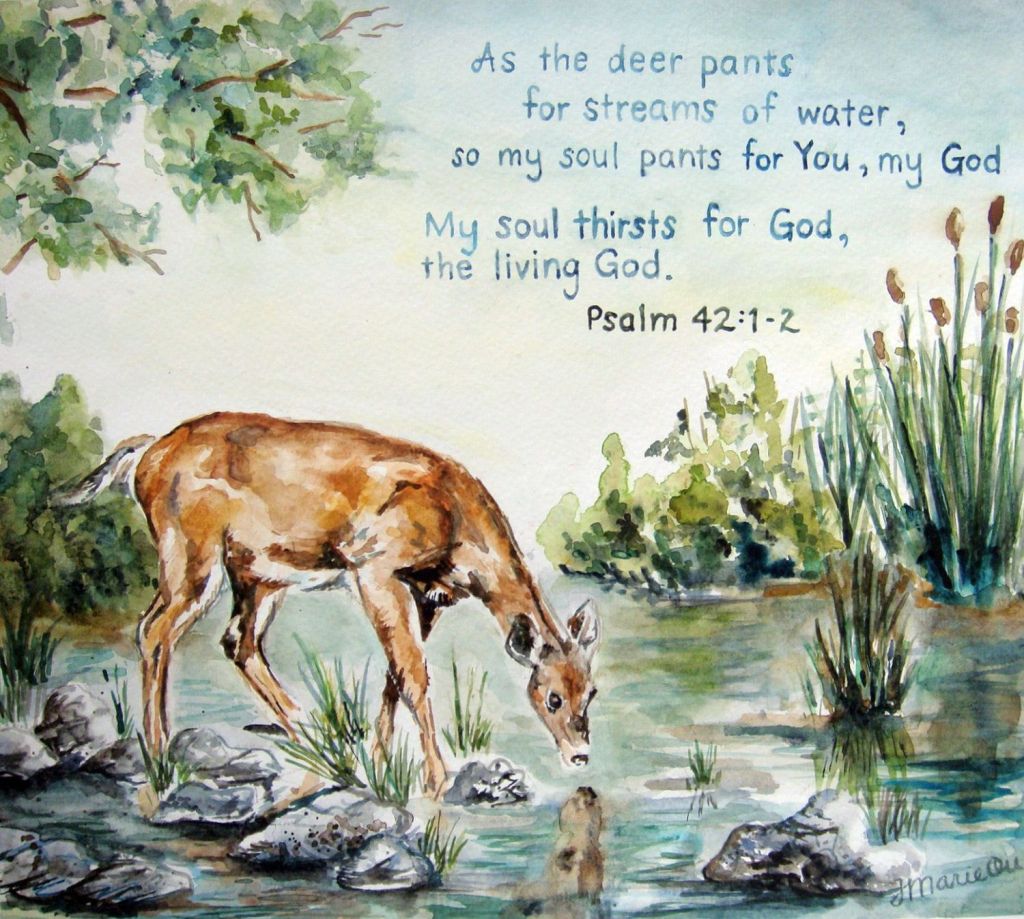
 Loving God, Living God, Loving Hope, Living Hope, Loving Living Life His Way! "Many things are possible for the person who has hope. Even more is possible for the person who has faith. And still more is possible for the person who knows how to love. But everything is possible for the person who practices all three virtues." - Brother Lawrence (1605-1691), Practicing the Presence of God (1692).