Romans 15:4 "For whatever was written in earlier times was written for our instruction, so that through perseverance and the encouragement of the Scriptures we might have hope."
Personal evangelism is sharing the message of Jesus Christ with others.
It is showing and telling and serving others— with, through both word and deed — who Jesus is and how it’s possible to have a relationship with Him.
Think of individual evangelism in light of our own and everyone else’s life’s journeys.
Personal evangelism is simply the privilege of entering into the spiritual journey of another person, living into and out from God’s summons, and discovering how God is at work, and the undeniable role that we can play.
Genesis 24:1-9 GOD’S WORD Translation
Abraham Instructs His Servant
24 By now Abraham was old, and the Lord had blessed him in every way. 2 So Abraham said to the senior servant of his household who was in charge of all that he owned, “Take a solemn oath. 3 I want you to swear by the Lord God of heaven and earth that you will not get my son a wife from the daughters of the Canaanites among whom I’m living. 4 Instead, you will go to the land of my relatives and get a wife for my son Isaac.”
5 The servant asked him, “What if the woman doesn’t want to come back to this land with me? Should I take your son all the way back to the land you came from?”
6 “Make sure that you do not take my son back there,” Abraham said to him. 7 “The Lord God of heaven took me from my father’s home and the land of my family. He spoke to me and swore this oath: ‘I will give this land to your descendants.’
“God will send his angel ahead of you, and you will get my son a wife from there. 8 If the woman doesn’t want to come back with you, then you’ll be free from this oath that you swear to me. But don’t take my son back there.” 9 So the servant did as his master Abraham commanded and swore the oath to him concerning this.
Gloria! In Excelsis Deo! Alleluia, Alleluia, Alleluia, Amen.
And Father Abraham Said Unto His Servant, “GO!”
Abraham’s wife Sarah has died (Genesis 23:2).
Isaac is the only son left through whom God will make a great nation of people.
So, the question naturally arises,
“Does not Isaac need a wife if he’s going to have children, bless generations ?”
Abraham is old, and he knows he won’t live much longer.
There is one more thing he needs to take care of – get a wife for his son Isaac.
Of one thing he is very sure: he cannot let Isaac take a bride from the Canaanite women who worship false gods.
Abraham calls on his most trusted servant and commissions him to find a wife for Isaac from among his kin.
Abraham is very clear that Isaac is not to go; he must stay in the land the Lord has promised them.
So, the loyal servant of Abraham swears an oath to Abraham and “Goes Forth.”
That’s the story we come to next.
In Genesis Chapter 24, however, we must first take careful note in our text that we have four main persons: the father, the son, the servant, and the bride.
This is very meaningful.
As we move forward in time and come to the writings of the New Testament, we should see that the Triune God is working, laboring together to obtain a bride for the Son….The subject of the New Testament is the Triune God, the Father, the Son, the Spirit, working, laboring together to obtain the bride for the Son.
From the start, The Father made the plan, the Spirit carries out the Father’s plan, the Son enjoys what the Father has planned, what the Spirit carries out.
Who is the bride?
The bride is that chosen part of the human race which will marry the Son and become His counterpart .
Upon Closer Scrutiny-With One Eye Towards Eternity
If we read this chapter through carefully, we will find that the central character in the text is not Rebekah, who is to become the bride of Abraham’s son Isaac.
Very little of her reaction is actually recorded here; she has a secondary part.
The spotlight of the story really follows Abraham and Abraham’s unnamed senior and most trusted, most faithful servant, who is the central character.
For us, this is a picture of the Holy Spirit’s work.
But remember, the Spirit of God chooses to do His work largely through men and women, through those of us who are His.
This is especially true in the work of the calling out a people for God’s name.
God has given us the responsibility and the privilege of being His instruments to go into the world and faithfully seek out and call His bride out of the world.
So this whole story from Genesis chapter 24 becomes for us a precursor, an ancient beautiful picture of the whole process of PERSONAL EVANGELISM.
PERSONAL EVANGELISM: The process of we, Father God’s loyal and trusted servants bringing others to Christ begins with the command of God the Father.
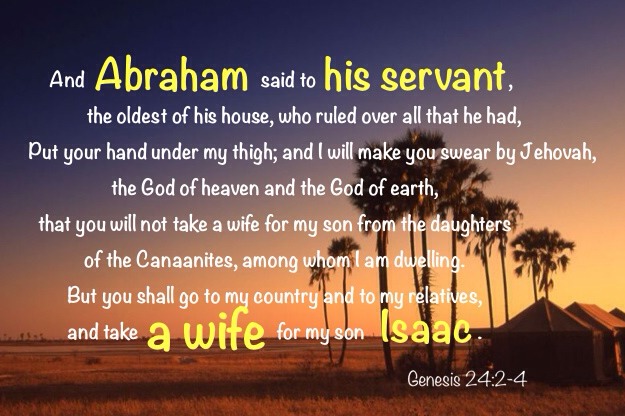
Genesis 24:1-4 New American Standard Bible
A Bride for Isaac
24 Now Abraham was old, advanced in age; and the Lord had blessed Abraham in every way. 2 Abraham said to his servant, the oldest of his household who was in charge of all that he owned, “Please place your hand under my thigh, 3 and I will make you swear by the Lord, the God of heaven and the God of earth, that you shall not take a wife for my son from the daughters of the Canaanites, among whom I live; 4 but you will go to my country and to my relatives, and take a wife for my son Isaac.”
The initiative here is with Father Abraham, he knew he was advanced in age and his length of years would soon end, and he knew well God blessed in every way.
Abraham sends his most senior and trusted servant, who has authority over everything Abraham owns, to do this work, binds him to the task with an oath.
When the servant puts his hand under Abraham’s thigh, he is simply practicing an oriental custom that recognized the loins of the thigh were the source of life.
For the trusted servant, it was a representation of being bound in a solemn oath.
As we apply this to our own situation and see God the Father standing in the place of Abraham here, He is asking every servant to give himself to this task.
The servant is unnamed here so that you and I can put our own names here.
The Father calls us His servants, commands us to go and take a wife for His Son.
This is not an option for a believer in Jesus Christ.
God has said, not only in the fashion we see here but also in direct statements in the Word of God, the obligation rests upon believers to give themselves over to the sacred task of reaching to others for the coming Bride Groom Jesus Christ.
God has commanded, us, His most trusted servants, to take a wife for my Son.
And so unto this end, the Holy Spirit of God has come into our hearts to dwell.
His whole purpose of coming into your life and mine is that He might be what He is and do what He came to do – send us out into the world to find a “Bride.”
Our Lord Jesus is the one dwelling within, and we are told what He came to do.
45 It’s the same way with the Son of Man. He didn’t come so that others could serve him. He came to serve and to give his life as a ransom for many people.”Mark 10:45
He said, For the Son of Man came to seek and to save what was lost(Luke 19:10).
If this is what He came to do, we will find Him doing exactly that in our lives, if we give Him the opportunity – we authentically become that “Trusted Servant.”
Do we recognize and live by our servant mandate as disciples of the Lord Jesus?
Are we being .01% authentically responsive to the prompting of the Holy Spirit?
Are we being .01% authentic, responsive to Acts 1:8 “go forth into the world?”
In the name of God, the Father and God the Son and God the Holy Spirit,
Let us Pray,
A Prayer for Opportunity
God, My Father, Like Abraham’s loyal servant I long to be sent forth, the chance to serve you, for the opportunity to proclaim the goodness of Your name. I long to seek others, engage with them, pray with them, be a servant unto them, draw them closer to you, for service in your Kingdom. As I go out today, please bring me into contact with those who have been given eyes to see, ears to hear. Direct my steps and lead me into those conversations You want me to have today, Jesus. In Jesus’ name, I pray.
53 Who has believed [confidently trusted in, relied on, and adhered to] our message [of salvation]? And to whom [if not us] has the arm and infinite power of the Lord been revealed? 2 For He [the Servant of God] grew up before Him like a tender shoot (plant), And like a root out of dry ground; He has no stately form or majestic splendor That we would look at Him, Nor [handsome] appearance that we would [a]be attracted to Him. 3 He was despised and rejected by men, A Man of sorrows and pain and acquainted with grief; And like One from whom men hide their faces He was despised, and we did not appreciate His worth or esteem Him.
4 But [in fact] He has borne our griefs, And He has carried our sorrows and pains; Yet we [ignorantly] assumed that He was stricken, Struck down by God and degraded and humiliated [by Him]. 5 But He was wounded for our transgressions, He was crushed for our wickedness [our sin, our injustice, our wrongdoing]; The punishment [required] for our well-being fell on Him, And by His stripes (wounds) we are healed. 6 All of us like sheep have gone astray, We have turned, each one, to his own way; But the Lord has caused the wickedness of us all [our sin, our injustice, our wrongdoing] To fall on Him [instead of us].
The Word of God for the Children of God.
Adeste Fidelis! Venite Adoremus! Dominum.
Gloria! In Excelsis Deo! Alleluia, Alleluia, Alleluia, Amen.
Someone Familiar With Our Suffering
“You can’t truly know people unless you walk a mile in their shoes,” we sometimes say.
Two thousand ago, a man named Jesus walked into humanity’s full view, in our shoes, and showed that he genuinely knew the full range of human experience.
The Word of God for His Children often reminds them that Jesus was one of us.
The Word of God comes right out of God’s mouth to reveal to human kind He experienced joy and suffering and sorrow, feasting and hunger, the fruits of hard work and the setbacks of humiliation, injustice, poverty, life and death.
He also knew the grief of losing a close friend, which led him to weep (John 11:32-35).
In addition, Jesus was sometimes discouraged by the spiritual numbness of his disciples (Matthew 16:8-12), and weary from hot, dusty travel (John 4:6).
He became angry when people mistreated God and others (Matthew 21:12-13), he also took children in his arms, taught and blessed them (Matthew 19:13-14).
Countless times we read of him healing the sick and destitute, individually and by the village full, approaching the unapproachable, touching the untouchable.
In the account of his crucifixion, as Isaiah foretold, Jesus even experienced total rejection, complete betrayal and unimaginable physical and spiritual suffering.
The reality: Our salvation wasn’t won in the beauty and safety of a royal palace.
Jesus pioneered our salvation through the experience of human living in this world.
He faced all the temptations and struggles we meet daily—and yet he never sinned (Hebrews 4:15).
There is not one single human heart who can claim it has never been wounded.
There is not one single human heart which can claim it has not ever suffered.
His words from the cross “I am thirsty” (John 19:28) assure us that he willingly and obediently dealt with all human experiences as he worked to defeat sin.
For humanity, there must eventually, gradually, subtly, suddenly, come the realization that there is a very real place in God’s divine order – where all our hurting, our woundedness, our suffering, our brokenness, sin, come together.
From Genesis to Revelation, The Word of God reveals to all of God’s children Jesus is our ultimate example of the type of heart we need to turn to, we need to surrender to, because by his crucifixion, He is our healer, our wounded healer.
And we see this heart, the heart of Jesus, not only from His life but also in the death He died for us, not only by the death He died for us, but by the witness of the EMPTY tomb, the angels’ words, by His resurrection and by His Ascension.
A Wounded Healer’s Heart
Jesus is a Wounded Healer.
He experienced our wounds by coming in flesh so He could feel what we feel.
“But He was wounded for our transgressions, He was bruised for our iniquities; The chastisement for our peace was upon Him, and by His stripes we are healed.”Isaiah 53:5. NKJV.
Are You A Wounded Healer?
Am I A Wounded Healer?
You and I may not even know there is a name for it; you are too busy doing what needs to be done.
You and I have almost certainly, surely been gravely wounded, hurt, maybe too even abused, maybe even bullied, maybe even betrayed, maybe even humiliated.
Somehow, by some means, in too many ways, we are all wounded throughout our lives, physically, emotionally, psychologically; some of us have been hurt in more ways than we can remember – the measure of trauma is too inconceivable.
A Wounded Healer is one who, although they have been wounded time and time again; discern they learn to take those experiences and use them to help others, to minister like Jesus, during their time of loss, tragedy, grief, pain or illness.
Even from hospital beds, with bodies wracked by severe illnesses, like Jesus, they realize that though they are suffering, have suffered in their bodies, they have also learned, by prayer, witness and their testimony of the work of their Savior Jesus in their lives, they can now benefit all others from that suffering.
Now they have become a Wounded Healer.
God isn’t causing their pain but He can use their pain to get your attention and help you and me and others grow, teach the many of compassion and grace.
By their example, you and I can learn how we too can share all our Savior Jesus Christ, minister to others in the middle of our own pain and it helps them heal!
Hebrews 13:1-2 Amplified Bible
The Changeless Christ
13 Let love of your fellow believers continue. 2 Do not neglect to extend hospitality to strangers [especially among the family of believers—being friendly, cordial, and gracious, sharing the comforts of your home and doing your part generously], for by this some have entertained angels without knowing it.
When this passage in Hebrews was anonymously written, people were expected to show generous hospitality to travelers and strangers who might otherwise have nowhere else to stay as they went from village to village and town to town.
The context of this advice urges believers in God to show love and care for one another as well for others who may be in need, such as strangers, travelers.
This advice echoes the words of Jesus in Matthew 25:31-46, where Rabbi Jesus teaches us all that caring for the needs of others is like doing the same for him.
This passage in Hebrews also invites us to consider that a stranger or visitor we encounter might be an angel—that is, a messenger from God (also Genesis 18).
The point is that we should treat anyone we meet as being so valuable and fully worthy of our time that they might be sent from God, and that showing love and care and compassion to them would be like doing the same for the Lord himself.
This can be hard to imagine, especially if hospitality is not so common anymore in our culture and we need to be ever so much more wary of “stranger danger.”
But here the Spirit of God is challenging us simply to treat others well, showing love and kindness to everyone, no matter who they are.
In other words, we are called, even from the midst of our suffering, to love and care for others just as our Lord, Savior Jesus Christ has done for us at Calvary.
Angels of Mercy who will probably not have a set of initials after their name, they won’t ever claim to know it all, and they won’t ever have all the answers.
But they know how to listen, they know how to care, whose families will show up with a casserole, a care package, or sit with you through the night if need be.
Sometimes they say nothing at all.
They do not have to because they have been there.
They were wounded, they know.
Silence is golden, a hug is infinitely better than words.
Where Our Hurt and Our Healing Collides
Isaiah 53:3-5 Amplified Bible
3 He was despised and rejected by men, A Man of sorrows and pain and acquainted with grief; And like One from whom men hide their faces He was despised, and we did not appreciate His worth or esteem Him.
4 But [in fact] He has borne our griefs, And He has carried our sorrows and pains; Yet we [ignorantly] assumed that He was stricken, Struck down by God and degraded and humiliated [by Him]. 5 But He was wounded for our transgressions, He was crushed for our wickedness [our sin, our injustice, our wrongdoing]; The punishment [required] for our well-being fell on Him, And by His stripes (wounds) we are healed.
Our Lord and Savior Jesus Christ is all of mankind’s Wounded Healer.
He experienced our wounds by coming in flesh so He could feel what we feel.
“But He was wounded for our transgressions, He was bruised for our iniquities; The chastisement for our peace was upon Him, and by His stripes we are healed.”Isaiah 53:5. NKJV.
If you have damaged emotions and physical and emotional scars, ABBA God the Father and Jesus His Son and God the Holy Spirit, are able to take care of those.
For God so loved the World that God sent His Son into the World that we should be saved – NOT CONDEMNED for our sins as we all so very righteously deserve.
Jesus gave His life at Calvary and rose again so that we could have eternal life AND be healers on this earth.
We cannot have open wounds and be a healer, we must have those taken care of.
Our resurrected Jesus is the only One who can overcome and heal our hurts so we can then recognize His Sovereignty and become the blessing God intended.
Maybe from your ailing’s you have never thought you had anything to offer.
My friend, I am certain you do.
If the Lord has forgiven you and restored you, pray for opportunities to give others hope and a light at the end of their tunnel.
Pray for the wisdom of God’s testimony and Jesus’ witness at Calvary above all, it is not an easy road to walk the road of suffering, but there are great rewards.
Are there areas in your life where you have opportunity to be a Wounded Healer?
I would love to hear about them!
Has someone else been a Wounded Healer to you?
Feel free to share Jesus Christ, your thoughts and encourage others here today.
In the name of God, the Father and God the Son and God the Holy Spirit,
Let us Pray,
Gracious God,
on this day we gather to remember the suffering death of Jesus.
He was despised and rejected,
oppressed and afflicted,
yet he was prepared to be wounded for our transgressions. We come overwhelmed by the depth of Jesus’ love for us,
and his commitment to defeat evil,
even when that meant his own suffering and his own death.
In his willingness to make us righteous, he poured himself out to death, even death on a cross, and so, in response to such love and sacrifice, we commit all of ourselves as his disciples to overcome evil with Your good, our suffering with Your wholeness, with love and compassion, acceptance and mercy for all, meeting oppression with Your justice. Thank you, Jesus, for being willing to enter the grit and grime of our humanity to save us. There has never been a greater sacrifice! Let that be our Witness and let that we our sure and certain Testimony unto the world. Jesus’ name, we pray.
Adeste Fidelis! Venite Adoremus! Dominum.
Gloria! In Excelsis Deo! Alleluia, Alleluia, Alleluia, Amen.
It was defined as “a photo of yourself that you take, typically with a smartphone or webcam, and usually put on social media.”
Since then, we also got the word “Selfitis,” meaning “an obsessive-compulsive desire to take photos of oneself and post them on social media.”
June 21 is the national selfie day.
In 2022, the national selfie day happened on Tuesday. In 2023, the national selfie day will occur on Wednesday.
How many selfies do you think are taken in any given day?
How many selfies are taken a day?
According to Photutorial’s data, 92 million selfies will be taken daily across all devices in 2022. This number coincides with the fact that 2.3 billion photos are taken every day, 4% of which are selfies.
The Guiness Book of World Records currently recognizes the most self-portrait photographs (selfies) taken in three minutes as being 168 and was achieved by James Smith (USA) aboard the Carnival Dream cruise ship on 22 January 2018.
Our children are growing up in what has been dubbed “the selfie generation.”
Most photos kids take these days are of themselves.
The accessibility of digital cameras, the ease of taking self-portraits, and the rise of social media have all led to the popularity of “selfies,” the modern-day term for digital self-portraits.
Personally, I take my idea of “plenty” of selfies with the intention of sharing my life with my wife and our social media friends who are also people of faith.
When we take a selfie and post it, we let the world know what we are up to.
However, as many sociologists have noticed, the word selfie has taken on a meaning that goes far beyond the object of the camera lens. It’s not just in photos that children are often the focus — it can extend into their lives.
The selfie culture turns people’s focus onto themselves
— how they look, how many “likes” and “loves” and “hugs” they get on social media, what kind of clothing they wear, how much fun they all have, and so on.
However, what started out as a harmless, fun activity has now been linked to growing rates of depression — and certainly an increase in narcissism.
The great irony, of course, is focusing on ourselves doesn’t always equate to the idea “selfies make us happier; rather they can also serve to robs us of our joy.
Our worldview can become biased and divided, deeply prejudiced and skewed.
The challenge for parents today is teaching our children to take the focus off themselves and turn the camera around so they can see the diversity of others.
We need to teach ourselves and our children how to see the people around them.
First and foremost, this includes their friends, their siblings, their parents, and their teachers, those in the neighborhood with authority over them – the police.
But it extends beyond to the people they encounter in daily life: the bus driver, the janitor, the widow, the orphan, the homeless person on the street corner, people of all races and ethnicities, our world cultures and diverse nationalities.
Only when our children begin to see in others’ their God-Given intrinsic value and human ‘suffering’ can they begin to understand how they can help others.
When we take a selfie and post it, we let the world know what ‘joy’ we’re up to.
Whether we’ve just tried the new coffee shop on the corner, or decided to dye our hair red, the selfie shows who we are, what we are doing to the online world.
Selfies gives us a great view into the intensity of our “joyful” virtual existence.
However, “joyful virtual existences” are not the whole of God’s story in God’s neighborhood. His neighborhood is a good deal more “diverse,” and “ugly.”
The intensity of that “Virtual Reality of that “Selfie?”
The intensity of that diverse ugliness as put on full display …. indescribable!
The intensity of that diverse ugliness as put on full display … beyond impactful!
The intensity of that diverse ugliness as put on full display … highly dangerous!
Those are the “Selfies” we seldom see on social media – they are censored or come with the poignant warning – “may not be suitable for young audiences.”
I always had the thought “Selfies” are a lot like the Bible should be in our lives.
The Bible should be showing us who we are, what we ourselves are to be doing.
Consider taking this “Selfie” and spreading it all over social media ……
Matthew 5:13-16Amplified Bible
Disciples and the World
13 “You are the [a]salt of the earth; but if the salt has [b]lost its taste (purpose), how can it be made salty? It is no longer good for anything, but to be thrown out and walked on by people [when the walkways are wet and slippery].
14 “You are the light of [Christ to] the world. A city set on a hill cannot be hidden; 15 nor does anyone light a lamp and put it under a basket, but on a lampstand, and it gives light to all who are in the house. 16 Let your light shine before men in such a way that they may see your good deeds and moral excellence, and [recognize and honor and] glorify your Father who is in heaven.
The Word of God for the Children of God. Gloria! In Excelsis Deo! Alleluia! Amen.
OK, how many of us get really excited when we see that media ad with a person holding up a bag of potato chips or a box of crackers, saying “reduced sodium”?
Well, probably not too many of us – potato chips are considered “junk food.”
Because salt is delicious.
Salt is needed for many essential functions within our bodies – being our hearts and their need to keep beating and us alive plus our muscles and our kidneys.
It’s why chips and crackers, French fries and pizza and many other things taste good. Salt exists to make food better. That is one of its God-given purposes.
In this passage Jesus says
we are “the salt of the earth” . . . and “the light and also “the critically essential internal balances which keeps our bodies working in God’s much necessary and healthy harmony and our hearts beating so we can remain alive” of the world.”
He doesn’t say we “can be” or “should be” these things.
He says we already are, by way of our new identity in him. Jesus expects us to bless people, to build them up, and to do what we can to help meet their needs.
He expects us to use our words and our actions to stick out in this unhealthy, unbalanced, biased, divided dark world, pointing people to the kingdom of God.
This isn’t limited to formal ministry in the church.
The ways we treat our spouses, talk to our coworkers, and use our resources or engage with social media are all examples of how we are called to be salt and light. Every single sphere of life presents us with salt and light opportunities.
If we walk in step with Christ, putting his desires ahead of our own, we are like a welcome seasoning, a source of critically needed, critically essential balance to enhance the taste of food, or like a beacon of light shining in this dark world.
WHAT SELFIES TEACH US ABOUT OURSELVES, OUR ENGAGING GOD’S WORD
The Bible shows us who we really are. If we need a self-esteem boost, the Bible shows us our great worth to God. (1 Cor 6:20)
If we are afraid, the Bible shows us that we are bold. (Proverbs 28:1)
If we feel we can’t make it, the Bible shows us we can. (Phil 4:13)
Just like a selfie, the Bible shows us who we are.
We are Selfless Servants of God – Selflessly Sent into God’s Neighborhood.
Mark 10:35-45 Amplified
35 James and John, the two sons of Zebedee, came to Him, saying, “Teacher, we want You to do for us whatever we ask of You.” 36 And He replied to them, “What do you want Me to do for you?” 37 They said to Him, “Grant that we may sit [with You], one on Your right and one on Your left, in Your glory [Your majesty and splendor in Your kingdom].” 38 But Jesus said to them, “You do not know what you are asking. Are you able to drink the cup that I drink, or to be baptized with the baptism [of suffering and death] with which I am baptized?” 39 And they replied to Him, “We are able.” Jesus told them, “The cup that I drink you will drink, and you will be baptized with the baptism with which I am baptized. 40 But to sit on My right or left, this is not Mine to give; but it is for those for whom it has been prepared [by My Father].”
41 Hearing this, the [other] ten became indignant with James and John. 42 Calling them to Himself, Jesus said to them, “You know that those who are recognized as rulers of the Gentiles lord it over them; and their powerful men exercise authority over them [tyrannizing them]. 43 But this is not how it is among you; instead, whoever wishes to become great among you must be your servant, 44 and whoever wishes to be first and most important among you must be slave of all. 45 For even the Son of Man did not come to be served, but to serve, and to giveHis life as a [a]ransom for many.”
We might not do a very good job, or take that “quality selfie,” “separating our selfish selves, from our selfless selves” or by our “selfie we’re worth much, are bold, or we can make it, but our feelings don’t matter. What matters is what is true, and the truth is found in God’s word. God’s word shows us who we are.
Our best “selfie” both with and against God’s greatest “selfie” taken together with our engagement of God’s Word in His Neighborhood also shows us what we truly look like to ourselves against who we are serving, what we are doing and how well we are projecting ourselves, projecting our ‘selfies” plus God.
Reading the Bible can open your eyes to habits that you and I need to get rid of, or things in my life and your life that need to change. We should be constantly striving for “selfies” to be more like “selfies of God, Jesus Christ, Holy Spirit.”
So, when we take a “selfie” of an attitude or moral or an ethic in our life that doesn’t line up with the Bible, we truly need to address that habit or attitude.
A Selfless Call
The more we think of ourselves, the less we think of others, and the more self-centered we become.
Jesus tells us the GREATEST commandment is “Love the Lord our God, with all of thy heart, and with all of thy soul and all of thy mind.”(Matthew 22:37-38)
Jesus tells us that the second greatest commandment is to “love our neighbors as ourselves(Matthew 22:39).
Which means we “Love ourselves better, best, greatest – 100% LAST!”
Again, our default affection is for ourselves.
We love ourselves and care for our bodies by eating and sleeping. We rarely ignore our own needs. Jesus says to think of our neighbors with the same affection. We must care for them, give to them, and seek to meet their needs.
Paul, through the authority given to him by God, explains Jesus’ command further. Not only do we need to love our neighbors as ourselves, but we also need to value them more than ourselves. He says this in Philippians 2:3-4:
Do nothing from selfish ambition or conceit, but in humility count others more significant than yourselves. Let each of you look not only to their own interests, but also to the interests of others.
A Selfless Savior
How do we get past such self-centered thinking and lifestyles as we see (or post) selfie after selfie on our screens each day?
The ongoing self-glorification on social media may not have directly caused you to stumble into the sin of selfishness today.
But the social acceptability of this self-worship feeds our tendency to make light of such sin in our world today.
When we feed our minds constantly with thoughts of ourselves, we easily disregard others, justify our own sin.
Paul continues in Philippians 2 with this:
Have this mind among yourselves, which is yours in Christ Jesus,who, though he was in the form of God, did not count equality with God a thing to be grasped, but emptied himself, by taking the form of a servant, being born in the likeness of men.And being found in human form, he humbled himself by becoming obedient to the point of death, even death on a cross. (v.5-8)
To love our neighbors, think of them above ourselves as the Lord commands us to in Philippians 2:3-4, we must have the mind of Christ—a humble mind.
The way to fight the sin of selfishness is to ask God to renew our minds so that they become like Christ’s.
With “perfect joy,” in perfect selflessness, he regarded the greatest need of every human—forgiveness of sin and reconciliation with God—and the will of his Father as infinitely more important than his own glory, even to the point of laying down his life for us at the cross (Hebrews 12:2).
Turn Your Camera Around
Hebrews 12:3 Amplified Bible
3 Just consider and meditate on Him who endured from sinners such bitter hostility against Himself [consider it all in comparison with your trials], so that you will not grow weary and lose heart.
We must turn the selfie lens away from our faces—away from our needs and wants—onto others, and onto Christ. We must not grow weary and lose heart, pray that he will humble us enough to care for our neighbors above ourselves.
When turn our cameras around, our “selfies” point of fixation changes, we will start using our resources differently by uniting, inviting others into our homes, giving more than we receive, helping others succeed, admiring others’ beauty, and doing more GOD activities for the sake of lost souls, not just lost “likes”.
Humility will never be our default attitude on our own, but it is Christ’s.
Hebrews 4:14-16Amplified Bible
14 Inasmuch then as we [believers] have a great High Priest who has [already ascended and] passed through the heavens, Jesus the Son of God, let us hold fast our confession [of faith and cling tenaciously to our absolute trust in Him as Savior]. 15 For we do not have a High Priest who is unable to sympathize and understand our weaknesses and temptations, but One who has been tempted [knowing exactly how it feels to be human] in every respect as we are, yet without [committing any] sin. 16 Therefore let us [with privilege] approach the throne of grace [that is, the throne of God’s gracious favor] with confidence and without fear, so that we may receive mercy [for our failures] and find [His amazing] grace to help in time of need [an appropriate blessing, coming just at the right moment].
Let us discipline ourselves to study and ponder the Word of God muchly, keep running boldly to his throne of grace in our time of need and ask for help. We need help from the only one who is perfectly selfless, and he promises to give it.
So, the next time you raise a “selfie stick or two or three” snap a selfie or pick up your Bible let it be a reminder of how important the word of God is. God’s Word is living, powerful, can change our thoughts, actions if we let it. Challenge yourself today to go deeper into God’s word and let His words transform you.
In the name of God, the Father and God the Son and God the Holy Spirit,
Let us Pray,
Lord, as Your Children, we humbly pray that you would renew our selfhood as the People of God – we are not to be the remains of a goal-less club rather, the Body of Christ, the Church- the Bride of Christ, the King who is over all things.
Father God, through your power and through your people,
Let your kingdom come.
Help us to show the world the true “selfie” of your Church: by faithfulness to the Master; by love for him and his creations; by participating in his work of global mission and servant ministry giving flavor to the world, in his humility.
Father God, through your power and through your people,
Let your kingdom come.
We ask you to give us the privilege, through your grace, of regaining our role as renewers of our world, as the people who serve our neighbors, our community, heal our society, who improve our surroundings, who improve circumstances.
Father God, through your power and through your people, Let your kingdom come.
Give us the discipline to read and study and ponder your Word. Give us the power to obey your will for our lives, for each other, for others, in acceptance, that understanding comes by a spirit of obedience to you, and that the source of life is your salt and your light, your heartbeat, your blood which gives to us life.
Father God, through your power and through your people, Let your kingdom come.
Let us learn to make neighbors and how to love them. Let us expect great and miraculous things from you. Let us always learn; let us persevere through the process of extending and inheriting God’s kingdom; let us be called ‘repairers of the breach’ and ‘restorers of streets of our towns and cities to be lived in.’
Father God, through your power and through your people, Let your kingdom come.
Today, we are walking alongside Peter. We are curious to what he is thinking.
Calvary is before us, though we realize it not. If we are in realization, we are not yet in a place where we can even begin to comprehend its awesome magnitude.
Three times, our Rabbi Jesus has told us of his having to suffer at the hands of his betrayers. He has prophesized that he must suffer unbelievable humiliation at the hands of the people – that he will be crucified, and he will be killed. We do not believe this is possible for such a one as our Rabbi – we will never allow it to happen as long as we are alive, can expend all strengths, and able to prevent it.
But, to our surprise, our Rabbi sharply rebukes us. He tells us we are to get out of his way – do not try to prevent his coming suffering. It is ordained by God! I cannot wrap my head or my heart or my suffering soul around such a notion. I am struggling with the notion that Rabbi suffering is a God ordained necessity.
I understand what it means to struggle and suffer – I have spent many days in my father’s boats – struggling and suffering to bring in the nets filled with my days catch. I also understand what it means to suffer and to struggle when the nets are empty at the end of the day, and that I have no fish to sell in the local market or to feed my family, friends and neighbors or donate to the Temple. I am used to such days and count them as the cost of doing what I choose to do.
But now, with these words of my Rabbi, weaving into and out of my soul, I do not believe I really know, nor comprehend what suffering he is referring to. I have seen people being crucified – and it frightens me to the core of my being. My own Rabbi tells me he must absolutely experience this for my greater good. These are strange words to me! These are surprising words to me! What now?
So, I continue to walk with my Rabbi as we prepare to celebrate the Passover ….
1 Peter 4:12-19 Easy-to-Read Version
Suffering as a Follower of Christ
12 My friends, do not be surprised at the painful things that you are now suffering, which are testing your faith. Do not think that something strange is happening to you. 13 But you should be happy that you are sharing in Christ’s sufferings. You will be happy and full of joy when Christ shows his glory. 14When people say bad things to you because you follow Christ, consider it a blessing. When that happens, it shows that God’s Spirit, the Spirit of glory, is with you. 15 You may suffer, but do not let it be because you murder, steal, make trouble, or try to control other people’s lives. 16 But if you suffer because you are a “Christ-follower,” do not be ashamed. You should praise God for that name. 17 It is time for judging to begin. That judging will begin with God’s family. If it begins with us, then what will happen to those who do not accept the Good News of God?
18 “If it is hard for even a good person to be saved, what will happen to the one who is against God and full of sin?”
19 So if God wants you to suffer, you should trust your lives to him. He is the one who made you, and you can trust him. So, continue to do good.
The Word of God for the Children of God. Gloria! In Excelsis Deo! Alleluia! Amen.
What ought we to learn from such a lesson as Peter dictates to us?
I want to highlight important four truths from this text.
First, don’t be surprised when you suffer for your faith in Jesus Christ (v. 12).
Second, rejoice, and glorify God when you suffer for your faith in Jesus Christ (vv. 13-14).
Third, don’t be ashamed to suffer for your faith in Jesus Christ (vv. 15-18).
Fourth, trust God when you suffer for your faith in Jesus Christ (v. 19).
In order to understand vv. 12-19, I will first discuss two introductory points about the context of our text.
1. Context of 1 Peter 4:12-19.
First, in my own personal view, Peter wrote this letter to exhort Christians who have suffered for their faith in Jesus Christ to be holy and to hope in God as they suffered for their faith in Christ.
For example, in 1:6-7, Peter states that these Christians should rejoice although they suffer “various trials” so that their faith would be tested (i.e., refined) and proven to be real at the revelation of Jesus Christ.
In 1:13, he exhorts them to hope in the saving grace of Jesus Christ, grace that will be offered to them when Jesus returns (see also 1:13-16).
In 2:18-25, he exhorts Christian slaves to endure their suffering at the hands of both unjust masters and just masters in a manner that honors Christ.
In 3:14, Peter exhorts these Christians not to fear their oppressors if they suffer for righteousness (i.e., if they suffer as a Christian).
Finally, in 4:12-19, Peter exhorts these Christians to honor Christ even if they are insulted, reviled, and ridiculed for their Christian faith.
Thus, in my view, Peter wrote this letter to exhort Christians who suffered for their faith in Jesus to be holy and to hope (i.e., trust/wait) for their salvation in Christ as they suffered for Christ.
Second, Peter grounds his exhortations to be holy and to hope in God and God’s sovereign work of salvation in Christ.
For example, in 1:1-2, Peter calls these Christians, scattered throughout Pontus, Cappadocia, Asia, Galatia, and Bithynia, elect (chosen by God) in accordance with his foreknowledge (i.e., in accordance with his covenantal love that he chose to place on them before the foundation of the world).
In 1:2, Peter further states that these Christians are the people of God when he refers to their conversion with the words elect by the sanctification of the Spirit for obedience and for sprinkling with the blood of Jesus Christ.
In 1:3-5, Peter further explains to his audience they are the people of God by emphasizing God himself has reached down from heaven and supernaturally entered their lives by causing them to be born again to a living hope according to his great mercy by the resurrection of Jesus Christ from the dead unto an incorruptible, unfading, and undefiled inheritance,
which is being kept in heaven for them, who are being kept by the power of God for an eschatological salvation that has invaded this present evil age and that will be revealed on the last day.
Then, Peter says, in verses 6-12, although they suffered various trials in this life, they should rejoice, because they would receive the goal of their faith, namely, the salvation of their souls.
Their suffering was a means by which their future salvation would be realized.
Based on Peter’s brief doxology about God’s sovereign work of salvation on behalf of his people in 1:3-12, Peter then exhorts these Christians in 1:13 until the end of the letter to be holy as they are suffering for their faith in Christ.
Therefore, before considering 4:12-19, we must remind ourselves that Peter grounds his gospel imperatives to be holy and to hope in the gospel indicatives of God’s own sovereign work of salvation in the lives of his people who were suffering for their faith in Christ.
This reminder takes me to my first point from 4:12-19.
First, don’t be surprised when you suffer for your faith in Jesus Christ (v. 12).
Don’t be surprised by the fiery trial (12): Peter begins verse 12 by exhorting his audience not to be surprised/shocked by this fiery trial that has come upon them as though something strange/foreign has come upon them. The fiery trial refers to suffering for their faith in Jesus Christ.
More specifically, it refers to suffering insults, revilements, social ostracism from the society in which these Christians lived, because Peter states in verse 14 these Christians are blessed if they are reviled/insulted for the name of Jesus. This latter point is supported elsewhere in 1 Peter (e.g., 1 Pet 2:12, 18-25; 3:14).
Peter calls this trial “fiery” because he associates it with God’s chastening or judgment of his people for the sake of purifying their faith.
In 1 Peter 1:7, Peter refers to the suffering of these Christians with an analogy of gold being refined through fire. He asserts in 1:7 that their tested faith, is more precious than gold refined by fire, will be proven to be real when Jesus returns.
Furthermore, in 4:17-18, Peter associates this fiery trial with God’s judgment and chastening of his people when he states that judgment begins with God’s people at God’s house first and that the righteous will be saved by means of difficulty (i.e., by means of suffering).
In 4:19, he declares that it is God’s will for Christians to suffer.
Consequently, if we read 1:7 beside of 4:12-19, we can infer that God brings the fiery trial of suffering for faith in Jesus Christ upon these Christians through evil antagonists of the Christian faith to be a means by which he keeps them in order to strengthen the faith of these Christians so that they will be saved from God’s eschatological wrath when Jesus returns.
Second, rejoice when you suffer for your faith in Jesus (vv. 13-14).
The tension between suffering and joy (13):
This verse introduces us to one of the many tensions of the Christian faith: namely, the tension of joy co-existing with suffering.
Peter says if “you participate in the sufferings of Christ” (by which I think he mentions you suffer for righteousness as a Christian), “then rejoice.”2 I do not expect Peter to say “rejoice” when you suffer!
Honestly, in light of verse 12, verse 13 comes as a shock to me since Christians who heard this exhortation and who have read this exhortation throughout history have suffered severely.
Nevertheless, Peter’s exhortation to rejoice is not a contradiction, but it is an exhortation to hope in God’s promise of eschatological salvation.
That is, he is exhorting these Christians to look to the eschatological salvation for which they have been saved and which God will reveal to them on the last day when Jesus returns.
In the midst of the certainty of their suffering for their faith in Jesus Christ, Peter reminds these Christians of the certainty of their future salvation, which has invaded this present evil age.
This interpretation seems right for the following reasons.
First, in the first half of verse 13, Peter says “but to the degree that you share/ participate in the sufferings of Christ, you rejoice!” In the second half of verse 13, he gives the reason for the command: “so that at the revelation of his glory” (i.e., at the second coming) “you may rejoice with much exultation.”
Second, in 1:6-9, Peter exhorts these Christians to hope in their various trials in this life because their suffering is a direct means by which they will truly inherit future salvation.
Finally, in 1:13, Peter exhorts these Christians to hope in their salvation that God will give to them when Jesus returns.
Therefore, in 4:13, Peter exhorts these Christians to hope in the certainty of God’s eschatological salvation in the midst of the shame and dishonor that their persecutors brought upon them for their faith.
Instead of being ashamed of suffering for Jesus, they should be rejoicing because they will be saved from their suffering and from God’s wrath when Jesus returns since they are the people of God.
The Spirit of God and of glory rests upon those who suffer (v. 14):
I believe verse 14 further supports the preceding interpretation. The Spirit rests upon the people of God in 1 Peter.
In 1:2, Peter states these Christians have been sanctified by the Holy Spirit: i.e., they have been converted.
Thus, Peter’s point in 4:14 seems to be when Christians suffer for their faith in Christ, this particular suffering proves they have the Spirit, it proves they are the people of God, and their suffering for Christ proves they will be saved on the last day when Jesus returns. Therefore, Christians should rejoice (i.e., hope in Christ’s salvation) when they suffer, because we are indeed blessed by God.
Third, don’t be ashamed when you suffer for your faith in Jesus Christ (vv. 15-18).
In verses 15-18, Peter further explains the argument he has been making in verses 12-14.
Namely, in verses 12-14, the argument is don’t be shocked/surprised when you suffer for your faith in Jesus Christ as though this is a strange thing.
But instead rejoice now when you suffer for your faith in Jesus Christ, so you will rejoice on the last day when Jesus returns in his glory, because if you suffer for your faith in Christ, then such suffering proves that you are converted.
In verse 15, Peter now says be ashamed to suffer for unrighteousness because that kind of suffering brings dishonor in God’s eschatological law-court.
There is no honor when one suffers as a murderer or as a thief or as a busy-body or as an evil-doer, for these acts bring shame in society and in God’s eschatological law-court (v. 15).
But Christians should not be ashamed to suffer as a Christian (i.e., for their faith in Christ) because suffering for Christ brings honor in God’s eschatological law-court although it brings shame in this life.
Christians should, nevertheless, glorify God by suffering for the name of Jesus Christ when non-Christian’s dishonor and shame them for their faith in Christ.
In v. 16, the command to glorify God by the name of Christ is another way of talking about hoping in God (cf. 1:13) and trusting God (cf. v. 19).
In verse 17-18, with an appeal to Proverbs 11:31 from the Septuagint (LXX), Peter specifically offers a reason why Christians should not be ashamed to suffer for their faith in Christ.
Namely, God judges his people in the current evil age by means of suffering via evil opponents of the Christian faith (v. 17).
In v. 18, he confirms this interpretation by asserting that the righteous (i.e., Christians [v. 16]) will be saved by means of difficulty, whereas the ungodly and the sinner (i.e., the non-Christian) will experience God’s wrath (vv. 17-18).
Although vv. 17-18 do not explicitly state the latter point, the context supports it since Peter has emphasized throughout the letter up to 4:18 that Christians are the people of God and that they will be saved from God’s future wrath.
The implication of 4:17-18 is that non-Christians will not escape God’s wrath since they reject Christ, which they demonstrate by persecuting Christians.
Fourth, trust God when you suffer for Christ (v. 19).
Peter concludes 4:12-19 with v. 19 by exhorting these Christians to implicitly trust God when they suffer in accordance with his will (i.e., when they suffer for righteousness as Christians) as they live righteously. (Consider Isaiah 43 here!)
The Long and the Short of this text is this …. against our 21st Century context,
Any “Suffering” sucks. Suffering for Christ is something else altogether.
To suffer for Jesus is something we should expect according to Jesus Himself.
He said that the world would be hostile to His followers and suffering through persecution was something we needed to prepare for. (Consider John 17)
That is because Christians were meant to shake up the world with a message of radical love, mercy, grace, forgiveness, salvation, and transformation.
But, WHERE IN GOD’S KINGDOM DO WE NOTE SUCH RADICAL BEHAVIOR?
Even though the world needed to know the truth, it would not take it easily.
There would be resistance and even fear, all directly and decisively, maliciously aimed at the messengers of The Gospel Message.
If we are honest, we do not want this to be our common faith experience.
Yet, we must absolutely acknowledge the struggle and suffering of churches in countries where communicating the message of the Gospel comes with a heavy price – imprisonment, torture, public humiliation, even worse is their death.
We must pray for the “underground churches” their leaders and congregants.
Where and when possible, support them with our abundance of resources.
We have more freedom here in America to follow Jesus, but unfortunately, I don’t know if that has made us bolder or more urgent with God’s message.
If anything, the culture is indifferent to Christians, because sadly, maybe that is how indifferently we live for Jesus too.
We are in a weird situation. We can be free to be faithful.
The prospect of suffering for our faith is low.
You would think the church would be thriving and believers emboldened and on fire for God’s work.
That is not the case at all.
If anything, Christians seem to blend in with the secular culture more and more.
The church does not struggle with suffering, rather, things like a how to have a more convenient and comfortable faith.
We have lost the edge that can only be sharpened through pressure and testing.
The irony is that the world around us is suffering.
People are struggling and broken without Jesus.
They are looking for hope and a way out.
While that is not pleasant, suffering for being a Christian would at least mean people recognize you are a Christian and you are living in a way that stands out.
However, persecution is not really a threat or reality for most of us.
I can’t say if that a good or bad thing.
What I can say is that a faith that you have to fight and stand up for is a stronger and more enduring faith, simply because it has been tested.
I firmly believe some of the believers reading this devotion right now would identify more with today’s Word because they would have come from countries where living for Jesus has a real price and potentially lethal consequences.
We need those stories and that faith experience to impact our churches here.
We know, or should make a point to know, that there are believers suffering for Christ all over the world.
We are richer for those who have suffered for Christ and come up the other end still standing.
Perhaps, a first step and response to a faith that is relatively free, is to wake up and seize that God-given opportunity by living boldly and recklessly for Jesus.
Believe thou this!
Think about that.
Pray without ceasing about that.
Do something ASSERTIVE about that ……
In the name of God, the Father and God the Son and God the Holy Spirit,
Let us Pray,
Heavenly Father, thank You for the Lord Jesus Christ and all that He has done for me. Thank You that in Him, I have eternal life and am secure in Your hands, no matter what I may have to suffer in this life. Thank You that by His blood, I have been fully and finally redeemed and forgiven of my sin. I pray that those who abuse me and cause me to suffer because of my faith in Jesus, may then be convicted of their sin and come to a saving faith in Christ. Thank You that Your grace is sufficient for everything I may have to face. May my life bring honor to You and Your Son’s suffering. In Jesus’ name, Alleluia! Alleluia! Alleluia! AMEN.




 Loving God, Living God, Loving Hope, Living Hope, Loving Living Life His Way! "Many things are possible for the person who has hope. Even more is possible for the person who has faith. And still more is possible for the person who knows how to love. But everything is possible for the person who practices all three virtues." - Brother Lawrence (1605-1691), Practicing the Presence of God (1692).