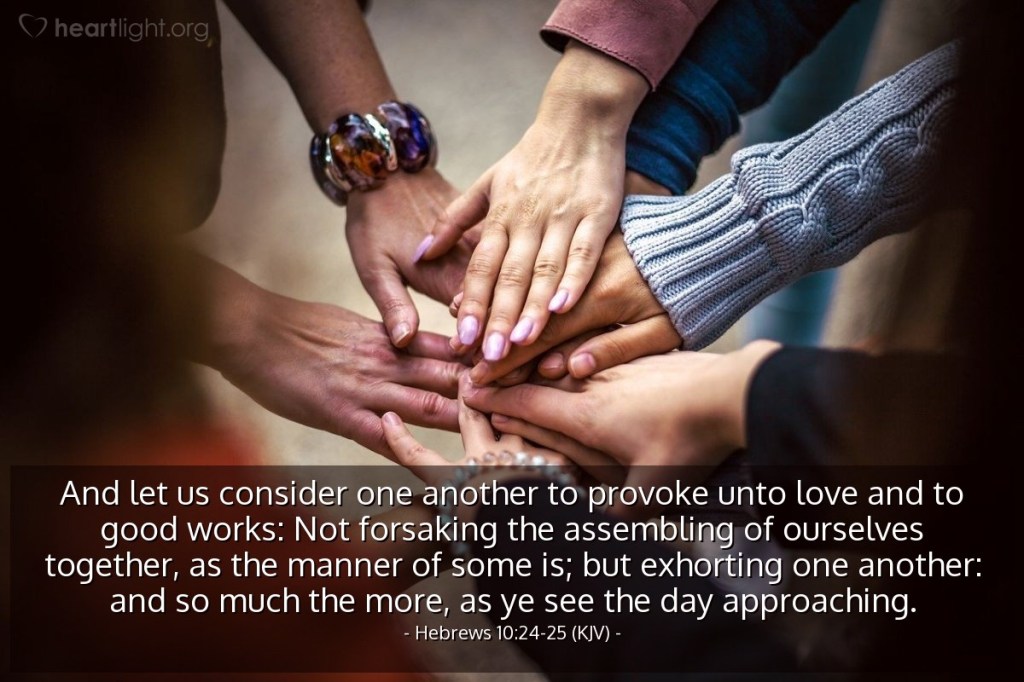
Consider how to Motivate each Other. Just how to Stir One another Up to love being the Church. Hebrews 10:19-25.

Ye Servants of God (Charles Wesley, 1707-1788)

1. Ye servants of God, your Master proclaim,
and publish abroad his wonderful name;
the name all-victorious of Jesus extol,
his kingdom is glorious and rules over all.

2. God ruleth on high, almighty to save,
and still he is nigh, his presence we have;
the great congregation his triumph shall sing,
ascribing salvation to Jesus, our King.

3. “Salvation to God, who sits on the throne!”
Let all cry aloud and honor the Son;
the praises of Jesus the angels proclaim,
fall down on their faces and worship the Lamb.

4. Then let us adore and give him his right,
all glory and power, all wisdom and might;
all honor and blessing with angels above,
and thanks never ceasing and infinite love.

Hebrews 10:19-25Disciples’ Literal New Testament

Therefore, Let Us Approach God in Full Assurance of Faith and Hold on Without Wavering

19 Therefore, brothers, having confidence for the entering of the Holies by the blood of Jesus— 20 which fresh[a] and living way He inaugurated for us through [b] the curtain, that is[c], His flesh— 21 and having a great Priest over the house of God, 22 let us be approaching God with a true heart in full-assurance of faith, having our hearts sprinkled[d] from an evil conscience, and having our body washed[e] with clean water. 23 Let us be holding-on- to the confession of our hope without-wavering, for the One having promised is faithful. 24 And let us be considering[f] one another for the provoking love and good works, 25 not forsaking the gathering-together of ourselves as is a habit with some, but exhorting[h] one another, and so-much more by-as-much-as you see the day drawing-near.

The Word of God for the Children of God. Gloria! In Excelsis Deo! Alleluia! Amen.

Ye Servants of God, What Exactly Are We Doing with our Life Which Points to Jesus?

When you get up in the morning and you face a day, what do you say to yourself about your hopes for the day? What do you do to motivate yourself? When you look from the beginning of the day to the end of the day, what do you want to happen because you have lived? What difference do you want your life to make?

If you say, I don’t even think like that, I just get up and do what I’ve got to do, then you are cutting yourself off from a basic means of grace and a source of guidance and strength and fruitfulness and joy.

It is crystal clear throughout the Bible, including this text from Hebrews, that God means for us to aim consciously at something significant in our days.

Gods revealed will for us is that when we get up in the morning, we don’t drift aimlessly through the day letting mere circumstances alone dictate what we do, but that we aim at something — that we focus on a certain kind of purpose.

I’m talking about children here, and teenagers, and adults — single, married, widowed, moms, every age, every season of life and every walk, every trade.

Aimlessness is akin to lifelessness. Dead leaves in the back yard may move around more than anything else — more than the dog, more than the children.

The wind blows this way, they go this way. The wind blows that way, they go that way. They tumble, they bounce, they skip, they press against a fence, but they have no aim whatsoever. They are full of motion and empty of real life.

God did not create humans in his image to be aimless, purposeless wanderers, like a mound of lifeless leaves blown around in the backyard of life. He created us to be motivated, purposeful — to have a focus and an aim for all our days.

And this is not the least bit oppressive. It’s not slavery. It’s not depleting.

To find what we were made for and to do it with all God’s might (Colossians 1:29), is freeing (Galatians 5:13) and energizing. Jesus said, “My food is to do the will of Him who sent Me” (John 4:34). Food! Aiming day by day to do what we were meant to do is like eating: it gives and nourishes life and energy, rather than taking it away. You will eventually die if you do what you were meant to do.

You and I may be young, or we may be old. That is God’s choice, not ours. But when live and die doing what we were meant to do, we live, die well and full.

Ye Servants of God, what do we consider the Aim, Focus of Our Lives as Christians?

Would you please consider with me what these verses from Hebrew teach us about the aim and focus of our lives as Christians?

I fervently pray God may use them to bring crystal-clear focus to your life. He may use them to blow away all the confusion and fog, the excuses and fear, and shall give a lucid, bright, crisp, spring-morning clarity to the aim of your days.

1. Ye Servants of God, Embrace Your Living Hope

First, verse 23 says, “Let us hold fast the confession of our hope without wavering, for He who promised is faithful.”

Now that is not something you do with your hands or your feet. You don’t go to the kitchen to do this, or to the den or across the street or to the office or to school. This is not done where anyone can see. This is an affair of the heart.

Embrace your living hope.

Hold fast to your living hope.

Be a hopeful, hope-filled person. Hope in God.

Because God has made promises to you, and he is faithful.

He has promised to write the law on your heart (Hebrews 10:16) and work in you what is pleasing in his sight (Hebrews 13:21);

He has promised to remember your sins no more (Hebrews 10:17);

He has promised that we will be perfected for all time by a single sacrifice (Hebrews 10:14);

He has promised never to leave us or forsake us (Hebrews 13:59);

He has promised to bring good from all our pain (Hebrews 12:10).

And so, Ye Servants of God, believe with all your heart God keeps his word.

But that does not provide you with a sufficient focus for the day?

God did not create you to curl up under the covers and hope in God all day in bed. Without some effect on your life, hope in God would be invisible and bring no public glory to God’s power and wisdom and goodness and trustworthiness.

If the act of hoping in God were all that he created you to aim at, then verse 24 would be wasted words.

But they are not.

God created you first to hope in him, and then to make that hope visible by the effect that it has on your life. And that effect is given in verse 24, and it is to be the aim of your daily life. This is why God wakes everyone up in the morning.

2. Ye Servants of God, Motivate yourself to Motivate others – Stir Up Each Other to Love and Good Deeds

Let’s read it. Verse 24: “Let us consider how to stimulate one another to love and good deeds.”

Here is the focus for our life. Here is what we aim at from morning till night as a Christian. Notice carefully: it is not what you might expect. It is not: consider how to love each other and do good deeds. That would be Biblical and right.

But it’s different: “Consider how to stimulate each other to love and good deeds.” Focus on helping others become loving people. Aim at stirring up others to do good deeds.

And of course, the implication would then also be that if others need help and stirring, we do too, and so we would be aiming at what diverse sorts of ways we can think and feel and talk and act that will likewise stir each other up to love and to do good deeds. The true aim of our lives is not just loving and doing good deeds but likewise helping to stir up others to love and to good deeds.

3. Ye Servants of God, Consider Each Other

But let’s be more precise. There is something in this text that is very hard to bring over into English.

The word “consider,” (“Let us consider how to . . .”) is used one other time in the book, namely, Hebrews 3:1, where the writer says, “Consider Jesus.”

That is, look at him; think about him, focus on him, study him, let your mind be occupied with him.

“Jesus” is the direct object of the verb “consider.” “Consider Jesus.”

Consider what? Consider Jesus. Well, in Hebrews 10:24 the grammar is the same: the direct object of the word “consider” is “one another.” Literally, it says, “Consider the Savior Jesus Christ in one another.”

Ye Servants of God – God’s Call for Everyone

Consider one another. But this is almost impossible to bring over into English with the rest of the sentence, because it would be so awkward.

It would have to go something like this: “Consider one another toward the stimulating of love and good works.” Now that is terrible English — good Greek word order but terrible English. The best we can do, it seems, is to say, “Consider how to stimulate one another to love and good deeds.”

But I want you to get this nuance of the original so you can feel the force of this as a daily aim and focus for your life.

Literally, this is God’s call on each of us to consider one another, that is, to look at one another, think about one another, focus on one another, to study one another, to let your mind be occupied with one another. And the goal of this focus on others is to think of ways of stimulating them to love and good deeds.

I ever so strongly urge you to hear God’s word in Hebrews 10:24. When you get up in the morning, Consider — think about, ponder, deliberate, meditate, mull over — other people, with this conscious goal: what can I do today so that they will be stirred up to radical, random, Christian acts love and to good deeds?

Now there is a reason to live and a focus for every day that will never be boring.

Every day is new and different. People change. Their circumstances change. You change. But the call remains the same: consider, consider, consider these people you will be around today.

What are they like? What am I like? What will the situation be like?

What helps a person become more loving?

What is the origin of genuine good deeds?

This is a reason for living that is focused enough to be practical and big enough to last a lifetime.

Ye Servants of God, Motivate yourself to Get Together, to Encourage One Another in God.

So, let’s look at the text to find the answer to how we go about this. Verse 24 gives the focus and aim: “Let us consider how to stimulate one another to love and good deeds.” Then verse 25 gives us instructions how. It says, “not forsaking our own assembling together, as is the habit of some, but also encouraging one another.” Two things. First, don’t neglect to get together.

Second, encourage one another.

When I was growing up, I heard this text referred to most often as an argument for regular attendance at worship services. “Do not forsake the assembling of yourselves together — come to church regularly.”

And that is not a wrong application of the text since one of the most important kinds of encouragements and exhortations we get is from our preaching and our sharing, fellowship and talking of God’s word in the power of God’s Spirit.

(Hebrews 13:22 calls the book of Hebrews a “word of encouragement.”)

But in the context, the kind of coming together in view seems to be one where the members “encourage one another.” Verse 25 is explicit: come together and encourage one another. The “one another” implies that there is something mutual going on. One is encouraging another, and another is encouraging one. Each is doing or saying something that encourages.

If you ask what that corresponds to in our church, I would say the closest thing is the small groups — which is why I regard this ministry as so utterly crucial.

I am a great believer in preaching. There is something about the word of God that begs to be heralded and trumpeted and exulted over — as well as discussed and taught. But I have no illusions preaching is enough in the life of a believer.

The New Testament — and especially this book of Hebrews — calls us again and again to a specific kind of mutual ministry that involves all the believers in encouraging others.

So, I ask you to take stock of your life: Where are you in verse 25?

There are two groups: those who gather to encourage each other, and those who have formed the habit of not gathering.

See that little phrase in verse 25: “Not forsaking our own assembling together, as is the habit of some.” Non-participation in a fellowship group can be habit-forming and rather nonproductive to God’s Kingdom aims.

How are we doing?

Ye Servants of God, Consider What Kind of Encouragement Motivates & Stimulates?

Which leaves one last question remaining for us to ask ourselves:

What kind of encouragement stimulates others to love and good deeds? It’s not obvious to some that this question has anything to do with God.

Lots of people think that love and good deeds are a good thing to seek after, and many would say that encouraging others is the way to do it — and they might not even be Christians. Or they might be Christians who put little focus on God.

For example, I have repeatedly read where one church was described like this:

“While [the pastor] spoke of sending out missionaries, the feeling was that his congregation existed to heighten only to edify the self-esteem of its members.”

Whether or not that’s an accurate description of that church, the point is this: a lot of churches would try to stimulate love and good deeds that way.

But it’s not even close to being the biblical way.

The key to encouraging love biblically is given in verse 23: “Let us hold fast the confession of our hope without wavering, for He who promised is faithful.”

The key to love, in the New Testament — the kind of love that magnifies God and not man — is hope rooted in the faithfulness of God. Embrace your hope! Cherish your hope! Because I know God is faithful. He keeps all his promises.

Without this kind of faith and hope, sustaining us day by day through all the disheartening frustrations and crushing disappointments, we would not have any strength or energy or joy to stir anybody up to love and good deeds.

But if we bank on God, not on ourselves, we always have that extra something encouraging and hope-giving to say, namely, “God can be absolutely trusted, God can be utterly trusted. I have no strength, but God can be 100% trusted.”

Ye Servants of God, Do This All the More

  1. Make the aim of your life to consider others — study them, know them, figure them out — to the end that you stimulate them to love and good deeds.
  2. Be sure that you do this by getting together often with other believers for the specific purpose of encouraging each other.
  3. And let the heart of that encouragement be reminders of how great our hope is in Christ and that God can be trusted.

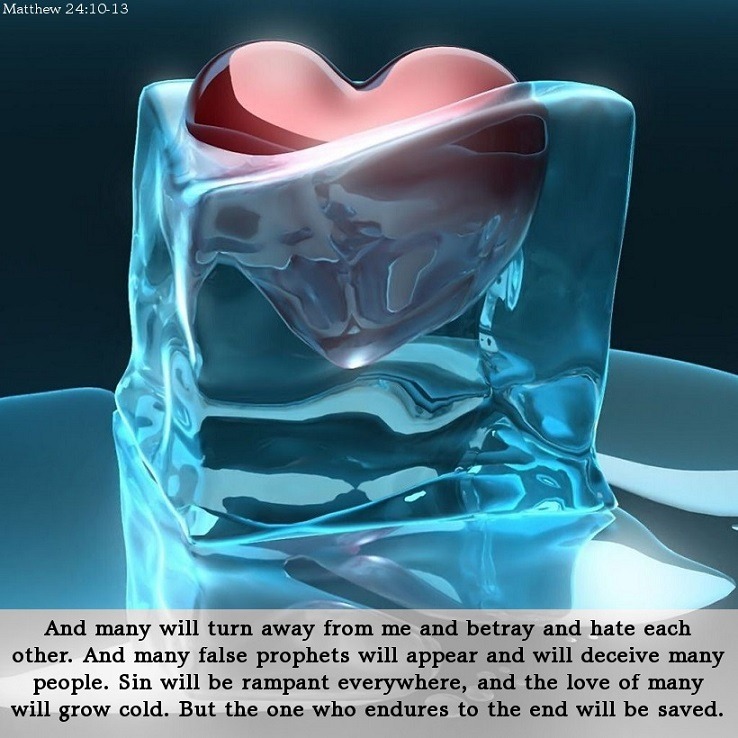
And as you see the end of the age drawing near, verse 25 says, do this all the more, not less.

Why?

As Jesus said, “Because lawlessness is increased, most people’s love will grow cold. But the one who endures to the end, he shall be saved” (Matthew 24:12).
In the name of God, the Father and God the Son and God the Holy Spirit,

Let us Pray,

Heavenly Father, thank You for loving me so much that while I was still dead in my trespasses and sins, Christ completed His finished work on the cross… so that by grace through faith in Him, I might have forgiveness of sin and life everlasting.

Thank You, my Savior, for those who taught me about the Lord Jesus and who demonstrated the love of Christ in their own lives – provoking me to love and good works in my own life. Help me to be so in tune with You that others may be provoked unto love and good works through my witness, as Christ lives in me and I in Him. Gloria! In Excelsis Deo! Alleluia! Alleluia! Alleluia! AMEN.


https://translate.google.com/

What about our Preaching the Gospel? Who has Believed our Message? What of our Excuses for not preaching, not speaking God’s Word? Romans 10:16-21

May the Word of God speak unto “Our Excuses and Our Mighty Mouths”

All of us attempt to justify our actions at one time or another with excuses. When people give an excuse, they give a reason or explanation to defend or justify an action or an inaction, a fault or offense; Usually we will give others a reason for NOT doing something, or a reason why something went wrong.

“Excuse” comes from the Latin meaning “out of cause”: We offer a cause or a reason for not doing something that we should…. we give a bizarre “excuse.”

Billy Sunday, the baseball star turned evangelist who lived from 1862 – 1935, said that “An excuse is the Skin of a Reason, Stuffed with a Lie.” Today, we are going to look at a few excuses Apostle Paul states Israel used for not believing.

Romans 10:15-21Disciples’ Literal New Testament

15 And how may they proclaim if they are not sent-forth?— just as it has been written[a] [in Isaiah 52:7]: “How beautiful are the feet of the ones announcing-good-newsof good things!” 16 But[b] they did not all obey the good-news, for Isaiah says [in Isaiah 53:1], “Lord, who put-faith-in our report?” 17 So[c] the faith[d] comes from a report-hearing[e], and the report-hearing through a word[f] about[g] Christ.

But It Is Not As Though Israel Did Not Hear

18 But I say[h]— it is not that they did not hear[i]is it ? On the contrary: “Their voice went-out into all the earth, and their words to the ends of the world” [Psalm 19:4].

And It Is Not As Though Israel Did Not Know

19 But I say— it is not that Israel did not know[j]is it? First, Moses says [in Deuteronomy 32:21] “I will provoke you to jealousy over what is not a nation. I will provoke you to anger over a nation without-understanding[k]”. 20 And Isaiah is very bold and says [in Isaiah 65:1] “I was found by the ones not seeking Me. I became visible[l] to the ones not asking-for Me”. 21 But with-regard-to Israel He says [in Isaiah 65:2], “I held-out[m] My hands the whole day toward a disobeying[n] and contradicting[o] people”.

The Word of God for the Children of God. Gloria! In Excelsis Deo! Alleluia! Amen.

The most meticulous and thorough presentation of the glorious Gospel of Christ is found in the book of Romans. It also meticulously details man’s own depravity, humanities estrangement from God and man’s reconciliation back to God. The book of Romans could be called the seedbed for all Christian doctrine… giving us a systematic, step-by-step teaching of the fundamentals of our faith.

Paul pounds home the truth that God’s gracious offer of righteousness is by faith. He points out that it is equally accessible to Jew and Gentile alike… for all are sinners and have fallen short of the Glory of God (Romans 3:23).

All have the sentence of death over their heads.. and without exception, all of us need a Savior. Paul points out that no-one, Jew or Gentile alike, is exempt from God’s condemnation for all have sinned and are in need of a Savior – all need to be justified by grace, through an abiding faith in the Son of God – Christ Jesus.

It baffles the mind of those that have taken up God’s free gift of salvation.. that His offer of reconciliation should be quickly, summarily rejected by so many.

It is astonishing that so many refuse to believe on His name and be rescued from condemnation and an eternity in hell.

And yet throughout the old and new testaments we discover with no small amount of astonishment.. the foolish depravity to which the human race has fallen and man’s arrogant refusal to accept God’s free gift of salvation.

Prophets like Jeremiah grieved at the unbelief in the heart of man when his call for Israel to return to the Lord was treated with such blind, malicious contempt.

Isaiah mourned at the hardness of men’s heart, when he wrote:

LORD: who has believed our report?’

Who has believed the saving message that God has tried to deliver through so many prophets?

Who has believed the word of the Lord and who is willing to admit that there are none that are righteous – not even one.

How few see the need to turn from their sins and believe on the Word of the Lord – and the gospel of grace?

In the first part of chapter 10 of Romans, God tells us what happens to a heart that calls on, believes in, and confesses the name of the Lord Jesus Christ .

We concluded with the prophecy which was first fulfilled in Christ and now is fulfilled in us as the Church in Romans 10:15: “Just as it is written, “HOW BEAUTIFUL ARE THE FEET OF THOSE WHO BRING GOOD NEWS (the Gospel) OF GOOD THINGS!” (Quoted from Isaiah. 52:7)

The Lord Jesus set His feet on this earth from His Heaven and proclaimed the Gospel in His Life, Death, Resurrection and Ascension.

His Ministry of miracles and healing proved beyond the shadow of a doubt, that no one but God could do those things! He proved over and over again HE WAS MESSIAH, THE ONE PROMISED from God, who would DIE FOR OUR SINS.

But, still, there was disbelief, there was unacceptance of the Gospel message.

Excuse #1: A Hearing Problem?

WHO COULD POSSIBLY REJECT THE Power and Clarity of the GOSPEL of God’s Grace in Jesus Christ?

Paul, under the inspiration of the Holy Spirit continues in Romans 10:16: “However, (UH-oh!) they did not all heed the good news; for Isaiah says, “LORD, WHO HAS BELIEVED OUR REPORT?”

The truth is that VERY FEW believed the report. Israel killed the prophets who preached God’s Word, and then they killed THE ONE, the LORD JESUS, which the prophets had foretold. But that does not change the way that God works:

Romans 10:17 “So faith comes from hearing, and hearing by the word of Christ.” 18 But I say, surely they have never heard, have they?”

Paul is saying: With such clear and powerful prophecy, could it at all be possible that Israel never heard the MESSAGE of the Gospel? Could it be possible that MOST of Israel had a “self-centered” hearing problem? Can Israel honestly stand up and give the excuse: We didn’t hear the message of salvation?

Paul responds with the second half of verse 18: Indeed they have; (NO WAY! NO EXCUSE; THEY HAVE HEARD THE MESSAGE) “THEIR VOICE HAS GONE OUT INTO ALL THE EARTH, AND THEIR WORDS TO THE ENDS OF THE WORLD.”

Here Paul quotes Psalm 19:4: “Their sound has gone out through all the earth, And their utterances to the end of the world.” Psalm 19:1 begins: “The heavens are telling of the glory of God; And their expanse is declaring the work of His hands.” Day and night, CREATION SPEAKS LOUDLY AND CLEARLY of the Glory and the power and the work of the Almighty God.

The excuse does not stand because Creation sings the Father’s song:

Romans 1:18-23Disciples’ Literal New Testament

God’s Wrath Is Upon All Sin

18 For the wrath of God is revealed from heaven against all ungodliness[a] and unrighteousness[b] of people holding-down[c] the truth in[d] unrighteousness.

Because God Revealed Enough of Himself In Creation For The World To Be Without Excuse

19 Because the thing known of God is evident[e] in[f] them, for God made it [self] evident to them. 20 For His invisible things— both His eternal power and divine-nature— are clearly-seen, being understood since the creation of the world in the things made, so that they are without-excuse.

And Having Known This Truth About God, The World Did Not Honor Him As God

21 Because having known God, they did not glorify Him as God or give-thanks, but became futile in their thoughts, and their senseless heart was darkened.

They Turned From The Glory of The Immortal God To Their Crafted Images of God

22 While claiming to be wise, they became-foolish 23 and exchanged the glory of the immortal God for a likeness— an image of a mortal person and of birds and of four-footed-animals and of reptiles.

If you go back to the beginning of Romans, read Romans 2-3, you find that NO ONE IS RIGHTEOUS and there is not one single usable excuse, and everyone is liable! No one can say: I don’t believe because I never heard.

Excuse # 2: Lack of Understanding?

Here’s excuse number two:

Romans 10:19 “But I say, surely Israel did not KNOW, did they?”

OK let’s bury deep the first excuse: We can admit Israel heard the word, but maybe they just didn’t UNDERSTAND (know) the Word. Could that be valid?

That they heard it but didn’t understand it? Could Israel’s excuse be that over the long course of years, “we just didn’t understand the message of salvation?”

Paul’s response Romans 10:19b is:

“First Moses says, “I WILL MAKE YOU JEALOUS BY THAT WHICH IS NOT A NATION, BY A NATION WITHOUT UNDERSTANDING WILL I ANGER. (YOU)”

Paul’s response comes from:

Deuteronomy 32:21-22 New American Standard Bible

21 They have made Me jealous with what is not God;
They have provoked Me to anger with their [a]idols.
So I will make them jealous with those who are not a people;
I will provoke them to anger with a foolish nation,
22 For a fire has flared in My anger,
And it burns to the lowest part of [b]Sheol,
And devours the earth with its yield,
And sets on fire the foundations of the mountains.

In essence, Israel caused God to be jealous by going after other gods, so God’s hope is to arouse jealousy within them, not by rejecting them, but by drawing other people outside of Israel to come to His Salvation.

How could anyone possibly not understand the message of salvation?

Not only did God give Israel the general revelation which He gave to EVERY CREATURE on this planet, but He gave to them HIS WORD and LAW, and they still disobeyed and followed other Gods.

We looked at the first part of Psalm 19 where the theme of God’s General revelation in creation is explained.

If you look at the second half of Psalm 19, you hear that Israel received the Perfect WORD and LAW of God, and they STILL rejected God.

So both of Israel’s excuses are groundless: They HEARD and UNDERSTOOD and still rejected God’s Grace. God’s response is heard in Roman 10:20:

Romans 10: 20 And Isaiah is very bold and says, “I WAS FOUND BY THOSE WHO DID NOT SEEK ME, I BECAME MANIFEST TO THOSE WHO DID NOT ASK FOR ME.” (from Isaiah 65:1: “I permitted Myself to be sought by those who did not ask for Me; I permitted Myself to be found by those who did not seek Me. I said, ‘Here am I, here am I,’ To a nation which did not call on My name.”

The overwhelming majority of the nation of Israel both heard and understood the message of God’s salvation of justification faith, but did not believe God’s promise, and when His Promised ONE arrived, they rejected and crucified Him.

They would NOT admit they needed God’s salvation nor submit by faith and grace. They were offended by the hearing and understanding of God’s Word and Grace and by a righteousness which comes by faith.

They were quite content to remain in their own self-righteousness and sin.

Their response to Deuteronomy 32 was basically: “Go ahead, give your grace to the Gentiles; at least we have our Judaism and we’re happy with that! We don’t want or need anything else.”

Romans 10:16 Disciples’ Literal New Testament

16 But[a] they did not all obey the good-news, for Isaiah says [in Isaiah 53:1], “Lord, who put-faith-in our report?”

What a disheartening thing to know that not everyone will accept Christ Jesus as Lord. Eventually they will confess this with their mouths (Philippians 2:11) but the timeframe to accept this gospel message is while we are in the world.

Christ came to redeem the world, although he knew, not everyone would accept him.

John said, 

John 1:11-13 Disciples’ Literal New Testament

11 He came to His own things, and His own ones did not accept Him. 12 But all who did receive Him, He gave them— the ones believing in His name— the right[a] to become children of God, 13 who were born not of bloods[b], nor of the will of the flesh, nor of the will of a husband, but of God[c].

Jesus came first to the nation of Israel and proclaimed peace between them and God. However, they received him not.

Paul says the same thing in today’s passage, 

“not all the Israelites accepted the good news. For Isaiah says, “Lord, who has believed our message?” (Romans 10:16). 

Isaiah foretold that the Israelites would reject Jesus.

Paul is quoting from Isaiah 53, which is a passage about Jesus. This is one of the most powerful chapters in the entire Old Testament.

It foretold everything Jesus would suffer on the cross. Isaiah starts out this beautiful word with saying, 

“Who has believed our message and to whom has the arm of the LORD been revealed?  He grew up before him like a tender shoot, and like a root out of dry ground. He had no beauty or majesty to attract us to him, nothing in his appearance that we should desire him.  He was despised and rejected by men, a man of sorrows, and familiar with suffering. Like one from whom men hide their faces he was despised, and we esteemed him not.  (Isaiah 53:1-3).

Christ knew that his own people would reject him and esteem him not. Yet he still came to redeem them, what a marvelous thing.

Why did the 1st Century Israelites reject Jesus?

For us, in 2022, we can look back through the Hebrew (Old) Testament with Jesus as our filter and identify every passage that was spoken about him. We can even read these passages out loud to others without telling them where they were found and the listener can tell you that it is talking about Christ, often the assumption is that the passage is actually the New Testament.

However, the Israelites read these same passages but looked for something entirely different than what Christ turned out to be.

They were looking for a warrior king and not a servant.

When the Word became flesh and dwelt among us, that Word fell on deaf ears, fulfilling what Isaiah prophesied about them. 

” ‘Be ever hearing, but never understanding; be ever seeing, but never perceiving.’ Make the heart of this people calloused; make their ears dull and close their eyes. Otherwise, they might see with their eyes, hear with their ears, understand with their hearts, and turn and be healed.” (Isaiah 6:9-10).

Jesus spoke about the same truth in the parable of the Sower of the seed.

There are four kinds of soil to sow and depending on the condition of the soil is whether or not the seed grows and bears’ fruit. Jesus spoke this parable to this nation and when the disciples asked him what was meant by it, he quoted this passage in Isaiah. He spoke to them in parables because of the condition of their heart which kept them blind and deaf to these amazing truths. If their heart would have been ready to hear it, he would have turned and healed them.

The Israel of the 1st Century in this case was the first kind of soil.

The farmer went out to sow seed, but it fell upon the path and the birds ate it up quickly. When Jesus told this parable to the disciples, he explained… 

“This is the meaning of the parable: The seed is the word of God. Those along the path are the ones who hear, and then the devil comes and takes away the word from their hearts, so that they may not believe and be saved” (Luke 8:11-12, Mark 4:13-18).

Jesus told in Matthew’s version the reason the seed is quickly stolen, 

“When anyone hears the message about the kingdom and does not understand it, the evil one comes and snatches away what was sown in his heart. This is the seed sown along the path” (Matthew 13:18-19). 

Now the condition of the soil made it easy for the seed to be eaten up by the birds, because the soil fell upon a path. A worn path is hard and compacted. In many cases it is impenetrable by something like a seed. For a seed to germinate it has to get down into the soil. But when it falls upon hard ground germination is not possible. The seed can be easily eaten because it is lying upon the surface.

Jesus said the seed was the word of God and Satan comes to steal it. If we don’t understand the word and the word falls upon deaf ears and the condition of the heart is impenetrable than stealing the word takes no effort. 

In this case, 1st Century Israel was the first kind of soil. They were expecting a Messiah that was entirely different than Jesus, so their notions blinded them to the truth of God’s word.

Like Isaiah said, their hearts are calloused, their ears dull and their eyes are closed (Isaiah 6:10). As Jesus spoke to them, Satan walked right behind him and picked up the seeds of eternal life that he spoke.

They allowed him to steal the word of God that had the power to save them because they had not prepared their hearts to receive it.

What a discouraging thing this must have been.

But this stands as a warning for us.

Paul said in the very next verse of Romans 10 that “Faith comes from hearing the message, and the message is heard through the word of Christ” (Romans 10:17).

This is how faith comes, by hearing the gospel and believing and receiving it.

This message comes from Christ and just like the hard condition of the heart blocked the words of life, the fourth kind of soil received it with gladness and produced an abundant crop. 

“But the one who received the seed that fell on good soil is the man who hears the word and understands it. He produces a crop, yielding a hundred, sixty or thirty times what was sown” (Matthew 13:23, Mark 4:20, Luke 8:15).

When called, separated by God, we will always have our excuses to either act on that calling or not act on that calling. Invariably, our first choice is to reject the Word of the Lord as Samuel did, but with help and guidance from others, we will respond to God as He needs, requires us, to respond. (1 Samuel 3:1-10)

The Word of God is the Word of God. The seed is the seed, but the condition of the soil determines the abundance of the crop or even whether it sprouts at all.

Praise God the message of salvation continues to be equally efficacious for Jew and Gentile alike, and in his epistle to the Roman followers, the Apostle Paul presents in minute detail every aspect of God’s righteous condemnation of sinful man… and his gracious offer of reconciliation through the death burial and resurrection of Christ our God and Savior.

Let us undertake to read, mark, learn, inwardly digest its truth and tell others the message of reconciliation and redemption – although sadly the are likely to be those who do not obey the message through pride, unbelief and rebellion.

This is a good word for us today; we can hear the Word of God; we can prepare our hearts to receive the Word of God, then speak of them. It is my prayer that we keep your heart soft and pliable before the Lord ready to receive his word.

Be the fourth kind of cultivated soil and receive this word with gladness. Let this seed penetrate and germinate in your heart yielding much eternal fruit, amen.

In the name of God, the Father and God the Son and God the Holy Spirit,

Let us Pray,

God, from the beginning, you were the word. You sent your only son to save us all and he even allowed himself to be tortured and crucified to obey you. Bless me with the gift of understanding and of unshaken faith in you. Let me know the meaning of your words in the Bible and how to live accordingly. Open up to me the door of my heart and fill me with your light and understanding. Amen.

https://translate.google.com/