Romans 15:4 "For whatever was written in earlier times was written for our instruction, so that through perseverance and the encouragement of the Scriptures we might have hope."
As Christ-followers, we serve a God who is not surprised at all by what we face each day. God is sovereign, so he knows all about panic, pandemics, chaos, and confusion. And he is with us no matter what we face. This is His PROMISE!
God has also left us His Word, so we can go to it any time we need reassurance of his presence. And in His Word, we find Psalm 18:2. In this one short verse, we can discover incredible measures of encouragement and motivation to believe in God. We can find and discover God gives us eight promises we can proclaim—about who He is and how He always finds us and helps in all our circumstances.
Psalm 18:1-2 King James Version
18 I will love thee, O Lord, my strength.
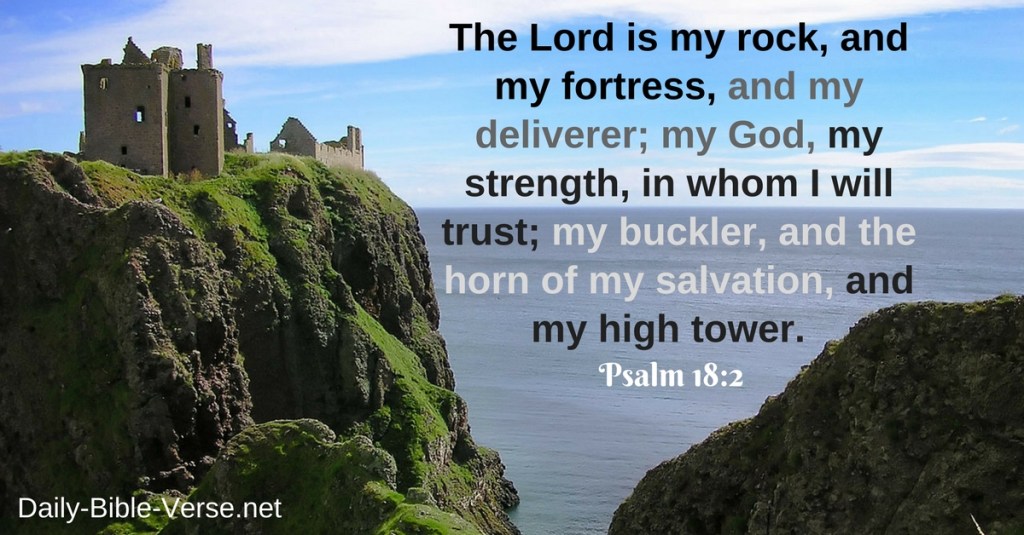
2 The Lord is my rock, and my fortress, and my deliverer; my God, my strength, in whom I will trust; my buckler, and the horn of my salvation, and my high tower.
The Word of God for the Children of God. Gloria! In Excelsis Deo! Alleluia! Amen.
1. The Lord Is My Rock
In times of trouble, when we feel shaky with life’s circumstances, it’s mightily inspiring and encouraging to know that God is our rock. God Someone who is extremely strong and mighty. Someone we can bear hug and hold onto when we feel the entire earth under our souls moving. It invigorates and motivates my soul to believe there is no one we can trust who is more reliable than the Lord.
In the chorus of the song The Solid Rock, by Edward Mote, he writes:
On Christ the solid rock I stand, all other ground is sinking sand, all other ground is sinking sand.
Christ is also referred to as the Rock of Ages in the hymn by Augustus Montague Toplady.
So often the words of hymns have brought me comfort as they tend to take my eyes off my circumstances and instead place them where they ought to be, on the Lord.
Rock of ages, cleft for me, let me hide myself in thee.
The picture I get in my mind is of a small child being afraid who runs to his parent for protection. Once there, the child feels as if everything will be okay.
2. The Lord Is My Fortress
When the word, “fortress,” refers to a person, it means that person is not susceptible to outside influence or disturbance.
The Lord is Almighty. He cannot be influenced, and nothing shakes the Lord. It reminds me of when Jesus was brought into the wilderness for 40 days and Satan tried to tempt him. Each time, the Lord responded in the same way. He used the words, “It is written…” He quoted verses straight from the scriptures.
God is our mighty fortress. Nothing is more powerful than our God.
Nothing can defeat him. The enemy tries to make us fearful by scaring us about what could happen, what might transpire. But God is aware of his tactics, and we can trust in His power.
3. The Lord is my Deliverer
To deliver means that you are removed from pain or from a situation. At times, it could also mean you will be delivered from whatever is going on around you. God delivered Daniel from the lion’s den. He was not physically delivered, but instead, God took the danger away by shutting the mouths of the lions (Daniel 6:19-23). God used an angel to ensure Daniel’s safety.
Because of what Jesus did on the cross, we have been delivered from the penalty of sin. And God has also delivered us from the power of sin, because we’re told if the Son therefore shall make you free, you shall be free indeed (John 8:36).
One day we will be in a new heaven and earth where there is no sin, but where righteousness dwells (2 Peter 3:13). All because the Lord is our deliverer.
4. God Is My God
All the attributes of God are wonderful, but what makes them so great is that God is my God. He’s someone I can call on at any time of the day or night. He has given me total access to his throne room where I am invited to bring him my petitions, knowing that God will answer them according to his perfect will.
God and I don’t think alike. He tells us that his ways are higher than our ways and his thoughts are higher than our thoughts (Isaiah 55: 8-9).
God loved us so much he sacrificed his precious Son and when we accept Jesus, what he did for us, our Creator becomes our Father. And God becomes my God.
I know God cares about me and tells me to cast my cares on him (1 Peter 5:7). I also know whatever circumstances I experience in life; God will work together for good for those who believe (Romans 8:28).
But truly, knowing that God will never leave me nor forsake me leaves me speechless, because everyone else in our lives can leave us—but our heavenly Father promises he won’t (Deuteronomy 31:6).
5. God is my Refuge
A refuge is a shelter of protection from danger or distress. It is like finding a safe place during a storm. The fears we face about these times cause even faithful Christian’s moments of unrest. And while we can focus on what is happening around us, it is much to our benefit if, like Peter, we keep our eyes on the Lord instead of focusing on the wind and waves crashing around us. (Matthew 14:29-32)
David was often running from enemies and in danger, yet he called out to God.
The same God who helped him when he was a boy, facing a lion and a bear. And later, as he stood facing the huge Philistine, Goliath. The youthful Shepherd David remembered the same God who had helped him before would give him what he needed now (1 Samuel 17:37).
All of us can probably remember when God delivered us from danger. The Holy Spirit is faithful in reminding us God never changes (Psalm 102:25-27).
6. God is my Shield
God provides protection for us. Our adversary, Satan, walks about like a roaring lion, seeking someone to devour (1 Peter 5:8). Yet, God reminds us that if we have accepted the Lord, we are God’s children and that the Spirit of God who abides in us is greater than the enemy who is in the world (1 John 4:4).
We remember when God told Abram that he was Abram’s shield and exceeding great reward (Genesis 15:1). God cares for his own. He is a loving father. And I know that if an earthly parent has this inborn desire to protect his family, how much more would the God of the universe protect his children?
7. God is the Horn of my Salvation
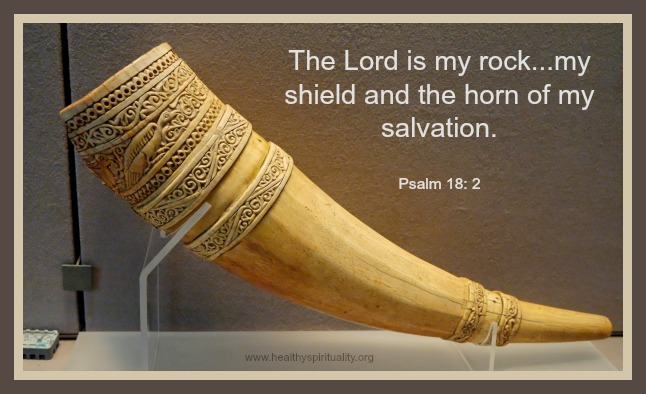
The horn is representative of Jesus’ sacrifice on the cross. It is a promise of future protection for believers. The kind of horn meant is the deadly weapon of the wild ox. In scripture it says, “thou has exalted my horn like that of the wild ox” (Psalm 92:9).
The horn is a sign of strength and a means of sure, and certain victory. God tells Jerusalem, “Arise and thresh, O daughter of Zion, for I will make your horn iron and your hoofs bronze…” (Micah 4:13).
God is the horn of salvation because he uses his power to secure and protect his people. God isn’t the horn of our salvation merely to liberate us, but also to make us holy and righteous people who don’t live in fear because we trust God.
8. God is my Stronghold
A stronghold is something which has been heavily fortified, so it is protected against the very worst forms and methods of attack. I love the idea that God has fortified us. He’s given us his Word, which guides us and gives us wisdom.
God has also told us in Scripture about how we are to put on the armor of God.
With the full armor of God, we will be able to stand against the rulers, the authorities, and the powers of this dark world, as well as stand against the spiritual forces of evil. The full armor of God will protect us from the devil’s schemes (Ephesians 6:10-18).
When Paul sought the Lord because of an infirmity, God did not remove what was hurting Paul, but instead, God encouraged and reminded Paul that God’s grace would be all-sufficient, for God’s power is made perfect in weakness.
Encouraged, Inspired and motivated, Paul then realized he would be wiser to boast of his weaknesses, as well as his hardships and calamities because in Paul’s weakness, God’s strength was evident (2 Corinthians 12:9-10).
In our lives, there are many times when things look impossible. And even then we are reminded that Jesus said impossible things are possible with God (Matthew 19:26).
Yes, God is my rock, my fortress, and my deliverer, my God, my rock in whom I take refuge, my shield and the horn of my salvation, my stronghold.
In Psalm chapter 18, we read David’s response to the Lord after being delivered from the hands of his oppressors, his enemies. David walked through the fire and was now able to look back and affirm God’s great love for him through his trails and tribulations.
We, too, walked through our own modern-day fires, (Ecclesiastes 3:1-8), and each of our natural inclinations just might be to turn from truth instead of towards truth. Yet, I love the vivid example we have in this portion of Scripture. David uses powerful descriptions in verses one and two, all of which can apply to us
In the name of God, the Father and God the Son and God the Holy Spirit,
Let us Pray,
Father God, I thank you for your protection. I thank you that you are Almighty and that nothing can touch us unless you allow it. Even in times like this, Lord, you are our refuge. You are our hiding place (Psalm 32:7). You are our only sufficiency (2 Corinthians 3:5). You are the Alpha and the Omega, who is and who was and who is to come (Revelation 1:8). And we look forward to living eternally with you. Thank you, Lord, for your protection. We praise you for being our God. And we pray others will see us trusting you and want to know about the hope within us (1 Peter 3:15). We pray all this in your Son’s precious name. In Jesus’ name, Amen.
It can be really easy to get caught in the trap of wanting more and getting more. We might be saving for those new shoes, a new phone, and trying to get a new car or the home we have always wanted for ourselves and our families.
We will motivate ourselves to work very hard; we will encourage ourselves to sacrifice very much with the fervent hope our return of investment will be what we hoped. Getting things can seem really important at times, however, the Bible challenges us, encourages us to not make getting the main priority in our life.
Instead, the Bible encourages us, it motivates us to live differently. Instead, the Bible encourages and motivates us to be radical givers. And the awesome part about being a giver is God rewards those who give. So, when you give, you’re not throwing away your time or money. Everything you give to God is always given back to you in many ways. God wants to reward you for your giving.
So, decide, perhaps today to make giving a habit in your life. Choose to begin to give and see how God will provide and reward you for your faithfulness to give.
Rabbi Jesus repeatedly teaches us about radical graciousness and generosity, he sums it up with two simple principles: 1) Our blessings will be based on our willingness to bless others, and 2) our measure of treating and judging others will be the basis used for how we are treated and judged by others and by God.
In other words, God has been radically gracious with us; and we can either share that graciousness or abuse it. Grace is wonderful and free until we take it off the market and out of circulation in our relationships. If we stymie, hold, or remove God’s grace from circulation, it becomes damaged and lost with us. This stern warning reminds us again how seriously God takes our generosity with others.
Luke 6:37-38 Disciples’ Literal New Testament
Do Not Judge or Condemn Others. Pardon And Give to Them
37 “And do not be judging[a], and you will never be judged. And do not be condemning, and you will never be condemned. Be pardoning, and you will be pardoned. 38 Be giving, and it will be given to you. They[b] will give a good measure— having been pressed down, having been shaken, running over— into your fold[c] [of the garment]. For with what measure you measure, it will be measured-back to you”.
The Word of God for the Children of God. Gloria! In Excelsis Deo! Alleluia! Amen.
The First Law of Christian Giving
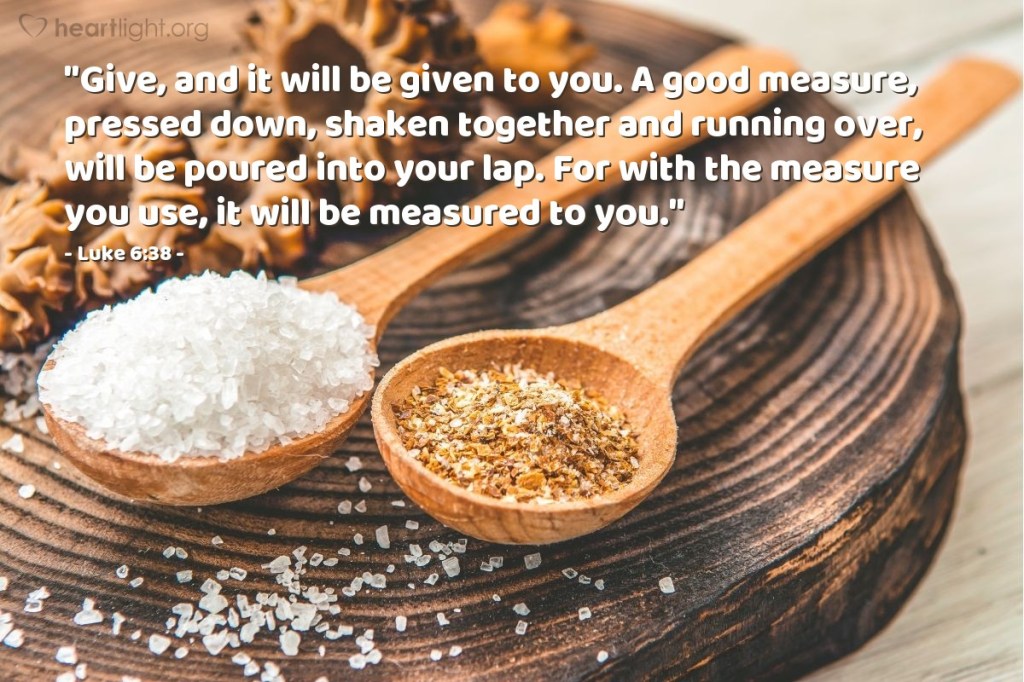
The man, Rabbi Jesus said to those disciples; Give, and it will be given to you. A good measure, pressed down, shaken together and running over, will be poured into your lap. For with the measure you use, it will be measured to you.
This morning as I studied for this devotional offering, I made an interesting discovery. Although this saying of Jesus is very well-known, it is not often discussed. In looking through several commentaries, I generally found not more than one or two sentences devoted to this verse. And I couldn’t find any based entirely on Luke 6:38. In general, I observed verse 37 always attached.
I find that intriguing since most of us have known these words for many years.
If you attended Sunday School as a child, you probably memorized these words.
Perhaps you have them cross-stitched and framed in your kitchen or you may have them on a plaque on or above your desk. Many people who don’t know much about the Bible have heard this phrase: “Give and it will be given to you.”
This verse isn’t as famous as the Golden Rule, but it’s close.
Yet we rarely examine these words closely. They have become a proverb or a Christian motto that we repeat without thinking. This morning I would like to discuss what these words really mean and how they apply to our lives today.
Luke 6:38 is a call for “Christian liberalism.” That in itself is unusual because many churches are quite conservative in their theology. We make no bones about what we believe in almost every area. We are unashamedly conservative when it comes to the great moral issues of the day. We are not moderate nor are we middle-of-the-road. We are strongly conservative in doctrine and morality.
All that is well and good, but it doesn’t encompass every aspect of the Christian life. There are time and places where liberalism ought to be the rule of the day. One of those areas is 100% Radically Encouraged, Radically Motivated Christian giving. In our text Jesus calls on his disciple to be liberals in the area of giving.
I. The Promise Jesus Made
Let’s begin by taking a look at the background of this promise.
Luke 6:27-36 NKJV
Love Your Enemies
27 “But I say to you who hear: Love your enemies, do good to those who hate you, 28 bless those who curse you, and pray for those who spitefully use you. 29 To him who strikes you on the one cheek, offer the other also. And from him who takes away your cloak, do not withhold your tunic either. 30 Give to everyone who asks of you. And from him who takes away your goods do not ask them back. 31 And just as you want men to do to you, you also do to them likewise.
32 “But if you love those who love you, what credit is that to you? For even sinners love those who love them. 33 And if you do good to those who do good to you, what credit is that to you? For even sinners do the same. 34 And if you lend to those from whom you hope to receive back, what credit is that to you? For even sinners lend to sinners to receive as much back. 35 But love your enemies, do good, and lend, [a] hoping for nothing in return; and your reward will be great, and you will be sons of the Most High. For He is kind to the unthankful and evil. 36 Therefore be merciful, just as your Father also is merciful.
It helps to know that this is part of the famous Sermon on the Mount. You can find the longer version in Matthew 5-7; the shorter version is found in Luke 6.
Our text is part of a larger section that begins in verse 27 and stretches through verse 38.
All 12 verses deal with the area of human relationships, especially the vexing question of how to deal with difficult people.
I read, pray, and understand these “Beatitudes” primarily in two ways:
The man, Rabbi Jesus is encouraging us, and trying to motivate us to be
First as: “Radically Motivated Love in Action”
Second as: “Radically Motivated through acts of Christian Kindness.”
Jesus begins with 5 staccato commands:
Love your enemies (27)
Do good to those who hate you (27)
Bless those who curse you (28)
Pray for those who mistreat you (28)
Give to everyone who asks you (30)
His teachings climax with the Golden Rule in verse 31: “Do to others as you would have them do to you.”
In Jewish law this was often found in the negative, “Do not do to other what you do not want done to you.”
However, by now stating the command positively Jesus offered a revolutionary, pro-“God” active way of encouraging, motivating and treating others. We are not simply to avoid retaliation; we are to treat others as we want to be treated.
The next few verses give us 5 encouraging reasons for these radical commands:
1. You must go beyond what sinners do 32-34
2. You will win a great reward from God 35
3. You will prove to be the sons of God 35
4. You will reflect God’s character 36
5. You will be treated as you treat others 37
To Market, To Market
That brings us to our key verse.
In order to grasp the meaning, we need to know that it is set in the context of a Middle Eastern market where the buyers and sellers would haggle together or prices, quality, and amount.
It is a scene often repeated in Third World countries today.
Farmers bring their grain—wheat, corn, barley—and spread it on a mat on the ground. Potential customers examine the grain, they make an offer, and the haggling begins. When a price is finally set, the customer offers his container—usually a large bowl or pot—and the seller uses a scoop to fill the container.
It’s exactly at this point that the process becomes really fascinating. In Jesus’ day there were basically four stages of measuring grain for a given customer:
First, the seller fills the container to the top.
Second, he presses the grain down and fills some more.
Third, he shakes the container so the grain will settle and then fills some more.
Finally, he fills the container until it overflows.
The seller would catch the overflow grain and pour it into the pouch of his robe.
That pouch acted as a kind of carry-all bag so the man or woman could bring food home from the market.
In short, Jesus is describing a situation that took place every time a person went to market. It’s unusual to us because everything we buy at our supermarkets is already precisely measured, vacuum sealed, and wrapped up with shrink wrap.
It’s also very carefully labeled on the outside “Contents sold by weight not by volume.” But in Jesus’ day grain was sold by volume not by weight. That’s why the verse mentions that the grain was pressed down and shaken together.
What Does It Mean?
With that as background, we may ask the simple question:
What precisely is Jesus teaching us here about Christian giving?
I think there are two simple answers to that question.
1. When you give, God gives back to you
2. God uses the same measure you use!
Or to put it in modern terms …
If you are stingy, God will be stingy in return!
If you are generous, God will be generous in return!
Before I go any further, let me say that I realize this teaching may not be often heard, preached or taught in all church circles. For diverse various reasons this teaching is more likely to be found in other kinds of evangelical churches.
You may in fact wonder if I am interpreting this verse correctly. Before you jump to any conclusions, Let’s take a look at the most famous teaching in the New Testament regarding Christian giving, 2 Corinthians 9:6-11.
Remember this:
Whoever sows sparingly will also reap sparingly, and whoever sows generously will also reap generously. That’s a principle drawn from the farm. Sow a little, reap a little. Sow a lot, reap a lot.
Each man should give what he has decided in his heart to give, not reluctantly or under compulsion, for God loves a cheerful giver. That’s the application to all of us. When we give our offering, we do not have a gun to our heads as the plates are being passed. That would not be legal, and it would not be moral or ethical.
We want people to give because they want to, not because they have to.
Four “Alls”
And God is able to make all grace abound to you, so that in all things at all times, having all that you need, you will abound in every good work. Notice the word “all” is repeated 4 times in one verse.
“All grace”—that’s the source
“All things”—that’s the extent
“All times”—that’s the duration
“All that you need”—that’s the result
This is God’s promise to those who dare to become generous givers.
You will have everything you need.
Maybe not everything you want, but God will not let generous givers go unrewarded.
As it is written:
Psalm 112:8-9 NIV
8 Their hearts are secure, they will have no fear; in the end they will look in triumph on their foes. 9 They have freely scattered their gifts to the poor, their righteousness endures forever; their horn[a] will be lifted high in honor.
Now he who supplies seed to the Sower and bread for food will also supply and increase your store of seed and will enlarge the harvest of your righteousness.
You will be made rich in every way so that you can be generous on every occasion, and through us your generosity will result in thanksgiving to God.
Here God makes a very plain promise.
If you need more seed, he’ll give it to you. God will make you rich in every way so that you can be generous on every occasion.
Have you ever heard an appeal for money and felt like you wanted to give, but just couldn’t afford it? Perhaps the call came from a ministry or mission you greatly respect or from a school you support or from a church you greatly love.
Perhaps you know of a need and wish you could do something about it.
“You Go First!”
What do you do when you are running short on money but see a need and you want to get involved? I believe the answer is clear. You give whatever you can and trust God to take care of you. It may not be a lot. Indeed, it may be very small. The amount doesn’t matter. What matters is the attitude of the heart.
Both in Luke 6:38 and 2 Corinthians 9:6-11, God specifically promises to take care of generous givers. And he promises to give back to you in accordance with the measure of generosity you use in your “heart” giving in the first place.
In essence, God says, “You go first.” We don’t like that. We want God to go first.
We say, “You give me the money and then I’ll give.”
God says, “I’ve given you, my Word. Isn’t that enough?”
“Well, your Word is nice, but I’d like some cash to go along with it.”
To all our bargaining, God says, “Trust me. You give and I’ll take care of you. And I promise you’ll never be disappointed.”
II. The Principle Behind the Promise
Now that we (prayerfully) better understand what Luke 6:38 means, it’s very important to understand the principle behind the promise.
Everything Jesus says rests in the character of God. When Jesus said, ‘It will be given to you,” he based that promise on the truth of who God is.
He is a generous, benevolent God who loves to give good things to his children.
Because it is in his nature to give, he will always give more to us than we will to him. This to me is the First Law of Christian Giving. You cannot out-give God
In just a few weeks we will gather to celebrate Pentecost.
As we each prepare our heart, consider the first three verses of Psalm 103—The Thanksgiving Psalm—from the King James Version:
“Bless the LORD, O my soul: and all that is within me, bless his holy name. Bless the LORD, O my soul, and forget not all his benefits.”
I love that last phrase. What a wonderful command for celebrating this season of the year: “FORGET NOT ALL HIS BENEFITS!”
If we’ve forgotten them already, David lists five of them for us in verses 3-5.
1. He forgives all your sins
2. He heals all your diseases
3. He redeems your life from destruction
4. He crowns you with love and compassion
5. He satisfies your desires with good things
Soon, as we get closer to Pentecost, I hope to begin an interesting bit of Bible study. Taking my concordances and commentaries, I will attempt to list all the things the Bible says that God encourages and motivates his people to give.
I may never finish the study because the list is too long. You would have to read the entire Bible verse by verse to find everything that God gives his children.
But I do pray God grants me the gift of His wisdom and time to at least make “substantial headway, edifying His Kingdom,” in the spread of His Gospel.
A Short List of God’s Gifts
But here’s a short list of God’s gifts I pray I can give some justice to:
victory, peace, hope, life, success, what is good, wisdom, knowledge, understanding, strength, health, discretion, wealth, honor, power, love, children, a heart to know him, songs in the night, joy in the morning, answers to prayer, food to the hungry, water to the thirsty, rest to the weary, good gifts to those who ask, eternal life, living water, all things, a spirit of unity, the new birth, the crown of life, the light of heaven, and the Word of God.
It will require a good deal of stretching myself where I have not been before.
But I am encouraged and motivated by my Savior’s radically generous words.
And what is his greatest gift? Is it not found in the greatest verse, John 3:16?
“For God so loved that he gave his only begotten Son, that whosoever believeth in him should not perish, but have everlasting life.” God so loved that he gave. The whole truth of the gospel is in those six words.
That’s the Kind of God He Is
Have you ever wondered why God loves sinners? Or have you ever looked in the mirror (especially after doing something really radically backwards) and then saying, “If I were God, I wouldn’t love a person like me.”
Most of us have had that experience because most of us have fouled up in a major way and felt ashamed and embarrassed many times. Deep inside we doubt God’s love for us because we know the truth about who we really are.
Why does God love people like you and me?
I know of only one answer to that question.
He loves us because that’s the kind of God he is.
It’s in his nature to love sinners and (I saw this reverently) he could not stop loving us even if he wanted to. His love for us is so eternal and his character so faithful that his love does not depend on anything we say or do. He loves us just the way we are because that’s the way he is.
Four Facts to Remember
How does this truth about God’s character apply to motivated Christian giving?
Let me suggest four answers.
1. You can’t out-give God
2. God will be no one’s debtor
3. He invites us to trust his Word
4. He challenges us to put him to the test
When God says, “You go first,” we say, “No, you go first.” “But I did go first,” he replies, “I went first when I gave my Son to die on the cross for you.”
God’s Goodness and Our Giving
What does all this have to do with our giving?
You may agree with everything I have just said, still wonder what this has to do with highly encouraging, highly motivated, highly ‘generous’ Christian giving.
I will offer these two answers to that question.
1. Generous givers are not the people with a large bank account, but the people with a large view of God.
Mark 12:41-44 NRSV
The Widow’s Offering
41 He sat down opposite the treasury and watched the crowd putting money into the treasury. Many rich people put in large sums. 42 A poor widow came and put in two small copper coins, which are worth a penny. 43 Then he called his disciples and said to them, “Truly I tell you; this poor widow has put in more than all those who are contributing to the treasury. 44 For all of them have contributed out of their abundance; but she out of her poverty has put in everything she had, all she had to live on.”
We often look at people who give generously and think, “They must be rich.”
But it is not so. Poor people are often very generous and rich people can be very stingy. Generosity has nothing to do with how much money you have. But it has everything to do with your view of God, whether you believe the tomb is empty
If your God is big, you will be generous. If he is small, you will be stingy.
If you struggle with your giving, it may be because your God is too small. The bigger your God, the emptier the tomb, the easier it will be for you to give.
2. When we give generously, we do so because we truly believe God will reward us one way or the other.
Note what the text says, “Give and it will be given to you.” Not might be given or may be given or could be given but will be given.
Our only problem comes with our interpretation of the nature of God’s reward.
Too often we focus on money or material gain as if there were the only way God could reward us.
But 2 Corinthians 9 speaks of receiving a bountiful “harvest of righteousness.”
God’s blessings are often material, but his absolute best blessings cannot be added up on anyone’s pocket calculator.
Luke 2:25-32 NRSV
25 Now there was a man in Jerusalem whose name was Simeon; [a] this man was righteous and devout, looking forward to the consolation of Israel, and the Holy Spirit rested on him. 26 It had been revealed to him by the Holy Spirit that he would not see death before he had seen the Lord’s Messiah. [b] 27 Guided by the Spirit, Simeon[c] came into the temple; and when the parents brought in the child Jesus, to do for him what was customary under the law, 28 Simeon[d] took him in his arms and praised God, saying,
29 “Master, now you are dismissing your servant[e] in peace, according to your word; 30 for my eyes have seen your salvation, 31 which you have prepared in the presence of all peoples, 32 a light for revelation to the Gentiles and for glory to your people Israel.”
So how does God reward his generous children?
–Might be with money
–Mighty be with answered prayer
–Might be with deep inner joy
–Might be with new friendships
–Might be with more opportunities to give
–Might be with a new revelation of His power in our lives.
–Might be with amazing miracles
–Might be with the peace that passes all understanding.
-Might be with HIS vision of a Tomb that is Undeniably EMPTY!
In the name of God, the Father and God the Son and God the Holy Spirit,
Let us Pray,
Lord, my guide, my guardian and my teacher, I’m often confused when I need to make important decisions about my work, my relationships, my health, or finances. Show me the way I should go when I don’t know which way to turn. Help me remember to come to you, rather than trying to figure everything out on my own. Guide me along the best pathway for my life. Advise me and watch over me. Help me to listen to your guidance and not resist it. I thank you that your unfailing love surrounds those who trust you. Alleluia! Alleluia! Amen.






 Loving God, Living God, Loving Hope, Living Hope, Loving Living Life His Way! "Many things are possible for the person who has hope. Even more is possible for the person who has faith. And still more is possible for the person who knows how to love. But everything is possible for the person who practices all three virtues." - Brother Lawrence (1605-1691), Practicing the Presence of God (1692).