

Genesis 25:7-11 The Message
7-11 Abraham lived 175 years. Then he took his final breath. He died happy at a ripe old age, full of years, and was buried with his family. His sons Isaac and Ishmael buried him in the cave of Machpelah in the field of Ephron son of Zohar the Hittite, next to Mamre. It was the field that Abraham had bought from the Hittites. Abraham was buried next to his wife Sarah. After Abraham’s death, God blessed his son Isaac. Isaac lived at Beer Lahai Roi.
The Word of God for the Children of God.
Adeste Fideles! Laeti Triumphantes! Venite Adoremus! Dominum.
Gloria! In Excelsis Deo! Alleluia, Alleluia, Alleluia, Amen.
Why Should We Be Contemplating Abraham’s Legacy?
What if, like Job and his 3 friends, if you and I had been sitting with Abraham at the very moments of him making his decision in his life, like Job’s friends, we might often have pitied him, counseled against, questioned the wisdom, of each and every single decision, then inserted our own “invaluable life experiences”:
When he left Ur, we might have said, Abraham, you poor fool, do you mean you are going to wander away from home into the desert, perhaps live in a tent the rest your life, when you could keep the enjoyment of home, all of its blessings?
When he allowed Lot to choose the best of the land, perhaps some of us might have thought, “Abraham, are you crazy, don’t throw away your rights like that!”
You are the older one.
You have the first right to choose.
Why let Lot take that choice piece while you are left with this dry old pasture?
You are throwing away your rights.
Instead of exercising his rights, Abraham let Lot choose, and God chose for him.
Do we remember when King of Sodom offered all the riches of his city to him, Abraham said, “I’ll not take even one of your shoelaces; I don’t want any of it.”
Some of us would have been tempted to say,
“Now wait, one minute, Abraham, as your CPA, you are carrying this a little too far. You could have deducted all this richness and wealth from your income tax, just think what you are missing, future you are walking away from. Your family could have all the vast riches of Sodom. Think how you could use it in the Lord’s work.”
But Abraham chose God every time, and his was a life of fullness.
Scripture tells us that Patriarch Abraham lived 175 years, and every one was packed full, spiced with excitement and adventure, filled with challenge and interest, rich in possessions, rich in faith, rich in obedience and in blessing.
He was finally “gathered to his people,” he died an old man, full of days.
There is the promise of a legacy, a full life to those who live in the Spirit.
In verse 8 there is an indication that Abraham, our man of faith and obedience and integrity, had divine fellowship; saying “he was gathered to his people.”
What does that mean?
It means he was gathered to those before him who had modeled themselves after Abraham, who had exercised a like level of faith and obedience in God.
He was with those righteous ones who all through that intervening time of history had been spending their length of days walking upright with God.
Enoch, Noah were examples of such men who learned to know the living God.
Those are Abraham’s people, just as the people who are ours are not the fleshly people, but the ones to whom we are spiritually bound to walk with in our faith.
By no means did Abraham’s legacy of faith end four thousand years ago.
Matthew 22:29-33 The Message
29-33 Jesus answered, “You’re off base on two counts: You don’t know what God said, and you don’t know how God works. At the resurrection we’re beyond marriage. As with the angels, all our ecstasies and intimacies then will be with God. And regarding your speculation on whether the dead are raised or not, don’t you read your Bibles? The grammar is clear: God says, ‘I am—not was—the God of Abraham, the God of Isaac, the God of Jacob.’ The living God defines himself not as the God of dead men, but of the living.” Hearing this exchange the crowd was much impressed.
In Matthew’s narrative,
when the Sadducees—who did not believe in the resurrection of the dead—asked Jesus a question, He answered them:
Have you not read what God said to you, ‘I am the God of Abraham, the God of Isaac, and the God of Jacob?’ He is not the God of the dead, but of the living
(Matthew 22:31b-32).
By this He was answering those who did not believe in life after death.
He was saying that Abraham is living.
What a picture Abraham’s life is!
His was a life like yours and mine!
Originally, there was nothing unusual about him; nevertheless, God had made him an extraordinary person whose life of faith and obedience to God reaches far beyond the realms of earth, out into furthest and widest depths of eternity.
His life is one of blessing, fellowship, and fullness.
The written legacy of faith and obedience of Abraham’s long life stands out as a living testimony to anyone who should walk on the path of faith, walks in their integrity, leaves a life of faith and obedience to be modeled, walks by God’s way.
Comprehending the Joys of Faith and of Obedience
Psalm 119:1-8 The Message
119 1-8 You’re blessed when you stay on course,
walking steadily on the road revealed by God.
You’re blessed when you follow his directions,
doing your best to find him.
That’s right—you don’t go off on your own;
you walk straight along the road he set.
You, God, prescribed the right way to live;
now you expect us to live it.
Oh, that my steps might be steady,
keeping to the course you set;
Then I’d never have any regrets
in comparing my life with your counsel.
I thank you for speaking straight from your heart;
I learn the pattern of your righteous ways.
I’m going to do what you tell me to do;
don’t ever walk off and leave me.
When it comes to our looking backwards and forwards at our own legacies of spiritual pursuits, many people discover they only put in the bare minimum.
They will engage in the daily pursuit of spiritual things only when it can be fit into their schedules, between their appointments and generally during a crisis.
When everything is going well, when the sky is blue, the sun is out, and all the bluebirds of happiness are singing, they don’t really have a thought about God.
But when a crisis looms on their horizon hits, when the storm clouds gather over their heads, then suddenly they are calling on the Lord out of necessity.
Some people pray only in a time of crisis or when they think of it.
They read the Bible only when they have time.
But that is not the faith-filled, faithful and obediently way to live for God.
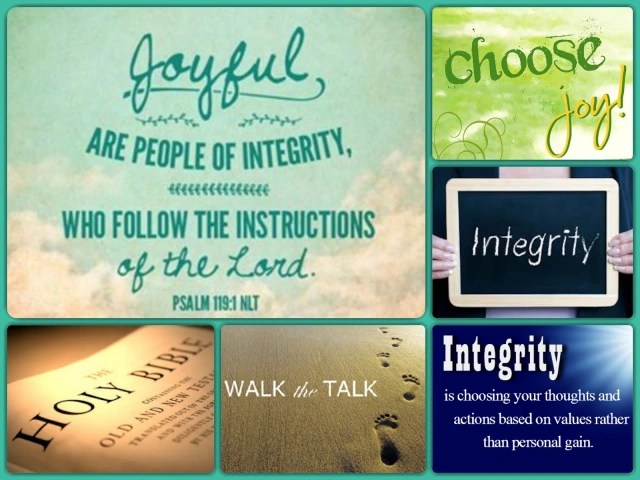
The Bible says, “Joyful are people of integrity, who follow the instructions of the Lord” (Psalm 119:1 NLT).
God’s commands are not something we should fear, minimize or shun.
Yet some Christians will still say, “I’m not under the law; I’m under grace.”
In a sense that’s true.
As we choose obedience to God, put our faith in Jesus Christ, we are no longer under the curse of the law, which we are unable to keep in our own strength.
But let’s also remember that Jesus said, “Don’t misunderstand why I have come. I did not come to abolish the law of Moses or the writings of the prophets. No, I came to accomplish their purpose” (Matthew 5:17 NLT).
We do not keep the law to earn God’s approval.
But it also doesn’t mean that we disregard it.
It doesn’t mean that we can do whatever we want.
It does not mean that we can live live whatever we want.
It does not mean that we can or should live the way culture would prefer.
We know all too well how culture wants us to live by its expectations, by its own shamefully weak worldly standards of “faithful, faith-filled, and obedient lives.
Christians, are by no means strangers to everyone else’s “great expectations.”
Yet, Jehovah God has His own “Great Expectations” His own exceedingly wiser standards of our own legacy of living faithful, faith-filled and obedient lives.
Exodus 20:1-17 New American Standard Bible
The Ten Commandments
20 Then God spoke all these words, saying,
2 “I am the Lord your God, who brought you out of the land of Egypt, out of the house of [a]slavery.
3 “You shall have no other gods [b]before Me.
4 “You shall not make for yourself [c]an idol, or any likeness of what is in heaven above or on the earth beneath, or in the water under the earth. 5 You shall not worship them nor serve them; for I, the Lord your God, am a jealous God, inflicting the [d]punishment of the fathers on the children, on the third and the fourth generations of those who hate Me, 6 but showing [e]favor to thousands, to those who love Me and keep My commandments.
7 “You shall not take the name of the Lord your God in vain, for the Lord will not [f] leave him unpunished who takes His name in vain.
8 “Remember the Sabbath day, to keep it holy. 9 For six days you shall labor and do all your work, 10 but the seventh day is a Sabbath of the Lord your God; on it you shall not do any work, you, or your son, or your daughter, your male slave or your female slave, or your cattle, or your [g]resident who [h]stays with you. 11 For in six days the Lord made the heavens and the earth, the sea and everything that is in them, and He rested on the seventh day; for that reason the Lord blessed the Sabbath day and made it holy.
12 “Honor your father and your mother, so that your days may be prolonged on the land which the Lord your God gives you.
13 “You shall not murder.
14 “You shall not commit adultery.
15 “You shall not steal.
16 “You shall not [i]give false testimony against your neighbor.
17 “You shall not covet your neighbor’s house; you shall not covet your neighbor’s wife, or his male slave, or his female slave, or his ox, or his donkey, or anything that belongs to your neighbor.”
The principles of the law, the Ten Commandments all surely still apply today.
Yet, we must still recognize our habits of being unfaithful and disobedient also.
Instead of being, or our by navigating through a long list of 614 rules that were basically unobtainable for us in our own strength, God’s laws have now all been written on the fleshly tablets of our hearts, as faith-filled, faithful and obedient Ministers of a New Covenant as Scripture says (see 2 Corinthians 3:1-3 NASB).
Ministers of a New Covenant
3 Are we beginning to commend ourselves again? Or do we need, as some, letters of commendation to you or from you? 2 You are our letter, written in our hearts, known and read by all people, 3 revealing yourselves, that you are a letter of Christ, [a] delivered by us, written not with ink but with the Spirit of the living God, not on any tablets of stone but on tablets of [b]human hearts.
They, the laws of God are weaved into our DNA, they become our delight.
They become our joy -and we obey them because it’s 100% our desire to do so.
In so doing, we will find the same lasting legacy of blessings Abraham lived out.
In the name of God, the Father and God the Son and God the Holy Spirit,
Let us Pray,
Psalm 16 The Message
16 1-2 Keep me safe, O God,
I’ve run for dear life to you.
I say to God, “Be my Lord!”
Without you, nothing makes sense.
3 And these God-chosen lives all around—
what splendid friends they make!
4 Don’t just go shopping for a god.
Gods are not for sale.
I swear I’ll never treat god-names
like brand-names.
5-6 My choice is you, God, first and only.
And now I find I’m your choice!
You set me up with a house and yard.
And then you made me your heir!
7-8 The wise counsel God gives when I’m awake
is confirmed by my sleeping heart.
Day and night I’ll stick with God;
I’ve got a good thing going and I’m not letting go.
9-10 I’m happy from the inside out,
and from the outside in, I’m firmly formed.
You canceled my ticket to hell—
that’s not my destination!
11 Now you’ve got my feet on the life path,
all radiant from the shining of your face.
Ever since you took my hand,
I’m on the right way.
Adeste Fideles! Laeti Triumphantes! Venite Adoremus! Dominum.
Gloria! In Excelsis Deo! Alleluia, Alleluia, Alleluia, Amen.
 Loving God, Living God, Loving Hope, Living Hope, Loving Living Life His Way! "Many things are possible for the person who has hope. Even more is possible for the person who has faith. And still more is possible for the person who knows how to love. But everything is possible for the person who practices all three virtues." - Brother Lawrence (1605-1691), Practicing the Presence of God (1692).