My Broken Dreams Were Restored! David’s Humble Prayer. 2 Samuel 7

King David’s desire toward the end of his life was to build a great Temple for the Lord. Except, God said “No! David, You are not the one who will build it!” He was required to forgo the longings of his heart in favour of his son, whom God had decided would be the man to erect the House of God – for His greater glory.

God’s call on David’s life was to fight the enemies of His people and to establish peace in the Promised Land, and so to unify a nation. King David was permitted to make preparations for the foundation of the Temple, but the building and beautifying of the House of the Lord was to be carried out by his son, Solomon.

We all have great hopes and dreams for our futures. But sometimes – it is NO! It is not meant to be. It is not for lack of want nor any lack for giving our efforts, it that sometimes our greatest dreams must be passed on to others to be fulfilled. It breaks our hearts to have to surrender them to another – unless it’s unto God.

2 Samuel 7:18-29 The Message

18-21 King David went in, took his place before God, and prayed: “Who am I, my Master God, and what is my family, that you have brought me to this place in life? But that’s nothing compared to what’s coming, for you’ve also spoken of my family far into the future, given me a glimpse into tomorrow, my Master God! What can I possibly say in the face of all this? You know me, Master God, just as I am. You’ve done all this not because of who I am but because of who you are—out of your very heart! —but you’ve let me in on it.

22-24 “This is what makes you so great, Master God! There is none like you, no God but you, nothing to compare with what we’ve heard with our own ears. And who is like your people, like Israel, a nation unique in the earth, whom God set out to redeem for himself (and became most famous for it), performing great and fearsome acts, throwing out nations and their gods left and right as you saved your people from Egypt? You established for yourself a people—your very own Israel!—your people permanently. And you, God, became their God.

25-27 “So now, great God, this word that you have spoken to me and my family, guarantee it permanently! Do exactly what you’ve promised! Then your reputation will flourish always as people exclaim, ‘The God-of-the-Angel-Armies is God over Israel!’ And the house of your servant David will remain sure and solid in your watchful presence. For you, God-of-the-Angel-Armies, Israel’s God, told me plainly, ‘I will build you a house.’ That’s how I was able to find the courage to pray this prayer to you.

28-29 “And now, Master God, being the God you are, speaking sure words as you do, and having just said this wonderful thing to me, please, just one more thing: Bless my family; keep your eye on them always. You have already as much as said that you would, Master God! Oh, may your blessing be upon my family permanently!”

The Word of God for the Children of God. Gloria! In Excelsis Deo! Alleluia! Amen.

The way David responded to God’s correction and the new Word from the Lord is a good example to follow for any Christian. For David could then be humbled, thoroughly overwhelmed by a tall sense of God’s grace, goodness and promises.

While David’s proposal has been turned aside, God’s acceptance of David’s desire is not denied. God takes the desire of David’s heart to build Yahweh’s house and sovereignly declares that He will build an everlasting house for David. While God had other plans for David’s life, God has dramatically and astoundingly promised to respond to the desire of David’s heart by making an everlasting covenant promise to him.

It was with great gratitude and awe that David learned of God’s gracious plans for him and his descendants. For he is overwhelmed at the magnitude of the Lord’s promise. His emotions tumble over one another as they seek expression.

There is thankfulness, delight, gratitude, and praise. God has superseded, reciprocated, to the prayer request of David’s heart (Psalm 37:4) and has done so in ways that far exceeded his wildest dreams. [Knowing that only God could do it David addressed Him as ‘Adonai Yahweh Sovereign Lord (NIV, LORD God, NASB) seven times (vv. 18-20, 22, 28-29).]

The Lord still delights to abundantly honor those who serve Him. Often, we react to a negative response from Him or life in ways He never intended. We then blindly ignore His numerous blessings that He has lavished and continues to lavish upon us as we bemoan our supposed loss.

The way David responded to God’s correction and the new Word from the Lord is a good example to follow for any Christian. For David could then be over-whelmed by a sense of God’s grace. He humbles himself before God and called himself the servant of God ten times. His prayer of praise and thanksgiving acknowledges the Sovereignty of God and the magnitude of His promises.

The covenant God had just established with David was unconditional. All David had to do was to affirm it and let God do the work. So, David pours out his heart before the Lord in thanksgiving for God’s promises to him and his people.

I. PRAISE FOR THE PRESENT PROMISE, 18-21.

II. PRAISE FOR THE PAST PROVIDENCE, 22-24.

III. PRAYER FOR THE FUTURE PROMISE, 25-29.

David’s initial response to this magnificent revelation concerning the covenant of eternal kingship was to acknowledge the Lord’s graciousness in bestowing it (vv.18-21). David is so overwhelmed all he can do in verse 18 is leave his palace, go before the Lord to sit down and wonder about the majesty of the moment. “Then David the king went in and sat before the Lord, and he said, “Who am I, O Lord God, and what is my house, that You have brought me this far?”

David has just heard God tell him the answer is no. God states in verse 10 that, “I have a plan to establish a center of worship, but not now, and not by you.” You’re not going to fulfil your dream. I’m going to honor you though, because such a noble dream was in your heart, but it is not part of My plan for your life.

David does not question the veracity of Nathan’s visionary words. He accepts them as coming personally from the Lord. He requires no further confirmation of God’s will. He goes and in humility sits in the presence of the Lord. Then in wonderment asks, “Why would You allow me to be a part of this grand plan?”

There is a genuine sense of humility. David picked up on God’s reminder that He had taken him “from the sheepfold” (v. 8) and then quietly raised the question many reflective Christians raise: “Who am I that You have brought me this far?”

Separating himself, now sitting before the Lord, David’s mind ran back to the beginning, to Samuel’s visit to his father’s house. He was overwhelmed at the memory of all the good things which God had done from that day on to bring him to the throne in Jerusalem and to bring peace and prosperity to Israel.

In these most uncertain of 21st century days, one of our great temptations is to take for granted the presence of the blessings of God. It is good for our spiritual life to leave our comforts, sit before God, remember how far He has brought us.

David softened God’s “forever” in verse 16 to “a far distant future” in verse 19. “And yet this was insignificant in Your eyes, O Lord God, for You have spoken also of the house of Your servant concerning the distant future. And this is the way of man, O Lord God.”

As David sits in God’s presence, he sees himself as he really is and the king recognizes his weakness, his insignificance. Thus, he is overwhelmed with a sense of gratitude for God’s promises. It was God’s grace which had brought David this far-from the sheep’s pen to Israel’s throne-and now God had spoken about his descendants far into the future. Only as we realize our shortcomings can we then be struck with awe and wonder that God would bless us as He has.

David had lived through several periods of great intrigue and uncertainty, not sure whether he would remain king over Israel. And now he has God’s promise that one of his descendants would be king forever and ever over God’s people.

Contemplate for a while the absolute magnitude of that promise within your very own circumstance. If that promise of God was now YOURS to live into!

In verse 20 David acknowledges he doesn’t know what to say in response to God’s promise. “Again, what more can David say to You? For You, Lord God, know Your servant!”

A poet and a songwriter, David was a very verbal man. But here he was tongue-tied, silenced by God’s grace and kindness.

But in his being still before the Lord the realization of God’s covenant promise is being prayed over and processed and sinking in deeper and deeper still.

Able to keep quiet no longer, praise begins to flow from David’s heart in verse 2.

“For the sake of Your word, and according to Your own heart, You have done all this greatness to let Your servant know.

David is overwhelmed.

He says Lord, You have blessed my life beyond my worth and You have blessed my house beyond my earthly vision and comprehension. You have brought me from leading my dad’s sheep to giving me this magnificent throne? Who am I?

You know, it’s important that every once in a while, we sit down, take a long look at our short lives, and just count our many blessings.

Who are we to have been protected from the snows and rains that fell, the ice and the mud that slid or the floods that drowned -leaving hundreds homeless?

Who are we that He has blessed our house, in our neighborhood, in our little community and kept it safe? Warm in the winter and cool in the summer.

Who am I, Lord, that You should give me health and strength to be able to go to school, hold a job or pursue this career or get this degree?

Or to have parents, siblings who have encouraged me? To find my soulmate for life or to have children and to watch them grow. Who am I? . . .to be so blessed?

“Fulfilled dream or no dream, I’m a blessed person,” says David. Here is more evidence that David was a man after God’s own heart.

What a powerful moment. What a statement of praise David offers to God, even when he has just received what must have been huge disappointment for him.

II. PRAISE FOR THE PAST PROVIDENCE, 22-24.

Next David praises God’s incomparable sovereignty which has been evidenced particularly in God’s selection of and marvelous provision for Israel in the past (vv. 23-24).

Verse 22 thanks and praises God for who He is, as demonstrated by His works on behalf of Israel and David. “For this reason, You are great, O Lord God; for there is none like You, and there is no God besides You, according to all that we have heard with our ears.”

All praises be unto our Creator God who has revealed himself down through history, particularly Israel’s history as we read it here in our biblical text.

God alone is God. There is no other true god; there is no God like Him. There can never be another God like Him. He is the great and awesome God. This is in full and maximum possible accord with all that we have heard of Him, from Him.

God has done great things for David, but these were not done for David.

God has worked in David and through David, to bring about the fulfillment of His promises to the nation Israel.

Verses 23 and 24 recount the greatness of God as revealed in His acts on behalf of His people, Israel. “And what one nation on the earth is like Your people Israel, whom God went to redeem for Himself as a people and to make a name for Himself, and to do a great thing for You and awesome things for Your land, before Your people whom You have redeemed for Yourself from Egypt, from nations and their gods? [24] “For You have established for Yourself Your people Israel as Your own people forever, and You, O Lord, have become their God.

David has recovered sufficiently to compare the God of Israel with the gods of the other nations as he places God’s gifts to him in a historical context. David understood that these promises had come to him and his descendants that Israel might benefit from them. God design has always been that through the nation of Israel the whole world would be blessed (Gen. 12:1-3).

God is the Lord of all nations, but He did great things for Israel, His chosen people. David recognized the wonderful truth that God had chosen Israel to be His people forever! [Wiersbe, Warren. The Bible Exposition Commentary. Joshua-Esther. David Cook. 2003. Colorado Springs, CO. p.325].

III. PRAYER FOR THE FUTURE PROMISE, 25-29.

Then David prayed his heart out that the promise God had made might indeed find its fulfillment to the glory of His of His own holy name—so that His name would be great forever (vv. 25-29)

In verse 25 David begins to lay before God the promises that God has made to him. “Now therefore, O Lord God, the word that You have spoken concerning Your servant and his house, confirm it forever, and do as You have spoken,

God gave the promise, David believed it and prayed for the Lord to fulfill it.

The Lord intends when He promises something we should confirm that we understood it and remind Him of it. God’s promises were never meant to be wasted but to be used.

Whenever God gives a promise, if a man does not use that promise, the promise fails in effect to that man, and God’s greatest intention it contained is in some measure, sadly, frustrated. God sent the promise for He desires it to be used.

If I receive a Promissory note, it is a promise for a certain amount of money, I take it and use it. But dear friends too often we do not cash in God’s promises.

Nothing pleases God better than to see His promises put into circulation.

He loves to see His children bring them up to him, and say, “Lord, fulfill Your promise.”[Spurgeon, Charles.] [Vv. 22 and 25 use “Yahweh Elohim,” the God of power.]

Verse 26 indicates that it glorifies God when He fulfills His promises. “That Your name may be magnified forever, by saying, ‘The Lord of Hosts is God over Israel’; and may the house of Your servant David be established before You.”

David reminds himself again of the true greatness of God as reflected in His promises. He asks for the house of God’s servant to be established before God and for God to be magnified through Israel.

That God’s name be magnified forever is the desire of ever faithful believer. I pray it is the desire of your life also (1 Corinthians 10:31).

David confesses in verse 27 that it is because of the word he has had the courage to ask such request of God. “For You, O Lord of Hosts, the God of Israel, have made a revelation to Your servant, saying, ‘I will build you a house’; therefore, Your servant has found courage to pray this prayer to You.

The thrust of verse 28 is the accepting of God’s will and a final pleading that God makes good on His true words. “Now, O Lord God, You are God, and Your words are truth, and You have promised this good thing to Your servant.

In true humility, David desired no more than God’s word, he expected no less.

Even though it was mightily disappointing to David that he wasn’t going to be allowed to build a house for God, he focuses on the centrality of what God’s will for him was. “Thy Kingdom comes. Thy will be done! O Lord Amen” Our prayer should be: “Your will, nothing more, nothing less, nothing else. Amen.”

In 1902 ADELAIDE POLLARD was hoping to go to Africa as a missionary. Despite her best efforts she was unable to raise the funds needed to make that journey.

In her great discouragement she attended a local prayer meeting. And as she sat there, she overheard another elderly woman quietly praying, “It really does not matter what You do with us, Lord, just have Your own way with our lives.”

Those words burned into the heart and mind of Adelaide Pollard. And she long pondered those words: “It really doesn’t matter what You do with us, Lord, just have Your own way with our lives.”

Before she went to bed that night.

Ms. Adelaide Pollard wrote four stanzas of a poem.

What was the poem?

‘Have Thine own way, Lord! Have Thine own way!’

Have Thine own way, Lord! Have Thine own way!

Thou art the Potter, I am the clay.

Mold me and make me after Thy will,

While I am waiting, yielded and still.

Have Thine own way, Lord! Have Thine own way!

Search me and try me, Master, today!

Whiter than snow, Lord, wash me just now,

As in Thy presence humbly I bow.

Have Thine own way, Lord! Have Thine own way!

Wounded and weary, help me, I pray!

Power, all power, surely is Thine!

Touch me and heal me, Savior divine.

Have Thine own way, Lord! Have Thine own way!

Hold o’er my being absolute sway!

Fill with Thy Spirit ’till all shall see

Christ only, always, living in me.

IN CLOSING

In our passage from 2 Samuel 7, David receives grace by receiving God Promise.

First, he humbled himself and gave praise for the promise, then he prays into the promise. Guess what, friends? That’s a winning combination. When you read the Scriptures, give praise for what you are reading, then pray it through!

My prayer is that you would marvel that God has built you a house, that He lives in your heart, and that He’ll build your house to the glory of His Son.

Perhaps instead of asking “why?” or “why not?” concerning the “woes” of our “broken dreams” we should be humbly asking and praying “what?” as in, “OK, God, what do you want me to do with this situation?” or “OK, Very well! Lord. What do you require, what do you need me to do now in light of your answer?”

Our attitude in responding to God will make all of the difference of receiving His blessing or not receiving it.

If we realize that sometimes the answer is “no” and understand that it is “no” for our own good, we, too, can begin to praise God for His blessings on our lives!!!

In the name of God, the Father and God the Son and God the Holy Spirit,

Let us pray,

As we are gathered here today, we ask you, our living God, to shower onto us the blessings of your great wisdom and your knowledge. We pray that as we listen, as we hearken unto your word, we may have the ability to clearly see what God has called us to do. We seek to live to fulfill your purpose so that we can see your kingdom. Illuminate our darkened eyes, reveal to us your glory. Alleluia! Amen.

https://translate.google.com/

Seeing Yourself Through the Eyes of God? – Remember! One Passion! One Devotion! One Love! Exactly One God!

The world is all too often a hostile place for believers. Goliaths no longer try to hide themselves from public view or from public judgement. They stand tall in their perceived invulnerability; surround, abound around every street corner. Goliath says, “you cannot touch me! “You cannot beat me!” “You are nothing!” We are intimidated by the sheer force of their size, their strength, their words. We shake and we quake in our boots – too easily accept unconditional defeat!

God wants his spiritual children to know, however, that they are not alone. He lives in us with His Son, our Savior Jesus, through his Spirit. We can be assured, therefore, that no matter what evil design someone else may have, the Holy Spirit of God is greater, more powerful, and more glorious. The victory is ours because God’s presence in us is infinitely greater than any force we will ever face. We have our victory assured over all forces, powers, spirits, or opponents.

The Question remains to be answered – if we are to claim such an overwhelming victory through God, the Father and God the Son and God the Holy Spirit, if we are to claim it and own it and possess it as the greatest gift, treasure, there is, to fully live into everything God has set aside for those who believe and conquered, then whose eyes do we look through whose perspective do we make all our own?

Our perspective through our finite eyes and limited wisdom and understanding?

Defined by our shame? Our Guilt? Our brokenness? Our weaknesses? Mistakes? Someone else’s opinion thrust upon us by those rampaging, ranting Goliaths?

God’s perspective through God’s eyes, knowledge and wisdom? (Psalm 139)

1 John 4:4-6 Authorized (King James) Version

Ye are of God, little children, and have overcome them: because greater is he that is in you, than he that is in the world. They are of the world: therefore, speak they of the world, and the world heareth them. We are of God: he that knoweth God heareth us; he that is not of God heareth not us. Hereby know we the spirit of truth, and the spirit of error.

The Word of God for the Children of God. Gloria! In Excelsis Deo! Alleluia! Amen.

Whether we like it or not, or realize, admit it or not, in our humanity, we are finite. We have a beginning; we have an end. It is the natural flow of our lives and is seen in everything from a good day’s work to a bedtime story for our kids. But when we brush up against eternity, we find that it has neither beginning, nor an ending. It always was, and it always will be. Such is the nature of love.

Scripture tells us in 1 John 4 that God is love. Therefore, since we know that God is eternal, we can reasonably assume that God’s love is also eternal. Love begins and love ends with God. But God is not stingy with this love. He longs to share Himself with every person on the face of the earth, and the tangible expression of that love is His Church, redeemed by the blood of His Son, our Savior, Jesus.

When you and I go to the source of love and find that we are indeed beloved by the God of the universe, it changes everything. Once our hearts are filled with His love and truth, we are given new eyes for others, and can’t help but want to share the priceless treasure we have found!

In his groundbreaking book, The Life of the Beloved: Spiritual Living in a Secular World, Henri Nouwen says this,

“When we claim and constantly reclaim the truth of being the chosen ones, we soon discover within ourselves a deep desire to reveal to others their own chosenness. Instead of making us feel that we are better, more precious or valuable than others, our awareness of being chosen opens our eyes to the chosenness of others. That is the great joy of being chosen: the discovery that others are chosen as well. In the house of God there are many mansions. There is a place for everyone – a unique, special place. Once we deeply trust that we ourselves are precious in God’s eyes, we are able to recognize the preciousness of others and their unique places in God’s heart.”

Whatever you and I are facing in life, or whatever is coming in your future, God has already given you the steadfast faith, the living hope and deepest love for it. It may not look like it now, and you may not feel like you have what it takes to overcome, but faith in God is never based on our circumstances or how we feel.

The enemy would like for you to believe that you don’t have a chance in life, that you’re a loser, too weak, too poor, too whatever. But God has a different perspective of you (Psalm 139). God sees you through the eyes of love. He sees not what you can be, but what He has invested in you, not what you or others may see from the egregiously limited perspective we have “worldly” learned.

Seeing yourself the way God sees you leads to a life of overwhelming victory. Living into that vision God has always had of us offers to us many challenges.

But it takes faith. You can’t just hear that God loves you and sees you as His child, you have to believe it. It takes faith to move forward and overcome the challenges of life. And faith does you no good if you don’t know how to release it, how to unleash it. You have to release your 100% faith in order for it to work.

We release faith through our words, actions and, of course, through prayer. It’s up to us to act.

1 John 4:4 is a scripture we quote a lot, and almost anytime I say this verse in a church or meeting, everybody claps and cheers. But how many people really do believe these words; “He who is in you is greater than he who is in the world?”

The truth is, the One in you is greater and He loves you. So, stretch your faith today, stretch your hopes today and stretch your love today and see yourself the exact way God sees you. It doesn’t matter what the enemy wants you to see or how things might look. Our faith overcomes through the One who lives in us!

In the name of God, the Father and God the Son and God the Holy Spirit,

Let us pray,

Father, my Guide, illuminate my mind so I can understand how you want me to live. Your word tells me that people of integrity who follow your instructions are joyful. You have said that those who obey your laws and search for you with all their hearts are blessed and happy. I want that joy! Holy Spirit, please guard me against allowing evil to influence what I believe and do. Help me walk only in your paths. May my actions consistently reflect what you have said is right and good. Alleluia! Alleluia! Alleluia! Amen.

https://translate.google.com/

A Final Personification of Wisdom… Rethinking the Proverbs 31 Standard

When one faithfully looks to God’s word to find guidance about how to know who your soulmate will be for the rest of your life, who will be the best wife and mother and true and faithful, faith-filled and genuine servant of God they can be, we simply cannot escape the words of Proverbs 31. Who wouldn’t want to be married to as talented, productive, strong, caring, and fearless as this woman?

But as normal human beings, many of us are more likely to cringe when this seemingly perfect woman is set before us as the example. Who can find her, indeed! Not everyone has good business sense or opportunities. Many do not have the gifts and creativity to provide for the home, make the clothes for the family and household. I don’t know if I’ve met anyone who is both a morning person and a night person like this woman. I know my wife is the closest for me.

But who is it who is even closer to us than even our own God-gifted soul mates?

Proverbs 31:10-31The Message

Hymn to a Good Wife

10-31 A good woman is hard to find,
    and worth far more than diamonds.
Her husband trusts her without reserve,
    and never has reason to regret it.
Never spiteful, she treats him generously
    all her life long.
She shops around for the best yarns and cottons,
    and enjoys knitting and sewing.
She’s like a trading ship that sails to faraway places
    and brings back exotic surprises.
She’s up before dawn, preparing breakfast
    for her family and organizing her day.
She looks over a field and buys it,
    then, with money she’s put aside, plants a garden.
First thing in the morning, she dresses for work,
    rolls up her sleeves, eager to get started.
She senses the worth of her work,
    is in no hurry to call it quits for the day.
She’s skilled in the crafts of home and hearth,
    diligent in homemaking.
She’s quick to assist anyone in need,
    reaches out to help the poor.
She doesn’t worry about her family when it snows;
    their winter clothes are all mended and ready to wear.
She makes her own clothing,
    and dresses in colorful linens and silks.
Her husband is greatly respected
    when he deliberates with the city fathers.
She designs gowns and sells them,
    brings the sweaters she knits to the dress shops.
Her clothes are well-made and elegant,
    and she always faces tomorrow with a smile.
When she speaks she has something worthwhile to say,
    and she always says it kindly.
She keeps an eye on everyone in her household,
    and keeps them all busy and productive.
Her children respect and bless her;
    her husband joins in with words of praise:
“Many women have done wonderful things,
    but you’ve outclassed them all!”
Charm can mislead and beauty soon fades.
    The woman to be admired and praised
    is the woman who lives in the Fear-of-God.
Give her everything she deserves!
    Adorn her life with praises!

The Word of God for the Children of God. Gloria! In Excelsis Deo! Alleluia! Amen.

Lady Wisdom is compared to the virtuous woman in this closing poem of the book of Proverbs: the very personification of our Savior Jesus Christ, and of all that we all should be in Him.

The book of Proverbs closes with an acrostic poem which commends the virtues of a certain (literally) “strong woman” (Proverbs 31:10).

If we have been reading through the book up to this point, we will find that we have met her already. This woman of worth, whose “price is above rubies” – is Lady Wisdom itself (cf. Proverbs 3:13-15).

We find Lady Wisdom is like Jesus. Wisdom, like Savior Jesus, is to be sought after; to be most highly valued and desired and treasured: to be found. Wisdom, like Jesus, is to be trusted; and will do us good (Proverbs 31:10-12).

This efficient homemaker and provider for her household (Proverbs 31:13-15) is one and the same as the Wisdom who furnishes a table before us and calls us to ‘Come and eat’ (Proverbs 9:1-6). In fact – viewed in this light – we can see in her the LORD our shepherd, who prepares a table before us (Psalm 23:5).

We can hear Jesus’ summoning, who cries ‘Come unto me’ to the broken in spirit, the weary soul and heavy laden (Matthew 11:28-30; cf. Isaiah 55:1-3).

This lady’s perfect industriousness stands as an upstanding, beyond reproach, ever living example to all of us, both women and men (Proverbs 31:16-19).

Yet behind the imagery we see that the LORD God is the landowner, and that we are His vineyard (cf. Matthew 21:33).

We also perceive that Jesus is the true vine (John 15:1).

The Lord strengthens His arm for our salvation (cf. Proverbs 31:17).

Wisdom stretches out her caring and compassionate and merciful and forgiving hand unto the poor, as should we when we are called, and able (Proverbs 31:20).

In like manner, the needy find their solace in Jesus: He is the LORD our provider (cf. Proverbs 31:21).

There is great honor in being attached to Wisdom (Proverbs 31:23).

We are not the least bit foolish to follow Christ. When we walk with Him, talk with Him we’ll be prayerfully respected, even by those who don’t agree with us.

We read of this woman’s coverings (Proverbs 31:22), and merchandise (Proverbs 31:24): but her greatest adornment is her strength and honor (Proverbs 31:25).

We, like her, will have assurances as to the future when we are ‘clothed’ with Christ.

We have put on Christ (Galatians 3:27); we must put on Christ (Romans 13:14).

In the poem, this woman opens her mouth with wisdom, and speaks truest kindness (Proverbs 31:26).

In this, as in so much else that we can discover, she is the very personification of Wisdom (cf. Proverbs 4:5-6).

If the law was our tutor, pointing us to Christ (Galatians 3:24); then Wisdom serves us in the same way: steering us away from worldly folly, and pointing us towards Jesus who is the Word of God, the ultimate manifestation of Wisdom (1 Corinthians 1:24).

Just as Lady Wisdom looks to the way of her household (Proverbs 31:27), so the LORD also is industrious (John 5:17).

The Father continually watches over His people (Psalm 121:5); and the Son feeds His flock and tends the lambs with the tenderness of a good shepherd (Isaiah 40:11). The Holy Spirit preserves us in a living hope, even in adverse circumstances beyond human description and understanding (Galatians 5:5).

The person who is married to Wisdom safely trusts in her (Proverbs 31:11) and is honored to be associated with her (Proverbs 31:23).

In a similar way the people of Jesus (Hebrews 2:12-13) deem Him to be blessed and praise His holy name (cf. Proverbs 31:28).

Wisdom is the principal thing, so by all means get wisdom (Proverbs 4:7) – and wisdom will teach you that ‘there is no other name under heaven given among men whereby we must be saved’ apart from the name of Jesus (Acts 4:12).

There is a kind of beauty which is only skin-deep.

We find this personified in the woman whom I call Mistress Folly (Proverbs 6:25). Yet Lady Wisdom’s attraction is of a spiritual order: she fears the LORD (Proverbs 31:30).

Our ministries, our works stand as the evidence of wisdom’s virtue (Proverbs 31:31).

The works the Father was doing in the Son stood as a verification of Jesus’ words (John 14:10-11). Works are evidence of faith in the believer (James 2:18-20), who is ‘called unto good works which the Father has before determined’ (Ephesians 2:10).

Proverbs 31:20-31 Authorized (King James) Version

20 She stretcheth out her hand to the poor;
yea, she reacheth forth her hands to the needy.
21 She is not afraid of the snow for her household:
for all her household are clothed with scarlet.
22 She maketh herself coverings of tapestry;
her clothing is silk and purple.
23 Her husband is known in the gates,
when he sitteth among the elders of the land.
24 She maketh fine linen, and selleth it;
and delivereth girdles unto the merchant.
25 Strength and honour are her clothing;
and she shall rejoice in time to come.
26 She openeth her mouth with wisdom;
and in her tongue is the law of kindness.
27 She looketh well to the ways of her household,
and eateth not the bread of idleness.
28 Her children arise up, and call her blessed;
her husband also, and he praiseth her.
29 Many daughters have done virtuously,
but thou excellest them all.
30 Favour is deceitful, and beauty is vain:
but a woman that feareth the Lord, she shall be praised.
31 Give her of the fruit of her hands;
and let her own works praise her in the gates.

The virtuous woman has more on her mind than just her family. Her ambitions, energy, and plans extend to the poor and needy that God has placed in her path. Rather than be content with having her husband, children, and home well cared for and happy, she has a conscience that drives her to take care of others who cannot provide for themselves.

Her thoughts toward the poor and needy are more than wishful thinking or kind words. Her thoughts result in diligent and personal action, which are the only thoughts that count in the sight of God and men (Proverbs 3:27-2820:11; James 2:15-16). She knows that true love is in-deed and truth, not merely in word and tongue (I John 3:16-18). Moved by God’s love for her, she has bowels of compassion to share her ability and substance with the needy.

The charitable giving here is not easy or passive action. “She stretcheth out her hand,” and, “She reacheth forth her hands.” These words do not convey casual donations or convenient acts of charity. A virtuous woman goes out of her way to meet the poor and needy and help them, even if it requires strenuous effort to accomplish the service. She is not merely available for charity; she volunteers and does the work without any prodding.

The virtuous woman has sympathy for the truly poor and needy (James 1:27).

She does not exchange mock charity with friends, subdivision neighbors, or peers at work. She knows that giving to the rich will bring God’s judgment (Proverbs 22:16). Neither does she care or worry about the foolish, lazy, or wasteful (Proverbs 13:2320:4II Thessalonians 3:10). She, like the Good Samaritan, waits for the Lord to put an act of God in her path (Luke 10:25-37).

She knows charity begins with true needs in extended family – parents, aunts and uncles, and grandparents (I Timothy 5:4,8,16). She then serves the poor and needy in her church (Acts 2:44-45Romans 12:13), then those in other churches (Matthew 25:40Galatians 6:10Acts 11:27-30), and then those God puts in her path (Job 31:16-22Luke 10:25-37). She is given to hospitality for brethren and for strangers (Romans 12:13I Timothy 5:10Hebrews 13:2).

A man with a virtuous wife should allow her a budget for this good use of money, and it will later praise her and him (Proverbs 31:23,31II King 4:8-10). It will also bring God’s blessing on the couple for their charity (Proverbs 11:24-27; 19:1728:27). Stingy husbands can discourage their wives and deprive the poor, and they will suffer for it now and later.

A virtuous woman is loved by all and praised by husband and children (Proverbs 31:28-31Acts 9:36-42), and this affection and honor is a great blessing and comfort. But her greatest glory is yet to come, when the High King of heaven will take special notice of her godly charity before the universe (Isaiah 32:8; Matthew 10:40-4225:31-40I Timothy 6:17-19Hebrews 6:10).

It stands to reason, then, that she would want to be generous with what she has and to go forth, to help those who are less fortunate. I might be walking way out on a limb here, but when I see that she “opens her arms” to the poor, I believe she is gifting them with money to get their necessities. Here’s where I’m out on a limb: the next portion of the verse says she “extends her hands to the needy.” 

When someone we know is fallen down into a hole, or needs help climbing out of a low place, what do you do? You extend your hand for them to grab hold of and pull up — you are giving them “a hand up.” (Acts 3:1-10) I believe that may be what this Spirit-filled, God-fearing woman of Proverbs 31 is doing; she not only gifts them financially, but she helps them in sensible, practical ways.

Ways that help them stay out of that tight spot, that low place. Perhaps she is going far out of her way, teaching them a skill or giving them encouragement from her own experience. Perhaps she is giving them what they need to move forward and keep moving. Perhaps she knows of a job for them to apply for and to do. Maybe it is just the perfect example that she sets, for them to imitate.

This Spirit-filled woman is truly challenging us to be the best that we can be!

In the name of God, the Father and God the Son and God the Holy Spirit,

Let us pray,

Father, faithful One, teach me your divine wisdom. Empower me to understand wise teaching. Give insight to my simple mind. Help me to live a life that is disciplined and successful, based on the wise teachings of your word. Give me the knowledge I need to make smart decisions. I know that reverence for you is the beginning of wisdom. Help me listen when you correct me, and not neglect your instruction. I know when I take heed of wisdoms voice and to follow your wisdom, I will receive grace and honor. Alleluia! Alleluia! Alleluia! Amen.

https://translate.google.com/

Man Shall Not Live by Bread Alone – A Brief Reflection upon Matthew 4:4

“If you believe what you like in the Gospel, and reject what you don’t like, it is not the Gospel you believe, but yourself.” ― St. Augustine of Hippo

“And men go abroad to admire the heights of mountains, the mighty waves of the sea, the broad tides of rivers, the compass of the ocean, and the circuits of the stars, yet pass over the mystery of themselves without a second thought.”
― St. Augustine of Hippo

“The truth is like a lion; you don’t have to defend it. Let it loose; it will defend itself.” ― St. Augustine of Hippo

“Some people, in order to discover God, read books. But there is a great book: the very appearance of created things. Look above you! Look below you! Read it. God, whom you want to discover, never wrote that book with ink. Instead, He set before your eyes the things that He had made. Can you ask for a louder voice than that?” ― St. Augustine of Hippo

“The Bible was composed in such a way that as beginners mature, its meaning grows with them.” ― St. Augustine of Hippo,

Matthew 4:1-11 New American Standard Bible

The Temptation of Jesus

Then Jesus was led up by the Spirit into the wilderness to be tempted by the devil. And after He had fasted for forty days and forty nights, He [a]then became hungry. And the tempter came and said to Him, “If You are the Son of God, command that these stones become bread.” But He answered and said, “It is written: ‘Man shall not live on bread alone, but on every word that comes out of the mouth of God.’” (Emphasis is my own for this devotional reflection)

Then the devil *took Him along into the holy city and had Him stand on the pinnacle of the temple, and he *said to Him, “If You are the Son of God, throw Yourself down; for it is written:

‘He will give His angels orders concerning You’;

and

‘On their hands they will lift You up,
So that You do not strike Your foot against a stone.’”

Jesus said to him, “[b]On the other hand, it is written: ‘You shall not put the Lord your God to the test.’”

Again, the devil *took Him along to a very high mountain and *showed Him all the kingdoms of the world and their glory; and he said to Him, “All these things I will give You, if You fall down and [c]worship me.” 10 Then Jesus *said to him, “Go away, Satan! For it is written: ‘You shall worship the Lord your God, and [d]serve Him only.’” 11 Then the devil *left Him; and behold, angels came and began to serve Him.

The Word of God for the Children of God. Gloria! In Excelsis Deo! Alleluia! Amen.

Today’s Gospel

But he answered and said, It is written, Man shall not live by bread alone, but by every word that proceeds out of the mouth of God. – Matthew 4:4

Jesus answered by quoting Deuteronomy: “It takes more than bread to stay alive. It takes a steady stream of words from God’s mouth.” (The Message)

Have you ever read the Bible but felt overwhelmed?

Have you ever read the Bible and felt underwhelmed?

Maybe the book seems really big.

Maybe the book seems too heavy to lift off of the dusty bookshelf.

Maybe the book seems really small.

Maybe the book looks too much like your smart phone.

Perhaps you simply don’t like reading “books” but looking at smart phones.

After all those “small screen tiny letter” technological things can make Bible reading seem really hard. However, the study of the Word of God is critical.

Today’s verse from Matthew’s “Temptation Narrative” shows us that we aren’t to just eat “bread” for food and that’s all we need for growth. Instead, it tells us that we also need also need to feast on the Word of God. Feeding on God’s word might sound 21st century weird, but it’s really helpful for your spiritual growth.

The Bible helps us learn right from wrong. It helps us to make good decisions and makes us wise.

God’s word is a powerful tool in our lives. Your heart was made for God’s word.

The Word of God for the Children of God is a seed that produces growth and life in your life. So, if you have not picked up or planted any new seeds lately, find ways to make time for God’s word. It might or could be something simple like picking up or looking up a small devotional book reading every day, listening to a YouTube sermon or Podcast. Even if you just don’t like to read there are many ways to get God’s word in your heart. Simply look up into the starry night sky!

Matthew 4:4 Complete Jewish Bible

But he answered, “The Tanakh says,

‘Man does not live on bread alone,
but on every word that comes from the mouth of Adonai

This verse should be many Christians’ motto. 

God’s Word IS the truth and the daily bread of our life.

Because of God’s word, we are supplied and sated in our spirit; so that we have “fed” faith to stand testimony when we encounter failure and defeat, trials and refinement, just as God’s word says, “Jesus (the man, the Rabbi, teacher) said, ‘Man shall not live by bread alone,’ which means that, although man lives in a physical body, what gives him real life, what allows his physical body to live and breathe, is not physical food, but all the words uttered by the mouth of God are.

On the one hand, man regards these words as truth. The words give him faith, make him feel that he can depend on God, that God is truth. On the other hand, is there a practical aspect to these words?

Yes! There is! Why? Because the man, Rabbi Jesus had fasted for 40 days and nights and He is still standing there, still alive. Is this a healthy illustration?

The point here is that He had not eaten anything, any food for 40 days and nights. He is still alive. This is the powerful evidence behind His phrase.

The phrase is simple, but, as far as our Rabbi Jesus is concerned, was His phrase taught to Him by someone else, or did He think of it only because of what Satan had said to Him trying to play him for a fool? Think about it. God is truth. God is life. God is the Way. Was God’s truth and God’s life and God’s Way a late Gospel add-on? Was it born of experience? No!! It is innate in God, meaning that truth and life already reside in God’s very abundance, in God’s abundant substance.

Whatever befalls Him, what He reveals is truth. This truth, this phrase—whether its content is long or short—it can let man live, give him life; it can enable man to find, within itself, truth, clarity about life’s journey, and enable him to have that well-nourished, well-sustained, faith and hope in God alone.

This is the source of God’s use of this phrase. The source is positive, so is this positive thing holy? (Yes.)” Thank God for bestowing His word to us so that we can each know God from His word and also understand the meaning of life and pursue the nourishing growth of life (Psalm 23:5-6) in God’s word every day.

“I have read in the writings of Plato and Cicero sayings that are wise and very beautiful; but I have never read in either of them: Come unto me all ye that labor and are heavy laden.” ― Saint Augustine of Hippo

“The Bible was composed in such a way that as beginners mature, its meaning grows with them.” ― St. Augustine of Hippo

In the name of God, the Father and God the Son and God the Holy Spirit,

Let’s Pray

“Oh, God, to know you is life. To serve You is freedom. To praise you is the soul’s joy and delight. Guard me with the power of Your grace here and in all places. Now and at all times, forever. Amen.” ― St. Augustine of Hippo

https://translate.google.com/

Yes! There is Hope, Refreshment, Satisfaction, for our Weary Souls!

In the overwhelming, hair-raising, and the all too often depressing prophecies of God’s (weeping) Prophet Jeremiah, God repeatedly told his people he would destroy them for their obstinate and hardened hearts. Yet in the middle of these all powerful and scorching warnings, God also slips in passages that roar, that soar, that shouts out with God’s hope and grace, refreshment and satisfaction.

Can you think of anything more reassuring, more spiritually refreshing than God’s promise to “refresh the weary and (to) satisfy the faint”? For seventy years, that’s all Israel had — God’s promise. But when God’s time came, God “showed up!” made good on his word. I believe he will do the same for us all!

Jeremiah 31:25 Authorized (King James) Version

25 For I have satiated the weary soul, and I have replenished every sorrowful soul.

Jeremiah 31:25 Holman Christian Standard Bible

25 for I satisfy the thirsty person and feed all those who are weak.”

Jeremiah 31:25 New Living Translation

25 For I have given rest to the weary and joy to the sorrowing.”

Jeremiah 31:25 Young’s Literal Translation

25 For I have satiated the weary soul, And every grieved soul I have filled.’

The Word of God for the Children of God. Gloria! In Excelsis Deo! Alleluia! Amen.

Do you feel drained or spiritually empty? You know you’re saved, but you’re “bone weary and “soul tired” and discouraged with no perceived end to that continual state of weariness. What do we do when we want to serve the Lord with all of your heart, with all of your soul and all of your mind and with all of your strength, to just energetically live for only Him, but we’re weary and feel like there’s nothing left for us to give? The Word of God for the Children of God comes into remembrance, answers our question.  In Jeremiah 31:25, God says,

I satisfy the weary ones and refresh everyone who languishes. 

The only one who can truly satisfy our weary souls is the one who created them.

In chapter 31 of Jeremiah, Israel is promised refreshment and restoration and satisfaction. Even wandering in the wilderness, Israel experienced God’s grace. 

 “The Lord hath appeared of old unto me, saying, Yea, I have loved thee with an everlasting love: therefore, with lovingkindness have I drawn thee.” verse 3

With everlasting love, God draws us to Him. He can give our weary souls rest, and hope but only if we listen, come to Him. Verse 25 says I have replenished every sorrowful soul as if it is already done. All we ever need do is to accept. 

God has promised to heal our sun-parched and cracked lips, fill the cracks in our “dehydrated” hearts and lives with His goodness. Nothing can satiate us the way God’s love can. No amount of money, fame, or relationship can. Only God. 

Every hunger and longing we have that the world cannot fix, God can. 

For I will satisfy the weary soul, and every languishing soul I will replenish.  Jeremiah 31:25 ESV

Looking up key words in a passage can help bring new meaning to the verse.

Satisfy – fulfill desire, expectation, need; to put an end to

Languishing – (languish) lacking in spirit or interest; indifferent

Replenish – to make full or complete again; to supply with fresh fuel

Using these definitions, reading and re-reading, studying, praying this Word of God, we can surely see how this verse comes alive with new meaning and depth.

For I will put an end to the weary soul and to every indifferent lacking soul I will supply fresh fuel.

The Septuagint, ancient Greek translation, reads thirsty and hungry rather than weary and sorrowful. 

The LORD is our refresher! 

Master Rabbi Jesus echoes this in his Sermon on the Mount, Matthew 5:3-6.

Are we poor in spirit? Are we indeed mourning? Are we hungry and thirsty for righteousness? If so, we can go to the ever-flowing river of Life in the LORD. We can drink deeply of His Word and Spirit. We can be refreshed, and our energy renewed to do what calling He places into our hearts. What a joy. What a God!

Reflect

God will supply with fresh fuel – a fresh word – when we are weary and worn down.  He will fill us! He will satisfy us completely, so we will lack for nothing.

Relate

Spending time with His Word is the way God will speak and fulfill a dry and worn-out spirit. We must discipline ourselves, make spending time with His word our highest priority. Continually dwelling in His Word and presence will help us prevent our souls being depleted and working inside our own strength.

WOW! So incredibly powerful!

AWESOME! So incredibly inspiring!

FINALLY! So hopeful, so hope-filled, so absolutely refreshing and satisfying!

In the name of God, The Father and God the Son and God the Holy Spirit,

Let us refresh our souls through prayer,

Great Shepherd, I am bone tired and soul weary. Please refresh my Spirit and my body. Please help me find satisfaction in the abundance you have already so graciously shared with me. To you belongs all glory, honor, strength and power. I joyously submit my whole and entire self in faith, in hope, waiting for the rest and satisfaction you have promised. In Jesus’ name I pray. Alleluia! Amen.

https://translate.google.com/

Open Hearts! Open Souls! Open Lives! Open Hands! Open Hope! Open Faith! Open Doors! Living into God’s Time!

At the beginning of the year, I sensed the Lord’s urging for me to grow in the area of prayer. To set aside focused time to pray expectantly. Since this time, I have been praying with and for those who dare to show, share the same passion for growing and maturing into the image of God by praying. We pray for each other, twice a week first thing in the morning for people we both know, and we do not know, for (un)believers around the world as well as many other things. 

One of the beautiful things that has come from our time together is that our prayer has morphed into a time of being directed by the Lord rather than us bringing a grocery list of items to petition Him with. In other words, we have definitely gotten very bold and have grown in our ability to pray as He directs.

We gather together with our Pastor. We hear, and we listen as we read Scripture text together. I deeply believe that the things we have learned and experienced together can clearly be gleaned from this short simple verse in Colossians, “Be earnest and unwearied and steadfast in your prayer [life], being [both] alert and intent in [your praying] with thanksgiving” (Colossians. 4:2 AMPLIFIED). 

Colossians 4:2-4 Amplified Bible

Be persistent and devoted to prayer, being alert and focused in your prayer life with an attitude of thanksgiving. At the same time pray for us, too, that God will open a door [of opportunity] to us for the word, to proclaim the mystery of Christ, for which I have been imprisoned; that I may make it clear [and speak boldly and unfold the mystery] in the way I should.

The Word of God for the Children of God. Gloria! In Excelsis Deo! Alleluia! Amen.

Throughout the length and breadth of our Christian life, we are entreated to continue steadfastly in prayer, to pray continuously, to present our needs before our heavenly Provider, to lift up others to the eternal throne of grace, and to bend our ear to His gentle promptings.

This is entreaty proposed by the Apostle Paul to the followers of Colossae whom he has never met, as a duty and responsibility, and yet it is the greatest privilege given to the believer – to come, gather before the throne of grace with petitions, prayers, and pleas for our fellowman and for our brothers and sisters in Christ.

When Jesus died on the cross, the curtain between man and God had been torn, and we are called upon to enter the holy place. We are to bring, in our hands, our hearts, our hopes, the needs of others, together with our grateful thanks, and to offer them in humble reverence before the feet of our Father in heaven.

The Apostle Paul was a man who devoted himself to pray for the saints and to continue steadfastly in prayer. In this verse, he calls the believers in Colossae to continuously, continually discipline, devote themselves into becoming prayer warriors, “devote yourselves to prayer…” he writes, “keeping alert in prayer, with an attitude of thanksgiving.” Open hearts! Open Souls! Open God’s doors!

Discipline! Devotion to prayer meant to continue steadfastly in prayer by their coming to the throne of grace for mercy to find help in times of need. We are to persevere in prayer… to commit to pray and not to give up, especially when the answer seems a long time in coming. We are to persist in prayer, even when we are faced with mounting difficulties and discouragements, we are to pray daily – to pray without ceasing, to take up our cross daily and to saturate it in prayer. 

Prayer is to become as regular as our breathing, but too often prayer is the first Christian ‘duty’ to be dropped when life starts to close-in on us, or time seems to be at a premium. Often, an irregular prayer life is the first slippery step on the downward path to complacency, carnality, and an ineffective Christian witness.

Our discipline and devotion to Prayer is our means to maintain an unbroken and continual fellowship with our heavenly Father, His Son and the Holy Spirit and unless we develop persistence in prayer and devote ourselves to praying, we are in serious danger of becoming lazy, disinterested, compromised in our faith.

Personal discipline and devotion to prayer is to ensure that every piece of our spiritual armor has been prayerfully strapped on. In Ephesians, Paul calls us to, “Pray always with all prayer and supplication in the Spirit, and stay alert in prayer, with all perseverance and intercession for all the saints.” (Ephesians 6:18-19)

Prayer is not sitting for a few minutes with hands folded, and eyes shut tight.

Prayer is the tool we have been given to prepare us for the work God has called us to do and to ensure that we are well-prepared when faced with a crisis.

Prayer is not meant to be saved solely for a rainy or snowy day or only used in case of an emergency. Prayer is our connection; it is our lifeline to the Lord, we should continually discipline ourselves, develop an attitude of ceaseless prayer. 

Continuous, ceaseless, prayer is not being engaged in a prayer closet 24/7 but is developing an addiction of prayer. It is our initiating a mindset of prayer… of keeping the lines of communication to the heavenly throne-room open and clean, as we walk in spirit and truth and abide in Christ, moment by moment.

During Christ’s ordeal in Gethsemane, a number of the disciples fell asleep when their prayer support would have been so welcome, and they had to be admonished to, “watch and pray – that ye enter not into temptation.” We live in fallen bodies with an inherent sin nature and hindering the prayer-life of the saints is a top priority for the enemy of our soul. “Keep alert in prayer,” we are all charged, “Watch and pray, with an attitude of thanksgiving.” (Luke 22:39-46)

Throughout this epistle, we are challenged to pray, “with thanksgiving”.

Paul opened his letter to the Colossians by telling them, “I give thanks to God, the Father of our Lord Jesus Christ, praying always for you,” and later he gave thanks to the Father for their great salvation and inheritance of the saints in the light. In chapter 2 we read the saints were, “firmly rooted and being built up in Him and established in your faith – just as you were instructed and overflowing with gratitude and thanksgiving.”

In chapter 3 Paul exhorts the Colossians, “whatever you do in word or deed, do all in the name of the Lord Jesus, giving thanks to God the Father through Him,” and here in chapter 4 we are instructed to, “Continue earnestly in prayer, being vigilant in it with thanksgiving.”

Prayer is warmed by worship, petitions are perfected by praise, promises are claimed through a grateful heart, and intercessions are offered in the solemn acknowledgement that we have an everlasting audience with the King of kings and Lord of lords. Prayer should not be the “hit and miss” quick afterthought of a busy believer, but a deeply humbled attitude that permeates one’s whole life.

Prayer should be the in-breathing of our Lord into the inner core of our being and prayer should be the out-breathing of our utter devotion to our Saviour and Lord. Let us try to discipline ourselves to remember that when the prayers of the saints are offered up to the Lord in steadfast faith, combined with grateful thanks and a trusting heart, we have the authority of heaven behind all that we carry into/unto the throne of grace – through His nail-pierced hands and feet.

Be Disciplined and Be Devoted to Prayer

Prayer is a skill; it takes time and discipline and practice to develop. To grow one must practice, which means growth comes from praying regularly. Paul said, “Pray continually” (1 Thessalonians. 5:17). Pray without ceasing, pray perseveringly. James said, “The prayer of a righteous man is powerful and effective” (James 5:16b). So, the first key is placing importance on praying. If it is not something you envision as important, you will never be devoted to it. 

Prayer carries with it a great promise from God—an answer, when the prayer is offered in faith according to God’s will. “This is the confidence we have in approaching God: that if we ask anything according to his will, he hears us. And if we know that he hears us—whatever we ask—we know that we have what we asked of him” (1 John 5:14-15). This is incentive to pray; learn what God’s will is and pray in faith. When you do you will see results, He will answer your prayers.

Be Watchful! Be Alert and Intent in Prayer

I steadfastly believe God wants all of His Children to pray, because in it is the ability for Him to move and act in and throughout our 21st century world. He has given authority on earth to believers (Matthew. 18:18; Luke 10:17-19) which carries with it a great responsibility. Prayer is truly one of our greatest weapons (Ephesians. 6:18-19) in other words, a prayerless Church is a weak Church

Here’s a few thoughts from great men of faith…

“Only God can move mountains, but faith and prayer move God” E.M Bounds; The Necessity of Prayer.

“God does nothing but in answer to prayer” John Wesley.

“The prayer closet is the arena that produces the overcomer” Paul E. Billheimer; Destined for the Throne.

Pauls instructions are that we are to be watchful, alert and intent in prayer. It is not a last resort, it is our first line of defense.

Be Thankful in Prayer

If devotion and intention get us to the true place where we are praying than gratitude and thankfulness is the key that unlocks the power of prayer. Why?

Because praise elevates you into a different realm of praying. Praise turns the focus off you and onto God; the result is faith and remember the prayer of faith is powerful (James 5:16b); the prayer of faith is answered (I John 5:14-15) and the prayer of faith moves mountains (Mark 11:23-24).

“Praise is the detergent that purifies faith and purges doubt from the heart. The secret of answered prayer is faith without doubt (Mark 11:23)And the secret of faith without doubt is praise—triumphant praise, continuous praise, praise that is a way of life” Paul E. Billheimer; Destined for the Throne.

Let’s Open our Hearts! Let’s Open up our Souls! Come, Let’s Have a Heart-to-Heart Conversation with our Jesus … Let us Open up a brand-new Door!

In the name of God, the Father, God the Son and God the Holy Spirit,

Let us pray,

Heavenly Father, I deeply bless You for Your grace and mercy to us. Thank You Jesus that I have the right to lay at Your feet my own needs and those of others. Increase my understanding of the great privilege of prayer which has now been granted to me and all Your children, and I pray that I increasingly devote my life to You in prayer, praise, and grateful thanks. This I ask in Jesus’ name, AMEN.

https://translate.google.com/

When Living Hope is all that Remains for us to Live our Lives by. Psalm 42:2

Psalm 42:1-4 New American Standard Bible

BOOK 2

Thirsting for God in Trouble and Exile.

For the music director. A [a]Maskil of the sons of Korah.

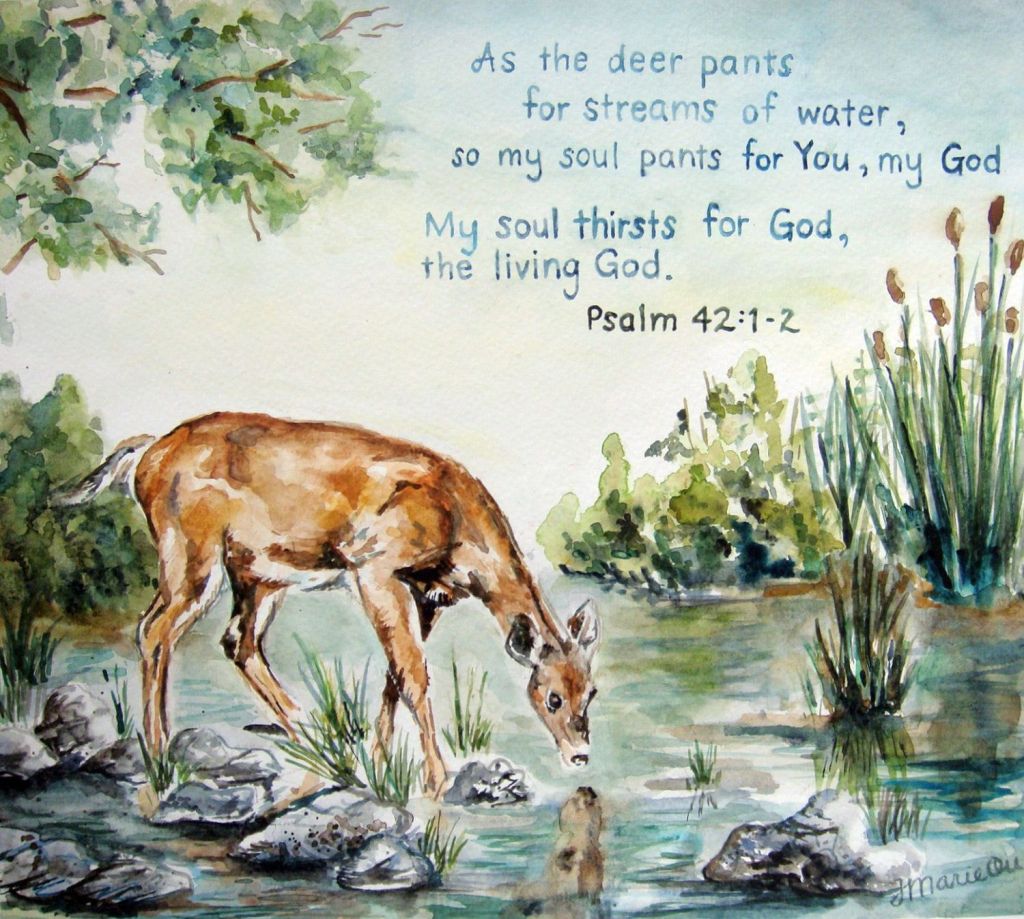
42 As the deer [b]pants for the water brooks,
So my soul [c]pants for You, God.
My soul thirsts for God, for the living God;
When shall I come and [d]appear before God?
My tears have been my food day and night,
While they say to me all day long, “Where is your God?”
I remember these things and pour out my soul within me.
For I used to go over with the multitude and walk them to the house of God,
With a voice of joy and thanksgiving, a multitude celebrating a festival.

The Word of God for the Children of God. Gloria! In Excelsis Deo! Alleluia! Amen.

Moses had to quickly flee into the desert after being discovered to have killed an Egyptian. He had not nearly enough time to outfit and provision himself for the long journey to wherever it was going to take him. Moses was a strong man, and a strong leader, he was truly well versed in surviving desert environments when he has had that large number of others serving his needs and also providing for each and every last one of them before he needed to ask or command for them.

Now, it was all going to be different now that he was discovered to have killed the Egyptian. He needed to leave and leave quickly or risk his own arrest and his humiliation, and the humiliation of the very throne of Egypt and then his death. No time to plan for provisions – for water and for food and for transportation by some means other than great chariots pulled by all the very mightiest of horses. He would be on his own now. He would be traversing the vast wilderness, desert upon his own two feet. Not one could help him, else they’d risk their own lives.

On your own. Thrust by circumstances both seen and unforeseen, in unfamiliar territory. Not knowing where to turn or when to turn for help. Enveloped deep within a situation for which there seems to be no visible nor evident solutions. We walk alongside Moses in such times as this held captive by our thoughts and our actions we cannot take back or move forward from. Homelessness, poverty, a total lack of resources and lack of even basic day to day provision to survive.

We have our own inner resources – our wits, our life skills which our parents had given us as we grew up. We learned about surviving life as life was thrust at us at a pace, we allowed ourselves to believe was wholeheartedly manageable. I have been there and done that more times than I can count, and I believe myself to be a strong person as I am sure each of those who read these few words also believe themselves to be a strong person capable of surviving whatever comes.

That is … until when the irresistible force of our pride and vanity runs headlong into that immovable brick wall, we are unceremoniously stopped in our tracks. There are no more survival skills for us to fall back on – that well has dried up. We are in that penultimate place where we literally have nowhere else to turn. No direction of the compass can we travel where there is any resemblance of that which we can call a living hope for a living and prosperous hope for our future. There is not one single hair follicle from our head that is left unpulled. No food, water is apparent to us as we navigate this most unwanted barrenness.

That is, until we chance to look up from out of our vast misery to see that quiet scene as the Psalmist did those thousands of years ago. That tranquil scene of one lone deer prancing and walking up to that source of water we had not seen nor even considered taking notice of, but which had always been there before us. A deer, coming out of the wilderness, seemingly without a care in the world approaches the edges of a flowing stream, sets itself to the business of taking a long cool drink to slake its lingering thirst. Such a tranquil scene, courtesy of the Lord our God in that exact moment when we needed to see and learn from it.

A scene which suddenly, now totally distracts us from the worst of the worst we had assigned to our limited fields of vision. A deer quietly reaches its head down to the still and quiet waters flowing and running before it. Lo! Placed before us is a brand-new survival skill. “LOOK UP!” NOTICE ALL THE QUIET WHICH IS ALWAYS AND FOREVER THERE BEFORE US! If the one deer is drinking quietly, why aren’t we? It is not as if that deer does not have anything else to be leery of, such as predators lurking nearby, it is just that in that exact moment, it knows it needs to drink, it recognizes its thirst, it recognizes the water as its survival. It’s absolute need for survival in that moment, overwhelms all its worst fears.

Such a tranquil and inspiring and empowering scene, for me, leads me away to the few remaining quiet places which remain unidentified deep within my soul.

It places a great, and much needed pause in all my most sorrowful pleadings: “WHERE ARE YOU, GOD, WHEN I NEED YOU THE MOST? LIKE RIGHT NOW!”

It encourages me to look OUTWARD and therefore, move myself FORWARD.

• It challenges us look at the real “dry places in our life” being our prayer life.

• It urges us to look up into the reality of God’s creation and to worship.

• It directly and decisively confronts the dynamic vibrance of our sin life.

• It helps us to enter the battlefields of the whims of our flesh versus God.

• It breathes a new and EVER living hope into us when we are under attack.

• It opens our eyes to the greatness of God and the power of His salvation.

• It mightily, quietly, softens the “immeasurable” blows of disappointment.

• It molds and shapes our minds into the greater SHALOM and plan of God.

The intense heart-soul – spirit yearnings of the Psalmist for the Lord and his deep pleading enquiry to know the whereabouts of his God, resounds like the repetitive tolling of a thousand, thousand blasts of the great Shofar through the intensely personal and sorrowful pleadings of Korah, in his Psalm – before he finally reached God’s victory in his heart and a deep satisfaction within his soul.

The soul which mightily thirsts for the Lord and heavily and zealously pants for the presence of its living God and keep on and on thirsting and panting for Him is the one for whom the Lord Himself will provide His deep well of satisfaction, brimming to over-abundance, overflowing with the refreshing waters of His life – living water that revives, restores revitalizes and reinvigorates the man or woman whose deepest inner being cries out; “I thirsteth!’ for more of my Jesus.

The one who asks, and indeed, mightily, thirstily, pleads for more of Jesus and keeps on asking will surely receive. The one who seeks the Savior and keeps on seeking will find Him and the one that thirsts and pants and keep on thirsting and panting for more of Jesus – will have their mightiest of thirsts quenched!!!

2 Corinthians 4 New Revised Standard Version

Treasure in Clay Jars

4 Therefore, since it is by God’s mercy that we are engaged in this ministry, we do not lose heart. We have renounced the shameful things that one hides; we refuse to practice cunning or to falsify God’s word; but by the open statement of the truth, we commend ourselves to the conscience of everyone in the sight of God. 3 And even if our gospel is veiled, it is veiled to those who are perishing. 4 In their case the god of this world has blinded the minds of the unbelievers, to keep them from seeing the light of the gospel of the glory of Christ, who is the image of God. 5 For we do not proclaim ourselves; we proclaim Jesus Christ as Lord and ourselves as your slaves for Jesus’ sake. 6 For it is the God who said, “Let light shine out of darkness,” who has shone in our hearts to give the light of the knowledge of the glory of God in the face of Jesus Christ.

But we have this treasure in clay jars, so that it may be made clear that this extraordinary power belongs to God and does not come from us. We are afflicted in every way, but not crushed; perplexed, but not driven to despair; persecuted, but not forsaken; struck down, but not destroyed; 10 always carrying in the body the death of Jesus, so that the life of Jesus may also be made visible in our bodies. 11 For while we live, we are always being given up to death for Jesus’ sake, so that the life of Jesus may be made visible in our mortal flesh. 12 So death is at work in us, but life in you.

13 But just as we have the same spirit of faith that is in accordance with scripture— “I believed, and so I spoke”—we also believe, and so we speak, 14 because we know that the one who raised the Lord Jesus will raise us also with Jesus and will bring us with you into his presence. 15 Yes, everything is for your sake, so that grace, as it extends to more and more people, may increase thanksgiving, to the glory of God.

When our wells seem to be at their driest, in all times and in and from all places, when we are in the very smallest or the very greatest of needs of revival, may we all in humility of heart, and the thirstiest of souls and gentleness of spirit thirst and all keep on thirsting for God, for the more deeply we sense our need of our Lord, Savior Jesus, the more passionately we’ll pursue the Living Waters of life.

In the name of God, the Father and God the Son and God the Holy Spirit,

Let us now seek the quiet, tranquil places from where even the deer will pray,

Heavenly Father, I thirst! therefore I pray that You would develop within me a deeper and more personal thirst for You with each passing day, for it is only as I drink deeply of You that my soul can be satisfied – only as I am refreshed by Your Living Waters of life… may I be used as a conduit through whom Your refreshment may be poured out to other thirsty souls, in Jesus’ name I pray, Alleluia! Alleluia! Alleluia! AMEN.

https://translate.google.com/

With All of My Heart, With All of My Soul, With All of My Strength, I Will Either Fear Man or I Will Trust God!

The providence of God has brought to my spirit today this well-known Hymn

Give to the Winds Thy Fears

Translator: John Wesley (1739); Author, Paul Gerhardt (1653)

1 Give to the winds thy fears,
hope and be undismayed;
God hears thy sighs and counts thy tears;
God shall lift up thy head.

2 Through waves and clouds and storms,
He gently clears the way;
wait thou His time, so shall this night
soon end in joyous day.

3 Still heavy is thy heart,
still sink thy spirits down?
Cast off the weight, let fear depart,
and ev’ry care be gone.

4 What though thou rulest not,
yet heav’n, and earth, and hell
proclaim, God sitteth on the throne,
and ruleth all things well.

5 Leave to His sov’reign sway
to choose and to command,
so shalt thou wond’ring own His way,
how wise, how strong His hand!

6 Far, far above thy thought
His counsel shall appear,
when fully He the work hath wrought,
that caused thy needless fear.

7 Thou seest our weakness, Lord,
our hearts are known to Thee;
O lift Thou up the sinking heart,
confirm the feeble knee.

8 Let us in life, in death,
Thy steadfast truth declare,
and publish with our latest breath
Thy love and guardian care.

Proverbs 29:25 Amplified Bible

25 
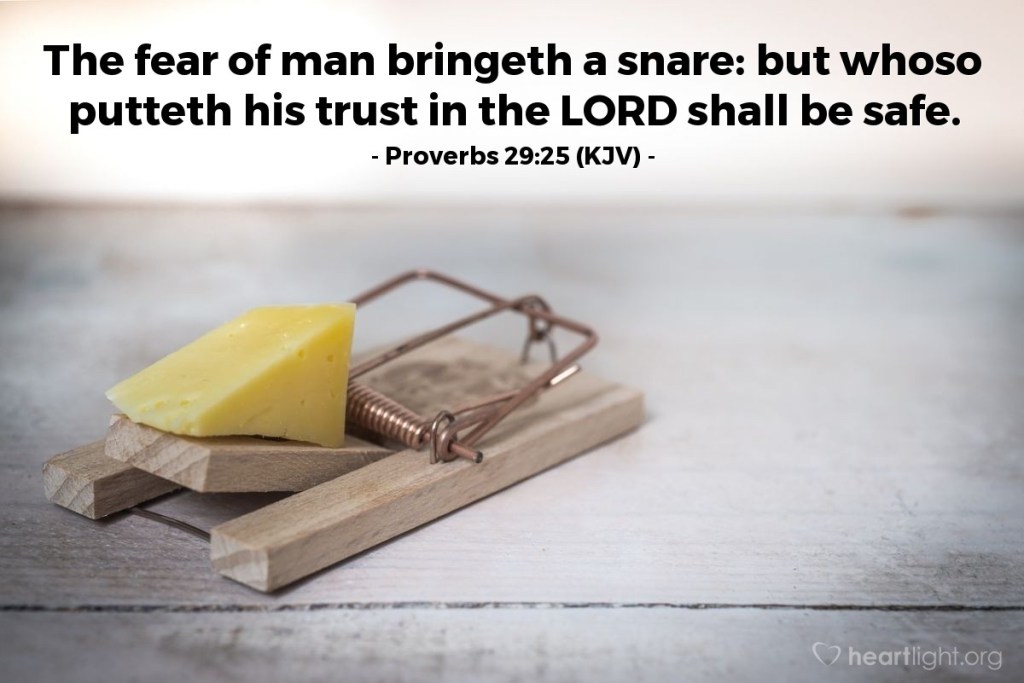
The fear of man brings a snare,
But whoever trusts in and puts his confidence in the Lord will be exalted and safe.

The Word of God for the Children of God. Gloria! In Excelsis Deo! Alleluia! Amen.

There are many pressures in our 21st century life that causes us to be fearful more than we are trusting, and all too often it is fear that causes man to seek to escape life’s problems through less than desirable means. If anxiety or worry causes a person to be controlled or to be restricted by their circumstances, or if they seek to, “any way possible” escape the cascade of consequences of life’s pressures by committing some sort of acts contrary to the laws of mankind and God, then that person sets a trap for themselves.

They become ensnared and embroiled in their own wrong responses, in their own limits of wisdom. However, the Word of God for the Children of God gives us a wonderful reassurance the one who implicitly trusts the LORD, with all of his heart and all of his soul and with all of his strength, is both safe and secure.

Many passages throughout the Word of God give a believer encouragement and “God” confidence and blessed reassurances, but they often come in the form of contrasts, sinners and the saved, death and life, darkness and light, carnal and spiritual, unbelief and trust. Here inside the book of Proverbs the little word but peppers its pages with many such glorious contrasts. One verse reads, “The fear of man brings a snare, BUT he who [1000%] trusts in the LORD will be exulted.”

This short verse has an undiscovered, unplumbed, depth, a richness of meaning and much to teach us because it first describes a problem, ‘the fear of man’, yet concludes with ‘the GRACE principle’ – “but the Lord…”

The inevitable outcome for the fear of man is a snare which entraps both the heart and soul and without warning results in disappointment, deep despair.

However, Proverbs 29:25 teaches the opposite of fear is faith, which ironically is sometimes called ‘the fear of the Lord’ which is the beginning of wisdom.

As the fear of man and dread of circumstances increases, so, conversely, faith in the Lord decreases. But as our faith stands firm on the promises of God, so fear is likewise and equally dispelled. When faith in God is practiced, fear is snuffed out like a candle and vaporizes like the morning mist. The result of trusting the Lord and reverencing His holy name brings with it wisdom, exaltation and joy.

There is a world of difference between the ungodly ‘fear of man’ and godly ‘fear of the Lord’. Reverence for the Lord brings with it wisdom and strength, hope and joy, humility and purpose while esteem for fallen man too often entraps the soul and is accompanied by a whole host of anxieties and worry. How important then, in these precarious of 21st century circumstance to take this warning in Proverbs to heart, “fear of man is a snare while trusting the LORD brings praise?”

Placing implicit, unquestioning trust in anyone other than the Lord, brings in its wake problems and pain, disappointments and despair. However, “the fear of the Lord is the beginning of wisdom,” and we have the assurance that the man who trusts in Him will be lifted up and certainly receive many blessings.

The fear of man over the fear of God often comes when we are trying far too hard to be a ‘people pleaser’ instead of honoring the Lord and pleasing Him.

The Bible clearly teaches that you and I cannot reverence God and man at the same time, and Paul addresses this issue in Galatians 1:6-10 when he asks, “Am I now seeking the favour of men, or of God? Am I striving to please men or the Lord?” And in Psalm 56, the writer shows that fear of man evaporates when we place our trust and confidence in the Lord. “In God I have put my trust,” he declares. “I shall not be afraid! What can man do to me?”

In every situation in which we find ourselves, in each life-problem we meet, we have irrefutable assurance in God’s Word that He is able and willing to deliver those that trust in the name of His only begotten Son – our Savior Jesus Christ.

1 Peter 5:8-11 New American Standard Bible

Be of sober spirit, be on the alert. Your adversary, the devil, prowls around like a roaring lion, seeking someone to devour. 9 [a]So resist him, firm in your faith, knowing that the same experiences of suffering are being accomplished by your [b]brothers and sisters who are in the world. 10 After you have suffered for a little while, the God of all grace, who called you to His eternal glory in Christ, will Himself perfect, confirm, strengthen, and establish you. 11 To Him be dominion forever and ever. Amen.

Please make no mistake here! Fear is an “up close in your face” sobering and dangerous emotion which entangles man in deep dark problems, and fear is also a favorite tool used by the enemy… who seeks to bring saved men down into his chaos, imbalance, ‘Slough of Despondency’ and entrap them in his ‘Pit of Despair’ which can over time, subtly, suddenly cause a believer to doubt the power and veracity of God’s Word and the Gospel truth of God’s Holy Scriptures.

Never forget somewhere in the Bible there is always a resounding, ‘BUT GOD…’

Purely as an illustration, suppose the Lord Jesus told you that “I am coming back very soon!” Do you think or believe He would then tell you to spend your time stockpiling provisions? Adding an addition to your home just for storage?

Hardly! I believe He would say “give all that you have to the homeless person who has nothing or go up and down the highways and by-ways and dark and darkened corridors and alleys and share the Gospel of His pending arrival. Give everything you have to those who do not have and declare the glory of what God has done for you, so they too may find someone to share the Good News also.

It is not my task or purpose to make people feel guilty or self-conscious. Every one of us knows they could be doing a better job of telling other people about our Savior. I am not talking about cornering people, backing them up against a wall and being “in your face” obnoxious. That only risks alienating someone.

I am here talking about starting everyday by praying this prayer: “Lord, today I am going to live solely for you. Today, if you would please just bring someone across my path who needs you, I will try hard to help them by pointing them unto you!”

Please, never allow any fear, as being conceived in your mind, to be birthed into a slice of terror which destroys the inner peace God gives to those who love Him. Rather, be too quick, be sober minded to dispel those thoughts which threaten to bring down your heart and soul, as soon as they come to mind, by setting your heart on the face of Jesus, taking those thoughts captive to Christ.

Our God of GRACE and peace in Whom we trust, has promised us all temporal, spiritual, and eternal mercies. Remember, it is fear of man that spawn’s death and dis-ease BUT the one who trusts in the Lord Jesus Christ honors the Father in heaven and brings life and release. Grace! Grace! God’s Grace! is always #1!

In the name of God, the Father and God the Son and God the Holy Spirit,

Let us pray,

Thank You, Father, for Your many beautiful promises of ‘contrast’. I begin now to understand more and more that there is nothing in life that should cause me to fear. Thank You that You have promised to be with me in every circumstance of life and have given me an assurance that Your GRACE is sufficient to counter every fear in my heart. Keep me looking UP to Jesus and trusting in His precious promises. I pray that on those occasions when doubts and fear arise within, that Your Spirit will prompt me to turn my thoughts away from the fear of man and onto trust in You. In Jesus’ name I pray, Alleluia! Alleluia! Alleluia! AMEN.

https://translate.google.com/

Jeremiah 29:11 Digging Deeper with God. Understand the Real Meaning of ‘For I Know the Plans I Have for You’!

We spend a lot of time thinking about God’s plans for us. What does God have in mind for me? What is God’s plan for my future? This is definitely something I can and will hang onto while I am trying to sort out just exactly what the plan is for the exact moment I am in right now as I sit and contemplate this devotion.

While this is definitely a wonderful thing to sit alone in one’s quiet places and ponder and perhaps even pray over, the plan for the next moments when I will take my next breath of life, and then the one after that, should God grace me in that moment with another breath, in a moment of Holy Spirit clarity, it came to me and I realized something, it’s easy to have the attitude: “It’s all about me.”

Am I thinking about God in the exact moments when I am trying to plan for my future? When I’m making my own plans to take my very own next breath of life? Have I even thought to plan on including God in my own plans for myself? God cares about every intricate detail in our lives (Psalm 139:1-18). Jesus said that he even numbers the hairs on our heads (Luke 12:7). And after all, when compared to God, everything is small. Am I planning on or for any Holy Spirit revelation?

What about God, the Father, Son and Holy Spirit? But should we expect that the main purpose of God’s plans is to solely make us happy right here, right now? Is it the least bit realistic to believe God’s plan “for me” is really only “my plan?” Where have I even minimally planned to try to make any living space for God? Where have I made any plans to invite Jesus into my home, my heart and soul? Where are my plans to have a Holy Spirit “party of all parties” to celebrate life?

Jeremiah 29:10-11 The Message

10-11 This is God’s Word on the subject: “As soon as Babylon’s seventy years are up and not a day before, I’ll show up and take care of you as I promised and bring you back home. I know what I’m doing. I have it all planned out—plans to take care of you, not abandon you, plans to give you the future you hope for.

The Word of God for the Children of God. Gloria! In Excelsis Deo! Alleluia! Amen.

God’s Word is full of wisdom and encouragement that guide Christians through life. Memorizing Scripture can serve as a powerful weapon against temptation, despair, hopelessness and worldliness. However, learning verses in isolation, without context can lead to misunderstanding and misapplying the virtues and lessons that God has already planned for all of His people to possess and learn.

One familiar verse that Christians often quote is Jeremiah 29:11, “For I know the plans I have for you, declares the Lord, plans for welfare and not for evil, to give you a future and a hope.” It is a critically important text to become acquainted with.

This is a message of hope and a promise of a good future that is easy to cling to and repeat. But knowing the full context of the verse is quite interesting and it reveals the enormous scope of God’s design and will for mankind. Let’s dig into what it really means when its God alone who tells all of us, he has plans for us.

What Does, Ought, It to Mean to ME That God Knows the Plans He Has for Me?

In the context of Jeremiah 29, the phrase, “I know the plans I have for you,” refers to the plans the Lord has had for the people of Israel from the beginning. This verse is a reiteration of the promises of God from the beginning of creation as well as the beyond absolute guarantee that He always keeps His covenants.

They were the descendants of Abraham, with whom God made a covenant to bless His descendants. They were the people of David, a man after God’s own heart. Even though they broke their promise to worship only the one true God, He was not going to forget His word, and would restore them to blessings. In fact, this verse is a foreshadowing of the coming Messiah, the Lord Jesus.

God promised David, a descendant who would reign forever, “You have said, ‘I have made a covenant with my chosen one; I have sworn to David my servant: ‘I will establish your offspring forever and build your throne for all generations’” (Psalm 89:3-4). There is only one throne that lasts forever, the throne of God where Jesus Christ will live and reign forever. If God allowed the descendants of David to stop being carried out to Babylon to go extinct in exile, that promise of an eternal throne for David’s descendants could not ever have been fulfilled. 

In context, this verse came to serve as an inspiration and encouragement for the Jews in exile and therefore should be a great inspiration and encouragement for Christians today. God’s timing is God’s timing. God is not fickle. He keeps all of His promises! Because the Father kept His promises to use the Jewish people in His plans, the whole world now has access to salvation through Jesus Christ.

Man would forsake man without hesitation. God did not forsake His people, redeeming them for His glory and their good. When the Lord promises that we are saved, He means it. When Jesus promises to return for His church, we can have confidence in His word. As Jesus says in the New Testament, centuries later, “Heaven and earth will pass away, but my words will not pass away” (Matthew 24:35). We change! God does not change, no matter how individuals or the world does, and believers can rest assured that He will keep His promises.

Who Wrote Jeremiah?

The Book of the Prophet Jeremiah is one of three books of prophecy called the Major Prophets. Its name comes from its author, who wrote during the last days before the exile to Babylon. Jeremiah, also known to us as the weeping prophet, wrote most of the text during the exile of the Israelites.

At this time in the history of the Jewish people, Israel was divided into two kingdoms: Israel to the north and Judah to the south. Both kingdoms were conquered by foreign powers during this period. Jeremiah was the main prophet to Judah and unto the exiles in Babylon working at the same time as the minor prophet Zephaniah, who is likewise briefly mentioned in Jeremiah’s book.

Babylon and the Kingdom of Judah had been in conflict for a few years, resulting in the Babylonian empire conquering Jerusalem, destroying the Temple, and carrying the Israelites into slavery. The book includes more than just prophetic text; it also has biographical information, sermons, and poetic messages which Jeremiah uses to communicate God’s will unto the people.

The prophet provides some biographic information about himself early in the book. He says, “The words of Jeremiah, the son of Hilkiah, one of the priests who were in Anathoth in the land of Benjamin, to whom the word of the Lord came in the days of Josiah the son of Amon, king of Judah, in the thirteenth year of his reign” (Jeremiah 1:1-2). He gives his father and his tribe, as well as the time he began receiving prophecy and prophetic messages from the Lord.

God’s Prophet Jeremiah preached all throughout Israel and received much persecution; “But I was like a gentle lamb led to the slaughter. I did not know it was against me they devised schemes, saying, ‘Let us destroy the tree with its fruit, let us cut him off from the land of the living, that his name be remembered no more’” (Jeremiah 11:19). Though God often guarded, protected him from these persecutions, Jeremiah’s prophecies were generally laughed at and ignored.

What Is Happening in Jeremiah 29?

Chapter 29 in the Book of Jeremiah is a letter with a specific message to a specific audience. The prophet wrote this passage to those Israelites in exile in Babylon. Many despaired, separated from their homes, their history, and their God. Solomon’s Temple was destroyed as well, adding to the calamity.

The Israelites received warnings from the Lord through the prophet Jeremiah that this would happen. Because they had been worshipping Baal and Moloch, false gods imported from foreign lands, breaking their covenant, the Lord allowed Babylon to invade. The Jews would be taken from their homeland for a period of seventy years. In chapter 29, the prophet wrote to encourage the people in exile, and warn them against false prophets during this time. 

The letter can be broken up into sections. Verses 1-3 serve as introductions, stating who wrote the letter and when. The following verses, 4-10, contain an edict from the Lord for the Jews to continue living, to not give up, and to ignore prophets whom He had not ordained. 

“Build houses and live in them; plant gardens and eat their produce. Take wives and have sons and daughters…multiply there and do not decrease…Do not let your prophets and your diviners who are among you deceive you.”

Jeremiah 24:4, and verse 8a

Next is a word of promise, an assurance that God has not forsaken His people. In this passage, verses 10-14 contains the famous verse. The Lord said through his prophet, “For thus says the Lord: When seventy years are completed for Babylon, I will visit you, and I will fulfill to you my promise and bring you back to this place. For I know the plans I have for you declares the Lord, plans for welfare and not for evil, to give you a future and a hope. Then you will call upon me and come and pray to me and I will hear you” (Jeremiah 29:10-13).

God gave the Israelites in captivity a deadline for their time under Babylonian rule. Verse eleven contains God’s assurances that He was not finished using Israel for His divine plan, and there were blessings to come in the future. After 70 years, the people would return to the Lord in prayer, and the relationship between God and His people would be restored. God alone would restore all!

What Covenant Did Israel Break?

To understand how incredible God’s statement in verse 11 is, it is important to understand the meaning and significance of the many covenants in that culture. It is often compared to a promise, which is not an incorrect assessment, but there is significantly more to it.

Covenants were seen as binding and lifelong. Because God lives forever, His promises live forever. One of the best examples of this kind of commitment from God is the rainbow, a sign of His promise to Noah that He would never again destroy the earth with water and flood.

Most covenants required both parties to do something. In Genesis 17, God makes a covenant with Abram, from that point forward called Abraham, to make him the father of many nations, with generations of blessings and kings. Abraham and his male descendants through all generations were to be circumcised to uphold their part of the covenant. 

The specific promise between Israel and the Lord that the Israelites broke, leading them into exile, was also reinforced several times through the Old Testament. If they kept God’s commandments, He would be with them. A specific message given to Solomon that illustrates this relationship is a clear articulation of this guarantee, and underscores how they violated it. 

God said to Solomon:

“And as for you, if you will walk before me, as David your father walked, with integrity of heart and uprightness, doing according to all that I have commanded you, and keeping my statutes and my rules, then I will establish your royal throne over Israel forever, as I promised David your father, saying, ‘You shall not lack a man on the throne of Israel.’ But if you turn aside from following me, you or your children, and do not keep my commandments and my statutes that I have set before you, but go and serve other gods and worship them, then I will cut off Israel from the land that I have given them, and the house that I have consecrated for my name I will cast out of my sight, and Israel will become a proverb and a byword among all peoples.”

1 Kings 9:4-7

Not only did Solomon allow his various wives from many other lands to worship and set up altars to their own gods, but his descendants would engage in idol worship for years before God cut them off from the land through conquest and exile. Yet, as He states in Jeremiah 29:11, He already had plans to restore them to a right relationship with Him.

What Does Jeremiah 29:11 NOT Mean?

This verse promises restoration and redemption for a people in exile that would lead to the salvation of mankind. It is full of hope and assurance. However, it is not always used to convey that message. It can sometimes be used, when taken out of context, to mean that Christians today have guarantees of blessings and prosperity. It can also be used to give a false sense of purpose, chasing after material blessings in a worldly fashion, rather than seeking after God. This verse only guarantees the exiled Israelites that they had not been forgotten by their Lord, not that He guarantees material gain for people who believe in Him.

Does this mean that, we the Christians of this 21st century cannot look to this magnificently hope-filled inspirational verse for hope and encouragement?

Not at all!

While the verse does not guarantee comfort and success, it does promise redemption, something the modern Christian experiences daily after being forgiven of their sins, because of the death and resurrection of Jesus Christ.

God does have a plan for all His people, and Jesus even says, “Are not two sparrows sold for a penny? And not one of them will fall to the ground apart from your Father. But even the hairs of your head are all numbered. Fear not, therefore you are of more value than many sparrows” (Matthew 10:29-31).

The truth Jesus states here is the same one from Jeremiah 29:11.

God loves all humanity, wants to redeem them to Himself, and plans for a glorious eternity together.   

From Psalm 107, There will be trials and troubles in this world, and the Bible never promises believers a problem-free life. There are many verses in the Old and New Testament that give assurance of His love and that He will keep His promises; Jeremiah 29:11 is such a “I want to hug God” transformational verse.

I am very big on not pulling Bible verses out of context. I want to know what does this verse mean for someone going through the worst of pain or abuse?

How could we ever share or pray this verse for a person living out life in prison? Wandering aimlessly in wildernesses? If those examples seem too extreme, try this: Does God really intend for us to apply this verse to our everyday lives?

I believe God does, and I have, by my own experiences, have discovered three ways we can live like we have a future and a hope, which is what God intends!

1. Live Fully No Matter Your Circumstances

No sooner had the Israelites been carried off into exile in Babylon than God prompted Jeremiah to send them a letter to encourage and instruct them! This is what we read in the 29th chapter of Jeremiah: a letter sent to people held captive, not living where or how they wanted. “Seek out the place of Shalom.”

Can you relate to any part of that?

Surprisingly, God didn’t first chastise them, and he also didn’t immediately rescue them. Instead, he encouraged them to put down roots and live fully despite their circumstances!

4 “Thus says the LORD of hosts, the God of Israel, to all the exiles whom I have sent into exile from Jerusalem to Babylon: 5 Build houses and live in them; plant gardens and eat their produce. 6 Take wives and have sons and daughters; take wives for your sons, and give your daughters in marriage, that they may bear sons and daughters; multiply there, and do not decrease. (Jeremiah 29:4-6 ESV)

We can apply this strong encouragement from God to our lives: When we are going through tough times, it is tempting to hang our heads and throw in our towel. But God says, “Don’t give up! Live, thrive! Build, plant, multiply!”

What part of that do you want to apply to your 21st century life today?

2. Pray for Peace, Pray for Shalom, and for Welfare for Those Who Are Troubling You

This next step is perhaps more difficult than we want to admit. Raise your hand if you have trouble praying for the good of all people around you, including those who are causing you problems. Hand raised here! Goodness, this hits between the eyes! Look at the reasons God’s covenant calls us to do just that:

7 But seek the welfare of the city where I have sent you into exile, and pray to the Lord on its behalf, for in its welfare you will find your welfare. (Jeremiah 29:7 ESV)

The NIV translates “welfare” here as “peace and prosperity.” Does it sound unspiritual to say this? When the people around us live in peace and prosperity, so will we, and wouldn’t we want that?

You know, in this passage–in this letter from Jeremiah to the exiles–God was reminding the Israelites they were his people, and he was still taking care of them. Part of that care was for them to be safe and to prosper in this new land.

How are we to live in peace if people in our lives are in turmoil?

Will you commit with me today to pray for the hardest people in your life to pray for? Will you commit to being a part of God’s greatest best plan for them?

3. Trust God’s Long-Term Plan! NOT Yours

Finally, God’s covenant calls us to surrender our best plans for our greatest future. Surrender, trust God’s plan for the long-term despite what things look like today. For the people of Israel, the wait for freedom would last 70 years. They would see kings rise and fall; they would live through persecution and trial. They would have more than their fair share of highest energy concerns.

Remember Daniel’s faith being severely tested in the Lion’s Den and too the account of Daniel’s friends thrown into The Fiery Furnace? Those events and countless other trials challenged the Israelites during their time in Babylon.

Yet God encouraged them to remain faithful, faith-filled, hope-filled and hopeful followers, to zealously hold onto to him, to implicitly trust in him, and trust that when God declared the exact time was right, their trial would end.

10 “For thus says the LORD: When seventy years are completed for Babylon, I will visit you, and I will fulfill to you my promise and bring you back to this place. 11 For I know the plans I have for you, declares the LORD, plans for welfare and not for evil, to give you a future and a hope. (Jeremiah 29:10-11 ESV)

God had a future and a hope planned for the Israelites, and he does for us, too!

Remember Joseph’s warm words to his brothers?

20 As for you, you meant evil against me, but God meant it for good, to bring it about that many people should be kept alive, as they are today. (Genesis 50:20 ESV)

So, too, we might experience what seems like straight-out evil for a time. But God is working for good. Matthew Henry in his commentary says,

We are sometimes ready to fear that God’s designs are all against us; but as to his own people, even that which seems evil, is for good. He will give them, not the expectations of their fears, or the expectations of their fancies, but the expectations of their faith; the end he has promised, which will be the best for them.

You might be thinking of another favorite verse at this very exacting time!

And we know that for those who love God all things work together for good, for those who are called according to his purpose. (Romans 8:28 ESV)

So, as you face today, with its plans, trials and stressors, trust God for the long term. He has a plan. It is utterly good! And in it you have a future and a hope! 

In the name of God, the Father and God the Son and God the Holy Spirit,

Let us Pray,

Lord and Savior Jesus Christ, thank you that every good and perfect gift comes from you, the King of all kings and Lord of all lords. You have promised that, if I commit whatever I do to you, then you will timely cause my plans to succeed. My success will come from aligning my plans with your will. Guide my path and show me favor. Now may you, the Lord of all, give me success at all times and in every way. In your mighty name, Alleluia! Alleluia! Alleluia! Amen.

https://translate.google.com/

God said, Show Me Your Friends and I Will Surely Show You Your Character!

Growing up I remember many times when my parents would be concerned with who my friends were.  One time in particular, they basically forbid me from my continuing to hang out with a couple of guys.  I was not too happy with the situation but knew that disobedience to such a strong prohibition came with very real consequences.  Little did I know but it would only be a few months later my mom told me that they were caught shoplifting.  I am not sure what would have happened to me if I had been there with them – but that was not an issue because of the prevailing wisdom of my father and mother over my own. 
 
My dad never quoted this proverb outright to me – but he must have read it.  More than once my parents would remind me that the company, I keep would have direct, decisive implications upon the character I later would possess. If we walk among the foolish, we risk becoming even greater fools than them. Yet, we cannot help but walk among our fellow citizens – we have no choice other than to isolate ourselves in our homes, in the woods somewhere or deep in a cave. In my own foolishness, I cannot always tell the “ever wise” apart from the foolish.

No matter how highly regarded and wise mankind believes himself to be, he will continue to be the consummate fool in the eyes of someone who does not know him. Jesus came sauntering into our lives and we thought him the drunken fool for doing what he was doing among those he was interacting with. But we did not know Him yet. We did not take the time to get to know him because we all thought him to be the consummate fool. We could not even muster up curiosity.

Pharisees thought him to be the ultimate fool for entering into the homes of the tax collector Levi who would become Matthew. Instead of interacting with the crowds in Jericho, Jesus looked up into the Sycamore Tree and called Zacchaeus down – to share a meal and fellowship and salvation. How did that crowd feel?? Jesus crossed the border of the hated Samaritans. What did the disciples feel?? How did the disciples feel about walking on such ground with their Rabbi in the lead? When we first read such stories, how do we feel about such foolish acts?

After we have read them, studied them, pondered and prayed over them, do we continue to feel, continue to believe they were such completely foolish acts?

Just a closer walk with this ever so dramatically foolish Jesus will make us wiser. Wiser to the lesser ways of my even greater foolishness for not taking the risk, walking even among the most foolish with my Rabbi, walking with my Savior who is Jesus Christ my Lord. Walking among fools reveals my true character!

I am weak but Thou art strong
Jesus keep me from all wrong
I’ll be satisfied as long
As I walk, let me walk close to Thee

“Just a closer walk with Thee
Grant it, Jesus, is my plea
Daily walking close to Thee
Let it be, dear Lord, let it be
(Author Anonymous)

Proverbs 13:20 The Message

20 Become wise by walking with the wise;
    hang out with fools and watch your life fall to pieces.

The Word of God for the Children of God. Gloria! In Excelsis Deo! Alleluia! Amen.

Today’s proverb speaks of these very things.  It speaks of a “walk with wise men” versus a “shepherding by fools.” 

First let’s look at the walk with “wise men.”  The one who walks with wise men will be wise.  The word for “walk” here refers to a journey or a walk from one place to another.  The company during this walk was a wise man, or wise men.

Proverbs 2:20 refers to it as a walk with “good men” and a “pathway of the righteous.”  When looking for companions and mentors – we do well to look for people who have walked with God (Who Himself is the wisest companion to have on the roads of life). 

These people are characterized by the apparent fact that they “allegedly” know God.  This they have supposedly “acquired” over a long or short lifetime of pursuing a relationship with Him through “reading and knowing His Word.”  

They have learned by “experience” that obedience to God is the wisest way to walk – and seeing life through His perspective and Word is how to obtain this. 

Look for such people and surround yourself with them and their counsel.  They will counsel you to walk closely with God – and learn to apply His Word to every situation in life.  Their lives will have the sweet smell of God’s favor upon them (even if the world deems them less than a success by their standards). 

Such people will be humble, gracious, loving, kind – and yet strong and willing to stand on God’s principles no matter what.  The blessing for being around such people is that you will become one of them.  The one who walks with wise men – will himself become wise.  One thing I would add to this is that a wise man or woman will look for at least one wise man or woman with some age on them.  The Word makes one wise – but wisdom over time is a rare thing to find.  When you do – befriend the one who has it – and – listen to them often! That is, of course, if the one “wiser than us” we are walking with is truly the wiser.
 
This one who grows wise in the company of wise men is contrasted with the “companion of fools.”  The word companion here is the Hebrew word “ra ah” which means to tend or feed sheep – i.e., a genuine shepherd of one another. 

Here is one who is being shepherded by fools.  He is fed and tended by them – having them lead him into their ways and their paths.  The fools he considers friends and mentors are mentioned in several ways in Scripture.  The word for fool is “kesiyl” and it means a fool or one lacking in wisdom. 

In Ecclesiastes 4:5 the fool is lazy, folding his hands in inactivity as his life wastes away.  In that same chapter verse 13 uses this word to describe a young man who “knows everything” and will not be instructed by anyone around him.  He even mocks those who offer wisdom – preferring the company of His own foolishness to any advice or instruction, sort of like Jesus’ own disciples as they argued among themselves over who would be greatest. (Luke 22:24-30)

Psalm 49:10 refers to this fool as one who thinks his stuff will last forever and lives for it rather than any kind of spiritual pursuit of God. 

Proverbs 1:32 speaks of the fool as one who loves wayward living and not only ignores the wisdom of God – but written earlier in chapter 1 verse 22 ESV we see him hating both the wisdom and the God who gave it.  22 “How long, O simple ones, will you love being simple? How long will scoffers delight in their scoffing and fools hate knowledge?

Psalm 92:6-7 reminds us that he also mocks the whole concept of God’s justice and judgment.  Proverbs 3:35 reminds us that he displays his godless dishonor like a trophy – and finally Ecclesiastes 10:2 the Teacher says that his heart (that which hates wisdom) is always turning him towards the wrong direction in life. 
 
What happens to the one who has such foolish companions and mentors? 

The language here is a very pointed.  He will suffer harm as a result of these leaders and friends.  The word used here is quite descriptive.  It is the Hebrew word “rua” – which referred to the deafening shout or blast of a horn that took place right before your enemy came upon you in battle. 

Such a shout was called a shout of victory – and to those about to be vanquished – it was the most terrifying sound you can imagine.  Often those who heard it were not prepared for the devastating defeat they were about to receive. 

The psychology of the battlefield. But when the shout rang out – their cockiness would be soon replaced by terror and fear.  Too often that is how the foolish are awakened to the measures of their folly.  They are full of self-confidence and self-congratulation until disaster awakens them to their true state.  The result of their poor choice of companions and commanders is the threat of great ruin. 
 
Unfortunately, some will read this and mock – saying that they are doing fine.  They will even point to a life where everything seemed pretty good for their friends and mentors.  But whether we live in relative comfort, ease, and man-oriented success is not the measure of a man. 

The true measure of a person and the way they lived happens in the twinkling of an eye – in the exact moment after they leave this world.  We are reminded in Hebrews 9:27 that we all have an appointment with death.  This happens only once, “It is appointed for man to die once, then comes the judgment.” 

There is not a second chance – no reincarnation to have another shot.  When we die – we will either be present with the Lord – or wholly absent from His favor forever.  In that very moment it truly will be seen how wise it was to walk with people who are wise.  And ultimately the One Wise Man with whom we should walk is Jesus Christ.  It is by His immeasurable wisdom we will escape so great a peril – so great a judgment – and forever enjoy so great a salvation. Walk with Him – take a risk – be wise – and be blessed far beyond your days on this earth!

When my feeble life is o’er
Time for me will be no more
Guide me gently, safely o’er
To Thy kingdom’s shore, to Thy shore

Just a closer walk with Thee
Grant it, Jesus, is my plea
Daily walking close to Thee
Let it be, dear Lord, let it be
.

In the name of God, the Father and God the Son and God the Holy Spirit,

Let us Pray,

Holy and gracious God, you are the greatest of all. You are full of wonders that no mere human can comprehend. Lord, I seek to understand you and your ways so that I can live according to your commandments. I pray for your divine illumination in my heart and mind. Help me see what you intend for me to see. Help me understand what you intend for me to understand. Open my eyes and my ears to see you and hear your whispers. Alleluia! Alleluia! Alleluia! Amen.

https://translate.google.com/