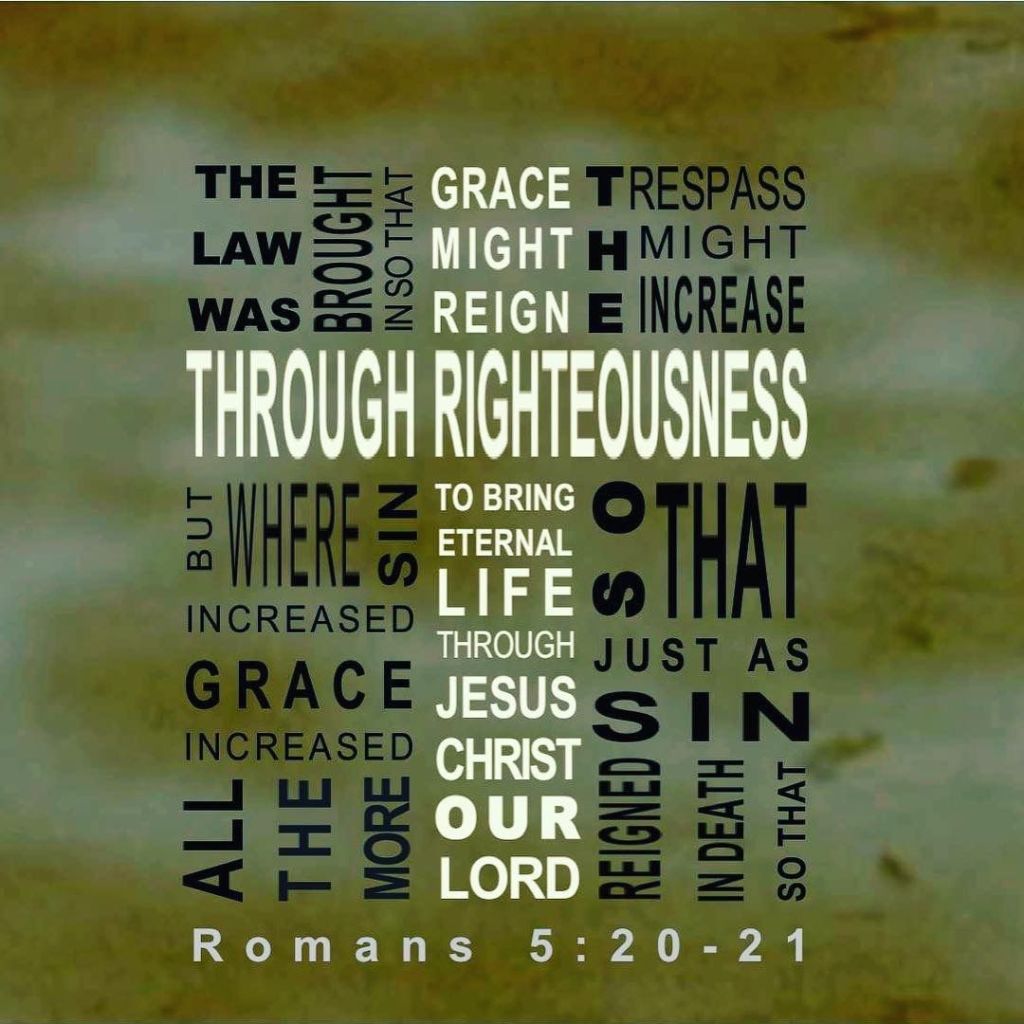
I have encountered the Resurrection. Receiving the free gift of God’s Grace: “Charisma” Romans 5:15-21

1. Marvelous grace of our loving Lord,
grace that exceeds our sin and our guilt!
Yonder on Calvary’s mount outpoured,
there where the blood of the Lamb was spilt.
Refrain:
Grace, grace, God’s grace,
grace that will pardon and cleanse within;
grace, grace, God’s grace,
grace that is greater than all our sin!

People love to receive presents, especially good ones that are useful, and that reveal how the giver put forth some thought and effort into the purchase.

In the Bible we are continuously told of the best and most beneficial gift of all.

Many will seek the favor of a [a]generous person,
And every person is a friend to him who gives gifts.
(Proverbs 19:6 NASB)

12 I know that there is nothing better for them than to rejoice and to do good in one’s lifetime; 13 moreover, that every person who eats and drinks sees good in all his labor—this is the gift of God. 14 I know that everything God does will remain forever; there is nothing to add to it and there is nothing to take from it. And God has so worked, that people will [a]fear Him. (Ecclesiastes 3:12-14)

[a]Ask, and it will be given to you; [b]seek, and you will find; [c]knock, and it will be opened to you. For everyone who asks receives, and the one who seeks finds, and to the one who knocks it will be opened. Or what person is there among you [d]who, when his son asks for a loaf of bread, [e]will give him a stone? 10 Or [f]if he asks for a fish, he will not give him a snake, will he? 11 So if you, despite being [g]evil, know how to give good gifts to your children, how much more will your Father who is in heaven give good things to those who ask Him! (Matthew 7:7-11 NASB)

The Apostle Paul proclaimed, “The gift of God is eternal life in Christ Jesus our Lord” (Romans 6:23b)!

God offers to everyone, without exception, the free gift of eternal life, and the free gift of His grace to make the choice to walk in, experience spiritual victory.

Even so, there are those individuals who have refused eternal life in the Son; and there are even those within the body of Christ who are not abiding in their God-given freedom.

The reason why some people are not living in victory is because they have not yet understood or received God’s grace.

Those who have not fully received His grace are walking about in judgment and condemnation.

For the “unbeliever” who has not accepted the gift of God,

he or she is indeed condemned to eternal separation from the Lord.

But your wrongdoings have caused a separation between you and your God,
And your sins have hidden His [a]face from you so that He does not hear. (Isaiah 59:2 NASB)

and a fiery judgment

11 “But when the king came in to look over the [a]dinner guests, he saw a man there who was not dressed in wedding clothes, 12 and he *said to him, ‘Friend, how did you get in here without wedding clothes?’ And the man was speechless. 13 Then the king said to the servants, ‘Tie his hands and feet, and throw him into the outer darkness; there will be weeping and gnashing of teeth in that place.’ (Matthew 22:11-13 NASB).

The Bible is abundantly clear in this matter.

For the “believer” who has not fully comprehended the gift of God, he or she is living in bondage from a self-imposed form of condemnation or self-reproach.

God offers the free gift of His grace and a complete pardon from sin; however, His gift does no good just sitting there all wrapped up and looking pretty.

God’s gift must be received and opened; and in this devotional message today,

Faithfully, hopefully, prayerfully, Gracefully, our goal is that we are going to come to a more informed understanding of what is entailed in receiving and benefiting from the greatest gift of all time.

Paul Shared God’s Gift of Grace.

Today, we are going to look at some words shared by the Apostle Paul. Paul is someone who felt compelled to emphasize “the free gift of God.”

In both Romans and Ephesians (2:8, 3:7, 4:7) he taught extensively about the gift of God’s grace, for he believed that receiving this gift was essential for redemption unto God and eternal life.

In Romans chapter five, Paul stressed in great detail the significance of what he called “the free gift of God.”

Right now, I want to invite us to brush off the dust on the covers of our bibles, to open them together with me in humble honor of the reading of God’s Word.

Romans 5:15-21 New American Standard Bible

15 But [a]the gracious gift is not like the offense. For if by the offense of the one the many died, much more did the grace of God and the gift by the grace of the one Man, Jesus Christ, overflow to the many. 16 The gift is not like that which came through the one who sinned; for on the one hand the judgment arose from one offense[b]resulting in condemnation, but on the other hand the gracious gift arose from many offenses, [c]resulting in justification. 17 For if by the offense of the one, death reigned through the one, much more will those who receive the abundance of grace and of the gift of righteousness reign in life through the One, Jesus Christ.

18 So then, as through one offense [d]the result was condemnation to all mankind, so also through one act of righteousness [e]the result was justification of life to all mankind. 19 For as through the one man’s disobedience the many were made sinners, so also through the obedience of the One the many will be made righteous. 20 [f]The Law came in so that the offense would increase; but where sin increased, grace abounded all the more, 21 so that, as sin reigned in death, so also grace would reign through righteousness to eternal life through Jesus Christ our Lord.

The Word of God for the Children of God. Gloria! In Excelsis Deo! Alleluia! Amen.

In this passage Paul emphasized the word “gift” six times.

If we view the original Greek, there are two words from which the English word gift has been translated.

https://www.blueletterbible.org/nasb95/rom/5/15-21/t_conc_1051015

When Paul spoke of the singular word “gift” he used the words dorea or dorema, which are simply translated as gift or bounty.

https://www.blueletterbible.org/lexicon/g1431/nasb95/mgnt/0-1/

When he utilized the phrase “free gift” he used the word charisma, which by definition means “a favor with which one receives without any merit of his own,” and “a pardon of sin and eternal salvation.”

https://www.blueletterbible.org/lexicon/g5486/nasb95/mgnt/0-1/

Paul also directly mentioned “grace,” and he used the word charis, which means “good will, lovingkindness” and “favor.”

https://www.blueletterbible.org/lexicon/g5485/nasb95/mgnt/0-1/

The words for “free gift” (charisma) and “grace” (charis) are interchangeable; therefore, when Paul spoke of the “free gift” (Rom 5:15, 16, 18) he was referring to the free gift of grace.

In Ephesians 3:7, Paul declared, “I became a servant of this gospel by the gift of God’s grace” (3:7a NIV).

https://www.blueletterbible.org/nasb95/eph/3/7/t_conc_1100007

The Bible teaches that God’s grace is a free gift that He offers willingly to those who will freely receive it.

There Is One Who Receives the Gift

The One who offers the gift of grace is God.

The Bible says, “For God so loved the world that he gave . . .” (Jn 3:16).

The Lord “gave” to the world – to each and every person. Love is not so much shown in the words “I love you” as it is demonstrated by action.

John said, “Let us not love in word or in tongue, but in deed and in truth” (1 John 3:18); he also said,

“In this is love, not that we loved God, but that He loved us and sent His Son to be the propitiation for our sins” (1 John 4:10).

God revealed His love by “sending” or “giving” the gift of His Son “to be the propitiation,” or rather the atoning sacrifice, to pay the penalty for the sins of mankind.

Notice the word used to express the degree and measure of that Love – Agape.

USED THREE TIMES IN THAT SINGLE VERSE!

https://www.blueletterbible.org/nasb95/1jo/4/10/t_conc_1163010

When Paul declared, “The gift of God is eternal life in Christ Jesus our Lord” in Romans 6:23.

https://www.blueletterbible.org/nasb95/rom/6/23/t_conc_1052023

https://www.blueletterbible.org/lexicon/g5486/nasb95/mgnt/0-1/

The word “gift” is translated from the Greek word charisma, meaning grace.

The “gift of God” is therefore the “grace of God.” God is the gift giver, and He offers the gift of His grace.

Paul identified the gift as “the grace of God” (Romans 5:15), the “abundance of grace” and “the gift of righteousness” (Romans 5:17).

Grace is the Lord’s gift of righteousness to mankind.

The Bible says that through Jesus all who believe in Him are to become the “righteousness of God in Him” (2 Corinthians 5:21).

Therefore, God saw that mankind needed to receive the gift of righteousness.

The Gift Giver Considers the Need

When someone wants to give a gift, then he or she must first consider the need. So, why is an abundance of grace and righteousness necessary for mankind?

Paul spoke of the death, judgment, and condemnation that resulted from the one man’s offense, disobedience and sin.

The “one man” he referred to was Adam (Romans 5:14), the very first man created. If you will recall the biblical account, he and his wife Eve ate of the forbidden fruit of the tree of the knowledge of good and evil.

God had commanded the man and woman not to eat of this tree, and when they acted in disobedience and ignored God’s commands, sin entered the world.

At that moment they were evicted from paradise and separated from God (cf. Gemesis 2:16-17, 3:1-24).

Adam committed the very first sin in history, and sin has plagued mankind ever since (Romans 5:14).

Adam demonstrated how sin results in death, judgment and condemnation.

Paul said, “Through one man’s offense judgment came to all men, resulting in condemnation” (Romans 5:18).

When Adam sinned then all mankind became enslaved to sin.

Paul said elsewhere, “For all have sinned and fall short of the glory of God” (Romans 3:23).

There is not one single person on earth who is without sin (Romans 3:10), and sin results in death. Paul stated, “The wages of sin is death” (Romans 6:23);

and the death he referred to was a spiritual death of eternal separation from God in the flames of hell.

Mankind was condemned to death, and the Lord saw that the need was for life.

The Gift Comes with a Price Tag

Every gift comes with a price tag, meaning there is a purchase price to be paid.

Just as sin came through the “one man” Adam, the gift of grace came through the “one Man” Jesus Christ (Romans 5:15, 17-19, 21).

We read that this gift came by way of His “righteous act” (Romans 5:18), or His act of payment.

What was the price for God’s grace and forgiveness to be shown to the world?

In Acts, Paul said that Christ “purchased [us] with His own blood” (20:28).

He also mentioned how “Christ died for our sins according to the Scriptures” (1 Corinthians 15:3),

and that “when we were still without strength, in due time Christ died for the ungodly” (Romans 5:6).

Jesus purchased the world’s freedom with His own life.

The story goes,

When Billy Graham was driving through a small southern town, he was stopped by a policeman and charged with speeding.

Graham admitted his guilt but was told by the officer that he would have to appear in court.

The judge asked, “Guilty, or not guilty?”

When Graham pleaded guilty, the judge replied, “That’ll be ten dollars – a dollar for every mile you went over the limit.”

Suddenly the judge recognized the famous minister.

“You have violated the law,” he said. “The fine must be paid – but I am going to pay it for you.”

He took a ten-dollar bill from his own wallet, attached it to the ticket, and then took Graham out and bought him a steak dinner!

“That,” said Billy Graham, “is exactly how God treats repentant sinners!”

The price of your redemption unto God was Jesus’ death. The Bible says that everyone is supposed to die for his or her sins (Romans 6:23);

however, Christ stepped in and took your place in death.

He took the penalty upon Himself, so that those who believe in Him (Romans 10:9) would not have to perish.

In Galatians, Paul said,

“Grace to you and peace from God the Father and our Lord Jesus Christ, who gave Himself for our sins, that He might deliver us from this present evil age, according to the will of our God and Father” (Galatians 1:3-4).

Jesus died for all mankind in order that those who choose to believe will have life.

Paul stated that the life he now possessed was “by faith in the Son of God, who loved me and gave Himself for me” (Galatians 2:20).

The Receiver Appreciates Its Worth

God has given the free gift of His grace, which is His divine favor and pardon from sin.

Paul declared, “For the wages of sin is death, but the gift of God is eternal life in Christ Jesus our Lord” (Romans 6:23).

In order to receive this gift, you must first appreciate its worth.

What did it cost? It cost God His one and only Son.

John said, “For God so loved the world that He gave His only begotten Son, that whoever believes in Him should not perish but have everlasting life. For God did not send His Son into the world to condemn the world, but that the world through Him might be saved” (John 3:16-17).

The forgiveness of sin is impossible to earn.

It could have only come by way of God’s perfect Son.

The Bible further says,

“For by grace you have been saved through faith, and that not of yourselves; it is the gift of God, not of works, lest anyone should boast” (Ephesians 2:8-9).

You and I must make the sincere effort to realize the cost of our salvation and recognize that the cost is far greater than anything you could pay by yourself.

If you and I believe that you and I can work our way into heaven, then you and I will forever be working and always owing.

Paul said, “Now to him who works, the wages are not counted as grace but as debt” (Romans 4:4).

Jerome was a church father who translated the Greek manuscripts into Latin and put the Bible in the language of the people.

He purposefully lived in Bethlehem where Jesus was born.

One night, Jerome had a dream that Jesus visited him.

In the dream, he collected all of his money and offered it to Jesus as a gift.

The Lord said, “I don’t want your money.”

So, Jerome rounded up all of his possessions and tried to give them to Jesus.

The Lord said, “I don’t want your possessions.”

Jerome then recalled the moment in his dream when he turned to Christ and asked, “What can I give you? What do you want?” Jesus simply replied, “Give to me your sin. That’s what I came for; I came to take away your sin.”

The Receiver Recognizes the Sacrifice

In order for us to receive God’s free gift of grace, we must also recognize and acknowledge Jesus’ great sacrifice.

Do you and I truly understand what Jesus did for us, and do you and I know what it is He offers us?

Jesus told the woman at the well,

“If you knew the gift of God, and who it is who says to you, ‘Give Me a drink,’ you would have asked Him, and He would have given you living water” (John 4:10).

If you and I truly understand the gift of God’s grace, and we realize that Jesus is offering you the gift of Himself and the gift of living water and eternal life,

then we should be unhesitant in receiving this indescribable gift!

You and I should be impossibly eager to take hold of it immediately!

The Receiver Must Unwrap the Gift

Once you and I appreciate the worth and recognize the sacrifice involved in the gift of grace, then you and I must receive it and unwrap it.

Grace will not take effect in your life until it is embraced.

In verse 17, Paul spoke of the need to receive.

He said,

“Those who receive abundance of grace and of the gift of righteousness will reign in life through the One, Jesus Christ” (Romans 5:17b).

You and I obtain life in Christ by “receiving” the abundance of His grace; and once you and I have received the gift then you and I must unwrap it.

The Bible shares how to lift the corner of the wrapping paper and open the gift of eternal life. 

Romans 10:9-10 says,

“If you confess with your mouth the Lord Jesus and believe in your heart that God has raised Him from the dead, you will be saved. For with the heart one believes unto righteousness, and with the mouth confession is made unto salvation.”

When you and I finally recognize the sacrifice of God’s one and only Son who paid the price for your sin, then our understanding must move from the head knowledge unto and into our heart knowledge before grace will take effect.

You and I must not only know in your mind what Jesus did, but you and I must believe and confess with all of your heart that He died for your sin and mine.

God offers you the free gift of His grace this very moment.

He has seen yours and my own futile attempts at becoming right with Him.

The Lord knows you and I are helpless sinners,

and that is why He gave His one and only Son.

Jesus wants to be our atoning sacrifice to step in and pay the price for your sin. He wants to give you the gift of eternal life.

Will you and I genuinely allow Him?

2. Sin and despair, like the sea waves cold,
threaten the soul with infinite loss;
grace that is greater, yes, grace untold,
points to the refuge, the mighty cross.
(Refrain)

Grace, grace, God’s grace,
grace that will pardon and cleanse within;
grace, grace, God’s grace,
grace that is greater than all our sin!

3. Dark is the stain that we cannot hide.
What can avail to wash it away?
Look! There is flowing a crimson tide,
brighter than snow you may be today.
(Refrain)

4. Marvelous, infinite, matchless grace,
freely bestowed on all who believe!
You that are longing to see his face,
will you this moment his grace receive?
(Refrain)

In Revelation we read,

“The Spirit and the bride say, ‘Come!’ And let him who hears say, ‘Come!’ Whoever is thirsty, let him come; and whoever wishes, let him take the free gift of the water of life” (22:17 NIV).

If you and I genuinely desire God’s gift of grace and salvation then you and I have to reach out and take it, tear into it with enthusiasm, and unwrap it!

I want to extend Jesus’ invitation to come, and invite you, the reader, to receive the gift of grace, the 100% free gift of salvation from your sins and eternal life.

In the name of God, the Father and God the Son and God the Holy Spirit,

Let us Pray,

Heavenly Father, the more I recognise my sinfulness, the more I understand the incredible grace that is being poured out on me and on all humanity. Thank You that the more my sin is exposed, the much more I realize what amazing grace has been bestowed on me – and on all who have trusted Christ for salvation, for the forgiveness of sins, and life everlasting. Thank You in Jesus’ name, AMEN

https://translate.google.com/

I am Encountering the Resurrection. “My Lord and my God!” John 20:26-29

Believing what we are “seeing!” Doubting Thomas became Believing Thomas when he “saw” with his very own eyes, the risen Christ standing before him.

From our unbelief to belief. From our “seeing” to believing. The development of a disciple’s faith in Jesus as their God, their Savior, can be followed, traced from the time of John the Baptist to the final chapters of John’s Revelation.

Recall what has come before this. For the three years of Christ’s own ministry, we see in the disciples’, tiny bits of evidence of little seeds of faith taking root, growing, maturing and blossoming into a firm foundation of unshakable faith.

It was revealed to Peter, Jesus was the Christ, the Son of the living God… and the content of John’s Gospel was written so we may believe that Jesus is the Christ, the Son of God, and that by believing on Him we might have life in His name.

Thomas was absent from that initial “appearance” of Resurrected Christ. As a consequence, Thomas did not “see” as the Disciples first “saw” 8 days prior.

We do not know where he was. Scripture is not clear in this matter. What is clear in this matter is none of the disciple’s present that first appearance, who “saw” the Resurrected Jesus, had made no such declaration of “My Lord and my God!”

We only read from John 20:19-20 NASB: 19 Now when it was evening on that day, the first day of the week, and when the doors were [a]shut where the disciples were together due to fear of the [b]Jews, Jesus came and stood in their midst, and *said to them, “Peace be to you.” 20 And when He had said this, He showed them both His hands and His side. The disciples then rejoiced when they saw the Lord.

Verse 20 suggests they only had an “emotional response” – They rejoiced when they “saw” the Lord. Had they come to a true state of “belief” in that moment?

This suggests to me that there is something significantly deeper to explore here with “doubting” Thomas’ response of “My Lord, and my God!”

John 20:26-29 Amplified Bible

26 Eight days later His disciples were again inside the house, and Thomas was with them. Jesus came, though the doors had been barred, and stood among them and said, “Peace to you.” 27 Then He said to Thomas, “Reach here with your finger, and see My hands; and put out your hand and place it in My side. Do not be unbelieving, but [stop doubting and] believe.” 28 Thomas answered Him, “My Lord and my God!” 29 Jesus said to him, “Because you have seen Me, do you now believe? Blessed [happy, spiritually secure, and favored by God] are they who did not see [Me] and yet believed [in Me].”

The Word of God for the Children of God. Gloria! In Excelsis Deo! Alleluia! Amen.

Thomas, called Didymus – which means twin, was chosen by Christ to be one of His 12 apostles. He was a zealous disciple who demonstrated a fearless attitude.

When Jesus set His face as a flint to go to Jerusalem to face the unbelieving Jews who desired to kill Him, Thomas boldly cried, “Let us also go to Jerusalem, with Him – so that we may die with Jesus!” (John 11:16 NASB)

Thomas was also a deep thinker who paid heed to Christ’s words of wisdom, but he did not always understand the depth of meaning behind Christ’s discourses.

“Lord, we do not know where You are going,” (John 14:5 NASB) was his quick complaint when Jesus revealed that He was soon to leave them and return to His Father in heaven, “so how can we know the way?” was his earnest query.

But it was his reliance on the logic of man, his inability to see truth beyond his physical senses, caused him to become labelled with the uncomplimentary title, ‘doubting Thomas’, for he would not accept the multiple eyewitness accounts of Christ’s Resurrection because he himself, had not seen His Resurrected Lord with his own eyes, nor had he touched the risen Savior with his own hands –

and so, in his initial response he made the astonishingly determined claim, “unless I “see” in His hands the imprint of the nails and put my finger into the place of the nails, and put my hand into His side, (ergo) I will not believe.”

When taken in isolation, this passage appears to declare Jesus IS God.  

Every serious Bible student will agree, however, that it’s never a good idea to evaluate a verse apart from its context.

What then is the immediate, as well as the broader, context in which Thomas’ confession appears? 

We’ll look at both, and in the process discover what Thomas meant when he said, “My Lord and my God.”

My Lord and My God:  The Immediate Context

As we read the immediate context surrounding Thomas’ confession, please do notice how many times the words “see” or “seen” are used in conjunction with the word “believe” in its various forms.

John 20:24-29New American Standard Bible

24 But Thomas, one of the twelve, who was called [a]Didymus, was not with them when Jesus came. 25 So the other disciples were saying to him, “We have seen the Lord!” But he said to them, “Unless I see in His hands the imprint of the nails and put my finger into the place of the nails, and put my hand into His side, I will not believe.”

26 [b]Eight days later His disciples were again inside, and Thomas was with them. Jesus *came, the doors having been [c]shut, and stood in their midst and said, “Peace be to you.” 27 Then He *said to Thomas, “Place your finger here, and see My hands; and take your hand and put it into My side; and do not continue in disbelief, but be a believer.” 28 Thomas answered and said to Him, “My Lord and my God!” 29 Jesus *said to him, “Because you have seen Me, have you now believed? Blessed are they who did not see, and yet believed.”

The word “see” in Greek is horaô

https://www.blueletterbible.org/nasb95/jhn/20/25/t_conc_1017025

https://www.blueletterbible.org/lexicon/g3708/nasb95/mgnt/0-1/

When used literally it means to see with one’s eye. 

For example, Thomas plainly stated that his belief in a resurrected Christ was predicated on seeing Jesus with his own eyes. 

When used figuratively horaô means to perceive or to discern, that is, to “see” with the mind or with one’s understanding.  

This figurative usage is common in English as well. 

We say, “I see what you mean,” that is, “I understand.” 

Jesus said those who believed (understood) that he was alive without literally seeing him were blessed.

Broader Context: What does Bible say about literally seeing God?

The Bible has much to say about seeing God.  When Moses asked God to show him His glory, God answered him without ambiguity:

Exodus 33:20 (NASB) But He said, “You cannot see My face, for no man can see Me and live!” (Emphasis added)

Exodus 33:20 NASB

The apostle Paul also communicates this truth on more than one occasion when he writes that God is “invisible,” and that “no man has seen or can see” Him.  In addition, the apostle John echoes these same emphatic statements:

1 John 4:12a (NASB) No one has seen God at any time… (emphasis added)

1 John 4:12a (NASB)

It is important to realize that John penned these words after tens of thousands of people had seen Jesus during his earthly ministry. 

Moreover, at least 500 people saw him after his resurrection. 

And most important for our discussion, even after Thomas had seen Jesus and supposedly declared him to be God, John still wrote, “No one has seen God at any time” (emphasis added). 

The contradiction between the Trinitarian view that Thomas was declaring Jesus to be God, and the numerous passages that unequivocally state that God cannot be seen, is rather glaring.

To say that Thomas “saw God” contradicts Scripture. 

Therefore, there must be another way to understand his words.

What did Jesus teach his disciples about seeing God?

The solution to this obvious contradiction lies in what Jesus taught his disciples about “seeing God.”

John 12:44-45 (NASB) And Jesus cried out and said, “He who believes in Me, does not believe in Me but in Him who sent Me45He who sees Me sees the One who sent Me. (emphasis added)

John 12:44-45 (NASB)

https://www.blueletterbible.org/nasb95/jhn/12/44-45/t_conc_1009044

https://www.blueletterbible.org/lexicon/g2334/nasb95/mgnt/0-1/

In this passage the word “sees” in Greek is theôreô, and it means to look closely at; to gaze with interest or careful observation. 

Figuratively it can mean to comprehend or recognize.  

It is a synonym of horaô.  

Thus, Jesus uses “seeing” as a metaphor for comprehending or knowing.  

In doing so, he conveys an important truth to his disciples: if you see me, it means that you also “see”–perceive, discern, comprehend and recognize–the One who sent Me, that is, the One who can’t be seen.

Jesus could say this because he perfectly represented the Father. 

The apostle Paul expresses this truth beautifully:

2 Corinthians 4:6 (NASB) For God, who said, “Light shall shine out of darkness,” is the One who has shone in our hearts to give the Light of the knowledge of the glory of God in the face of Christ. (Emphasis added)

In this context, Paul is comparing Jesus to Moses who reflected the glory of God after having spent 40 days and nights on Mt. Sinai in God’s presence. 

Moses wasn’t God, but he reflected God’s glory.

Similarly, Jesus isn’t God, but he reflects the glory of God, thus enabling us to know Him.

Paul wrote something similar to the church in Colossae:

Colossians 1:15 (NASB)  He [Jesus] is the image of the invisible God, the firstborn of all creation. (emphasis added)

Jesus is the image of the God who can’t be seen. 

An image is not the original, rather it is a picture or a reflection of the original. 

https://www.blueletterbible.org/nasb95/col/1/15/t_conc_1108015

https://www.blueletterbible.org/lexicon/g1504/nasb95/mgnt/0-1/

The word “image” in this passage is the Greek eikôn, and it literally means a statue

Figuratively, it means a representation.  

Jesus used eikôn in this way when he responded to the Jews’ question about the legality of the poll-tax. 

Jesus told them to bring him a denarius, a coin imprinted with Caesar’s likeness:

Matthew 22:20-21 (NASB) And He *said to them, “Whose likeness and inscription is this?” 21  They *said to Him, “Caesar’s.” Then He *said to them, “Then render to Caesar the things that are Caesar’s; and to God the things that are God’s.” (emphasis added)

Matthew 22:20-21 (NASB)

The word “likeness” is eikôn, the same word used in Colossians 1:15 where it is translated as “image.” 

Obviously, the image or likeness of Caesar on the coin was not literally Caesar. 

Rather it was a representation of him. 

Similarly, Jesus is the image of God and not the original. 

How did Jesus reflect or image God to mankind?

By speaking only, the words God gave him to speak, by doing only the works God gave him to do, and by obeying God’s will and denying his own.  

This is how he could say in John 12:45: when you see me, you see God who sent me.  Not surprising, this idea is in perfect keeping with Hebraic thought. 

The night Jesus was arrested

On the night Jesus was arrested, he gathered his disciples in the upper room and taught them about knowing and seeing God. 

This discourse provides us with further critical insight into the meaning behind Thomas’ confession:

John 14:3-6 (NASB) “If I go and prepare a place for you, I will come again and receive you to Myself, that where I am, there you may be also.  “And you know the way where I am going.”  Thomas *said to Him, “Lord, we do not know where You are going, how do we know the way?”  Jesus *said to him, “I am the way, and the truth, and the life; no one comes to the Father but through Me. (emphasis added)

Notice that the Father is the objective, while Jesus is the means by which the objective is reached. 

Furthermore, Thomas is specifically mentioned as being an active part of the discussion that evening. 

What follows are some of the last words Jesus spoke to his disciples before being arrested and ultimately crucified.

John 14:7 (NASB) “If you had known Me, you would have known My Father also; from now on you know Him and have seen Him.” (Emphasis added)

John 14:7 (NASB)

https://www.blueletterbible.org/nasb95/jhn/14/7/t_conc_1011007

https://www.blueletterbible.org/lexicon/g1097/nasb95/mgnt/0-1/

The word “know” here, along with its various forms, is the Greek word ginôskô, and it means to come to know, recognize, perceive. 

The word “seen” is horaô. 

You will please recall that it can mean to see, perceive, to discern. 

Again, Jesus uses “seeing” as a metaphor for “knowing.”

He does not mean that when they look at him, they are literally looking at the Father. 

For one reason, God cannot be seen, and for another reason, Jesus is not the Father.

Rather, Jesus is saying that when they see or observe him, they also come to “see” and know God. 

Philip, however, misses Jesus’ point:

John 14:8-9 (NASB) Philip *said to Him, “Lord, show us the Father, and it is enough for us.”  Jesus *said to him, “Have I been so long with you, and yet you have not come to know Me, Philip? He who has seen Me has seen the Father; how can you say, ‘Show us the Father’? (emphasis added)

Jesus questions their failure to understand that to see him is to “see” the Father especially since he had been revealing the Father to them for so long.

After Jesus’ Resurrection

After God raised Jesus from the dead, he appeared to the disciples.  Thomas, however, was not present:

John 20:24-25 (NASB) But Thomas, one of the twelve, called Didymus, was not with them when Jesus came. 25  So the other disciples were saying to him, “We have seen the Lord!” But he said to them, “Unless I see in His hands the imprint of the nails, and put my finger into the place of the nails, and put my hand into His side, I will not believe.”  (emphasis added)

The point here is that Thomas refused to believe Jesus was alive, even though there were eyewitness.

Several days later, Jesus appeared to the group a second time.

Thomas is now among them.   

John 20:26-29 (NASB) After eight days His disciples were again inside, and Thomas with them. Jesus *came, the doors having been shut, and stood in their midst and said, “Peace be with you.” 27 Then He *said to Thomas,  “Reach here with your finger, and see My hands; and reach here your hand and put it into My side; and do not be unbelieving, but believing.” 28  Thomas answered and said to Him, “My Lord and my God!” 29  Jesus *said to him, “Because you have seen Me, have you believed? Blessed are they who did not see, and yet believed.”

John 20:26-29 (NASB)

The Meaning of Thomas’ Confession

In view of the context we have examined, Thomas finally understands what Jesus has been trying to teach him all along: 

“Not only do I see my risen Lord, but I also now “see” or perceive that you are indeed the image of the invisible God.  You have been revealing the Father to us all along!”

Thomas finally sees his Lord and perceives his God.

Understanding Thomas’ confession in this way resolves the conflict created by the Trinitarian interpretation which claims that Thomas sees Jesus as God when Scripture repeatedly says God cannot be seen. 

Furthermore, it is in keeping with Hebraic thought which views the one sent, in this case Jesus, as being the personal presence of the sender, that is God. 

In addition, Jesus’ statement in John 17– that God the Father is the only true God, while he is the Christ–remains intact, and no complicated formula is required for dealing with a multi-personal God.

It also helps explain why Thomas’ confession is not included within the other gospels; something we would expect to see if he were truly confessing Jesus to be deity. 

It’s important to note that no other disciple declares Jesus is God. 

Not one. 

Perhaps most telling is the reason John gave for writing his gospel. 

A mere two verses after Thomas’ so-called confession of Jesus’ deity,

John says his purpose for penning his gospel is that we might believe Jesus is the Christ.  John does not say one word about the supposed recent revelation about Jesus’ deity, which, if it were true, would eclipse Jesus being the Christ.

John 20:30-31 (NASB) Therefore many other signs Jesus also performed in the presence of the disciples, which are not written in this book; 31  but these have been written so that you may believe that Jesus is the Christthe Son of God; and that believing you may have life in His name.

If Thomas’ confession was actually a declaration that Jesus was God, you can be sure John would have featured it as a reason for writing his gospel. 

God made it possible for Jesus to be seen. 

There is one last point that is worthy of inclusion in this examination of John 20:28.

Peter provides us with an important detail regarding Jesus’ post resurrection appearances. 

He says that Jesus was made visible because God made it possible for him to be seen:

Acts 10:40-41 (NASB) “God raised Him up on the third day and granted that He become visible41  not to all the people, but to witnesses who were chosen beforehand by Godthat is, to us who ate and drank with Him after He arose from the dead.

Acts 10:40-41 (NASB)

If Jesus is God, why would someone else named God have to grant him the ability to be physically seen, and only by certain witnesses of God’s choosing?

Would not Jesus have the right, the authority and the ability as God to do this himself? 

It makes no sense unless Jesus is the human Messiah and not the God-man the 4th century Church Fathers interpreted him to be.

By examining both the immediate and broader contexts surrounding Thomas’ confession, we see a continuity between Jesus’ teaching that to see him is to “see God” and Thomas’ realization his Lord (literally), his God (figuratively) were before his eyes. 

Jesus’ teaching is relevant for us today. 

We, too, are blessed if we believe in Jesus even though we have not seen him with our eyes.  It’s no wonder Peter writes:

 1 Peter 1:8-9 (NASB) and though you have not seen Him [Jesus], you love Him, and though you do not see Him now, but believe in Him, you greatly rejoice with joy inexpressible and full of glory,   obtaining as the outcome of your faith the salvation of your souls.

1 Peter 1:8-9 (NASB)

We can only barely imagine the depth of sweet joy, bitter shame, and utter astonishment, when Christ came and stood before Thomas.

The doors were locked, the disciples were assembled, and this time Thomas was with them.

Jesus came and stood in the midst of them and said, “Thomas – reach here with your finger, and see My hands; and reach here your hand and put it into My side; and do not be unbelieving but believing.”

Then Thomas answered and proclaimed to Him, “My Lord and my God!”

What a confession from Thomas!

What an incredible declaration.

What a wonderful truth – for Jesus is alive and has broken the power of death in the lives of all who believe.

When Thomas saw his Lord, his cocky comments and disdainful disbelief must have frozen on his lips – his only response could be, “My Lord and my God!”

Indeed, how grateful we are these words of Thomas are here recorded in the inspired, God-breathed Scriptures… for Jesus is indeed our God and our Savior.

We were nowhere near the Upper Room. You and I do not have the opportunity to see the risen Lord Jesus in the same way that Thomas saw Him

– but Jesus also added these words of comfort… especially for you and for me,

“Blessed are they who have not seen, and yet have believed.”

In the name of God, the Father and God the Son and God the Holy Spirit,

Let us Pray,

Heavenly Father, thank You that Jesus is our risen, ascended, and glorified God and Lord, Who died to redeem us and Who rose to give us His resurrected life.

Thank You that even when we doubt You and are faithless, You remain faithful to Your promise that whosoever believes in Jesus for the forgiveness of sins will not perish but have everlasting life. Thank You! In Jesus’ holy name, AMEN.

https://translate.google.com/

Encountering the Resurrection – The Presence of Jesus – “Breathe on Me!” The Gospel of John 20:19-23.

“And with that he breathed on them and said, ‘Receive the Holy Spirit’” John 20:22.

Our personal journey of faith travels past many milestones where God “simply shows up,” sometimes in surprising ways and sometimes in rather subtle ones.

There’s no rhyme or reason for us to be sitting around waiting for God to do something supernatural in our lives.

If we have responded to God’s call on our lives, we need to be moving forward in those areas we already know God would have us travel.

God will equip us further as we progress on our very personal spiritual journey.

Today’s verse reminds us we need to be open to what God might do when God in Christ Jesus enters into what we believe, even prefer to be, our “locked away” lives, living like our ideas are set in concrete, thinking now we are Christians.

“God hasn’t anything further for us.”

“God may want to equip us for something we don’t feel ready to do it.”

I’m reasonably sure the disciples didn’t feel like being “sent” anywhere there might be an “arrest warrant,” a Roman spear or sword to greet them (verse 22).

At this point, these disciples were still “meeting alone” behind locked doors.

Then without any notice whatsoever, catching each and every one of them,

inside their own uniquely personal “I’m too busy getting my story straight in their own heads in case the door should be splintered” moment,

Jesus enters.

His sudden presence – “ALIVE?” materializes – Can they be any more shaken?

What can the presence of Jesus bring into our lives behind our locked doors?

What happens when we allow Jesus’ presence to come through our locked doors and straight into our hearts, our minds and our souls?

Let’s look at what Jesus did for these disciples and discover what He can do for all of us this morning.

John 20:19-23 Amplified Bible

Jesus among His Disciples

19 So when it was evening on that same day, the first day of the week, though the disciples were [meeting] behind barred doors for fear of the Jews, Jesus came and stood among them, and said, “[a]Peace to you.” 20 After He said this, He showed them His hands and His side. When the disciples saw the Lord, they were filled with great joy. 21 Then Jesus said to them again, “Peace to you; as the Father has sent Me, I also send you [as My representatives].” 22 And when He said this, He breathed on them and said to them, “Receive the Holy Spirit. 23 If you forgive the sins of anyone they are forgiven [because of their faith]; if you retain the sins of anyone, they are retained [and remain unforgiven because of their unbelief].”

The Word of God for the Children of God. Gloria! In Excelsis Deo! Alleluia! Amen.

Grace and peace from God the Father, Son and Holy Spirit!

Have you ever been in a room when suddenly (or subtly) someone walks into your seclusion and suddenly there is this air of electricity; this certain spark of energy that accompanies them?

Is it you or is it I as we are bristling at our privacy suddenly ending?

It seems that certain people just possess an added bit of charisma or charm that can change the very atmosphere of a room or a meeting. They possess a certain “uniqueness,” a “specialness” which causes people to stop and pay attention.

Some would see this as an intentional, malicious act of major annoyance and maximum rudeness and almost immediately be “turned off” and “ticked off.”

In spite of how we feel in that exact moment when our privacy ended without our permission, have you ever noticed that certain people defuse our annoyance with their ability to possess an extra amount of charisma, charm, and allure?

Their presence makes a room come alive. There is a magnetic pull towards them as they begin to talk and walk around.

They have that something “special” that causes people to stop and listen. They have that something “special” that speaks to the very heart of people’s lives.

When they walked into a room, the whole atmosphere of the room changed.

You knew immediately someone important was present. You rushed forward, people rushed through you to be near them and hushed to hear them speak.

People like Elvis Presley. Elvis was able to electrify audiences with his voice and presence even before his band played a note or before he sang his first words.

However, there is one that possessed more charisma, more of that something “special” than any of those that I have mentioned.

As charismatic, as charming, electrifying as all of the most charismatic men throughout history, there were none who had more power to change the atmosphere of a room than our Savior and LORD Jesus Christ. No one.

Jesus was able to immediately command the attention of thousands of men, women and children for hours, for days at a time. He possessed charisma plus.

Our reading (John 20:19-23) this morning deals with one of those electric moments in the life of Jesus and his followers.

It deals with one of those singularly unique times when Jesus’ mere presence in a room immediately transformed everything.

Instantly, with Jesus’ presence things went from negative to positive.

With Jesus in the room there came courage and faith where there once was fear and doubt.

With Jesus in the room there was laughter and joy where once there had been sorrow and despair.

And what Jesus was able to do in that room so long ago, I believe this morning He wants to do in our lives and in our Church Services each and every worship session, every bible study session, every prayer and fellowship session.

I believe when encounter Christ, we invite Jesus into our sinful humanity, to be with us and within us, to be present among us, we will experience seasons of newness, joy, peace, transformation, salvation, courage, faith in amazing ways.

Ways that will certainly unsettle us in unanticipated ways, change not only the atmosphere of our worship settings, but ways that will change all of us as well.

In our passage this morning, we see Jesus doing the same thing.

The Disciples locked away in that Upper Room were all wondering in their own way if their Messiah Jesus had really died, was actually dead or actually alive.

Then suddenly Jesus comes into the disciples’ room and the whole atmosphere inside that locked Upper Room is transformed.

Things go from being downcast and negative to becoming electrifying and positive.

The disciples go from being anxiety ridden and fearful to possessing courage.

They go from experiencing feelings of severe uncertainty, anger, fear, anxiety, confusion and sorrow to experiencing blessed assurance, joy, peace, happiness.

I. Jesus’ Presence Brought Peace and Stability

In verse 19 we read where Jesus’ disciples were hiding behind a locked door because they were afraid.

Even though they had heard the message of the Risen Lord from the women and had then listened intently to what Mary had said, listened intently to Peter and John to the “apparent emptiness” they had witnessed at the “empty tomb” they were still very much afraid of “My God! My God! What could possibly be next?”

They were afraid for their lives and for the lives of their families.

Down deep, the disciples knew it would not be long before the Sadducees and the Pharisees would want them silenced.

They knew that both Pilate and the Temple would be doing all they could to destroy any teachings or influence of the Jesus Movement.

After all, the Temple had been successful in finding Jesus guilty of both treason and blasphemy.

That meant that Jesus’ disciples could also be arrested for the same things, treason and blasphemy.

They could find themselves arrested, beaten and at the very least thrown into prison and at the very worst hanging on a cross taking their last breaths of life.

I am sure the people huddled down in that room were wondering how long they would have to hide out in Jerusalem until things died down.

How long would it take before they could safely go back to Galilee and disappear back into the woodwork of their old lives?

What would they do now?

+Could Andrew, Peter, James and John go back to fishing?

+Could Matthew go back to being a tax collector?

+Could Simon the Zealot get back into politics?

+Could Bartholomew go back to his royal family?

Would they or their families ever be safe?

What would the new normal look like?

Just as they were perhaps wondering about all of those things it happened.

Suddenly, in the middle of all their anxiety and angst Jesus appears.

Right there standing in front of them was Jesus, alive and well.

I am sure it had to startle them.

After all, the doors were shut. But right here in front of them was Jesus.

There was no denying that it was Jesus.

He showed them His hands and feet.

They saw the nail prints and they heard His voice speaking peace

– “Peace be with you.”

“Peace – Be – With – You”

There is no fussing about why they were not at the tomb.

There is no fussing about locking the door in fear.

There is no fussing about how they had abandoned him.

There is no judgment or condemnation.

There was just the voice of peace.

There was just the voice able to bring harmony, stability, courage and calmness.

That is what happens when Jesus enters our rooms when they are filled with fear, with doubt and despair.

That is what happens when Jesus enters our rooms when they are filled with uncertainty, confusion and chaos.

Jesus brings peace.

Our Risen Lord brings tranquility.

He replaces doubt and despair with peace and salvation.

He removes the negative and replaces it with positivity.

Remember Psalm 107?

It is a song about peace.

A song of praise and worship and prayerful contemplation centered on how the LORD brought peace to four diverse and uniquely different groups of people:

+Verses 1-9 – Wanderers who have nowhere to go

+Verses 10-16 – People who find themselves imprisoned

+Verses 17-22 – People injured by their own sinfulness

+Verses 23 – 32 – Sailors who are overcome by a storm

All four groups are beleaguered and overwhelmed.

In each case their only hope is in God.

Only God can rescue them.

Only God can bring them peace.

Only God can bring them harmony, stability and joy and in all four cases God does bring them peace, harmony and stability.

It’s why we love some of the old hymns that speak of peace in the midst of trials and tribulations:

+I Need Thee, Every Hour

+It is Well with My Soul

+Peace Like a River

+Blessed Assurance

+Amazing Grace

+To God be the Glory

+Great is Thy Faithfulness

and our own singularly unique lists which are far too long to be placed here.

They all remind us that in Christ there is peace.

They all remind us that when we feel like shutting and locking the doors, we need to invite the Presence of Jesus.

They all remind us that when fear, doubt and worry overtake us we need to understand that in the midst of it all is our Lord and Savior Jesus wanting to bring to us an amazing measure of peace, salvation, stability and tranquility.

Today, no matter what we are going through the truth is right beside us is the Risen One. Right beside us is the Alpha and the Omega. Right beside us is the pre-existing one who can bring peace to our troubled hearts, minds and souls.

Jesus can bring us a peace and a stability that is tangible. Jesus can bring a peace that passes all understanding (John 14:25-27, Philippians 4:4-9)

II. Secondly, Jesus’ Presence brought Great Joy and Forgiveness

Not only did Jesus bring peace into the room but He brought a great deal of joy and forgiveness.

When those disciples saw Jesus’ hands and His side it revealed to them that what the women had said was true.

Jesus had in fact risen from the dead.

The proof was right there in front of them.

He was there to see, to feel and to experience.

Can you imagine how much joy suddenly rushed into that room?

The one they thought was dead was not dead; He was right there with them.

Jesus had risen from the dead. He was alive. Their friend, their teacher and Lord was alive. There was no doubt now that Jesus was the Messiah, the Son of God.

Today, there are a great many people trying their best to manufacture their own joy.

Often, they take a similar route taken by the Prodigal Son we read about in Luke 15:11-32 (Parable of the Prodigal Son.)

+If you remember that young man thought that he could find ultimate joy in possessing certain material goods or belonging to the right crowd.

+If he could just enjoy certain physical pleasures then he would have joy.

+If he could just have enough money then he could have joy.

He did everything he could to manufacture true joy.

He spent everything to experience joy but, in the end, he discovered that true joy had escaped him.

Instead of finding true joy he found himself sitting in a hog lot wishing that he had it as well as the hogs.

We know deep down that true joy cannot be bought.

It can’t come from immoral pleasures.

It can’t come from just having a bank account full of riches.

The young man found joy when he went back to His Father.

He found true joy when he found himself surrounded again with people that truly loved and cared for him.

He found lasting joy when he found himself surrounded with people that understood how to forgive him, accept him and that wanted him.

This is the joy that Jesus gives. It is the joy that Jesus’ church is able to give.

III. Jesus’ Presence Brought the Holy Spirit

In verse 21 we read where Jesus simply breathed on them His Holy Spirit. He filled the air with His Spirit for them to receive, enjoy and experience.

This is the same Holy Spirit that we read about in Genesis chapter one that helped creation take form.

It is the same Holy Spirit that God breathes into a lump of clay called Adam and he comes alive.

It is the same Holy Spirit that we read about in Ezekiel chapter thirty-seven where a valley of dry, dead bones comes to life.

And now Jesus breathes on those gathered there and gives them

+Peace +Stability +Joy +Forgiveness +New Purpose

They no longer have to live under their own power.

They are now able to live with the breath of God inside of them,

the Holy Spirit in their lives, revealing to them how to live and leading them into what Jesus earlier called the Abundant Life.

It is astonishing, utterly amazing what the Holy Spirit can do in a person’s life.

John 20:20 After he said this, he showed them his hands and side. The disciples were overjoyed when they saw the Lord.

The disciples were overcome with joy when Jesus arrived in their midst.

More than anything they needed and wanted to be with Jesus.

Joy is such a wonderful thing and yet for all to many people it is evasive.

These disciples learned that true joy is relational in nature.

That is to say, true, lasting joy happens between people.

Our society promotes that true joy can be found in things and in the possession of things.

All you have to do is watch a car or phone commercial.

The idea is that if you own this item or that item you will surely, suddenly be overwhelmed with great lasting joy and happiness.

And yet, history is littered with stories that belie that premise.

Joy lasts about as long as the shine does on our new toy. In a matter of days people are again overwhelmed with a sense of loneliness and despair. Often because after the shine wears off the payments continue on and on.

The disciple rejoiced that day – peace and joy filled that little house – because the resurrected Jesus was in their midst.

Joy replaced fear and sorrow because of Jesus being there.

Joy, laughter and celebration filled the air.

If we could only experience this as we gather together as His people today.

If only Jesus’ disciples today could only experience His presence of joy, laughter and celebration in the same way those first disciples did amongst themselves.

How different would be the air in our sanctuaries. Our services, our study times, our prayers, must be saturated by His Peace and His Joy.

And what a big difference that would make in how we learn to respond to the presence of God, what we do here, what we experience here each Lord’s Day.

Pope Francis is right when he stated;

— “An evangelizer must never look like someone who has just come back from a funeral.” (“Evangelii Gaudium,” Nov. 24, 2013).

In other words – in our churches there should be a spirit of joy, of laughter and celebration. For in the Church there is life – in the world there is death. In the Church there is peace and joy – in the world there is sorrow, pain and despair.

But without Jesus – the Church will look and feel forlorn.

Without Jesus these disciples were full of gloom, heartache and despair.

Without Jesus they could only hide and lock their doors.

But with Jesus – there is JOY.

Breathe on Me, Breath of God by Edwin Hatch, 1835-1889

1. Breathe on me, Breath of God,
fill me with life anew,
that I may love what thou dost love,
and do what thou wouldst do.

2. Breathe on me, Breath of God,
until my heart is pure,
until with thee I will one will,
to do and to endure.

3. Breathe on me, Breath of God,
till I am wholly thine,
till all this earthly part of me
glows with thy fire divine.

4. Breathe on me, Breath of God,
so shall I never die,
but live with thee the perfect life
of thine eternity.

There is a spirit of enjoyment, there is an atmosphere of praise.

Is it not time we allow Jesus to bring joy back into our fellowships?

It is not time to cast out doom and gloom from our faces?

Paul tells us to rejoice, to rejoice evermore (1 Thessalonians 5:16-18).

Because this is the power of the resurrection living and breathing within us,

This is the covenant call of Christ Jesus on our lives!

In the name of God, the Father and God the Son and God the Holy Spirit,

Let us Pray,

Lord God, my Way-maker, I know you have a destiny for me to achieve in this life. I want to follow the plan that you have laid out. Help me to understand and follow your call. Show me your will for my life and what I need to do right now to get started. Enable me to know who I am in Christ, and the special gifts and abilities you have given me. Give me the spirit of wisdom and revelation as I seek to know you more intimately. Gloria! In Excelsis Deo! Alleluia! Amen.

https://translate.google.com/

Memorial Day: Remembering God is Remembering You. Deuteronomy 8:11

Well, today Memorial Day. Itis the close of the Memorial Day weekend.

And it’s an important holiday.

Not just because people get off work. And not because we get to see so many families, and friends, inaugurate summer Barbecue season in our own back yards or at beaches or in some other traditional way and place.

Even though those things are nice. It is important because of what it’s all about.

Memorial Day in America began after the Civil War, as a day to recognize the fallen soldiers who died fighting for what they believed in.

It was originally called Decoration Day as families would decorate the graves of the fallen soldiers with flowers, flags, and ribbons.

It didn’t become an official holiday until 1967. And it’s vitally important that we do never forget those who have given their lives in the service to their country.

Americans will break out the flags, hot dogs and red, white and blue apparel to celebrate Memorial Day on the last Monday of the month of May.

But while they aren’t all on the same date, countries around the world have their own celebration days and traditions to commemorate fallen soldiers.

Australia and New Zealand—Anzac Day

Anzac Day, April 25, is the anniversary of the first major military action fought by Australian and New Zealand forces during the World War I.

The day begins with commemorative services at dawn, followed by marches of former military men and women.

People also play two-up on Anzac Day, a gambling game that involves betting on which way pennies will land on the table that was often played by Australian soldiers in World War I.

The Netherlands—Dodenherdenking

Dodenherdenking, which means “remembrance of the dead” in Dutch, is held every year on May 4, and celebrates and remembers all civilians and military members from the Netherlands who have died in conflicts since World War II.

The main ceremony of the day is observed in Amsterdam at the National Monument on Dam Square, attended by the royal family.

At 8 p.m., two minutes of silence are observed throughout the country; even public transportation is halted.

England—Remembrance Day

Celebrated on Nov. 11, Remembrance Day marks the end of fighting in World War I.

It is celebrated throughout the British Commonwealth, but in England, the British Royal Family assembles outside for two minutes of silence beginning at 11 a.m. Poppies have become the symbol of the day in England; wreaths of them are laid at war memorials and small artificial ones are worn on clothing.

On November 11 at 11 a.m.—the time of the signing of the armistice—the UK holds a two-minute silence.

“Remembrance poppies” are worn and displayed as per a tradition inspired by the Canadian poet John McCrae’s “In Flanders Fields:”

In Flanders’ fields the poppies blow
Between the crosses, row on row,
That mark our place: and in the sky
The larks, still bravely singing, fly
Scarce heard amid the guns below.

Canadian Poet John McCrae

Belgium—Armistice Day

Belgium also celebrates the end of World War I on Nov. 11.

The nation holds a Last Post ceremony at the Menin Gate in Ypres.

The Last Post was a bugle call played by armies to mark the end of the day, and it is now used by the country to celebrate, remember fallen soldiers.

At the end of the ceremony, people lay wreaths of poppies and the flowers are released from the top of the gate.

South Korea

South Koreans observe Memorial Day on June 6, the same month that the Korean War began, to honor servicemen and civilians who have died for their country. The nation holds a one-minute silence at 10 a.m.

France

Armistice Day in France is solemnly observed on Nov. 11 with ceremonies, special church services and poppy adornments. In recent years, the holiday has come to recognize all of the country’s war dead in addition to the 1.4 million people killed in the First World War.

The point of this is this, country’s all over the globe remember their people as they remember, seek to celebrate their service men and women and population following the close of some great conflict their countries fought and died in.

Memorial Day, in whatever form or under whatever title a country chooses to call it, is celebrated quite literally in all corners of our Globe – as it should be!

We celebrate sacrifice. We celebrate struggle. We celebrate hard fought victory!

To help us to always remember the high cost of freedom.

The unquantifiable high cost to our own humanity of fighting for that freedom. 

But unfortunately; a lot of folks don’t remember… even though we have this national holiday.

To many, it’s not about the lost lives, it’s about getting a day off of work and back yard bar-b-ques, going out for that great celebration – summer vacation.

The purpose of the holiday seems to be forgotten.

But I guess that shouldn’t be all that surprising… because I believe a whole lot of people just as easily forget about God, Jesus and the Holy Spirit as well.

I want you to take your Bibles, open them up to Deuteronomy 8:11-19 (AMP)

I ask you to read the passage that talks about what happens when we forget. 

11 “Beware that you do not forget the Lord your God by failing to keep His commandments and His judgments (precepts) and His statutes which I am commanding you today; 12 otherwise, when you have eaten and are satisfied, and have built good houses and lived in them13 and when your herds and flocks multiply, and your silver and gold multiply, and all that you have Increases, 14 then your heart will become lifted up [by self-conceit and arrogance] and you will forget the Lord your God who brought you from the land of Egypt, out of the house of slavery. 15 He led you through the great and terrible wilderness, with its fiery serpents and scorpions and thirsty ground where there was no water; it was He who brought water for you out of the flinty rock. 16 He fed you manna in the wilderness, [a substance] which your fathers did not know, so that He might humble you [by dependence on Him] and that He might test you, to do good [things] for you at the end. 17 Otherwise, you may say in your heart, ‘My power and the strength of my hand made me this wealth.’ 18 But you shall remember [with profound respect] the Lord your God, for it is He who is giving you power to make wealth, that He may confirm His covenant which He swore (solemnly promised) to your fathers, as it is this day. 19 And it shall come about if you ever forget the Lord your God and follow other gods and serve them and worship them, I testify against you today that you will most certainly perish.

The Word of God for the Children of God. Gloria! In Excelsis Deo! Alleluia! Amen.

This is one of those devotions I have prayed about writing for quite some time.

What is on my heart and deep within my soul is a reality I pray is not too real.

What I believe I need to say is going to be reasonably controversial and too some degree represents some misinterpretation of belief verses unbelief.

Where you might believe, based on your own experience and remembrances, to be different from what I do say and have held to be “true”, please enlighten me, please educate me, please correct my perceptions and my misrepresentations.

With those caveats in mind, here we go ….

There are days when I really truly believe that one of the biggest problems the modern-day Church faces is not what or who we remember but that we forget.

We forget that God is God – and we are not.

We forget that He is sovereign, Almighty, and in control – and we are not.

We forget that Jesus is Lord, and that He alone is the way, the truth, and the life.

We forget that God’s Word is authoritative and that it’s through His Word that God saves us, changes us, sanctifies us, matures us, and transforms us.

I want to share a quote with you from the late pastor, theologian R.C. Sproul.

“The majority of American’s claim to be Christian, and only a small percentage claim to be actual atheists. But the truth is – many within the Church are functional atheists. In other words, they would never say that they do not believe in God, but they live their lives like there is no God. Truly, they profess Christ with their lips, but their hearts are far from Him.”

Now, I have to think about this for a second: Atheists do not pray, and neither do functional atheists… even though they say there’s a God, they don’t pray.

Their behavior doesn’t line up with their profession.

Atheists don’t believe in the authority of God’s Word, and neither do functional atheists…

They might say they believe it’s God’s Word, but it doesn’t rule their lives.

Atheists do not believe in laying up treasures in heaven, and neither really do functional atheists – they’re too busy seeking all their treasures here on earth.

Atheists only live for themselves and live for today.

Functional atheists are no different.

Now here’s the difference: Atheists believe that there is no God… functional atheists say they believe in God, but their lives show that they really don’t.

Basically, the functional atheist is trying to hedge his bets, just in case.

He’s become aware of the possibility that there is a God, and he’s aware of the possibility that God is real, and so he’s trying to play the odds and cover all his bases.

But the problem is – it doesn’t work that way. Jesus doesn’t give us the option of riding or straddling the fence.

He says, “Those who are not with Me, are against Me.”

He says, “If you’re lukewarm, I’ll spit you out of My mouth.”

He says, “You can’t love two masters.”

All through the New Testament He makes this distinction.

He separates the sheep and the goats.

He separates the wheat and the chaff.

He says, “This is My Church, My Body… and this over here isn’t.”

So basically; the functional atheist is someone who has forgotten God.

Now what does it mean to forget something, or someone?

Well basically it means that thing, or that person; are not in your thoughts, or in your mind.

And that happens when other things are in your thoughts or in your mind.

Those other things or people have taken the forefront.

You’ve set your minds, and your thoughts, and your desires on them. And you dismiss or disregard the thoughts of that other thing… or another person.

And that’s what the functional atheist does.

Monday through Saturday, the thoughts of God don’t cross their mind.

The thoughts of living for Christ, learning about Christ, loving Christ, worshiping Christ… it’s there only one day a week.

But the rest of the week, their hearts are far from Him.

And church – here’s the thing… this is something WE ALL have to be watchful of. You, me, and every other Christian out there.

Let’s go back to our text in Deuteronomy and look at verse 11 again.

God says this to His people…

“Take care lest you forget the Lord your God…”

In other words, “Be careful that this doesn’t happen to you.”

“Take precautions that you’re not forgetting God.”

That’s what this says.

But look at the last part of that verse…

God says, “Take care so you don’t forget… and here’s how you do that – keep His commandments and His rules, and His statutes.”

How do you forget God?

By not keeping His commandments, and His rules, and His statutes.

He goes on and says, “Take care that you don’t forget God… because when life is good, and things are going well, and you’re comfortable and content with your place in life… you’ll be tempted to forget about God.”

You’ll not be going to Him every morning asking for your daily bread.

You’ll believe the lie that pastor down at such and such church tells that this is your best life now.

Well, it’s not!

What happens is that a person becomes content with the poor substitutes this world offers, and their focus shifts.

What does it mean to genuinely remember God?

Remembering God’s goodness moves us to respond to our world in hope rather than fear.

Remembering God’s love for us fuels our love for others.

The discipline of remembering inspires us to act.

Throughout the Bible, God’s people are exhorted to place their trust in him and join him as he restores and redeems our world.

Instead of their goal being going out and making disciples their goal is maintaining mankind’s standards of comfort, safety and sustainability.

Instead of their goal being to see more disciples made, their goal is maintaining and sustaining what they have already got.

Instead of their goal being to strive towards living for Christ, they live for themselves.

You see; I believe here’s the thing: All of us, as fallen human beings are born with atheistic hearts.

We are born with a tendency to forget God.

But if you go back to our text and look at what the Lord has Moses write in verses 14 – 16 we’ll notice He reminds them of what He has done for them.

This is the second way God helps us TO NOT forget…

first – He told us to keep His commands…

Second, we need to remind ourselves of what He’s done in our lives.

You know, one of the best ways you can talk to someone about God, and even share the Gospel with them is by sharing your testimony and by telling them what God has done in your life.

It doesn’t have to have a whole lot of theological jargon…

it’s as simple as saying,

“This is what God has done for me!” “I was blind, but now I see.” “I was an alcoholic, but now I’m free.” “I was an angry, violent person, but now I have love and peace in my heart.” “I was promiscuous, but now I’m faithful.” “I was an idolater, but now I love Jesus.” “I once was lost, but now I’m found.”

WHAT HAS GOD DONE FOR YOU?

Has He forgiven you?

Has He delivered you?

Has He changed you?

Has He set you free from sin?

We need to remind ourselves of those things.

And we need to share those things with others.

So, The Lord is telling us… the way we don’t forget about God is –

We keep His commands, and we continually remind ourselves of what He’s done in our lives, and what He’s done in history.

But then you go on to verse 17 and He gives us another warning.

He says, “Beware, lest you say in your heart…”

So, it doesn’t even have to be with words… you can say this in your heart…

“Beware, lest you say in your heart, ‘My power and the might of my hand have gotten me this wealth.’”

Now that’s the sin of pride…

that’s the sin of saying, “I don’t need God. I can and will do it on my own. I can and will make it on my own because that is what I have always done.”

And again; most people would probably never verbalize that.

But they can say it in their heart… and our lives display what’s in our heart.

Did you know; that in the New Testament, when it talks about Jesus, it refers to Him 24 times as Savior. But it refers to Him over 600 times as Lord. Functional atheism comes from putting yourself on the throne. You are not lord… JESUS IS LORD!

That means He’s our master. He’s the one who is to have control of us. He is our ruler. He’s our boss. He owns us. He bought us with a price. And here’s what Jesus says to us… Matthew 16:24

“If anyone would come after Me, let him deny himself and take up his cross and follow Me.”

The Cross serves one purpose – death. Jesus is saying that we have to die to sin, and die to self, take ourselves off the throne and acknowledge that He is Lord.

Church – the purpose of Memorial Day is so that we don’t forget what it costs to be free.

It’s different than the 4th of July… on Independence Day we celebrate our freedom, but on Memorial Day we remember what our freedom cost.

But please do not think that taking just one day out of the year is enough to adequately remember.

It’s not enough… one day out of the year is not enough for anything.

If you eat one day out of the year – you’ll die.

If you work at a job, one day out of the year, you’ll be homeless and have nothing.

If you mow your yard one day out of the year, it’s going to be an overgrown mess.

If you bathe one day out of the year – you’ll be one nasty, stinky dude.

We know, one day is not enough.

We have to continually remember; we have to remind ourselves.

We have to diligently maintain what we have.

This nation is the greatest nation on earth, but it’s not what it used to be.

And what’s really interesting is that if our nation is going to get back to what it once was…

it’s not about taking up arms, and it’s not about voting the right kind of people in, and it’s not about legislation or politics… it’s about what our text says…

it’s about remembering God.

It’s about remembering Jesus Christ.

It’s about remembering Holy Spirit.

It’s about following Him, and obeying Him, and living for Him.

God tells us – in the very last verse of our text,

“If you forget the Lord your God and go after other gods and serve them and worship them… YOU WILL SURELY PERISH.”

So, today, let’s ask ourselves –

do we live our lives as if there is no God?

Are we serving the Lord Jesus Christ, or ourselves?

Who is seated on the throne of our hearts?

Are we functional atheists or are we following Jesus Christ the Lord?

When we sing that hymn – “I Surrender All” Do you really mean it?

Maybe you are here reading this morning

and you’re saying to yourself,

“if I’m being honest, I’d have to say that there are things in my life that I haven’t surrendered to the Lordship of Christ, and if I’m being honest, I’m scared to do that… what if Jesus calls me to do something that’s hard? What if He tells me to give up something that I really like? What if He calls me to something that takes me out of my comfort zone?”

Those are all legitimate and honest questions, and if you’re asking them you might want to look again at verses 12 – 13 of our text there in Deuteronomy.

And then I would encourage you that our God is good. He is a loving Father.

And it’s so much better to know Him, and walk with Him, and be in fellowship with Him, than it is to be comfortable in this world.

It’s so much better to be in His presence, and in His will than to have anything this world offers.

Because this world is temporary and it’s passing away, but eternity is forever.

What is the perfect way to remember God?

5 Creative ways to remember God’s goodness in 2022 and beyond:

  1. Start a Gratitude Journal. “Give thanks in all circumstances; for this is God’s will for you in Christ Jesus.” …
  2. Make a Miracle Jar. …
  3. Keep a Prayer journal. …
  4. Keep God’s Word as your best reference – as a visual reminder. …
  5. Be a Living Breathing Reminder, source of remembrance for Others.

Here are some things to do throughout the day to spend your time more intentionally with God.

  1. Remember this is the day that the Lord hath made for you.
  2. Remember to rejoice, be glad in the day which the Lord hath given you.
  3. Grab a devotional,
  4. Open your bible,
  5. Start Your Day … “I Love You God because You …”
  6. Pray Intentionally. …
  7. Write Down Things You Are Thankful For. …
  8. Write down … “This is where I saw the Goodness of God today …”
  9. Notice Your Complaints and Turn Them into Praise. …
  10. Celebrate God exactly as much as God Celebrates You!
  11. Go outside and Enjoy God’s Creation. …
  12. Love Others. …
  13. Love Yourself.
  14. Remember God as God remembers you! (John 3:16-17)
  15. Remember Jesus as Jesus remembers you! (Matthew 28:18-20)
  16. Remember Holy Spirit as Holy Spirit remembers you. (Romans 8:26-28)

Let’s open our eyes to look for evidence of God with us in our daily life and in our trials. What has He already done for us? What blessings have we already received? Let’s thank Him and ask Him to open our eyes to His presence.

In the name of God, the Father and God the Son and God the Holy Spirit,

Let us Pray,

Lord, help me to recognize you are with me today. Forgive me for so easily forgetting your presence when I get busy or feel stressed by the worries of this life. Lord, remind me I am walking on holy ground, right where I am in the middle of my challenges, because you are, now and forever, exactly there. 

I choose to remember. I choose to recall. I choose to believe that you see me, you hear me, and you care for me. Give me grace to draw near to you. I want to know you better; Lord, reveal yourself to me. I long to see you more fully and know your great love, power, and faithfulness. Gloria! Alleluia! Alleluia! Amen.

https://translate.google.com/

Is Your Glass Half Empty or Half Full? Think Again! Attitude of your Hearts.

“Suffering has been stronger than all other teaching and has taught me to understand what your heart used to be. I have been bent and broken, but – I hope – into a better shape.” ― Charles Dickens, Great Expectations

So, here again is the perennial question: 

Is your glass half empty or is your glass half full?

You know the standard answers that supposedly determine whether you’re a pessimist or an optimist. 

But pessimism and optimism are both over-rated and unrealistic because they don’t see the whole picture. 

In fact, they ignore the part where if I say, “I am god” versus when God says “I AM GOD!” part of the picture, one of us is a liar and it is not GOD, but it is me.

To the wise and perceptive, the glass is actually FULL.

There is some water (which is obvious).  The rest of the glass is filled with air. 

Just because you can’t see it doesn’t mean it’s not there.

We need the air just as much as we need the water. Both are vital.

How many times in your life have you judged yourself, another person or a situation based only on what you see?

It happens every day, moment by moment, when we only use the five physical senses.

How often do you “see” or understand the whole picture?  This happens only when we use our spiritual senses, our spiritual eyes, ears, etc.

What a different view when we look at things from a spiritual perspective – GOD’S HEART ALONE!

Proverbs 15:13-17Amplified Bible

13 
A heart full of joy and goodness makes a cheerful face,
But when a heart is full of sadness the spirit is crushed.
14 
The mind of the intelligent and discerning seeks knowledge and eagerly inquires after it,
But the mouth of the [stubborn] fool feeds on foolishness.
15 
All the days of the afflicted are bad,
But a glad heart has a continual feast [regardless of the circumstances].
16 
Better is a little with the [reverent, worshipful] fear of the Lord
Than great treasure and trouble with it.
17 
Better is a dinner of vegetables and herbs where love is present
Than a fattened ox served with hatred.

The Word of God for the Children of God. Gloria! In Excelsis Deo! Alleluia! Amen.

“It’s Not ever enough…”

Have you ever had an experience where it seemed like your glass was half full/half empty? 

There wasn’t enough time, money, energy, love, cooperation, etc., to do what needed to be done?  Sure, you’re grateful for whatever you do have, but it really doesn’t seem to be enough to meet the demands of the situation.

Well, today is as good a time as any to open your spiritual eyes, to spiritualize your view, to see the unseen because: 

“There’s more FULLNESS in the half empty glass than you thought.”

God’s Heart!

God’s love and care!

God’s guidance and protection!

God’s glory and grace are always there filling the glass (our lives) to the fullest. 

It’s easy to see this when things are going well. 

But do we see it when our glass seems not only empty but as dry as the driest Sahara Desert? 

The good news is that our glass is full whether we see it or not.

The Book of Proverbs is packed full of wisdom about the heart.

There are nearly fifty occurrences of the word “heart” in the Book of Proverbs.

I want to call your attention to some of them today.

1st in Proverbs 15:13 where we learn that joyful hope in the heart puts a smile on the face.

“A joyful heart makes a cheerful [good] face, but when the heart is sad, the spirit is broken” (NASB).

[“A merry heart makes a cheerful countenance, but by sorrow of the heart the spirit is broken (NIV).]

Inner feelings whether from joy or sadness will come to exterior expression.

To be joyful is to be glad, merry or cheerful.

Inner joy shows on a person’s face. When we’re happy on the inside, our faces can’t help but show it on the outside.

Happiness and Sadness are issues of the heart.

What a person is inwardly has more lasting impact on his emotional state than do his circumstances.

Some people hold up under difficult circumstances better than others because of inner strength. Christians though can have inner joy.

Body language communicates without words.

The shrug of a shoulder, a raised eyebrow, a false smile, a down-turned mouth, a knowing nod-all of these can speak volumes even when no sound is heard.

Sit on a shopping mall bench and study the faces of those who pass by.

Listen to snatches of conversations, and catch the emotions expressed. Soon the evidence of a broken spirit will become obvious in someone by both words and body language. A pretended cheerfulness is difficult to maintain for long.

So, we wonder are only a few fortunate people born with a bright outlook on life or is optimism an attitude we can learn?

Dr. Susan C. Vaughan, author of Half Empty, Half Full, Understanding the Psychological Roots of Optimism, (May 2001) https://smile.amazon.com/Half-Empty-Full-Understanding-Psychological/dp/015601100X/ref=sr_1_1?crid=3D4IBR41G6H5N&keywords=Susan+Vaughan+%22Half+Full%22&qid=1653819092&sprefix=susan+vaughan+half+full+%2Caps%2C60&sr=8-1

says that

seeing life’s potentials and possibilities instead of its pitfalls is the result of an internal process anyone can follow.

One of her stated conclusions is that “there is a powerful link between facial expression and emotions.

She believes that people who begin to act happier actually feel happier.”

There is merit in thinking and acting positively, but the Bible declares that true spiritual joy begins deep inside us, then spreads to our faces.

But, what about us, how do we develop a merry or joyful heart?

Practice the Presence of God every day!

We can begin by thanking the Lord for being with us and working for our good in every situation (Romans 8:28).

A daily walk with God can produce a merry heart if we focus on His blessings.

It’s not a matter of pretending but of practicing an outlook on life that reflects our faith in Christ.

“Rejoice in the Lord always,” Paul wrote from prison. “Again, I will say, rejoice! (Philippians 4:4).

Turn Your eyes upon Jesus ….

Turn Your Eyes Upon Jesus

Helen H. Lemmel

O soul are you weary and troubled
No light in the darkness you see
There’s light for a look at the Savior
And life more abundant and free

Turn your eyes upon Jesus
Look full in his wonderful face
And the things of earth will grow strangely dim
In the light of his glory and grace

His word shall not fail you he promised
Believe him and all will be well
Then go to a world that is dying
His perfect salvation to tell

Turn your eyes upon Jesus
Look full in his wonderful face
And the things of earth will grow strangely dim
In the light of his glory and grace

O soul are you weary and troubled
No light in the darkness you see
There’s light for a look at the Savior
And life more abundant and free

Turn your eyes upon Jesus
Look full in his wonderful face
And the things of earth will grow strangely dim
In the light of his glory and grace.

Paul writes, “For in him [Jesus] dwelleth all the fulness of the Godhead bodily.” (Colossians 2:9)

Jesus was the embodiment of God’s full glory.

Paul saw that we too have access to this fulness of God. 

He prays for the Ephesians (and us) that we also may be able

“to know the love of Christ, which passeth all knowledge [knowledge gained from the five material senses.  There’s that outward appearance of things again.], that ye might be filled with all the fulness of God.”  (Ephesians 3:19 KJV)

Think of that, to be filled with ALL the FULNESS of GOD.

But it’s crucial here to see the context of these verses from Ephesians 3:14-21:

Ephesians 3:14-21Amplified Bible

14 For this reason [grasping the greatness of this plan by which Jews and Gentiles are joined together in Christ] I bow my knees [in reverence] before the Father [of our Lord Jesus Christ], 15 from whom every family in heaven and on earth [a]derives its name [God—the first and ultimate Father]. 16 May He grant you out of the riches of His glory, to be strengthened and spiritually energized with power through His Spirit in your inner self, [indwelling your innermost being and personality], 17 so that Christ may dwell in your hearts through your faith. And may you, having been [deeply] rooted and [securely] grounded in love, 18 be fully capable of comprehending with all the saints (God’s people) the width and length and height and depth of His love [fully experiencing that amazing, endless love]; 19 and [that you may come] to know [practically, through personal experience] the love of Christ which far surpasses [mere] knowledge [without experience], that you may be filled up [throughout your being] to all the fullness of God [so that you may have the richest experience of God’s presence in your lives, completely filled and flooded with God Himself].

20 Now to Him who is able to [carry out His purpose and] do superabundantly more than all that we dare ask or think [infinitely beyond our greatest prayers, hopes, or dreams], according to His power that is at work within us, 21 to Him be the glory in the church and in Christ Jesus throughout all generations forever and ever. Amen.

We must bow our knees to the Father.  We must worship God. 

God gives us the riches of His glory which strengthen us inwardly, thereby allowing Christ to dwell in our hearts. 

When Christ lives in our hearts, then we are filled with the fulness of God.

So open your eyes, your spiritual eyes.

See the unseen.

Give Christ full access to all the broad avenues of your heart as well as all the nooks and crannies.  (Don’t try to hide anything. It never works.)

No matter what the outward material picture is,

your glass, your heart, your life in God the Father, Son, Holy Spirit is 100% full.

Completely FULL.

“The only calibration that counts is how much heart people invest, how much they ignore their fears of being hurt or caught out or humiliated. And the only thing people regret is that they didn’t live boldly enough, that they didn’t invest enough heart, didn’t love enough. Nothing else really counts at all.”
― Ted Hughes, Letters of Ted Hughes

https://www.goodreads.com/book/show/1892251.Letters_of_Ted_Hughes

That kind of optimism begins with a merry heart and spreads to the face.

In turn, a truly cheerful countenance spreads a contagion of hope and joy to others.

We don’t know who will cross our paths today or what burdens those persons may carry.

You might want to check, then double and dare to triple check your mirror.

When the storms of life are raging – am I All full of me or all full of God?

How’s that self portrait of “My smile versus GOD’s Smile?”

Hmm … YEP! that’s much more like it.

In the name of God, the Father and God the Son and God the Holy Spirit,

Let us Pray,

Lord God, my Way-maker, I know you have a destiny for me to achieve in this life. I want to follow the plan that you have laid out. Help me to understand and follow your call. Show me your will for my life and what I need to do right now to get started. Enable me to know who I am in Christ, and the special gifts and abilities you have given me. Give me the spirit of wisdom and revelation as I seek to know you more intimately. Gloria! In Excelsis Deo! Alleluia! Amen.

https://translate.google.com/

Genuinely, Do We 100%, Each Honestly Believe Everyone Who Calls Upon the Name of the Lord Will Truly Be Saved? Romans 10:8-13

Take any empty cola 2L bottle sometime and fill it half full of water. Then, take some vegetable oil and fill it the rest of the way. Then try to shake it with all of your might and strength so it will become all mixed up. What happens? The moment you stop shaking, it begins to separate from one another, doesn’t it? What is the moral? The moral is, by their very nature, oil and water do not mix.

The same is true with Godliness and worldliness. For many ages many people have remarked that there was too much world in the church. I agree. But if that is even minimally true, it’s true because there is too much world in each of us.

You might say “well, we live here, and we need to be in the world.” We might need to be in the world, but does so much of the world have to be within us?

In Ephesians 2:19, we are told that we are each citizen and members of God’s household. We are no longer citizens of this world, and as the song says, “This World is Not My Home, I’m Just a Passing Through.”

Since we belong to God; since we are citizens of heaven working as ambassadors here on earth; we need to focus more on God and less on the world, but to do so, we need to make sure that we really believe in God, and not just “think we do.”

Well, perhaps now is as good a time as any other to ask ourselves;

JUST WHAT DO WE BELIEVE OF GOD’S PROMISE OF SALVATION FOR ALL?

Romans 10:8-13 Disciples’ Literal New Testament

But what does it say? “The word is near you, in your mouth and in your heart”, that is, the word of [a] faith which we are proclaiming, that[b] if you confess with your mouth Jesus as Lord and you believe in your heart that God raised Him from the dead, you will be saved. 10 For it is believed with the heart resulting-in righteousness, and it is confessed with the mouth resulting in salvation.

The Scripture Says Faith Leads To Salvation For Both Jew And Greek

11 For the Scripture says [in Isaiah 28:16] “everyone putting-faith upon Him will not be put-to-shame”. 12 For there is no distinction between both Jew and Greek— for the same Lord is Lord of all, being rich toward all of the ones calling – upon Him. 13 For “everyone who calls-upon the name of the Lord will be saved” [Joel 2:32].

The Word of God for the Children of God. Gloria! In Excelsis Deo! Alleluia! Amen.

When I was going to school, I had a physics professor who was teaching us about the law of the pendulum. We all know what a pendulum is, right? It swings from side to side, and it always decreases in the length of its ark with every swing.

I remember vividly the professor had nailed a rope to the wall just above the blackboard. To this rope, he had attached a baseball. He asked how many of us really believed in the law of the pendulum and we all raised our hands.

With that, he pulled the rope to one side and marked where it was on the board.

Then he let go of it and every time it swung back to his side, he put another mark where it stopped. The end result was that he had many marks, all closer to the center than the one before, proving the law was true. He asked again how many of us really believed in the law, and we all raised our hands once again.

Then he took us to the auditorium, where he had hung a thick nylon cord from the rafters just above the stage. Attached to this chord was a 50-pound weight.

He asked for a volunteer. He had a chair sitting on the side of the stage and he had the man who volunteered sit in it. He then took the gym weight, which was hanging in the middle of the stage and carried it over to about an inch from the boy’s face. He asked him again and again and again if he believed in the law of the pendulum, and the boy, starting to get a little worried by now, said he did.

With that, the professor let go of the weight and it swung clear to the other side of the stage, and then began to come back. I do not believe I have never seen anyone move so fast in my life as that young man trying to get out of the way.

Did he believe in the Law of the Pendulum, or did he just think he believed?

This is not a particularly long devotional, rather it is particularly short, but I felt I should talk about the true belief Christians have, at least, should have.

The first thing we need is…

1. A BELIEVING HEART

In JOHN 1:7, we are told that Jesus came so that all men might believe. That is how we come to believe, through Jesus Christ. Without Jesus there is no belief.

That is confirmed in JOHN 20:31, when it says that by believing in Jesus Christ, one may have life in His name.

In order to be a real Christian, and in order to receive eternal life, we must be real believers. We must have a burning in our hearts to be with Jesus; to know more about Him; and to know Him more.

Remember the story about the young man who sat on the chair wondering and waiting for the 50-pound gym weight about to swing back towards his face?

There are many Christians who have the same type of faith in their belief in Jesus. They think they believe, say they believe, but when push comes to shove, and Jesus “swings back their way” they get out of the way as fast as they can.

Remember when Peter told Jesus he would follow him into death if necessary?

A few verses later, we see where Peter denied Jesus three times.

Peter was just like that young man on stage, too. He thought he believed, but when he was pushed, he moved his chair away from the table just as fast as he could physically move it. And we cannot have faith unless we really believe.

Everybody believes in something. Everybody has to believe in at one thing.

What is it that you believe in? And how much do you really believe in it?

It is very easy to think you believe when there is no risk involved. It is more difficult to truly believe when you risk losing something very important.

Just like the student, we need to know the basics of what is offered to us. He needed to know what the law of the pendulum was, and we need to know what the law of salvation is. It is eternal life in heaven, with God who is our Creator.

Once we understand what is offered, we are ready to find out …

2. WHAT IT IS WE REALLY BELIEVE IN

In ISAIAH 55:8, we are told,

For My thoughts are not your thoughts, neither are your ways My ways, declares the Lord.’

Why are we so fully and completely intent on taking God’s Word and trying to change and shape it and transform it to fit our desires instead of just accepting His word as the law we should live by? But by our works is how we live, isn’t it?

We must earn the respect of others and earn promotions at work. We can sing about the best things in life being free, but when it comes to the things of this world, it all has to be earned. And that is how most people come to think about going to heaven; it must be earned by what titanic efforts we put into our life.

The Israelites had a believing heart, but what they believed in wasn’t helping them. They believed they had to follow all the laws of the Old Testament to get into heaven. They were just like the people today; good and earnest people who have an incomplete picture when thinking about their relationship to heaven.

Those who believe in works or some other way of getting to heaven besides believing in Jesus are not bad people. They are wonderful people who have the right heart, but their heart is misdirected. The trouble with works getting you to heaven is that you have to be in 100% compliance – in everything, all the time.

That, in itself, is impossible for us to do. That is the same thing as saying you can never make any mistakes. Not one of us could live up to that expectation.

Mark Twain once said that if doing good was what got us to heaven, you could not get in, but your dog could. Like Paul says, you cannot be good enough to get into heaven any more than you can stand on top of earth and touch the stars.

The Bible is very clear in what we should believe in. It does not mince words and it uses no metaphors to explain it. Pure and simply this, we each need to 100% believe that Jesus Christ is the Son of God, sent to be our ONLY way to heaven. He is our Redeemer and our Savior. He is THE path, not ONE OF THE paths.

So, we need a believing heart, we need to realize just what we really believe in.

Once we have these down pat, (at least believe we do) we are then ready to …

3. STOP RUNNING AWAY

The student restless sat in the chair, and when the weight started swinging back his way, he quickly jumped out of his chair and ran away. He believed, but he believed only until he believed he had to risk losing something, like his head.

Many Christians are the same way, too. They will all go to church and do all the things, and they will continue to do that until a serious challenge comes along.

With our finite minds, we must have certain logical steps to take us into Christian maturity. God knew this, so we find His instructions in the Bible.

In MARK 9, we read Jesus healed a demon-possessed boy and then the boy’s father came up and said, “I do believe, but help me overcome my unbelief.”

We are much like that boy’s father.

We all believe, but we also sometimes … don’t fully believe. In other words, we believe with our intellect, but we do not believe with our whole heart. We need to do like the boy’s father did and ask Jesus to help us have a bit more belief.

We need to do the same thing Jesus told Thomas about the scars in His side. In the last part of JOHN 20:27, Jesus said, “Stop doubting and believe!”

We have a natural tendency to run away before we commit. We see that all the time with people who say they are Christians but will not go to anybody and tell them about Jesus. I believe that being non-committal towards Jesus is a sin. If we do not know Him here, I truly believe He has promised to not know us there.

Let me ask you a question. Picture yourself at your wedding. You are standing there, and the minister asks you if you will take your fiancé for better or worse, etc. What do you think would happen if you just looked around, and walked out?

What do you believe now? Do you believe you might have hurt your fiancé?

If the minister asked you if you took that person to be your spouse, what do you think the response would be if you were to simply remain absolutely silent?

Again, do you think or believe you would hurt your fiancé? Do you think or do you believe you would be helping yourself? No, you would be doing far more damage to that person and to yourself than you could ever possibly calculate.

That is the same with your relationship to Jesus. Many people freeze up when asked to state their relationship to Jesus. Many people would actually rather deny Him than take the risk of having somebody mock them by confessing Jesus. Isn’t that what Peter did on the exact night that they arrested Jesus?

ROMANS 10:9 promises us,

‘… if you confess with your mouth, “Jesus is Lord”, and believe in your heart that God raised Him, you will be saved.

Now, before we go any further, let me say we must believe in Him, and we must confess Him. And, if we confess Jesus as Savior Lord, we have Him in our hearts, doesn’t it make sense we would also be striving to do what He wants us to do?

In ACTS 2:38, we are told to repent and be baptized. It means just that.

Stop running! Get on B.A.S.E. with God.

BELIEVE – ADMIT – SURRENDOR – EXPRESS

Believe that Jesus is Lord.

Admit to yourself that He is your Savior.

Surrender your heart to Him today.

Express Him to others around you.

The young man who sat in the chair on the stage had a decision to make.

He could trust the truth, or he could run when it got uncomfortable.

We have that same choice to make today.

We can choose to actually have a genuinely believing heart; then ponder and study what it is we actually believe; then stop running long enough to cement our relationship with Christ or contemplate Jesus in our path then run away.

The problem with running, is that one day you will have no other place to run to, and you will find yourself in that long line, waiting to be judged one-on-one with the Lord. When you find yourself standing there, what are you going to feel like when He looks directly at you, into your eyes and soul and says, “NEXT”?

I personally believe the only ETERNAL option we have today is to be absolutely sure we are ETERNALLY protected against everyone of tomorrow’s onslaughts.

Do we really believe in the revealed truth contained within the Word of God?

Do we believe we are protected by the Blood of the Lamb of God?

Do we believe we would you like to be protected by the Blood of the Lamb?

Do we think we should better prepare ourselves for the reality of Salvation?

Is it a good a time as any to ask yourself –

“What exactly do I believe – Is there is no other name under heaven …?”

In the name of God, the Father and God the Son and God the Holy Spirit,

Let us Pray,

Father, my Guide, illuminate my mind so I can understand how you want me to live. Your Word tells me people of integrity who follow your instructions are joyful. You have said those who obey your laws and search for you with all their hearts are blessed and happy. I want joy! Holy Spirit, please guard me against allowing evil to influence what I believe and do. Help to me walk only in your paths. May my actions consistently reflect what you have said is right and good. Gloria! In Excelsis Deo! Alleluia! Alleluia! Alleluia! Amen.

https://translate.google.com/

Countdown to Calvary: Humility, We See Jesus – Dying to Bear Much Fruit. Lessons in our Living John 12:20 – 26

Today, I want to try to tell you a short story about two men and their wheat.

One man had a grain of wheat and he loved it very much. He spent the majority of his time and energies on securing the best possible container for his wheat.  

When it came to moving his wheat from one place to another, he spared no expense. He loved his wheat, so he bought the best. He made sure his grain of wheat stayed out of harm’s way; if wheat gets wet you know it will quickly spoil.

So, he was very careful to be sure to always do what the wheat experts told him to do in order to see his grain of wheat stay strong even into old age. This man was sold out for his wheat, and it showed. Then the man died.

The other man also had a grain of wheat but what he did was very different. 

He went out into the backyard, dug a hole, threw his wheat in to it, covered it with dirt, and poured water all over it thus completely ruining the wheat. 

Then the man died.

Sometime after both men were dead and buried a news reporter got wind of these two unusual men and their wheat. The reporter decided to do a follow up. 

Where the first man had lived the grain of wheat was easily spotted surrounded by the best. But when the lid was removed, and the cameras pulled in close the sight was saddening; that grain of wheat though greatly prized and protected had been ruined. Stuck away in the dark of selfishness that wheat had spoiled

The reporter got back in her car and assumed she was about to go from bad to worse. If the first man had done everything to protect his wheat and it had all been for nothing, then what would there be to show for the other man who just threw his in the ground and wasted it?

As she drove closer, she noticed these tall and vibrant green plants along the side of the road; very strange. As she pulled into the driveway the entire yard of the second man was covered in three-foot-tall green grass. Now filled with curiosity the reporter asked the neighbor, “What are all these plants.” And he responded, “It’s this man’s wheat”

One man protected his wheat and lost it all. 

The other man threw his wheat into the ground, and it produced much fruit. 

Christ’s life is that single grain of wheat. He is glorious and he has done many glorious things. But if he doesn’t die there is no salvation for you or for me. If Jesus is not the suffering Servant/Savior of Isaiah 53, then he is no savior at all. 

But if he did come to die and if he did die and rise again, then he will produce much fruit. There will be lives changed. There will be a great harvest of joy-filled Christ-followers. Jesus came to die, and he died so to bear much fruit.

John 12:20-26 Holman Christian Standard Bible

Jesus Predicts His Crucifixion

20 Now some Greeks were among those who went up to worship at the festival. 21 So they came to Philip, who was from Bethsaida in Galilee, and requested of him, “Sir, we want to see Jesus.”

22 Philip went and told Andrew; then Andrew and Philip went and told Jesus. 23 Jesus replied to them, “The hour has come for the Son of Man to be glorified.

24 “I assure you: Unless a grain of wheat falls to the ground and dies, it remains by itself. But if it dies, it produces a large crop. [a] 25 The one who loves his life will lose it, and the one who hates his life in this world will keep it for eternal life. 26 If anyone serves Me, he must follow Me. Where I am, there My servant also will be. If anyone serves Me, the Father will honor him.

The Word of God for the Children of God. Gloria! In Excelsis Deo! Alleluia! Amen.

I. Eternal life requires more than fearing God and being interested in Jesus (20-23)

As we look into these verses from John, we need to realize that we are at a turning point in salvation history. God’s plan to reconcile the world to himself through the seed of the woman is about to advance at a rapid pace.  

Here’s the point

A.  The glorification of Jesus Christ is required for the salvation of the nations.

The Pharisees in verse 19 make the observation that, “the world has gone after [Jesus].” In the triumphal entry and in the people’s loud praises the Pharisees see the popularity of Jesus. That confession in verse 19 leads us to the account of “some Greeks” in verses 20-22.

Now among those who went up to worship at the feast were some Greeks. So these came to Philip, and asked him, “Sir, we wish to see Jesus.” Philip went and told Andrew; Andrew and Philip went and told Jesus.

Literally the people and nations are coming to Jesus. They want to see him. Now this phrase means more than look at him. These Greeks want to talk with Jesus.

They are hesitant. Possibly because they have just witnessed Jesus clean out the court of the Gentiles when he cleansed the temple; that’s a bit intimidating. So, they instead go to Philip who probably spoke Greek and asked for an audience with Jesus. The people and the nations are mightily curious coming to Christ.

And Jesus responds with a surprising and an unexpected word, verse 23, “The hour has come for the Son of Man to be glorified.”

Up to this point in the life of Christ when Jesus has spoken of “his hour” it has always been in the future tense.

In John 2:4 he told Mary, “My hour has not yet come.”

In John 7:30 we read, “So they were seeking to arrest him, but no one laid a hand on him, because his hour had not yet come.”

In John 8:20 we read, “These words he spoke in the treasury, as he taught in the temple; but no one arrested him, because his hour had not yet come.” 

From here on, from the coming of the Greeks on, Jesus will emphasize the fact that his hour is here.

In John 12:27, “Father, save me from this hour? But for this purpose, I am come to this hour.”

Using the language of the time to glorify the Son Jesus says in John 13:31, “Now is the Son of Man glorified, and God is glorified in him. If God is glorified in him, God will also glorify him in himself, and glorify him at once.”

It is possible that Jesus is only 4 days from the cross. Jesus is fully aware that his death his required for the salvation of the people and the nations.

And Jesus is fully aware that now is the appointed time of his glorification. He must be glorified in order for these Greeks to be saved. He must be glorified in order for you, me to be saved. No one from Adam to the last of God’s children will see eternal life if Jesus does not fulfill the Father’s plan of redemption.

Let’s drive this point home

B.  Your salvation depends upon Jesus’ glorification

Let’s bring in some of the terminology from verse 23. Unless Jesus is glorified, unless the grain of wheat is put into the ground, he will not bear fruit.  Unless Jesus be glorified no one will be saved.

That’s how crucial the cross is. That’s how important this hour is; salvation depends on it.

We should expect the theme of glory to be central from here on in John and it is. We’ll unpack this more, Lord willing, I just want you to see what glorification is.

Look down to verses 28-33.

‘Father, glorify your name.’ Then a voice came from heaven: ‘I have glorified it, and I will glorify it again… verse 31…’Now is the judgment of this world; now will the ruler of this world be cast out. And I, when I am lifted up from the earth, will draw all people to myself’ He said this to show by what kind of death he was going to die.

The glorification of God is displayed through the judgment of sin when God’s wrath for poured out on Jesus. The glorification of God is displayed through the defeat of Satan when his power is broken through the resurrection of Jesus.

The glory of God is about to be displayed through Jesus’ finished work on the cross, resurrection from the grave, ascension back to God’s glorious right hand, and the salvation of the people and the nations who come to Him.

Our salvation and the salvation of the nations, depends on the Son of man being glorified.  The death, resurrection, and ascension of Jesus do not just show us something they secure something.  The glorious work of Jesus Christ on your behalf secures your salvation. 

If this hour doesn’t ever come, then we are lost and hopeless but if Jesus has been glorified then we are saved and we are all born again into a living hope.

These Greeks in John 12 were God-fearers who were willing to submit to God’s laws. They were interested in meeting and learning from Jesus.

But that’s not what is required for salvation. We must be connected by faith, by hope and by love, to the glorified Jesus crucified, resurrected, and ascended.

Where are you today? Does our religion consist only of some rule keeping and occasional interest in Jesus?

If so, you and I would do well to fear that we are missing salvation all together (Hebrews 4:1).  Salvation depends on you being connected to the glorified Jesus.

By faith you and I are joined to him. And with him we are as righteous as God and have power over the grave. Jesus has been glorified. There is salvation and eternal life for you. But you and I must absolutely be connected to him by faith.

Salvation is a promise because salvation depends on the completed work of Jesus Christ. Jesus’ death is a necessity. – The Single Seed must Be Planted!

II. Nature proves that a harvest requires death (24)

A.  Jesus illustrates the necessity of his death by pointing to the planting and harvesting of wheat. Verse 24

Truly, truly, I say to you, unless a grain of wheat falls into the earth and dies, it remains alone; but if it dies, it bears much fruit.

We grow vast fields of wheat to make bread.

Here is what a grain of wheat looks like. 

If you do nothing with this single wheat, then as a whole, it is 100% worthless.

But if you plant that wheat there comes a miracle. By continual harvesting and sowing, one grain of wheat can produce millions of grains of wheat. But what is required to make that harvest happen? You absolutely have to plant the wheat.

You must make it for the moment ruined. Once that grain of wheat is put in the ground and watered you cannot dig it up, grind it up, and make bread out of it. 

But when it dies it bears much fruit.

Jesus obviously isn’t giving us instructions for our gardens.

He’s giving us hope for our souls.

If Jesus skips the cross, if he does not die, then there is no salvation.

But since Jesus endured the cross dying in our place then there is salvation.

Just as millions of grains of wheat come from the death of one grain so the salvation of the people, the nations, comes from the death of the only Son of God.  Eternal life depends on the death of Jesus Christ.

All of the Realm of Nature illustrates this clearly.

Here’s our third point that comes out of Jesus’ death on our behalf.

III. You are the fruit (24-25)

A.  God, The Father is the Lord of the harvest, Jesus the Son is the single grain which starts the harvest, and all that we are and do is a part of the harvest

You and I must fight to keep the call of verses 25 and26 grounded in the work of Christ explained in verse 23 and 24. You and I will live life rightly, enjoy eternal life, serve Jesus, follow Jesus, be with Jesus, and be honored by God as we cling to the glorified Jesus.

All that we are as a Christian is a direct product of all that Jesus has done. God doesn’t demand our death for your salvation. God saves only those who have the glorification of Jesus credited to their souls.

B.  I was quite surprised! Verse 25 is not what I expect

I thought verse 25 should read, “Whoever loves his life loses it, and whoever hates his life in this world bears much fruit.

But the teaching here is not that you and I should die to bear fruit.

That is true and Jesus is going to teach us all about that in John 15.

But before we get to chapter 15, we need to get this point. 

Our redeemed life, our experience of eternal life this very moment, is the produce of Jesus’ death, resurrection, and ascension.

If we get our place wrong when you think about God’s will for all of creation, then we’ll get our life wrong, and we’ll be frustrated by a lack of fruit bearing.

Let’s lay a foundation and hold fast to it.  Our salvation and the salvation of others realized through our good works is ultimately the result of Jesus’ work. 

Since Jesus is the grain of wheat that fell into the earth and died, and since Jesus bears much fruit, we are saved and so are others.  Eternal life today is the result of the glorification of Jesus Christ 2000 years ago.

C.  Your Christian Life is “found” not by protecting yourself but in your gaining the Life of Jesus Christ

Look at John 12:25, Whoever loves his life loses it, and whoever hates his life in this world will keep it for eternal life.

When we read the bible there is a repetition of someone loving a person and hating another person.

Romans 9:13 reiterates the facts that God loved Jacob and hated Esau.

Now let us read and study and pray over Genesis 29:30 – 32

30 So Jacob…loved Rachel more than Leah and served Laban for another seven years. 31 When the Lord saw that Leah was hated, he opened her womb, but Rachel was barren.

Hate is not necessarily the emotional disgust that we feel when we say we hate something. Love and hate in this context have more to do with priorities.

Think about it this way, “Whoever focuses on his life loses it, and whoever forgets his life in this world will keep it for eternal life.”

Have you and I ever been so focused on one thing that we completely forget everything else? That’s the idea. If you focus on your life, your wants, your plans, and yourself then you will also forget, lose your focus on Christ. 

But as we focus on Christ, his wants, his plans, and his self then we will forget our life.

Look at God’s promised product: if we love our life, we will destroy our life.

We are like Lennie from Of Mice and Men by John Steinbeck.

Our thinking is off and so we end up destroying the thing we love the most. 

By protecting ourselves and looking out for ourselves and taking care of numeral uno we ultimately end up destroying ourselves. That is warning.

But here is the promise of John chapter 12: whoever hates his life in this world will keep it for eternal life.

I believe it’s important that the verbs loving, loses, hating, and keeping are present active indicatives. That means they keep right on happening.

These are not one-time events but characteristics, a way of living.

A life primarily focused on Christ will necessarily be a life which neglects self.

You can’t love yourself and Christ. You will love the one and hate the other.

Please do not be fooled into thinking there is a healthy balance between loving self and loving Jesus. There is no such place as a “middle ground.” To attempt to be there is to be disgusting. Jesus promises to vomit you out of his mouth.

We love Jesus.

So, here’s how to pursue this self-hating Christ loving life: follow Christ. 

We must never set out to hate or neglect our lives.

What we must set out to do is focus on, prioritize, and follow Christ. 

This is the connection between verses 25 and 26. It leads to our final point.

IV. Following Christ entails serving now, and gaining heaven and honor then (26)

A.  Following Christ is forgetting self

You can’t protect yourself and follow Christ because going after Christ means following the One who came to die.

Look at verse 26, “If anyone serves me; he must follow me.” 

This is Christianity: finding life not in yourself but in the glorified Jesus.

Adopt his plans as your plans.

Do the things he did. Care about the things he cared about.

Christianity is not keeping the rules and being somewhat interested in Jesus. 

Please notice something.

Twice the word ‘serve’ is repeated in these two verses.

Christians are those people who see the glorified Jesus and serve him.

We are those who are changed by the work of Christ so that we give ourselves to the work of Christ.

Christians work the works God sent Jesus to do.

Christians serve Christ and follow Christ by joining in the grain harvest. Serving and following Jesus demand our everything.

This is why in a similar passage Jesus tells us to count the cost (Luke 14:25-33).

Notice, eternal life is not something we get after we die because of a decision we made as a kid with little consequence for the time in between. 

Eternal life is the time span in which we will enjoy the life Christ has given us.

When we forget ourselves and follow Christ, we will gain a life that is worth living and enjoying for all of eternity. Our self-centered lives would make for a miserable eternity. God’s Christ-centered life makes for an amazing eternity.

Here’s the promise of heaven, verse 26, “and where I am, there will my servant be also.” 

Jesus said in John 14:3, “If I go and prepare a place for you, I will come again and will take you to myself, that where I am you may be also.” 

The promise of heaven, everlasting life and joy in the presence of God, is held out to both you and to me today. 

Follow Christ. 

Serve Christ. 

Ground yourself in the glorification of the only Son. 

Heaven is for you.

Plant your hopes in the death, resurrection, and ascension of Jesus.

You will not be disappointed.

There’s more.

Verse 26, Jesus promises, “If anyone serves me, the Father will honor him.” 

Jesus knows nothing of bait-and-switch. Hating your life is not going to turn out to be a bad idea. If you trust Christ and let him shape your desires and your direction, then look what you’ll get.

Do you see it in verse 26? God himself will honor you. 

Every honor bestowed on man by man goes no farther than this earth and our graves and that appointed day we are all laid therein – never to be seen again.

But every honor bestowed on the servants of Christ is eternal and unceasing.

The honor given by God to you because of Christ cannot be taken away, revoked, or destroyed. There is a meaningful substantial life for you and for me,

and it all depends on Jesus.

V. Imagine with me that your lunch plans have changed and instead of what you had planned you’re going to sit down with Jesus on a public park bench and review your life

Would it become evident that the reason you do what you do and have a family and come to worship and live where you live is so that you can get something for yourself?

Or would it become evident that the reason for everything you do is because you are caught up in the great harvest that depends on the glorified Jesus?

Do you do what you do because of you?

Or do you do what you do because Jesus has been glorified?

Jesus has been glorified. Your salvation, your life, and your future can be secure but only if you give your life over to him. Turn from your sin and insufficiency and utterly trust in the Jesus who makes you pure and is himself Sufficiency.

There is an amazing harvest going on all over this globe and in our community. 

We are a people who have faith in the work of Jesus and will get engaged in his works.  Because Jesus is glorified giving us eternal life we serve him, follow him, and look forward to the honor of eternal life. 

Look around your neighborhood and your work and the grocery store. the fields are indescribably vast and white for harvest. Let’s plant the seed of Jesus! Let’s praise the Lord of the harvest and go from this place to be a part of the harvest.

In the name of God, the Father and God the Son and God the Holy Spirit,

Let us Pray,

Dear Heavenly Father, how I praise and thank You for Your amazing plan of redemption and that the Lord Jesus was ready and willing to forgo all human glory and praise and be led as a lamb to the Cross, so that His death could pay the price for my sin and the sin of the whole world.

Thank You that Jesus lived a perfect life, foregoing any honor, in order to be made sin on my account and died a cruel death on Calvary’s Cross so that by faith in Him I might be forgiven of my sin and receive life everlasting. Praise Your Holy Name, and thank You, Lord Jesus, Alleluia! Alleluia! Alleluia! AMEN.

https://translate.google.com/

Luke 19:33-34 ||Devotion in Action|| “My God! The Lord has need of ME!?”

“My God! My God! The Lord hath need of ME!?!”

Who is saying this?

The Twelve Disciples standing behind Jesus as he rides the donkey?

The crowd which is before Jesus as he is about to enter the city gates?

The small man in the tree – remember the newly repentant Zacchaeus?

The small man in front of the donkey holding the palm in his hand?

The donkey itself as it carries Jesus on its back with a small smile on its face?

The owner of the donkey who gave his ascent to his animal being taken away by men he never met before who told him simply: “The Lord Hath Need of It?”

The City of Jerusalem itself now in the midst of celebrating the Passover?

The citizens of Jerusalem aware and/or unaware of Jesus’ arrival?

The Priests and Workers of the Temple – the Center of Religious Life for the Jewish people. Where people come to worship and sacrifice as God requires?

How about the mountain – “The Mount of Olives?”

How about the rocks on the ground which the people and donkey walk on?

How about the man, Itinerant Master Rabbi Jesus Himself?

A whole lot of revelation is going on here – each one singularly unique!

Each one saying to themselves ….

Each one shouting unto and into the heavens ….

“MY GOD! MY GOD! THE LORD HATH NEED OF ME!”

“MY GOD! MY GOD! THE LORD HATH NEED OF ME?”

And so, Jesus comes unto the city …. on the back of a donkey ……

This is the moment they were living in, as the events unfolded.

It is now the 21st Century, the year of our Lord and Savior 2022.

Today is Palm Sunday – we will gather for worship this morning.

We will have our families with us.

Those who only come once or twice a year – will miraculously appear.

We have those who cannot or will not come to church – but have some connection to a social media site – Facebook, or You Tube, or ZOOM.

God will (hopefully, prayerfully) have their undivided attention again.

We still have the ancient stories of the Gospel narratives.

We have the benefit of history.

We have the benefit of their struggles and the fruits of their labors.

We have the benefit of the full Biblical Canon, God’s Holy Scriptures.

We have the benefit of commentaries and sermons and devotions.

We read, re-read these Gospel Narratives year after year after year.

As we consider one angle after another trying to be original, trying to reach the older generations and communicate to current and coming generations of both believers and non-believers alike – unto into those “great clouds of witnesses,” “MY GOD! MY GOD! THE LORD HATH NEED OF ME!?!

What are we to anticipate in the coming minutes and hours ahead?

As we consider the words – “THE LORD HATH NEED OF ME ….”

Relevant or Irrelevant?

Absolutely Meaningful or Utterly Useless?

Are we exclaiming it or are we questioning it?

Are we accepting the possibility or are we brushing it away and denying it?

Is anybody even seriously reading or studying, listening or praying, teaching or preaching the critically true meaning and absolute importance to the words?

“MY GOD! MY GOD! THE LORD HATH NEED OF ME!?!

Luke 19:28-40 Amplified Bible

The Triumphal Entry

28 After saying these things, Jesus went on ahead [of them], going up to Jerusalem.

29 When He approached Bethphage and Bethany, at the mount that is called Olivet, He sent two of the disciples, 30 saying, “Go into the village ahead of you; there, as you enter, you will find a [donkey’s] [a]colt tied, on which no one has ever sat. Untie it and bring it here. 31 If anybody asks you, ‘Why are you untying the colt?’ you will say, ‘The Lord needs it.’” 32 So those who were sent left and found the colt just as He had told them. 33 As they were untying the colt, its owners asked them, “Why are you untying the colt?” 34 They said, “The Lord needs it.” 35 They brought it to Jesus, and [b]they threw their robes over the colt and put Jesus on it. 36 As He rode along, people were spreading their coats on the road [as an act of homage before a king]. 37 As soon as He was approaching [Jerusalem], near the descent of the Mount of Olives, the entire multitude of the disciples [all those who were or claimed to be His followers] began praising God [adoring Him enthusiastically and] joyfully with loud voices for all the miracles and works of power that they had seen, 38 shouting,

“Blessed (celebrated, praised) is the King who comes in the name of the Lord!
Peace in heaven and glory (majesty, splendor) in the highest [heaven]!”

39 Some of the Pharisees from the crowd said to Him, “Teacher, rebuke Your disciples [for shouting these Messianic praises].” 40 Jesus replied, “I tell you, if these [people] keep silent, the stones will cry out [in praise]!”

The Word of God for the Children of God. Gloria! In Excelsis Deo! Alleluia! Amen.

The Lord Needs It – Luke 19:34

I wonder how much our faith, hope and love would affect our daily lives if we lived to exclusively serve Christ’s needs instead of our own?

Is that even possible? Would our churches be filled with people on Sundays because the Lord needed them to be there? Would missions throughout the world be fully funded because the Lord needs affluent Christians in the West to ‘pony up’ and provide from their ample resources all that is needed by Christ to medicate, educate, feed and clothe people living in poverty across the globe?

If we are 100% comfortable doing religious things without being challenged by the radical nature of the surprise and scandal of the Gospel, then we are going to go through life as spiritually shallow people.

However, if we take time to really think about what Christ needs us to do with our lives and resources, then everything will change about how we ‘do’ church and how we share our faith.

The owners of the colt in today’s Gospel passage (Luke 19:28-36) could have told the disciples to “get lost or I will call the cops”, or that it was inconvenient, or that it would be okay the next day. They didn’t do that; when they heard the words “The Lord Needs It,” they gave over the colt freely and perhaps gladly.

In these 21st century times, would we be so accommodating or dismissive?

The Lord hath need of many things from each and every one of us ……

YEA OR NAY ……

21 So get rid of all uncleanness and [a]all that remains of wickedness, and with a humble spirit receive the word [of God] which is implanted [actually rooted in your heart], which is able to save your souls. 22 But prove yourselves doers of the word [actively and continually obeying God’s precepts], and not merely listeners [who hear the word but fail to internalize its meaning], deluding yourselves [by unsound reasoning contrary to the truth]. 23 For if anyone only listens to the word [b]without obeying it, he is like a man who looks very carefully at his natural face in a mirror; 24 for once he has looked at himself and gone away, he immediately forgets [c]what he looked like. (James 1:21-24 Amplified)

Questions for personal reflection

What does the Lord need of me?

Am I willing to give my time, talents, and resources to Him for His work?

In the name of God, the Father and God the Son and God the Holy Spirit,

Let us Pray,

Lord Jesus, Your Gospel brings goodness and forgiveness, strength and love into our lives. It also presents us with unique challenges and causes us to reflect upon our daily choices. Help us so to live according to Your needs and liberate us from our insecurities, as well as our desires. In Your Holy Name, we cheerfully pray. Amen.

https://translate.google.com/

When I Survey the Wondrous Cross, No Other Name, No Other Option, No Other Power. A Study of Acts 4:1-12

Peter quoted from the Psalms as he answered the religious powerbrokers about the power, he had invoked to heal the man at the gate of the Temple. While he quoted only one verse, those religious scholars would have known the context and the MAX message that surrounded the verse and should have heard Peter’s poignant and urgent message to them about the gate of the LORD and salvation:

Open to me the gates of righteousness,
that I may enter through them
and give thanks to the LORD.
This is the gate of the LORD;
the righteous shall enter through it.
I thank you that you have answered me
and have become my salvation.
The stone that the builders rejected
has become the cornerstone.

This is the LORD’s doing;
it is marvelous in our eyes.
This is the day that the LORD has made;
let us rejoice and be glad in it.

(Psalm 118:19-24 ESV)

Even though Peter spoke to those who intended to harm him, he was extending the offer of salvation outward into eternity. YAHWEH, the LORD, the covenant God of Israel, had done through Jesus all that is in this great Messianic psalm.

The assembled religious leaders Peter was addressing could turn and accept Jesus as the cornerstone and be saved or not. It could be a day of rejoicing and not of accusation. For rejoicing to reign, people must turn to Jesus, recognize what he has done as being marvelous in their eyes because he is the only name, the only person, who is the foundation of grace and by whom we are saved!

Acts 4:1-12 NRSV

Peter and John before the Council

While Peter and John[a] were speaking to the people, the priests, the captain of the temple, and the Sadducees came to them, much annoyed because they were teaching the people and proclaiming that in Jesus there is the resurrection of the dead. So they arrested them and put them in custody until the next day, for it was already evening. But many of those who heard the word believed; and they numbered about five thousand.

The next day their rulers, elders, and scribes assembled in Jerusalem, with Annas the high priest, Caiaphas, John, [b] and Alexander, and all who were of the high-priestly family. When they had made the prisoners[c] stand in their midst, they inquired, “By what power or by what name did you do this?” Then Peter, filled with the Holy Spirit, said to them, “Rulers of the people and elders, if we are questioned today because of a good deed done to someone who was sick and are asked how this man has been healed, 10 let it be known to all of you, and to all the people of Israel, that this man is standing before you in good health by the name of Jesus Christ of Nazareth,[d] whom you crucified, whom God raised from the dead. 11 This Jesus[e] is

‘the stone that was rejected by you, the builders;
    it has become the cornerstone.’[f]

12 There is salvation in no one else, for there is no other name under heaven given among mortals by which we must be saved.”

The Word of God for the Children of God. Gloria! In Excelsis Deo! Alleluia! Amen.

The book of Acts is filled with stories of amazing devotion, and it reads like the script of a movie.

 Acts 3, when Peter and John were going up to the temple at the hour of prayer. They were both evidently on their way to a large colonnaded area known as Solomon’s Portico. As they entered the temple there was a lame man sitting in front of the Gate Beautiful, and he asked them for a gift.

Peter said, “Silver and gold have I none, but such as I have give I to thee. In the name of Jesus of Nazareth, rise up and walk.”

Peter reached down and grabbed the man’s hand and pulled him to his feet. Suddenly the man’s feet and legs received strength and he want walking and leaping and praising God into the temple. A great crowd gathered on Solomon’s Portico, and Peter began preaching the, Gospel But his sermon was interrupted when the temple police came, pushed through the crowd and arrested the two disciples. That’s where we pick up the devotional story today in chapter 4.

When he is giving testimony in Acts 4, Peter asks the Temple Authorities if the healing of a lame man is a good deed or not. If this is an act of kindness, then it must come from God. The obvious answer seems to be yes, it is a good deed from God. If they agree it is a good deed from God, then they have a problem:

Peter states the man was healed by the name of Jesus of Nazareth, the one put to death by this very council only two months before!

The problem for the High Priest is obvious.  If Peter healed the man “in the name of Jesus” that means that Jesus was, at the very least, an innocent man and God is now doing miracles “in the name of Jesus.”  

If Jesus was innocent, then the High Priest is guilty of killing an innocent man. If he was Messiah and actually raised to the right hand of God, then the coming messianic age has begun, and the High Priest finds himself “on the outside.”

The last line of Peter’s defense is a classic statement of the gospel: “There is no other name under heaven given to men by which we must be saved” (Acts 4:12).

This is a bold, strong statement of total dedication to Jesus Christ. There is no possibility of religious pluralism, Jesus is in fact the only way, truth and life. If humans (these people before Peter or any human) expect to be right with God, they can only do it through the name of Jesus.

This is really an outgrowth of the belief that God raised Jesus from the dead and seated him on his right hand. The name of Jesus is now the highest authority possible, so Paul can say in Phil 2 that at the name of Jesus every knew will bow.

There is a remarkable and radical boldness in this statement which must not be under-estimated, but from the modern perspective of religious pluralism. The boldness is that uneducated Galilean Peter is saying this to a group of highly educated, highly respected, highly religious Jews who thought that they were the only ones who held the right way to salvation. “If you wanted to be right with God, you had to “humbly” come to them and hear their interpretation of the Law and participate in worship only in the Temple, which they control.

Peter is saying that salvation now comes through Jesus, not the Temple. Little wonder why these men were shocked at Peter’s boldness!

The Great Rabbi Gamaliel had cautioned them.

If all of this were an invention of man’s mind alone – it will very soon go away.

If it were a thing of God – there was nothing anyone could ever do to stop it.

Now, everything was becoming real!

Now, the stark implications of these past two months since the crucifixion was revealing for all, a living and unstoppable thing of God in the eyes of the people.

It was coming from an uneducated man – a man close to the everyday people. The people saw uneducated Peter stand boldly before thousands and speak the same words Jesus spoke as he walked among them. Jesus died. But the Word is continuing to emanate forth with an authority not of the Temple Leadership.

The people were listening to Peter. They heard the tongues being spoken. Had heard Peter recite God’s Holy Scriptures, and were convicted by the Holy Spirit.

They came to Peter literally by the thousands and were baptized and the Church was born. They gathered as a believing community as they had not done under the authority of the Temple leadership. The Temple leaders were losing ground. They were fast losing the respect of the people. Jesus whom they killed – LIVED!

Now it was real.

The words of this man Jesus were coming to life too – and they could not stop it! They could not command the people to not speak of Jesus without losing it all! It was all becoming crystal clear to them – they could only remember the events which had led up to this “no return now” moment of incalculable implications

Before, they heard Jesus had taught his disciples about what would happen to them because of him and his name. He had told them that they would be his witnesses to the ends of the earth. He had told them that they would be hated because of him.  He told them that they would be handed over to rulers and authorities–and much worse–because of him. They thought it had all ended when they had him humiliated as the ultimate criminal – crucified – crucified!

Now Peter and John were before them, under arrest of the Sanhedrin, perhaps eerily familiar to what happened to their beloved Teacher not too long before. All were gathered – they were experiencing exactly what Jesus had foretold.

But, instead of fear, there was a definite change, there was boldness. Peter and John did not back down. Would they, could they refuse to talk about Jesus? And would, could they obey men rather than God? They couldn’t and they wouldn’t.

Why? Why be so resilient? Why ignore the threat of prison, torture, or death?

Why?

They had surveyed the humiliation of cross for themselves.

Had a long three-day chance to think about it, its implications for them.

They had both peered into Rabbi Jesus’ tomb and found it to be EMPTY!

The Jesus Himself returned to the Upper Room – through a locked door!

Convinced beyond any shadow of a doubt – They stood before the authorities.

Peter gives us the only reason that matters:  Salvation is found in no one else, for there is no other name under heaven given to men by which we must be saved.

Peter and John were convinced! Had their lives changed because they came to know salvation through Jesus. They also knew that other people had to know about this too, for there is no other way of salvation except through Jesus alone!

No other message mattered to them in that moment! So today, we Christians who also are persecuted. Perhaps not in America at the same level as the early disciples were, or even as other Christians around the globe are persecuted.

But regardless of how much or little we are oppressed or persecuted now or in the future, the message remains – Salvation is in Jesus! We will not back down!

1. When I survey the wondrous cross
on which the Prince of Glory died;
my richest gain I count but loss,
and pour contempt on all my pride.

2. Forbid it, Lord, that I should boast,
save in the death of Christ, my God;
all the vain things that charm me most,
I sacrifice them to his blood.

3. See, from his head, his hands, his feet,
sorrow and love flow mingled down.
Did e’er such love and sorrow meet,
or thorns compose so rich a crown.

4. Were the whole realm of nature mine,
that were an offering far too small;
love so amazing, so divine,
demands my soul, my life, my all.
(Isaac Watts, 1707)

God has worked in our hearts faith to know and believe salvation through Jesus.

That faith is so empowering, so overwhelming that we also can’t help but boldly share what we have seen and heard. Other people need to know about Jesus to.

So fellow Christian, without ceasing: Testify! Witness! Preach! Teach! The only name, no other power, no other option under heaven that matters for Salvation!

I Pledge My Allegiance to the Lamb of God …..

In the name of God, the Father and God the Son and God the Holy Spirit,

Let us Pray,

O LORD God, Father of Abraham, Isaac, Jacob, and Jesus, you are my only Abba Father. I love you. I see your love for me poured out in what Jesus did for me and for all others because we all need salvation. Thank you for sending him — thank you for YOU coming in human flesh in Jesus to show us this love. Your work, your plan, your salvation, and, most of all, a Savior sent for me are marvelous. Thank you for such a great salvation. In Jesus’ name, I offer my thanks and my heart. Gloria! In Excelsis Deo! Alleluia! Alleluia! Alleluia! Amen.

https://translate.google.com/

Abounding, Abundant, Faithfulness is the True Keys to God’s Blessings. Wisdom From: Proverbs 28:18-22

In this devotional for today I am seeking to bless your life, shake up, and stir up your affections for God, today we’re going to look at the blessedness of God’s faithfulness and how we ourselves can express our gratitude to God, revealing it, returning it and sharing it. You and I can have faith, because God is faithful. His faithfulness lays the foundation for our faithfulness. We need to love him, follow him, walk with him. May God draw us closer to him and give us a greater measure of His faith today as we focus on his steadfast love and his faithfulness.

Proverbs 28:18-22Amplified Bible

18 
He who walks blamelessly and uprightly will be kept safe,
But he who is crooked (perverse) will suddenly fall.
19 
He who cultivates his land will have plenty of bread,
But he who follows worthless people and frivolous pursuits will have plenty of poverty.
20 
A faithful (right-minded) man will abound with blessings,
But he who hurries to be rich will not go unpunished.
21 
To have regard for one person over another and to show favoritism is not good,
Because for a piece of bread a man will transgress.
22 
He who has an evil and envious eye hurries to be rich
And does not know that poverty will come upon him.

The Word of God for the Children of God. Gloria! In Excelsis Deo! Alleluia! Amen.

In today’s devotional, we are going to look at six areas of life which too many people are being the most unfaithful and what does the Bible say about it. Be faithful to God in these areas, you surely, certainly will unlock his blessings.

1. Being Faithful to God and His Word

A. In such times as these, all of us are forced to wait at certain times of life and waiting is a time when our faithfulness is put into test. If we are faithful, we will wait upon the Lord for sustenance, not anything or anyone else, (Psalm 62:5).
B. We need to be faithful to God’s word also. We are to devote ourselves to it on a daily basis. We are to live it in our heart so that we will not sin, (Psalms 119:11).
C. God will surely, certainly bless when we delve into, when we abide, and we abound deeply into his word. Above all we will have his perfect peace, even while living in a world of tranquility, (John 15:7Isaiah 26:3, 1 Timothy 2:15).

2. Being Faithful to the Local Church

A. The local church is every Christian’s spiritual family. God has called us to be a family of One God, One Spirit, and One Baptism. Be fed only by the Word of God (Psalm 19, Psalm 34:8 -10, Psalm 119, Proverbs 1, 8, 16:24, Proverbs 22:6)
B. Faithfulness to one’s local church is best expressed by his obedience to his precepts and teachings. Love God, Neighbor and self. Respect their ideologies and the nuances of their various and diverse theologies, biases and prejudices are irrelevant and immaterial and unnecessary (Acts 2, Galatians 3:25-29)
C. Always support each other in ministry, as we all labor for the Kingdom of God, in our tears and in sweat, (1 Thessalonians 5:12-131 Timothy 5:17-18).

3. Being Faithful to Your Family

A. Husbands are commanded to love their wives like Christ loved the Church and gave his life for her and wives are told to be subject to their husbands, (Ephesians 5:22-25).
B. Husbands should be faithful to their wives and wives should be faithful to their husbands, (Hebrews 13:4).
C. Children are told to obey their parents in the Lord. It’s a conditional promise. Parents are told not to provoke their children to anger. but bring them up in the discipline and instruction of the Lord, (Ephesians 6:1-4).

4. Be Faithful to Your Finances

A. Plan your budget, expenses with great care, (Luke 14:28-30). Constantly give attention to your financial health, (Proverbs 27:23).
B. Pay your tithe on time. Everything you have belongs to God. But he is asking you to give one-tenth of it back, for the welfare of his servant. He has promised to bless your tithe and told you to test him on it, (Malachi 3:10).
C. Give regularly, in addition to the tithe. Not because God wants your money. Giving is a form of worship. To worship means to surrender your whole self and surrendering your finances is a good place to begin with, (Proverbs 3:9).

5. Being Faithful to One’s Country

A. The Bible commands us to submit to the government because it’s the established will of God, (Romans 13:1). Its authority comes from God alone.
B. The Bible forbids rebelling against the governing authorities. Rebellion against the government is the same as rebellion against God, (Romans 13:2).
C. God is in control of all. The Bible also urges us to pray for those who govern, (1 Timothy 2:1-4).

6. Being Faithful at the Work Place

A. We are to obey our employers in the Lord. Means we should obey them, as long as their wishes don’t contradict God’s word, (Ephesians 6:5).
B. Don’t steal from your employer or deceive him. We should work for our employers as if we are working for God, (Ephesians 6:8).
C. Employers should treat their employees with respect. God will judge the employer that that oppresses his employees, (Ephesians 6:9).

Conclusion

You and I were never meant to live life apart from the knowledge of God’s faithfulness. You and I aren’t meant to live with the weight of doing life on our own. Man may fail you, but your God will not. Family and friends may not be there when you need them the most, but your God will always be there for you.

Where do you feel on your own?

In what ways do you need a fresh revelation of God’s faithfulness?

He promises to be true to you.

He promises to see you through any situation you find yourself in. 

Isaiah 54:10 says, “‘For the mountains may depart and the hills be removed, but my steadfast love shall not depart from you, and my covenant of peace shall not be removed,’ says the Lord, who has compassion on you.” 

Faithfulness is foundational to the very character of God. God’s steadfast love for you is surer than the very ground you walk on.

So, respond to God’s faithfulness today. Let his promises steady the parts of your life that feel unsure. As you step outside today, take time to look at the world around you. Think about the things you’ve put your trust in.

And remember, God promises that his faithfulness will outlast anything your eyes can see. May your affections for him be mightily shaken and stirred today.

May you all come to respond to his faithfulness with your own. And may you experience the love and joy of a Father who loves you perfectly and completely.

I want to urge you to search for yourself and know whether you have been unfaithful in any of these areas. Remember, that the one who conceals his sin shall not prosper. But God will restore us if we confess and renounce them, (Proverbs 28:13).

In the name of God, the Father and God the Son and God the Holy Spirit,

Let us Pray,

Help me Lord to follow you with my whole heart. Help me Lord to be faithful to my calling. Help me Lord to fulfil promises I make to people. Let me abound with all covenant blessings in Jesus’ name. Alleluia! Alleluia! Alleluia! Amen.

https://translate.google.com/