Ordering our First Steps. Moving Forth into Mission and Ministry. Proverbs 9:10

Perhaps each and every one of us has our own nuanced version of this story.

A little boy comes to his father: “Daddy, I cannot get these two pieces of my model airplane to fit together. I know they come together somehow, but no matter what I try or how I try it, they just will not come together for me.”

The father walks his young son back to where he was working on his model. He sits down with his son and looks over the table where the model is now laid out.

The father picks up the directions which came in the box with the model, and he carefully looks over and through them – occasionally looking back at the pieces that were laid out on the table. He moved the pieces around a couple of times to try and make sense and match up the individual pieces to the written directions.

He calls his son over to the table and together they now both starts looking at the pieces, then at the directions, then back to the pieces arrayed on the table.

Then together they both discover the problem was that both of the parts should have been brought together s few steps sooner in the model building process.

Dad and son now look at each other with giant smiles plastered on their faces. In the next several hours, both Father and son complete the model as it looked on the box. They put the completed model next to the box – it all came together!

See what happens? The father asked the son. “They tell you to put these pieces together early because they know it will be way more difficult to do so later.”

Lesson being, sometimes when it seems that life’s pieces do not fit together, it maybe because we skipped over the first step because we thought it was all too obvious what that first step was supposed to be. We skip over the first steps.

We seem to “automatically” skip over the first essential steps – then we cannot figure out why all those later steps just do not work the way the directions read.

The first step to any project – big or small – always and forever start with God.

Proverbs 9:9-12 Amplified Bible


Give instruction to a wise man and he will become even wiser;
Teach a righteous man and he will increase his learning.
10 
The [reverent] fear of the Lord [that is, worshiping Him and regarding Him as truly awesome] is the beginning and the preeminent part of wisdom [its starting point and its essence],
And the knowledge of the Holy One is understanding and spiritual insight.
11 
For by me (wisdom from God) your days will be multiplied,
And years of life shall be increased.
12 
If you are wise, you are wise for yourself [for your own benefit];
If you scoff [thoughtlessly ridicule and disdain], you alone will pay the penalty.

The Word of God for the Children of God. Gloria! In Excelsis Deo! Alleluia! Amen.

“What to do first and then what to do next?”

Who is ordering our steps – giving us our directions – step by step directions –

Adam and Eve, evicted from the Garden to cultivate and toil the soil – where did the very first step of those very first step-by-step instructions come from so to even begin what had not been previously known – the cultivating of new soils.

Whose wisdom first taught and then guided Adam on those very first “best gardening practices” how to till and cultivate the previously unworked soils?

Patriarch Noah and God’s command to build the ark. Such a vast and seemingly impossible building project.

What skill sets did Noah possess to even begin such a magnanimous project?

Where did the “blueprints” come from? Who drew them up and hands them off to Noah alone? Blueprints are truly complicated and detailed drawings – who drew, detailed the plans for the construction of the Ark?

Where did Noah begin? Genesis 6:13-17 Amplified Version

It began with God’s command –

13 God said to Noah, “I intend to make an end of all that lives, for through men the land is filled with violence; and behold, I am about to [a]destroy them together with the land. 14 Make yourself an [b]ark of [c]gopher wood; make in it rooms (stalls, pens, coops, nests, cages, compartments) and [d]coat it inside and out with pitch (bitumen). 15 This is the way you are to make it: the length of the ark shall be three hundred cubits, its width fifty cubits, and its height thirty cubits (450’ x 75’ x 45’). 16 You shall make a [e]window [for light and ventilation] for the ark and finish it to at least a cubit (eighteen inches) from the top—and set the [entry] door of the ark in its side; and you shall make it with lower, second and third decks. 17 For behold, I, even I, will bring a flood of waters on the earth, to destroy all life under the heavens in which there is the breath and spirit of life; everything that is on the land shall die.

How would Noah know what the first and most essential steps would be? The first step in any project is always the most essential step to get “exactly right.”

Such a vast and previously untried and seemingly impossible task as building that very first and specifically “God-detailed, God directed, God measured,” mission minded and ministry-oriented project to be finished by man’s hands.

Genesis 12:1-7Amplified Bible

Abram Journeys to Egypt

12 Now [in Haran] the Lord had said to Abram,

“Go away from your country,
And from your relatives
And from your father’s house,
To the land which I will show you;

And [a]I will make you a great nation,
And I will bless you [abundantly],
And make your name great (exalted, distinguished);
And you shall be a blessing [a source of great good to others];

And I will bless (do good for, benefit) those who bless you,
And I will curse [that is, subject to My wrath and judgment] the one who curses (despises, dishonors, has contempt for) you.
And in you all the families (nations) of the earth will be blessed.”

So Abram departed [in faithful obedience] as the Lord had directed him; and Lot [his nephew] left with him. Abram was seventy-five years old when he left Haran. Abram took Sarai his wife and Lot his nephew, and all their possessions which they had acquired, and the people (servants) which they had acquired in Haran, and they set out to go to the land of Canaan. When they came to the land of Canaan, Abram passed through the land as far as the site of Shechem, to the [great] terebinth (oak) tree of Moreh. Now the [b]Canaanites were in the land at that time. Then the Lord appeared to Abram and said, “I will give this land to your descendants.” So, Abram built an altar there to [honor] the Lord who had appeared to him.

Consider the scope and magnitude of the task God placed before Abram –

How did it all begin – “The Lord said to Abram …

The Lord commanded a polytheistic man who had not ever heard God before.

The Command – Verse 1

“Go away from your country,
And from your relatives
And from your father’s house,
To the land which I will show you;”

Can we presume that Abram would automatically know which ‘land’ God was talking about?

Can we presume Abram already knew exactly where that ‘land’ was located?

Can we presume that Abram knew the exact route to any and every ‘land’ God might have in mind to ‘blindly’ send him to?

What maps did Abram possess as there certainly was no Garmin GPS system?

Read that first and last line again – “Go! … To the land which I will show you …”

This incomprehensible mission and ministry project began with God’s Wisdom.

Verses 2 and 3

It outlined the promises of “if you, Abram, follow me step – by – step …” then the rewards of your fullest obedience to “MY step – by – step …” instructions.

It moved to Abram’s obedience – Verses 4 – 6

Verse 7: It concludes with Abram’s praise and worship for God’s step – by – step directions. Then the Lord appeared to Abram and said, “I will give this land to your descendants.” So, Abram built an altar there to [honor] the Lord who had appeared to him.

In fullest possible obedience to God’s carefully detailed, specific step – by – step directions, Abram obeyed! Let God order each of Abrams’ steps and his journey.

The Reward – God made Abraham the Father of “Many Nations.”

Genesis 17:1-5 Amplified Bible

Abraham and the Covenant of Circumcision

17 When Abram was ninety-nine years old, the [a]Lord appeared to him and said,

“I am [b]God Almighty;
Walk [habitually] before Me [with integrity, knowing that you are always in My presence], and be blameless and complete [in obedience to Me].

“I will establish My covenant (everlasting promise) between Me and you,
And I will multiply you exceedingly [through your descendants].”

Then Abram fell on his face [in worship], and God spoke with him, saying,


“As for Me, behold, My covenant is with you,
And [as a result] you shall be the father of many nations.

“No longer shall your name be Abram (exalted father),
But your name shall be Abraham (father of a multitude);
For I will make you the father of many nations.

Everything we have received, everything we have right now in life, everything we will receive in the future always came arrived and will always and forever come to us, will come to us from God, the Father, God the Son and God the Holy Spirit, with the already fulfilled and forever promise of “new beginnings.”

The word ‘beginning’ can mean either “the first part” or “the main part.”

In both cases, the eminently practical message is exactly the same.

The absolute most essential “first step,” and the continual first and foremost priority, in fitting all the parts of life together is to glorify, to honor, to revere, and to worship God, the Father and God the Son and God the Holy Spirit.

Why?

Because all knowledge, and all wisdom and all truth comes first from God!

And in obedience, we must absolutely first seek our answers only through Him.

If we find ourselves stumped with a part of our life that completely refuses to fit together no matter manners and methodologies, we try –

Revelation 1:8 Amplified Bible

“I am the [a]Alpha and the Omega [the Beginning and the End],” says the Lord God, “Who is [existing forever] and Who was [continually existing in the past] and Who is to come, the Almighty [the Omnipotent, the Ruler of all].”

#1: THINGS WITH GOD!

THEN END ALL THINGS WITH GOD!

Revelation 22:12-14Amplified Bible

12 “Behold, I (Jesus) am coming quickly, and My reward is with Me, [a]to give to each one [b]according to the merit of his deeds (earthly works, faithfulness). 13 I am the Alpha and the Omega, the First and the Last, the Beginning and the End [the Eternal One].”

14 [c]Blessed (happy, prosperous, to be admired) are those who wash their robes [in the blood of Christ by believing and trusting in Him—the righteous who do His commandments], so that they may have the right to the tree of life and may enter by the gates into the city.

In the name of God, the Father and God the Son and God the Holy Spirit,

Let us Pray,

Lead Me on Level Ground Prayer,

God, my Creator, God, the Author of the entirety of my life, teach me to do your will, for you are my only true God. May your Holy Spirit lead me on level ground. I see your faithfulness and goodness in what you have done for me throughout my life. I think about these things, and I thirst for you. Let me hear of your unfailing love every morning, for I am trusting you. Show me where to walk, for I give myself to you. Keep me on firm footing for the glory of your name. Amen.

https://translate.google.com/

I am Encountering the Resurrection. “My Lord and my God!” John 20:26-29

Believing what we are “seeing!” Doubting Thomas became Believing Thomas when he “saw” with his very own eyes, the risen Christ standing before him.

From our unbelief to belief. From our “seeing” to believing. The development of a disciple’s faith in Jesus as their God, their Savior, can be followed, traced from the time of John the Baptist to the final chapters of John’s Revelation.

Recall what has come before this. For the three years of Christ’s own ministry, we see in the disciples’, tiny bits of evidence of little seeds of faith taking root, growing, maturing and blossoming into a firm foundation of unshakable faith.

It was revealed to Peter, Jesus was the Christ, the Son of the living God… and the content of John’s Gospel was written so we may believe that Jesus is the Christ, the Son of God, and that by believing on Him we might have life in His name.

Thomas was absent from that initial “appearance” of Resurrected Christ. As a consequence, Thomas did not “see” as the Disciples first “saw” 8 days prior.

We do not know where he was. Scripture is not clear in this matter. What is clear in this matter is none of the disciple’s present that first appearance, who “saw” the Resurrected Jesus, had made no such declaration of “My Lord and my God!”

We only read from John 20:19-20 NASB: 19 Now when it was evening on that day, the first day of the week, and when the doors were [a]shut where the disciples were together due to fear of the [b]Jews, Jesus came and stood in their midst, and *said to them, “Peace be to you.” 20 And when He had said this, He showed them both His hands and His side. The disciples then rejoiced when they saw the Lord.

Verse 20 suggests they only had an “emotional response” – They rejoiced when they “saw” the Lord. Had they come to a true state of “belief” in that moment?

This suggests to me that there is something significantly deeper to explore here with “doubting” Thomas’ response of “My Lord, and my God!”

John 20:26-29 Amplified Bible

26 Eight days later His disciples were again inside the house, and Thomas was with them. Jesus came, though the doors had been barred, and stood among them and said, “Peace to you.” 27 Then He said to Thomas, “Reach here with your finger, and see My hands; and put out your hand and place it in My side. Do not be unbelieving, but [stop doubting and] believe.” 28 Thomas answered Him, “My Lord and my God!” 29 Jesus said to him, “Because you have seen Me, do you now believe? Blessed [happy, spiritually secure, and favored by God] are they who did not see [Me] and yet believed [in Me].”

The Word of God for the Children of God. Gloria! In Excelsis Deo! Alleluia! Amen.

Thomas, called Didymus – which means twin, was chosen by Christ to be one of His 12 apostles. He was a zealous disciple who demonstrated a fearless attitude.

When Jesus set His face as a flint to go to Jerusalem to face the unbelieving Jews who desired to kill Him, Thomas boldly cried, “Let us also go to Jerusalem, with Him – so that we may die with Jesus!” (John 11:16 NASB)

Thomas was also a deep thinker who paid heed to Christ’s words of wisdom, but he did not always understand the depth of meaning behind Christ’s discourses.

“Lord, we do not know where You are going,” (John 14:5 NASB) was his quick complaint when Jesus revealed that He was soon to leave them and return to His Father in heaven, “so how can we know the way?” was his earnest query.

But it was his reliance on the logic of man, his inability to see truth beyond his physical senses, caused him to become labelled with the uncomplimentary title, ‘doubting Thomas’, for he would not accept the multiple eyewitness accounts of Christ’s Resurrection because he himself, had not seen His Resurrected Lord with his own eyes, nor had he touched the risen Savior with his own hands –

and so, in his initial response he made the astonishingly determined claim, “unless I “see” in His hands the imprint of the nails and put my finger into the place of the nails, and put my hand into His side, (ergo) I will not believe.”

When taken in isolation, this passage appears to declare Jesus IS God.  

Every serious Bible student will agree, however, that it’s never a good idea to evaluate a verse apart from its context.

What then is the immediate, as well as the broader, context in which Thomas’ confession appears? 

We’ll look at both, and in the process discover what Thomas meant when he said, “My Lord and my God.”

My Lord and My God:  The Immediate Context

As we read the immediate context surrounding Thomas’ confession, please do notice how many times the words “see” or “seen” are used in conjunction with the word “believe” in its various forms.

John 20:24-29New American Standard Bible

24 But Thomas, one of the twelve, who was called [a]Didymus, was not with them when Jesus came. 25 So the other disciples were saying to him, “We have seen the Lord!” But he said to them, “Unless I see in His hands the imprint of the nails and put my finger into the place of the nails, and put my hand into His side, I will not believe.”

26 [b]Eight days later His disciples were again inside, and Thomas was with them. Jesus *came, the doors having been [c]shut, and stood in their midst and said, “Peace be to you.” 27 Then He *said to Thomas, “Place your finger here, and see My hands; and take your hand and put it into My side; and do not continue in disbelief, but be a believer.” 28 Thomas answered and said to Him, “My Lord and my God!” 29 Jesus *said to him, “Because you have seen Me, have you now believed? Blessed are they who did not see, and yet believed.”

The word “see” in Greek is horaô

https://www.blueletterbible.org/nasb95/jhn/20/25/t_conc_1017025

https://www.blueletterbible.org/lexicon/g3708/nasb95/mgnt/0-1/

When used literally it means to see with one’s eye. 

For example, Thomas plainly stated that his belief in a resurrected Christ was predicated on seeing Jesus with his own eyes. 

When used figuratively horaô means to perceive or to discern, that is, to “see” with the mind or with one’s understanding.  

This figurative usage is common in English as well. 

We say, “I see what you mean,” that is, “I understand.” 

Jesus said those who believed (understood) that he was alive without literally seeing him were blessed.

Broader Context: What does Bible say about literally seeing God?

The Bible has much to say about seeing God.  When Moses asked God to show him His glory, God answered him without ambiguity:

Exodus 33:20 (NASB) But He said, “You cannot see My face, for no man can see Me and live!” (Emphasis added)

Exodus 33:20 NASB

The apostle Paul also communicates this truth on more than one occasion when he writes that God is “invisible,” and that “no man has seen or can see” Him.  In addition, the apostle John echoes these same emphatic statements:

1 John 4:12a (NASB) No one has seen God at any time… (emphasis added)

1 John 4:12a (NASB)

It is important to realize that John penned these words after tens of thousands of people had seen Jesus during his earthly ministry. 

Moreover, at least 500 people saw him after his resurrection. 

And most important for our discussion, even after Thomas had seen Jesus and supposedly declared him to be God, John still wrote, “No one has seen God at any time” (emphasis added). 

The contradiction between the Trinitarian view that Thomas was declaring Jesus to be God, and the numerous passages that unequivocally state that God cannot be seen, is rather glaring.

To say that Thomas “saw God” contradicts Scripture. 

Therefore, there must be another way to understand his words.

What did Jesus teach his disciples about seeing God?

The solution to this obvious contradiction lies in what Jesus taught his disciples about “seeing God.”

John 12:44-45 (NASB) And Jesus cried out and said, “He who believes in Me, does not believe in Me but in Him who sent Me45He who sees Me sees the One who sent Me. (emphasis added)

John 12:44-45 (NASB)

https://www.blueletterbible.org/nasb95/jhn/12/44-45/t_conc_1009044

https://www.blueletterbible.org/lexicon/g2334/nasb95/mgnt/0-1/

In this passage the word “sees” in Greek is theôreô, and it means to look closely at; to gaze with interest or careful observation. 

Figuratively it can mean to comprehend or recognize.  

It is a synonym of horaô.  

Thus, Jesus uses “seeing” as a metaphor for comprehending or knowing.  

In doing so, he conveys an important truth to his disciples: if you see me, it means that you also “see”–perceive, discern, comprehend and recognize–the One who sent Me, that is, the One who can’t be seen.

Jesus could say this because he perfectly represented the Father. 

The apostle Paul expresses this truth beautifully:

2 Corinthians 4:6 (NASB) For God, who said, “Light shall shine out of darkness,” is the One who has shone in our hearts to give the Light of the knowledge of the glory of God in the face of Christ. (Emphasis added)

In this context, Paul is comparing Jesus to Moses who reflected the glory of God after having spent 40 days and nights on Mt. Sinai in God’s presence. 

Moses wasn’t God, but he reflected God’s glory.

Similarly, Jesus isn’t God, but he reflects the glory of God, thus enabling us to know Him.

Paul wrote something similar to the church in Colossae:

Colossians 1:15 (NASB)  He [Jesus] is the image of the invisible God, the firstborn of all creation. (emphasis added)

Jesus is the image of the God who can’t be seen. 

An image is not the original, rather it is a picture or a reflection of the original. 

https://www.blueletterbible.org/nasb95/col/1/15/t_conc_1108015

https://www.blueletterbible.org/lexicon/g1504/nasb95/mgnt/0-1/

The word “image” in this passage is the Greek eikôn, and it literally means a statue

Figuratively, it means a representation.  

Jesus used eikôn in this way when he responded to the Jews’ question about the legality of the poll-tax. 

Jesus told them to bring him a denarius, a coin imprinted with Caesar’s likeness:

Matthew 22:20-21 (NASB) And He *said to them, “Whose likeness and inscription is this?” 21  They *said to Him, “Caesar’s.” Then He *said to them, “Then render to Caesar the things that are Caesar’s; and to God the things that are God’s.” (emphasis added)

Matthew 22:20-21 (NASB)

The word “likeness” is eikôn, the same word used in Colossians 1:15 where it is translated as “image.” 

Obviously, the image or likeness of Caesar on the coin was not literally Caesar. 

Rather it was a representation of him. 

Similarly, Jesus is the image of God and not the original. 

How did Jesus reflect or image God to mankind?

By speaking only, the words God gave him to speak, by doing only the works God gave him to do, and by obeying God’s will and denying his own.  

This is how he could say in John 12:45: when you see me, you see God who sent me.  Not surprising, this idea is in perfect keeping with Hebraic thought. 

The night Jesus was arrested

On the night Jesus was arrested, he gathered his disciples in the upper room and taught them about knowing and seeing God. 

This discourse provides us with further critical insight into the meaning behind Thomas’ confession:

John 14:3-6 (NASB) “If I go and prepare a place for you, I will come again and receive you to Myself, that where I am, there you may be also.  “And you know the way where I am going.”  Thomas *said to Him, “Lord, we do not know where You are going, how do we know the way?”  Jesus *said to him, “I am the way, and the truth, and the life; no one comes to the Father but through Me. (emphasis added)

Notice that the Father is the objective, while Jesus is the means by which the objective is reached. 

Furthermore, Thomas is specifically mentioned as being an active part of the discussion that evening. 

What follows are some of the last words Jesus spoke to his disciples before being arrested and ultimately crucified.

John 14:7 (NASB) “If you had known Me, you would have known My Father also; from now on you know Him and have seen Him.” (Emphasis added)

John 14:7 (NASB)

https://www.blueletterbible.org/nasb95/jhn/14/7/t_conc_1011007

https://www.blueletterbible.org/lexicon/g1097/nasb95/mgnt/0-1/

The word “know” here, along with its various forms, is the Greek word ginôskô, and it means to come to know, recognize, perceive. 

The word “seen” is horaô. 

You will please recall that it can mean to see, perceive, to discern. 

Again, Jesus uses “seeing” as a metaphor for “knowing.”

He does not mean that when they look at him, they are literally looking at the Father. 

For one reason, God cannot be seen, and for another reason, Jesus is not the Father.

Rather, Jesus is saying that when they see or observe him, they also come to “see” and know God. 

Philip, however, misses Jesus’ point:

John 14:8-9 (NASB) Philip *said to Him, “Lord, show us the Father, and it is enough for us.”  Jesus *said to him, “Have I been so long with you, and yet you have not come to know Me, Philip? He who has seen Me has seen the Father; how can you say, ‘Show us the Father’? (emphasis added)

Jesus questions their failure to understand that to see him is to “see” the Father especially since he had been revealing the Father to them for so long.

After Jesus’ Resurrection

After God raised Jesus from the dead, he appeared to the disciples.  Thomas, however, was not present:

John 20:24-25 (NASB) But Thomas, one of the twelve, called Didymus, was not with them when Jesus came. 25  So the other disciples were saying to him, “We have seen the Lord!” But he said to them, “Unless I see in His hands the imprint of the nails, and put my finger into the place of the nails, and put my hand into His side, I will not believe.”  (emphasis added)

The point here is that Thomas refused to believe Jesus was alive, even though there were eyewitness.

Several days later, Jesus appeared to the group a second time.

Thomas is now among them.   

John 20:26-29 (NASB) After eight days His disciples were again inside, and Thomas with them. Jesus *came, the doors having been shut, and stood in their midst and said, “Peace be with you.” 27 Then He *said to Thomas,  “Reach here with your finger, and see My hands; and reach here your hand and put it into My side; and do not be unbelieving, but believing.” 28  Thomas answered and said to Him, “My Lord and my God!” 29  Jesus *said to him, “Because you have seen Me, have you believed? Blessed are they who did not see, and yet believed.”

John 20:26-29 (NASB)

The Meaning of Thomas’ Confession

In view of the context we have examined, Thomas finally understands what Jesus has been trying to teach him all along: 

“Not only do I see my risen Lord, but I also now “see” or perceive that you are indeed the image of the invisible God.  You have been revealing the Father to us all along!”

Thomas finally sees his Lord and perceives his God.

Understanding Thomas’ confession in this way resolves the conflict created by the Trinitarian interpretation which claims that Thomas sees Jesus as God when Scripture repeatedly says God cannot be seen. 

Furthermore, it is in keeping with Hebraic thought which views the one sent, in this case Jesus, as being the personal presence of the sender, that is God. 

In addition, Jesus’ statement in John 17– that God the Father is the only true God, while he is the Christ–remains intact, and no complicated formula is required for dealing with a multi-personal God.

It also helps explain why Thomas’ confession is not included within the other gospels; something we would expect to see if he were truly confessing Jesus to be deity. 

It’s important to note that no other disciple declares Jesus is God. 

Not one. 

Perhaps most telling is the reason John gave for writing his gospel. 

A mere two verses after Thomas’ so-called confession of Jesus’ deity,

John says his purpose for penning his gospel is that we might believe Jesus is the Christ.  John does not say one word about the supposed recent revelation about Jesus’ deity, which, if it were true, would eclipse Jesus being the Christ.

John 20:30-31 (NASB) Therefore many other signs Jesus also performed in the presence of the disciples, which are not written in this book; 31  but these have been written so that you may believe that Jesus is the Christthe Son of God; and that believing you may have life in His name.

If Thomas’ confession was actually a declaration that Jesus was God, you can be sure John would have featured it as a reason for writing his gospel. 

God made it possible for Jesus to be seen. 

There is one last point that is worthy of inclusion in this examination of John 20:28.

Peter provides us with an important detail regarding Jesus’ post resurrection appearances. 

He says that Jesus was made visible because God made it possible for him to be seen:

Acts 10:40-41 (NASB) “God raised Him up on the third day and granted that He become visible41  not to all the people, but to witnesses who were chosen beforehand by Godthat is, to us who ate and drank with Him after He arose from the dead.

Acts 10:40-41 (NASB)

If Jesus is God, why would someone else named God have to grant him the ability to be physically seen, and only by certain witnesses of God’s choosing?

Would not Jesus have the right, the authority and the ability as God to do this himself? 

It makes no sense unless Jesus is the human Messiah and not the God-man the 4th century Church Fathers interpreted him to be.

By examining both the immediate and broader contexts surrounding Thomas’ confession, we see a continuity between Jesus’ teaching that to see him is to “see God” and Thomas’ realization his Lord (literally), his God (figuratively) were before his eyes. 

Jesus’ teaching is relevant for us today. 

We, too, are blessed if we believe in Jesus even though we have not seen him with our eyes.  It’s no wonder Peter writes:

 1 Peter 1:8-9 (NASB) and though you have not seen Him [Jesus], you love Him, and though you do not see Him now, but believe in Him, you greatly rejoice with joy inexpressible and full of glory,   obtaining as the outcome of your faith the salvation of your souls.

1 Peter 1:8-9 (NASB)

We can only barely imagine the depth of sweet joy, bitter shame, and utter astonishment, when Christ came and stood before Thomas.

The doors were locked, the disciples were assembled, and this time Thomas was with them.

Jesus came and stood in the midst of them and said, “Thomas – reach here with your finger, and see My hands; and reach here your hand and put it into My side; and do not be unbelieving but believing.”

Then Thomas answered and proclaimed to Him, “My Lord and my God!”

What a confession from Thomas!

What an incredible declaration.

What a wonderful truth – for Jesus is alive and has broken the power of death in the lives of all who believe.

When Thomas saw his Lord, his cocky comments and disdainful disbelief must have frozen on his lips – his only response could be, “My Lord and my God!”

Indeed, how grateful we are these words of Thomas are here recorded in the inspired, God-breathed Scriptures… for Jesus is indeed our God and our Savior.

We were nowhere near the Upper Room. You and I do not have the opportunity to see the risen Lord Jesus in the same way that Thomas saw Him

– but Jesus also added these words of comfort… especially for you and for me,

“Blessed are they who have not seen, and yet have believed.”

In the name of God, the Father and God the Son and God the Holy Spirit,

Let us Pray,

Heavenly Father, thank You that Jesus is our risen, ascended, and glorified God and Lord, Who died to redeem us and Who rose to give us His resurrected life.

Thank You that even when we doubt You and are faithless, You remain faithful to Your promise that whosoever believes in Jesus for the forgiveness of sins will not perish but have everlasting life. Thank You! In Jesus’ holy name, AMEN.

https://translate.google.com/

Memorial Day: Remembering God is Remembering You. Deuteronomy 8:11

Well, today Memorial Day. Itis the close of the Memorial Day weekend.

And it’s an important holiday.

Not just because people get off work. And not because we get to see so many families, and friends, inaugurate summer Barbecue season in our own back yards or at beaches or in some other traditional way and place.

Even though those things are nice. It is important because of what it’s all about.

Memorial Day in America began after the Civil War, as a day to recognize the fallen soldiers who died fighting for what they believed in.

It was originally called Decoration Day as families would decorate the graves of the fallen soldiers with flowers, flags, and ribbons.

It didn’t become an official holiday until 1967. And it’s vitally important that we do never forget those who have given their lives in the service to their country.

Americans will break out the flags, hot dogs and red, white and blue apparel to celebrate Memorial Day on the last Monday of the month of May.

But while they aren’t all on the same date, countries around the world have their own celebration days and traditions to commemorate fallen soldiers.

Australia and New Zealand—Anzac Day

Anzac Day, April 25, is the anniversary of the first major military action fought by Australian and New Zealand forces during the World War I.

The day begins with commemorative services at dawn, followed by marches of former military men and women.

People also play two-up on Anzac Day, a gambling game that involves betting on which way pennies will land on the table that was often played by Australian soldiers in World War I.

The Netherlands—Dodenherdenking

Dodenherdenking, which means “remembrance of the dead” in Dutch, is held every year on May 4, and celebrates and remembers all civilians and military members from the Netherlands who have died in conflicts since World War II.

The main ceremony of the day is observed in Amsterdam at the National Monument on Dam Square, attended by the royal family.

At 8 p.m., two minutes of silence are observed throughout the country; even public transportation is halted.

England—Remembrance Day

Celebrated on Nov. 11, Remembrance Day marks the end of fighting in World War I.

It is celebrated throughout the British Commonwealth, but in England, the British Royal Family assembles outside for two minutes of silence beginning at 11 a.m. Poppies have become the symbol of the day in England; wreaths of them are laid at war memorials and small artificial ones are worn on clothing.

On November 11 at 11 a.m.—the time of the signing of the armistice—the UK holds a two-minute silence.

“Remembrance poppies” are worn and displayed as per a tradition inspired by the Canadian poet John McCrae’s “In Flanders Fields:”

In Flanders’ fields the poppies blow
Between the crosses, row on row,
That mark our place: and in the sky
The larks, still bravely singing, fly
Scarce heard amid the guns below.

Canadian Poet John McCrae

Belgium—Armistice Day

Belgium also celebrates the end of World War I on Nov. 11.

The nation holds a Last Post ceremony at the Menin Gate in Ypres.

The Last Post was a bugle call played by armies to mark the end of the day, and it is now used by the country to celebrate, remember fallen soldiers.

At the end of the ceremony, people lay wreaths of poppies and the flowers are released from the top of the gate.

South Korea

South Koreans observe Memorial Day on June 6, the same month that the Korean War began, to honor servicemen and civilians who have died for their country. The nation holds a one-minute silence at 10 a.m.

France

Armistice Day in France is solemnly observed on Nov. 11 with ceremonies, special church services and poppy adornments. In recent years, the holiday has come to recognize all of the country’s war dead in addition to the 1.4 million people killed in the First World War.

The point of this is this, country’s all over the globe remember their people as they remember, seek to celebrate their service men and women and population following the close of some great conflict their countries fought and died in.

Memorial Day, in whatever form or under whatever title a country chooses to call it, is celebrated quite literally in all corners of our Globe – as it should be!

We celebrate sacrifice. We celebrate struggle. We celebrate hard fought victory!

To help us to always remember the high cost of freedom.

The unquantifiable high cost to our own humanity of fighting for that freedom. 

But unfortunately; a lot of folks don’t remember… even though we have this national holiday.

To many, it’s not about the lost lives, it’s about getting a day off of work and back yard bar-b-ques, going out for that great celebration – summer vacation.

The purpose of the holiday seems to be forgotten.

But I guess that shouldn’t be all that surprising… because I believe a whole lot of people just as easily forget about God, Jesus and the Holy Spirit as well.

I want you to take your Bibles, open them up to Deuteronomy 8:11-19 (AMP)

I ask you to read the passage that talks about what happens when we forget. 

11 “Beware that you do not forget the Lord your God by failing to keep His commandments and His judgments (precepts) and His statutes which I am commanding you today; 12 otherwise, when you have eaten and are satisfied, and have built good houses and lived in them13 and when your herds and flocks multiply, and your silver and gold multiply, and all that you have Increases, 14 then your heart will become lifted up [by self-conceit and arrogance] and you will forget the Lord your God who brought you from the land of Egypt, out of the house of slavery. 15 He led you through the great and terrible wilderness, with its fiery serpents and scorpions and thirsty ground where there was no water; it was He who brought water for you out of the flinty rock. 16 He fed you manna in the wilderness, [a substance] which your fathers did not know, so that He might humble you [by dependence on Him] and that He might test you, to do good [things] for you at the end. 17 Otherwise, you may say in your heart, ‘My power and the strength of my hand made me this wealth.’ 18 But you shall remember [with profound respect] the Lord your God, for it is He who is giving you power to make wealth, that He may confirm His covenant which He swore (solemnly promised) to your fathers, as it is this day. 19 And it shall come about if you ever forget the Lord your God and follow other gods and serve them and worship them, I testify against you today that you will most certainly perish.

The Word of God for the Children of God. Gloria! In Excelsis Deo! Alleluia! Amen.

This is one of those devotions I have prayed about writing for quite some time.

What is on my heart and deep within my soul is a reality I pray is not too real.

What I believe I need to say is going to be reasonably controversial and too some degree represents some misinterpretation of belief verses unbelief.

Where you might believe, based on your own experience and remembrances, to be different from what I do say and have held to be “true”, please enlighten me, please educate me, please correct my perceptions and my misrepresentations.

With those caveats in mind, here we go ….

There are days when I really truly believe that one of the biggest problems the modern-day Church faces is not what or who we remember but that we forget.

We forget that God is God – and we are not.

We forget that He is sovereign, Almighty, and in control – and we are not.

We forget that Jesus is Lord, and that He alone is the way, the truth, and the life.

We forget that God’s Word is authoritative and that it’s through His Word that God saves us, changes us, sanctifies us, matures us, and transforms us.

I want to share a quote with you from the late pastor, theologian R.C. Sproul.

“The majority of American’s claim to be Christian, and only a small percentage claim to be actual atheists. But the truth is – many within the Church are functional atheists. In other words, they would never say that they do not believe in God, but they live their lives like there is no God. Truly, they profess Christ with their lips, but their hearts are far from Him.”

Now, I have to think about this for a second: Atheists do not pray, and neither do functional atheists… even though they say there’s a God, they don’t pray.

Their behavior doesn’t line up with their profession.

Atheists don’t believe in the authority of God’s Word, and neither do functional atheists…

They might say they believe it’s God’s Word, but it doesn’t rule their lives.

Atheists do not believe in laying up treasures in heaven, and neither really do functional atheists – they’re too busy seeking all their treasures here on earth.

Atheists only live for themselves and live for today.

Functional atheists are no different.

Now here’s the difference: Atheists believe that there is no God… functional atheists say they believe in God, but their lives show that they really don’t.

Basically, the functional atheist is trying to hedge his bets, just in case.

He’s become aware of the possibility that there is a God, and he’s aware of the possibility that God is real, and so he’s trying to play the odds and cover all his bases.

But the problem is – it doesn’t work that way. Jesus doesn’t give us the option of riding or straddling the fence.

He says, “Those who are not with Me, are against Me.”

He says, “If you’re lukewarm, I’ll spit you out of My mouth.”

He says, “You can’t love two masters.”

All through the New Testament He makes this distinction.

He separates the sheep and the goats.

He separates the wheat and the chaff.

He says, “This is My Church, My Body… and this over here isn’t.”

So basically; the functional atheist is someone who has forgotten God.

Now what does it mean to forget something, or someone?

Well basically it means that thing, or that person; are not in your thoughts, or in your mind.

And that happens when other things are in your thoughts or in your mind.

Those other things or people have taken the forefront.

You’ve set your minds, and your thoughts, and your desires on them. And you dismiss or disregard the thoughts of that other thing… or another person.

And that’s what the functional atheist does.

Monday through Saturday, the thoughts of God don’t cross their mind.

The thoughts of living for Christ, learning about Christ, loving Christ, worshiping Christ… it’s there only one day a week.

But the rest of the week, their hearts are far from Him.

And church – here’s the thing… this is something WE ALL have to be watchful of. You, me, and every other Christian out there.

Let’s go back to our text in Deuteronomy and look at verse 11 again.

God says this to His people…

“Take care lest you forget the Lord your God…”

In other words, “Be careful that this doesn’t happen to you.”

“Take precautions that you’re not forgetting God.”

That’s what this says.

But look at the last part of that verse…

God says, “Take care so you don’t forget… and here’s how you do that – keep His commandments and His rules, and His statutes.”

How do you forget God?

By not keeping His commandments, and His rules, and His statutes.

He goes on and says, “Take care that you don’t forget God… because when life is good, and things are going well, and you’re comfortable and content with your place in life… you’ll be tempted to forget about God.”

You’ll not be going to Him every morning asking for your daily bread.

You’ll believe the lie that pastor down at such and such church tells that this is your best life now.

Well, it’s not!

What happens is that a person becomes content with the poor substitutes this world offers, and their focus shifts.

What does it mean to genuinely remember God?

Remembering God’s goodness moves us to respond to our world in hope rather than fear.

Remembering God’s love for us fuels our love for others.

The discipline of remembering inspires us to act.

Throughout the Bible, God’s people are exhorted to place their trust in him and join him as he restores and redeems our world.

Instead of their goal being going out and making disciples their goal is maintaining mankind’s standards of comfort, safety and sustainability.

Instead of their goal being to see more disciples made, their goal is maintaining and sustaining what they have already got.

Instead of their goal being to strive towards living for Christ, they live for themselves.

You see; I believe here’s the thing: All of us, as fallen human beings are born with atheistic hearts.

We are born with a tendency to forget God.

But if you go back to our text and look at what the Lord has Moses write in verses 14 – 16 we’ll notice He reminds them of what He has done for them.

This is the second way God helps us TO NOT forget…

first – He told us to keep His commands…

Second, we need to remind ourselves of what He’s done in our lives.

You know, one of the best ways you can talk to someone about God, and even share the Gospel with them is by sharing your testimony and by telling them what God has done in your life.

It doesn’t have to have a whole lot of theological jargon…

it’s as simple as saying,

“This is what God has done for me!” “I was blind, but now I see.” “I was an alcoholic, but now I’m free.” “I was an angry, violent person, but now I have love and peace in my heart.” “I was promiscuous, but now I’m faithful.” “I was an idolater, but now I love Jesus.” “I once was lost, but now I’m found.”

WHAT HAS GOD DONE FOR YOU?

Has He forgiven you?

Has He delivered you?

Has He changed you?

Has He set you free from sin?

We need to remind ourselves of those things.

And we need to share those things with others.

So, The Lord is telling us… the way we don’t forget about God is –

We keep His commands, and we continually remind ourselves of what He’s done in our lives, and what He’s done in history.

But then you go on to verse 17 and He gives us another warning.

He says, “Beware, lest you say in your heart…”

So, it doesn’t even have to be with words… you can say this in your heart…

“Beware, lest you say in your heart, ‘My power and the might of my hand have gotten me this wealth.’”

Now that’s the sin of pride…

that’s the sin of saying, “I don’t need God. I can and will do it on my own. I can and will make it on my own because that is what I have always done.”

And again; most people would probably never verbalize that.

But they can say it in their heart… and our lives display what’s in our heart.

Did you know; that in the New Testament, when it talks about Jesus, it refers to Him 24 times as Savior. But it refers to Him over 600 times as Lord. Functional atheism comes from putting yourself on the throne. You are not lord… JESUS IS LORD!

That means He’s our master. He’s the one who is to have control of us. He is our ruler. He’s our boss. He owns us. He bought us with a price. And here’s what Jesus says to us… Matthew 16:24

“If anyone would come after Me, let him deny himself and take up his cross and follow Me.”

The Cross serves one purpose – death. Jesus is saying that we have to die to sin, and die to self, take ourselves off the throne and acknowledge that He is Lord.

Church – the purpose of Memorial Day is so that we don’t forget what it costs to be free.

It’s different than the 4th of July… on Independence Day we celebrate our freedom, but on Memorial Day we remember what our freedom cost.

But please do not think that taking just one day out of the year is enough to adequately remember.

It’s not enough… one day out of the year is not enough for anything.

If you eat one day out of the year – you’ll die.

If you work at a job, one day out of the year, you’ll be homeless and have nothing.

If you mow your yard one day out of the year, it’s going to be an overgrown mess.

If you bathe one day out of the year – you’ll be one nasty, stinky dude.

We know, one day is not enough.

We have to continually remember; we have to remind ourselves.

We have to diligently maintain what we have.

This nation is the greatest nation on earth, but it’s not what it used to be.

And what’s really interesting is that if our nation is going to get back to what it once was…

it’s not about taking up arms, and it’s not about voting the right kind of people in, and it’s not about legislation or politics… it’s about what our text says…

it’s about remembering God.

It’s about remembering Jesus Christ.

It’s about remembering Holy Spirit.

It’s about following Him, and obeying Him, and living for Him.

God tells us – in the very last verse of our text,

“If you forget the Lord your God and go after other gods and serve them and worship them… YOU WILL SURELY PERISH.”

So, today, let’s ask ourselves –

do we live our lives as if there is no God?

Are we serving the Lord Jesus Christ, or ourselves?

Who is seated on the throne of our hearts?

Are we functional atheists or are we following Jesus Christ the Lord?

When we sing that hymn – “I Surrender All” Do you really mean it?

Maybe you are here reading this morning

and you’re saying to yourself,

“if I’m being honest, I’d have to say that there are things in my life that I haven’t surrendered to the Lordship of Christ, and if I’m being honest, I’m scared to do that… what if Jesus calls me to do something that’s hard? What if He tells me to give up something that I really like? What if He calls me to something that takes me out of my comfort zone?”

Those are all legitimate and honest questions, and if you’re asking them you might want to look again at verses 12 – 13 of our text there in Deuteronomy.

And then I would encourage you that our God is good. He is a loving Father.

And it’s so much better to know Him, and walk with Him, and be in fellowship with Him, than it is to be comfortable in this world.

It’s so much better to be in His presence, and in His will than to have anything this world offers.

Because this world is temporary and it’s passing away, but eternity is forever.

What is the perfect way to remember God?

5 Creative ways to remember God’s goodness in 2022 and beyond:

  1. Start a Gratitude Journal. “Give thanks in all circumstances; for this is God’s will for you in Christ Jesus.” …
  2. Make a Miracle Jar. …
  3. Keep a Prayer journal. …
  4. Keep God’s Word as your best reference – as a visual reminder. …
  5. Be a Living Breathing Reminder, source of remembrance for Others.

Here are some things to do throughout the day to spend your time more intentionally with God.

  1. Remember this is the day that the Lord hath made for you.
  2. Remember to rejoice, be glad in the day which the Lord hath given you.
  3. Grab a devotional,
  4. Open your bible,
  5. Start Your Day … “I Love You God because You …”
  6. Pray Intentionally. …
  7. Write Down Things You Are Thankful For. …
  8. Write down … “This is where I saw the Goodness of God today …”
  9. Notice Your Complaints and Turn Them into Praise. …
  10. Celebrate God exactly as much as God Celebrates You!
  11. Go outside and Enjoy God’s Creation. …
  12. Love Others. …
  13. Love Yourself.
  14. Remember God as God remembers you! (John 3:16-17)
  15. Remember Jesus as Jesus remembers you! (Matthew 28:18-20)
  16. Remember Holy Spirit as Holy Spirit remembers you. (Romans 8:26-28)

Let’s open our eyes to look for evidence of God with us in our daily life and in our trials. What has He already done for us? What blessings have we already received? Let’s thank Him and ask Him to open our eyes to His presence.

In the name of God, the Father and God the Son and God the Holy Spirit,

Let us Pray,

Lord, help me to recognize you are with me today. Forgive me for so easily forgetting your presence when I get busy or feel stressed by the worries of this life. Lord, remind me I am walking on holy ground, right where I am in the middle of my challenges, because you are, now and forever, exactly there. 

I choose to remember. I choose to recall. I choose to believe that you see me, you hear me, and you care for me. Give me grace to draw near to you. I want to know you better; Lord, reveal yourself to me. I long to see you more fully and know your great love, power, and faithfulness. Gloria! Alleluia! Alleluia! Amen.

https://translate.google.com/

Is Your Glass Half Empty or Half Full? Think Again! Attitude of your Hearts.

“Suffering has been stronger than all other teaching and has taught me to understand what your heart used to be. I have been bent and broken, but – I hope – into a better shape.” ― Charles Dickens, Great Expectations

So, here again is the perennial question: 

Is your glass half empty or is your glass half full?

You know the standard answers that supposedly determine whether you’re a pessimist or an optimist. 

But pessimism and optimism are both over-rated and unrealistic because they don’t see the whole picture. 

In fact, they ignore the part where if I say, “I am god” versus when God says “I AM GOD!” part of the picture, one of us is a liar and it is not GOD, but it is me.

To the wise and perceptive, the glass is actually FULL.

There is some water (which is obvious).  The rest of the glass is filled with air. 

Just because you can’t see it doesn’t mean it’s not there.

We need the air just as much as we need the water. Both are vital.

How many times in your life have you judged yourself, another person or a situation based only on what you see?

It happens every day, moment by moment, when we only use the five physical senses.

How often do you “see” or understand the whole picture?  This happens only when we use our spiritual senses, our spiritual eyes, ears, etc.

What a different view when we look at things from a spiritual perspective – GOD’S HEART ALONE!

Proverbs 15:13-17Amplified Bible

13 
A heart full of joy and goodness makes a cheerful face,
But when a heart is full of sadness the spirit is crushed.
14 
The mind of the intelligent and discerning seeks knowledge and eagerly inquires after it,
But the mouth of the [stubborn] fool feeds on foolishness.
15 
All the days of the afflicted are bad,
But a glad heart has a continual feast [regardless of the circumstances].
16 
Better is a little with the [reverent, worshipful] fear of the Lord
Than great treasure and trouble with it.
17 
Better is a dinner of vegetables and herbs where love is present
Than a fattened ox served with hatred.

The Word of God for the Children of God. Gloria! In Excelsis Deo! Alleluia! Amen.

“It’s Not ever enough…”

Have you ever had an experience where it seemed like your glass was half full/half empty? 

There wasn’t enough time, money, energy, love, cooperation, etc., to do what needed to be done?  Sure, you’re grateful for whatever you do have, but it really doesn’t seem to be enough to meet the demands of the situation.

Well, today is as good a time as any to open your spiritual eyes, to spiritualize your view, to see the unseen because: 

“There’s more FULLNESS in the half empty glass than you thought.”

God’s Heart!

God’s love and care!

God’s guidance and protection!

God’s glory and grace are always there filling the glass (our lives) to the fullest. 

It’s easy to see this when things are going well. 

But do we see it when our glass seems not only empty but as dry as the driest Sahara Desert? 

The good news is that our glass is full whether we see it or not.

The Book of Proverbs is packed full of wisdom about the heart.

There are nearly fifty occurrences of the word “heart” in the Book of Proverbs.

I want to call your attention to some of them today.

1st in Proverbs 15:13 where we learn that joyful hope in the heart puts a smile on the face.

“A joyful heart makes a cheerful [good] face, but when the heart is sad, the spirit is broken” (NASB).

[“A merry heart makes a cheerful countenance, but by sorrow of the heart the spirit is broken (NIV).]

Inner feelings whether from joy or sadness will come to exterior expression.

To be joyful is to be glad, merry or cheerful.

Inner joy shows on a person’s face. When we’re happy on the inside, our faces can’t help but show it on the outside.

Happiness and Sadness are issues of the heart.

What a person is inwardly has more lasting impact on his emotional state than do his circumstances.

Some people hold up under difficult circumstances better than others because of inner strength. Christians though can have inner joy.

Body language communicates without words.

The shrug of a shoulder, a raised eyebrow, a false smile, a down-turned mouth, a knowing nod-all of these can speak volumes even when no sound is heard.

Sit on a shopping mall bench and study the faces of those who pass by.

Listen to snatches of conversations, and catch the emotions expressed. Soon the evidence of a broken spirit will become obvious in someone by both words and body language. A pretended cheerfulness is difficult to maintain for long.

So, we wonder are only a few fortunate people born with a bright outlook on life or is optimism an attitude we can learn?

Dr. Susan C. Vaughan, author of Half Empty, Half Full, Understanding the Psychological Roots of Optimism, (May 2001) https://smile.amazon.com/Half-Empty-Full-Understanding-Psychological/dp/015601100X/ref=sr_1_1?crid=3D4IBR41G6H5N&keywords=Susan+Vaughan+%22Half+Full%22&qid=1653819092&sprefix=susan+vaughan+half+full+%2Caps%2C60&sr=8-1

says that

seeing life’s potentials and possibilities instead of its pitfalls is the result of an internal process anyone can follow.

One of her stated conclusions is that “there is a powerful link between facial expression and emotions.

She believes that people who begin to act happier actually feel happier.”

There is merit in thinking and acting positively, but the Bible declares that true spiritual joy begins deep inside us, then spreads to our faces.

But, what about us, how do we develop a merry or joyful heart?

Practice the Presence of God every day!

We can begin by thanking the Lord for being with us and working for our good in every situation (Romans 8:28).

A daily walk with God can produce a merry heart if we focus on His blessings.

It’s not a matter of pretending but of practicing an outlook on life that reflects our faith in Christ.

“Rejoice in the Lord always,” Paul wrote from prison. “Again, I will say, rejoice! (Philippians 4:4).

Turn Your eyes upon Jesus ….

Turn Your Eyes Upon Jesus

Helen H. Lemmel

O soul are you weary and troubled
No light in the darkness you see
There’s light for a look at the Savior
And life more abundant and free

Turn your eyes upon Jesus
Look full in his wonderful face
And the things of earth will grow strangely dim
In the light of his glory and grace

His word shall not fail you he promised
Believe him and all will be well
Then go to a world that is dying
His perfect salvation to tell

Turn your eyes upon Jesus
Look full in his wonderful face
And the things of earth will grow strangely dim
In the light of his glory and grace

O soul are you weary and troubled
No light in the darkness you see
There’s light for a look at the Savior
And life more abundant and free

Turn your eyes upon Jesus
Look full in his wonderful face
And the things of earth will grow strangely dim
In the light of his glory and grace.

Paul writes, “For in him [Jesus] dwelleth all the fulness of the Godhead bodily.” (Colossians 2:9)

Jesus was the embodiment of God’s full glory.

Paul saw that we too have access to this fulness of God. 

He prays for the Ephesians (and us) that we also may be able

“to know the love of Christ, which passeth all knowledge [knowledge gained from the five material senses.  There’s that outward appearance of things again.], that ye might be filled with all the fulness of God.”  (Ephesians 3:19 KJV)

Think of that, to be filled with ALL the FULNESS of GOD.

But it’s crucial here to see the context of these verses from Ephesians 3:14-21:

Ephesians 3:14-21Amplified Bible

14 For this reason [grasping the greatness of this plan by which Jews and Gentiles are joined together in Christ] I bow my knees [in reverence] before the Father [of our Lord Jesus Christ], 15 from whom every family in heaven and on earth [a]derives its name [God—the first and ultimate Father]. 16 May He grant you out of the riches of His glory, to be strengthened and spiritually energized with power through His Spirit in your inner self, [indwelling your innermost being and personality], 17 so that Christ may dwell in your hearts through your faith. And may you, having been [deeply] rooted and [securely] grounded in love, 18 be fully capable of comprehending with all the saints (God’s people) the width and length and height and depth of His love [fully experiencing that amazing, endless love]; 19 and [that you may come] to know [practically, through personal experience] the love of Christ which far surpasses [mere] knowledge [without experience], that you may be filled up [throughout your being] to all the fullness of God [so that you may have the richest experience of God’s presence in your lives, completely filled and flooded with God Himself].

20 Now to Him who is able to [carry out His purpose and] do superabundantly more than all that we dare ask or think [infinitely beyond our greatest prayers, hopes, or dreams], according to His power that is at work within us, 21 to Him be the glory in the church and in Christ Jesus throughout all generations forever and ever. Amen.

We must bow our knees to the Father.  We must worship God. 

God gives us the riches of His glory which strengthen us inwardly, thereby allowing Christ to dwell in our hearts. 

When Christ lives in our hearts, then we are filled with the fulness of God.

So open your eyes, your spiritual eyes.

See the unseen.

Give Christ full access to all the broad avenues of your heart as well as all the nooks and crannies.  (Don’t try to hide anything. It never works.)

No matter what the outward material picture is,

your glass, your heart, your life in God the Father, Son, Holy Spirit is 100% full.

Completely FULL.

“The only calibration that counts is how much heart people invest, how much they ignore their fears of being hurt or caught out or humiliated. And the only thing people regret is that they didn’t live boldly enough, that they didn’t invest enough heart, didn’t love enough. Nothing else really counts at all.”
― Ted Hughes, Letters of Ted Hughes

https://www.goodreads.com/book/show/1892251.Letters_of_Ted_Hughes

That kind of optimism begins with a merry heart and spreads to the face.

In turn, a truly cheerful countenance spreads a contagion of hope and joy to others.

We don’t know who will cross our paths today or what burdens those persons may carry.

You might want to check, then double and dare to triple check your mirror.

When the storms of life are raging – am I All full of me or all full of God?

How’s that self portrait of “My smile versus GOD’s Smile?”

Hmm … YEP! that’s much more like it.

In the name of God, the Father and God the Son and God the Holy Spirit,

Let us Pray,

Lord God, my Way-maker, I know you have a destiny for me to achieve in this life. I want to follow the plan that you have laid out. Help me to understand and follow your call. Show me your will for my life and what I need to do right now to get started. Enable me to know who I am in Christ, and the special gifts and abilities you have given me. Give me the spirit of wisdom and revelation as I seek to know you more intimately. Gloria! In Excelsis Deo! Alleluia! Amen.

https://translate.google.com/

Radical Encouragement, Radical Motivation: The Principle of Radical Generosity. What Jesus Really Means By: “Give and It Will Be Given to You.” Luke 6:37-38

It can be really easy to get caught in the trap of wanting more and getting more. We might be saving for those new shoes, a new phone, and trying to get a new car or the home we have always wanted for ourselves and our families.

We will motivate ourselves to work very hard; we will encourage ourselves to sacrifice very much with the fervent hope our return of investment will be what we hoped. Getting things can seem really important at times, however, the Bible challenges us, encourages us to not make getting the main priority in our life.

Instead, the Bible encourages us, it motivates us to live differently. Instead, the Bible encourages and motivates us to be radical givers. And the awesome part about being a giver is God rewards those who give. So, when you give, you’re not throwing away your time or money. Everything you give to God is always given back to you in many ways. God wants to reward you for your giving.

So, decide, perhaps today to make giving a habit in your life. Choose to begin to give and see how God will provide and reward you for your faithfulness to give.

Rabbi Jesus repeatedly teaches us about radical graciousness and generosity, he sums it up with two simple principles: 1) Our blessings will be based on our willingness to bless others, and 2) our measure of treating and judging others will be the basis used for how we are treated and judged by others and by God.

In other words, God has been radically gracious with us; and we can either share that graciousness or abuse it. Grace is wonderful and free until we take it off the market and out of circulation in our relationships. If we stymie, hold, or remove God’s grace from circulation, it becomes damaged and lost with us. This stern warning reminds us again how seriously God takes our generosity with others.

Luke 6:37-38 Disciples’ Literal New Testament

Do Not Judge or Condemn Others. Pardon And Give to Them

37 “And do not be judging[a], and you will never be judged. And do not be condemning, and you will never be condemned. Be pardoning, and you will be pardoned. 38 Be giving, and it will be given to you. They[b] will give a good measure— having been pressed down, having been shaken, running over— into your fold[c] [of the garment]. For with what measure you measure, it will be measured-back to you”.

The Word of God for the Children of God. Gloria! In Excelsis Deo! Alleluia! Amen.

The First Law of Christian Giving

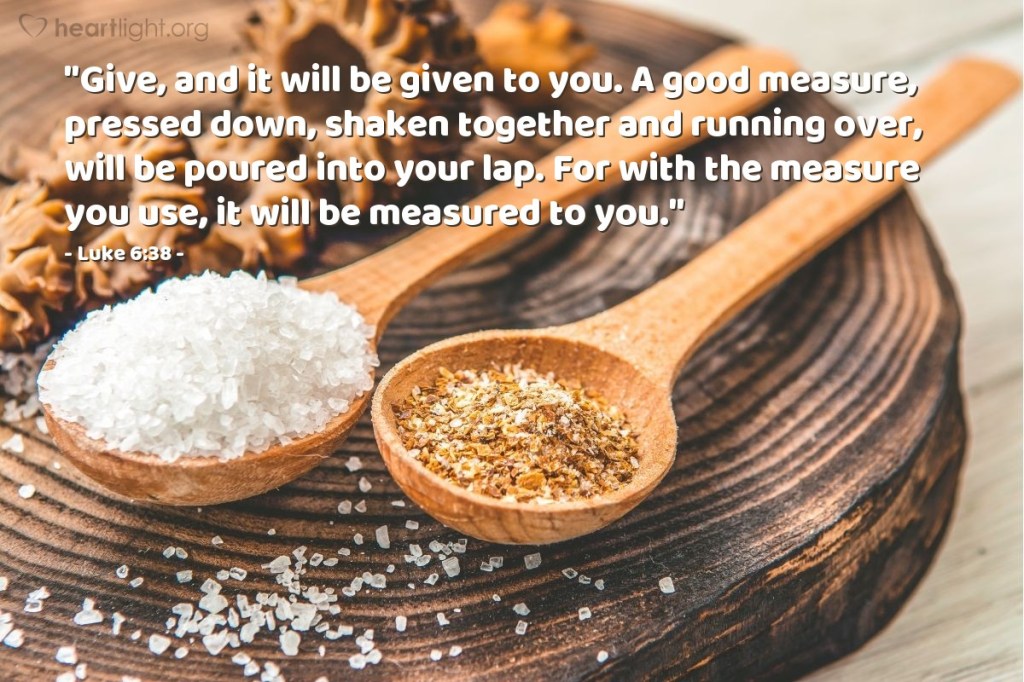
The man, Rabbi Jesus said to those disciples; Give, and it will be given to you. A good measure, pressed down, shaken together and running over, will be poured into your lap. For with the measure you use, it will be measured to you.

This morning as I studied for this devotional offering, I made an interesting discovery. Although this saying of Jesus is very well-known, it is not often discussed. In looking through several commentaries, I generally found not more than one or two sentences devoted to this verse. And I couldn’t find any based entirely on Luke 6:38. In general, I observed verse 37 always attached.

I find that intriguing since most of us have known these words for many years.

If you attended Sunday School as a child, you probably memorized these words.

Perhaps you have them cross-stitched and framed in your kitchen or you may have them on a plaque on or above your desk. Many people who don’t know much about the Bible have heard this phrase: “Give and it will be given to you.”

This verse isn’t as famous as the Golden Rule, but it’s close.

Yet we rarely examine these words closely. They have become a proverb or a Christian motto that we repeat without thinking. This morning I would like to discuss what these words really mean and how they apply to our lives today.

Luke 6:38 is a call for “Christian liberalism.” That in itself is unusual because many churches are quite conservative in their theology. We make no bones about what we believe in almost every area. We are unashamedly conservative when it comes to the great moral issues of the day. We are not moderate nor are we middle-of-the-road. We are strongly conservative in doctrine and morality.

All that is well and good, but it doesn’t encompass every aspect of the Christian life. There are time and places where liberalism ought to be the rule of the day. One of those areas is 100% Radically Encouraged, Radically Motivated Christian giving. In our text Jesus calls on his disciple to be liberals in the area of giving.

I. The Promise Jesus Made

Let’s begin by taking a look at the background of this promise.

Luke 6:27-36 NKJV

Love Your Enemies

27 “But I say to you who hear: Love your enemies, do good to those who hate you, 28 bless those who curse you, and pray for those who spitefully use you. 29 To him who strikes you on the one cheek, offer the other also. And from him who takes away your cloak, do not withhold your tunic either. 30 Give to everyone who asks of you. And from him who takes away your goods do not ask them back. 31 And just as you want men to do to you, you also do to them likewise.

32 “But if you love those who love you, what credit is that to you? For even sinners love those who love them. 33 And if you do good to those who do good to you, what credit is that to you? For even sinners do the same. 34 And if you lend to those from whom you hope to receive back, what credit is that to you? For even sinners lend to sinners to receive as much back. 35 But love your enemies, do good, and lend, [a] hoping for nothing in return; and your reward will be great, and you will be sons of the Most High. For He is kind to the unthankful and evil. 36 Therefore be merciful, just as your Father also is merciful.

It helps to know that this is part of the famous Sermon on the Mount. You can find the longer version in Matthew 5-7; the shorter version is found in Luke 6.

Our text is part of a larger section that begins in verse 27 and stretches through verse 38.

All 12 verses deal with the area of human relationships, especially the vexing question of how to deal with difficult people.

I read, pray, and understand these “Beatitudes” primarily in two ways:

The man, Rabbi Jesus is encouraging us, and trying to motivate us to be

First as: “Radically Motivated Love in Action”

Second as: “Radically Motivated through acts of Christian Kindness.”

Jesus begins with 5 staccato commands:

Love your enemies (27)

Do good to those who hate you (27)

Bless those who curse you (28)

Pray for those who mistreat you (28)

Give to everyone who asks you (30)

His teachings climax with the Golden Rule in verse 31: “Do to others as you would have them do to you.”

In Jewish law this was often found in the negative, “Do not do to other what you do not want done to you.”

However, by now stating the command positively Jesus offered a revolutionary, pro-“God” active way of encouraging, motivating and treating others. We are not simply to avoid retaliation; we are to treat others as we want to be treated.

The next few verses give us 5 encouraging reasons for these radical commands:

1. You must go beyond what sinners do 32-34

2. You will win a great reward from God 35

3. You will prove to be the sons of God 35

4. You will reflect God’s character 36

5. You will be treated as you treat others 37

To Market, To Market

That brings us to our key verse.

In order to grasp the meaning, we need to know that it is set in the context of a Middle Eastern market where the buyers and sellers would haggle together or prices, quality, and amount.

It is a scene often repeated in Third World countries today.

Farmers bring their grain—wheat, corn, barley—and spread it on a mat on the ground. Potential customers examine the grain, they make an offer, and the haggling begins. When a price is finally set, the customer offers his container—usually a large bowl or pot—and the seller uses a scoop to fill the container.

It’s exactly at this point that the process becomes really fascinating. In Jesus’ day there were basically four stages of measuring grain for a given customer:

First, the seller fills the container to the top.

Second, he presses the grain down and fills some more.

Third, he shakes the container so the grain will settle and then fills some more.

Finally, he fills the container until it overflows.

The seller would catch the overflow grain and pour it into the pouch of his robe.

That pouch acted as a kind of carry-all bag so the man or woman could bring food home from the market.

In short, Jesus is describing a situation that took place every time a person went to market. It’s unusual to us because everything we buy at our supermarkets is already precisely measured, vacuum sealed, and wrapped up with shrink wrap.

It’s also very carefully labeled on the outside “Contents sold by weight not by volume.” But in Jesus’ day grain was sold by volume not by weight. That’s why the verse mentions that the grain was pressed down and shaken together.

What Does It Mean?

With that as background, we may ask the simple question:

What precisely is Jesus teaching us here about Christian giving?

I think there are two simple answers to that question.

1. When you give, God gives back to you

2. God uses the same measure you use!

Or to put it in modern terms …

If you are stingy, God will be stingy in return!

If you are generous, God will be generous in return!

Before I go any further, let me say that I realize this teaching may not be often heard, preached or taught in all church circles. For diverse various reasons this teaching is more likely to be found in other kinds of evangelical churches.

You may in fact wonder if I am interpreting this verse correctly. Before you jump to any conclusions, Let’s take a look at the most famous teaching in the New Testament regarding Christian giving, 2 Corinthians 9:6-11.

Remember this:

Whoever sows sparingly will also reap sparingly, and whoever sows generously will also reap generously. That’s a principle drawn from the farm. Sow a little, reap a little. Sow a lot, reap a lot.

Each man should give what he has decided in his heart to give, not reluctantly or under compulsion, for God loves a cheerful giver. That’s the application to all of us. When we give our offering, we do not have a gun to our heads as the plates are being passed. That would not be legal, and it would not be moral or ethical.

We want people to give because they want to, not because they have to.

Four “Alls”

And God is able to make all grace abound to you, so that in all things at all times, having all that you need, you will abound in every good work. Notice the word “all” is repeated 4 times in one verse.

“All grace”—that’s the source

“All things”—that’s the extent

“All times”—that’s the duration

“All that you need”—that’s the result

This is God’s promise to those who dare to become generous givers.

You will have everything you need.

Maybe not everything you want, but God will not let generous givers go unrewarded.

As it is written:

Psalm 112:8-9 NIV

Their hearts are secure, they will have no fear;
    in the end they will look in triumph on their foes.
They have freely scattered their gifts to the poor,
    their righteousness endures forever;
    their horn[a] will be lifted high in honor.

Now he who supplies seed to the Sower and bread for food will also supply and increase your store of seed and will enlarge the harvest of your righteousness.

You will be made rich in every way so that you can be generous on every occasion, and through us your generosity will result in thanksgiving to God.

Here God makes a very plain promise.

If you need more seed, he’ll give it to you. God will make you rich in every way so that you can be generous on every occasion.

Have you ever heard an appeal for money and felt like you wanted to give, but just couldn’t afford it? Perhaps the call came from a ministry or mission you greatly respect or from a school you support or from a church you greatly love.

Perhaps you know of a need and wish you could do something about it.

“You Go First!”

What do you do when you are running short on money but see a need and you want to get involved? I believe the answer is clear. You give whatever you can and trust God to take care of you. It may not be a lot. Indeed, it may be very small. The amount doesn’t matter. What matters is the attitude of the heart.

Both in Luke 6:38 and 2 Corinthians 9:6-11, God specifically promises to take care of generous givers. And he promises to give back to you in accordance with the measure of generosity you use in your “heart” giving in the first place.

In essence, God says, “You go first.” We don’t like that. We want God to go first.

We say, “You give me the money and then I’ll give.”

God says, “I’ve given you, my Word. Isn’t that enough?”

“Well, your Word is nice, but I’d like some cash to go along with it.”

To all our bargaining, God says, “Trust me. You give and I’ll take care of you. And I promise you’ll never be disappointed.”

II. The Principle Behind the Promise

Now that we (prayerfully) better understand what Luke 6:38 means, it’s very important to understand the principle behind the promise.

Everything Jesus says rests in the character of God. When Jesus said, ‘It will be given to you,” he based that promise on the truth of who God is.

He is a generous, benevolent God who loves to give good things to his children.

Because it is in his nature to give, he will always give more to us than we will to him. This to me is the First Law of Christian Giving. You cannot out-give God

In just a few weeks we will gather to celebrate Pentecost.

As we each prepare our heart, consider the first three verses of Psalm 103—The Thanksgiving Psalm—from the King James Version:

“Bless the LORD, O my soul: and all that is within me, bless his holy name. Bless the LORD, O my soul, and forget not all his benefits.”

I love that last phrase. What a wonderful command for celebrating this season of the year: “FORGET NOT ALL HIS BENEFITS!”

If we’ve forgotten them already, David lists five of them for us in verses 3-5.

1. He forgives all your sins

2. He heals all your diseases

3. He redeems your life from destruction

4. He crowns you with love and compassion

5. He satisfies your desires with good things

Soon, as we get closer to Pentecost, I hope to begin an interesting bit of Bible study. Taking my concordances and commentaries, I will attempt to list all the things the Bible says that God encourages and motivates his people to give.

I may never finish the study because the list is too long. You would have to read the entire Bible verse by verse to find everything that God gives his children.

But I do pray God grants me the gift of His wisdom and time to at least make “substantial headway, edifying His Kingdom,” in the spread of His Gospel.

A Short List of God’s Gifts

But here’s a short list of God’s gifts I pray I can give some justice to:

victory, peace, hope, life, success, what is good, wisdom, knowledge, understanding, strength, health, discretion, wealth, honor, power, love, children, a heart to know him, songs in the night, joy in the morning, answers to prayer, food to the hungry, water to the thirsty, rest to the weary, good gifts to those who ask, eternal life, living water, all things, a spirit of unity, the new birth, the crown of life, the light of heaven, and the Word of God.

It will require a good deal of stretching myself where I have not been before.

But I am encouraged and motivated by my Savior’s radically generous words.

And what is his greatest gift? Is it not found in the greatest verse, John 3:16?

“For God so loved that he gave his only begotten Son, that whosoever believeth in him should not perish, but have everlasting life.” God so loved that he gave. The whole truth of the gospel is in those six words.

That’s the Kind of God He Is

Have you ever wondered why God loves sinners? Or have you ever looked in the mirror (especially after doing something really radically backwards) and then saying, “If I were God, I wouldn’t love a person like me.”

Most of us have had that experience because most of us have fouled up in a major way and felt ashamed and embarrassed many times. Deep inside we doubt God’s love for us because we know the truth about who we really are.

Why does God love people like you and me?

I know of only one answer to that question.

He loves us because that’s the kind of God he is.

It’s in his nature to love sinners and (I saw this reverently) he could not stop loving us even if he wanted to. His love for us is so eternal and his character so faithful that his love does not depend on anything we say or do. He loves us just the way we are because that’s the way he is.

Four Facts to Remember

How does this truth about God’s character apply to motivated Christian giving?

Let me suggest four answers.

1. You can’t out-give God

2. God will be no one’s debtor

3. He invites us to trust his Word

4. He challenges us to put him to the test

When God says, “You go first,” we say, “No, you go first.” “But I did go first,” he replies, “I went first when I gave my Son to die on the cross for you.”

God’s Goodness and Our Giving

What does all this have to do with our giving?

You may agree with everything I have just said, still wonder what this has to do with highly encouraging, highly motivated, highly ‘generous’ Christian giving.

I will offer these two answers to that question.

1. Generous givers are not the people with a large bank account, but the people with a large view of God.

Mark 12:41-44 NRSV

The Widow’s Offering

41 He sat down opposite the treasury and watched the crowd putting money into the treasury. Many rich people put in large sums. 42 A poor widow came and put in two small copper coins, which are worth a penny. 43 Then he called his disciples and said to them, “Truly I tell you; this poor widow has put in more than all those who are contributing to the treasury. 44 For all of them have contributed out of their abundance; but she out of her poverty has put in everything she had, all she had to live on.”

We often look at people who give generously and think, “They must be rich.”

But it is not so. Poor people are often very generous and rich people can be very stingy. Generosity has nothing to do with how much money you have. But it has everything to do with your view of God, whether you believe the tomb is empty

If your God is big, you will be generous. If he is small, you will be stingy.

If you struggle with your giving, it may be because your God is too small. The bigger your God, the emptier the tomb, the easier it will be for you to give.

2. When we give generously, we do so because we truly believe God will reward us one way or the other.

Note what the text says, “Give and it will be given to you.” Not might be given or may be given or could be given but will be given.

Our only problem comes with our interpretation of the nature of God’s reward.

Too often we focus on money or material gain as if there were the only way God could reward us.

But 2 Corinthians 9 speaks of receiving a bountiful “harvest of righteousness.”

God’s blessings are often material, but his absolute best blessings cannot be added up on anyone’s pocket calculator.

Luke 2:25-32 NRSV

25 Now there was a man in Jerusalem whose name was Simeon; [a] this man was righteous and devout, looking forward to the consolation of Israel, and the Holy Spirit rested on him. 26 It had been revealed to him by the Holy Spirit that he would not see death before he had seen the Lord’s Messiah. [b] 27 Guided by the Spirit, Simeon[c] came into the temple; and when the parents brought in the child Jesus, to do for him what was customary under the law, 28 Simeon[d] took him in his arms and praised God, saying,

29 “Master, now you are dismissing your servant[e] in peace,
    according to your word;
30 for my eyes have seen your salvation,
31     which you have prepared in the presence of all peoples,
32 a light for revelation to the Gentiles
    and for glory to your people Israel.”

So how does God reward his generous children?

–Might be with money

–Mighty be with answered prayer

–Might be with deep inner joy

–Might be with new friendships

–Might be with more opportunities to give

–Might be with a new revelation of His power in our lives.

–Might be with amazing miracles

–Might be with the peace that passes all understanding.

-Might be with HIS vision of a Tomb that is Undeniably EMPTY!

In the name of God, the Father and God the Son and God the Holy Spirit,

Let us Pray,

Lord, my guide, my guardian and my teacher, I’m often confused when I need to make important decisions about my work, my relationships, my health, or finances. Show me the way I should go when I don’t know which way to turn. Help me remember to come to you, rather than trying to figure everything out on my own. Guide me along the best pathway for my life. Advise me and watch over me. Help me to listen to your guidance and not resist it. I thank you that your unfailing love surrounds those who trust you. Alleluia! Alleluia! Amen.

https://translate.google.com/

So, Have I Not Commanded You? Be Strong and Courageous! Joshua 1:9

We all face situations in life when we feel scared and alone. We are in that pit of indecision. “Do I stand still and do nothing – Am I a Coward?” or “Do I stand my ground as David did before his Goliath?” “Do I go forward?” or “Do I retreat?” “Do I stay in the pit I have probably dug for myself or fight, claw my way out?”

“Do I turn to the right or to the left?” “Do I take out my compass?” “Do I stand firm in the faith, hope, love and trust of my Savior Jesus Christ?” “Do I stand upon the power, presence of God as revealed through His Word?” Or do I just choose: “talk a great game when I need to because I’m waiting for another to come along and give me a vaccination against the call of God for my lifetime?

Many tough and very legitimate questions believers and non-believers alike are confronted by. However, we can all take some measure of courage from what today’s Bible verse offers our tendency to commit to a course of timidity. We don’t have to be scared or dismayed because the Lord is with us wherever we go.

One too many times, we can want to turn away from situations that seem scary or overwhelming. such as the calling God has placed into our hearts. However, we can face those situations with confidence when we begin believing what this verse says. We begin to believe that we’re not alone and that we’ve got God with us wherever we go we can face any situation. We’ve got God’s help on our side!

Joshua 1:1-9 Holman Christian Standard Bible

Encouragement of Joshua

After the death of Moses the Lord’s servant, the Lord spoke to Joshua[a] son of Nun, who had served Moses: “Moses My servant is dead. Now you and all the people prepare to cross over the Jordan to the land I am giving the Israelites. I have given you every place where the sole of your foot treads, just as I promised Moses. Your territory will be from the wilderness and Lebanon to the great Euphrates River—all the land of the Hittites—and west to the Mediterranean Sea. [b] No one will be able to stand against you as long as you live. I will be with you, just as I was with Moses. I will not leave you or forsake you.

“Be strong and courageous, for you will distribute the land I swore to their fathers to give them as an inheritance. Above all, be strong and very courageous to carefully observe the whole instruction My servant Moses commanded you. Do not turn from it to the right or the left, so that you will have success wherever you go. This book of instruction must not depart from your mouth; you are to recite[c] it day and night so that you may carefully observe everything written in it. For then you will prosper and succeed in whatever you do. Haven’t I commanded you: be strong and courageous? Do not be afraid or discouraged, for the Lord your God is with you wherever you go.”

The Word of God for the Children of God. Gloria! In Excelsis Deo! Alleluia! Amen.

There he was, a summer camper, about halfway up a 100-foot-high rock face.

He started the climb with plenty of self-confidence, but now his palms were sweating, calves were quivering, and fingertips were slipping. He looked down, confirmed the instructor was definitely right when he said not to look down.

How much longer could he hold on?

One of the main reasons he came to rock-climbing camp was to show to his friends exactly how “strong and courageous” he was. He thought they’d all be suitably impressed when he “scampered up the rock wall like a mountain goat chugging a gallon of energy drink.” And now everything was coming unraveled.

Joshua 1:9 These ancient words speak to us today, “Have I not commanded you? Be strong and courageous. Do not be frightened, and do not be dismayed, for the Lord your God is with you wherever you go.” What are they saying to you now?

Rock climbing takes a good healthy dose of both strength and courage. And God definitely calls us to be “strong and courageous.” In fact, He repeats it 3 times!

In fact, in this verse, he COMMANDS it. That’s no mere polite suggestion. If you believe in God, it should inspire confidence and courage for everything you face! Ah, but here’s the catch: This whole “strong and courageous” thing isn’t really about rock climbing, and it isn’t about your strength and courage.

Notice what this verse says is the basis of our strength: “for the Lord your God is with you wherever you go.” This verse is not describing a kind of strength and a courage that’s based on our own ability to be “strong and courageous.”

No, it’s an invaluable lesson on character building and development: strength and courage based only on who God is; on how strong and courageous HE is.

Like when the neighborhood bully was about to give you a new “lesson in life” (so nice of him), but as the lesson was to begin, you both saw your dad coming.

A new surge of strength and courage rushed over you, not because you were suddenly bigger and stronger, but because of the strength and courage of your dad, and you trusted in that. That’s the kind of “strong and courageous” this verse is talking about. This kind of courage is based on something stronger than us: Something significantly, immeasurably, undeniably stronger outside of us.

Back to our climber left dangling on the rock face. At just about the point, he was going to give up, the guide yelled down “I’ve got you! Just sit back in your harness and take a break: lean into the strength of the rope.”

See, he began the ascent by strapping into a harness and attaching that to a rope so that he couldn’t fall. He leaned back on the rope for a moment. His legs stopped shaking. Arms stopped quivering. His toenails recovered. He realized he was safe. He couldn’t fall. Even if he slipped. He was soon able to relax himself, regain his strength and footing and his courage and continue up the mountain.

When you encounter the difficult trials of life, you can try to lean on your own strength and courage for some measure of time and long concourse of seasons, but there comes a point you need something stronger than yourself to continue.

Lean into the strength and the courage and the wisdom of the Lord.

Lean into the promises and truths of the Word of God.

Use God’s Rope, His Knot, Live Life Upheld by God – Ecclesiastes 4:9-12

Who do you think of when you think of someone who is modeling “strong and courageous?” What person comes to mind? How do you want to be like them? What do you think is their main source of strength and courage? What area of life do you feel like you need a healthy injection of strength or courage today? 

In the name of God, the Father and God the Son and God the Holy Spirit,

Let us Pray,

God, My Father, we all face situations every day when we need strength and courage. And we are often too tempted to lean on our own strength and courage, to depend on ourselves. Help us to look unto you first and foremost and to lean upon the strength and courage of who you are in every situation. Give us your strength and courage to boldly trust you completely to meet our every need. I pray this in the strength of the name echelons above all other names – Jesus Christ, My Life, My Lord, My Rock of My Salvation! Alleluia! Alleluia! Amen.

https://translate.google.com/

A Father to the Fatherless. What to Believe When “Dad” Walks Away? What to Believe of God, our Father?

I remember back to my earliest days of Sunday School when the subject of the day was Prayer. The question was raised by one of the other children who asked the teacher: “How do you converse with God?” The Sunday School teacher said, “As you talk with your daddy and your daddy talks to you, you talk with God.”

At five years old, I responded in return, “When I talk to my daddy, my daddy always removes both of his hearing aids, and then he stops talking to me.”

Psalm 68:5 has recently taken on a whole new meaning to me. The God of the universe–The one who created me, knitted me together in my mother’s womb, and despite all of my gravest faults and failures and also my father’s faults and failures, preserved me through my “fatherless” empty childhood–is also a true father to the fatherless! Let’s think about that for a second; I can probably think of so many other things that He could be doing, seeing that He is God and all.  

But no, He’s a model dad! He’s the one who kisses every boo-boo, cradles us in the big, perfect hug that only a genuine father has and can, and always has the best stash of band-aids and words to make the pain of an empty childhood go away. It’s probably a good thing Iam not God because I highly doubt, I would take time for knowing of those simple things. But I am very thankful He does.

Psalm 68:5 Holman Christian Standard Bible

God in His holy dwelling is
a father of the fatherless
and a champion of widows.

The Word of God for the Children of God. Gloria! In Excelsis Deo! Alleluia! Amen.

Reverend Dr. A.W. Tozer says, “What comes into our minds when we think about God is the most important thing about us” (The Knowledge of the Holy). What we think about our heavenly Father says a whole lot about who we are.

But what if our thoughts about our heavenly Father are entangled with and stained by the abuse and abandonment of our earthly father? Anyone who has experienced the acute pain of dad walking out knows it can be all-consuming.

I have, and I know. Dad, greatly afflicted by the harsh memories of the Korean War, copious amounts of alcohol and severe hearing loss made worse by war, stole the thing I believed to be indestructible, superhuman even: my family.

But family turned out to be more fluid than I once thought . . . and hoped. Like a permanent smudge on the lens through which we see the world, the dissolution of the family distorts all that we know and all that we are. Our hearts beat out of rhythm. Our thoughts weigh heavier upon our minds. Our tears flow faster. The only voice that once calmed us in the middle of the night is suddenly silent. The picture frame that preserved our family on the wall is either gone or it is empty.

Instinctively human beings have a need of a loving and compassionate father, who will feed us when we are hungry, love us when we are lonely, and care for us when we are crying. We long for a “smiling” dad, who will listen to us when we have questions, encourage us when we are discouraged, and discipline us when we do wrong. A father who cares and also takes time with the little things, who extends wisdom when we are concerned, and who most of all prays and seeks to know, understand God’s will and direction before acting on his own.  

God placed within us a desire to be loved by our father. Some fathers do well, and others do not. Some are extremely successful, and others fail miserably. 

Warped by such confusion and despair, just how do we paint accurate, biblical portraits of our Father’s goodness and faithfulness? When our fathers turn off their hearing aids or remove them from their ears instead of listening to their children, we’ve a very much harder time seeing who God promises to be for us.

The Bible articulates the truth we need, but believing the Bible isn’t always so easy either. When advice seems too thin, though, and life too cruel, God’s word is the only truly reliable brush for the suffering, painting fresh strokes of God’s character onto the marred canvas of our hearts and experience.

He draws near unto, the brokenhearted and ready to care for you, his precious son or daughter. (Psalm 34:18)

Fortunately, God is the perfect model of a faithful father, and He fills the gaps left by our earthly father as we seek Him each day. Therefore, we should listen to Him and honor Him in everything that we think, say and do.

Fathers need to learn to have a relationship with God, even if they did not or do not have a relationship with their earthly father. This is fully realized through the reading, studying and understanding of the Scriptures, where a father will gain and grow in wisdom, grace and the ability to raise kids to the glory of God.

Fathers, who accept God as their #1 penultimate Father, which also have made Jesus Christ their Lord and Savior are God’s children and learn from Him and in turn, unhesitatingly, teach their children the truths and treasures of the Bible.

1. Your Father will never leave you.

No one wants to suffer through the absence of a father who might walk away or remove their hearing aids from their ears at any moment. It’s agonizing riding the bus home from school wondering if dad’s truck will be in the driveway, if his clothes will still be in the closet, he will listen to you with both hearing aids.

God does not leave us in that suspense. God is deeply, unshakably committed to fathering you. You never have to ask whether he will stay or leave or listen. God himself promises, “I will never leave you nor forsake you” (Hebrews 13:5). He will hear our cries, our pleas from the furthest reaches of eternity (Psalm 18:6-19).

No matter what you’ve been through with your father, if you are God’s child through faith, he promises to never pack up his suitcase and leave you peering out from the kitchen window. In the middle of your loneliness, God is 10000% right there with you (John 14:16–18). Even when your earthly dad is somewhere else, God will not forget or neglect the commitment He has made unto you.

2. Your Father will protect you, not hurt you.

Sadly, some fathers hinder and hurt, rather than help. They bring pain, rather than protection. As a child, even into adulthood, you may have suffered both physical and emotional pain because of your dad. Your home wasn’t a safe place for you. Instead, it was a “Roman” arena of anger, tears, fears and uncertainty.

Pray! Take hope: your Father in heaven will never hurt you like this.

He will always protect you, keeping you safe from attacks against you. His hand of protection is unmoved and never tires.

Even when he must discipline us, he introduces pain in grace and love, and for our greatest good (Proverbs 3:12).

No matter what dangers you face, God remains an unparalleled source of safety and help. He will not let danger overtake you (Isaiah 43:2–3). 

He is a Father of ceaseless comfort and protection, not of terror and abuse.

3. Your Father knows what you need.

In a single-parent home, provision for the family can be a daily struggle and anxiety. Meals uncertain. Clothes borrowed. Aren’t our parents supposed to provide for our basic needs? When dad is gone, and with him a major source of income, when dad stops hearing and listening to their children, we must fight to see through the fog and fight to trust that God remains faithful to provide.

His resources never end (Psalm 50:10). He loves to provide for you, because you are a great delight to him. Your most fundamental needs will always ultimately be met in your heavenly Father (Philippians 4:19), not your earthly parents.

Even when Adam and Eve, God’s very first children, disobeyed, not only did God clothe their nakedness and also cover their shame, he promised us the ultimate provision of Christ for their sin, as well as for our sin (Genesis 3:1521). In Jesus, the Father has not left us wanting. He promises to eventually provide an eternal home, one where his children will never be crying or wanting (John 14:1–3).

4. Your Father takes great delight in you.

Without any love or encouragement from our dad, we can too easily question whether we are even loved at all. It’s normal to wonder how much we are worth, whether we’re a source of pleasures or problems for others.

But where our dad might be absent and silent, God has spoken. God affirms that we always and forever bring him great delight. He says, “You are precious in my eyes” (Isaiah 43:4). As His Children, we are a unique source of pleasure for him.

Rest in this: you and I are a constant delight to God, not because you, I, bring something to him, but because he loves us freely. He showers us with shouts of deliverance, love, and gladness (Zephaniah 3:17).

Questioning whether you are a delight to your dad is a real insecurity for many. It may be excruciatingly hard to believe that you are loved, but your heavenly Father does not ever leave us in doubt. If we are his, we are infinitely loved!

5. Your Father does not love you because of you.

Those of us who have watched dad remove his hearing aids, watched dad walk away have wrestled with trying to earn our father’s love and affection. Maybe we fight for the merits of academic or athletic success. This was my hardest fight as a young son, deeply desiring the unhindered love and affection of my dad. Whatever the perceived standard may be, it’s no way to live as a child.

Thankfully, our heavenly Father’s love for us is not conditional.

He does not love us based on our successes. Instead, God loves us because he loves us. That’s who he is. Even when we’re disobedient and rebellious, his love covers us. Even when we run away from him, he patiently waits for us to come home — a Father ready to wrap his arms around you, kiss you, and shower you with forgiveness and grace (Luke 15:20–24).

As it is truly written somewhere, there is more mercy in God than sin in you.

God reached out to you in great love when you were at your worst, not your best (Romans 5:6–8).

Child of God, LIVE! Run freely into your heavenly Father’s embrace, trusting the Father’s arms to hold you because his Son’s arms were stretched out for you on the cross. He is a living hope for the defeated, abandoned and forsaken, a refuge and a haven like no other can ever be for the fearful, a Father to the fatherless.

Our earthly fathers deserve respect. Our heavenly Father deserves our respect, commands our maximum love because He is always there, totally trustworthy.

What God says, He does. God our heavenly Father, will not let us down, He knows what we need and when we need it. At times it may feel as if He is not with us, but He is. He is probably speaking but we are not listening. Or is it maybe He is silent because He wants to grow our faith and our trust in Him?

In the name of God, our Father, God the Son and God the Holy Spirit,

Let us Pray,

Great is thy faithfulness, O God my Father; …... Thomas O. Chisolm, 1923

Father may my life, my compassion and my ministry reflect your heart for those who need care and protection and love. Give me eyes to see this need more clearly and a heart to responded more certainly so that your love may be demonstrated through me. In the precious name of my Savior Jesus, I pray.

Lord, today we pray specifically for fathers and fatherhood across our land.

Your Word faithfully teaches fathers to bring up their children in the discipline, instruction of the Lord (Ephesians 6:4). God, we do thank You for the men who are leading their families according to Your statutes and the ones that are laying their lives down for Your purposes.

We pray You will continue to use these men to lead their families and other men. We pray You will strengthen the fathers of our nation and that You will continue to empower churches, organizations, and individuals to 100% invest in fathers, fatherhood for the sake of Your children. Gloria! In Excelsis Deo! Alleluia! Alleluia! Alleluia! Amen.

 https://translate.google.com/

Abounding, Abundant, Faithfulness is the True Keys to God’s Blessings. Wisdom From: Proverbs 28:18-22

In this devotional for today I am seeking to bless your life, shake up, and stir up your affections for God, today we’re going to look at the blessedness of God’s faithfulness and how we ourselves can express our gratitude to God, revealing it, returning it and sharing it. You and I can have faith, because God is faithful. His faithfulness lays the foundation for our faithfulness. We need to love him, follow him, walk with him. May God draw us closer to him and give us a greater measure of His faith today as we focus on his steadfast love and his faithfulness.

Proverbs 28:18-22Amplified Bible

18 
He who walks blamelessly and uprightly will be kept safe,
But he who is crooked (perverse) will suddenly fall.
19 
He who cultivates his land will have plenty of bread,
But he who follows worthless people and frivolous pursuits will have plenty of poverty.
20 
A faithful (right-minded) man will abound with blessings,
But he who hurries to be rich will not go unpunished.
21 
To have regard for one person over another and to show favoritism is not good,
Because for a piece of bread a man will transgress.
22 
He who has an evil and envious eye hurries to be rich
And does not know that poverty will come upon him.

The Word of God for the Children of God. Gloria! In Excelsis Deo! Alleluia! Amen.

In today’s devotional, we are going to look at six areas of life which too many people are being the most unfaithful and what does the Bible say about it. Be faithful to God in these areas, you surely, certainly will unlock his blessings.

1. Being Faithful to God and His Word

A. In such times as these, all of us are forced to wait at certain times of life and waiting is a time when our faithfulness is put into test. If we are faithful, we will wait upon the Lord for sustenance, not anything or anyone else, (Psalm 62:5).
B. We need to be faithful to God’s word also. We are to devote ourselves to it on a daily basis. We are to live it in our heart so that we will not sin, (Psalms 119:11).
C. God will surely, certainly bless when we delve into, when we abide, and we abound deeply into his word. Above all we will have his perfect peace, even while living in a world of tranquility, (John 15:7Isaiah 26:3, 1 Timothy 2:15).

2. Being Faithful to the Local Church

A. The local church is every Christian’s spiritual family. God has called us to be a family of One God, One Spirit, and One Baptism. Be fed only by the Word of God (Psalm 19, Psalm 34:8 -10, Psalm 119, Proverbs 1, 8, 16:24, Proverbs 22:6)
B. Faithfulness to one’s local church is best expressed by his obedience to his precepts and teachings. Love God, Neighbor and self. Respect their ideologies and the nuances of their various and diverse theologies, biases and prejudices are irrelevant and immaterial and unnecessary (Acts 2, Galatians 3:25-29)
C. Always support each other in ministry, as we all labor for the Kingdom of God, in our tears and in sweat, (1 Thessalonians 5:12-131 Timothy 5:17-18).

3. Being Faithful to Your Family

A. Husbands are commanded to love their wives like Christ loved the Church and gave his life for her and wives are told to be subject to their husbands, (Ephesians 5:22-25).
B. Husbands should be faithful to their wives and wives should be faithful to their husbands, (Hebrews 13:4).
C. Children are told to obey their parents in the Lord. It’s a conditional promise. Parents are told not to provoke their children to anger. but bring them up in the discipline and instruction of the Lord, (Ephesians 6:1-4).

4. Be Faithful to Your Finances

A. Plan your budget, expenses with great care, (Luke 14:28-30). Constantly give attention to your financial health, (Proverbs 27:23).
B. Pay your tithe on time. Everything you have belongs to God. But he is asking you to give one-tenth of it back, for the welfare of his servant. He has promised to bless your tithe and told you to test him on it, (Malachi 3:10).
C. Give regularly, in addition to the tithe. Not because God wants your money. Giving is a form of worship. To worship means to surrender your whole self and surrendering your finances is a good place to begin with, (Proverbs 3:9).

5. Being Faithful to One’s Country

A. The Bible commands us to submit to the government because it’s the established will of God, (Romans 13:1). Its authority comes from God alone.
B. The Bible forbids rebelling against the governing authorities. Rebellion against the government is the same as rebellion against God, (Romans 13:2).
C. God is in control of all. The Bible also urges us to pray for those who govern, (1 Timothy 2:1-4).

6. Being Faithful at the Work Place

A. We are to obey our employers in the Lord. Means we should obey them, as long as their wishes don’t contradict God’s word, (Ephesians 6:5).
B. Don’t steal from your employer or deceive him. We should work for our employers as if we are working for God, (Ephesians 6:8).
C. Employers should treat their employees with respect. God will judge the employer that that oppresses his employees, (Ephesians 6:9).

Conclusion

You and I were never meant to live life apart from the knowledge of God’s faithfulness. You and I aren’t meant to live with the weight of doing life on our own. Man may fail you, but your God will not. Family and friends may not be there when you need them the most, but your God will always be there for you.

Where do you feel on your own?

In what ways do you need a fresh revelation of God’s faithfulness?

He promises to be true to you.

He promises to see you through any situation you find yourself in. 

Isaiah 54:10 says, “‘For the mountains may depart and the hills be removed, but my steadfast love shall not depart from you, and my covenant of peace shall not be removed,’ says the Lord, who has compassion on you.” 

Faithfulness is foundational to the very character of God. God’s steadfast love for you is surer than the very ground you walk on.

So, respond to God’s faithfulness today. Let his promises steady the parts of your life that feel unsure. As you step outside today, take time to look at the world around you. Think about the things you’ve put your trust in.

And remember, God promises that his faithfulness will outlast anything your eyes can see. May your affections for him be mightily shaken and stirred today.

May you all come to respond to his faithfulness with your own. And may you experience the love and joy of a Father who loves you perfectly and completely.

I want to urge you to search for yourself and know whether you have been unfaithful in any of these areas. Remember, that the one who conceals his sin shall not prosper. But God will restore us if we confess and renounce them, (Proverbs 28:13).

In the name of God, the Father and God the Son and God the Holy Spirit,

Let us Pray,

Help me Lord to follow you with my whole heart. Help me Lord to be faithful to my calling. Help me Lord to fulfil promises I make to people. Let me abound with all covenant blessings in Jesus’ name. Alleluia! Alleluia! Alleluia! Amen.

https://translate.google.com/

Living for Jesus: Don’t Grow Weary in Doing Good to All – Galatians 6:9-10

God’s tireless Prophet Jeremiah enduringly wrote some 2650 years ago; blessed is the man who trusts in the Lord, and whose hope is in the Lord. For he shall be like a tree planted by the waters, which spreads out its roots by the river, and he will not fear when heat comes; but its leaf will be green and will not be anxious in the year of drought, nor will cease from yielding fruit. (Jeremiah 17:7-8 NKJV)

The person who loves God is like a tree with deep roots. During a drought, when all the other trees are perishing, the single tree planted by the river will remain healthy and strong – drawing its nourishment from all the waters flowing by it. There is no anxiety, for the commitment of that single tree reaches far beyond the circumstances, life threatening effects, of the drought which surrounds it.

If we are to succeed in the midst of the swirling circumstances which threaten to continually define and continuously overwhelm our day-to-day existence, and if we are not trying to quit on God or our neighbors or ourselves when the going gets tough, we need to get our roots planted by the rivers of living water steadily flowing forever down unto us from the very throne room of God itself.

We need to set a covenant goal to commit our life unto our Savior Jesus Christ. A covenant commitment which plants, then grows stronger, matures far beyond than what overwhelms us, until only the commitment to Christ remains known.

Galatians 6:9-10 The Message

9-10 So let’s not allow ourselves to get fatigued doing good. At the right time we will harvest a good crop if we don’t give up or quit. Right now, therefore, every time we get the chance, let us work for the benefit of all, starting with the very people closest to us in the community of faith.

The Word of God for the Children of God. Gloria! In Excelsis Deo! Alleluia! Amen.

The major theme of Paul’s letter to the Galatians is that we are saved by faith, and not by works. Yet what I do as a believer is important. True salvation is not just my accepting Jesus into my heart with an eye toward heaven in the future. It is an ongoing relationship with Jesus as my Lord. And that is what is reflected clearly in this closing instruction in Paul’s letter to the churches of Galatia.

Do not become weary in doing good to all. Especially to other believers. We are summoned, “Called to Do Good” But what does that mean to ‘Do Good’?

What Does it Mean to Do Good?

‘Doing good’ is not the same thing as doing no harm. Doing no harm is a quiet passive activity – it is staying seated upon our couches in our living rooms. But doing good is all active. It is something that takes effort on my part. Something that I could grow weary of. And something that is directed toward other people.

Doing good means that when I see an opportunity to help another person, I take it. It may be something simple and with little cost. Or it may be more costly and time consuming too. Doing good simply means that I do what I can to help you.

For God so loved the world, He sent His Son to us to continually love us, not to continuously condemn us. He came unto us that we might find goodness and abundance beyond our ability to comprehend or to receive in one lifetime. This instruction to do commit to a lifestyle of being abundantly good, sharing all of God’s abundant goodness is all inclusive, all of the time, has all people in mind.

Even those who are not believers. And even those that I may not get along with. If I can do good for someone, regardless of my relationship to them, I should.

But it is especially true for those within the family of believers. They are the ones I should care most about. I should actively seek out, look for ways to do good; to be helpful and hopeful and joyous to them. As you live your life with Christ, be doing good to all people, especially within the community of faith.

The simple gospel of grace is to come to Christ and believe – for we are saved by grace alone and not by doing good works, lest any may should boast. But once we do believe and are saved, we should then become a true disciple and take up our cross, follow daily after Jesus – for this is God’s desire for all His children.

If we are going to root ourselves in Christ, if we are to truly grow in grace and mature in the faith, we are to do the good works that God has already prepared for us to do. If we are to mature in the faith and press onward to the goal of our calling, we ought to be living our lives as unto the Lord – and “not lose heart in doing good, for in due time, God’s time, we will reap, if we do not grow weary.”

“Give me one hundred preachers who fear nothing but sin, and desire nothing but God, and I care not a straw whether they be clergymen or laymen; such alone will shake the gates of hell and set up the kingdom of heaven on Earth.”
― John Wesley

“Do all the good you can,
By all the means you can,
In all the ways you can,
In all the places you can,
At all the times you can,
To all the people you can,
As long as ever you can.”
― John Wesley

In the name of God, the Father and God the Son and God the Holy Spirit,

Let us pray,

Loving Father, I want to press on in my Christian life, to become more and more like the Lord Jesus. I know that it will require me to put my hand to the plough and press on, with the patient endurance that only comes from You. I pray that I may not lose heart or fatigue or growing weary in doing the good works which You have prepared for me to do. Thank You that in due time I may reap a fruitful reward, if I do not give up on you. In Jesus’ name, Alleluia! Alleluia! AMEN.

https://translate.google.com/