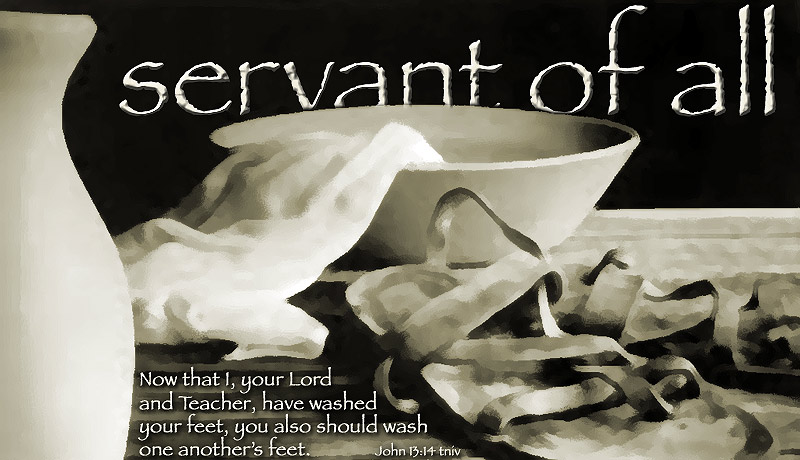
Jesus is Washing His Disciples Feet: Healing is in our Becoming a Servant. John 13:1-17

John 13:1-17 New King James Version

Jesus Washes the Disciples’ Feet

13 Now before the Feast of the Passover, when Jesus knew that His hour had come that He should depart from this world to the Father, having loved His own who were in the world, He loved them to the end.

And [a]supper being ended, the devil having already put it into the heart of Judas Iscariot, Simon’s son, to betray Him, Jesus, knowing that the Father had given all things into His hands, and that He had come from God and was going to God, rose from supper and laid aside His garments, took a towel and girded Himself. After that, He poured water into a basin and began to wash the disciples’ feet, and to wipe them with the towel with which He was girded. Then He came to Simon Peter. And Peter said to Him, “Lord, are You washing my feet?”

Jesus answered and said to him, “What I am doing you do not understand now, but you will know after this.”

Peter said to Him, “You shall never wash my feet!”

Jesus answered him, “If I do not wash you, you have no part with Me.”

Simon Peter said to Him, “Lord, not my feet only, but also my hands and my head!”

10 Jesus said to him, “He who is bathed needs only to wash his feet, but is completely clean; and you are clean, but not all of you.” 11 For He knew who would betray Him; therefore He said, “You are not all clean.”

12 So when He had washed their feet, taken His garments, and sat down again, He said to them, “Do you [b]know what I have done to you? 13 You call Me Teacher and Lord, and you say well, for so I am. 14 If I then, your Lord and Teacher, have washed your feet, you also ought to wash one another’s feet. 15 For I have given you an example, that you should do as I have done to you. 16 Most assuredly, I say to you, a servant is not greater than his master; nor is he who is sent greater than he who sent him. 17 If you know these things, blessed are you if you do them.

The Word of God for the Children of God.

Adeste Fidelis! Venite Adoremus! Dominum.

Gloria! In Excelsis Deo! Alleluia, Alleluia, Alleluia, Amen.

Jesus came to model for us, show us what the Kingdom of Heaven is so we could become a dynamic, functional and living part of it.

Spending time reading the Gospels and studying and praying about who he was is a great way to remind ourselves that of all the rich and transformational ways Jesus is never what we expect but, in every way, is better than our expectations.

The story of Jesus redefining kingdom expectations, of kneeling to the floor and as host, gently handing his disciples feet so all could comfortably dine together is truly one of the most profound pictures of our Savior’s heart of love for us!

Jesus, like His Father in Heaven, cared so very much about the minutest details of his followers’ lives!

He was willing to completely surrender himself to the moment His Father set aside, to move into his destiny, to not shy away from God’s plan, get messy, to reach, teach, and show undeserved compassion to his ragtag group of disciples.

This is still true today!

Jesus cares about even the most minute details of your life and still come to us, still willing to model, set the example get messy to show you that you are loved.

None of your fears are too small, too inconsequential, needs much too silly, or stresses too insignificant or too great that God does not care about them all.

He cares about it all… even our stinky feet!

Jesus’ actions in this passage set an example of what it means to imitate him with our lives.

We are called to be more and more like Jesus every day, without exception, the servant of others, selflessly to live with humility, and love in every situation.

Christ-Followers are called to a selfless life as servant, conduct themselves in a very radical counter-cultural fashion – in unity, healing, instead of dividing.

Let’s learn more about what we can learn from the story of Jesus washing his disciples’ feet at Passover.

Where Does the Bible Talk about Jesus Washing the Disciples’ Feet?

The story of Jesus washing his disciples’ feet is recorded in John 13:1-17.

This event occurred in the upper room during the Last Supper.

In the biblical account, we read that when Jesus’ disciples arrived at a special gathering Jesus took the role of the ultimate servant of the house and humbly surrendered to His Father’s will and began washing each of his disciples’ feet.

This gathering, this time of communion, of the breaking and sharing of the bread, fruit of the vine, would later come to be known as the Last Supper.

It was the last time Jesus and his disciples broke bread together before his death on the cross.

It was during this Passover meal that Rabbi Jesus served as host, took the first communion with the disciples and also quietly identified Judas as his betrayer.

The act of feet washing was a necessary custom during this time period when gathering to have a communal meal.

The men would have come in with their feet dust-covered and dirty from their walking the undoubtedly, the decidedly unhygienic sun baked Roman roads.

Cleaning of the feet would have been necessary because the group would have likely been reclining together at a low table and dirty feet would not be the least bit welcomed so close to their food.

It was the servant of a household’s job to wash the feet of incoming guests.

Why Did Jesus Do This and What Was the Significance of Washing Their Feet?

In the Old Testament, priests performed and received ceremonial foot washings before they entered the temple for worship.

Foot washing was a serious matter: a basin for foot washing would have been placed between the Tent of Meeting and the altar so Aaron and his sons could wash before entering the Tent of Meeting, “Whenever they enter the Tent of Meeting, they shall wash with water so that they will not die” (Exodus 30:20).

Disregarding the ritual cleansing meant death to a priest.

In John 13:4-5, Jesus “got up from the meal, took off his outer clothing, and wrapped a towel around his waist. After that, he poured water into a basin and began to wash his disciples’ feet, drying them with the towel that was wrapped around him.” 

Jesus has placed the basin between the disciples and the altar, His cross.

Through the witness of His death and the testimony of His resurrection, Jesus makes holy all who do come to the cross through the power of the Holy Spirit.

Through Christ’s atoning work on the cross the disciples and all believers are made holy and righteous before God and then cleansed of their sin and set apart by GOD for service in His body, the Church, a holy priesthood of believers.

Jesus set himself aside, washes his disciples’ feet to purify and cleanse them for their service to God: “Unless I wash you, you have no part with me” (John 13:8).

Jesus, knowing his coming destiny, washing the feet of his disciples came with so much significance for both his disciples in this intimate moment and for all Christians who strive to live, to love, to follow Jesus’ example and teachings.

This selfless act displayed Jesus’ amazing humility!

He took the role of a servant to wash the dusty and dirt-covered feet of his disciples.

Rabbi Jesus was setting an incredible example of what it is to be “Christ-like” through his decidedly humble actions.

Status, pride, or even dirt did not stop him from rolling up his sleeves to serve the men who had been at his side throughout the duration of his ministry.

Prior to this encounter, the disciples had been fighting amongst themselves trying to determine who was the “greatest” among them (Luke 22:24).

Jesus was in a very hands-on way showing them that in his Kingdom the last shall be first and the first shall be last (Matthew 20:16).

Jesus even prompts his disciples to show the same heart of service for each other (John 13:15).

He is clear that servanthood is essential to what it means to be his follower.

This washing also is symbolic of the cleansing power of the blood of Jesus to wash away our sins.

Peter objects to Jesus’ actions but then Jesus rebukes him by saying that unless he washed him, Peter had no part in him (John 13:7-8).

Peter then in a display of passion for the Lord asks him to then wash him from head to toe!

Jesus explains Peter does not need to be washed from head to toe because his actions were symbolic of the cleansing power that being a Christ-follower has in our lives (John 13:10).

Once washed by the blood of a lamb you are free from the stains of sin!

Jesus anoints the disciples for their new role as priests in the new temple that God Himself will raise up.

Jesus ordains them so they can serve His church when He leaves this world, returning to the Father.

Through the act of purification, Jesus imparts His holiness to the disciples so they will be set apart from the world even though they will remain in the world.

Jesus teaches his disciples that His holiness, salvation, and purity will all come through Him and His suffering.

Through the cleansing blood of our Savior – No repeat washing is necessary.

Our Healing is in our Becoming a Servant

John 13:14-15 New King James Version

14 If I then, your Lord and Teacher, have washed your feet, you also ought to wash one another’s feet. 15 For I have given you an example, that you should do as I have done to you.

In our culture today, sadly we don’t have an automatic equivalent to Jesus’ instruction to wash one another’s feet.

But we can figure out that it’s mainly about showing hospitality and serving one another.

The roads of Palestine were unpaved, and with sandals as common footwear, people’s feet would get really dirty—sometimes caked with dust and mud.

As a result, before you entered someone’s home, a servant would come with a pitcher of water, a basin and a towel and wash your feet, an act of hospitality.

It was a customary act of hospitality—like someone offering to hang up your coat and scarf on a cold day as you entered their warm home.

On the night of the last supper, Jesus took the role of a servant as he got up from the meal and began washing his disciple’s feet.

In doing this, Jesus was teaching his disciples an important spiritual principle.

We come to Jesus with nothing of our own, and we must receive from him and be ministered to by him before we have anything to give.

Then, having been served, we go and do the same, we surrender ourselves to God, serving, sharing with others the fullness God has poured into our hearts.

In this example, Jesus provided a profound symbol of his call to servanthood.

Following him is not about position, power, or prestige.

We serve because Jesus Christ came to us as sinners, yet he has served us first.

Jesus shows no squeamishness: He performs this ceremonial washing of His disciples’ feet with a solemn purpose – so others may be prepared to serve.

Setting aside their squeamishness to serve all others as Jesus first served all.

Jesus’ determination made me want to explore the Scriptures more deeply.

What Does Jesus Show When He Washes the Disciples’ Feet?

Through this simple act of foot washing, Jesus demonstrates to His disciples His eternal role as God’s High Priest and Mediator and the disciples part in the priesthood.

Even though He, Jesus must suffer and die and be raised again, the disciples can by faith in the empty tomb be certain He will never leave them or forsake them. 

Scripture says, “During the days of Jesus’ life on earth, he offered up prayers and petitions with loud cries and tears to the one who could save him from death, and he was heard because of his reverent submission. Although he was a son, he learned obedience from what he suffered and, once made perfect, he became the source of eternal salvation for all who obey him and was designated by God to be high priest in the order of Melchizedek” (Hebrews 5:7-10). 

Jesus is the High Priest of Heaven.

Through the foot washing, He ordained His disciples to be priests of the church in the world.

1 Peter 2:4-10 New King James Version

The Chosen Stone and His Chosen People

Coming to Him as to a living stone, rejected indeed by men, but chosen by God and precious, you also, as living stones, are being built up a spiritual house, a holy priesthood, to offer up spiritual sacrifices acceptable to God through Jesus Christ. 6 Therefore it is also contained in the Scripture,

“Behold, I lay in Zion
A chief cornerstone, elect, precious,
And he who believes on Him will by no means be put to shame.”

Therefore, to you who believe, He is precious; but to those who [a]are disobedient,

“The stone which the builders rejected
Has become the chief cornerstone,”

and

“A stone of stumbling
And a rock of offense.”

They stumble, being disobedient to the word, to which they also were appointed.

But you are a chosen generation, a royal priesthood, a holy nation, His own special people, that you may proclaim the praises of Him who called you out of darkness into His marvelous light; 10 who once were not a people but are now the people of God, who had not obtained mercy but now have obtained mercy.

Christ, our permanent High Priest, sitting at the right hand of the Father;

He will offer up prayers on their behalf, “he always lives to intercede for them” (Hebrews 7:25), and will empower them through the Holy Spirit to perform their priestly duties to the glory of God. 

3 Lessons from Jesus Washing the Disciples’ Feet

1. God’s Kingdom Works In Reverse Order

Matthew 18:4 says, “Therefore, whoever takes the lowly position of this child is the greatest in the kingdom of heaven.”

Humility, trust, simplicity, joy, full of wonder, and playfulness are all words that could be used to characterize children.

In Jesus’ Kingdom what seems logical to adults oftentimes goes against the way God works. Jesus calls the last to be first (Matthew 20:16).

His Word prompts us to serve one another in love (Galatians 5:13).

The Bible teaches us to humble ourselves before the Lord (James 4:10).

In Matthew 5:38-40, Jesus teaches that when we are wronged not to fight back but to offer our offenders more of ourselves!

All of these ideas go against everything that seems logical, right, or justified in our world!

We live in a world where pride, greed, and ambition rule our systems.

Money talks, looking out for yourself is prized, and caring for those who are hurt so you can get ahead is not often considered.

Jesus intentionally sets an example of how we are to live as his followers through his actions at the Last Supper.

He makes it clear that we are called to be the feet washers of our community.

Our mission as Believers is to be those who love beyond reason every chance we get.

2. Jesus Washes Us Clean

Isaiah 1:18 says, “Come now, let us reason together, says the Lord: though your sins are like scarlet, they shall be as white as snow; though they are red like crimson, they shall become like wool.”

The prophet foretold of the cleansing power of Jesus years before Jesus physically walked the earth.

His followers would have seen the feet washing and the breaking of bread and sharing of wine at the first communion that happened at the Last Supper as symbolic of Jesus’ cleansing power.

When we bring our sins to the Lord he is willing and able to wash us clean.

All Jesus did led up to the work of the cross, where he took the weight of our sins onto himself, so we could be forgiven.

Don’t be ashamed of your “dirty feet” bring all that you are to the Lord and he is willing and able to set you free.

3. Jesus Was Not What the World Expected

Peter was shocked by Jesus’ actions and asked him to stop because in his mind his king and Savior wouldn’t stoop to the level of a feet-washing-servant.

Jesus was not what the world expected.

They were looking for a political liberator, someone who would help restore power to the Jewish people, and they thought their Messiah would be powerful in the same way the world measures power.

Jesus was full of heavenly ability and did many miracles but he never strove for a place of worldly power or influence.

Jesus rebuked the Pharisees (Matthew 23), avoided political confrontation (John 18:10-11), and took the posture of a servant throughout his ministry.

Meanwhile, his disciples were concerned about who would get the best seat in Heaven next to Jesus.

It wasn’t until Jesus’ death and resurrection that the full picture of Jesus as a Messiah as their foretold Savior was fully understood because while on Earth he never did as they were expecting.

When we think of what it means to be a Christ-Follower do our expectations line up with the example of Jesus?

It is easy to put God in a box, thinking he should work in ways that make sense to our worldly sensibilities.

The Bible reminds us that God rarely plays by our rules.

Jesus came to show us what the Kingdom of Heaven is so we could become a part of it.

Spending time reading the Gospels and studying and Praying over who he was is a great way to remind ourselves of all the ways Jesus is never what we expect but, in every way, abundantly, utterly, infinitely better than our expectations.

In the name of God, the Father and God the Son and God the Holy Spirit,

Let us Pray,

“Unless I wash you

you have no share with me.”

If only it were otherwise.

If only I could present my credentials,

show my record of service,

get some kind of unlimited pass.

In every area of my life

I am more used

to proving how adequate I am,

presenting a polished image,

gaining certain privileges.

But you, Lord,

you bring me down

to where you are kneeling,

and take hold

of the feet I prefer to hide.

We are here together,

near the ground,

and in this humble position

I am touched by you

and made clean.

Adeste Fidelis! Venite Adoremus! Dominum.

Gloria! In Excelsis Deo! Alleluia, Alleluia, Alleluia, Amen.

https://translate.google.com/

Countdown to Calvary. We Have Set both our feet inside the Upper Room. The Humility of Love. John 13:1-17

Today is Holy Thursday, also called Maundy Thursday, one of the holiest days in the Church year.  We are in the Upper Room with the man, Rabbi Jesus and his disciples. We will celebrate Passover. We will recite the ancient story and we will sing the ancient hymns all over again. But as we sit with our Rabbi, we become surprised at sone of his words – he takes the bread and says, “this is my body broken for you” and then he takes the cup of wine and says, “this is my blood poured out for you and for many for the forgiveness of sin.” What is all this?

In just a short while, he will raise from the table with a pitcher of water and a bowl and a towel. He kneels at our feet, and as the lowest of house slaves, he washes our feet. Soon after that, he will cry tears of red. We will next watch him be betrayed and arrested and given a sham trial. He will be condemned to die on a Cross he will have to carry on his back and wide across his bloodied shoulders.

He will be raised up, nails hammered into his body to suffer. We will watch him suffer humiliation as no other man ever has in history. We will celebrate the greatest act of love ever performed: Jesus’s death on the cross for our salvation.

But first, in our Gospel text for today, Jesus demonstrates for us the humbled, humbling act of the washing of the disciples’ feet. He is the example for all Christian acts of servanthood, but more importantly, servants of their people.  That being said, this reading really made me think about humility, love and service—not just on this single day of the Christian Calendar but every day.

John 13:1-17Easy-to-Read Version

Jesus Washes His Followers’ Feet

13 It was almost time for the Jewish Passover festival. Jesus knew that the time had come for him to leave this world and go back to the Father. Jesus had always loved the people in the world who were his. Now was the time he showed them his love the most.

Jesus and his followers were at the evening meal. The devil had already persuaded Judas Iscariot to hand Jesus over to his enemies. (Judas was the son of Simon.) The Father had given Jesus power over everything. Jesus knew this. He also knew that he had come from God. And he knew that he was going back to God. So while they were eating, Jesus stood up and took off his robe. He got a towel and wrapped it around his waist. Then he poured water into a bowl and began to wash the followers’ feet.[a] He dried their feet with the towel that was wrapped around his waist.

He came to Simon Peter. But Peter said to him, “Lord, you should not wash my feet.”

Jesus answered, “You don’t know what I am doing now. But later you will understand.”

Peter said, “No! You will never wash my feet.”

Jesus answered, “If I don’t wash your feet, you are not one of my people.”

Simon Peter said, “Lord, after you wash my feet, wash my hands and my head too!”

10 Jesus said, “After a person has a bath, his whole body is clean. He needs only to wash his feet. And you are clean, but not all of you.” 11 Jesus knew who would hand him over to his enemies. That is why he said, “Not all of you are clean.”

12 When Jesus finished washing their feet, he put on his clothes and went back to the table. He asked, “Do you understand what I did for you? 13 You call me ‘Teacher.’ And you call me ‘Lord.’ And this is right, because that is what I am. 14 I am your Lord and Teacher. But I washed your feet. So, you also should wash each other’s feet. 15 I did this as an example for you. So, you should serve each other just as I served you. 16 Believe me, servants are not greater than their master. Those who are sent to do something are not greater than the one who sent them. 17 If you know these things, great blessings will be yours if you do them.

The Word of God for the Children of God. Gloria! In Excelsis Deo! Alleluia! Amen.

The Humbled, Humbling Humility of His Great Love for US! …….

We live in a very proud and egotistical generation.

It is now considered acceptable and even normal for people to promote themselves, to praise themselves, and to put themselves first. Pride is considered a virtue by many. Humility, on the other hand, is considered a weakness. Everyone, it seems, is screaming for his or her own rights and seeking to be recognized as someone important.

The preoccupation with self-esteem, self-love, and self-glory is destroying the very foundations upon which our society was built. No culture can survive pride run rampant, for all of society depends on relationships. When all people are committed first of all to themselves, relationships disintegrate. And that is just what is happening, as friendships, marriages, and families fall apart.

Sadly, the preoccupation with self has found its way into the church.

Perhaps the fastest growing phenomenon in modern Christianity is the emphasis on pride, self-esteem, self-image, self-fulfillment, and other manifestations of selfism. Out of it is emerging a new religion of self-centeredness, pride—even arrogance. Voices from every part of the theological spectrum call us to join the self-esteem cult.

Scripture is clear, however, that selfism has no place in Christian theology.

The man, Rabbi Jesus repeatedly taught against pride, and with His life and teaching He constantly exalted the virtue of humility. Nowhere is that clearer than in John chapter 13.

John 13 marks a turning point in John’s gospel and the ministry of Jesus Christ. Jesus’ public ministry to the nation of Israel had run its course and ended in his complete and final rejection of Him as Messiah.

On the first day of the week, Jesus had entered Jerusalem in triumph to the enthusiastic shouts of the people. Those people nevertheless misunderstood His ministry and His message. The Passover season had arrived, and by Friday He would be utterly rejected and executed. God, however, would turn that execution into the great and final sacrifice for sin, and Jesus would die as the true Passover Lamb.

He had come unto His own people, the Jews, “and those who were His own did not receive Him” (John 1:11). So He had turned away from His public ministry to the intimate fellowship of His disciples.

Now it is the day before Jesus’ death, and rather than being preoccupied with thoughts of His death, sin-bearing, and glorification, He is totally consumed with His love for the disciples. Knowing that He would soon go to the cross to die for the sins of the world, He is still concerned with the needs of twelve men, including his betrayer! His love is never impersonal—that’s the mystery of it.

In what were literally the last hours before His death, Jesus kept showing them His love over and over. John relates this graphic demonstration of it:

Now before the Feast of the Passover, Jesus knowing that His hour had come that He should depart out of this world to the Father, having loved His own who were in the world, He loved them to the end.  During supper, the devil having already put into the heart of Judas Iscariot, the son of Simon, to betray him, Jesus, knowing that the Father had given all things into His hands, and that He had come forth from God and was going back to God, got up from supper, and laid aside His garments; and taking a towel, He girded Himself.  Then He poured water into the basin and began to wash the disciples’ feet and to wipe them with the towel with which He was girded.

So He came to Simon Peter.  He said to him, “Lord, do You wash my feet?”  Jesus answered and said to him, “What I do you do not realize now, but you will understand hereafter.”

Peter said to Him, “Never shall You wash my feet!”

Jesus answered him, “If I do not wash you, you have no part with Me.”

Simon Peter said to Him, “Lord, then wash not only my feet, but also my hands and my head.”

Jesus said to him, “He who has bathed needs only to wash his feet, but is completely clean; and you are clean, but not all of you.” For He knew the one who was betraying Him; for this reason, He said, “Not all of you are clean.”

So when He had washed their feet, and taken His garments and reclined at the table again, He said to them, “Do you know what I have done to you?  You call Me Teacher and Lord; and you are right, for so I am.  If I then, the Lord and the Teacher, washed your feet, you also ought to wash one another’s feet.  For I gave you an example that you also should do as I did to you.  Truly, truly, I say to you, a slave is not greater than his master, nor is one who is sent greater than the one who sent Him.  If you know these things, you are blessed if you do them.” (John 13:1-17)

It is very likely that Jesus and the disciples had been hiding at Bethany during this final week before the crucifixion. Having come from there (or from anywhere near Jerusalem), they would have had to travel on extremely dirty roads. Naturally, by the time they arrived, their feet were covered with dust and Lord knows what else from the road.

Everyone in that culture faced the same problem. Sandals did little to keep dirt off the feet, and the roads were either a thick layer of dust or deep masses of mud. At the entrance to every Jewish home was a large pot of water to wash dirty feet. Normally, foot washing was the duty of the lowliest slave.

When guests came, he had to go to the door and wash their feet—not a pleasant task. In fact, washing feet was probably his most abject duty, and only slaves performed it for others. Even the disciples of rabbis were not to wash the feet of their masters—that was singularly and most uniquely the task of a lowly slave.

As Jesus and His disciples all arrived in the upper room, they found that there was no servant to wash their feet.

Only days before, Jesus had said to the twelve, “Whoever wishes to become great among you shall be your servant, and whoever wishes to be first among you shall be your slave” (Matthew 20:26-27).

If they had given mind and heart to His teaching, one of the twelve would have washed the others’ feet, or they would have mutually shared the task. It could have been a beautiful thing, but it never occurred to them because of their selfishness. A parallel passage in Luke 22 gives us an idea just how selfish they were and what they were thinking about that evening:

And there arose also a loud dispute among them as to which one of them was regarded to be greatest.  And He said to them, “The kings of the Gentiles lord it over them; and those who have authority over them are called ‘Benefactors.’  But it is not this way with you, but the one who is the greatest among you must become like the youngest, and the leader like the servant.” (vv. 24-26)

What a sickening picture this is! They were bickering about who was the greatest. And in an argument about who is the greatest, no one is going to get down to the ground and wash feet. The basin was there, the towel was there, and everything was ready. But no one moved to wash the others’ feet.

If anyone in that room should have been thinking about the glory that would be his in the Kingdom, it was Jesus. John 13:1 says that Jesus knew His hour was come. He was on a divine time schedule, and He knew He was going to be with the Father. He was very conscious of the fact that He soon would be glorified:

“Jesus [knew] that the Father had given all things into His hands, and that He had come forth from God and was going back to God” (v. 3).

But instead of their being more concerned with His glory, and in spite their selfishness, He was totally conscious of revealing clearly His personal love to the twelve that they might be secure in it. They might be a part of His Kingdom.

Verse 1 says, “Having loved His own who were in the world, He loved them to the end.”

“To the end” in the Greek is ‘eis’ telos, and it means this:

He loved to them to perfection. He loved them to the uttermost. He loved them with total fullness of love. That is the nature of Christ’s love, and He showed it repeatedly—even in His death.

When He was arrested, He arranged that the disciples would not be arrested.

While He was on the cross, He made sure that John would give Mary a home and care in years to come.

He reached out to a dying thief and saved him.

It is most amazing that in those last hours of carrying the sins of the world, in the midst of all the pain and suffering He was bearing, He was conscious of that one would-be disciple hanging next to him.

He loves humbly, utterly, absolutely, to perfection, totally, completely, without reservation. At the moment when most men would have been wholly concerned with self, He selflessly humbled Himself to meet the most basic needs of others.

Genuine humble, humbled, humbling love is EXACTLY like that.

And here is the great lesson of this whole account:

Only absolute humility can generate absolute love.

It is the nature of love to be selfless, giving. In 1 Corinthians 13:5, Paul said that love “does not seek its own.” In fact, to distill all the truth of 1 Corinthians 13 into one statement, we might say that the greatest virtue of love is its humility, for it is the humility of love that proves it and makes it visible.

Christ’s love and His humility are inseparable.

He could not have been so consumed with a passion for serving others if He had been primarily concerned with Himself.

“Love…in Deed and Truth”

How could anyone reject that kind of love? Men do it all the time. Judas did.

“During supper, the devil [had] already put into the heart of Judas Iscariot, the son of Simon, to betray Him” (v. 2).

Do you see the tragedy of Judas?

He was constantly basking in the light, yet living in darkness, experiencing the love of Christ, yet hating Him at the same time.

The contrast between Jesus and Judas is striking. And perhaps that is the very reason the Holy Spirit included verse 2 in this passage. Set against the backdrop of Judas’ hatred, Jesus’ love shines even brighter. We can better understand its magnitude when we understand that in the heart of Judas was the blackest kind of hatred and rejection.

The words of love by which Jesus gradually drew the hearts of the other disciples to Himself only pushed Judas further and further away. The teaching by which He uplifted the souls of the other disciples just seemed to drive a stake into the heart of Judas.

Everything Jesus said in terms of love must have become like chafing shackles to Judas. From his fettered greed and his disappointed ambition began to spring jealousy, spite, and hatred—and now he was ready to destroy Christ, if need be.

But the more men hated Jesus and desired to hurt Him, the more it seemed He manifested love to them. It would be easy to understand resentment. It would be easy to understand bitterness. But all Jesus had was love—He even met the greatest injury with supreme love. In a little while He would be kneeling at the feet of Judas, washing them.

Jesus waited until everyone was seated and supper was served. Then, in a devastating act of humility that must have stunned the disciples,

[Jesus] got up from supper and laid aside His garments; and taking a towel, He girded Himself.  Then He poured water into the basin and began to wash the disciples’ feet and to wipe them with the towel with which He was girded. (Verses 4-5) 

With calmness and majesty, in total silence, Jesus surprised everyone except himself, stood up, walked over and took the pitcher, and poured the water into the basin. He then removed his outer robe, His belt, and very likely His inner tunic—leaving Him clothed like a slave—put a towel around His waist and knelt down to wash the feet of His disciples, one by one – without exception!

Can you imagine how that must have stung the disciples’ hearts? Do you feel the pain, the regret, and the sorrow that must have shot through them? One of them could have had the joy of kneeling and washing the feet of Jesus. I’m sure they were dumb-founded and broken-hearted. What a painful and profound lesson this was for them!

We, too, can learn from this incident.

Sadly, the church is full of people who are standing on their dignity when they ought to be kneeling at the feet of their brother. The desire for prominence is death to love, death to humility, and death to service. One who is proud and self-centered has no capacity for love or humility. Consequently, any service he may think he is performing for the Lord is a waste.

When you are tempted to think of your dignity, your prestige, or your rights, open your Bible to John 13 and get a good look at Jesus—clothed like a slave, kneeling, washing dirt off the feet of sinful men who are utterly indifferent to His impending death.

To go from being God in glory (v. 3) to washing the feet of sinful, inglorious disciples (vv. 4-5) is a long step. Think about this: the majestic, glorious God of the universe comes to earth—that’s humility. Then He kneels on the ground to wash the feet of sinful men—that’s indescribable humility.

You see, for a fisherman to wash the feet of another fisherman is a relatively small sacrifice of dignity.

But that Jesus Christ, in whose heart beats the very pulse of eternal deity, would humbly stoop down and wash the worse than filthy feet of lowly men, that’s the greatest kind of humiliation.

And that is the nature of genuine humility, as well as the proof of genuine love.

Love has to be more than words. The apostle John wrote, “Let us not love with word or with tongue, but in deed and in truth” (1 John 3:18). Love that is real is love expressed in activity, not just words.

“If I Do Not Wash You, You Have No Part with Me”

Here we have one of the most interesting insights into Peter we see anywhere in Scripture. As Jesus loves from disciple to disciple, He finally arrives at Peter, who must have been completely broken.

He said with a mixture of remorse and incredulity, “Lord, do You wash my feet?” (v. 6), and perhaps he pulled back his feet.

Jesus replied to Peter, “What I do you do not realize now, but you will understand hereafter” (v. 7).

At this point, Peter was still thinking that the Kingdom of God was coming, and Jesus was the coming King of that Kingdom. Exactly how could he ever allow the King of kings to leave his throne and be seen stooping down and wash his feet?

It wasn’t until after Jesus’ death, resurrection, and ascension that Peter understood the total humiliation of Jesus.

Peter got bolder. In verse 8, he says, “Never shall You wash my feet!”

To emphasize his words, Peter uses the strongest form of negation in the Greek language. He calls Jesus Lord but acts as if he is lord. This is not praiseworthy modesty on Peter’s part – this is Peter’s overzealous over-protective selfism.

Jesus bluntly answered him, “If I do not wash you, you have no part with Me.”
Simon Peter said to Him, “Lord, then wash not only my feet, but also my hands and my head.” (vv. 8-9)

That is typical of Peter—he goes from one extreme (“Never shall You wash my feet!”) to the other (“Not only my feet, but also my hands and my head.”).

There is profound meaning in Jesus’ words, “If I do not wash you, you have no part with Me.”

You see, the typical Jewish mindset could not accept the Messiah humiliated. In Peter’s own mind, there was no place for the coming Christ to be humiliated like this. He must be made to realize that Christ came to be humiliated.

If Peter could not accept this act of humiliation, he would certainly have trouble accepting what Jesus would do for him on the cross.

There is yet another, more profound, truth in Jesus’ words. He has moved from the physical illustration of washing feet to the spiritual truth of washing the inner man. Throughout John’s gospel, when He dealt with people, Jesus spoke of spiritual truth in physical terms. He did it when He spoke to Nicodemus, the Samaritan woman at the well, and the Pharisees. Now He does it with Peter.

He is saying, “Peter, unless you allow Me to wash you in a spiritual way, you are not clean and you have no part with Me.”

All cleansing in the spiritual realm comes from Christ, and the only way anyone can be clean is if he is washed by regeneration through Jesus Christ (Titus 3:5).

No man has a relationship with Jesus Christ unless Christ has cleansed his sins. And no one can enter into the presence of the Lord unless he first submits the whole of his and her heart and soul unto that humble, humbling cleansing.

Peter learned that truth—he preached it himself in Acts 4:12: “And there is salvation in no one else; for there is no other name under heaven that has been given among men by which we must be saved.”

When a man puts his faith in Jesus Christ, he’s clean, and not until then.

“He Who Has Bathed…Is Completely Clean”

Thinking that the Lord was speaking of physical cleansing, Peter offered his hands and head—everything.

He still did not see the full spiritual meaning, but he said in essence, “Whatever washing you’ve got to offer me that makes me a part of You, I want it.”

Jesus, still speaking of spiritual washing, said, “He who has bathed needs only to wash his feet, but is completely clean; and you are clean” (v.10).

There is a difference between a bath and a foot washing. In the culture of that day, a man would take a bath in the morning to get himself completely clean. As he went through the day, he had to wash his feet from time to time, because of the dusty roads, but he didn’t have to keep taking baths. All he needed was to wash the dust and the dirt off both his feet when he entered someone’s home.

Jesus is saying this: once your inner man has been bathed in redemption, you are clean. From that point on, you do not need a new bath—you do not need to be redeemed again—every time you commit a sin.

All God has to do is daily get the dust off your feet. Positionally, you are clean (as He told Peter in 13 verse 10), but on the practical side, you need washing every day, as you walk through the world and get dirty feet.

That spiritual washing of the feet is what 1 John 1:9 refers to:

“If we confess our sins, He is faithful and righteous to forgive us our sins and to cleanse us [literally, keep on cleansing us] from all unrighteousness.”

Jesus knew which of the disciples were truly cleansed by redemption.

Furthermore, He knew what Judas’ plans for the evening were: “For He knew the one who was betraying Him; for this reason, He said, ‘Not all of you are clean'” (v. 11). That should have pricked the darkened heart of Judas.

Judas knew what He meant. Those words, combined with Jesus’ washing his feet, constituted what would be the last loving appeal for Judas not to do what he was planning to do. What was going through the mind of Judas as Jesus knelt washing his feet? Whatever it was, it had no deterring effect on Judas.

“You also Ought to Wash One Another’s Feet”

Notice what happened after Jesus finished washing their feet:

So, when He had washed their feet, and taken His garments and reclined at the table again, He said to them, “Do you know what I have done to you?  You call Me Teacher and Lord; and you are right, for so I am.  If I then, the Lord and the Teacher, washed your feet, you also ought to wash one another’s feet.  For I gave you an example that you also should do as I did to you.  Truly, truly, I say to you, a slave is not greater than his master, nor is one who is sent greater than the one who sent him.  If you know these things, you are blessed if you do them.” (vv. 12-17)

Having inserted a parenthetical lesson on salvation—a sort of theological interlude—Jesus gets back to the real point He is teaching His disciples: that they need to begin to experience, practice, operate on the basis of humility.

He argues from the greater to the lesser.

If the Lord of glory is willing to gird Himself with a towel, take upon Him the form of a servant, act like a slave, and wash the dirty feet of sinful disciples, it is reasonable that the disciples might be willing to wash each other’s feet.

The visual example Jesus taught surely did more good than a lecture on humility ever would have. It was something they never forgot. (Perhaps from then on they had a contest to see who got to the water first!)

Many people believe that Jesus was instituting an ordinance for the church.

Some churches practice foot washing in a ritual similar to the way we have baptism and communion.

I have no quarrel with that, but I do not feel that it is being taught in this passage. Jesus was not advocating a formal, ritualistic foot washing service.

Verse 15 says, “I gave you an example that you also should do as I did to you.”

The word “as” is a translation of the Greek word kathos, which means “according as.”

If He were establishing foot washing as a pattern of ritual to be practiced in the church, He would have used the Greek word ho, which means “that which.”

Then He would have been saying, “I have given you an example that you should do what I have done to you.”

He is not saying “Do the same thing I have done”; He is saying, “Behave in the same manner as I have behaved.”

The example we are to follow is not the washing of feet, it is His humility. Do not minimize the lesson by trying to make foot washing the important point of John 13. Jesus’ humility is the real lesson—and it is a practical humility that governs every area of life, everyday practice of life, in every experience of life.

The result of that kind of humility is always loving service—doing the menial and humiliating tasks for the glory of Jesus Christ. That demolishes most of the popular ideas of what constitutes spirituality.

Some people seem to think the nearer you get to God the further you must be from men, but that’s not true. Actual proximity to God is to serve someone else.

In terms of sacrificing to serve others, there was never anything Jesus was unwilling to do. Why should we be different? We are not greater than the Lord:

“Truly, truly, I say to you, a slave is not greater than his master; nor is one who is sent greater than the one who sent him. If you know these things, you are blessed [happy] if you do them” (vv. 16-17).

Do you want to be blessedly fulfilled and happy? Develop a servant’s heart.

We are His bondservants, and a servant is not greater than his master.

If Jesus can step down from a position of deity to become a man, and then even further humble Himself to be a servant and wash the feet of twelve undeserving sinners, we also ought to be willing to suffer any indignity to serve Him.

It should then come to be a surprise to no one ……

that is truer than true love, and truer than true humbled, humbling humility. 

In the name of God, the Father and God the Son and God the Holy Spirit,

Let us Pray,

Heavenly Father, thank You for this precious picture in the upper room, when in humble submission to the Father’s will, the Lord Jesus laid aside His garment and began to wash the feet of His bewildered disciples. Lord there are too many times in my finite life I simply do not understand the reason that You would allow certain things to happen but help me to simply trust You in all things and enable me to pray, thy will not mine be done. Open my understanding to all You are seeking to teach me, and may I grow in grace as I submit to Your will for my life – in Jesus’ name I pray, Gloria! In Excelsis Deo! Alleluia! Alleluia! AMEN.

https://translate.google.com/