
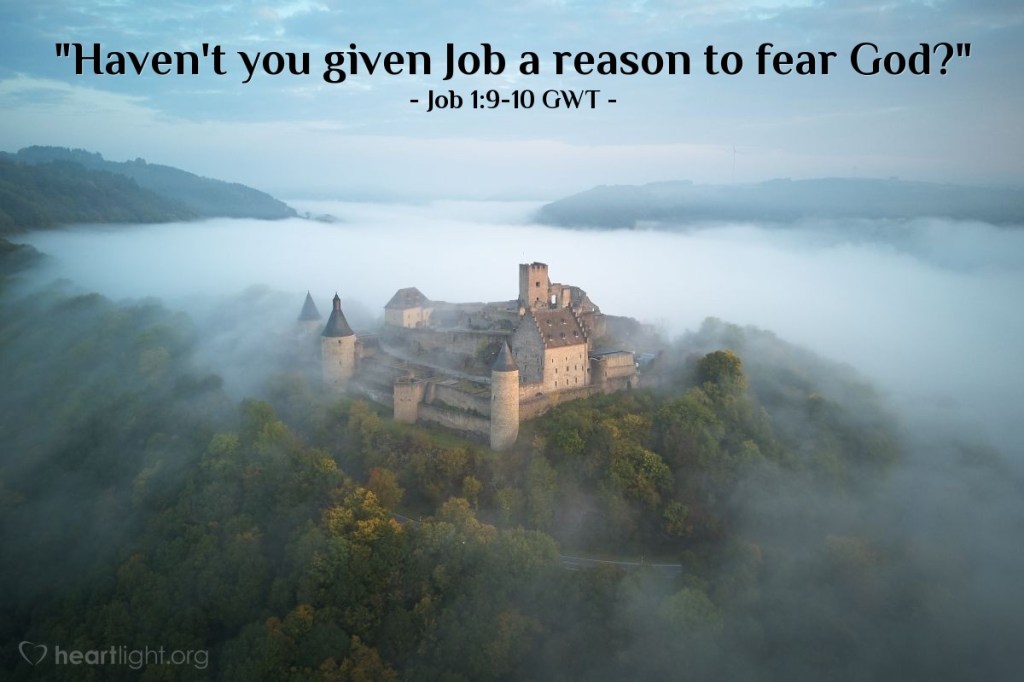
Job 1:6-12 Amplified Bible
6 Now there was a day when the sons of God (angels) came to present themselves before the [a]Lord, and Satan (adversary, accuser) also came among them. 7 The Lord said to Satan, “From where have you come?” Then Satan answered the Lord, “From roaming around on the earth and from walking around on it.” 8 The Lord said to Satan, “Have you considered and reflected on My servant Job? For there is none like him on the earth, a blameless and upright man, one who fears God [with reverence] and abstains from and turns away from evil [because he honors God].” 9 Then Satan answered the Lord, “Does Job fear God for nothing? 10 Have You not put a hedge [of protection] around him and his house and all that he has, on every side? You have blessed the work of his hands [and conferred prosperity and happiness upon him], and his possessions have increased in the land. 11 But put forth Your hand now and touch (destroy) all that he has, and he will surely curse You to Your face.” 12 Then the Lord said to Satan, “Behold, all that Job has is in your power, only do not put your hand on the man himself.” So Satan departed from the presence of the Lord.
The Word of God for the Children of God.
Adeste Fideles! Laeti Triumphantes! Venite Adoremus! Dominum.
Gloria! In Excelsis Deo! Alleluia, Alleluia, Alleluia, Amen.
Job’s Prosperity Acknowledged as God’s Blessing
At the beginning of the Book of Job we are introduced to an exceptionally prosperous farmer/rancher named Job.
He is described as “the greatest man among all the people of the East” (Job 1:3).
Like the patriarchs Abraham, Isaac and Jacob, his wealth was measured by his many thousand head of livestock, numerous servants and large family.
His seven sons and three daughters (Job 1:2) are both a personal joy to him and an important foundation of his wealth.
In agricultural societies, children supply the most reliable part of the labor needed in a household.
They are the best hope for a comfortable retirement, the only pension plan available in the Ancient Near East, as is in many parts of the world today.
Job regards his success to be the result of God’s blessing.
We are told that God has “blessed the work of Job’s hands, and his possessions have increased in the land” (Job 1:10).
Job’s recognition that he owes everything to God’s blessing is highlighted by an unusual detail.
He worries that his children might inadvertently offend God.
Although Job takes care to remain “blameless and upright” (Job 1:1), he worries that his children may not be so fastidious.
What if one of them, addled by too much drink during their frequent days-long feasts, should sin by cursing God (Job 1:4)?
Therefore, after every feast, to forestall any offense to God, “Job would send and sanctify them, and he would rise early in the morning and offer burnt offerings according to the number of them all” (Job 1:5).
God recognizes Job’s faithfulness.
He remarks to his Satan (a Hebrew word meaning simply “accuser”,
“Have you considered my servant Job? There is no one like him on the earth, a blameless and upright man who fears God and turns away from evil” (Job 1:8).
The accuser spots an opening for mischief and replies, “Does Job fear God for nothing?” (Job 1:9).
That is, does Job love God only because God has blessed him so richly?
Is Job’s praise and his burnt offerings “according to the number of them all” just a calculated scheme to keep the goods flowing?
Or to use a modern image, is Job’s faithfulness nothing more than a coin fed into the vending machine of God’s blessing?
We could apply this question to ourselves.
Do we relate to God primarily so that He will bless us with the stuff we want?
Or worse yet, so that God won’t “jinx” the success we seem to be achieving on our own?
In good times, this may not be a burning issue.
We believe in God.
We have faith in God.
We acknowledge him — at least theoretically — as the source of all good things.
At the same time, we work diligently, we work and we labor faithfully in God’s Kingdom so God’s goodness, our work go hand in hand like “peas and carrots.”
When times are good, blessings abound and we do in fact have a season or two and prosper, it is natural to thank God and praise him highly and mightily for it.
We all know and recognize that things can go wrong in a big hurry and we have a clever adversary, yet there are things about him we sometimes get wrong.
I cannot tell you how many times I have heard people mention how Satan is attacking them and he is after their stuff.
They talk as if Satan is primarily interested in robbing them of their health and their finances and all manner of earthly possessions and resources.
I’ve a heard a number of sermons that center around this, listened to music that echoes the same sentiment, and witnessed many falling into the belief Satan is ceaselessly, relentlessly, skulking around every street corner, after their things.
But let me offer you a gentle awakening.
Satan does not have an insatiable desire for your belongings.
He is not fixated on your house, your car, your bank account, or your job.
In fact,
I believe our material possessions hardly register to him, unless he can somehow subtly exploit them to undermine our faith and hinder our relationship with God.
The One Thing Satan Is After?
Hebrews 11:5-6 The Message
5-6 By an act of faith, Enoch skipped death completely. “They looked all over and couldn’t find him because God had taken him.” We know on the basis of reliable testimony that before he was taken “he pleased God.” It’s impossible to please God apart from faith. And why? Because anyone who wants to approach God must believe both that he exists and that he cares enough to respond to those who seek him.
However, there is one thing in your life that Satan relentlessly pursues.
He knows that without it, the reality of you leading a victorious Christian life becomes utterly unattainable.
What indescribably valuable resource is our Adversary after?
Your Faith.
My Faith.
My Wife’s Faith.
The Faith of Parents
Our Children’s Faith.
Our Neighbor’s Faith.
The Faith of our Teachers, our Educators
The Homeless person’s Faith.
The Addicts and Alcoholics persons Faith
The Mentally Ill person’s Faith.
The people just diagnosed with Cancer’s Faith.
The Faith of our Clergy.
The Faith of our Laity.
The Faith of our Neighborhoods and our Communities.
Our Churches Faith, regardless of denominations.
In short and in hardcore truth – everyone’s Faith.
From the very beginning, Satan has attempted to instill doubt within the hearts of all humanity (Genesis 3).
He tries to provoke you to question the very words of God, his character, and even his existence.
The reason is that he understands the important role faith plays in all our lives.
Satan is fully aware of bible verses which highlight the significance of our faith.
Faith is essential in our Christian journey.
It is the foundation upon which we build our relationship with God.
Without faith, our ability to please God diminishes, and our desire to seek him can taper off.
Satan, the enemy of our soul, understands this truth all too well.
He knows that when our faith diminishes, our faith erodes, faith disappears, our spiritual vitality suffers also, and our connection to Savior God weakens.
It is in those moments of wavering faith we may feel most distant from God.
We may notice a lack of motivation to pray.
We may neglect the reading and studying of his Word, and we may isolate ourselves from the Koinonia fellowship of fellow believers.
Think back to times in your own life when you have experienced a lack of faith (I have had plenty).
Perhaps it was during a season of doubt, disappointment, or personal struggle.
In those moments, you may recall that seeking God was not a priority in your life and this was all connected to your faith.
Because of this connection, the enemy knows if he can weaken our faith, it will steadily, subtly, suddenly cascade through every part of your walk with God.
That is why he is so passively and aggressively persistent in attacking our faith.
Your Faith Is Like Your Heart
Matthew 6:19-23 The Message
A Life of God-Worship
19-21 “Don’t hoard treasure down here where it gets eaten by moths and corroded by rust or—worse!—stolen by burglars. Stockpile treasure in heaven, where it’s safe from moth and rust and burglars. It’s obvious, isn’t it? The place where your treasure is, is the place you will most want to be, and end up being.
22-23 “Your eyes are windows into your body. If you open your eyes wide in wonder and belief, your body fills up with light. If you live squinty-eyed in greed and distrust, your body is a musty cellar. If you pull the blinds on your windows, what a dark life you will have!
Just as your heart pumps life-giving oxygen rich blood throughout the body, faith fuels your relationship with God.
It enables you to experience his presence, guidance, and power.
Faith is necessary when you begin your walk with God, and it is crucial for you to grow in your walk with God.
You are saved by faith, justified by faith, and empowered to live according to his will by faith.
If you damage or neglect your faith, your walk with God withers, just as your body would die without a functioning heart and a set of healthy lungs.
How Does Satan Attack Your Faith?
Genesis 3:1-8 The Message
3 The serpent was clever, more clever than any wild animal God had made. He spoke to the Woman: “Do I understand that God told you not to eat from any tree in the garden?”
2-3 The Woman said to the serpent, “Not at all. We can eat from the trees in the garden. It’s only about the tree in the middle of the garden that God said, ‘Don’t eat from it; don’t even touch it or you’ll die.’”
4-5 The serpent told the Woman, “You won’t die. God knows that the moment you eat from that tree, you’ll see what’s really going on. You’ll be just like God, knowing everything, ranging all the way from good to evil.”
6 When the Woman saw that the tree looked like good eating and realized what she would get out of it—she’d know everything!—she took and ate the fruit and then gave some to her husband, and he ate.
7 Immediately the two of them did “see what’s really going on”—saw themselves naked! They sewed fig leaves together as makeshift clothes for themselves.
8 When they heard the sound of God strolling in the garden in the evening breeze, the Man and his Wife hid in the trees of the garden, hid from God.
One of the principal ways Satan attacks your faith is by using life’s realities against you.
Sometimes he will even try to use God’s own word against you.
Remember the question he asked Eve, “Did God really say?”
In John 16:33, Jesus said in this world, you will have trouble.
I have written on this verse before, calling it the most overlooked promise in Scripture.
However, even though this is a reality of life, when trouble comes, we often end up disappointed or sometimes even feeling deserted by God.
In these vulnerable moments, Satan will use this against you by stirring up a whole range of our emotions, which affect our faith.
He might whisper or shout things like –
If God really loved you, this would have never happened.
You fasted and prayed and God didn’t answer your prayer. That’s because he really doesn’t care.
I thought God said call upon me and I will answer. How’s that going for you?
These types of whispers and darts the enemy throws at you are all designed to attack and weaken your faith.
When you are discouraged, disillusioned, or disappointed, the result is your faith can suffer, your belief in God, Jesus and the Holy Spirit can suffer too.
When seeds of doubt or discouragement don’t work, Satan may turn to worldly distractions.
He may tempt you to look at other things and take your eyes off Jesus.
He aims to strip away your confidence in God’s promises and provision.
This can render you ineffective in your pursuit of God and his plans for your life.
Regardless of the method, it all goes back to the one thing he wants to take from you, which is your faith.
How to Guard against These Attacks?
Ephesians 6:10-18 The Message
A Fight to the Finish
10-12 And that about wraps it up. God is strong, and he wants you strong. So take everything the Master has set out for you, well-made weapons of the best materials. And put them to use so you will be able to stand up to everything the Devil throws your way. This is no weekend war that we’ll walk away from and forget about in a couple of hours. This is for keeps, a life-or-death fight to the finish against the Devil and all his angels.
13-18 Be prepared. You’re up against far more than you can handle on your own. Take all the help you can get, every weapon God has issued, so that when it’s all over but the shouting you’ll still be on your feet. Truth, righteousness, peace, faith, and salvation are more than words. Learn how to apply them. You’ll need them throughout your life. God’s Word is an indispensable weapon. In the same way, prayer is essential in this ongoing warfare. Pray hard and long. Pray for your brothers and sisters. Keep your eyes open. Keep each other’s spirits up so that no one falls behind or drops out.
To counter these attacks, you must guard and nurture your faith.
One reason is because you overcome the enemies’ attacks on your faith by using the same thing he is after, your faith.
The Bible reminds us in Ephesians 6:10-18 that we extinguish the darts of the enemy with the shield of faith.
When the enemy comes to attack your faith, you use that same faith to fight back and defeat his plan.
However, to do this effectively, you must cultivate a vibrant faith.
This requires intentional effort and a steadfast commitment to seeking God and His truth.
You must immerse yourself in his Word and commune with him in prayer.
It also helps to surround yourself with fellow believers who can encourage you and aid you in building your faith.
One thing to note is faith is not an all-or-nothing proposition.
It is a journey — a process of growth and development.
You will experience seasons of struggle, but that does not mean your faith is irreparably damaged.
God is gracious and compassionate, ready to restore and revive your faith as you surrender yourself to Him.
When you face moments of doubt or spiritual dryness – and they will come – then you must not succumb to the enemy’s ploys.
Hebrews 6:13-20 The Message
God Gave His Word
13-18 When God made his promise to Abraham, he backed it all the way, putting his own reputation on the line. He said, “I promise that I’ll bless you with everything I have—bless and bless and bless!” Abraham stuck it out and got everything that had been promised to him. When people make promises, they guarantee them by appeal to some authority above them so that if there is any question that they’ll make good on the promise, the authority will back them up. When God wanted to guarantee his promises, he gave his word, a rock-solid guarantee—God can’t break his word. And because his word cannot change, the promise is likewise unchangeable.
18-20 We who have run for our very lives to God have every reason to grab the promised hope with both hands and never let go. It’s an unbreakable spiritual lifeline, reaching past all appearances right to the very presence of God where Jesus, running on ahead of us, has taken up his permanent post as high priest for us, in the order of Melchizedek.
Instead, we can choose to anchor ourselves in the steadfast and immovable and always and forever truths of God’s Word and rely on his unyielding faithfulness.
As we walk closer to Him, we fortify our faith and we prevent the enemy from robbing our spiritual vitality.
This does not mean life won’t hurt, but through it all your faith will stay strong.
Final Thoughts
Hebrews 11:1-6 The Message
Faith in What We Don’t See
11 1-2 The fundamental fact of existence is that this trust in God, this faith, is the firm foundation under everything that makes life worth living. It’s our handle on what we can’t see. The act of faith is what distinguished our ancestors, set them above the crowd.
3 By faith, we see the world called into existence by God’s word, what we see created by what we don’t see.
4 By an act of faith, Abel brought a better sacrifice to God than Cain. It was what he believed, not what he brought, that made the difference. That’s what God noticed and approved as righteous. After all these centuries, that belief continues to catch our notice.
5-6 By an act of faith, Enoch skipped death completely. “They looked all over and couldn’t find him because God had taken him.” We know on the basis of reliable testimony that before he was taken “he pleased God.” It’s impossible to please God apart from faith. And why? Because anyone who wants to approach God must believe both that he exists and that he cares enough to respond to those who seek him.
Faith is an indispensable component of your walk with God.
Just as your physical heart and lungs sustains life in your body, faith sustains and nourishes your spiritual life.
Satan recognizes the power of faith and seeks to strip it away from you, hindering your connection with God.
But you have the choice to protect and cultivate your faith.
Let us commit to nurturing our faith through prayer, the study of God’s Word, and fellowship with other believers.
By doing so, we can guard against the enemy’s schemes.
This will also position us to experience the fullness of a vibrant, faith-filled relationship with your loving Heavenly Father.
I pray today, come what may, you would go forth anyway and walk by faith.
In the name of God, the Father, and God the Son and God the Holy Spirit,
Let us Pray,
Lord, God of the Patriarchs and the Prophets, help me to be more like Job. You put a wall of protection around him, his family, and his property, and You were also the source of his prosperity. I pray for that same hedge of protection for my family and my property. By Christ, Help me to use my life, resources, talents, and position to lead others closer to You and bring You glory. Use me — like you did Job — as a source of great encouragement to those in my sphere of influence. In Jesus’ name, Amen.
Adeste Fideles! Laeti Triumphantes! Venite Adoremus! Dominum.
Gloria! In Excelsis Deo! Alleluia, Alleluia, Alleluia, Amen.

 Loving God, Living God, Loving Hope, Living Hope, Loving Living Life His Way! "Many things are possible for the person who has hope. Even more is possible for the person who has faith. And still more is possible for the person who knows how to love. But everything is possible for the person who practices all three virtues." - Brother Lawrence (1605-1691), Practicing the Presence of God (1692).