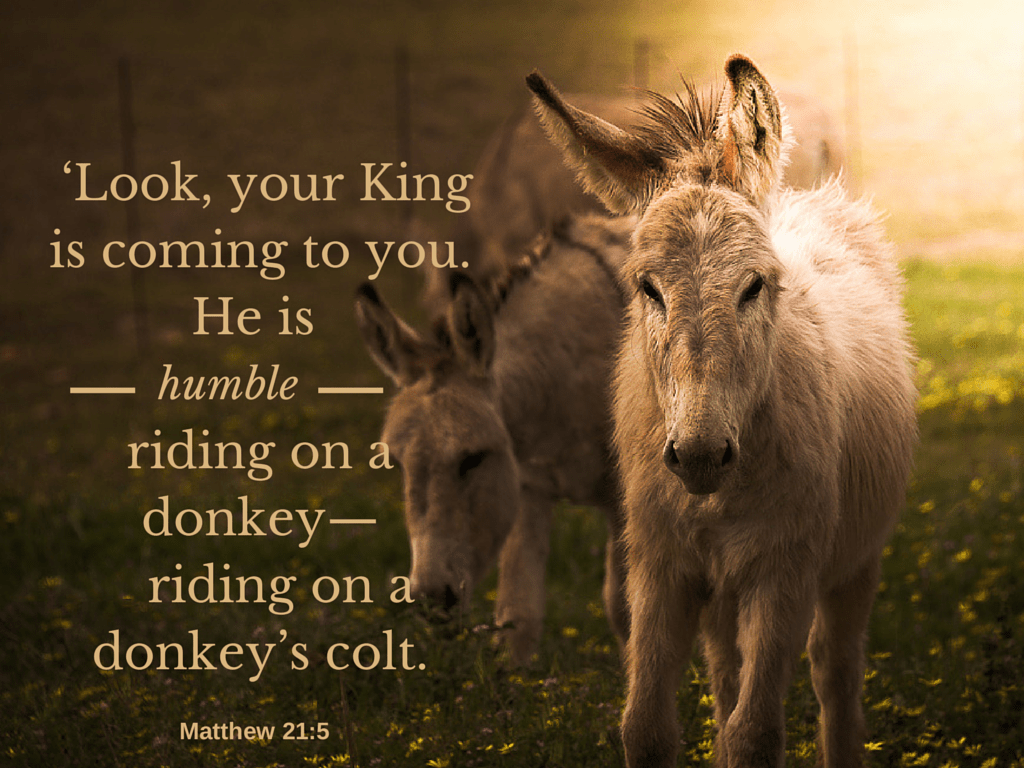
Jesus’ Triumphal Entry! Our Great Expectations? What About A King Paraded on the back of a Donkey? Matthew 21:1-11

Matthew 21:1-11 Amplified Bible

The Triumphal Entry

21 When they approached Jerusalem and had reached Bethphage, at the Mount of Olives, Jesus sent two disciples [ahead], saying to them, “Go into the village opposite you, and at once you will find a donkey tied, and a colt with her; untie them and bring them to Me. If anyone says anything to you, you should say, ‘The Lord needs them,’ and without delay the owner will send them [with you].” This happened so that what was spoken by the prophet would be fulfilled, saying:


“Tell the daughter of Zion (the people of Jerusalem),
‘Behold, your King is coming to you,
Gentle and mounted on a donkey,
Even on a colt, the foal of a beast of burden.’”

Then the disciples went and did as Jesus had instructed them, and they brought the donkey and [a]the colt, and [b]placed their coats on them; and Jesus sat on the coats. Most of the crowd spread their coats on the road [as before a king], while others were cutting branches from the trees and spreading them on the road. The crowds that went ahead of Him, and those that followed Him, were shouting [in praise and adoration],

[c]Hosanna to the Son of David (Messiah);
Blessed [praised, glorified] is He who comes in the name of the Lord;
Hosanna in the highest [heaven]!”

10 When He entered Jerusalem, all the city was trembling [with excitement], saying, “Who is this?” 11 And the crowds were saying, “This is the prophet Jesus, from Nazareth in Galilee.”

The Word of God for the Children of God.

Adeste Fidelis! Venite Adoremus! Dominum.

Gloria! In Excelsis Deo! Alleluia, Alleluia, Alleluia, Amen.

Triumphal Entry? Great Expectations? A King on His Donkey?

At first observation after a few readings of this narrative account of the entry of Jesus into Jerusalem, I realized something about the two images disconnected.

The picture would have been perfect if Jesus had been riding a white horse, used in those days by warrior kings to symbolize conquering power, decisive victory.

But the narrator Matthew specifically highlighted: Jesus rode on the back of a donkey – the disciples celebrated and paraded their Messiah King on a donkey.

Why?

What image were they hoping, planning to project to the gathered crowds?

What were they expecting the gathering crowds to see and understand of this?

What of the gathering crowds at the gates of the city of Jerusalem?

What were their expectations of the coming of their “Messiah King?”

What were we expecting to see?

What “coming new thing” were we expecting to learn about or be reminded of?

An unarmed conquering warrior Itinerant Master Rabbi?

Long ago, prophet Zechariah said the Messiah would come in righteousness, riding on a donkey, a symbol of humility and peace (Zechariah 9:9 Amplified).

Rejoice greatly, O Daughter of Zion!
Shout aloud, O Daughter of Jerusalem!
Behold, your King (Messianic King) is coming to you;
He is righteous and endowed with salvation,
[a]Humble and unassuming [in submission to the will of the Father] and riding on a [b]donkey,
Upon a colt, the foal of a donkey.

Though most of the people would have probably seen Jesus fulfilling this prophecy as their Messiah (see also Psalm 118:25-26 Amplified),

25 
O Lord, save now, we beseech You;
O Lord, we beseech You, send now prosperity and give us success!
26 
Blessed is the one who comes in the name of the Lord;
We have blessed you from the house of the Lord [you who come into His sanctuary under His guardianship].

Jesus came in triumph into His city under God’s guardianship, they expected him to announce the arrival of a war of rebellion against Roman oppressors.

But he didn’t.

Instead he had no army behind him, nobody is waving any swords or spears.

He was not even armed with a spear or a sword nor did anyone hand him one!

Perhaps with expectations crushed that’s why the chanting crowds changed their tune from “Hosanna” to “Crucify him!” 5 days later (Matthew 27:22-23).

Matthew 27:22-23 Amplified Bible

2Pilate said to them, “Then what shall I do with Jesus who is called Christ?” They all replied, “Let Him be crucified!” 23 And he said, “Why, what has He done that is evil?” But they continued shouting all the louder, “Let Him be crucified!”

Considering our state of current events, I don’t guess, and I wont prophesize that things will have actually changed much from then until now, have they?

People are still willing to rally around the banner of Christ if it goes along with their own interests, if their expected understanding of Christ comes to them as they always expected, approved because their expectations have been fully met.

We also desire, even to go so far as to expect we can maintain a good Christian confession while trying to avoid standing too close to the lingering shadows of the cross, or getting too close to actually running to the tomb to see emptiness.

But Jesus, the King who actually rode on an actual donkey, calls us to actually examine our much paraded walk with him as we come to the cross this Friday.

Center yourselves and dig deep and CRY,

“Am I just here for the Parade?“

Am I just coming along side of everyone else, because everyone else is here right now or everyone else is going along for the ride because it all looks so very interesting and might even be a measure of fun or something I and my business might profit from?

If I have to actually get serious about all this, to decide between God and my job, my reputation, something else in my life—will I also change my expectations?”

The celebration of Palm Sunday is about King Jesus riding to the cross in total obedience to his Father – about His grace and peace come by way of the cross.

Will we with our packed luggage of preconceived expectations receive him in the same way he was presented by the Gospel narrator Matthew in chapter 21?

Our Expectations – A Humble, Triumphant King?

Matthew 21:5-11 Amplified Bible


“Tell the daughter of Zion (the people of Jerusalem),
‘Behold, your King is coming to you,
Gentle and mounted on a donkey,
Even on a colt, the foal of a beast of burden.’”

Then the disciples went and did as Jesus had instructed them, and they brought the donkey and [a]the colt, and [b]placed their coats on them; and Jesus sat on the coats. Most of the crowd spread their coats on the road [as before a king], while others were cutting branches from the trees and spreading them on the road. The crowds that went ahead of Him, and those that followed Him, were shouting [in praise and adoration],

[c]Hosanna to the Son of David (Messiah);
Blessed [praised, glorified] is He who comes in the name of the Lord;
Hosanna in the highest [heaven]!”

10 When He entered Jerusalem, all the city was trembling [with excitement], saying, “Who is this?” 11 And the crowds were saying, “This is the prophet Jesus, from Nazareth in Galilee.”

Jesus was getting near the end of His ministry.

He had been telling the disciples that He would be killed.

Now He comes riding into the city, sitting on donkey’s foal.

This was to fulfill a prophecy made by Zechariah.

Kings, leaders, presidents and others in high authority are known for arriving with a lot of pomp and circumstance – it is expected to show them great respect.

There is always a lot of fanfare going on to bring in someone of high leadership.

Whenever the President of the United States arrives at a building where he is going to speak, he arrives with a great fanfare and a great entourage of people.

There are multiple vehicles in front and behind him.

When he walks out into a room, there is always some music playing, people rise up for him, and He is announced.

The same goes for famous celebrities.

Standing room only crowds

There is a lot of pictures and videos being taken.

All kinds of busyness, posting and sharing activity across social media outlets.

Celebrities arrive in a large limousine.

There is flashing of jewelry and expensive clothing.

There are red carpets.

There are lots and lots of television and journalists, and paparazzi’s.

It is a show of pride and luxury, with no sign of humility.

In many countries, when their leader arrives, there is also a great show of their military power.

Soldiers, weapons, and military equipment tour d’ force go paraded before the visiting leader to show who is in control and who exactly has all the power .

Jesus did not do any of this.

He came in riding on a baby donkey.

In the biblical times, a king would arrive on a horse showing great power.

Jesus did not show any of that, even though He had more power than all the kings on the earth combined.

He created the earth and all who are in it (John 1:1-5).

John 1:1-5 Amplified Bible

The Deity of Jesus Christ

1 In the beginning [before all time] was the Word ([a]Christ), and the Word was with God, and [b]the Word was God Himself. He was [continually existing] in the beginning [co-eternally] with God. All things were made and came into existence through Him; and without Him not even one thing was made that has come into being. In Him was life [and the power to bestow life], and the life was the Light of men. The Light shines on in the [c]darkness, and the darkness did not understand it or overpower it or appropriate it or absorb it [and is unreceptive to it].

The purpose of His arriving in that way, was to show love and compassion.

He is a king who can understand where people are, so He comes in humility.

Most people do not have the grand horse to ride on, but just have the donkey.

Even today, our Savior, our King Jesus comes to you in love and compassion.

He does have the power, but will not show a force of threat to get you to follow.

Jesus wants you and me to want to follow Him.

He understands where we and our “great expectations” are and is there for you.

As we proceed through this Holy Week,

Let’s take a slightly longer look at our “great expectations,”

our Godly versus Worldly priorities;

Matthew 6:33Amplified Bible

33 But first and most importantly seek (aim at, strive after) His kingdom and His righteousness [His way of doing and being right—the attitude and character of God], and all these things will be given to you also.

He is not unapproachable.

He is not unknowable.

He is not unreachable.

He is not untouchable.

Do not fear your king.

Do not fear your Savior.

He is gentle.

He is always and forever in and within our very midst …

In the name of God, the Father and God the Son and God the Holy Spirit,

Let us Pray,

1. Come, thou long expected Jesus,
born to set thy people free;
from our fears and sins release us,
let us find our rest in thee.
Israel’s strength and consolation,
hope of all the earth thou art;
dear desire of every nation,
joy of every longing heart.

2. Born thy people to deliver,
born a child and yet a King,
born to reign in us forever,
now thy gracious kingdom bring.
By thine own eternal spirit
rule in all our hearts alone;
by thine all sufficient merit,
raise us to thy glorious throne.

___Charles Wesley___ 1707-1788

I pray today that you will know this Jesus riding on the donkey’s back as your king; you will know Jesus is gentle and loving; that you and I will seek him as he seeks you and me to find Jesus in our life; that we will show His love and humility in your life. Lord Jesus, may we ever so lovingly and willingly obey you and joyfully follow you, the King of kings, the Lord of lords, Savior of us all, in whose name we pray. Amen.

Adeste Fidelis! Venite Adoremus! Dominum.

Gloria! In Excelsis Deo! Alleluia, Alleluia, Alleluia, Amen.
 

Hosanna! It Is Our Palm Sunday! Is Our Jesus Our Center or Periphery of Life? John 12:12-19

John 12:12-19 Amplified Bible

The Triumphal Entry

12 The next day, when the large crowd who had come to the Passover feast heard that Jesus was coming to Jerusalem, 13 they took branches of palm trees [in homage to Him as King] and went out to meet Him, and they began shouting and kept shouting “Hosanna! Blessed (celebrated, praised) is He who comes in the name of the Lord, even the King of Israel!” 14 And Jesus, finding a young donkey, sat on it; just as it is written [in Scripture], 15 “Do not fear, Daughter of Zion; Behold, Your King is coming, seated on a donkey’s colt.” 16  His disciples did not understand [the meaning of] these things at first; but when Jesus was glorified and exalted, they remembered that these things had been written about Him and had been done to Him. 17 So the people, who were with Him when He called Lazarus out of the tomb and raised him from the dead, continued to tell others about Him. 18 For this reason the crowd went to meet Him, because they heard that He had performed this [miraculous] sign. 19 Then the Pharisees [argued and] said to one another, “You see that your efforts are futile. Look! The whole world has gone [running] after Him!”

The Word of God for the Children of God.

Adeste Fidelis! Venite Adoremus! Dominum.

Gloria! In Excelsis Deo! Alleluia, Alleluia, Alleluia! Amen.

Open your Bible to John’s gospel chapter 12.

We have come to the last week of Jesus.

On Saturday, He had been in Bethany with Mary, Martha, and Lazarus in the home of Simon the ex-leper.

Then on Monday, He left Bethany, and headed towards Jerusalem riding on the foal of a donkey.

Soon the people took palm branches and shouted: John 12:13 “Hosanna!” “Blessed is he who comes in the name of the Lord” Blessed is the King of Israel.”

So, when Jesus comes into the city of Jerusalem on this occasion with the word going everywhere about raising Lazarus from the dead, they are all thrilled and have broken off their palm branches, waved, hailed the arrival of Jesus as king.

John 12:13-15 Amplified Bible

13 they took branches of palm trees [in homage to Him as King] and went out to meet Him, and they began shouting and kept shouting “Hosanna! Blessed (celebrated, praised) is He who comes in the name of the Lord, even the King of Israel!” 14 And Jesus, finding a young donkey, sat on it; just as it is written [in Scripture], 15 “Do not fear, Daughter of Zion; Behold, Your King is coming, seated on a donkey’s colt.”

In John’s narrative account of Jesus’ ride into Jerusalem, the crowd shouts the right things about Jesus, “Hosanna! blessed is He who comes in the name of the Lord, even the King of Israel” but we soon find out that even Jesus’ disciples really “did not understand all this.”

Then we read in the very next verse that His disciples were mysteriously blank.

They didn’t realize the true gravity of this event was a prophetic fulfillment of an Old Testament prophecy (Zechariah 9:9) until after Jesus rose into heaven.

Zechariah 9:9 Amplified Bible


Rejoice greatly, O Daughter of Zion!
Shout aloud, O Daughter of Jerusalem!
Behold, your King (Messianic King) is coming to you;
He is righteous and endowed with salvation,
[a]Humble and unassuming [in submission to the will of the Father] and riding on a [b]donkey,
Upon a colt, the foal of a donkey.

The crowd had come out to meet Jesus only because they had seen or they heard that Jesus had raised someone named Lazarus from the dead earlier.

And the Pharisees saw Jesus’ popularity as a threat to their own power and position (John 11:47-50; 12:9-11).

Why do or did you come out of wherever it is you live to attend Palm Sunday?

Were you aware of the words of prophecy of Zechariah 9:9?

Are you at Palm Sunday worship service because you only briefly heard of Jesus?

Do you even know of the name of Lazarus and his biblical connection to Jesus?

Are, were you, there because it is an “old family tradition” of uncertain origin or because being there is fulfilling a favor to someone even though you do not, have no plan to believe in God, the Father or God the Son or God the Holy Spirit?

Or are we those who consider ourselves totally committed loving GOD 1000%?

It’s easy to think that we would do better.

It’s easy to think that we know who Jesus really is.

But most longtime followers of Christ would agree that Jesus is a mystery.

He is not any easier to get to know than anyone else we might meet.

In fact, we wouldn’t be wrong to assume that it would take more effort to know the Son of God than to know anyone else.

And yet we can grow to know Jesus.

We can acknowledge that Jesus spends more time as an out layer of our life.

We can recognize where, when Jesus spends too much time on our periphery.

Our relationships with our family members, with our neighbors, co-workers.

Our relationships with strangers on the streets, our fellow communities of faith in our shared efforts to provide volunteer services, meals, a glass of cold water.

We can learn how to gradually move Jesus into the center of our lives where we are the ones who are most eager to not just wave our Palms but to lead Jesus in.

Taking the reins of the colt while Jesus sits next to us on the colt and enters in.

Setting the pace of the colt with Jesus sitting on its back.

Crowds of people see, witness our lives at the center of where Jesus is coming.

Directed display of Discipleship in action.

It takes time to move out from the crowds, work on our part, we are not alone.

The Spirit of Jesus himself comes into our hearts, teaches us (see John 16:7-15).

By the Holy Spirit, John and the other disciples eventually did understand what was going on here, what their closeness and proximity to Jesus meant to others.

And as we diligently study the Bible as God’s living Word, asking for the Holy Spirit’s guidance, we can grow, greatly mature to know, experience Jesus too.

It can take some mightily significant work, but the Holy Spirit will help us, and there is no better relationship to invest in than our relationship with our King.

Palm Sunday … Jesus is Being Led into the City

Palm Sunday is a Christian celebration that marks the beginning of the Holy Week leading to Easter Sunday.

It commemorates Jesus’ triumphant entrance into Jerusalem, when people laid down palms and branches in front of him as a sign of honor.

In modern times, churches hold Palm Sunday services in which assembled worshippers are each given a palm branch or cross made from palm leaves.

The celebration involves singing hymns, reading Scripture, and sometimes even a parade or procession with the palms around the church or community.

Palm Sunday is a timeless reminder of the selfless love Jesus showed by laying down his life for us, entering directly into the center of our lives and it is a time to reflect on our own lives, how we can show that same love to those around us.

Palm Sunday is the day we each remember and celebrate the day Jesus entered Jerusalem as our coming Savior and King.

As Jesus rode a donkey into the town of Jerusalem, a large crowd gathered and laid palm branches, their cloaks across the road, giving Jesus royal treatment.

Hundreds, perhaps thousands of people shouted, “Hosanna to the Son of David! Blessed is he who comes in the name of the Lord! Hosanna in the highest heaven!”

Palm Sunday is a moveable holiday that changes yearly based on Lent and the spring equinox.

Many churches celebrate Palm Sunday by waving palm branches, singing traditional hymns, and making crosses out of palm fronds for the children.

But while this is a triumphal entry, it is Jesus’ first step toward His death.

Many churches celebrate Palm Sunday.

Maybe your church has their member congregants, the children, even complete strangers collectively waving palm branches to help them connect to the story.

But while this is our triumphal entry, it was Jesus’ first step toward His death.

Matthew 21:4 tells us:

‘This took place to fulfill what was spoken by the prophet, saying, ‘Say to the daughter of Zion, ‘Behold, your king is coming to you, humble, and mounted on a donkey, and on a colt, the foal of a beast of burden.’

*The prophecy is cited from Zechariah 9:9 and Isaiah 62:11.

Palm Sunday Bible Story – Triumphal Entry

Matthew 21:1-11 – Jesus Comes to Jerusalem as King

As they approached Jerusalem and came to Bethphage on the Mount of Olives, Jesus sent two disciples, saying to them, “Go to the village ahead of you, and at once you will find a donkey tied there, with her colt by her. Untie them and bring them to me. If anyone says anything to you, say that the Lord needs them, and he will send them right away.” This took place to fulfill what was spoken through the prophet: “Say to Daughter Zion, ‘See, your king comes to you, gentle and riding on a donkey, and on a colt, the foal of a donkey.’ ” The disciples went and did as Jesus had instructed them. They brought the donkey and the colt and placed their cloaks on them for Jesus to sit on. A very large crowd spread their cloaks on the road, while others cut branches from the trees and spread them on the road. The crowds that went ahead of him and those that followed shouted, “Hosanna to the Son of David!” “Blessed is he who comes in the name of the Lord!”“Hosanna in the highest heaven!” When Jesus entered Jerusalem, the whole city was stirred and asked, “Who is this?” The crowds answered, “This is Jesus, the prophet from Nazareth in Galilee.”

In this closing of this Lenten season as we reflect on the sacrifice of Christ, we see him riding a donkey as he comes to Jerusalem as King.

This animal was symbolic of humility, peace, and King David’s royalty (see also King Solomon’s Procession 1 Kings 1:33).

Jesus rode into Jerusalem on the back of a donkey to show everyone publicly that he was the chosen Son of David (another name for the promised Messiah).

We might have expected a stallion.

But this surprising King rides a donkey.

Jesus identifies with the the common man and woman, with the lowly of heart.

The kingdom of God is totally different from the here-today, gone-tomorrow kingdoms of the world.

Don’t mistake this King on a donkey for the kind of ruler we usually see in this world.

From Jesus we learn that being a king in God’s kingdom is about service and humility.

A king serves.

So, as we fulfill our own calling, we will serve the Lord, we serve one another.

As we live by the guidance of the Spirit, visit people who are sick, care for those who are poor, feed the hungry, and we will learn to love our neighbors as much we love our God, we are servant kings and queens of the kingdom of heaven.

That is when we are most like Jesus, when Jesus finds His way delicately weaved into the center of our lives who calls us to reign with him today and for eternity.

Jesus once came riding on a donkey.

Next he will come riding on the clouds of heaven to reign over us, claim us as His own, to live with us in the new heaven and earth forever (Revelation 21- 22).

Come, Lord Jesus, Come!

On the heels of this, another Palm Sunday, as we begin this Holy Week, may we constantly, centrally, be reminded of its significance, value for our lives today.

That very important day in history, when Jesus centered Himself directly, and decisively into the eternal affairs of man, began His journey towards the cross.

Yet maybe again, ultimately centrally, amid busy lives, on the heels of Spring Break, or in all the upcoming thoughts about Easter, the real central meaning of it may, even unintentionally, get missed – again – until the next Palm Sunday.

One day, Palm Sunday will be an every day celebration of the centrality of Jesus!

His Word becomes central, reveals such great truths in every part of this story.

Truths that draw us closer towards Christ, reminding us that He alone is King…

Palm Sunday reminders Centering Christ as Our King

1. God’s Word tells us the people cut palm branches, waved them in the air, and laid them out on the ground before Jesus as He rode into the city.

The palm branch represented goodness and victory and was symbolic of the final victory He would soon fulfill over death.

“O death, where is your victory? O death, where is your sting?” 1 Corinthians 15:55

2. Jesus chose to ride in on a donkey, which directly fulfilled the Old Testament prophecy of Zechariah. 9:9.

In Biblical times, it was common for kings or important people to arrive by a procession riding on a donkey.

The donkey symbolized peace, so those who chose to ride them showed that they came with peaceful intentions.

Jesus even then reminded us that He is the Prince of Peace.

“Rejoice greatly, O daughter of Zion! Shout aloud, O daughter of Jerusalem! Behold, your king is coming to you; righteous and having salvation is he, humble and mounted on a donkey, on a colt, the foal of a donkey.” Zechariah. 9:9

3. When the people shouted “Hosanna!” they were hailing Christ as King.

That word actually means “save us now,” and though in their own minds, they waited for an earthly king, God had a different plan of bringing true salvation to all who would trust in Him.

“Blessed is he who comes in the name of the LORD!” Psalm 118:26

“If you confess with your mouth that Jesus is Lord and believe in your heart that God raised him from the dead, you will be saved.” Romans 10:9

4. The Bible says that Jesus wept for Jerusalem.

Amid the praise of the moment, He knew in His heart that it wouldn’t be long that these same people would turn their backs on Him, betray Him, and crucify Him, truly His heart broke with the reality of how much they needed a Savior.

“As he approached Jerusalem and saw the city, he wept over it, and said, “If you, even you, had only known on this day what would bring you peace–but now it is hidden from your eyes.” Luke 19:41-42

5. Palm Sunday reminds us that the reign of Christ is far greater than any man’s mind could ever conceive or plan.

Man looked for someone to fight their battles in the present day world.

Yet God had the ultimate plan of sending His Son to fight the final battle over the grave and death itself.

This is the greatness of why we celebrate this week.

Because of Christ’s ultimate sacrifice, we can be set free of death.

“Jesus said to her, ‘I am the resurrection and the life; he who believes in Me will live even if he dies,'” John 11:25

We have so much to be grateful for this week.

The enemy knows that, and you can bet, the enemy will do everything he can to distract us from this Holy Week’s true meaning.

Don’t let him win.

In this Holy Week, I fervently pray may God direct our thoughts and attention towards the exact center what and who matters most, Jesus Christ our King…

Let’s choose to center our focus on worshipping our Lord, thanking Him for the gift of His sacrifice, celebrating the power of the Resurrection, and the new life found in only one place, being the exact, exacting center of Him and Him alone.

Let us center our day, celebrate Palm Sunday as the crowds that greeted Christ that day, singing Hosanna! Blessed is he who comes in the name of the Lord!” 

In the name of God, the Father and God the Son and God the Holy Spirit,

Let us Pray,

O Lord Jesus Christ,
when you entered Jerusalem,
great crowds waved palm branches and cried “Hosanna.”

Save us now from our sins,
and make us to rejoice in you,
our only Redeemer;

through your mercy, O our God,
you are blessed,
and live and govern all things,
now and forever. Amen.

Adeste Fidelis! Venite Adoremus! Dominum.

Gloria! In Excelsis Deo! Alleluia, Alleluia, Alleluia, Amen.

https://translate.google.com/

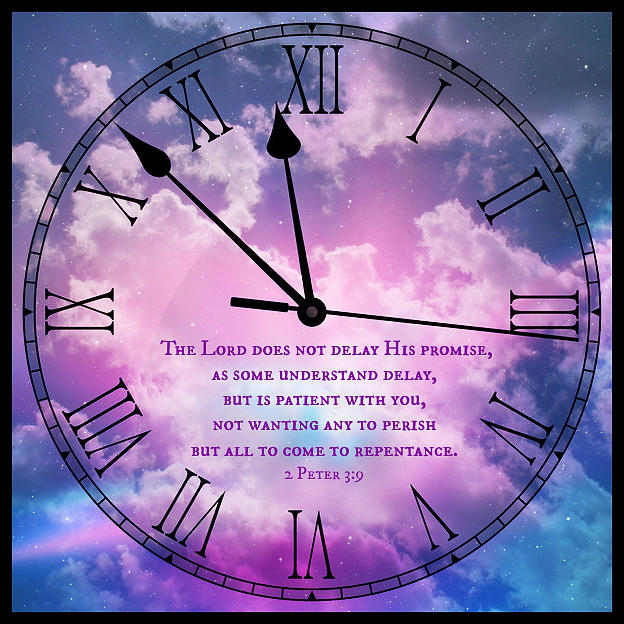
God’s Plan For Us All: We Should Each Come to Know God, As God Knows, Us. 2 Peter 3:8-9

2 Peter 3:8-9 Amplified Bible

Nevertheless, do not let this one fact escape your notice, beloved, that with the Lord one day is like a thousand years, and a thousand years is like one day. The Lord does not delay [as though He were unable to act] and is not slow about His promise, as some count slowness, but is [extraordinarily] patient toward you, not wishing for any to perish but for all to come to repentance.

The Word of God for the Children of God.

Adeste Fidelis! Venite Adoremus! Dominum.

Gloria! In Excelsis Deo! Alleluia, Alleluia, Alleluia! Amen.

Many of God’s plans are detailed throughout the Bible.

He has plans for nations, for people groups, and for individuals. 

Isaiah 46:10–11 summarizes what God wants us to know about His plans:

“My purpose will stand, and I will do all that I please. From the east I summon a bird of prey; from a far-off land, a man to fulfill my purpose. What I have said, that I will bring about; what I have planned, that I will do.”

It’s one thing to recognize that God has an overarching plan for the world; it is quite another to acknowledge that God has a specific life plan for each person.

Many places in Scripture indicate that God does have a specific plan for each human being.

It starts before we are conceived.

Lord told Jeremiah, “Before I formed you in the womb I knew you, before you were born I set you apart; I appointed you as a prophet to the nations” (Jeremiah 1:5).

God’s plan was not reactive, a response to Jeremiah’s conception.

It was preemptive, implying that God specially formed this male child to accomplish His plan.

David underscores this truth: “You created my inmost being; you knit me together in my mother’s womb” (Psalm 139:13).

Unborn children are not and never will be accidents.

They are being formed by their Creator for His purposes.

That is one reason abortion is wrong.

We have no right to disrespect God’s plan and violate God’s workmanship by killing a child He is in the process of forming and shaping into His Image.

God’s plan for every human being is that each one comes to know Him and accept His offer of salvation (2 Peter 3:9).

He created us for fellowship with Him, and, when we reject the reconciliation He offers, we live at cross purposes with His plan for us.

Beyond salvation, God also designed good works for each of us according to our gifts, strengths, and opportunities (Ephesians 2:10).

He orchestrated the location, time into which each of us is born (Psalm 139:16).

If He knows the number of hairs on our heads, then He knows us better than we know ourselves (Luke 12:7).

He knows the gifts, talents, strengths, and weaknesses He gave us, and He knows how we could best use them to make an eternal impact.

He gives us opportunities to store up treasure in heaven so that, for all eternity, we can enjoy His reward (Mark 9:41; Matthew 10:41–42).

God’s plan for each person is generally stated in Micah 6:8: “He has told you, O man, what is good; and what does the LORD require of you but to do justice, and to love kindness, and to walk humbly with your God?”

His plan is for relationship over duties.

When we walk in the Spirit (Galatians 5:16, 25), enjoying a loving relationship with the Lord, our actions indicate that closeness.

Pleasing Him is our delight.

His plan unfolds naturally as we grow in faith, mature in knowledge, and practice obedience with all we understand.

As we obey His general plan for His children, we discover His uniquely designed plan for us individually.

We know God’s plan for those who know Him includes reaching others with the good news of reconciliation and salvation (Matthew 28:19; 2 Corinthians 5:20).

His plan is for His children to be conformed to the likeness of Jesus Christ (Romans 8:29).

He wants us to grow in grace and knowledge (2 Peter 3:18).

He wants us to love other Christians the way He loves us (John 13:34).

As we diligently read, and study and follow His Word, we will discover our own spiritual gifts and abilities that specially suit us to serve Him in unique ways (2 Corinthians 12:4–11).

God’s plan unfolds in our lives as we use all we have exclusively for His glory (1 Corinthians 10:31).

We often become impatient in wondering what God’s plan is for our lives.

But it is not as complicated as we make it out to be.

God’s plan for us is revealed a little at a time as we follow Him, and His plan may look different in different seasons of life.

Hypothetically …

A middle aged person working hard to support the responsibilities of career and family, an older person working hard to successfully get into their retirements.

An already retired person looking to quietly move and gradually settle into their “time away” years, a young person may ask God to direct their steps to His plan for their lives and believes college or vocational training is part of that plan.

But halfway to their happiness and joy through their plans for themselves, they fall ill and must spend an extended and unknown period of time to rest, recover.

Are they now out of God’s plan?

Not if their hearts and souls are set to focus exclusively upon Him.

In that time of rest and recovery and rehabilitation, the young women meets a young man who becomes her husband.

They both love the Lord and desire to serve Him and believe that His plan for them is some ministry or mission field which they have had their hearts upon.

They begin planning and preparation, but halfway through the training, she becomes pregnant with what becomes an unplanned high-risk pregnancy.

Did they miss God’s plan?

Does the Lord have a plan to forsake them?

Has the Lord got a “plan B” to abandon them when things go awry?

Will the Lord abandon or forsake the middle aged person when plans change?

Will the Lord subtly or suddenly turn His face or His back unto the aged when their lives subtly, or suddenly become diverted by health or financial concerns?

Will the Lord change His plan for everyone to come to know Him in these times or from these times and seasons?

Not at all.

Proverbs 16:1-4 English Standard Version

16 The plans of the heart belong to man,
    but the answer of the tongue is from the Lord.
All the ways of a man are pure in his own eyes,
    but the Lord weighs the spirit.[a]
Commit your work to the Lord,
    and your plans will be established.
The Lord has made everything for its purpose,
    even the wicked for the day of trouble.

We must recall, God guides and Shepherds us in and unto HIS plan not our own.

The answer of the tongue is from the Lord.

The Lord alone is the one who weighs the spirit.

Commit your work unto the Lord and your plans will be established.

The Lord has made everything for its purpose.

The Lord alone has made everything beautiful in its time.

Ecclesiastes 3:10-13 English Standard Version

10 I have seen the business that God has given to the children of man to be busy with. 11 He has made everything beautiful in its time. Also, he has put eternity into man’s heart, yet so that he cannot find out what God has done from the beginning to the end. 12 I perceived that there is nothing better for them than to be joyful and to do good as long as they live; 13 also that everyone should eat and drink and take pleasure in all his toil—this is God’s gift to man.

All this is of God, from God alone, to fulfill God’s own purpose, plan for them.

Hypothetically,

Perhaps because of their experience caring for a child with special needs, they are able to get closer to God and minister to other families with similar needs.

A person coming through the harsh reality of a Cancer diagnosis may find the need to share their experiences with treatment and surgery – to give comfort.

Whatever was “their planned mission field” will subtly, suddenly look much different from the one they had envisioned, but it is now God’s plan for them.

Hopefully, Prayerfully, Faithfully, Lovingly so …

They are able to look back and see God’s hand in every turn along their way.

Ecclesiastes 12:9-14 English Standard Version

Fear God and Keep His Commandments

Besides being wise, the Preacher also taught the people knowledge, weighing and studying and arranging many proverbs with great care. 10 The Preacher sought to find words of delight, and uprightly he wrote words of truth.

11 The words of the wise are like goads, and like nails firmly fixed are the collected sayings; they are given by one Shepherd. 12 My son, beware of anything beyond these. Of making many books there is no end, and much study is a weariness of the flesh.

13 The end of the matter; all has been heard. Fear God and keep his commandments, for this is the whole duty of man.[a] 14 For God will bring every deed into judgment, with[b] every secret thing, whether good or evil.

“Will God please make up His and my mind so I will know what I am to do!”

We will struggle mightily acknowledging and accepting God’s plan as rarely being a straight shot to, as much as we can tell anyway, a clearly visible goal.

Psalm 57:2 English Standard Version

I cry out to God Most High,
    to God who fulfills his purpose for me.

His plan requires of us a journey, illustrated so well in Bunyan’s The Pilgrim’s Progress, and that journey may be filled with detours and diversions, sudden and slow crawls, stops, and hosts and myriad and myriads of confusing turns.

Psalm 138:8 English Standard Version

The Lord will fulfill his purpose for me;
    your steadfast love, O Lord, endures forever.
    Do not forsake the work of your hands.

Romans 8:28 English Standard Version

28 And we know that for those who love God all things work together for good,[a] for those who are called according to his purpose.

But if their hearts and their souls are genuinely set to obey Him in all that they know to do, then they will be at, in the center of His will every step of the way.

In the name of God, the Father and God the Son and God the Holy Spirit,

Let us Pray,

Psalm 8 The Message

God, brilliant Lord,
    yours is a household name.

Nursing infants gurgle choruses about you;
    toddlers shout the songs
That drown out enemy talk,
    and silence atheist babble.

3-4 I look up at your macro-skies, dark and enormous,
    your handmade sky-jewelry,
Moon and stars mounted in their settings.
    Then I look at my micro-self and wonder,
Why do you bother with us?
    Why take a second look our way?

5-8 Yet we’ve so narrowly missed being gods,
    bright with Eden’s dawn light.
You put us in charge of your handcrafted world,
    repeated to us your Genesis-charge,
Made us stewards of sheep and cattle,
    even animals out in the wild,
Birds flying and fish swimming,

    whales singing in the ocean deeps.

God, brilliant Lord,
    your name echoes around the world.

Adeste Fidelis! Venite Adoremus! Dominum.

Gloria! In Excelsis Deo! Alleluia, Alleluia, Alleluia, Amen.

https://translate.google.com/